
Informatics and Mathematical Modelling Intelligent Signal Processing Multiplicative
- Slides: 17
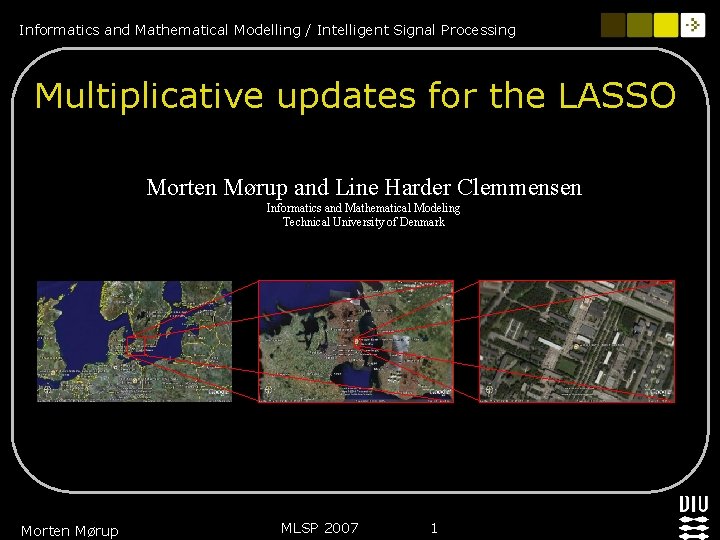
Informatics and Mathematical Modelling / Intelligent Signal Processing Multiplicative updates for the LASSO Morten Mørup and Line Harder Clemmensen Informatics and Mathematical Modeling Technical University of Denmark Morten Mørup MLSP 2007 1
Informatics and Mathematical Modelling / Intelligent Signal Processing Overview n n n Multiplicative updates (MU) Non-negative matrix factorization (NMF) Convergence of MU Semi-NMF MU for the LASSO Results obtained analyzing a small and 2 large scale Bio. Informatics datasets Morten Mørup 2
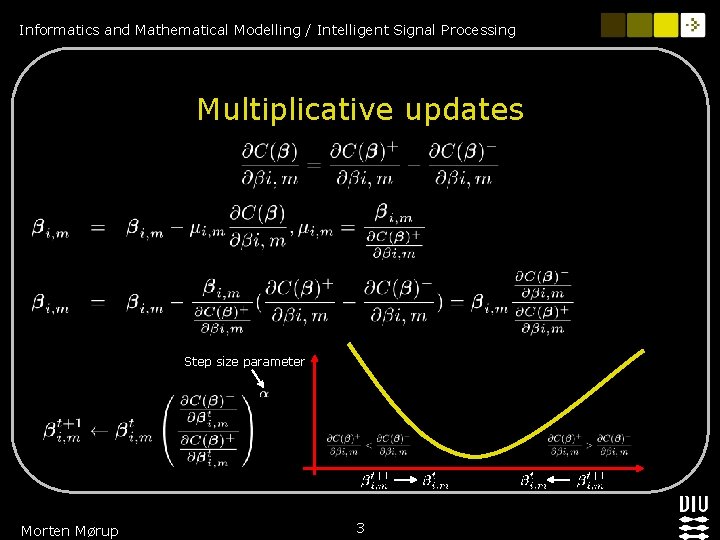
Informatics and Mathematical Modelling / Intelligent Signal Processing Multiplicative updates Step size parameter Morten Mørup 3
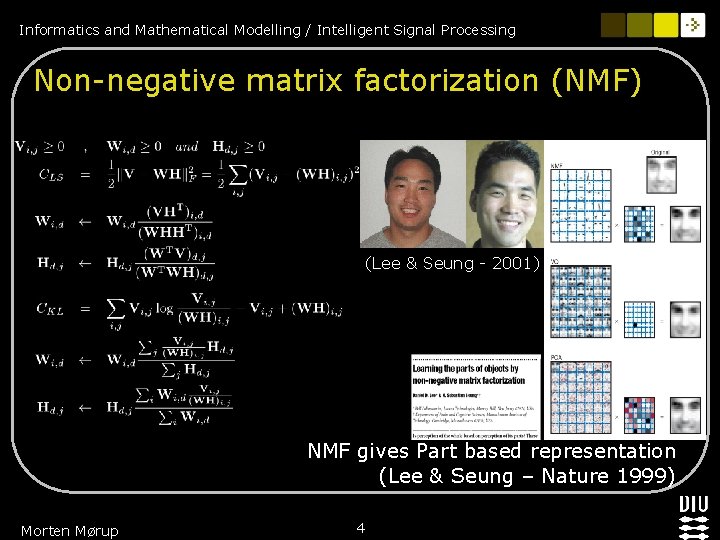
Informatics and Mathematical Modelling / Intelligent Signal Processing Non-negative matrix factorization (NMF) (Lee & Seung - 2001) NMF gives Part based representation (Lee & Seung – Nature 1999) Morten Mørup 4
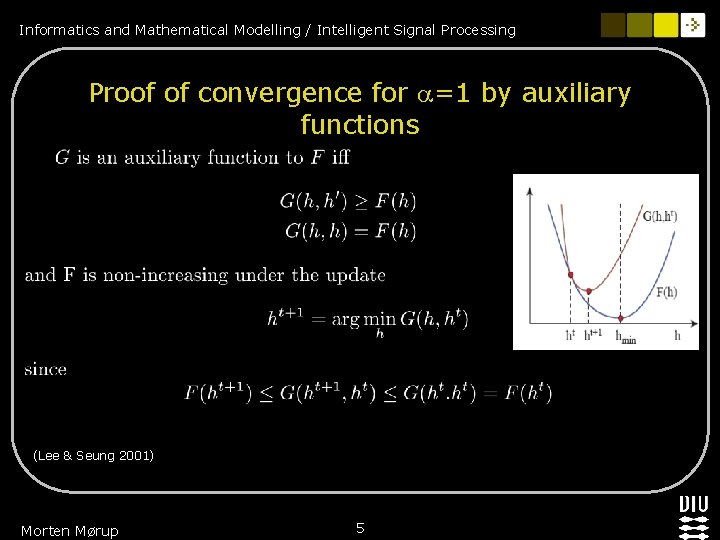
Informatics and Mathematical Modelling / Intelligent Signal Processing Proof of convergence for =1 by auxiliary functions (Lee & Seung 2001) Morten Mørup 5
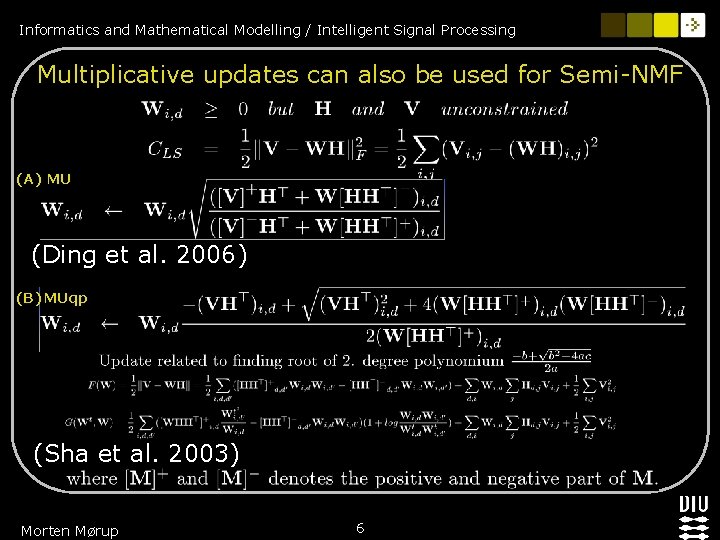
Informatics and Mathematical Modelling / Intelligent Signal Processing Multiplicative updates can also be used for Semi-NMF (A) MU (Ding et al. 2006) (B) MUqp (Sha et al. 2003) Morten Mørup 6
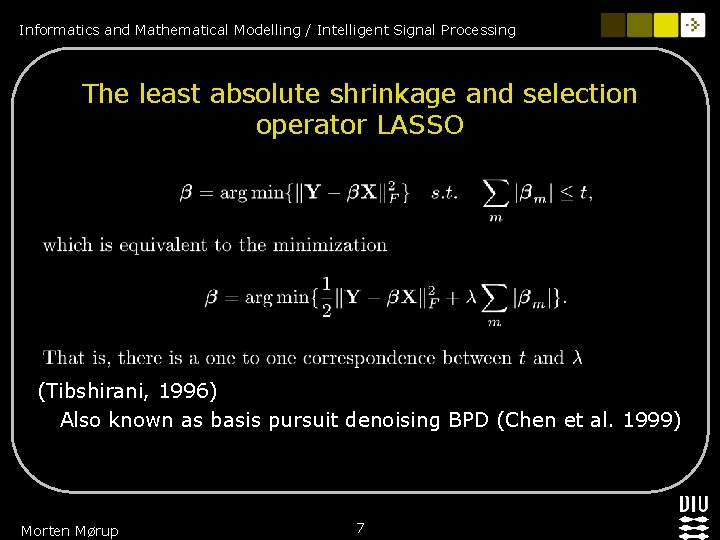
Informatics and Mathematical Modelling / Intelligent Signal Processing The least absolute shrinkage and selection operator LASSO (Tibshirani, 1996) Also known as basis pursuit denoising BPD (Chen et al. 1999) Morten Mørup 7
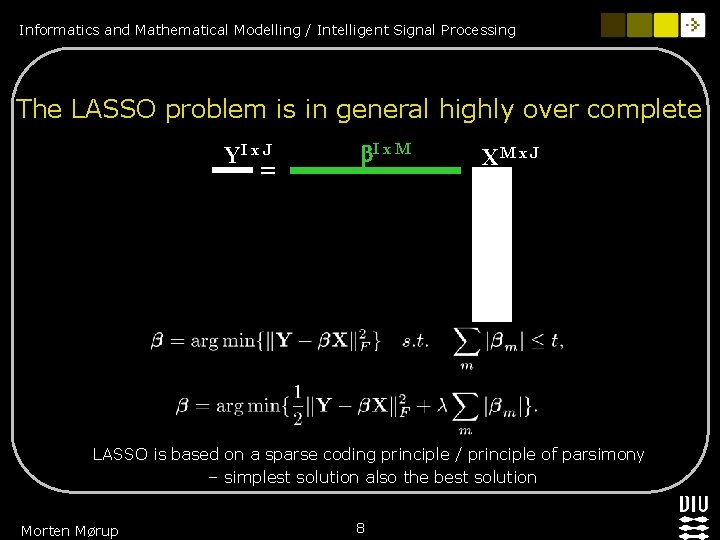
Informatics and Mathematical Modelling / Intelligent Signal Processing The LASSO problem is in general highly over complete YI x J = I x M XM x J LASSO is based on a sparse coding principle / principle of parsimony – simplest solution also the best solution Morten Mørup 8
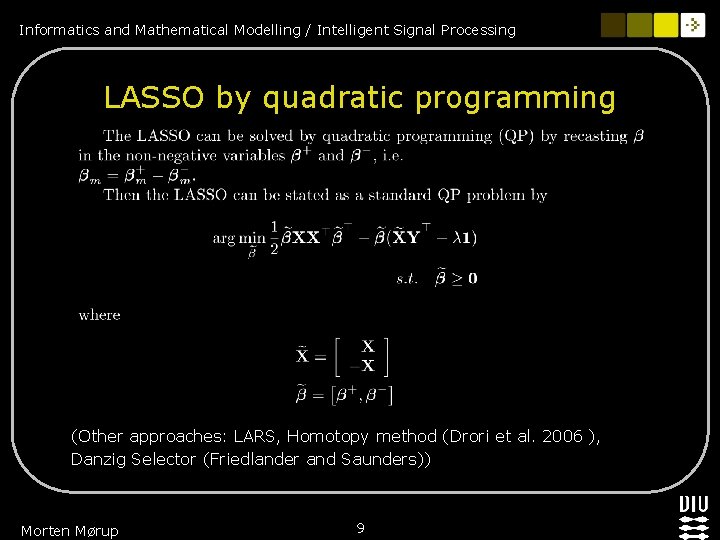
Informatics and Mathematical Modelling / Intelligent Signal Processing LASSO by quadratic programming (Other approaches: LARS, Homotopy method (Drori et al. 2006 ), Danzig Selector (Friedlander and Saunders)) Morten Mørup 9
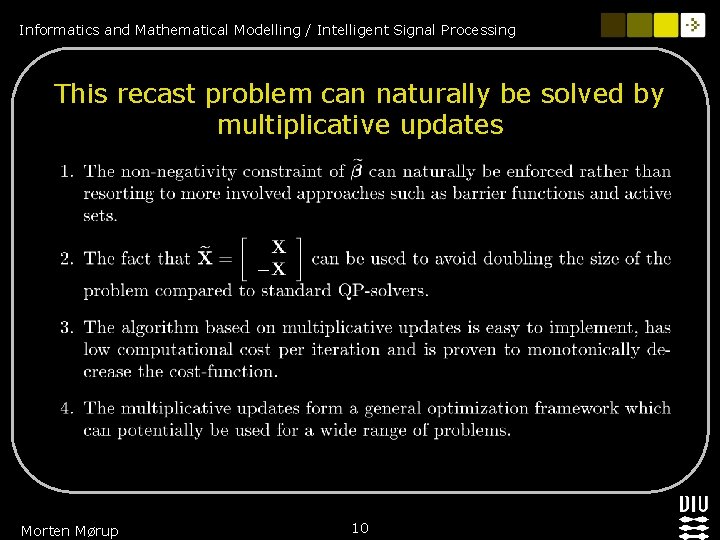
Informatics and Mathematical Modelling / Intelligent Signal Processing This recast problem can naturally be solved by multiplicative updates Morten Mørup 10
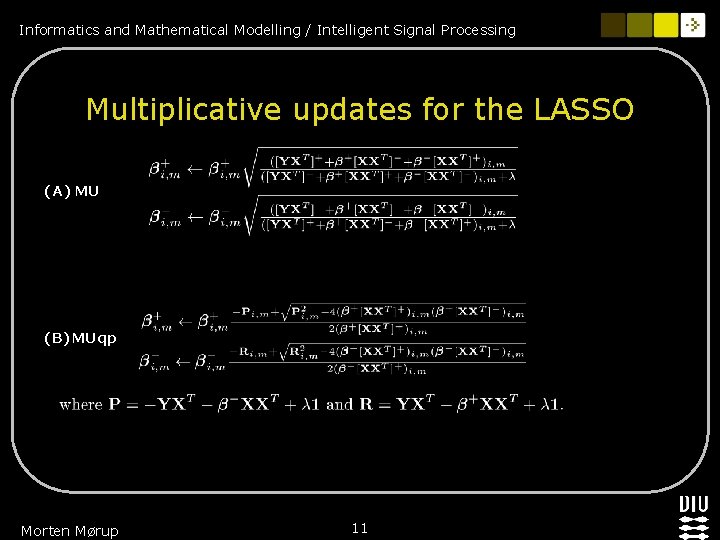
Informatics and Mathematical Modelling / Intelligent Signal Processing Multiplicative updates for the LASSO (A) MU (B) MUqp Morten Mørup 11
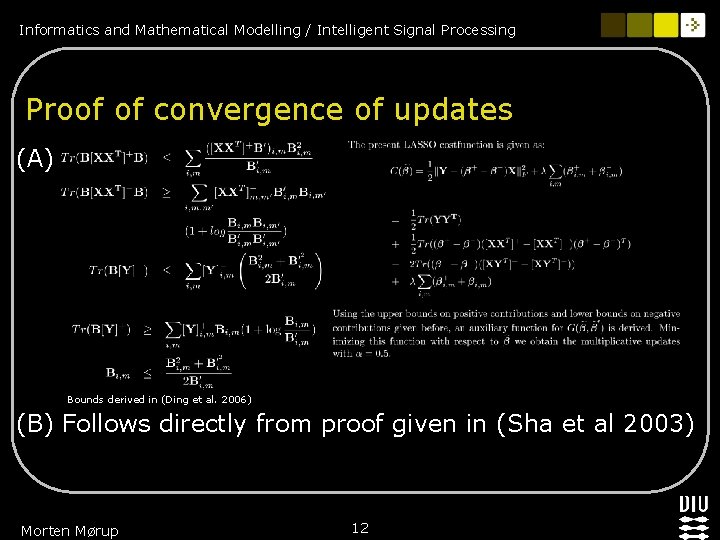
Informatics and Mathematical Modelling / Intelligent Signal Processing Proof of convergence of updates (A) Bounds derived in (Ding et al. 2006) (B) Follows directly from proof given in (Sha et al 2003) Morten Mørup 12
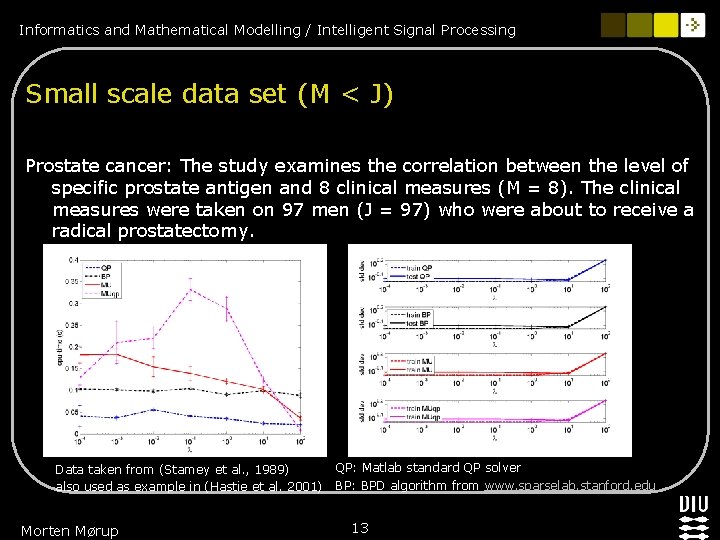
Informatics and Mathematical Modelling / Intelligent Signal Processing Small scale data set (M < J) Prostate cancer: The study examines the correlation between the level of specific prostate antigen and 8 clinical measures (M = 8). The clinical measures were taken on 97 men (J = 97) who were about to receive a radical prostatectomy. Data taken from (Stamey et al. , 1989) also used as example in (Hastie et al. 2001) Morten Mørup QP: Matlab standard QP solver BP: BPD algorithm from www. sparselab. stanford. edu 13
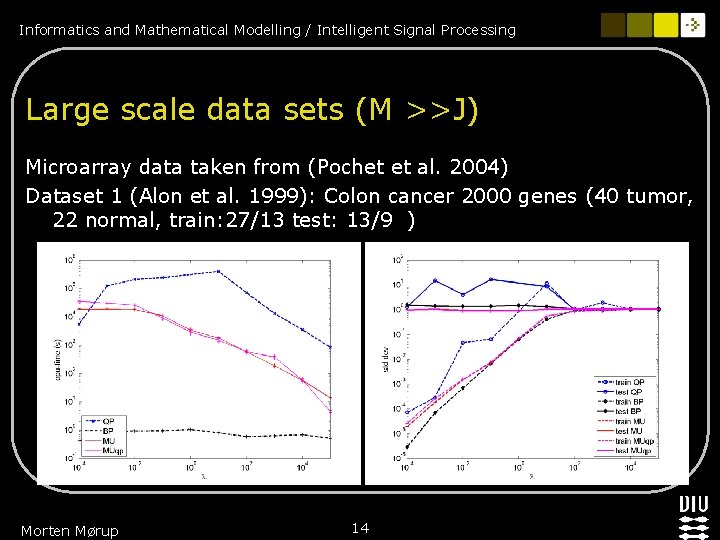
Informatics and Mathematical Modelling / Intelligent Signal Processing Large scale data sets (M >>J) Microarray data taken from (Pochet et al. 2004) Dataset 1 (Alon et al. 1999): Colon cancer 2000 genes (40 tumor, 22 normal, train: 27/13 test: 13/9 ) Morten Mørup 14
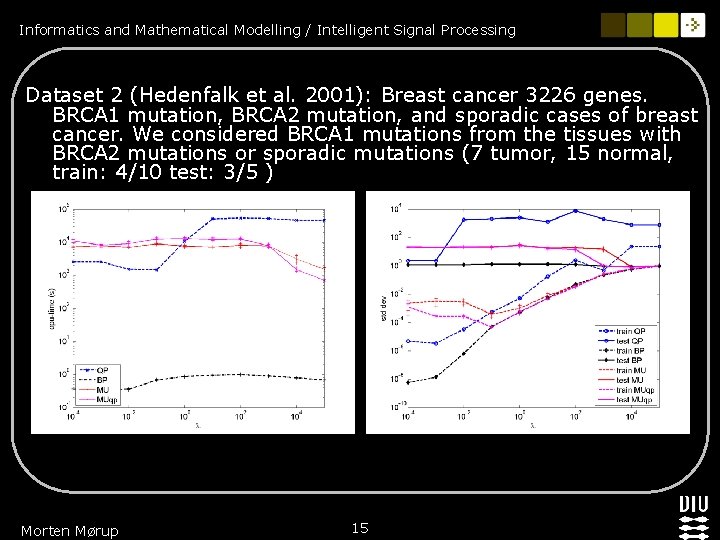
Informatics and Mathematical Modelling / Intelligent Signal Processing Dataset 2 (Hedenfalk et al. 2001): Breast cancer 3226 genes. BRCA 1 mutation, BRCA 2 mutation, and sporadic cases of breast cancer. We considered BRCA 1 mutations from the tissues with BRCA 2 mutations or sporadic mutations (7 tumor, 15 normal, train: 4/10 test: 3/5 ) Morten Mørup 15
Informatics and Mathematical Modelling / Intelligent Signal Processing Conclusion n Multiplicative updates forms simple algorithms to solve for the LASSO and as such also generalizes to unconstrained optimization, i. e. = +- -. n The updates are ensured to converge (in the sense of monotonically decreasing the objective function). n The MU-algorithms devised for the LASSO more stable than traditional QP solvers such as MATLAB’s standard QP-solver but not as fast as state of the art algorithms such as the solver given for BPD at www. sparselab. stanford. edu. n The MU-algorithms can easily be extended to the elastic net and fused lasso and forms a general optimization framework. Morten Mørup 16
Informatics and Mathematical Modelling / Intelligent Signal Processing References A. Alon, N. Barkai, D. A. Notterman, K. Gish, S. Ybarra, D. Mack, and A. J. Levine, “Broad patterns of gene expression revealed by clustering analysis of tumor and normal colon tissues probed by oligonucleotide arrays, ” Proc. Natl. Acad. Sci. USA, 1999. S. S. Chen, D. L. Donoho, and M. A. Saunders, “Atomic decomposition by basis pursuit, ” SIAM J. Sci. Comp. , vol. 20, no. 1, pp. 33– 61, 1999. C. Ding, T. Li, and M. I. Jordan, “Convex and seminonnegative matrix factorizations, ” LBNL Tech Report 60428, 2006. I. Drori and D. L. Donoho, “Solution of l 1 minimization problems by lars/homotopy methods, ” in IEEE International Conference on Acoustics, Speech, and Signal Processing, 2006. B. Efron, T. Hastie, I. Johnstone, and R. Tibshirani, “Least angle regression, ” Annals of Statistics, vol. 32, no. 2, pp. 407– 499, 2004. Michael P. Friedlander and Michael A. Saunders ”DISCUSSION OF “THE DANTZIG SELECTOR” BY CAND`ES AND TAO” submitted annals of Statistics V. Guigue, A. Rakotomamonjy, and S. Canu, “Kerne basis pursuit, ” European Conference on Machine Learning, Porto, 2005. T. Hastie, R. Tibshirani, and J. Friedman, The Elements of Statistical Learning, Springer, 2001. I. Hedenfalk, D. Duggan, Y. Chen, M. Radmacher, M. Bittner, R. Simon, P. Meltzer, B. Gutsterson, M. Esteller, M. Raffeld, Z. Yakhini, A. Ben-Dor, E. Dougherty, J. Kononen, L. Bubendorf, W. Fehrle, S. Pittaluga, S. Gruvberger, N. Loman, O. Johannsson, H. Olsson, B. Wilfond, G. Sauter, O. -P. Kallioniemi, A. Borg, and J. Trent, “Gene-expression profiles in hereditary breast cancer, ” The New England Journal of Medicine, vol. 344, pp. 539– 548, 2001. D. D. Lee and H. S. Seung, “Learning the parts of objects by non-negative matrix factorization, ” Nature, vol. 401, no. 6755, pp. 788– 91, 1999. D. D. Lee and H. S. Seung, “Algorithms for non-negativematrix factorization, ” in Advances in Neural Information. Processing Systems, 2000, pp. 556– 562. M. Mørup and L. H. Clemmensen, “Mulasso, ”http: //www 2. imm. dtu. dk/pubdb/views/edoc_download. php/5235/zip/imm 5235. zip. N. Pochet, F. De Smet, A. K. Suykens, and L. R. De Moor Bart, “Systematic benchmarking of microarray data classification: assessing the role of nonlinearity and dimensionality reduction, ” Bioinformatics, vol. 20, no. 17, pp. 3185– 95, 2004. M. R. Osborne, B. Presnell, and B. A. Turlach, “A new approach to variable selection in least squares problems, ” IMA Journal of Numerical Analysis, vol. 20, no. 3, pp. 389– 403, 2000. S. C. Shaobing and D. Donoho, “Basis pursuit, ” 28 th Asilomar conf. Signals, Systems Computers, 1994. F. Sha, L. K. Saul, and D. D. Lee, “Multiplicative updates for nonnegative quadratic programming in support vector machines, ” in Advances in Neural Information v. Processing Systems 15, 2002. T. Stamey, J. Kabalin, J. Mc. Neal, I. Johnstone, H. Freiha, E. Redwine, and N. Yang, “Prostate specific antigen in the diagnosis and treatment of adenocarcinoma of the prostate ii. radical prostatectomy treated patients, ” Journal of Urology, vol. 16, pp. 1076– 1083, 1989. R. Tibshirani, “Regression shrinkage and selection via the lasso, ” Journal of the Royal Statistical Society. Series B (Methodological), vol. 58, no. 1, pp. 267– 288, 1996. R. Tibshirani and M. A. Saunders, “Sparsity and smoothness via the fused lasso, ” J. R. Statist. Soc. B, vol. 67, no. 1, pp. 91– 108, 2005. H. Zou and T. Hastie, “Regularization and variable selection via the elastic net, ” J. R. Statist. Soc. B, vol. 67, no. 2, pp. 301– 320, 2005. Morten Mørup 17