
Informatics 43 Introduction to Software Engineering Lecture 4

- Slides: 49
Informatics 43 Introduction to Software Engineering Lecture 4 -1 October 28, 2014 Emily Navarro Duplication of course material for any commercial purpose without the explicit written permission of the professor is prohibited. SDCL Software Design and Collaboration Laboratory Department of Informatics, UC Irvine sdcl. ics. uci. edu 1
Today’s lecture • • Quiz Answers Architectural styles Evolution Quiz 3 • Some slides adopted and adopted from “Software Architecture: Foundations, Theory, & Practice” by Taylor, Medvidovic, and Dashofy SDCL Software Design and Collaboration Laboratory Department of Informatics, UC Irvine sdcl. ics. uci. edu 2
Today’s lecture • • SDCL Quiz Answers Architectural styles Evolution Quiz 3 Software Design and Collaboration Laboratory Department of Informatics, UC Irvine sdcl. ics. uci. edu 3
Today’s lecture • • SDCL Quiz Answers Architectural styles Evolution Quiz 3 Software Design and Collaboration Laboratory Department of Informatics, UC Irvine sdcl. ics. uci. edu 4
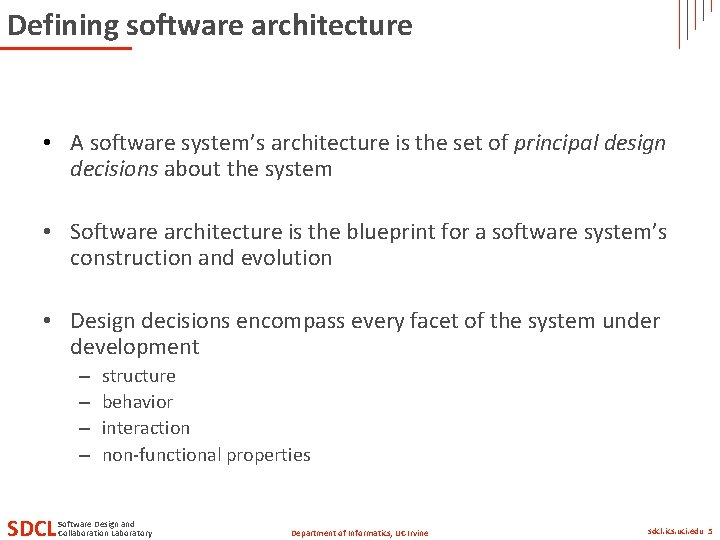
Defining software architecture • A software system’s architecture is the set of principal design decisions about the system • Software architecture is the blueprint for a software system’s construction and evolution • Design decisions encompass every facet of the system under development – – SDCL structure behavior interaction non-functional properties Software Design and Collaboration Laboratory Department of Informatics, UC Irvine sdcl. ics. uci. edu 5
“Principal” • “Principal” implies a degree of importance that grants a design decision “architectural status” – it implies that not all design decisions are architectural – that is, they do not necessarily impact a system’s architecture • How one defines “principal” will depend on what the stakeholders define as the system goals SDCL Software Design and Collaboration Laboratory Department of Informatics, UC Irvine sdcl. ics. uci. edu 6
Architectural style • Certain design choices regularly result in solutions with superior properties – compared to other possible alternatives, solutions such as this are more elegant, effective, efficient, dependable, evolvable, scalable, and so on • An architectural style is a named collection of architectural design decisions that – are applicable in a given development context – constrain architectural design decisions that are specific to a particular system within that context – elicit beneficial qualities in each resulting system SDCL Software Design and Collaboration Laboratory Department of Informatics, UC Irvine sdcl. ics. uci. edu 7
Architectural style • A pattern of decisions that work well together • A named, commonly used set of components and connectors – Each component/connector has its own job in an architectural style SDCL Software Design and Collaboration Laboratory Department of Informatics, UC Irvine sdcl. ics. uci. edu 8
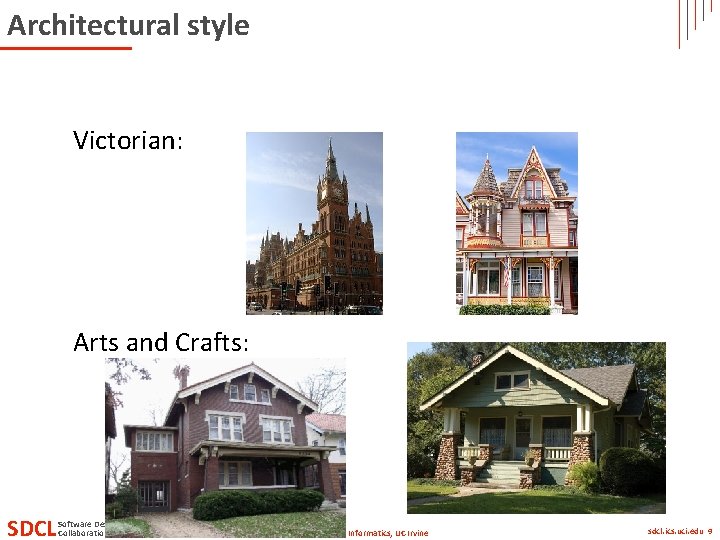
Architectural style Victorian: Arts and Crafts: SDCL Software Design and Collaboration Laboratory Department of Informatics, UC Irvine sdcl. ics. uci. edu 9
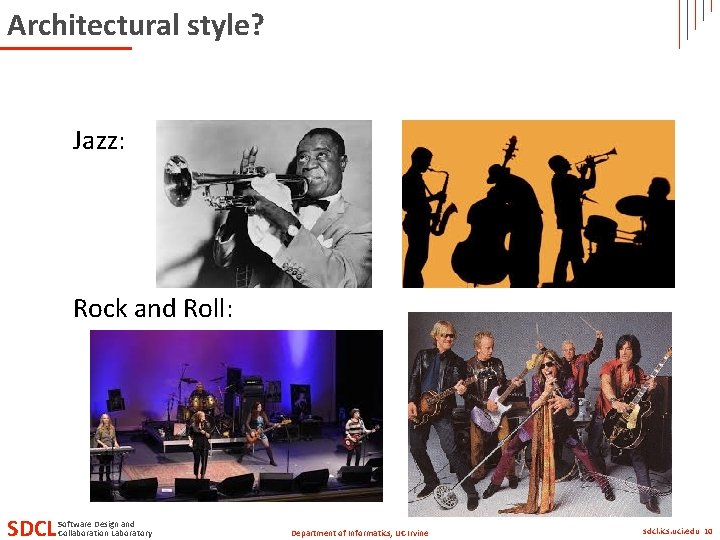
Architectural style? Jazz: Rock and Roll: SDCL Software Design and Collaboration Laboratory Department of Informatics, UC Irvine sdcl. ics. uci. edu 10
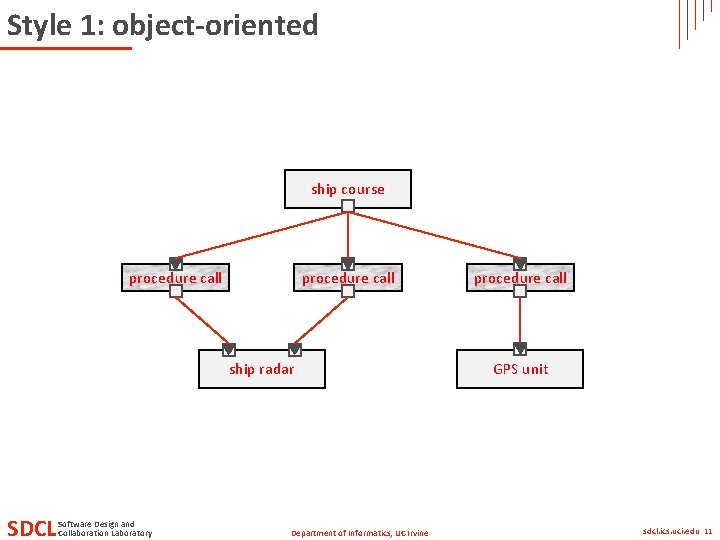
Style 1: object-oriented ship course procedure call ship radar SDCL Software Design and Collaboration Laboratory Department of Informatics, UC Irvine procedure call GPS unit sdcl. ics. uci. edu 11
Style 1: object-oriented • Components are objects – Containing all the data and behavior relevant to the object • Connectors are messages and method invocations • Key benefits – Objects expose a certain interface to other objects • Abstraction – An object’s internal representation is hidden from other objects • Anticipation of change – Objects in software used to model real-world objects • Understandability • Examples – Business applications SDCL Software Design and Collaboration Laboratory Department of Informatics, UC Irvine sdcl. ics. uci. edu 12
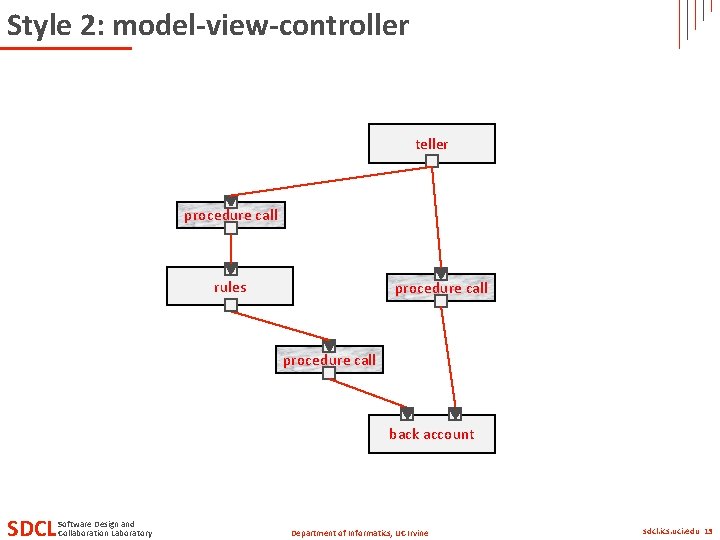
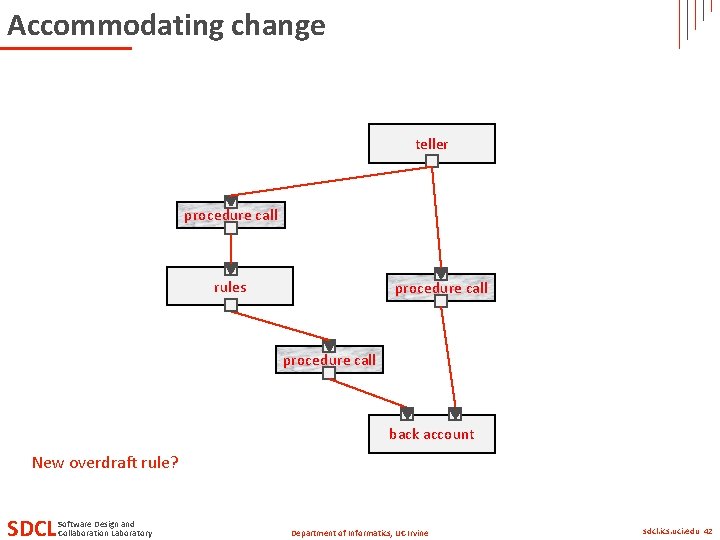
Style 2: model-view-controller teller procedure call rules procedure call back account SDCL Software Design and Collaboration Laboratory Department of Informatics, UC Irvine sdcl. ics. uci. edu 13
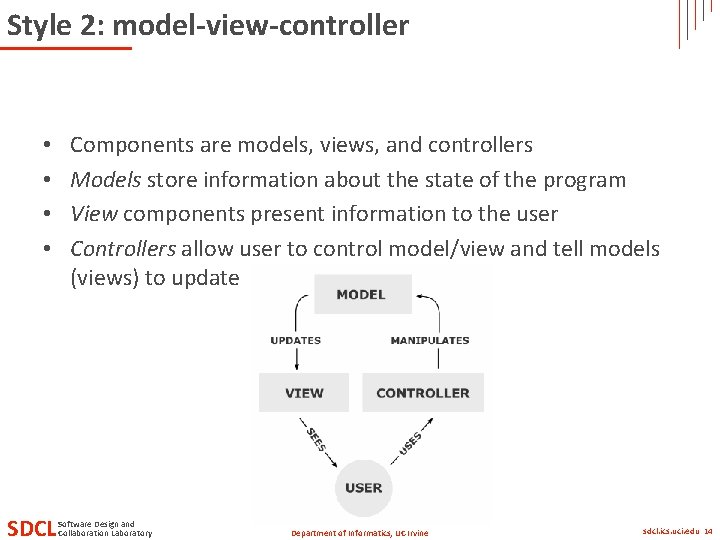
Style 2: model-view-controller • • SDCL Components are models, views, and controllers Models store information about the state of the program View components present information to the user Controllers allow user to control model/view and tell models (views) to update Software Design and Collaboration Laboratory Department of Informatics, UC Irvine sdcl. ics. uci. edu 14
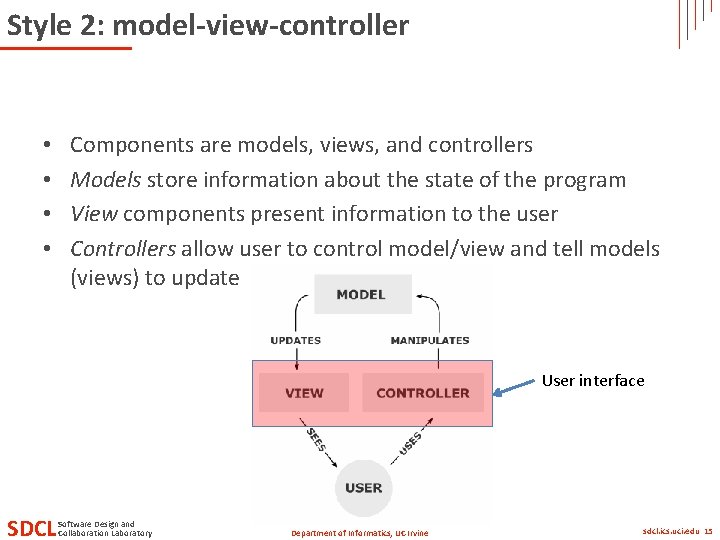
Style 2: model-view-controller • • Components are models, views, and controllers Models store information about the state of the program View components present information to the user Controllers allow user to control model/view and tell models (views) to update User interface SDCL Software Design and Collaboration Laboratory Department of Informatics, UC Irvine sdcl. ics. uci. edu 15
Style 2: model-view-controller • Key benefits: – Decouples model and view – one model can support multiple views – Decouples view and controller – can change the way a view responds to user input – Modularity, anticipation of change • Examples – Websites – Web applications SDCL Software Design and Collaboration Laboratory Department of Informatics, UC Irvine sdcl. ics. uci. edu 16
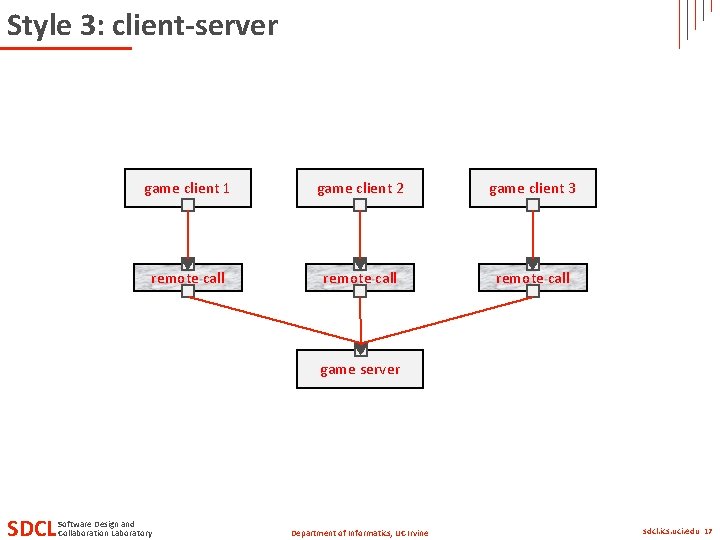
Style 3: client-server game client 1 game client 2 game client 3 remote call game server SDCL Software Design and Collaboration Laboratory Department of Informatics, UC Irvine sdcl. ics. uci. edu 17
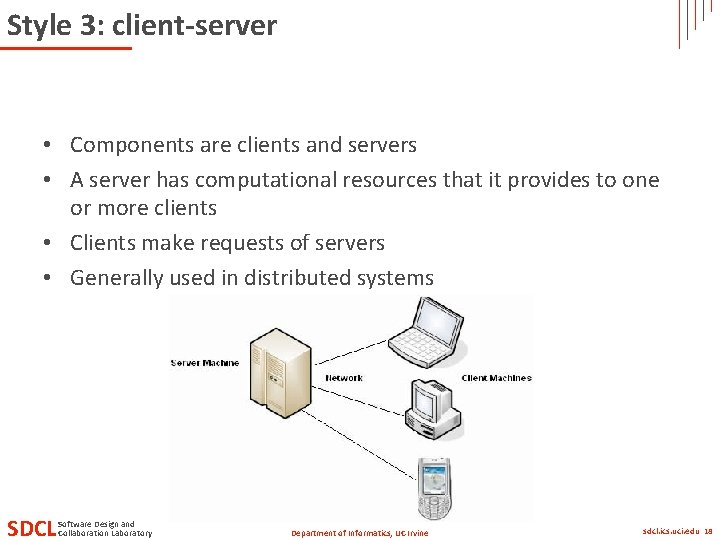
Style 3: client-server • Components are clients and servers • A server has computational resources that it provides to one or more clients • Clients make requests of servers • Generally used in distributed systems SDCL Software Design and Collaboration Laboratory Department of Informatics, UC Irvine sdcl. ics. uci. edu 18
Style 3: client-server • Key benefits – Centralized security – Centralized data access and management • Examples – email – Web browser-based programs SDCL Software Design and Collaboration Laboratory Department of Informatics, UC Irvine sdcl. ics. uci. edu 19
Style 4: layered SDCL Software Design and Collaboration Laboratory Department of Informatics, UC Irvine sdcl. ics. uci. edu 20
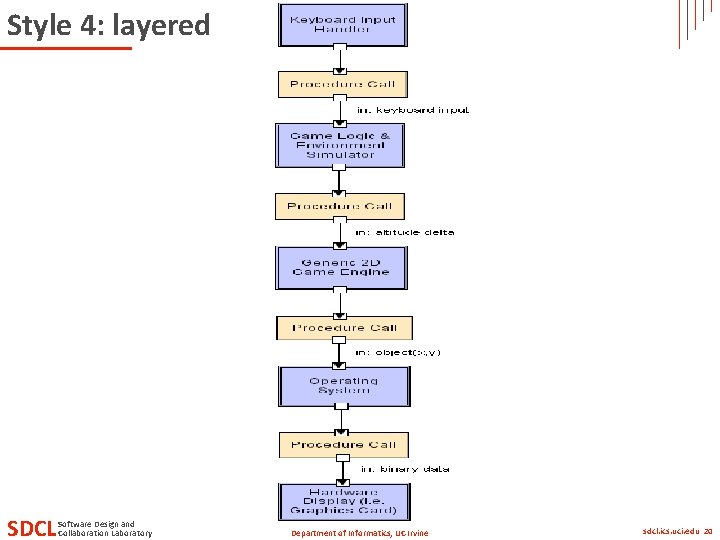
Style 4: layered • Components are organized in hierarchical layers • Connectors are protocols of layer interaction • “Multi-level client server: ” each layer acts as a – Service: service provider to layers “above” – Client: service consumer of layer(s) “below” • Key benefits – Increasing abstraction levels – Changes in a layer affect at most the adjacent two layers • Anticipation of change – Lower layers are easily reusable • Examples – Operating systems – Networks SDCL Software Design and Collaboration Laboratory Department of Informatics, UC Irvine sdcl. ics. uci. edu 21
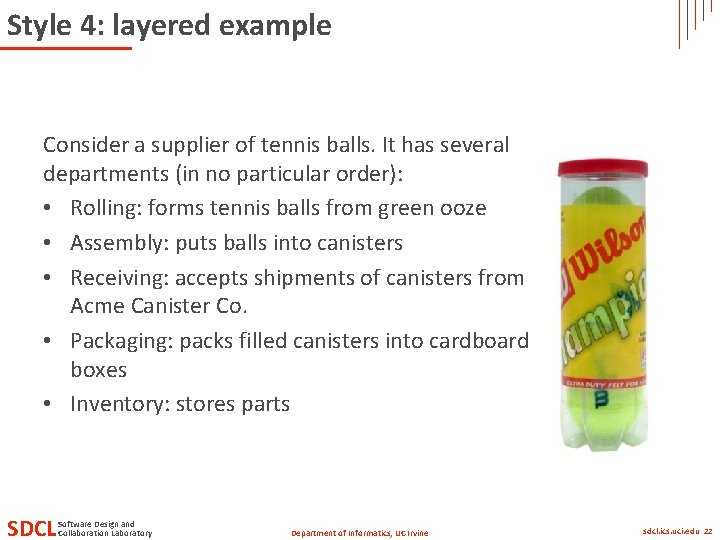
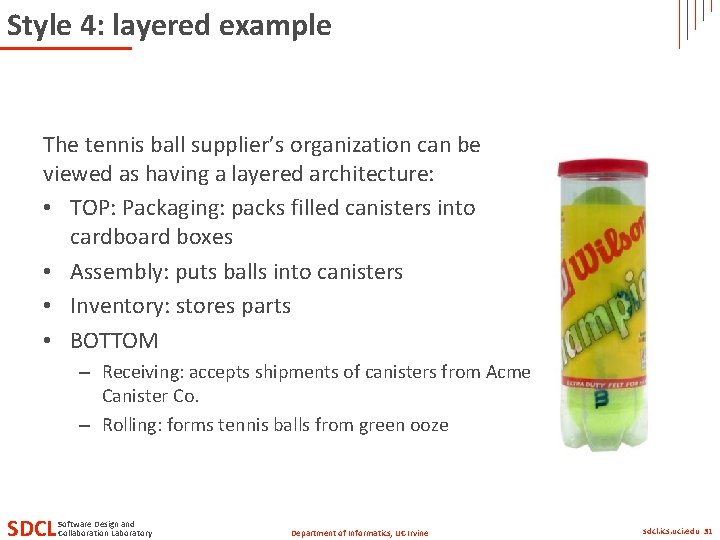
Style 4: layered example Consider a supplier of tennis balls. It has several departments (in no particular order): • Rolling: forms tennis balls from green ooze • Assembly: puts balls into canisters • Receiving: accepts shipments of canisters from Acme Canister Co. • Packaging: packs filled canisters into cardboard boxes • Inventory: stores parts SDCL Software Design and Collaboration Laboratory Department of Informatics, UC Irvine sdcl. ics. uci. edu 22
Which department goes on the top layer of the company’s manufacturing architecture? A. Rolling B. Assembly C. Receiving D. Packaging E. Inventory SDCL Software Design and Collaboration Laboratory Department of Informatics, UC Irvine sdcl. ics. uci. edu 23
Which department goes on the top layer of the company’s manufacturing architecture? A. Rolling B. Assembly C. Receiving D. Packaging E. Inventory SDCL Software Design and Collaboration Laboratory Department of Informatics, UC Irvine sdcl. ics. uci. edu 24
Which department goes on the second layer of the company’s manufacturing architecture? A. Rolling B. Assembly C. Receiving D. Packaging E. Inventory SDCL Software Design and Collaboration Laboratory Department of Informatics, UC Irvine sdcl. ics. uci. edu 25
Which department goes on the second layer of the company’s manufacturing architecture? A. Rolling B. Assembly C. Receiving D. Packaging E. Inventory SDCL Software Design and Collaboration Laboratory Department of Informatics, UC Irvine sdcl. ics. uci. edu 26
Which department goes on the third layer of the company’s manufacturing architecture? A. Rolling B. Assembly C. Receiving D. Packaging E. Inventory SDCL Software Design and Collaboration Laboratory Department of Informatics, UC Irvine sdcl. ics. uci. edu 27
Which department goes on the third layer of the company’s manufacturing architecture? A. Rolling B. Assembly C. Receiving D. Packaging E. Inventory SDCL Software Design and Collaboration Laboratory Department of Informatics, UC Irvine sdcl. ics. uci. edu 28
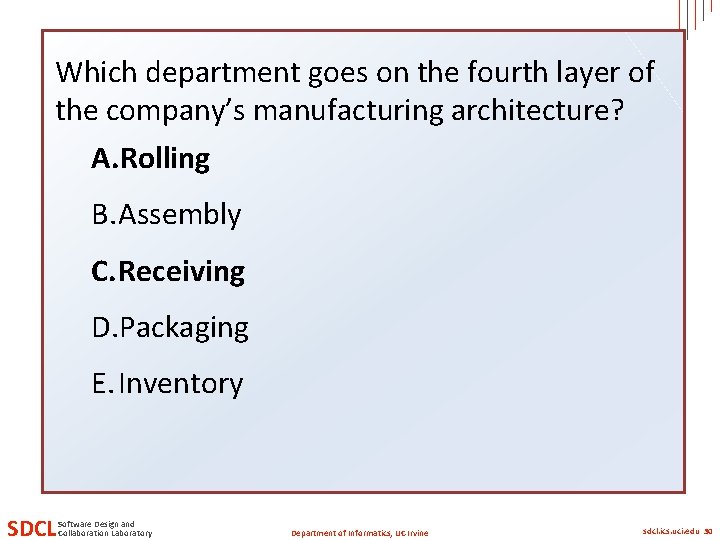
Which department goes on the fourth layer of the company’s manufacturing architecture? A. Rolling B. Assembly C. Receiving D. Packaging E. Inventory SDCL Software Design and Collaboration Laboratory Department of Informatics, UC Irvine sdcl. ics. uci. edu 29
Which department goes on the fourth layer of the company’s manufacturing architecture? A. Rolling B. Assembly C. Receiving D. Packaging E. Inventory SDCL Software Design and Collaboration Laboratory Department of Informatics, UC Irvine sdcl. ics. uci. edu 30
Style 4: layered example The tennis ball supplier’s organization can be viewed as having a layered architecture: • TOP: Packaging: packs filled canisters into cardboard boxes • Assembly: puts balls into canisters • Inventory: stores parts • BOTTOM – Receiving: accepts shipments of canisters from Acme Canister Co. – Rolling: forms tennis balls from green ooze SDCL Software Design and Collaboration Laboratory Department of Informatics, UC Irvine sdcl. ics. uci. edu 31
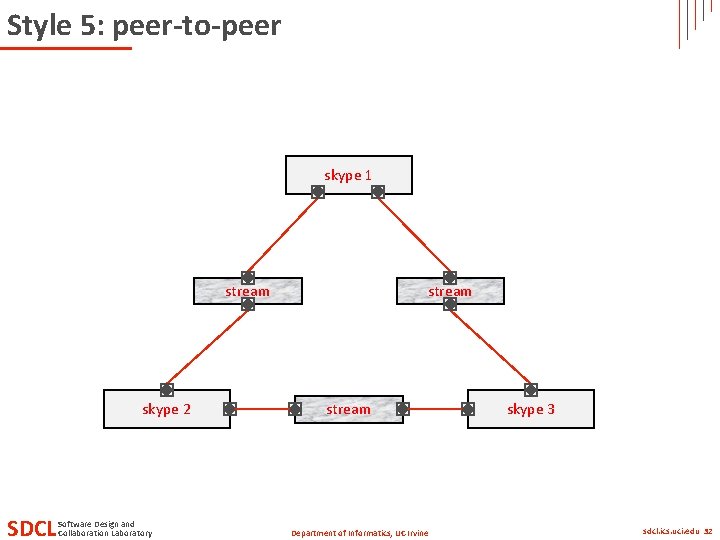
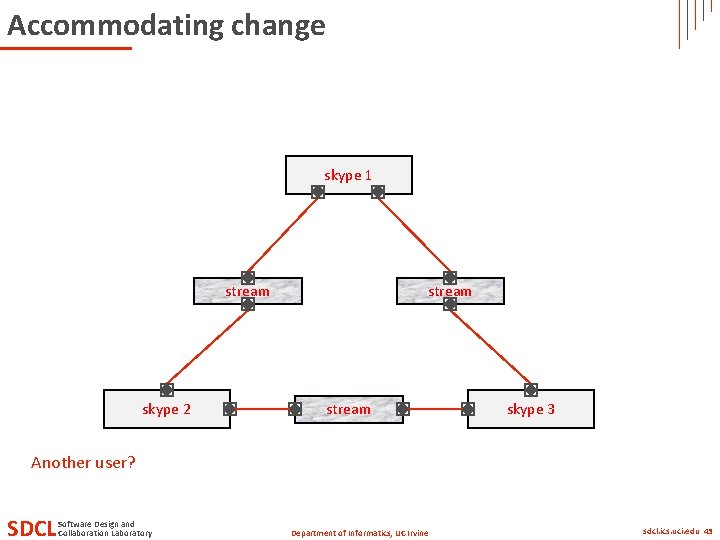
Style 5: peer-to-peer skype 1 stream skype 2 SDCL Software Design and Collaboration Laboratory stream Department of Informatics, UC Irvine skype 3 sdcl. ics. uci. edu 32
Style 4: peer-to-peer • Components (“peers”) can act as either clients or servers – Data and behavior are distributed among peers • Connectors are network protocols • Key benefits – Highly robust in the face of failure of any given node • Examples – File sharing systems, Skype SDCL Software Design and Collaboration Laboratory Department of Informatics, UC Irvine sdcl. ics. uci. edu 33
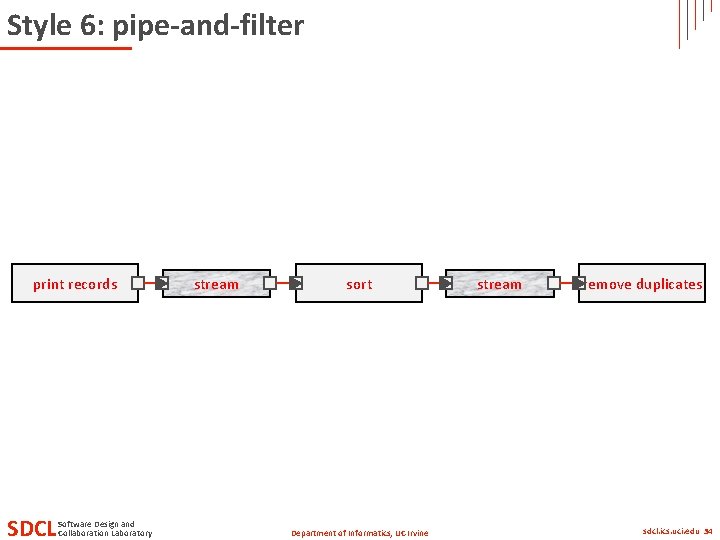
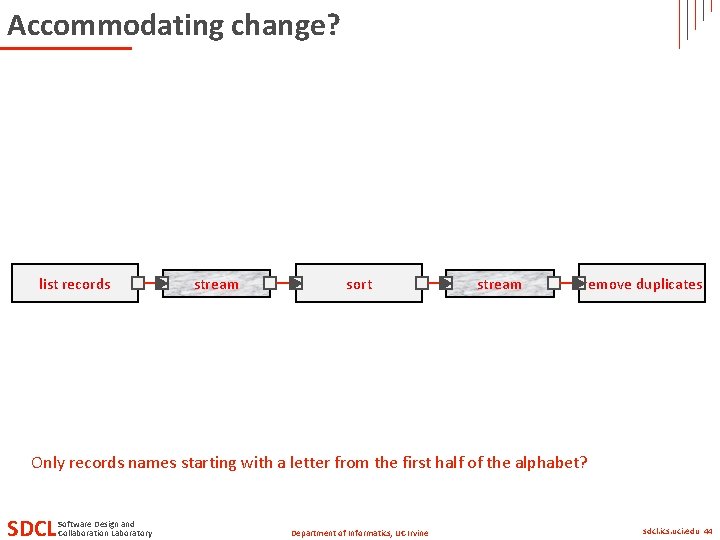
Style 6: pipe-and-filter print records SDCL Software Design and Collaboration Laboratory stream sort Department of Informatics, UC Irvine stream remove duplicates sdcl. ics. uci. edu 34
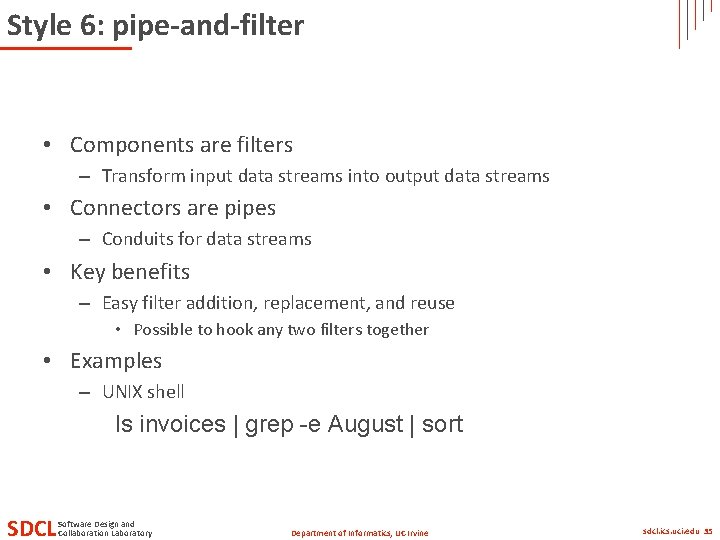
Style 6: pipe-and-filter • Components are filters – Transform input data streams into output data streams • Connectors are pipes – Conduits for data streams • Key benefits – Easy filter addition, replacement, and reuse • Possible to hook any two filters together • Examples – UNIX shell ls invoices | grep -e August | sort SDCL Software Design and Collaboration Laboratory Department of Informatics, UC Irvine sdcl. ics. uci. edu 35
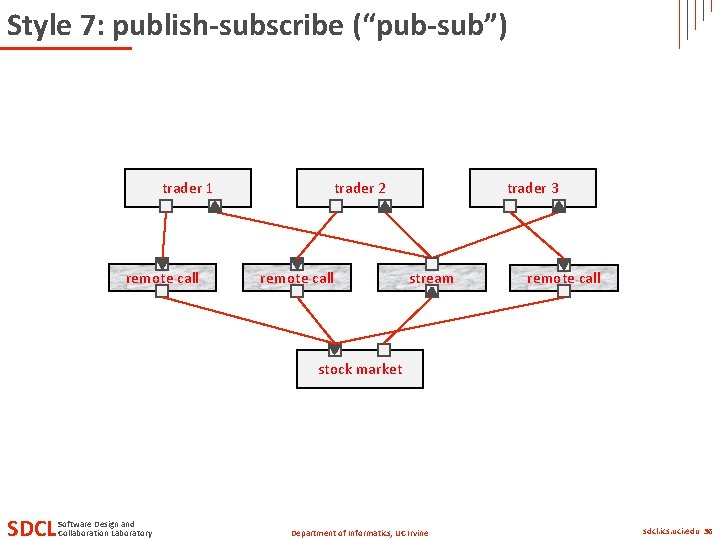
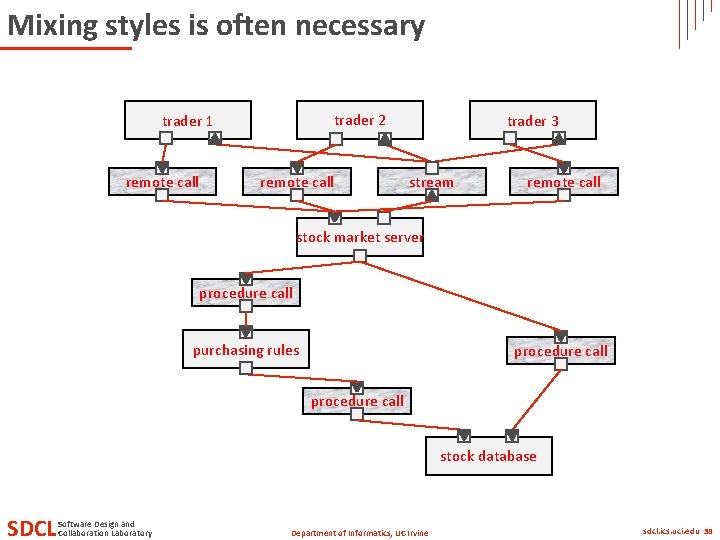
Style 7: publish-subscribe (“pub-sub”) trader 2 trader 1 remote call trader 3 stream remote call stock market SDCL Software Design and Collaboration Laboratory Department of Informatics, UC Irvine sdcl. ics. uci. edu 36
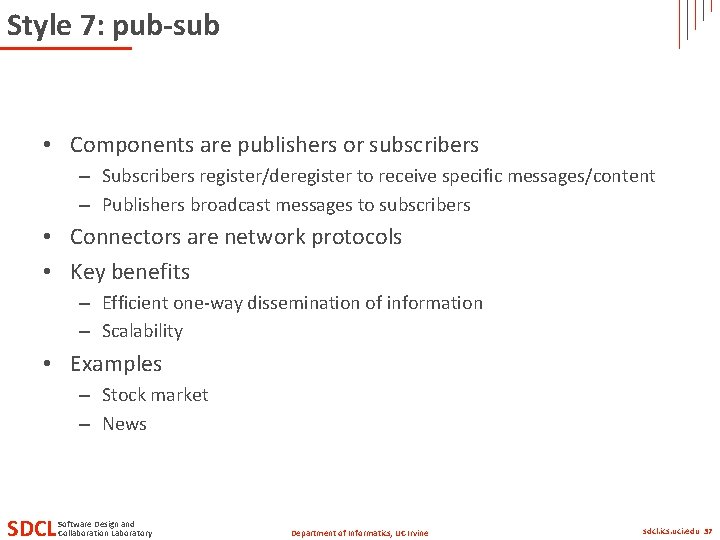
Style 7: pub-sub • Components are publishers or subscribers – Subscribers register/deregister to receive specific messages/content – Publishers broadcast messages to subscribers • Connectors are network protocols • Key benefits – Efficient one-way dissemination of information – Scalability • Examples – Stock market – News SDCL Software Design and Collaboration Laboratory Department of Informatics, UC Irvine sdcl. ics. uci. edu 37
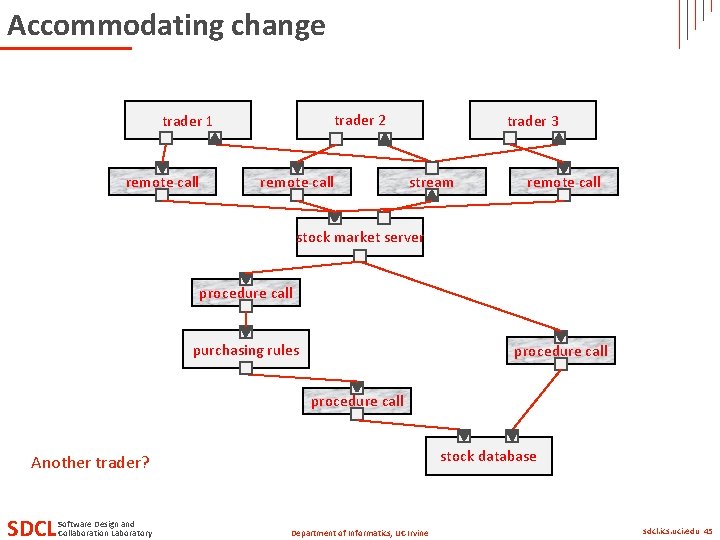
Mixing styles is often necessary trader 2 trader 1 remote call trader 3 stream remote call stock market server procedure call purchasing rules procedure call stock database SDCL Software Design and Collaboration Laboratory Department of Informatics, UC Irvine sdcl. ics. uci. edu 38
Today’s lecture • • SDCL Quiz Answers Architectural styles Evolution Quiz 3 Software Design and Collaboration Laboratory Department of Informatics, UC Irvine sdcl. ics. uci. edu 39
Back to evolution • Essential part of software development • Must be accommodated as much as possible • Must be planned as much as possible SDCL Software Design and Collaboration Laboratory Department of Informatics, UC Irvine sdcl. ics. uci. edu 40
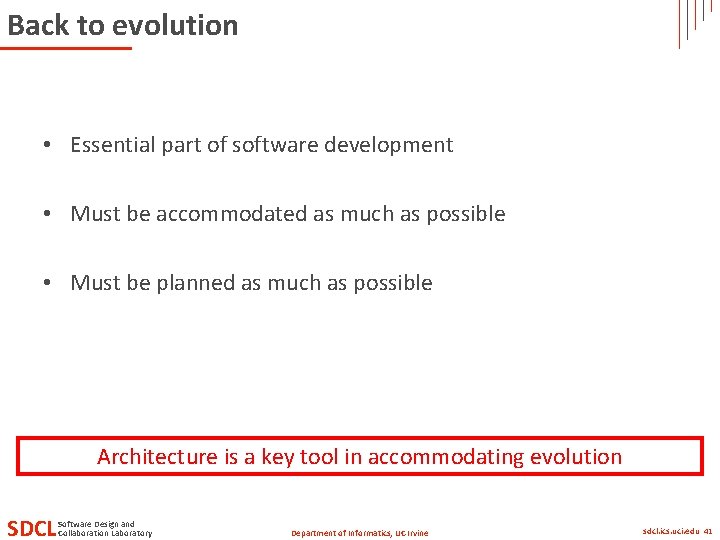
Back to evolution • Essential part of software development • Must be accommodated as much as possible • Must be planned as much as possible Architecture is a key tool in accommodating evolution SDCL Software Design and Collaboration Laboratory Department of Informatics, UC Irvine sdcl. ics. uci. edu 41
Accommodating change teller procedure call rules procedure call back account New overdraft rule? SDCL Software Design and Collaboration Laboratory Department of Informatics, UC Irvine sdcl. ics. uci. edu 42
Accommodating change skype 1 stream skype 2 stream skype 3 Another user? SDCL Software Design and Collaboration Laboratory Department of Informatics, UC Irvine sdcl. ics. uci. edu 43
Accommodating change? list records stream sort stream remove duplicates Only records names starting with a letter from the first half of the alphabet? SDCL Software Design and Collaboration Laboratory Department of Informatics, UC Irvine sdcl. ics. uci. edu 44
Accommodating change trader 2 trader 1 remote call trader 3 stream remote call stock market server procedure call purchasing rules procedure call stock database Another trader? SDCL Software Design and Collaboration Laboratory Department of Informatics, UC Irvine sdcl. ics. uci. edu 45
Architectural evolution • When a system evolves, ideally its prescriptive architecture is modified first • In practice, the system – and thus its descriptive architecture – is often directly modified • This happens because of – developer sloppiness – perception of short deadlines which prevent thinking through and documenting – lack of documented prescriptive architecture – need or desire for code optimizations – inadequate techniques or tool support SDCL Software Design and Collaboration Laboratory Department of Informatics, UC Irvine sdcl. ics. uci. edu 46
Today’s lecture • • SDCL Quiz Answers Architectural styles Evolution Quiz 3 Software Design and Collaboration Laboratory Department of Informatics, UC Irvine sdcl. ics. uci. edu 47
Quiz 3: software architecture • Lectures: – – – – Essential ingredients of SE Definitions of software architecture Elements of software architecture Prescriptive vs. descriptive architectures Software/architectural evolution What an architectural style is The basics of the seven styles presented today • Readings – Architectural styles: only those presented in lecture – Architectural views SDCL Software Design and Collaboration Laboratory Department of Informatics, UC Irvine sdcl. ics. uci. edu 48
Next time • Software process models • Quiz 3 • Homework 1 final draft due tonight 11: 55 pm – Use format given in template! SDCL Software Design and Collaboration Laboratory Department of Informatics, UC Irvine sdcl. ics. uci. edu 49