
Informal statistical inference Years 10 to 12 Maxine
- Slides: 23
Informal statistical inference: Years 10 to 12 Maxine Pfannkuch and Chris Wild The University of Auckland
Outline • A story from my research • Brief introduction to comparative reasoning and informal inference • Experiencing sampling variability • Two Activities
A story from my research • Year 11: Drawing conclusions from the comparison of two distributions (e. g. , Which battery is better, A or B? ) (Pfannkuch, 2005, 2006, 2007) • How was the teacher reasoning from the plots? • Was the teacher drawing an inference about the population from the sample? • On what grounds were students drawing conclusions? • Students - no concepts of sample, population, sampling variability
Solving these problems • Comparative reasoning – Elements of reasoning (Pfannkuch, 2006; 2007) – Differentiating between descriptive and inferential thoughts and contextual (Pfannkuch et al. , 2008) • Sampling reasoning – Web applications and by hand (Pfannkuch, 2008) – Automated web applications (Wild et al. , 2008)
How would we like students to reason? Investigative Question Do 13 year-old NZ boys tend to have bigger right foot lengths than 13 year-old NZ girls? Two random Samples from Census. At. School
Overall visual non-numerical comparisons • Overlap • Shift • Unusual features
Then consider 8 elements: spread, shape, summary statistics, explanatory etc. (Pfannkuch, 2006; 2007) See “A Teacher’s Guide” attached
Shape I notice (descriptive): : • the sample distribution for the boys’ foot lengths is roughly symmetrical with a mound around 24 to 27 cm, i. e. , unimodal • the sample distribution for the girls’ foot lengths shows a large mound around 22 to 24 cm and a hint of a small mound around 27 cm, i. e. , a hint of bimodality I wonder (inferential): : • if boys’ and girls’ foot length distributions back in the two populations are roughly symmetric and unimodal. – I expect so for a body measurement such as foot length for both girls and boys. (contextual)
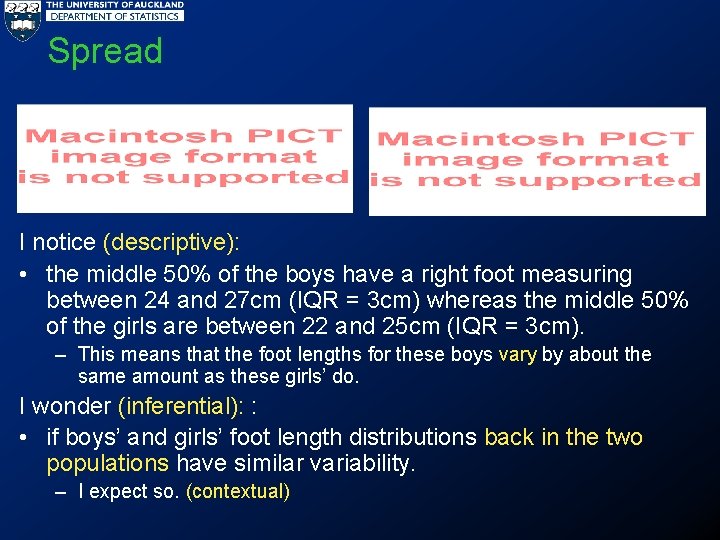
Spread I notice (descriptive): • the middle 50% of the boys have a right foot measuring between 24 and 27 cm (IQR = 3 cm) whereas the middle 50% of the girls are between 22 and 25 cm (IQR = 3 cm). – This means that the foot lengths for these boys vary by about the same amount as these girls’ do. I wonder (inferential): : • if boys’ and girls’ foot length distributions back in the two populations have similar variability. – I expect so. (contextual)
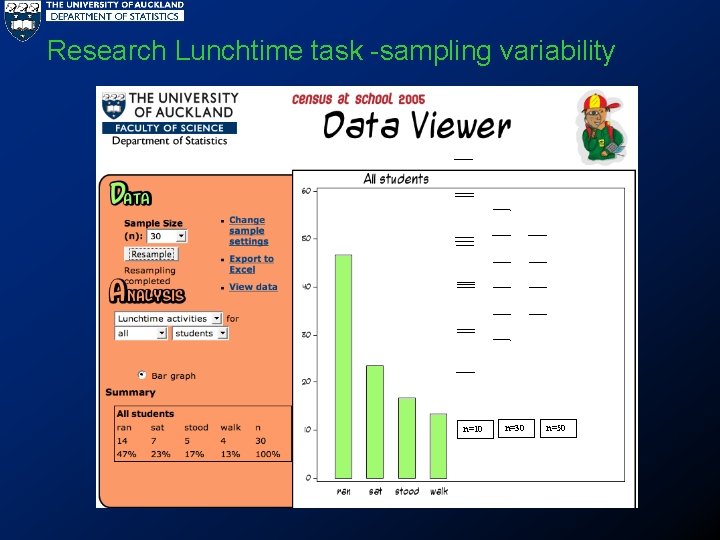
Research Lunchtime task -sampling variability n=10 n=30 n=50
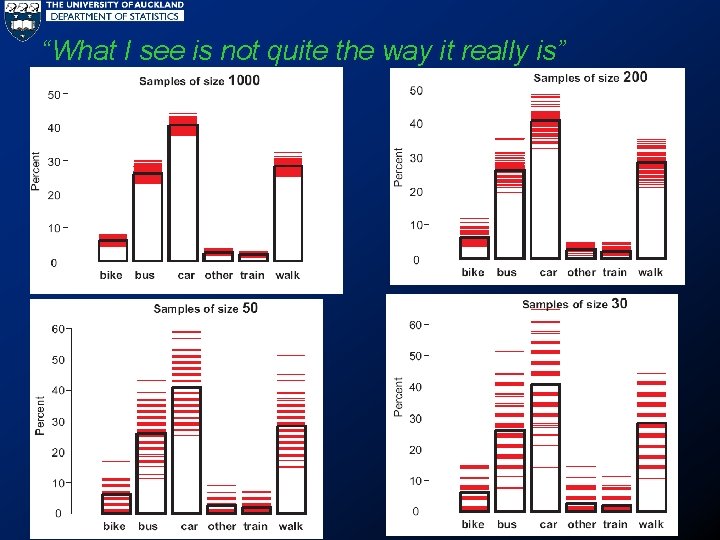
“What I see is not quite the way it really is”
Some student quotes • I found it interesting when you only need a sample to work out problems from a large population. It’s just really weird and cool at the same time that you just take any sample that is representative and it gives you near enough accurate answers. • Comparing distributions with different sized sample graphs because the variation of the graph changing each time when the sample was small but having less variation when the sample size got larger. • The part where we compares and saw all the different medians from different sample sizes. Coz it was really interesting to see it change. Its buzzy…
How were students “making a call”? • Using the MEDIANS (Pfannkuch, 2008)
Experiencing sampling variability • Hands-on • Computer generated simulations • Keep a history of the variability – Build up concepts of sample, population, sample size effect, distribution, confidence interval etc. • Making a call: Which is bigger? – From class activities and simulations get students to create “decision rules” to make a claim or informal inference
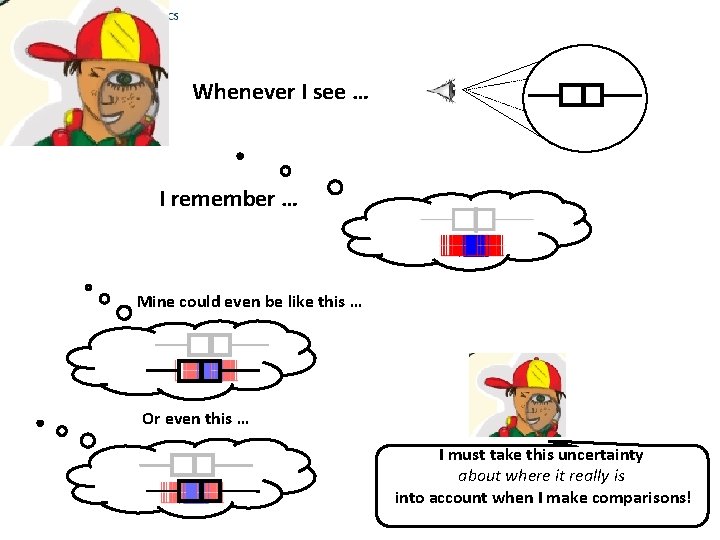
Whenever I see … I remember … Mine could even be like this … Or even this … I must take this uncertainty about where it really is into account when I make comparisons!
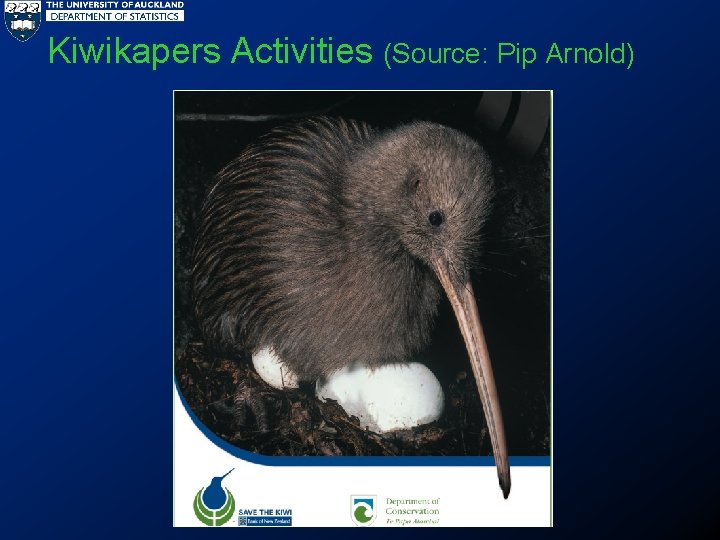
Kiwikapers Activities (Source: Pip Arnold)
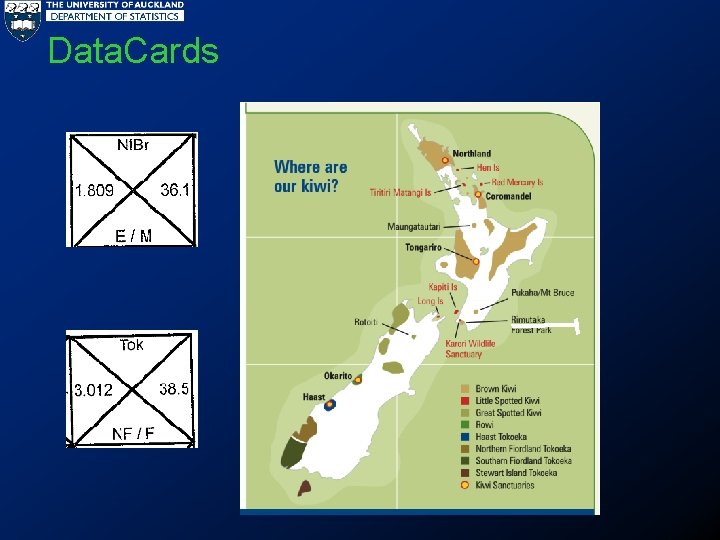
Data. Cards
Investigation Question • I wonder if … • North Island Brown kiwi tend to be heavier than South Island Tokoeka kiwi?
ACTIVITY ONE - COMPARATIVE REASONING In groups of 2 – Sample one species (n=30) from kiwi population – Do Datacard Plot on sheet provided (round weights to 1 d. p) – Look at SHAPE - discuss your descriptive, inferential & contextual thoughts (see teacher guide)
ACTIVITY TWO - LEARNING TO MAKE A CALL • Remove datacards and draw a Dot plot & Box plot • Transfer box plot onto transparency • Learning to “Make a call” – As a class put NI Browns • Side-by-side • On top of each other – View automated pdf “movie” – Create a decision rule for making a call • Test on comparison of two samples of NI Browns • Test on comparison of NI Browns and Tokoekas • Test on comaprison of NI Browns an Great Spotteds
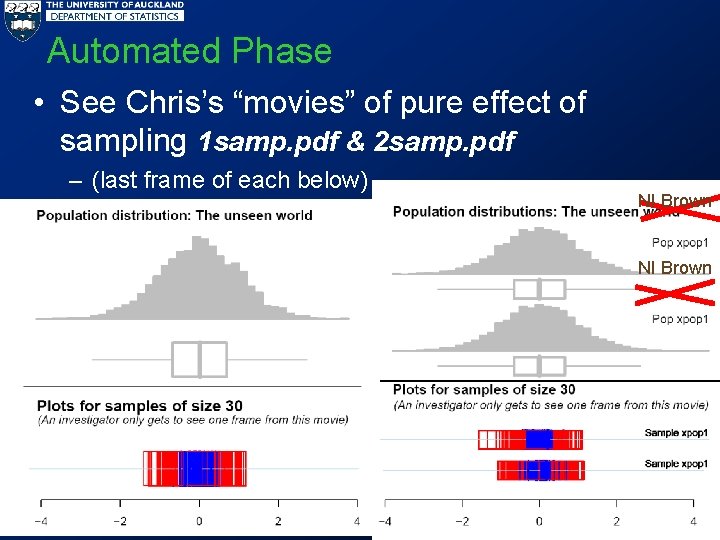
Automated Phase • See Chris’s “movies” of pure effect of sampling 1 samp. pdf & 2 samp. pdf – (last frame of each below) NI Brown
Developing a method to “make a call”
Informal statistical inference • Building statistical concepts - provide a pathway through the curriculum for students to understand the logic of inference • For more information and “movies” see: www. censusatschool. org. nz/2008/informal-inference/