
Informal Leadership and EI Agenda What is informal
- Slides: 14
Informal Leadership and EI
Agenda What is informal leadership? What is emotional intelligence? Practice question activity 8. 4
Learning goals Understand the difference between formal and informal leaders Be able to explain whether an informal leader would be a good formal leader Explain why employees might listen to an informal leader more than a formal leader Understand emotional intelligence and explain the four competencies
Vocabulary Informal leader Formal leader Emotional intelligence Self-awareness Self-management Social awareness Social skills
Informal Leadership Formal leader: person appointed by the organization to exercise authority over others Informal leader: person who has no formal authority but has the respect of colleagues and some power over them. At school who would be your formal leader and informal leader? Why would you listen or follow your informal leader?
Informal Leadership They have the ability to lead without any formal power Could be due to more experience, personality or special knowledge Would they make a good formal leader? Yes? No? Why?
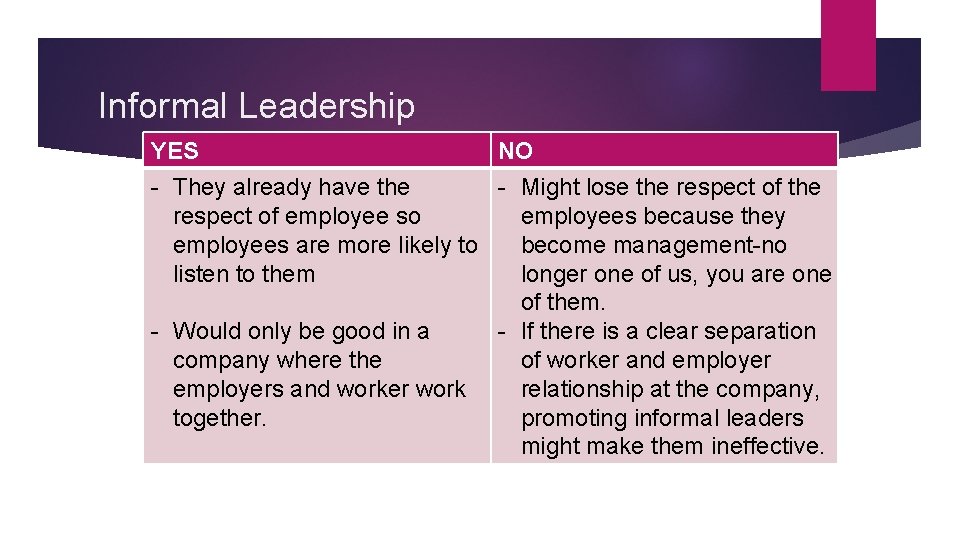
Informal Leadership YES NO - They already have the - Might lose the respect of employee so employees because they employees are more likely to become management-no listen to them longer one of us, you are one of them. - Would only be good in a - If there is a clear separation company where the of worker and employers and worker work relationship at the company, together. promoting informal leaders might make them ineffective.
Emotional Intelligence EI (Emotional Intelligence): the ability of managers to understand their own emotions, and those of the people they work with, to achieve better business performance. Being supper intelligent doe not mean you will be a great manager or leader. To be a good manager you need: Understand yourself, your goals, your behaviour and your responses to people. Understand other and their feelings
EI and Daniel Goleman is the best-known researcher into EI He has suggested that there are four main EI competencies that manger should try to develop and improve Self-awareness Self-management Social awareness Social skills
Self-Awareness Knowing what we feel Having a realistic view of our own abilities Having self confidence in our ability
Self-Management Being able to recover quickly from stress Bing trustworthy and conscientious Showing initiative and self-control
Social Awareness Sensing what others are feeling Being able to take their views into account Being able to get along with many different people
Social skills Handling emotion in relationship well and accurately Understanding different social situations Using social skills to persuade, negotiate and lead
Practice Question Activity 8. 4 on page 151 of the textbook