
Informal document GRBP71 xy 71 th GRBP January
Informal document GRBP-71 -xy (71 th GRBP, January 28 -31, 2020, agenda item 3. ) Transmitted by the Chair of TF MU Task Force Measurement Uncertainty Strategic Approach to Handle Measurement Uncertainties in UN Regulations Application of the Concept to UN R 51. 03 and UN R 117. 02 GRBP 71 – January 2020
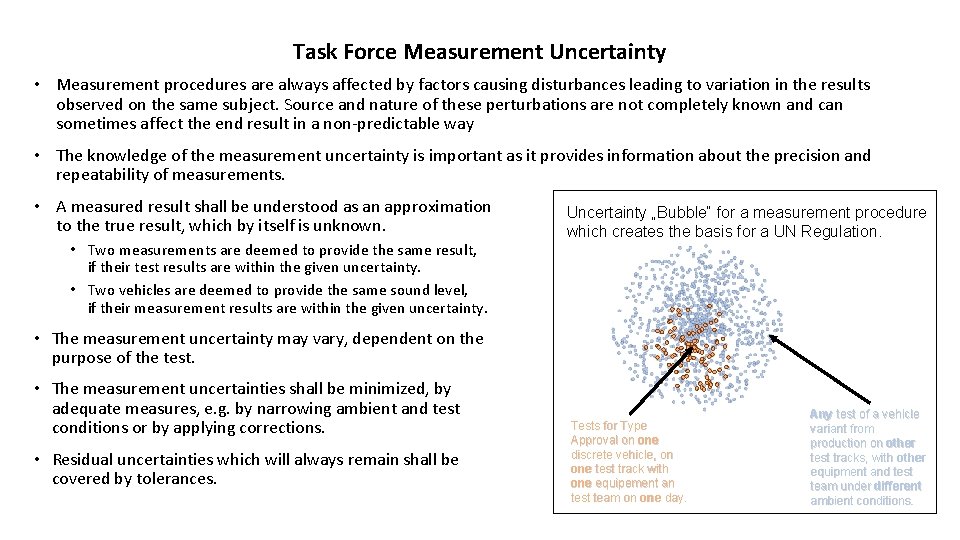
Task Force Measurement Uncertainty • Measurement procedures are always affected by factors causing disturbances leading to variation in the results observed on the same subject. Source and nature of these perturbations are not completely known and can sometimes affect the end result in a non-predictable way • The knowledge of the measurement uncertainty is important as it provides information about the precision and repeatability of measurements. • A measured result shall be understood as an approximation to the true result, which by itself is unknown. • Two measurements are deemed to provide the same result, if their test results are within the given uncertainty. • Two vehicles are deemed to provide the same sound level, if their measurement results are within the given uncertainty. Uncertainty „Bubble“ for a measurement procedure which creates the basis for a UN Regulation. • The measurement uncertainty may vary, dependent on the purpose of the test. • The measurement uncertainties shall be minimized, by adequate measures, e. g. by narrowing ambient and test conditions or by applying corrections. • Residual uncertainties which will always remain shall be covered by tolerances. Tests for Type Approval on one discrete vehicle, on one test track with one equipement an test team on one day. Any test of a vehicle variant from production on other test tracks, with other equipment and test team under different ambient conditions.
ISO/IEC Guide 98 -3 (Guide to the expression of Uncertainty in Measurement) Ø The uncertainty of results obtained from measurements can be evaluated by the procedure given in ISO/IEC Guide 98 -3 (GUM) or by interlaboratory comparisons in accordance with ISO 5725 (part 1 to 6) Ø The procedure given in ISO 5725 (part 1 to 6) to estimate the uncertainties associated with the test procedures mentioned in UN Regulation No. 51. 03 or No. 117. 02 (for Rolling Sound) is not followed, as extensive inter- and intra-laboratory data are not available for the calculation of the uncertainties. Ø Instead, the procedure given in ISO/IEC Guide 98 -3 (GUM) can be followed to estimate the uncertainties associated with the test procedures mentioned above. Ø The data for the calculation of the uncertainties are based on existing statistical data, analysis of tolerances and engineering judgement and can be grouped as follows for Ø the same vehicle ü Run to Run ü Day to Day ü Site to Site Ø different vehicles of the same kind ü New Vehicle to new Vehicle or, new Vehicle to used Vehicle
How are Uncertainties Handled Today in a Regulation? • Regulations provide already provisions to ensure accurate testing. Without these provisions, test results would not be repeatable and would provide a variation, which is inacceptable for the purpose of regulation. • However, even with all these provisions, uncertainties remain and must be assessed, especially when considering third party testing such as in-use conformity and market surveillance provide additional uncertainties.
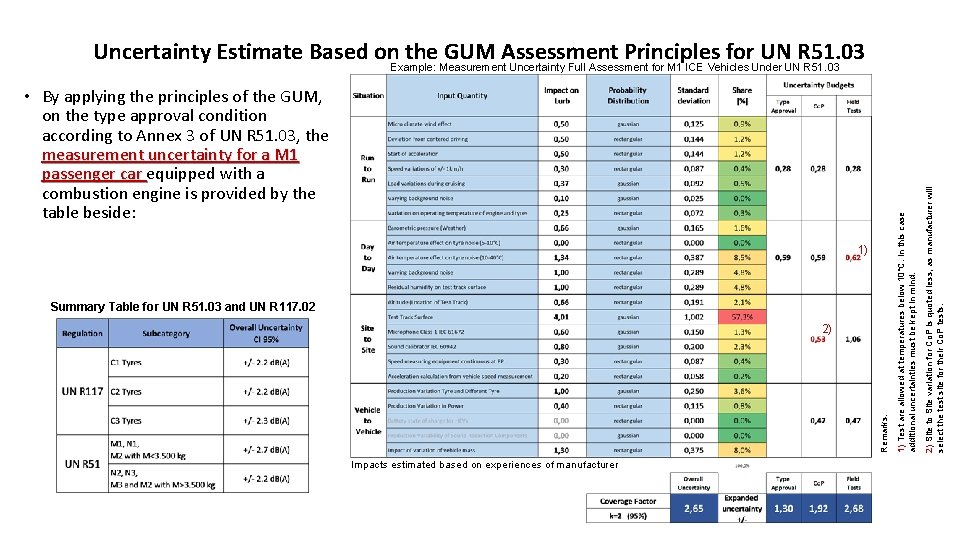
1) Summary Table for UN R 51. 03 and UN R 117. 02 Remarks: 2) Impacts estimated based on experiences of manufacturer 2) Site to Site variation for Co. P is quoted less, as manufacturer will select the test site for their Co. P tests. • By applying the principles of the GUM, on the type approval condition according to Annex 3 of UN R 51. 03, the measurement uncertainty for a M 1 passenger car equipped with a passenger car combustion engine is provided by the table beside: 1) Test are allowed at temperatures below 10°C. In this case additional uncertainties must be kept in mind. Uncertainty Estimate Based on. Example: the Measurement GUM Assessment Principles for UN R 51. 03 Uncertainty Full Assessment for M 1 ICE Vehicles Under UN R 51. 03
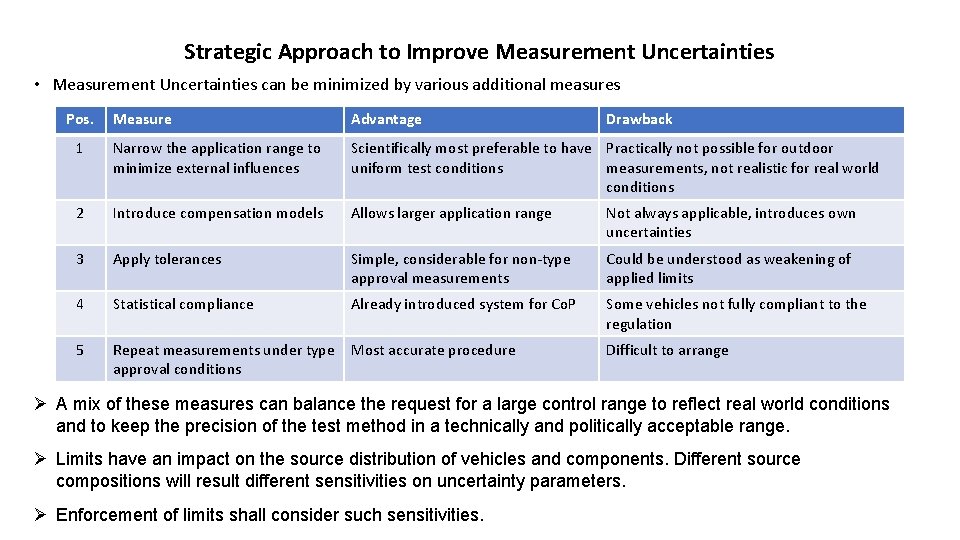
Strategic Approach to Improve Measurement Uncertainties • Measurement Uncertainties can be minimized by various additional measures Pos. Measure Advantage Drawback 1 Narrow the application range to minimize external influences Scientifically most preferable to have Practically not possible for outdoor uniform test conditions measurements, not realistic for real world conditions 2 Introduce compensation models Allows larger application range Not always applicable, introduces own uncertainties 3 Apply tolerances Simple, considerable for non-type approval measurements Could be understood as weakening of applied limits 4 Statistical compliance Already introduced system for Co. P Some vehicles not fully compliant to the regulation 5 Repeat measurements under type Most accurate procedure approval conditions Difficult to arrange Ø A mix of these measures can balance the request for a large control range to reflect real world conditions and to keep the precision of the test method in a technically and politically acceptable range. Ø Limits have an impact on the source distribution of vehicles and components. Different source compositions will result different sensitivities on uncertainty parameters. Ø Enforcement of limits shall consider such sensitivities.
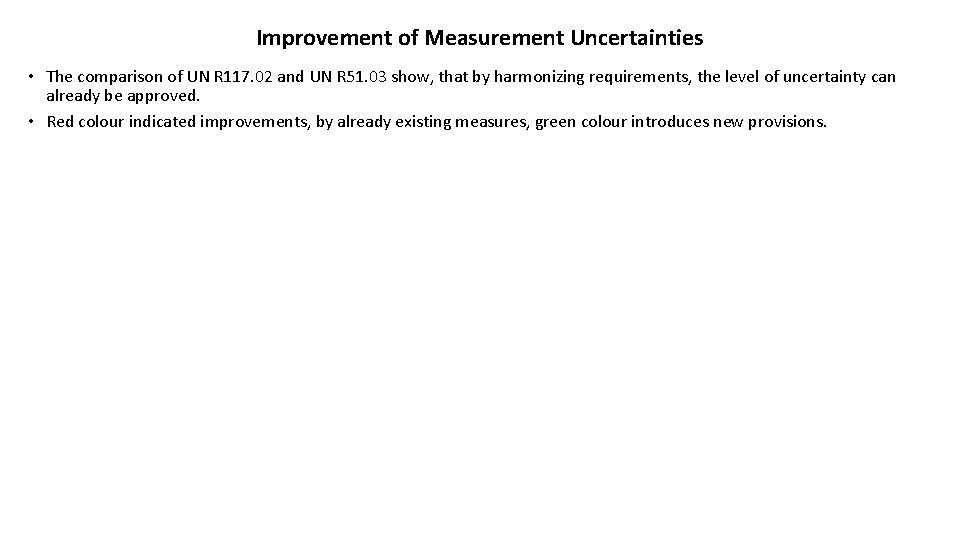
Improvement of Measurement Uncertainties • The comparison of UN R 117. 02 and UN R 51. 03 show, that by harmonizing requirements, the level of uncertainty can already be approved. • Red colour indicated improvements, by already existing measures, green colour introduces new provisions.
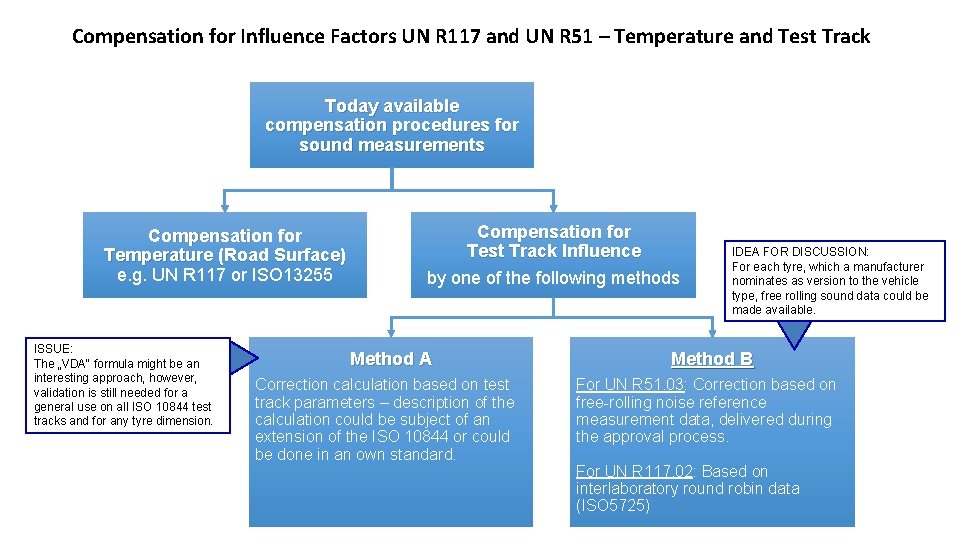
Compensation for Influence Factors UN R 117 and UN R 51 – Temperature and Test Track Today available compensation procedures for sound measurements Compensation for Temperature (Road Surface) e. g. UN R 117 or ISO 13255 ISSUE: The „VDA“ formula might be an interesting approach, however, validation is still needed for a general use on all ISO 10844 test tracks and for any tyre dimension. Compensation for Test Track Influence by one of the following methods Method A Correction calculation based on test track parameters – description of the calculation could be subject of an extension of the ISO 10844 or could be done in an own standard. IDEA FOR DISCUSSION: For each tyre, which a manufacturer nominates as version to the vehicle type, free rolling sound data could be made available. Method B For UN R 51. 03: Correction based on free-rolling noise reference measurement data, delivered during the approval process. For UN R 117. 02: Based on interlaboratory round robin data (ISO 5725)
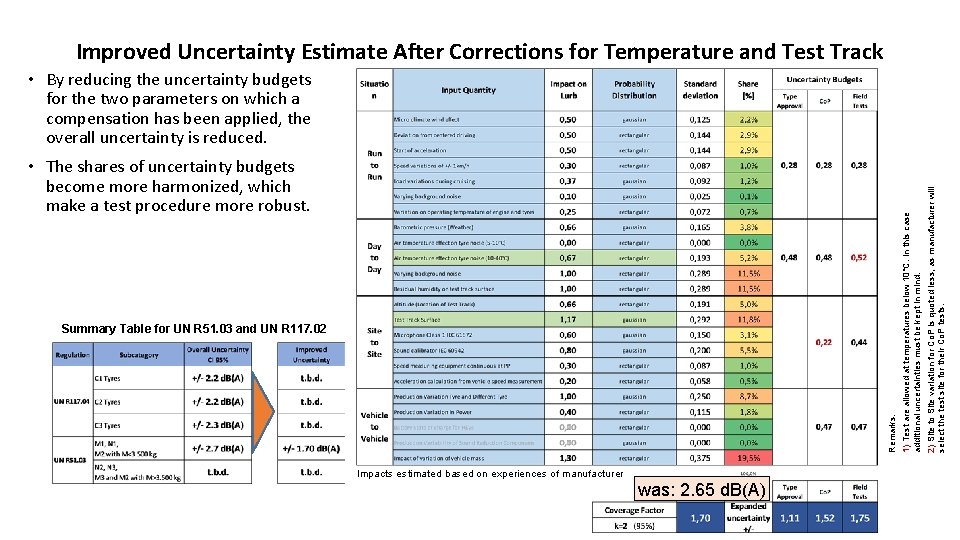
Improved Uncertainty Estimate After Corrections for Temperature and Test Track Remarks: Summary Table for UN R 51. 03 and UN R 117. 02 Impacts estimated based on experiences of manufacturer was: 2. 65 d. B(A) 2) Site to Site variation for Co. P is quoted less, as manufacturer will select the test site for their Co. P tests. • The shares of uncertainty budgets become more harmonized, which make a test procedure more robust. 1) Test are allowed at temperatures below 10°C. In this case additional uncertainties must be kept in mind. • By reducing the uncertainty budgets for the two parameters on which a compensation has been applied, the overall uncertainty is reduced.
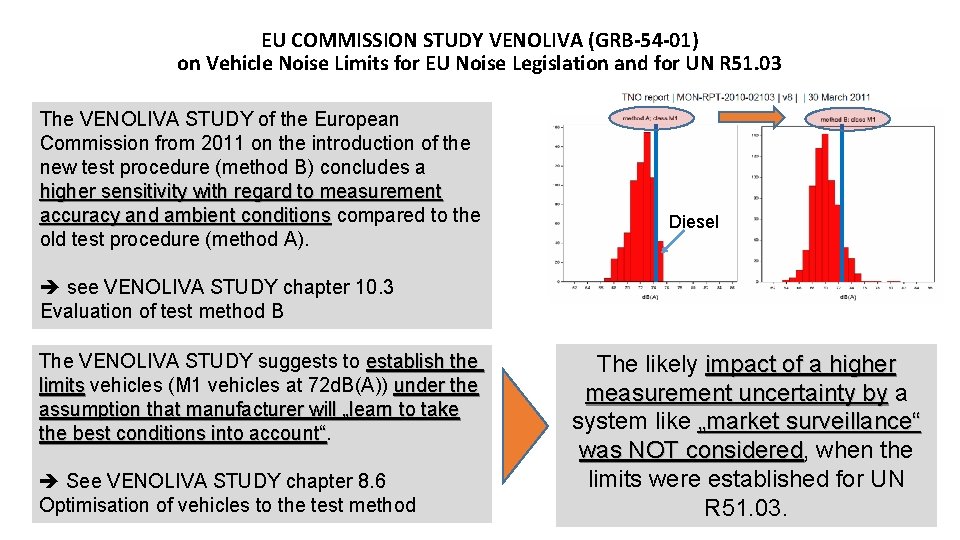
EU COMMISSION STUDY VENOLIVA (GRB-54 -01) on Vehicle Noise Limits for EU Noise Legislation and for UN R 51. 03 The VENOLIVA STUDY of the European Commission from 2011 on the introduction of the new test procedure (method B) concludes a higher sensitivity with regard to measurement accuracy and ambient conditions compared to the old test procedure (method A). Diesel see VENOLIVA STUDY chapter 10. 3 Evaluation of test method B The VENOLIVA STUDY suggests to establish the limits vehicles (M 1 vehicles at 72 d. B(A)) under the assumption that manufacturer will „learn to take the best conditions into account“ See VENOLIVA STUDY chapter 8. 6 Optimisation of vehicles to the test method The likely impact of a higher measurement uncertainty by a system like „market surveillance“ was NOT considered, considered when the limits were established for UN R 51. 03.
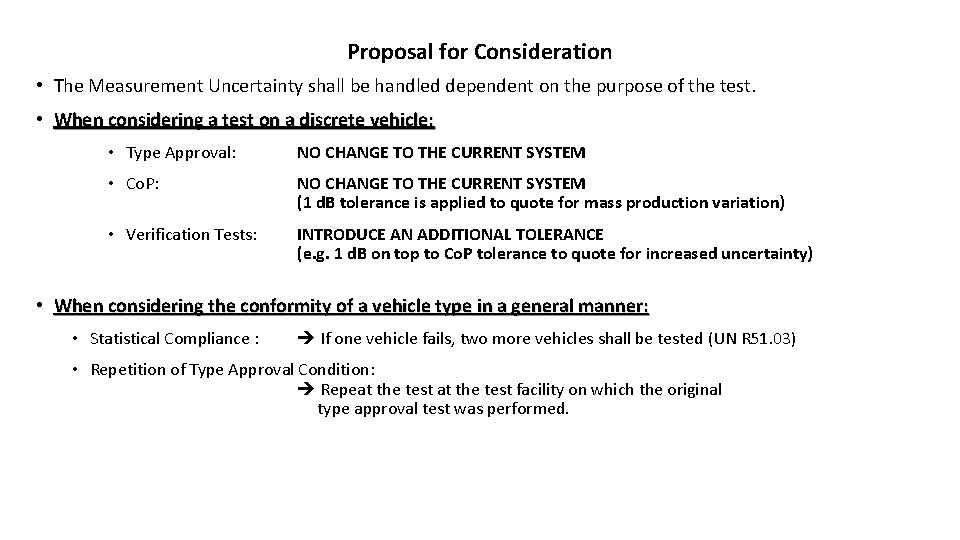
Proposal for Consideration • The Measurement Uncertainty shall be handled dependent on the purpose of the test. • When considering a test on a discrete vehicle: • Type Approval: NO CHANGE TO THE CURRENT SYSTEM • Co. P: NO CHANGE TO THE CURRENT SYSTEM (1 d. B tolerance is applied to quote for mass production variation) • Verification Tests: INTRODUCE AN ADDITIONAL TOLERANCE (e. g. 1 d. B on top to Co. P tolerance to quote for increased uncertainty) • When considering the conformity of a vehicle type in a general manner: • Statistical Compliance : If one vehicle fails, two more vehicles shall be tested (UN R 51. 03) • Repetition of Type Approval Condition: Repeat the test facility on which the original type approval test was performed.

BACKUP MATERIAL
Uncertainty Estimate Based on the GUM Assessment Principles for UN R 117 • By applying the general numerical approach with the GUM, for carrying out calculations required as part of an evaluation on measurement uncertainty, the actual uncertainty for tyre rolling sound measurements according to UN R 117 are provided by the table below:
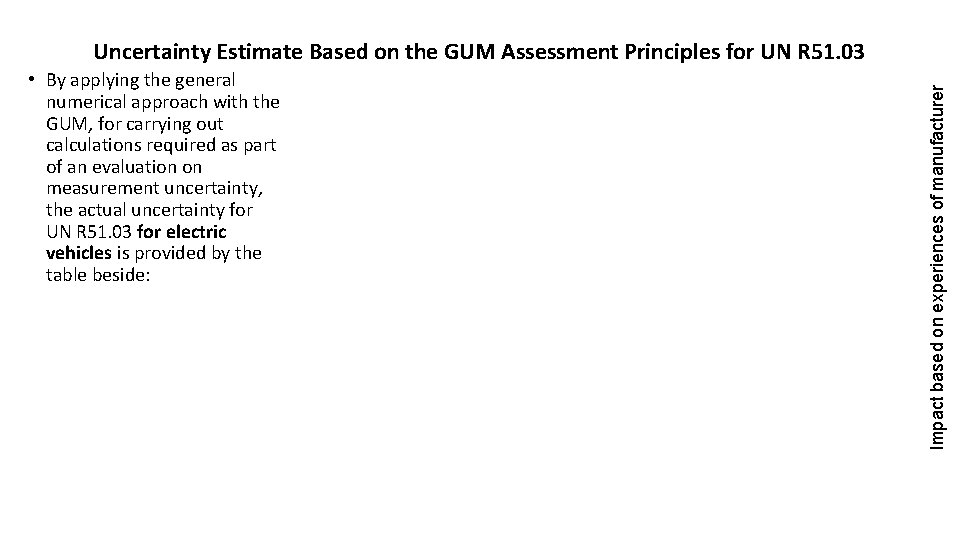
• By applying the general numerical approach with the GUM, for carrying out calculations required as part of an evaluation on measurement uncertainty, the actual uncertainty for UN R 51. 03 for electric vehicles is provided by the table beside: Impact based on experiences of manufacturer Uncertainty Estimate Based on the GUM Assessment Principles for UN R 51. 03
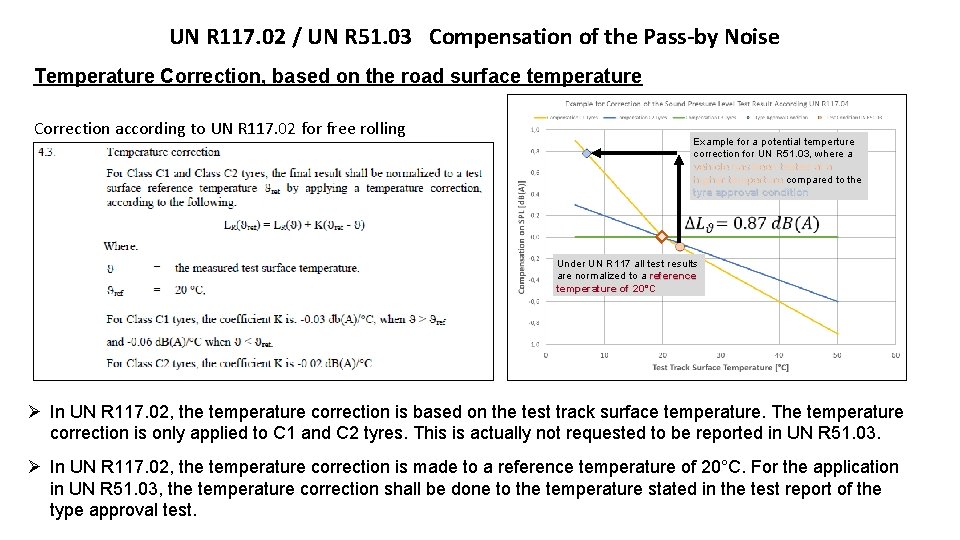
UN R 117. 02 / UN R 51. 03 Compensation of the Pass-by Noise Temperature Correction, based on the road surface temperature Correction according to UN R 117. 02 for free rolling Example for a potential temperture correction for UN R 51. 03, where a vehicle has been tested at a higher temperture compared to the tyre approval condition Under UN R 117 all test results are normalized to a reference temperature of 20°C Ø In UN R 117. 02, the temperature correction is based on the test track surface temperature. The temperature correction is only applied to C 1 and C 2 tyres. This is actually not requested to be reported in UN R 51. 03. Ø In UN R 117. 02, the temperature correction is made to a reference temperature of 20°C. For the application in UN R 51. 03, the temperature correction shall be done to the temperature stated in the test report of the type approval test.
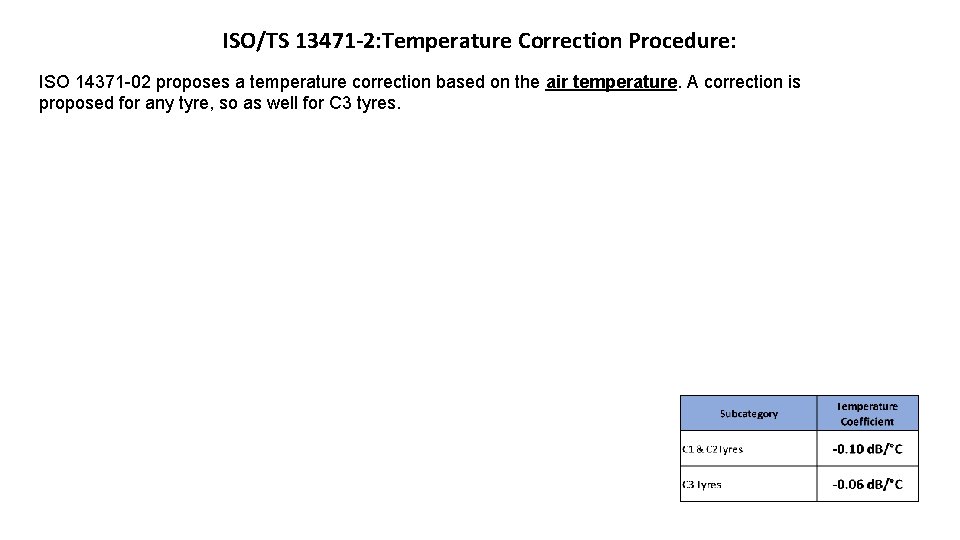
ISO/TS 13471 -2: Temperature Correction Procedure: ISO 14371 -02 proposes a temperature correction based on the air temperature. A correction is proposed for any tyre, so as well for C 3 tyres.
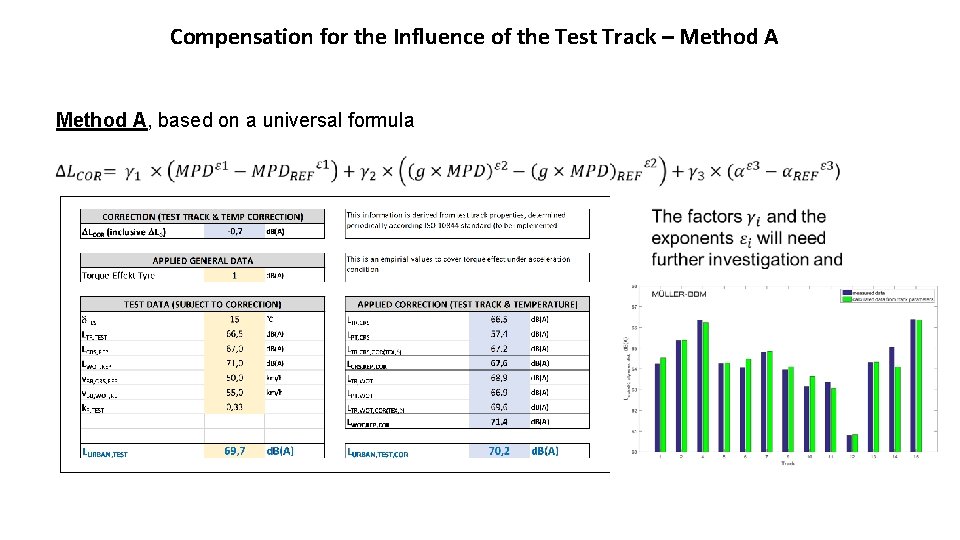
Compensation for the Influence of the Test Track – Method A, based on a universal formula
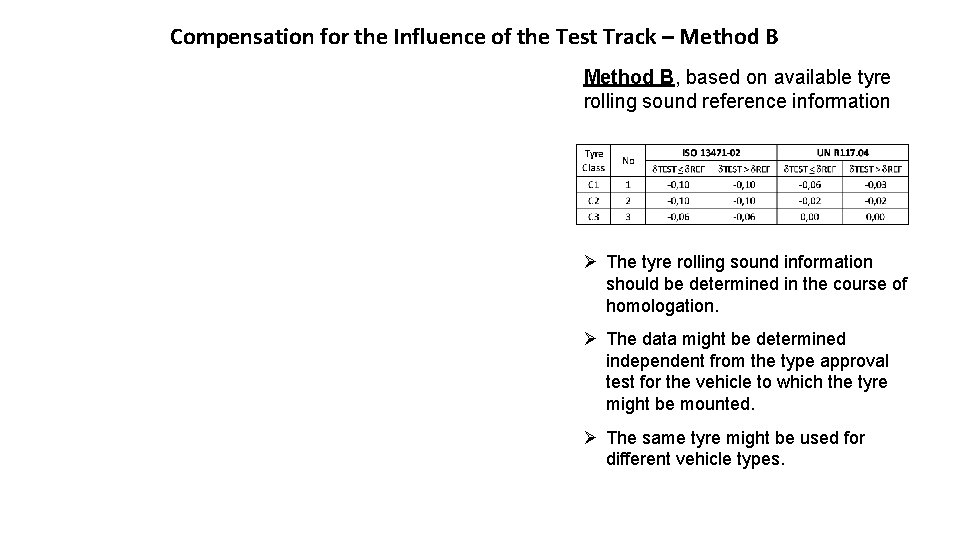
Compensation for the Influence of the Test Track – Method B, based on available tyre rolling sound reference information Ø The tyre rolling sound information should be determined in the course of homologation. Ø The data might be determined independent from the type approval test for the vehicle to which the tyre might be mounted. Ø The same tyre might be used for different vehicle types.
Update of the Uncertainty Sheets based on the Compensation • By applying a compensation for the temperature the originally estimated uncertainty will become lower. • However, there is no universal „true“ compensation model. • The temperature sensitivity of a tyre is dependent on the design and materials used in the tyre. • As no discrete results exist, a conservative guess is made, that the uncertainty is reduced by 50%, e. g. for UN R 51. 03 from 2 d. B(A) to 1 d. B(A). • The test track compensation is as well subject to uncertainties. • Even when using measurements of the same tyre on the test tracks, the residual uncertainty will apply to both measurement. • By good engineering judgement, the uncertainty is considered to be lowed from 5 d. B(A) under cruise condition to 1. 5 d. B(A) for both combustion engine vehicles and those with electric propulsion. • The following slides show the result of the compensation
Improved Uncertainty Estimate After Corrections for Temperature and Test Track (UN R 51. 03) Impact based on experiences of manufacturer • By applying the general numerical approach with the GUM, for carrying out calculations required as part of an evaluation on measurement uncertainty, the actual uncertainty for UN R 51. 03 for electric vehicles is provided by the table beside: was: 3. 41 d. B(A)
VENOLIVA STUDY on UN R 51. 03 (EU COM 2011) 10. 3 Evaluation of test method B The practicability and manageability of method B was investigated by means of a small enquiry among a number of type approval authorities that had submitted significant numbers of test report files for the database. Based on the response from these type approval authorities the following conclusions can be drawn: • The complexity of the new method B for light vehicles (M 1, N 1 and N 2 < 3, 5 t) is approximately three times higher than of the current method A; • For these vehicles method B requires more attention to avoid errors and to achieve the necessary measurement accuracy than method A; • Depending on the type of measuring equipment (fully integrated or separate systems) the management of the test process may be rather time consuming; • Method B is more sensitive to environmental parameters, because the test results for light vehicles are lower than for method A; • Nevertheless, method B is considered reproducible and manageable; The VENOLIVA STUDY of the European Commission from 2011 on the introduction of the new test procedure (method B) concludes a higher sensitivity with regard to measurement accuracy and ambient conditions compared to the old test procedure (method A)
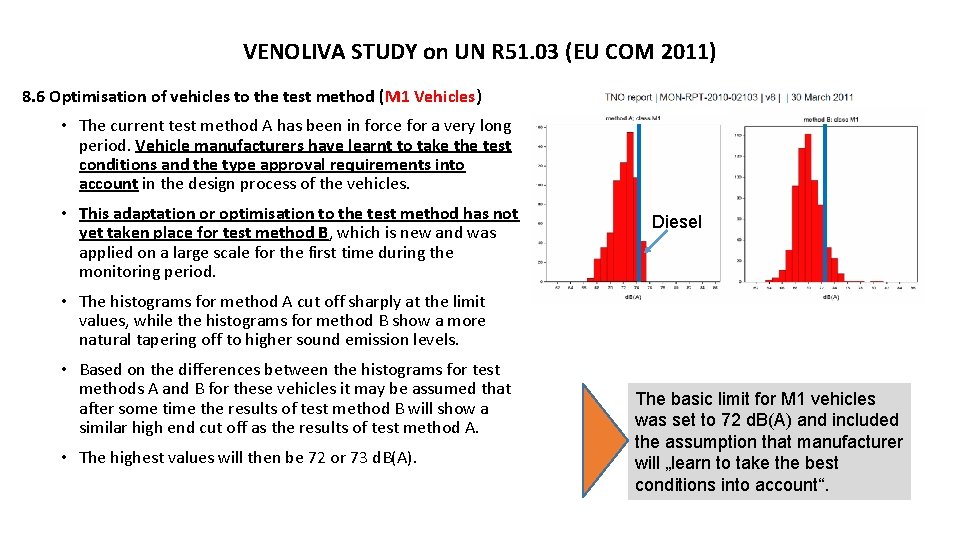
VENOLIVA STUDY on UN R 51. 03 (EU COM 2011) 8. 6 Optimisation of vehicles to the test method (M 1 Vehicles) • The current test method A has been in force for a very long period. Vehicle manufacturers have learnt to take the test conditions and the type approval requirements into account in the design process of the vehicles. • This adaptation or optimisation to the test method has not yet taken place for test method B, which is new and was applied on a large scale for the first time during the monitoring period. Diesel • The histograms for method A cut off sharply at the limit values, while the histograms for method B show a more natural tapering off to higher sound emission levels. • Based on the differences between the histograms for test methods A and B for these vehicles it may be assumed that after some time the results of test method B will show a similar high end cut off as the results of test method A. • The highest values will then be 72 or 73 d. B(A). The basic limit for M 1 vehicles was set to 72 d. B(A) and included the assumption that manufacturer will „learn to take the best conditions into account“.
- Slides: 22