
INFORM RISK ASSESSMENT METHODOLOGY PROJECT DESIGNING A TOOL
- Slides: 1
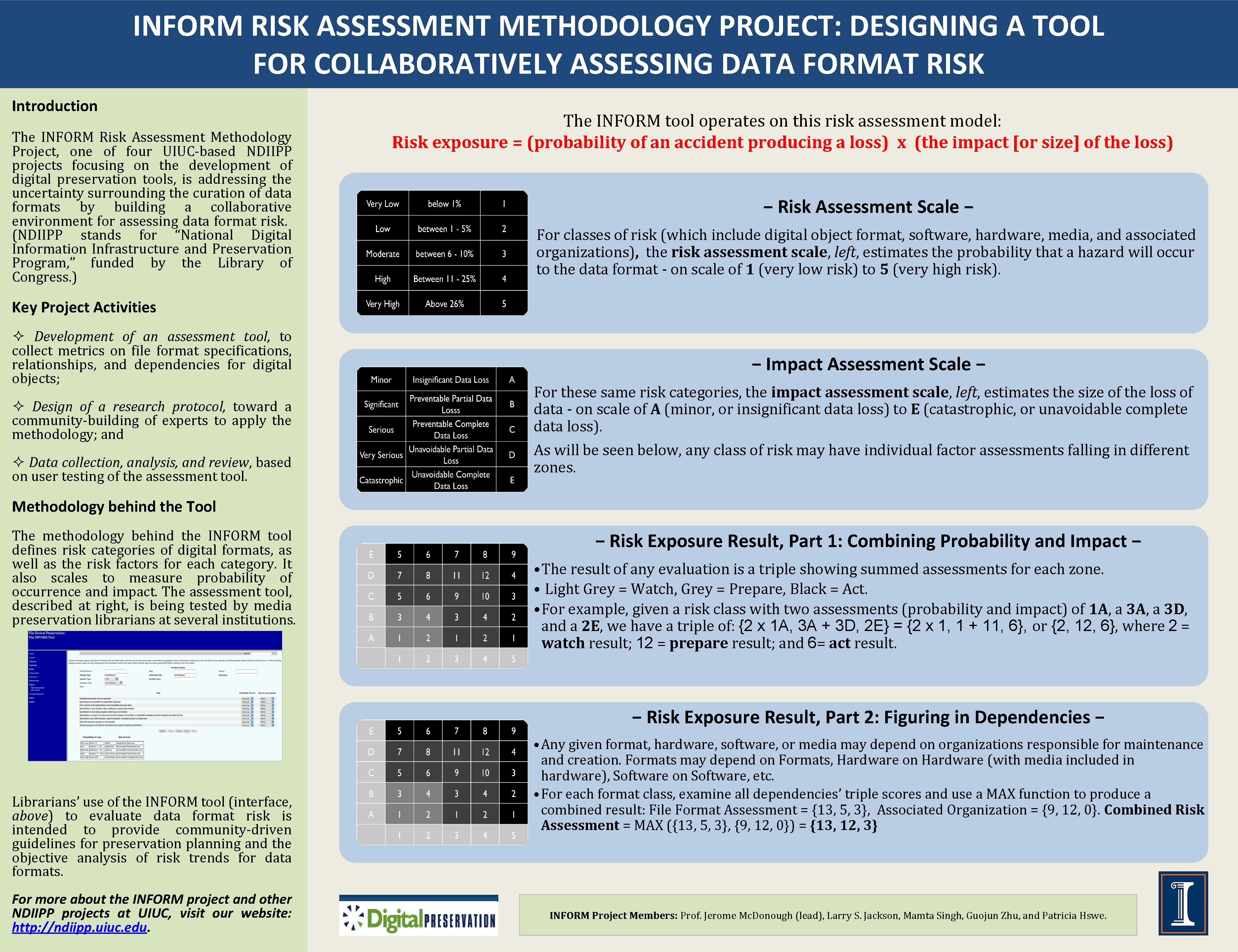
INFORM RISK ASSESSMENT METHODOLOGY PROJECT: DESIGNING A TOOL FOR COLLABORATIVELY ASSESSING DATA FORMAT RISK Introduction The INFORM Risk Assessment Methodology Project, one of four UIUC-based NDIIPP projects focusing on the development of digital preservation tools, is addressing the uncertainty surrounding the curation of data formats by building a collaborative environment for assessing data format risk. (NDIIPP stands for “National Digital Information Infrastructure and Preservation Program, ” funded by the Library of Congress. ) The INFORM tool operates on this risk assessment model: Risk exposure = (probability of an accident producing a loss) x (the impact [or size] of the loss) − Risk Assessment Scale − For classes of risk (which include digital object format, software, hardware, media, and associated organizations), the risk assessment scale, left, estimates the probability that a hazard will occur to the data format - on scale of 1 (very low risk) to 5 (very high risk). Key Project Activities ² Development of an assessment tool, to collect metrics on file format specifications, relationships, and dependencies for digital objects; ² Design of a research protocol, toward a community-building of experts to apply the methodology; and ² Data collection, analysis, and review, based on user testing of the assessment tool. − Impact Assessment Scale − For these same risk categories, the impact assessment scale, left, estimates the size of the loss of data - on scale of A (minor, or insignificant data loss) to E (catastrophic, or unavoidable complete data loss). As will be seen below, any class of risk may have individual factor assessments falling in different zones. Methodology behind the Tool The methodology behind the INFORM tool defines risk categories of digital formats, as well as the risk factors for each category. It also scales to measure probability of occurrence and impact. The assessment tool, described at right, is being tested by media preservation librarians at several institutions. − Risk Exposure Result, Part 1: Combining Probability and Impact − • The result of any evaluation is a triple showing summed assessments for each zone. • Light Grey = Watch, Grey = Prepare, Black = Act. • For example, given a risk class with two assessments (probability and impact) of 1 A, a 3 D, and a 2 E, we have a triple of: {2 x 1 A, 3 A + 3 D, 2 E} = {2 x 1, 1 + 11, 6}, or {2, 12, 6}, where 2 = watch result; 12 = prepare result; and 6= act result. − Risk Exposure Result, Part 2: Figuring in Dependencies − Librarians’ use of the INFORM tool (interface, above) to evaluate data format risk is intended to provide community-driven guidelines for preservation planning and the objective analysis of risk trends for data formats. For more about the INFORM project and other NDIIPP projects at UIUC, visit our website: http: //ndiipp. uiuc. edu. • Any given format, hardware, software, or media may depend on organizations responsible for maintenance and creation. Formats may depend on Formats, Hardware on Hardware (with media included in hardware), Software on Software, etc. • For each format class, examine all dependencies’ triple scores and use a MAX function to produce a combined result: File Format Assessment = {13, 5, 3}, Associated Organization = {9, 12, 0}. Combined Risk Assessment = MAX ({13, 5, 3}, {9, 12, 0}) = {13, 12, 3} INFORM Project Members: Prof. Jerome Mc. Donough (lead), Larry S. Jackson, Mamta Singh, Guojun Zhu, and Patricia Hswe.