
INFO 2950 Prof Carla Gomes gomescs cornell edu
- Slides: 28
INFO 2950 Prof. Carla Gomes gomes@cs. cornell. edu Module 8 Probability – part 2 Rosen, Chapter 6 1
Bayes’ Theorem How to assess the probability that a particular event will occur on the basis of partial evidence? Examples: What is the likelihood that people who test positive to a particular disease (e. g. , HIV), actually have the disease? What is the probability that an e-mail message is spam? Key idea: one should factor in additional information regarding occurrence of events. 2
Assume that with respect to events F and E (“E” for “Evidence”): We know P(F) – probability that event F occurs (e. g. probability that email message is spam; this is given by what fraction of email is spam) We also know event E has occurred. (e. g. , email message contains words “sale” and “bargain”) Therefore the probability conditional probability that F occurs given that E occurs, P(F|E), is a more realistic estimate that F occurs than P(F). How do we compute P(F|E)? E. g. , based on P(F), P(E|F), and P(E| ¬F) Note: ¬F is also referred to as complement of F (FC or F).
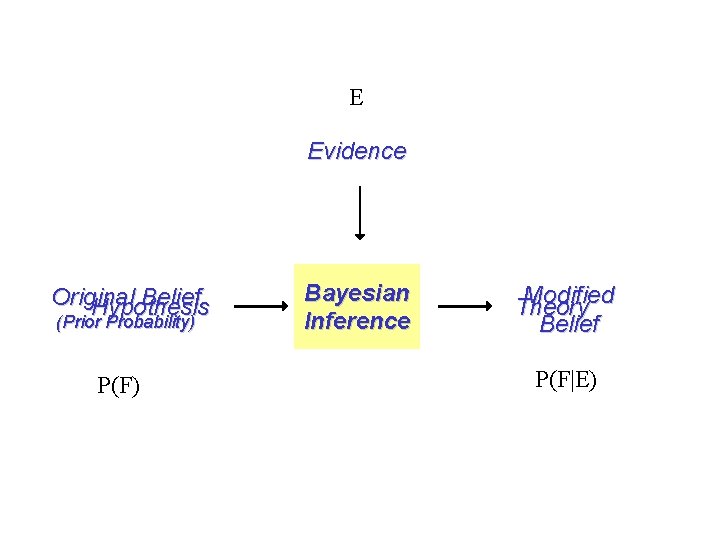
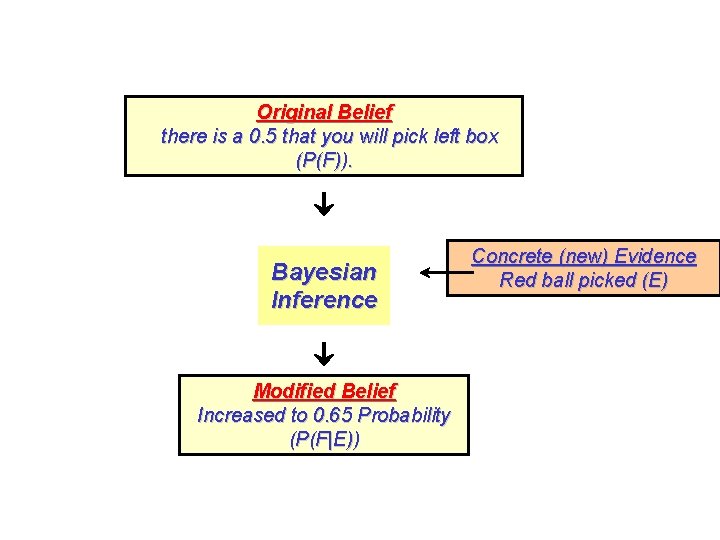
E Evidence Original Belief Hypothesis (Prior Probability) P(F) Bayesian Inference Modified Theory Belief P(F|E)
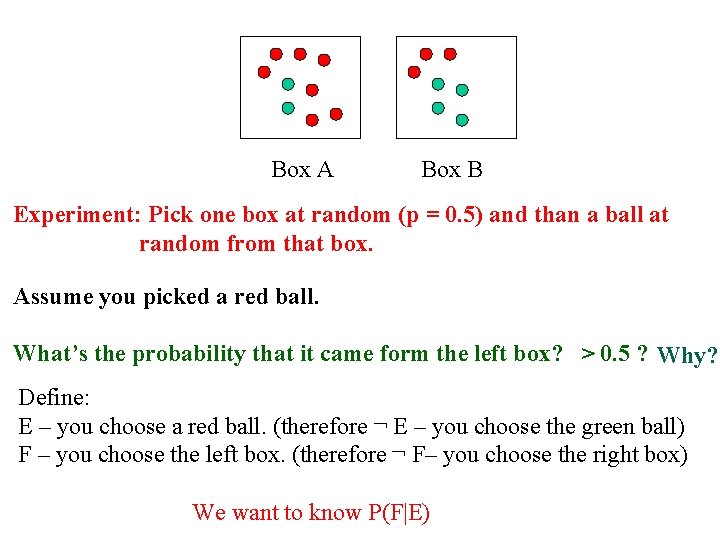
Box A Box B Experiment: Pick one box at random (p = 0. 5) and than a ball at random from that box. Assume you picked a red ball. What’s the probability that it came form the left box? > 0. 5 ? Why? Define: E – you choose a red ball. (therefore ¬ E – you choose the green ball) F – you choose the left box. (therefore ¬ F– you choose the right box) We want to know P(F|E)
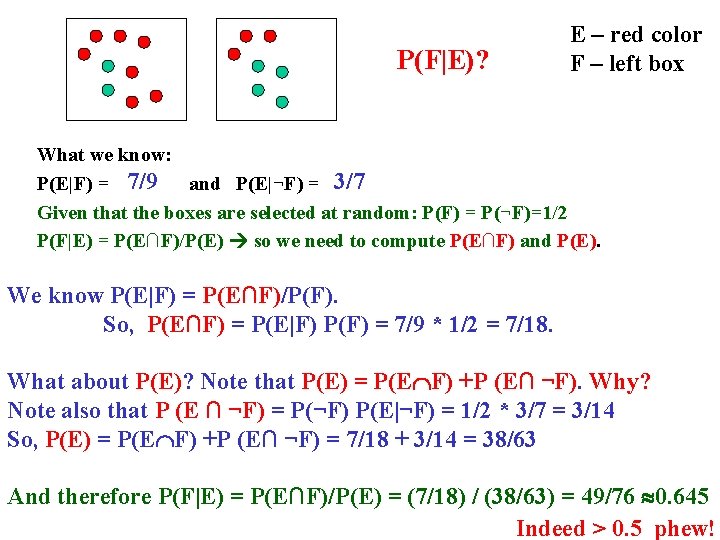
P(F|E)? E – red color F – left box What we know: P(E|F) = 7/9 and P(E|¬F) = 3/7 Given that the boxes are selected at random: P(F) = P(¬F)=1/2 P(F|E) = P(E∩F)/P(E) so we need to compute P(E∩F) and P(E). We know P(E|F) = P(E∩F)/P(F). So, P(E∩F) = P(E|F) P(F) = 7/9 * 1/2 = 7/18. What about P(E)? Note that P(E) = P(E F) +P (E∩ ¬F). Why? Note also that P (E ∩ ¬F) = P(¬F) P(E|¬F) = 1/2 * 3/7 = 3/14 So, P(E) = P(E F) +P (E∩ ¬F) = 7/18 + 3/14 = 38/63 And therefore P(F|E) = P(E∩F)/P(E) = (7/18) / (38/63) = 49/76 0. 645 Indeed > 0. 5 phew!
Original Belief there is a 0. 5 that you will pick left box (P(F)). Bayesian Inference Modified Belief Increased to 0. 65 Probability (P(F|E)) Concrete (new) Evidence Red ball picked (E)
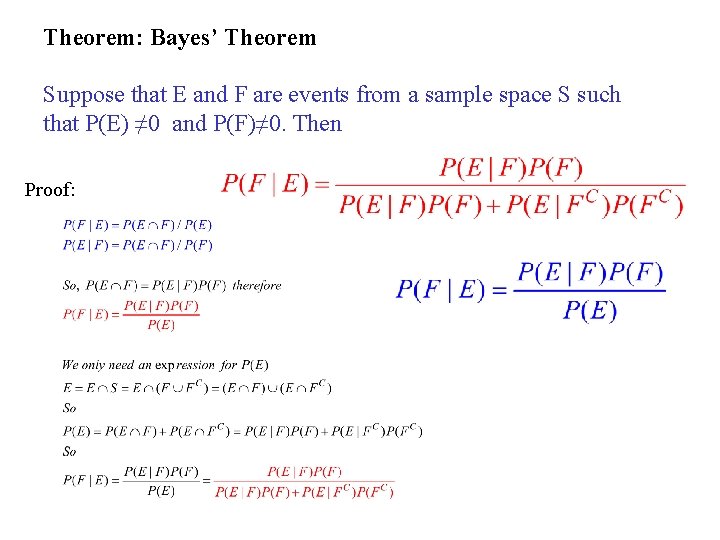
Theorem: Bayes’ Theorem Suppose that E and F are events from a sample space S such that P(E) ≠ 0 and P(F)≠ 0. Then Proof:
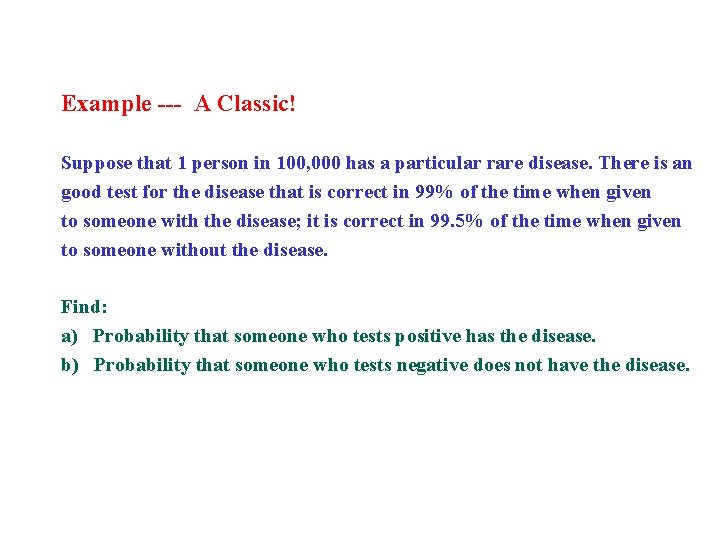
Example --- A Classic! Suppose that 1 person in 100, 000 has a particular rare disease. There is an good test for the disease that is correct in 99% of the time when given to someone with the disease; it is correct in 99. 5% of the time when given to someone without the disease. Find: a) Probability that someone who tests positive has the disease. b) Probability that someone who tests negative does not have the disease.
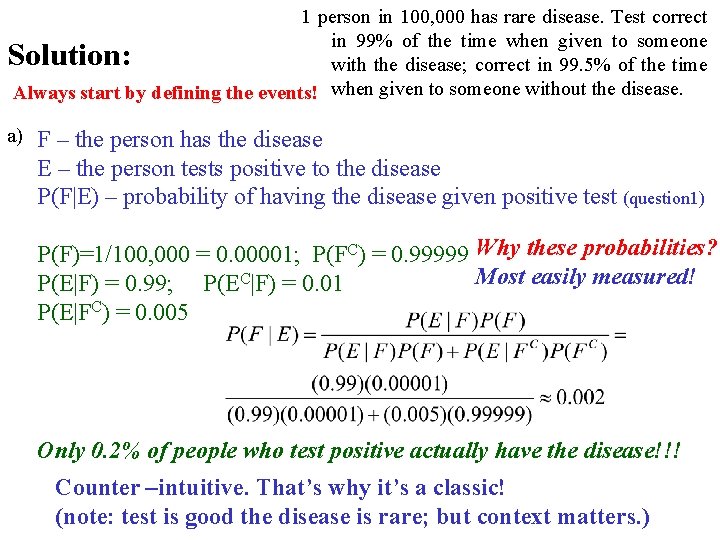
1 person in 100, 000 has rare disease. Test correct in 99% of the time when given to someone with the disease; correct in 99. 5% of the time Always start by defining the events! when given to someone without the disease. Solution: a) F – the person has the disease E – the person tests positive to the disease P(F|E) – probability of having the disease given positive test (question 1) P(F)=1/100, 000 = 0. 00001; P(FC) = 0. 99999 Why these probabilities? Most easily measured! P(E|F) = 0. 99; P(EC|F) = 0. 01 P(E|FC) = 0. 005 Only 0. 2% of people who test positive actually have the disease!!! Counter –intuitive. That’s why it’s a classic! (note: test is good the disease is rare; but context matters. )
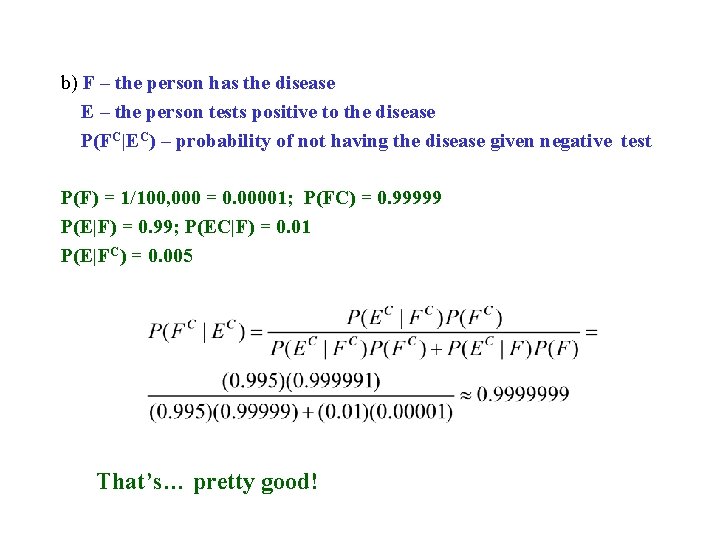
b) F – the person has the disease E – the person tests positive to the disease P(FC|EC) – probability of not having the disease given negative test P(F) = 1/100, 000 = 0. 00001; P(FC) = 0. 99999 P(E|F) = 0. 99; P(EC|F) = 0. 01 P(E|FC) = 0. 005 That’s… pretty good!
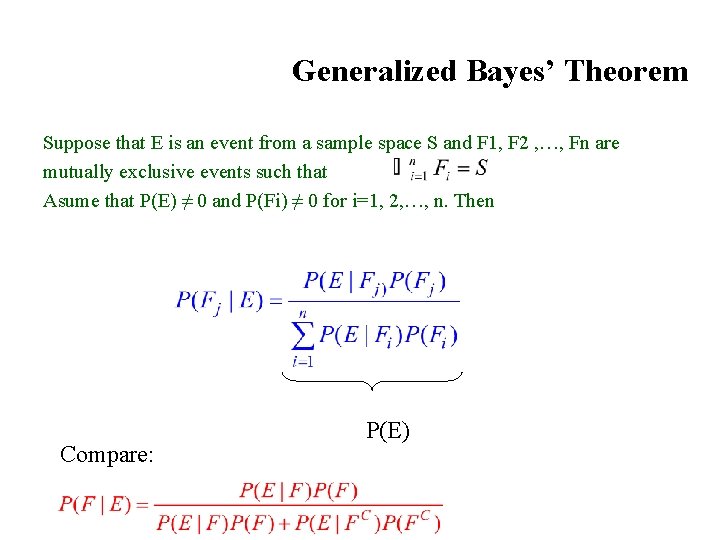
Generalized Bayes’ Theorem Suppose that E is an event from a sample space S and F 1, F 2 , …, Fn are mutually exclusive events such that Asume that P(E) ≠ 0 and P(Fi) ≠ 0 for i=1, 2, …, n. Then Compare: P(E)
Bayesian Spam Filters 17 17
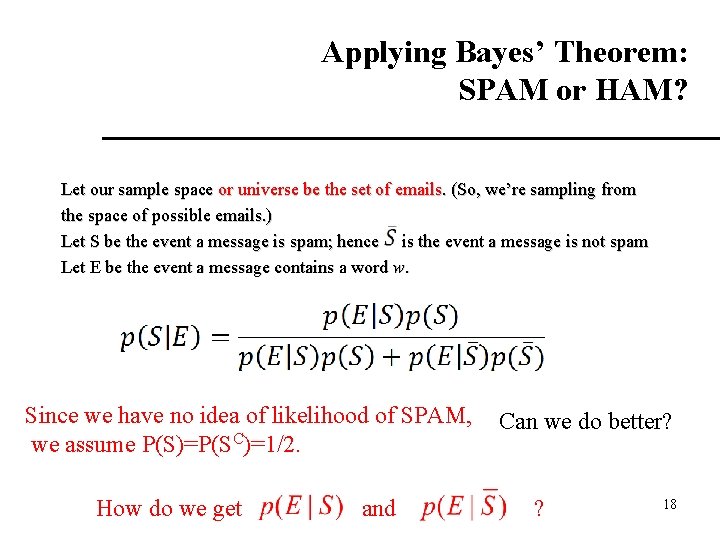
Applying Bayes’ Theorem: SPAM or HAM? Let our sample space or universe be the set of emails. (So, we’re sampling from the space of possible emails. ) Let S be the event a message is spam; hence is the event a message is not spam Let E be the event a message contains a word w. Since we have no idea of likelihood of SPAM, we assume P(S)=P(SC)=1/2. Can we do better? How do we get and ? 18
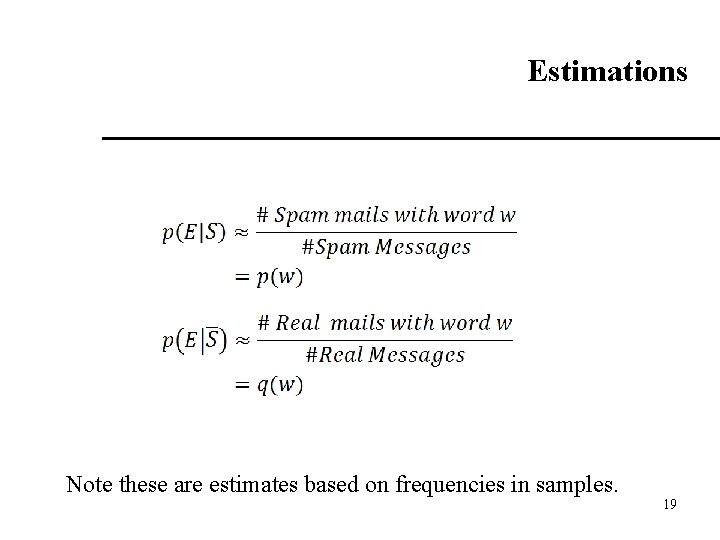
Estimations Note these are estimates based on frequencies in samples. 19 19
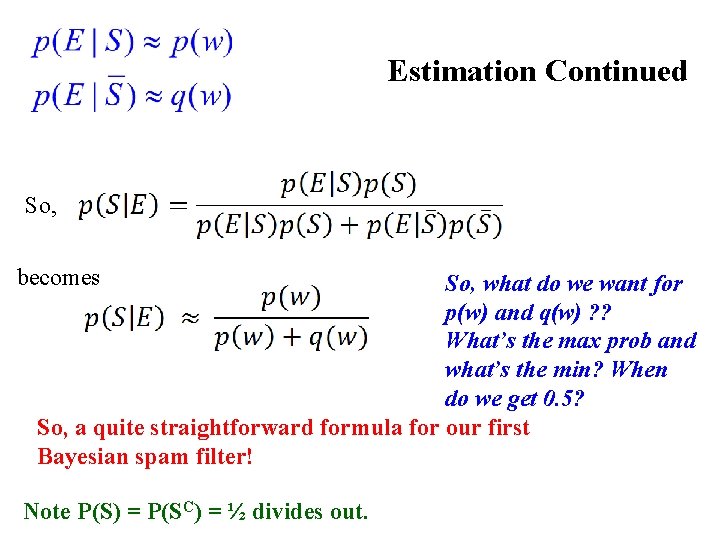
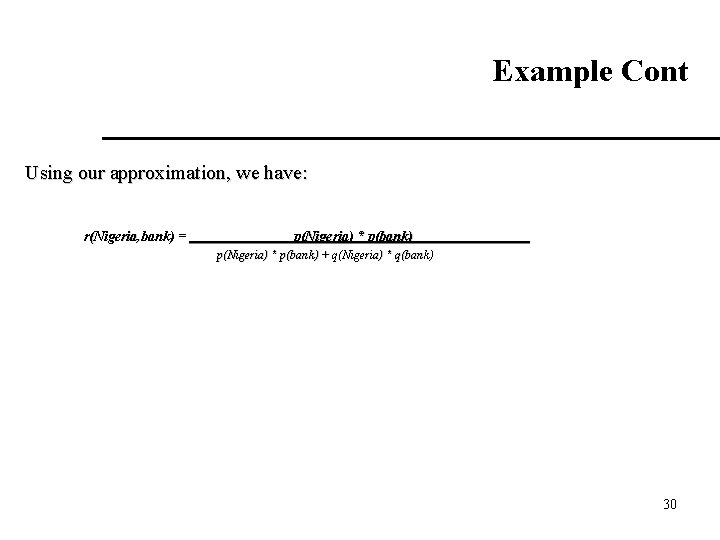
Estimation Continued So, becomes So, what do we want for p(w) and q(w) ? ? What’s the max prob and what’s the min? When do we get 0. 5? So, a quite straightforward formula for our first Bayesian spam filter! Note P(S) = P(SC) = ½ divides out. 20
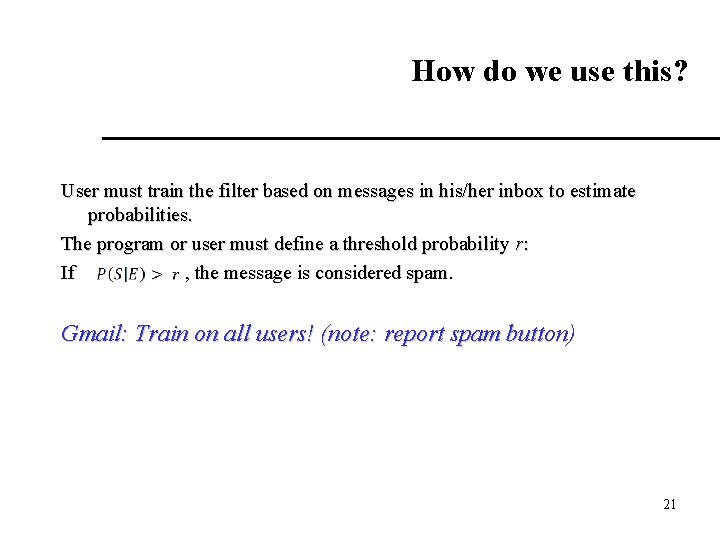
How do we use this? User must train the filter based on messages in his/her inbox to estimate probabilities. The program or user must define a threshold probability r: If , the message is considered spam. Gmail: Train on all users! (note: report spam button) 21 21
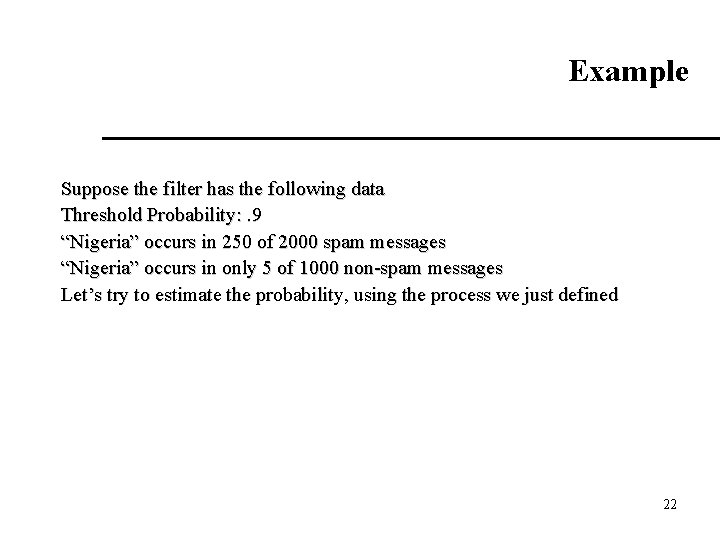
Example Suppose the filter has the following data Threshold Probability: . 9 “Nigeria” occurs in 250 of 2000 spam messages “Nigeria” occurs in only 5 of 1000 non-spam messages Let’s try to estimate the probability, using the process we just defined 22 22
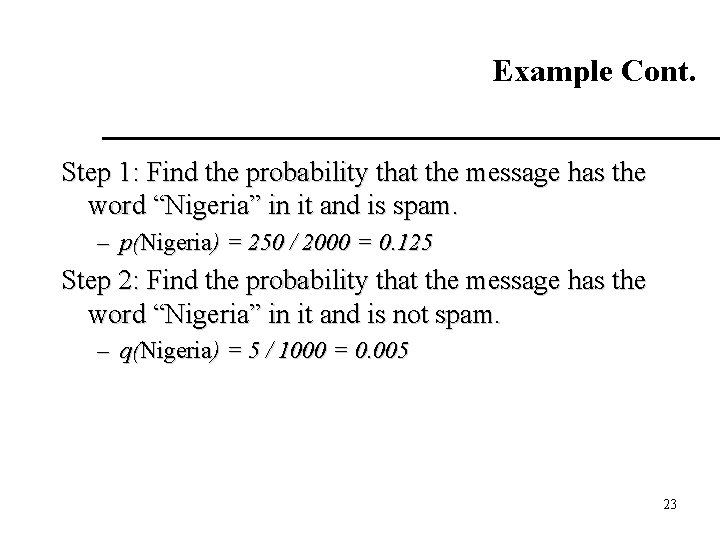
Example Cont. Step 1: Find the probability that the message has the word “Nigeria” in it and is spam. – p(Nigeria) = 250 / 2000 = 0. 125 Step 2: Find the probability that the message has the word “Nigeria” in it and is not spam. – q(Nigeria) = 5 / 1000 = 0. 005 23 23
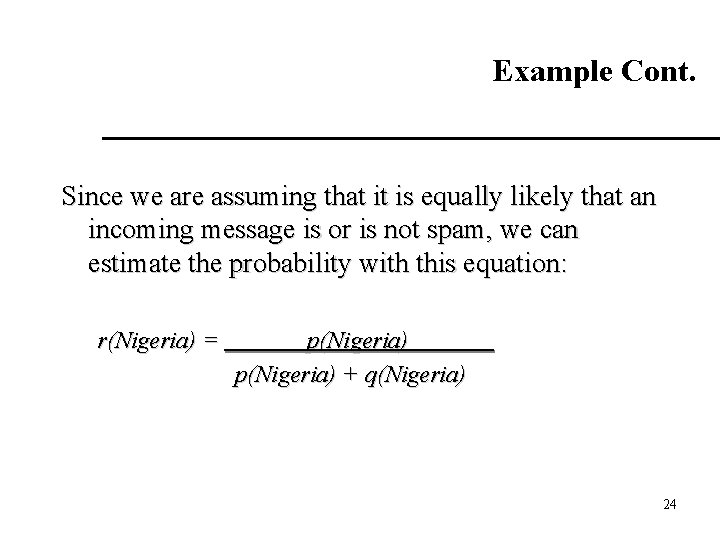
Example Cont. Since we are assuming that it is equally likely that an incoming message is or is not spam, we can estimate the probability with this equation: r(Nigeria) = p(Nigeria) + q(Nigeria) 24 24
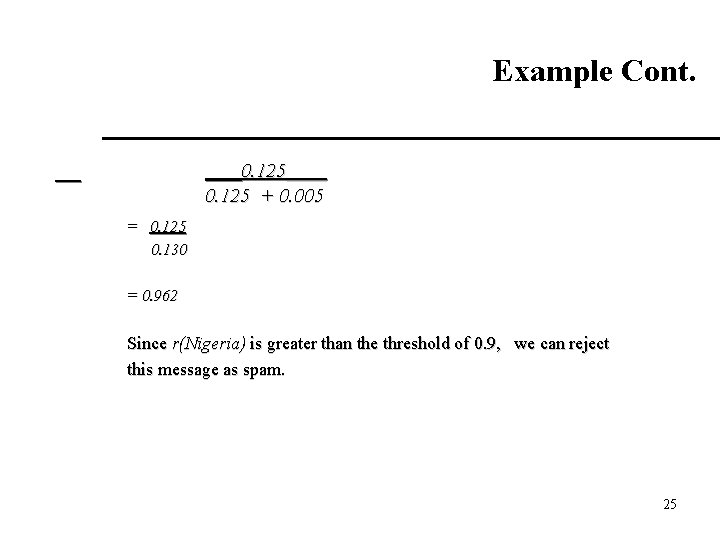
Example Cont. 0. 125____ 0. 125 + 0. 005 = 0. 125 0. 130 = 0. 962 Since r(Nigeria) is greater than the threshold of 0. 9, we can reject this message as spam. 25 25
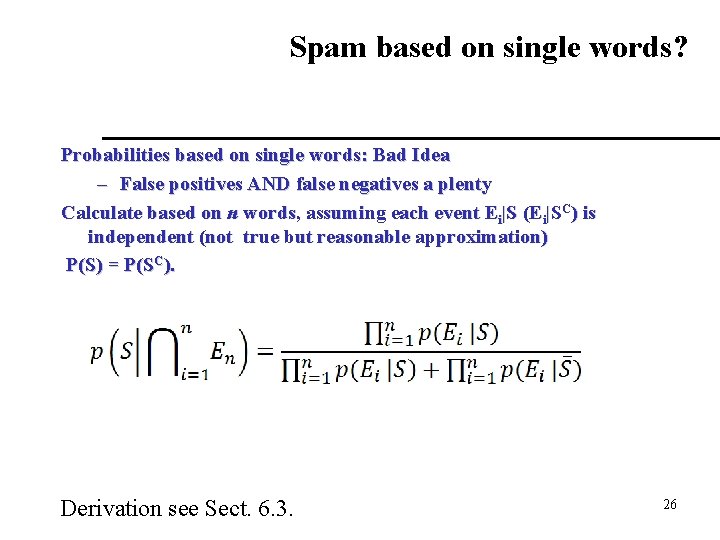
Spam based on single words? Probabilities based on single words: Bad Idea – False positives AND false negatives a plenty Calculate based on n words, assuming each event Ei|S (Ei|SC) is independent (not true but reasonable approximation) P(S) = P(SC). Derivation see Sect. 6. 3. 26 26
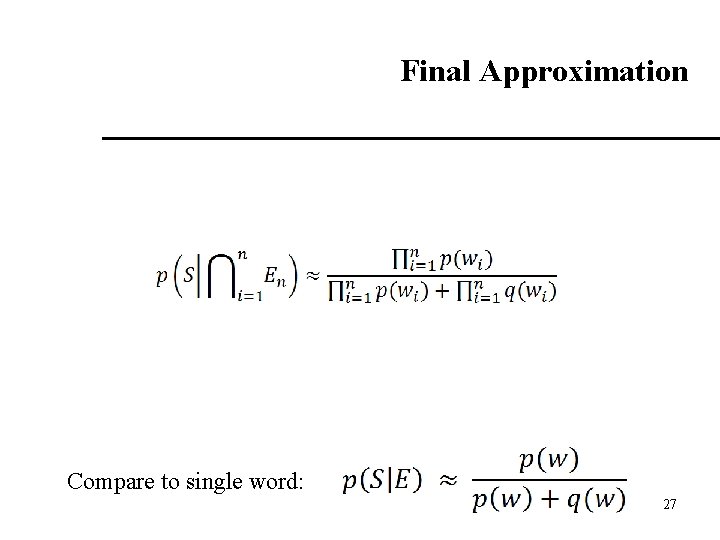
Final Approximation Compare to single word: 27 27
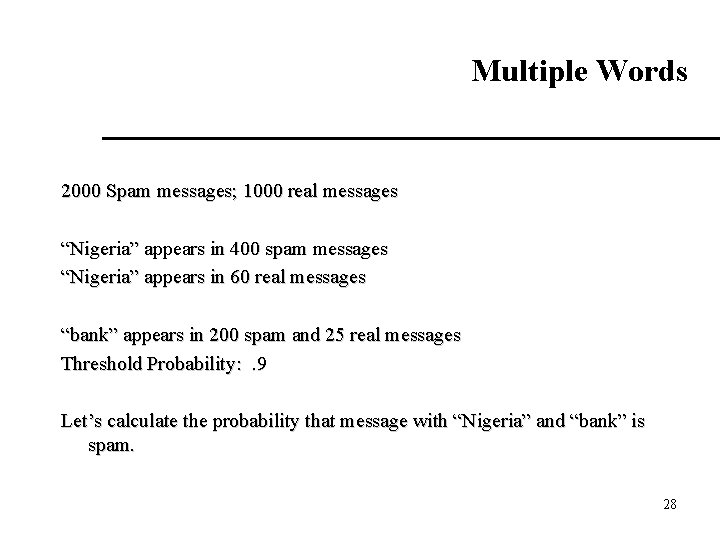
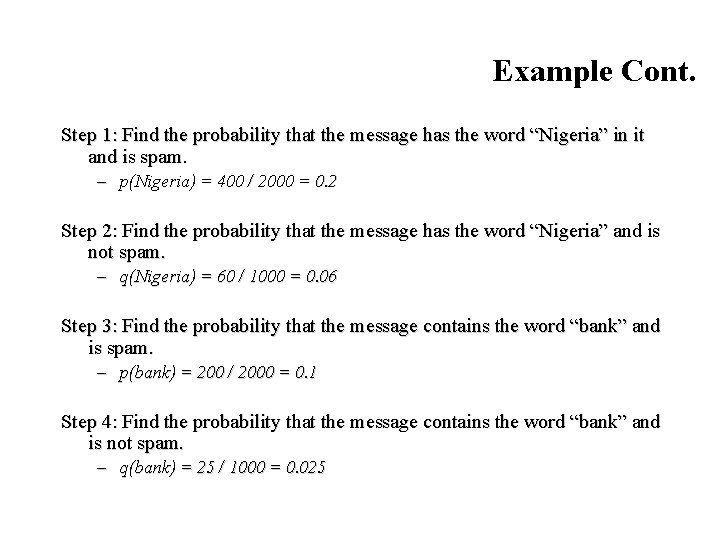
Multiple Words 2000 Spam messages; 1000 real messages “Nigeria” appears in 400 spam messages “Nigeria” appears in 60 real messages “bank” appears in 200 spam and 25 real messages Threshold Probability: . 9 Let’s calculate the probability that message with “Nigeria” and “bank” is spam. 28 28
Example Cont. Step 1: Find the probability that the message has the word “Nigeria” in it and is spam. – p(Nigeria) = 400 / 2000 = 0. 2 Step 2: Find the probability that the message has the word “Nigeria” and is not spam. – q(Nigeria) = 60 / 1000 = 0. 06 Step 3: Find the probability that the message contains the word “bank” and is spam. – p(bank) = 200 / 2000 = 0. 1 Step 4: Find the probability that the message contains the word “bank” and is not spam. – q(bank) = 25 / 1000 = 0. 025 29
Example Cont Using our approximation, we have: r(Nigeria, bank) = p(Nigeria) * p(bank) + q(Nigeria) * q(bank) 30 30
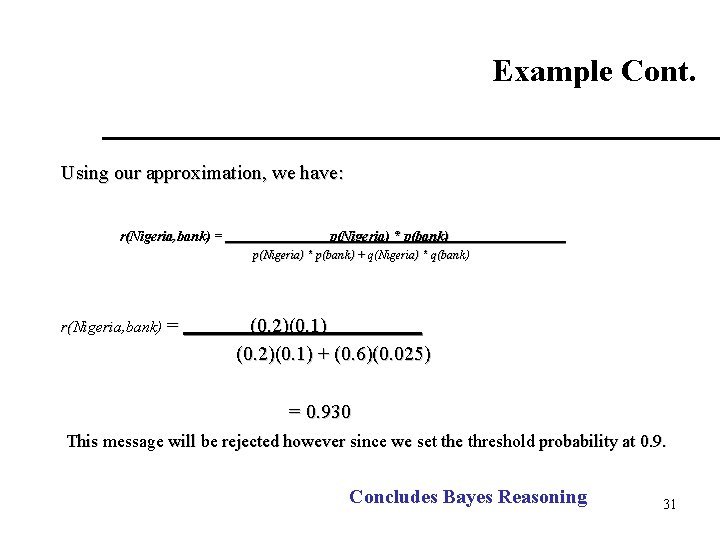
Example Cont. Using our approximation, we have: r(Nigeria, bank) = p(Nigeria) * p(bank) + q(Nigeria) * q(bank) r(Nigeria, bank) = (0. 2)(0. 1) + (0. 6)(0. 025) = 0. 930 This message will be rejected however since we set the threshold probability at 0. 9. Concludes Bayes Reasoning 31 31
Summary Module 1: Introduction Module 2: Logic Module 3: Sets Module 4: Functions and Sequences Module 5: Algorithms and Growth Rates; Intro to Computational Complexity Module 6: Induction Module 7: Modeling Computation – – Languages and Grammars Finite State Machines with Output and without output Language Recognition Turing Machines Module 8: Probability 46