
Influence propagation in large graphs theorems and algorithms
![Networks are everywhere! Facebook Network [2010] Gene Regulatory Network [Decourty 2008] Human Disease Network](https://slidetodoc.com/presentation_image/ea8a49a600acb94cac5ad9609902b112/image-2.jpg "Networks are everywhere! Facebook Network [2010] Gene Regulatory Network [Decourty 2008] Human Disease Network")
![Why do we care? (1: Epidemiology) • Dynamical Processes over networks [AJPH 2007] Diseases](https://slidetodoc.com/presentation_image/ea8a49a600acb94cac5ad9609902b112/image-5.jpg "Why do we care? (1: Epidemiology) • Dynamical Processes over networks [AJPH 2007] Diseases")
![Why do we care? (1: Epidemiology) ~6 x fewer! CURRENT PRACTICE [US-MEDICARE NETWORK 2005]](https://slidetodoc.com/presentation_image/ea8a49a600acb94cac5ad9609902b112/image-7.jpg "Why do we care? (1: Epidemiology) ~6 x fewer! CURRENT PRACTICE [US-MEDICARE NETWORK 2005]")
![Real Examples [Google Search Trends data] Reddit v Digg April'12 Blu-Ray v HD-DVD Prakash](https://slidetodoc.com/presentation_image/ea8a49a600acb94cac5ad9609902b112/image-48.jpg "Real Examples [Google Search Trends data] Reddit v Digg April'12 Blu-Ray v HD-DVD Prakash")
![Our Algorithm “SMARTALLOC” ~6 x fewer! [US-MEDICARE NETWORK 2005] • Each circle is a](https://slidetodoc.com/presentation_image/ea8a49a600acb94cac5ad9609902b112/image-63.jpg "Our Algorithm “SMARTALLOC” ~6 x fewer! [US-MEDICARE NETWORK 2005] • Each circle is a")
- Slides: 68
Influence propagation in large graphs - theorems and algorithms B. Aditya Prakash http: //www. cs. cmu. edu/~badityap Christos Faloutsos http: //www. cs. cmu. edu/~christos Carnegie Mellon University
Networks are everywhere! Facebook Network [2010] Gene Regulatory Network [Decourty 2008] Human Disease Network [Barabasi 2007] The Internet [2005] April'12 Prakash and Faloutsos 2012 2
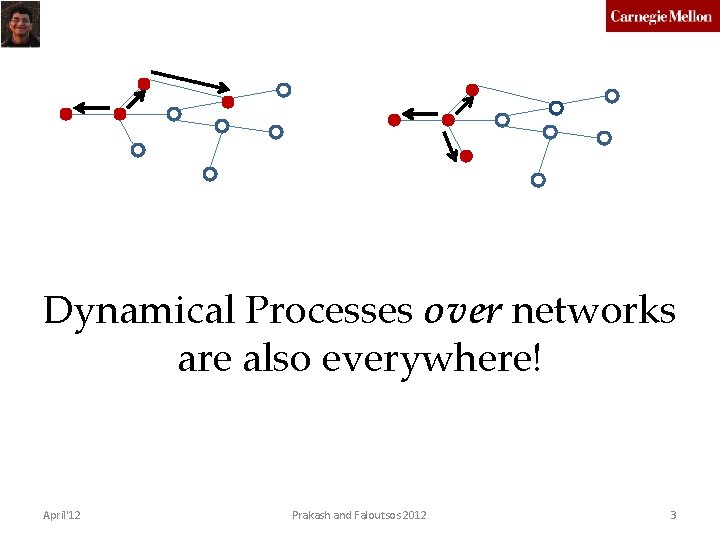
Dynamical Processes over networks are also everywhere! April'12 Prakash and Faloutsos 2012 3
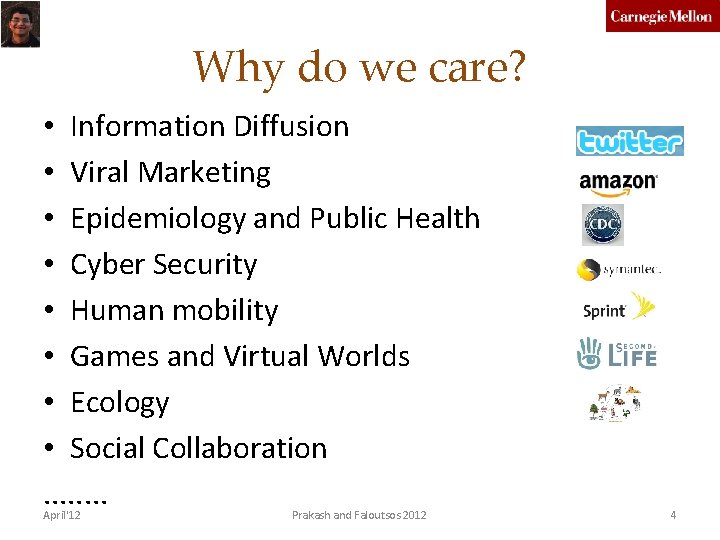
Why do we care? • Information Diffusion • Viral Marketing • Epidemiology and Public Health • Cyber Security • Human mobility • Games and Virtual Worlds • Ecology • Social Collaboration. . . . April'12 Prakash and Faloutsos 2012 4
Why do we care? (1: Epidemiology) • Dynamical Processes over networks [AJPH 2007] Diseases over contact networks April'12 Prakash and Faloutsos 2012 CDC data: Visualization of the first 35 tuberculosis (TB) patients and their 1039 contacts 5
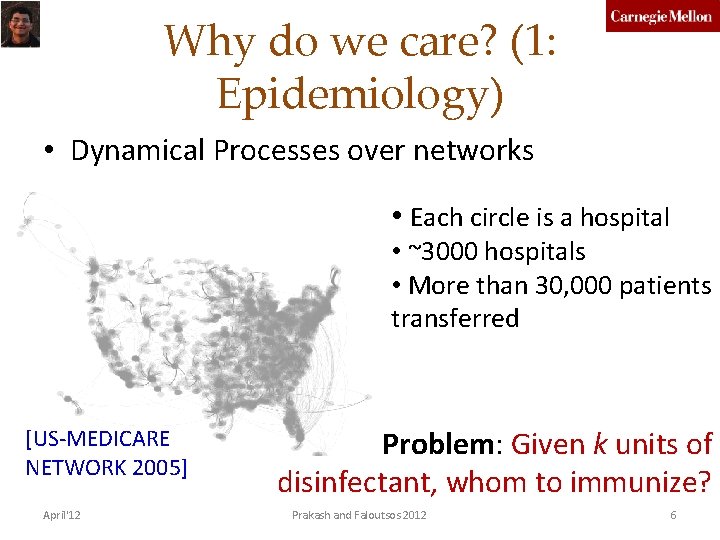
Why do we care? (1: Epidemiology) • Dynamical Processes over networks • Each circle is a hospital • ~3000 hospitals • More than 30, 000 patients transferred [US-MEDICARE NETWORK 2005] April'12 Problem: Given k units of disinfectant, whom to immunize? Prakash and Faloutsos 2012 6
Why do we care? (1: Epidemiology) ~6 x fewer! CURRENT PRACTICE [US-MEDICARE NETWORK 2005] OUR METHOD April'12 Prakash and Faloutsos 2012 7 Hospital-acquired inf. took 99 K+ lives, cost $5 B+ (all per year)
Why do we care? (2: Online Diffusion) > 800 m users, ~$1 B revenue [WSJ 2010] ~100 m active users > 50 m users April'12 Prakash and Faloutsos 2012 8
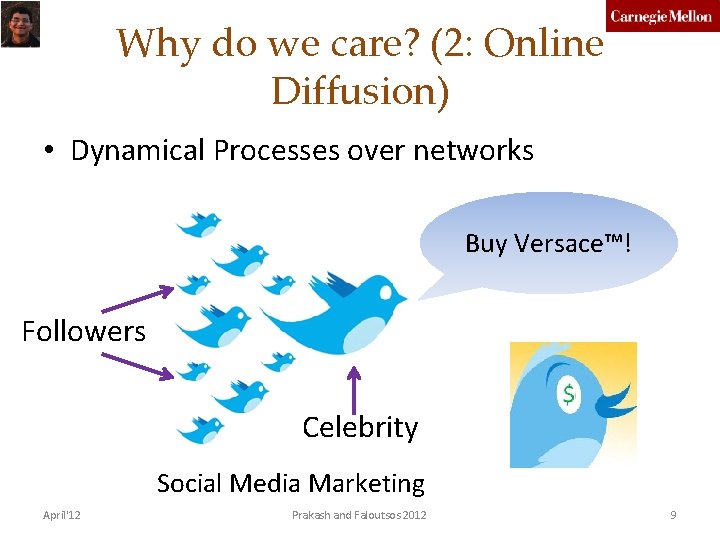
Why do we care? (2: Online Diffusion) • Dynamical Processes over networks Buy Versace™! Followers Celebrity Social Media Marketing April'12 Prakash and Faloutsos 2012 9
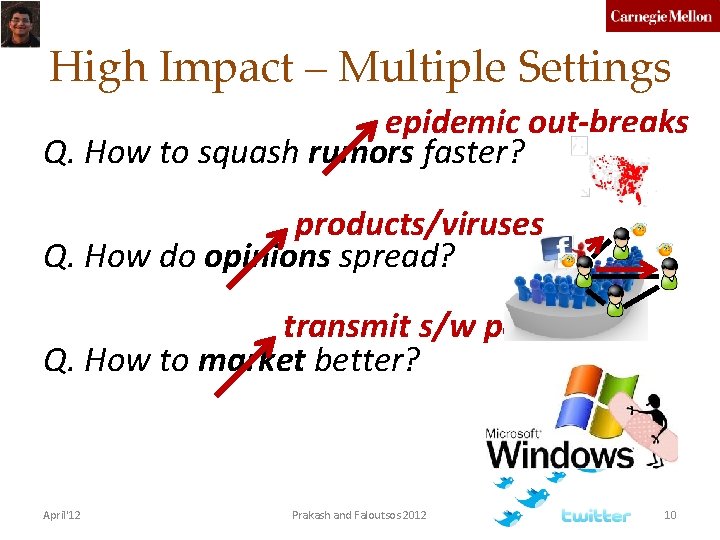
High Impact – Multiple Settings epidemic out-breaks Q. How to squash rumors faster? products/viruses Q. How do opinions spread? transmit s/w patches Q. How to market better? April'12 Prakash and Faloutsos 2012 10
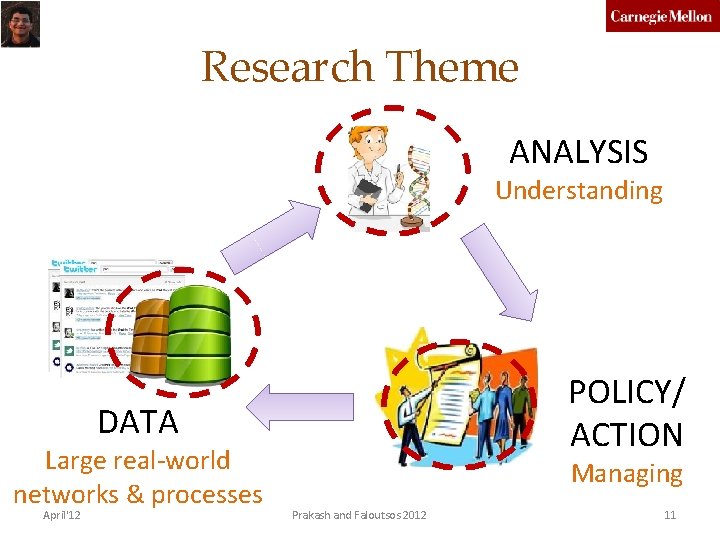
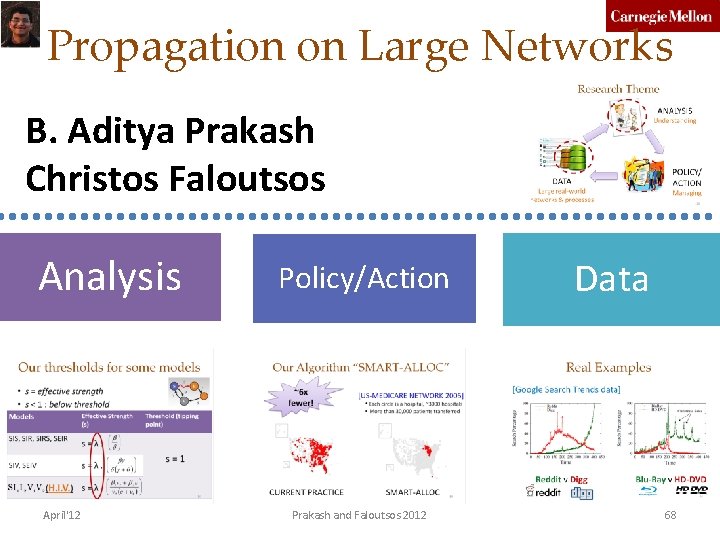
Research Theme ANALYSIS Understanding POLICY/ ACTION DATA Large real-world networks & processes April'12 Managing Prakash and Faloutsos 2012 11
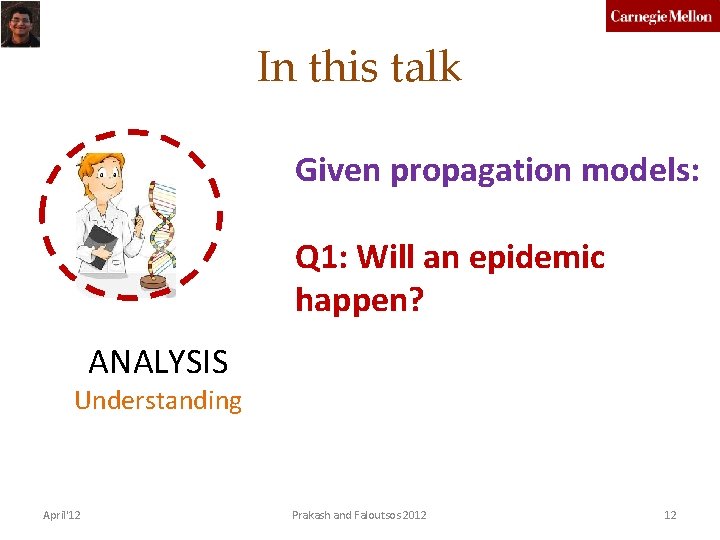
In this talk Given propagation models: Q 1: Will an epidemic happen? ANALYSIS Understanding April'12 Prakash and Faloutsos 2012 12
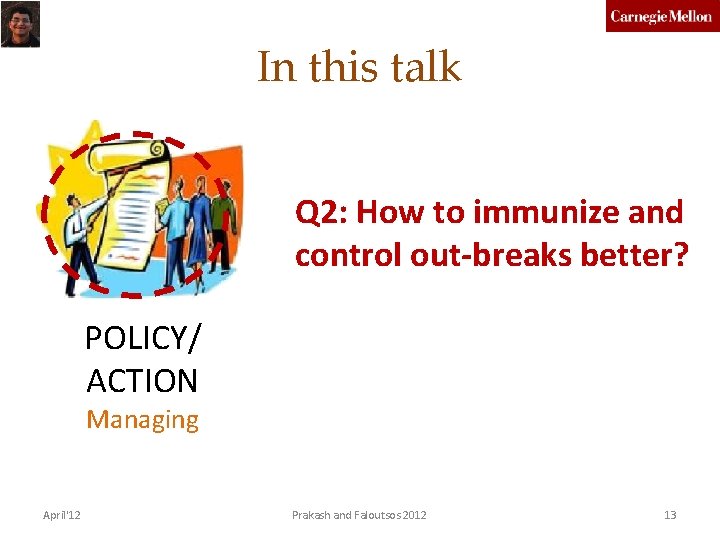
In this talk Q 2: How to immunize and control out-breaks better? POLICY/ ACTION Managing April'12 Prakash and Faloutsos 2012 13
Outline • Motivation • Epidemics: what happens? (Theory) • Action: Who to immunize? (Algorithms) April'12 Prakash and Faloutsos 2012 14
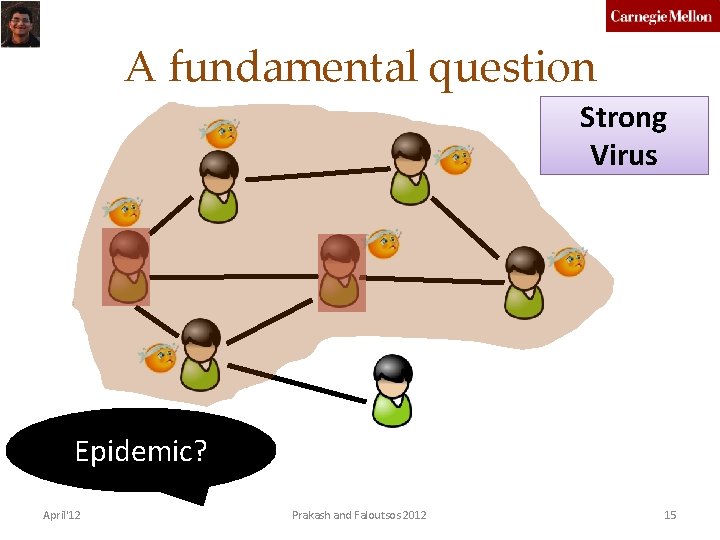
A fundamental question Strong Virus Epidemic? April'12 Prakash and Faloutsos 2012 15
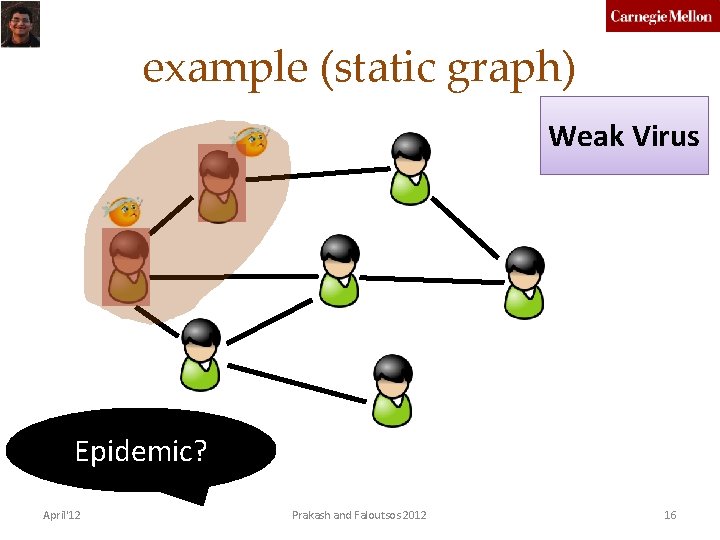
example (static graph) Weak Virus Epidemic? April'12 Prakash and Faloutsos 2012 16
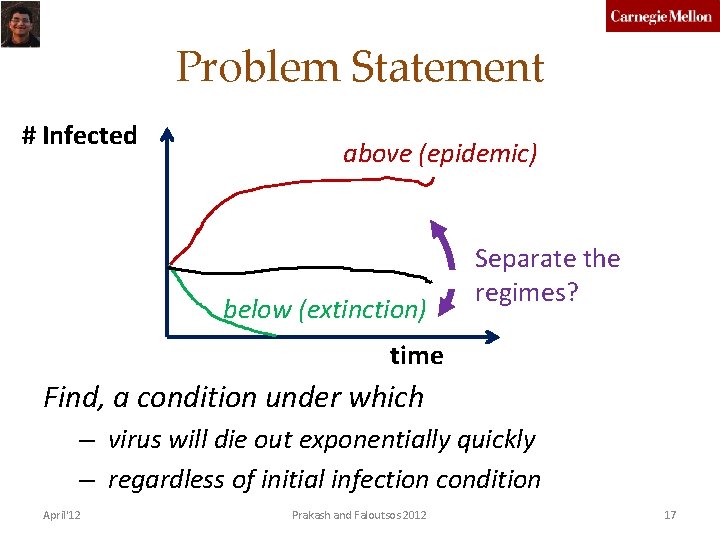
Problem Statement # Infected above (epidemic) below (extinction) Separate the regimes? time Find, a condition under which – virus will die out exponentially quickly – regardless of initial infection condition April'12 Prakash and Faloutsos 2012 17
Threshold (static version) Problem Statement • Given: – Graph G, and – Virus specs (attack prob. etc. ) • Find: – A condition for virus extinction/invasion April'12 Prakash and Faloutsos 2012 18
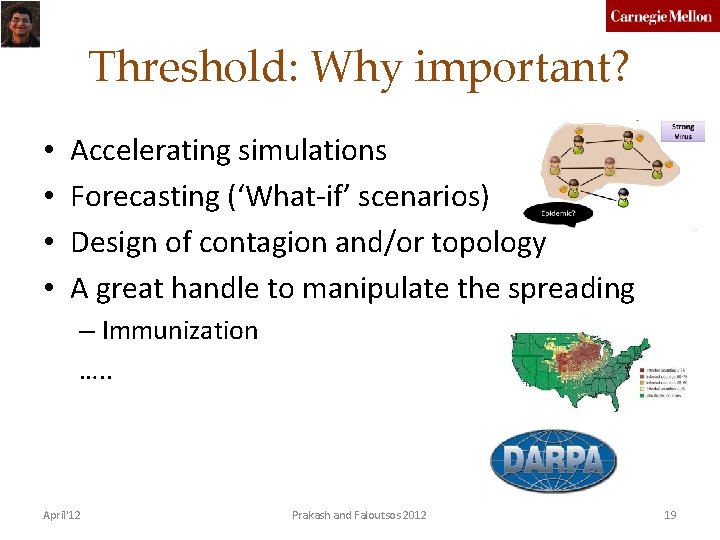
Threshold: Why important? • • Accelerating simulations Forecasting (‘What-if’ scenarios) Design of contagion and/or topology A great handle to manipulate the spreading – Immunization …. . April'12 Prakash and Faloutsos 2012 19
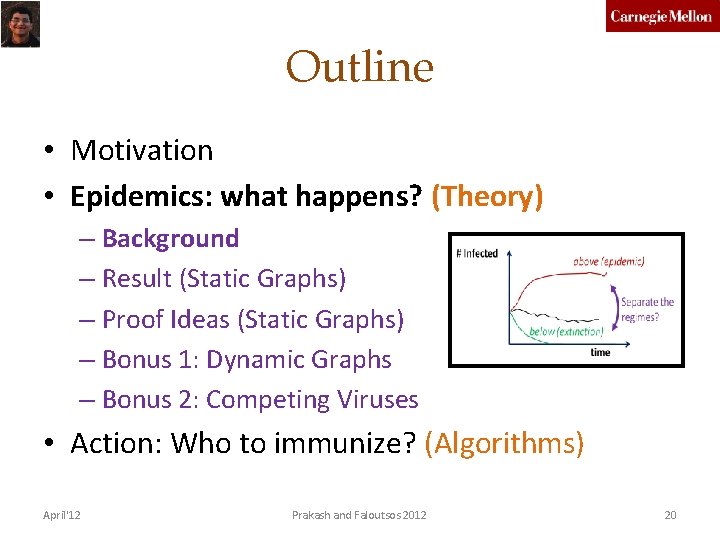
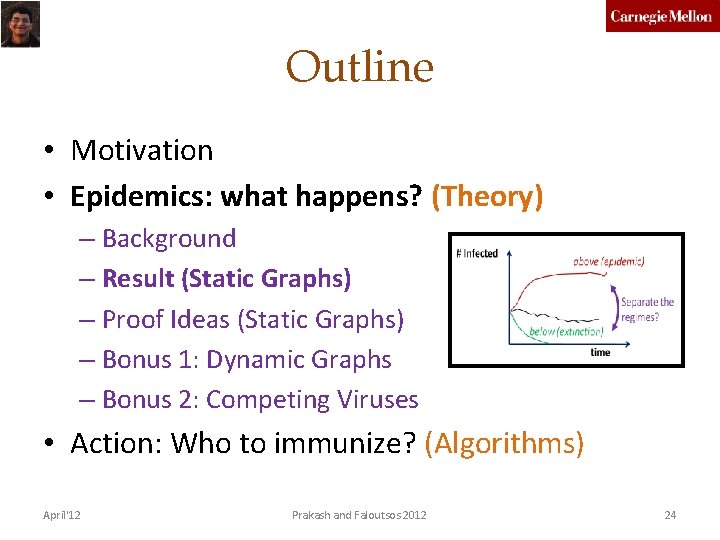
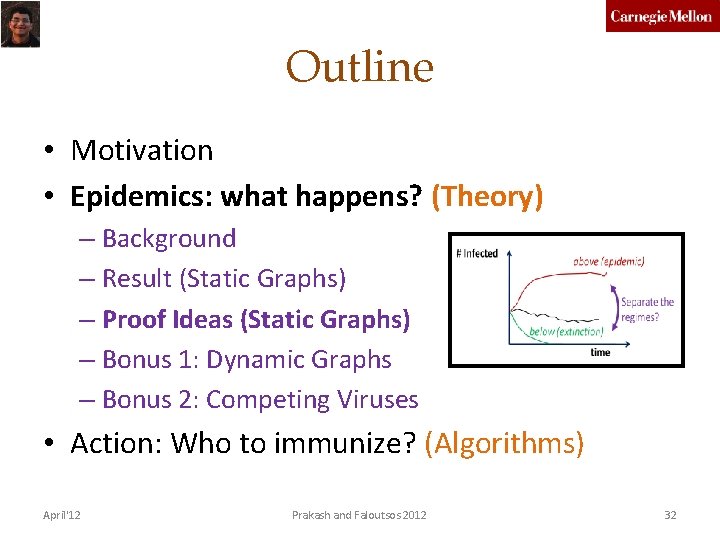
Outline • Motivation • Epidemics: what happens? (Theory) – Background – Result (Static Graphs) – Proof Ideas (Static Graphs) – Bonus 1: Dynamic Graphs – Bonus 2: Competing Viruses • Action: Who to immunize? (Algorithms) April'12 Prakash and Faloutsos 2012 20
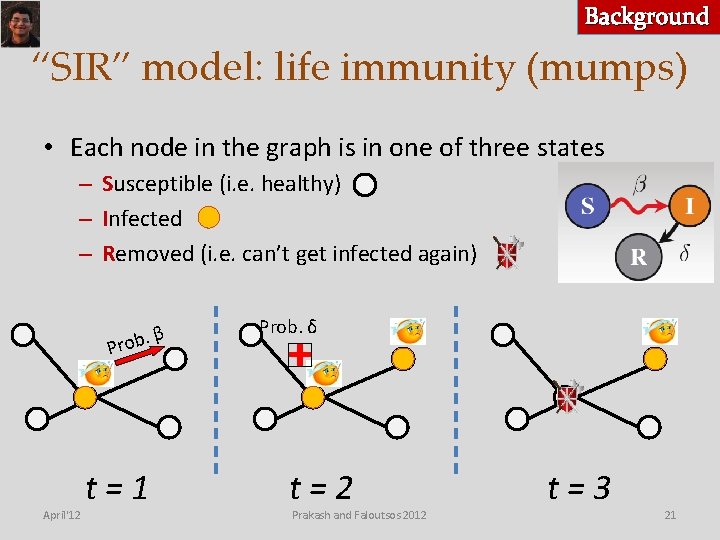
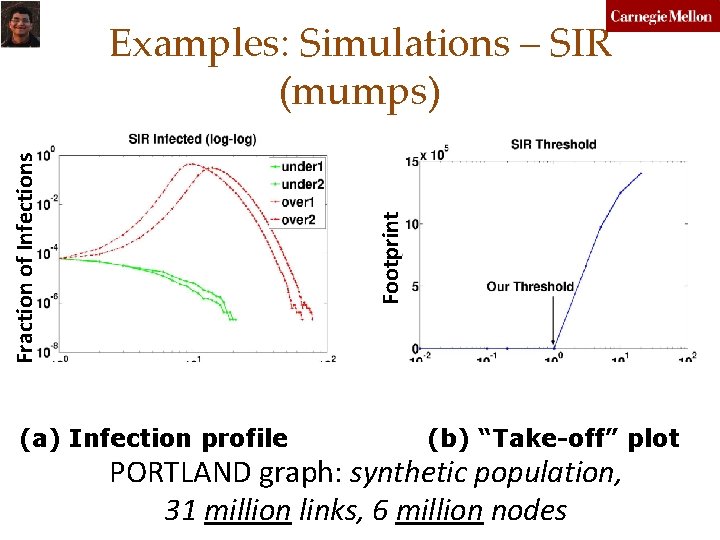
Background “SIR” model: life immunity (mumps) • Each node in the graph is in one of three states – Susceptible (i. e. healthy) – Infected – Removed (i. e. can’t get infected again). β Prob April'12 t=1 Prob. δ t=2 Prakash and Faloutsos 2012 t=3 21
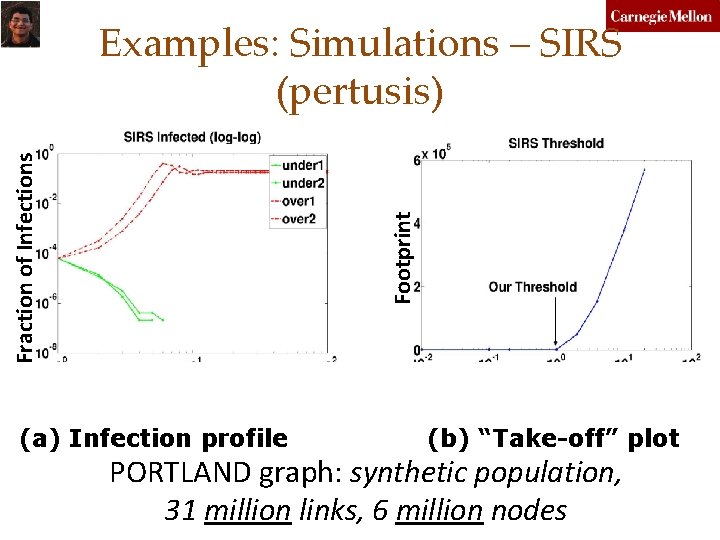
Background Terminology: continued • Other virus propagation models (“VPM”) – SIS : susceptible-infected-susceptible, flu-like – SIRS : temporary immunity, like pertussis – SEIR : mumps-like, with virus incubation (E = Exposed) …. …………. • Underlying contact-network – ‘who-can-infectwhom’ April'12 Prakash and Faloutsos 2012 22
Background Related Work q q q q R. M. Anderson and R. M. May. Infectious Diseases of Humans. Oxford University Press, 1991. A. Barrat, M. Barthélemy, and A. Vespignani. Dynamical Processes on Complex Networks. Cambridge University Press, 2010. F. M. Bass. A new product growth for model consumer durables. Management Science, 15(5): 215– 227, 1969. D. Chakrabarti, Y. Wang, C. Wang, J. Leskovec, and C. Faloutsos. Epidemic thresholds in real networks. ACM TISSEC, 10(4), 2008. D. Easley and J. Kleinberg. Networks, Crowds, and Markets: Reasoning About a Highly Connected World. Cambridge University Press, 2010. A. Ganesh, L. Massoulie, and D. Towsley. The effect of network topology in spread of epidemics. IEEE INFOCOM, 2005. Y. Hayashi, M. Minoura, and J. Matsukubo. Recoverable prevalence in growing scale-free networks and the effective immunization. ar. Xiv: cond-at/0305549 v 2, Aug. 6 2003. H. W. Hethcote. The mathematics of infectious diseases. SIAM Review, 42, 2000. H. W. Hethcote and J. A. Yorke. Gonorrhea transmission dynamics and control. Springer Lecture Notes in Biomathematics, 46, 1984. J. O. Kephart and S. R. White. Directed-graph epidemiological models of computer viruses. IEEE Computer Society Symposium on Research in Security and Privacy, 1991. J. O. Kephart and S. R. White. Measuring and modeling computer virus prevalence. IEEE Computer Society Symposium on Research in Security and Privacy, 1993. R. Pastor-Santorras and A. Vespignani. Epidemic spreading in scale-free networks. Physical Review Letters 86, 14, 2001. ……… ……… April'12 All are about either: • Structured topologies (cliques, block-diagonals, hierarchies, random) • Specific virus propagation models • Static graphs Prakash and Faloutsos 2012 23
Outline • Motivation • Epidemics: what happens? (Theory) – Background – Result (Static Graphs) – Proof Ideas (Static Graphs) – Bonus 1: Dynamic Graphs – Bonus 2: Competing Viruses • Action: Who to immunize? (Algorithms) April'12 Prakash and Faloutsos 2012 24
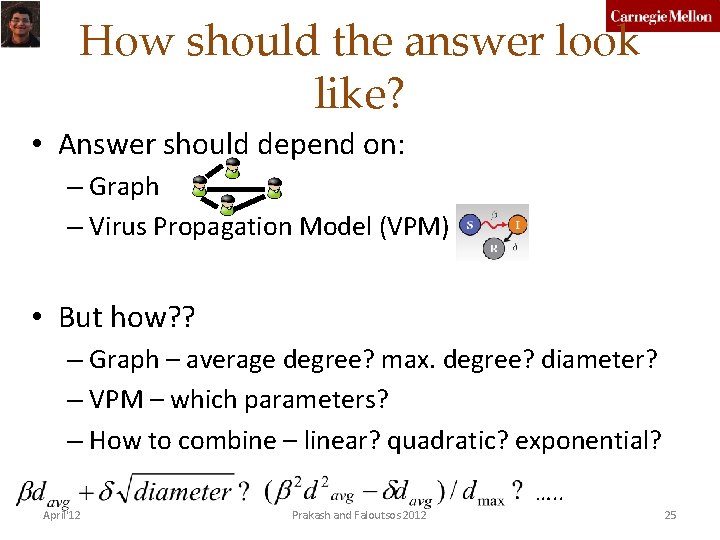
How should the answer look like? • Answer should depend on: – Graph – Virus Propagation Model (VPM) • But how? ? – Graph – average degree? max. degree? diameter? – VPM – which parameters? – How to combine – linear? quadratic? exponential? …. . April'12 Prakash and Faloutsos 2012 25
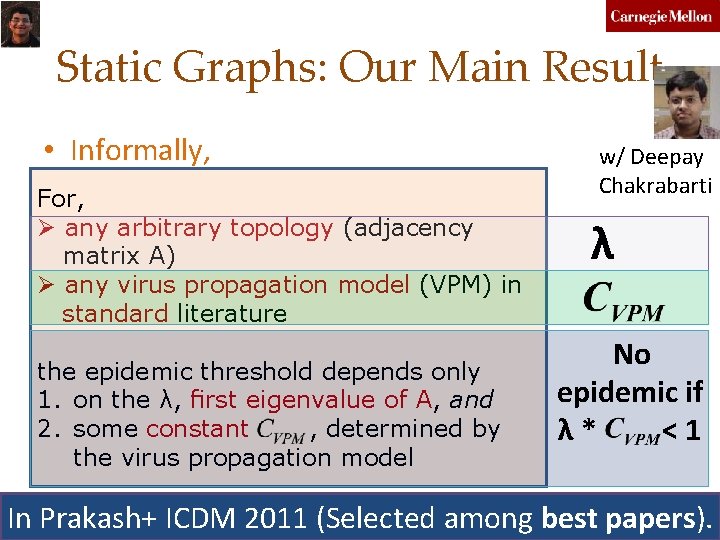
Static Graphs: Our Main Result • Informally, For, Ø any arbitrary topology (adjacency matrix A) Ø any virus propagation model (VPM) in standard literature • the epidemic threshold depends only 1. on the λ, first eigenvalue of A, and 2. some constant , determined by the virus propagation model w/ Deepay Chakrabarti λ No epidemic if λ* <1 In Prakash+ ICDM 2011 (Selected among best papers). April'12 Prakash and Faloutsos 2012 26
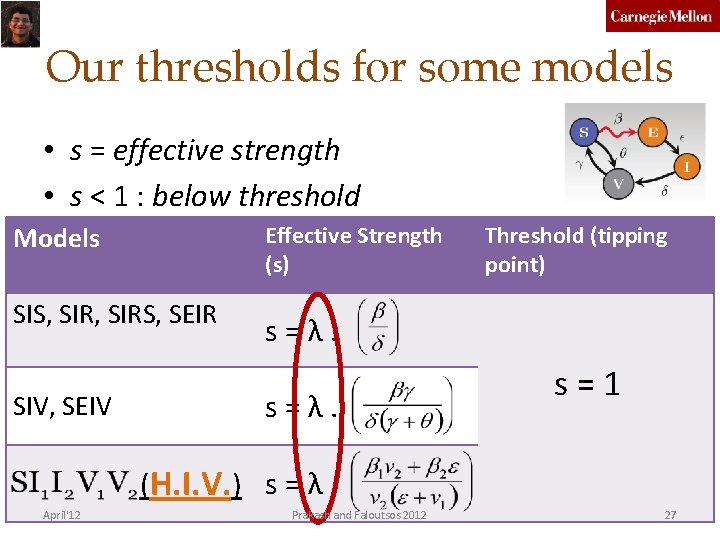
Our thresholds for some models • s = effective strength • s < 1 : below threshold Models Effective Strength (s) SIS, SIRS, SEIR SIV, SEIV Threshold (tipping point) s=λ. s=1 (H. I. V. ) s = λ. April'12 Prakash and Faloutsos 2012 27
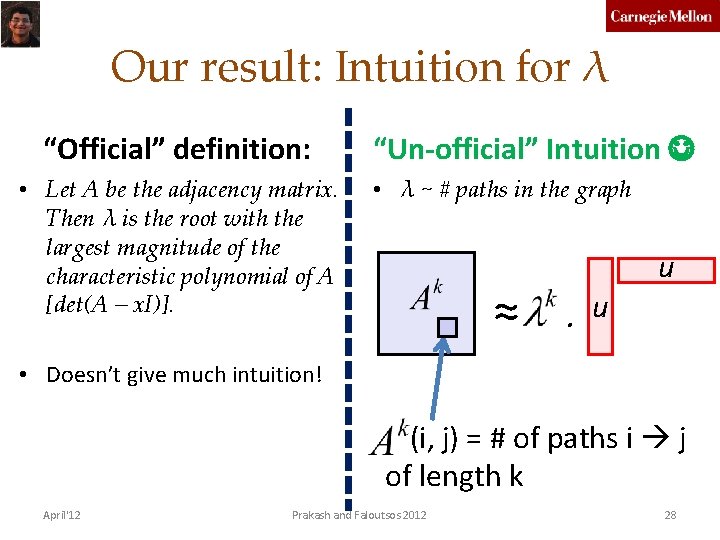
Our result: Intuition for λ “Official” definition: • Let A be the adjacency matrix. Then λ is the root with the largest magnitude of the characteristic polynomial of A [det(A – x. I)]. “Un-official” Intuition • λ ~ # paths in the graph ≈ . u u • Doesn’t give much intuition! (i, j) = # of paths i j of length k April'12 Prakash and Faloutsos 2012 28
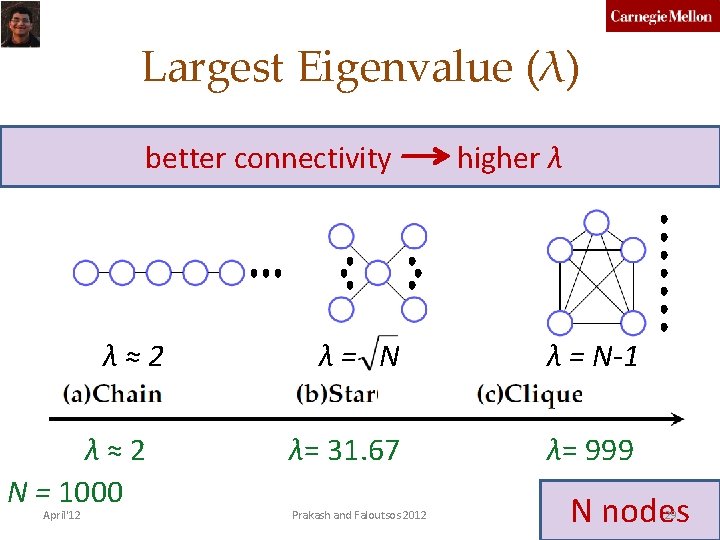
Largest Eigenvalue (λ) better connectivity λ≈2 N = 1000 April'12 higher λ λ= N λ = N-1 λ= 31. 67 λ= 999 Prakash and Faloutsos 2012 N nodes 29
Footprint Fraction of Infections Examples: Simulations – SIR (mumps) Effective Strength Time ticks (a) Infection profile April'12 (b) “Take-off” plot PORTLAND graph: synthetic population, 31 million links, 6 million nodes Prakash and Faloutsos 2012 30
Footprint Fraction of Infections Examples: Simulations – SIRS (pertusis) Time ticks (a) Infection profile April'12 Effective Strength (b) “Take-off” plot PORTLAND graph: synthetic population, 31 million links, 6 million nodes Prakash and Faloutsos 2012 31
Outline • Motivation • Epidemics: what happens? (Theory) – Background – Result (Static Graphs) – Proof Ideas (Static Graphs) – Bonus 1: Dynamic Graphs – Bonus 2: Competing Viruses • Action: Who to immunize? (Algorithms) April'12 Prakash and Faloutsos 2012 32
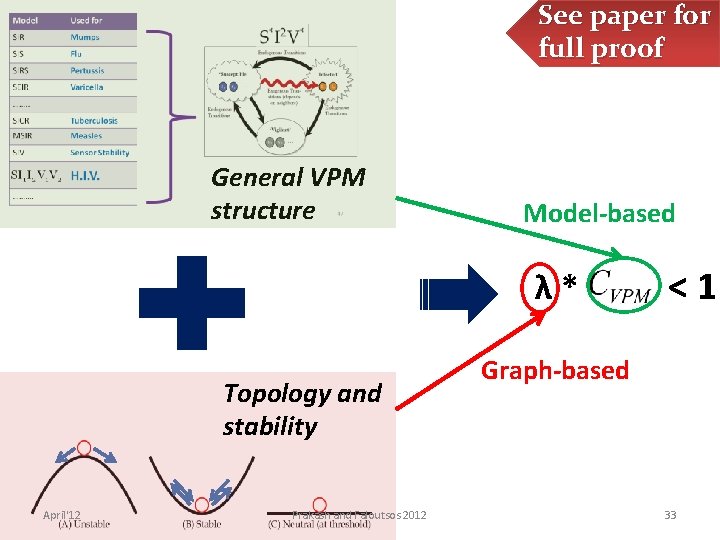
See paper for full proof General VPM structure Model-based λ* Topology and stability April'12 Prakash and Faloutsos 2012 <1 Graph-based 33
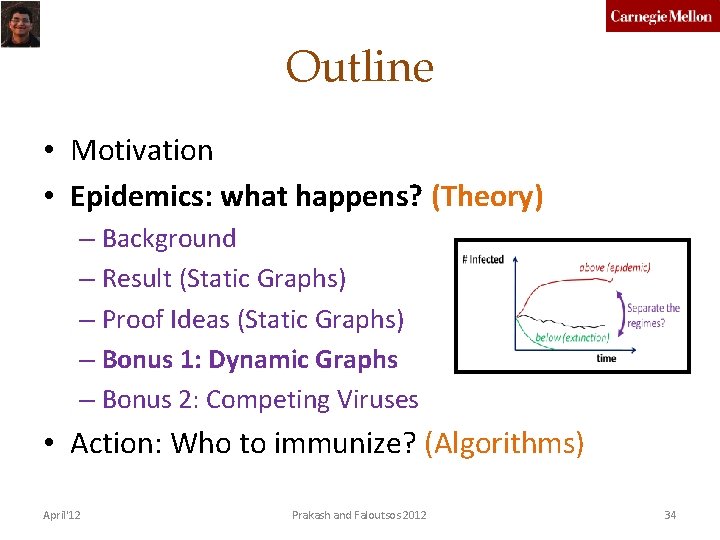
Outline • Motivation • Epidemics: what happens? (Theory) – Background – Result (Static Graphs) – Proof Ideas (Static Graphs) – Bonus 1: Dynamic Graphs – Bonus 2: Competing Viruses • Action: Who to immunize? (Algorithms) April'12 Prakash and Faloutsos 2012 34
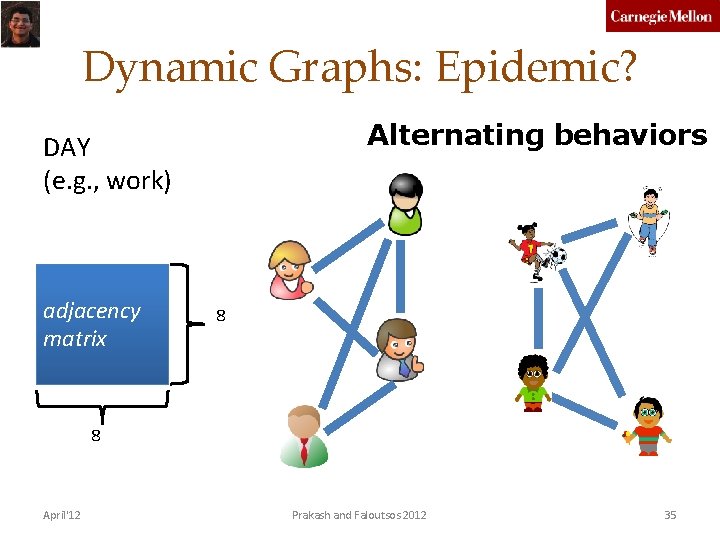
Dynamic Graphs: Epidemic? Alternating behaviors DAY (e. g. , work) adjacency matrix 8 8 April'12 Prakash and Faloutsos 2012 35
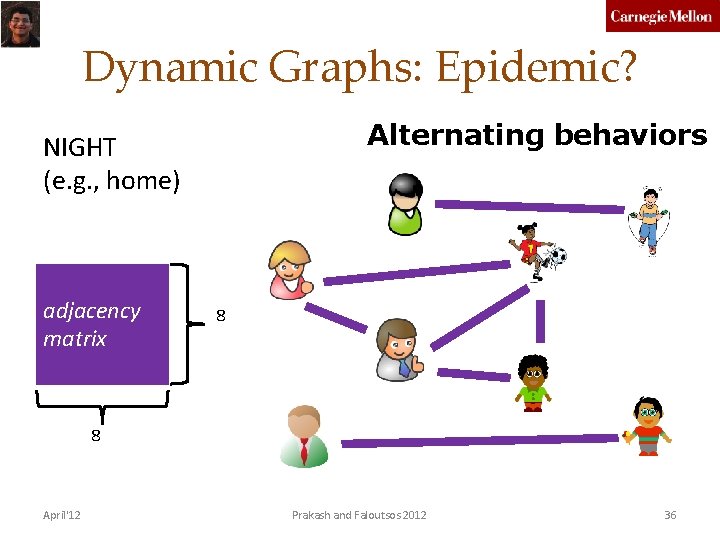
Dynamic Graphs: Epidemic? Alternating behaviors NIGHT (e. g. , home) adjacency matrix 8 8 April'12 Prakash and Faloutsos 2012 36
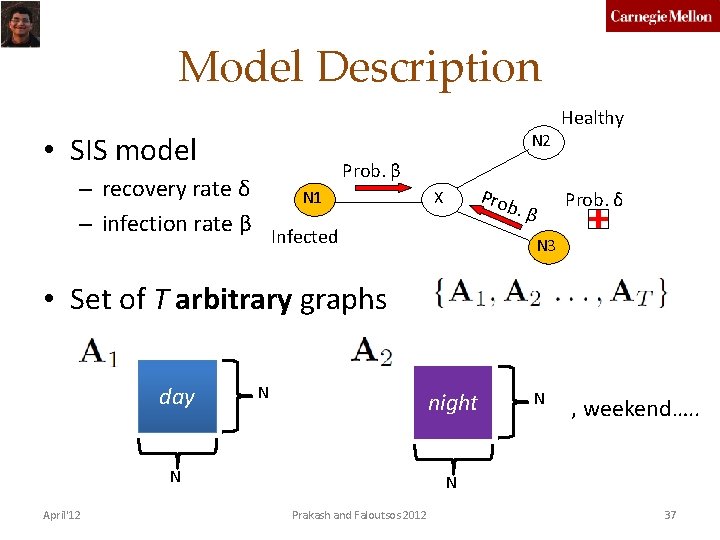
Model Description • SIS model N 2 Healthy Prob. β – recovery rate δ – infection rate β N 1 Prob X Prob. δ . β Infected N 3 • Set of T arbitrary graphs day N night N April'12 N , weekend…. . N Prakash and Faloutsos 2012 37
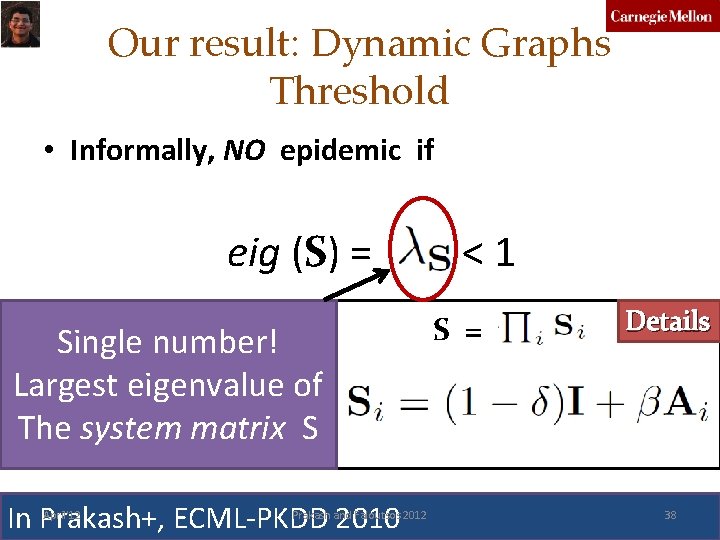
Our result: Dynamic Graphs Threshold • Informally, NO epidemic if eig (S) = Single number! Largest eigenvalue of The system matrix S In Prakash+, ECML-PKDD 2010 April'12 Prakash and Faloutsos 2012 <1 S = Details 38
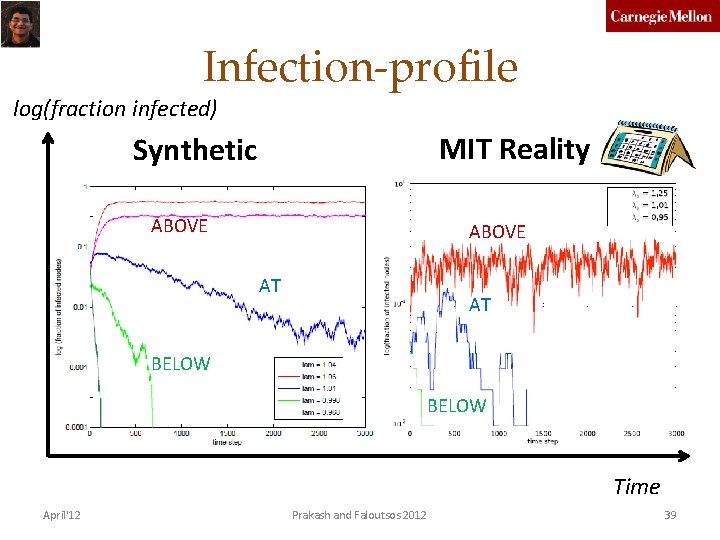
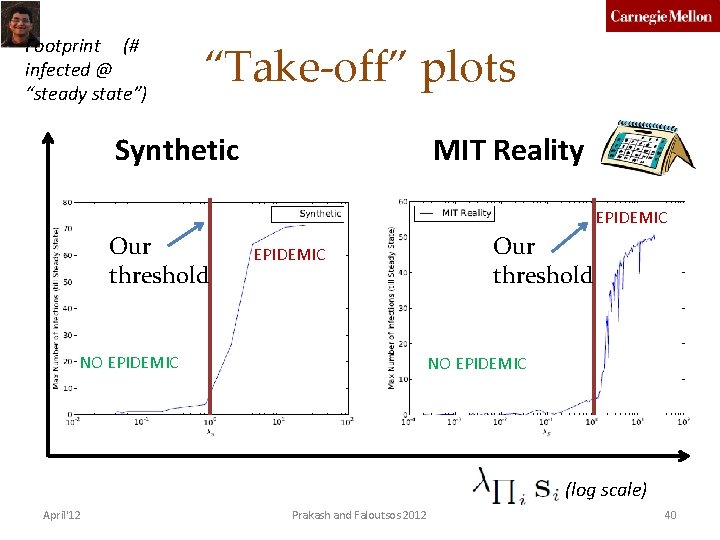
Infection-profile log(fraction infected) MIT Reality Mining Synthetic ABOVE AT AT BELOW Time April'12 Prakash and Faloutsos 2012 39
Footprint (# infected @ “steady state”) “Take-off” plots Synthetic MIT Reality EPIDEMIC Our threshold NO EPIDEMIC Our threshold EPIDEMIC NO EPIDEMIC (log scale) April'12 Prakash and Faloutsos 2012 40
Outline • Motivation • Epidemics: what happens? (Theory) – Background – Result (Static Graphs) – Proof Ideas (Static Graphs) – Bonus 1: Dynamic Graphs – Bonus 2: Competing Viruses • Action: Who to immunize? (Algorithms) April'12 Prakash and Faloutsos 2012 41
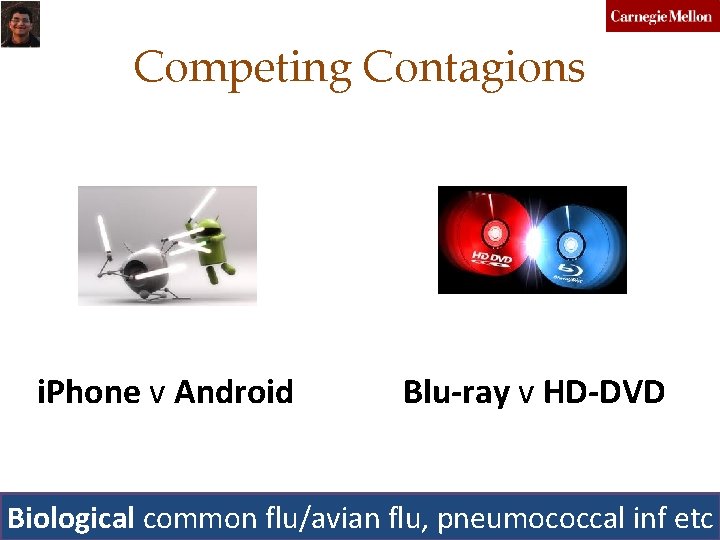
Competing Contagions i. Phone v Android Blu-ray v HD-DVD Biological common flu/avian flu, pneumococcal inf etc April'12 Prakash and Faloutsos 2012 42
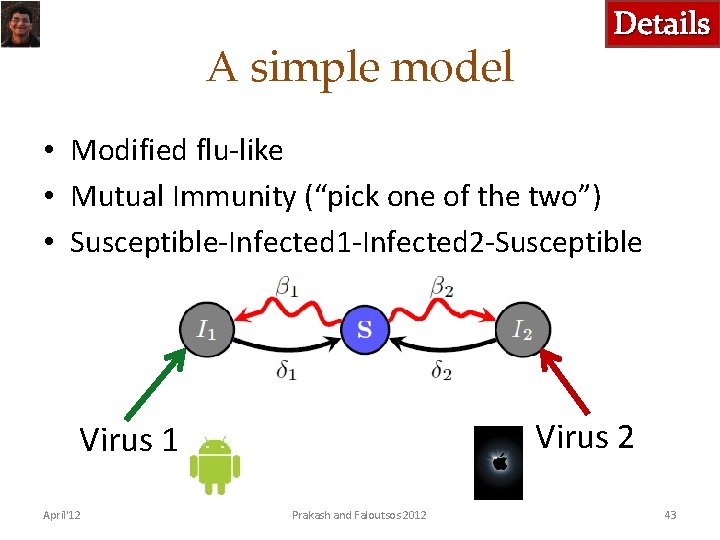
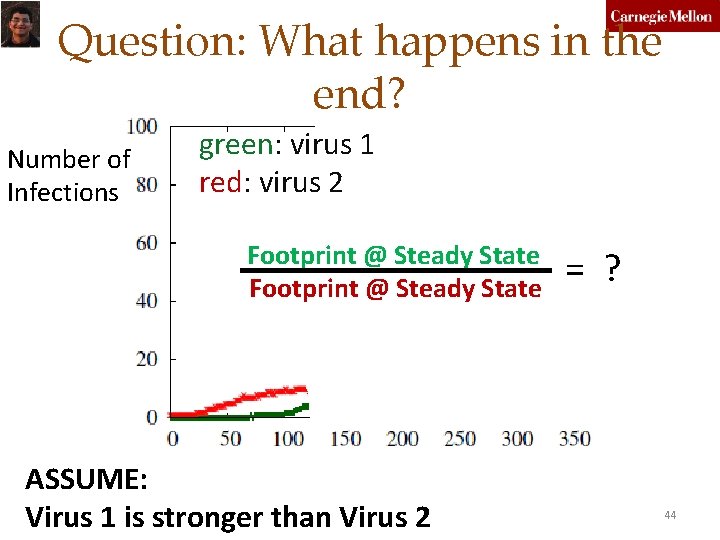
A simple model Details • Modified flu-like • Mutual Immunity (“pick one of the two”) • Susceptible-Infected 1 -Infected 2 -Susceptible Virus 2 Virus 1 April'12 Prakash and Faloutsos 2012 43
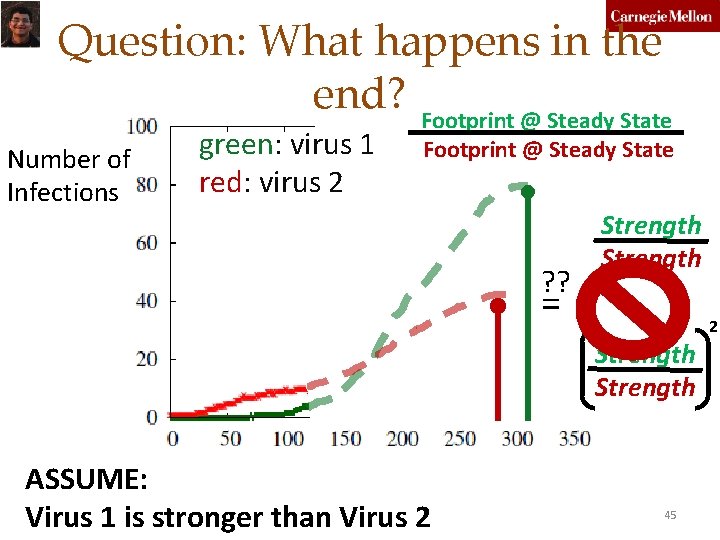
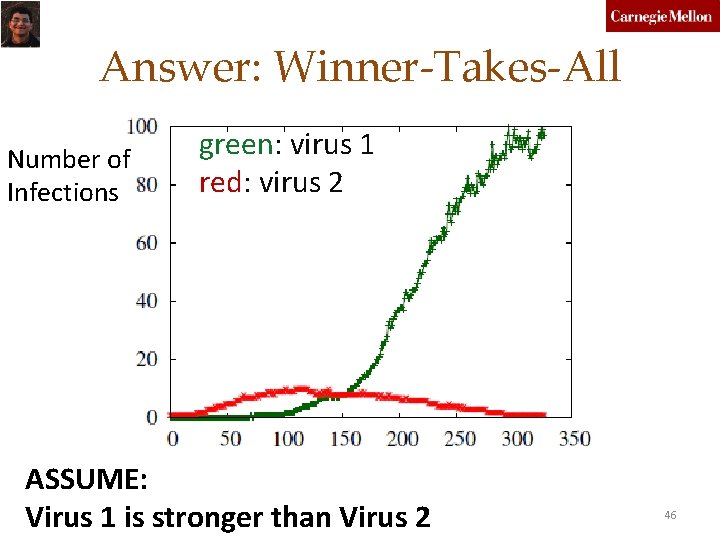
Question: What happens in the end? Number of Infections green: virus 1 red: virus 2 Footprint @ Steady State ASSUME: Virus 1 is stronger than Virus 2 April'12 Prakash and Faloutsos 2012 = ? 44
Question: What happens in the end? Footprint @ Steady State Number of Infections green: virus 1 red: virus 2 Footprint @ Steady State ? ? Strength = Strength ASSUME: Virus 1 is stronger than Virus 2 April'12 Prakash and Faloutsos 2012 45 2
Answer: Winner-Takes-All Number of Infections green: virus 1 red: virus 2 ASSUME: Virus 1 is stronger than Virus 2 April'12 Prakash and Faloutsos 2012 46
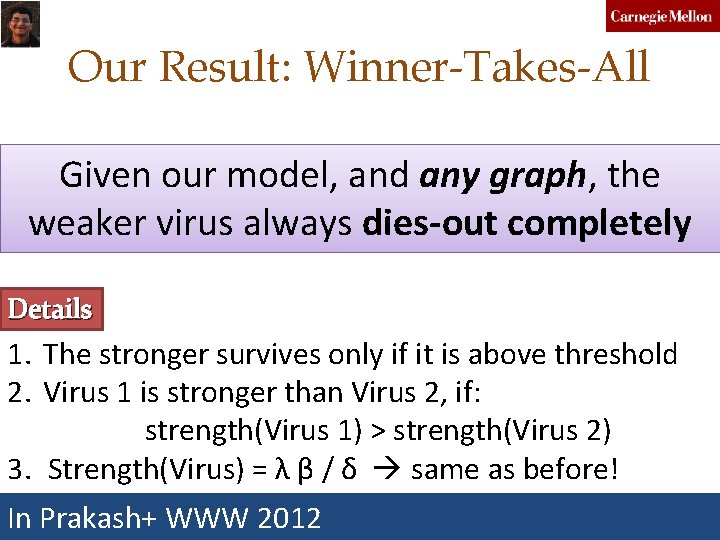
Our Result: Winner-Takes-All Given our model, and any graph, the weaker virus always dies-out completely Details 1. The stronger survives only if it is above threshold 2. Virus 1 is stronger than Virus 2, if: strength(Virus 1) > strength(Virus 2) 3. Strength(Virus) = λ β / δ same as before! In Prakash+ WWW 2012 April'12 Prakash and Faloutsos 2012 47
Real Examples [Google Search Trends data] Reddit v Digg April'12 Blu-Ray v HD-DVD Prakash and Faloutsos 2012 48
Outline • Motivation • Epidemics: what happens? (Theory) • Action: Who to immunize? (Algorithms) April'12 Prakash and Faloutsos 2012 49
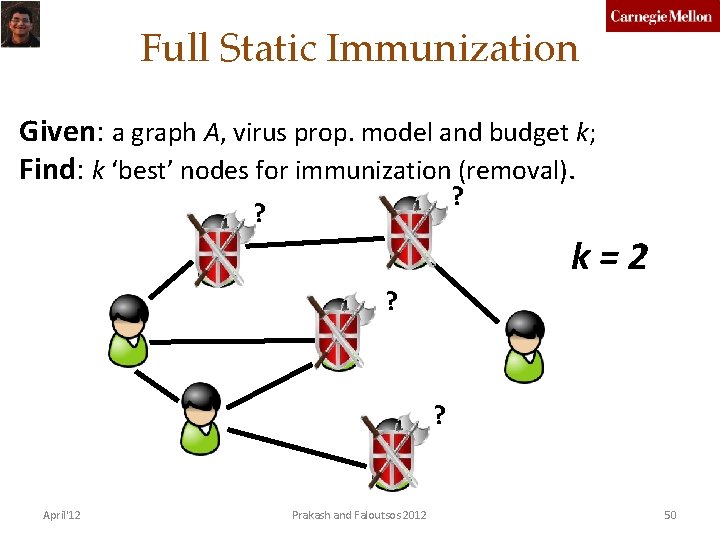
Full Static Immunization Given: a graph A, virus prop. model and budget k; Find: k ‘best’ nodes for immunization (removal). ? ? k=2 ? ? April'12 Prakash and Faloutsos 2012 50
Outline • Motivation • Epidemics: what happens? (Theory) • Action: Who to immunize? (Algorithms) – Full Immunization (Static Graphs) – Fractional Immunization April'12 Prakash and Faloutsos 2012 51
Challenges • Given a graph A, budget k, Q 1 (Metric) How to measure the ‘shieldvalue’ for a set of nodes (S)? Q 2 (Algorithm) How to find a set of k nodes with highest ‘shield-value’? April'12 Prakash and Faloutsos 2012 52
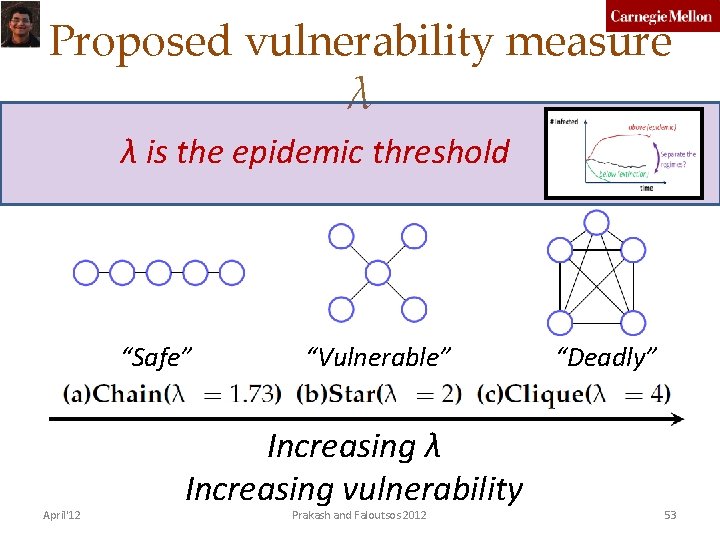
Proposed vulnerability measure λ λ is the epidemic threshold “Safe” April'12 “Vulnerable” Increasing λ Increasing vulnerability Prakash and Faloutsos 2012 “Deadly” 53
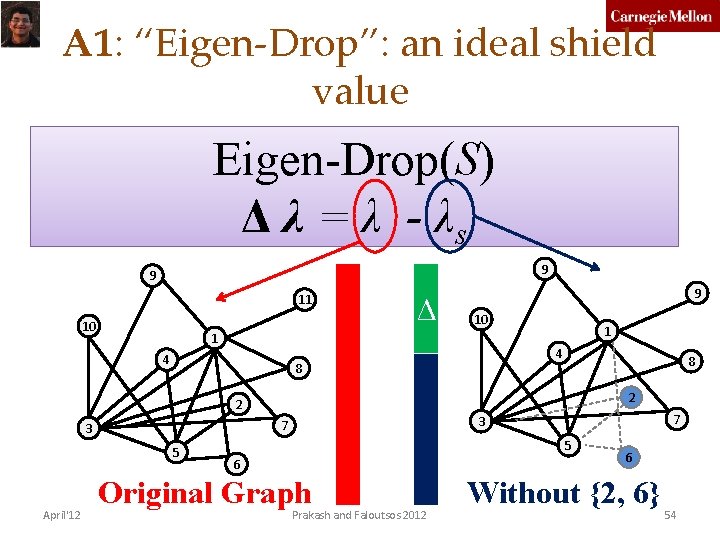
A 1: “Eigen-Drop”: an ideal shield value Eigen-Drop(S) Δ λ = λ - λs 9 9 11 10 Δ 9 10 1 4 8 8 2 2 5 April'12 7 3 5 6 Original Graph Prakash and Faloutsos 2012 6 Without {2, 6} 54
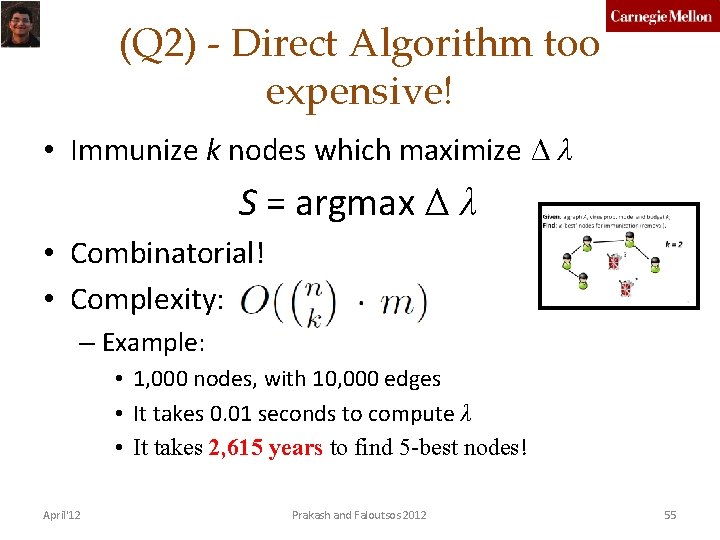
(Q 2) - Direct Algorithm too expensive! • Immunize k nodes which maximize Δ λ S = argmax Δ λ • Combinatorial! • Complexity: – Example: • 1, 000 nodes, with 10, 000 edges • It takes 0. 01 seconds to compute λ • It takes 2, 615 years to find 5 -best nodes! April'12 Prakash and Faloutsos 2012 55
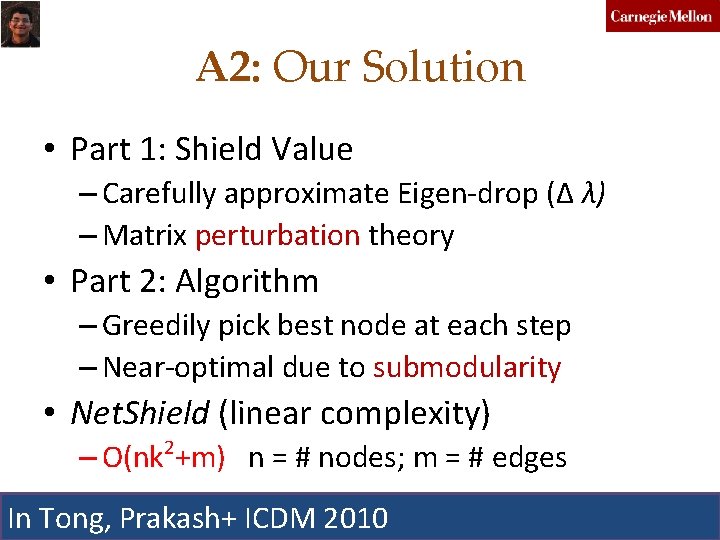
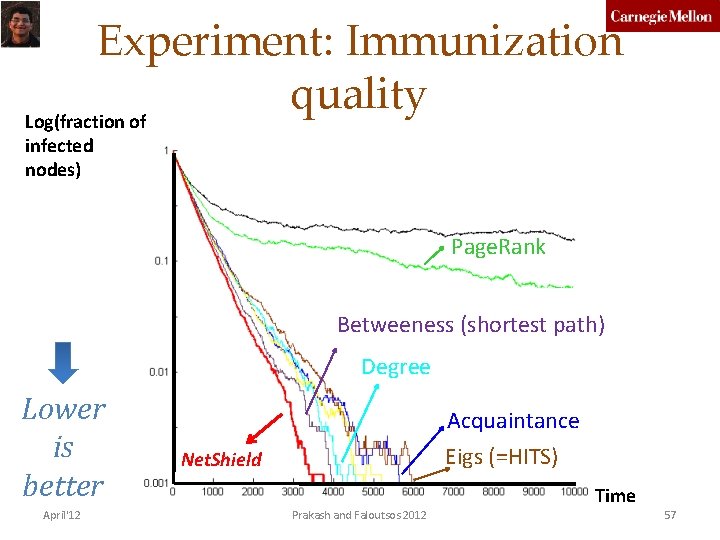
A 2: Our Solution • Part 1: Shield Value – Carefully approximate Eigen-drop (Δ λ) – Matrix perturbation theory • Part 2: Algorithm – Greedily pick best node at each step – Near-optimal due to submodularity • Net. Shield (linear complexity) – O(nk 2+m) n = # nodes; m = # edges In Tong, Prakash+ ICDM 2010 April'12 Prakash and Faloutsos 2012 56
Experiment: Immunization quality Log(fraction of infected nodes) Page. Rank Betweeness (shortest path) Degree Lower is better April'12 Acquaintance Eigs (=HITS) Net. Shield Prakash and Faloutsos 2012 Time 57
Outline • Motivation • Epidemics: what happens? (Theory) • Action: Who to immunize? (Algorithms) – Full Immunization (Static Graphs) – Fractional Immunization April'12 Prakash and Faloutsos 2012 58
Fractional Immunization of Networks B. Aditya Prakash, Lada Adamic, Theodore Iwashyna (M. D. ), Hanghang Tong, Christos Faloutsos Under review April'12 Prakash and Faloutsos 2012 59
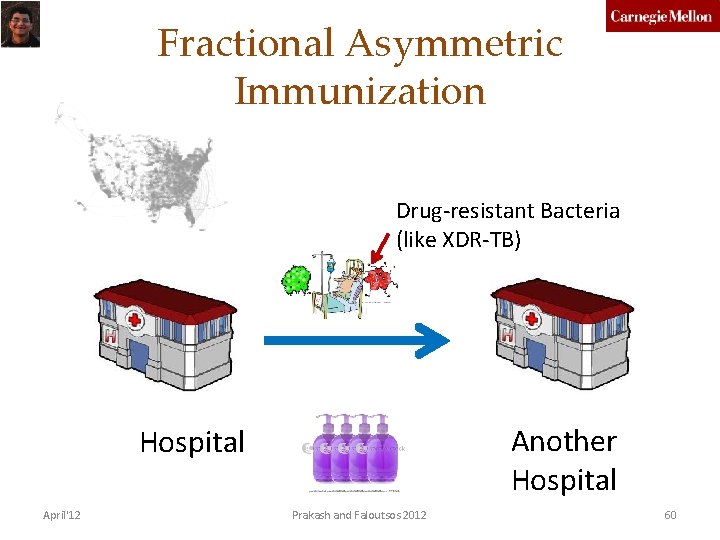
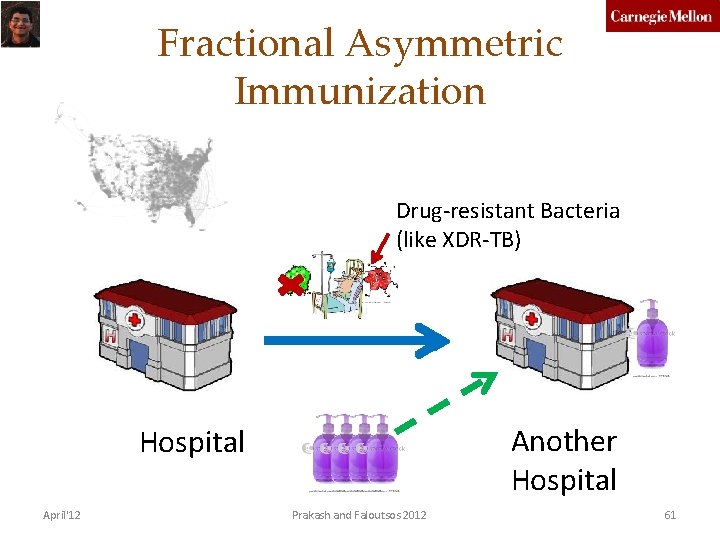
Fractional Asymmetric Immunization Drug-resistant Bacteria (like XDR-TB) Another Hospital April'12 Prakash and Faloutsos 2012 60
Fractional Asymmetric Immunization Drug-resistant Bacteria (like XDR-TB) Another Hospital April'12 Prakash and Faloutsos 2012 61
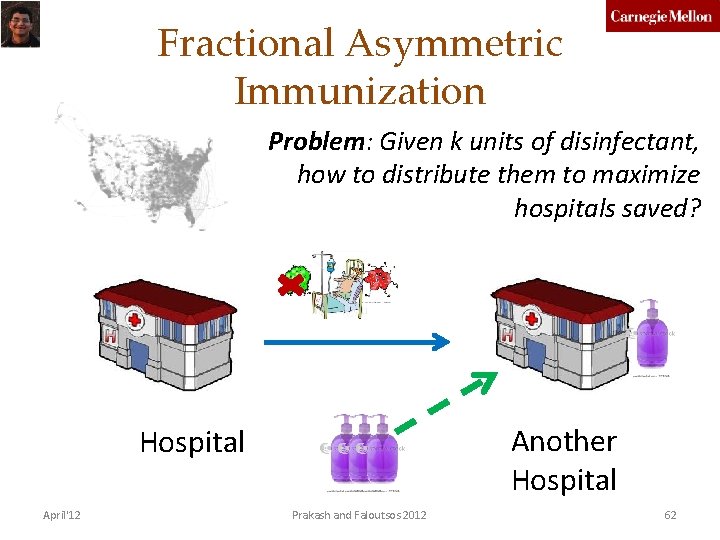
Fractional Asymmetric Immunization Problem: Given k units of disinfectant, how to distribute them to maximize hospitals saved? Another Hospital April'12 Prakash and Faloutsos 2012 62
Our Algorithm “SMARTALLOC” ~6 x fewer! [US-MEDICARE NETWORK 2005] • Each circle is a hospital, ~3000 hospitals • More than 30, 000 patients transferred CURRENT PRACTICE April'12 Prakash and Faloutsos 2012 SMART-ALLOC 63
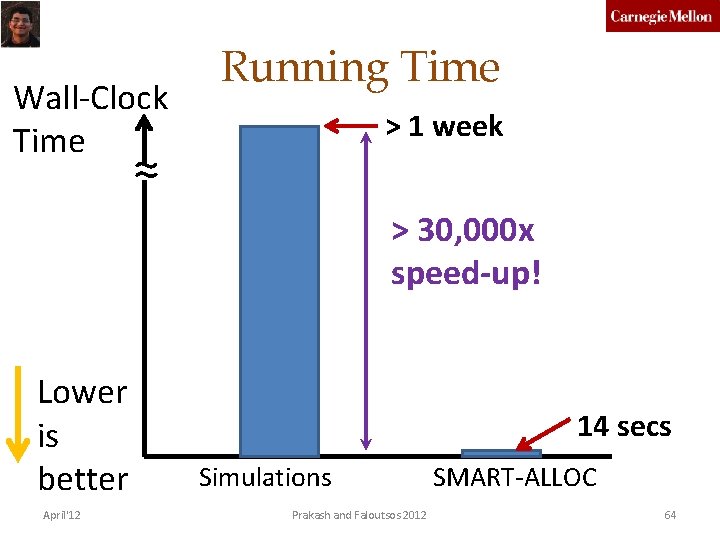
Wall-Clock Time Running Time > 1 week ≈ > 30, 000 x speed-up! Lower is better April'12 14 secs Simulations Prakash and Faloutsos 2012 SMART-ALLOC 64
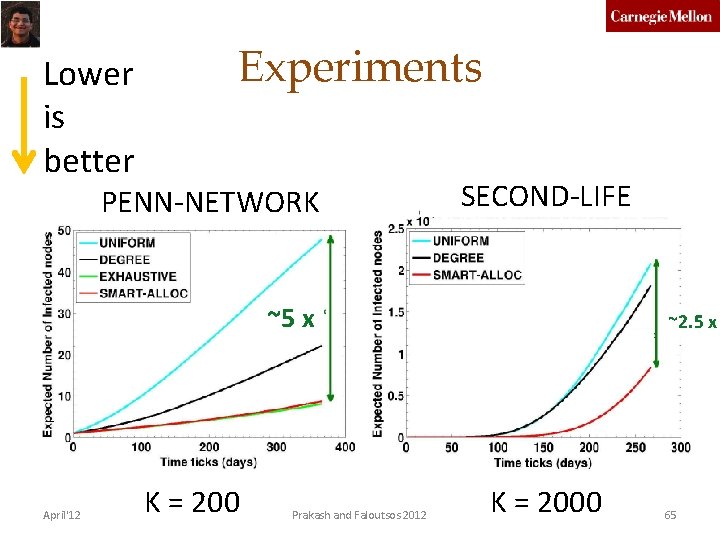
Lower is better Experiments PENN-NETWORK SECOND-LIFE ~5 x April'12 K = 200 Prakash and Faloutsos 2012 ~2. 5 x K = 2000 65
Acknowledgements Funding April'12 Prakash and Faloutsos 2012 66
References 1. 2. 3. 4. 5. 6. 7. Threshold Conditions for Arbitrary Cascade Models on Arbitrary Networks (B. Aditya Prakash, Deepayan Chakrabarti, Michalis Faloutsos, Nicholas Valler, Christos Faloutsos) In IEEE ICDM 2011, Vancouver (Invited to KAIS Journal Best Papers of ICDM. ) Virus Propagation on Time-Varying Networks: Theory and Immunization Algorithms (B. Aditya Prakash, Hanghang Tong, Nicholas Valler, Michalis Faloutsos and Christos Faloutsos) – In ECML-PKDD 2010, Barcelona, Spain Epidemic Spreading on Mobile Ad Hoc Networks: Determining the Tipping Point (Nicholas Valler, B. Aditya Prakash, Hanghang Tong, Michalis Faloutsos and Christos Faloutsos) – In IEEE NETWORKING 2011, Valencia, Spain Winner-takes-all: Competing Viruses or Ideas on fair-play networks (B. Aditya Prakash, Alex Beutel, Roni Rosenfeld, Christos Faloutsos) – In WWW 2012, Lyon On the Vulnerability of Large Graphs (Hanghang Tong, B. Aditya Prakash, Tina Eliassi. Rad and Christos Faloutsos) – In IEEE ICDM 2010, Sydney, Australia Fractional Immunization of Networks (B. Aditya Prakash, Lada Adamic, Theodore Iwashyna, Hanghang Tong, Christos Faloutsos) - Under Submission Rise and Fall Patterns of Information Diffusion: Model and Implications (Yasuko Matsubara, Yasushi Sakurai, B. Aditya Prakash, Lei Li, Christos Faloutsos) - Under Submission http: //www. cs. cmu. edu/~badityap/ April'12 Prakash and Faloutsos 2012 67
Propagation on Large Networks B. Aditya Prakash Christos Faloutsos Analysis April'12 Policy/Action Prakash and Faloutsos 2012 Data 68