
Influence of pit wall stability on underground planning
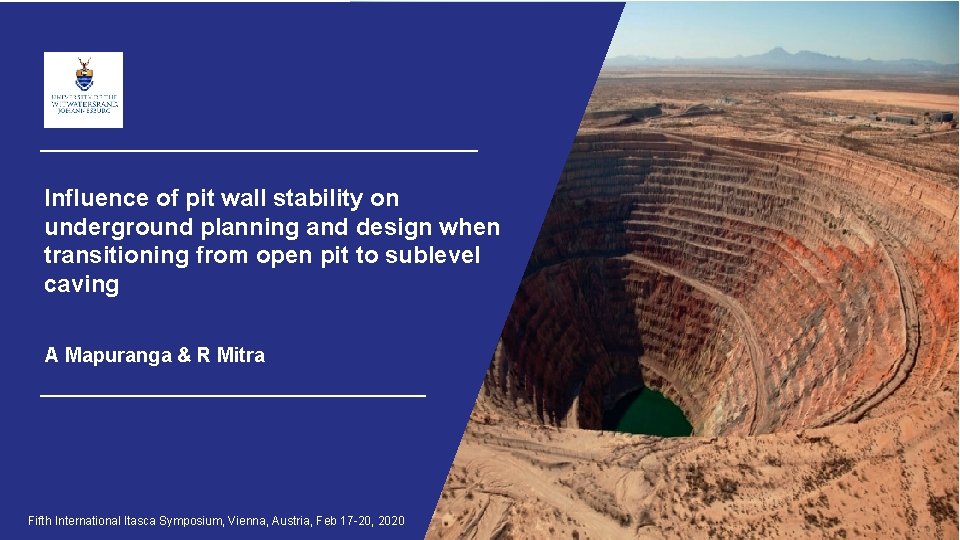
Influence of pit wall stability on underground planning and design when transitioning from open pit to sublevel caving A Mapuranga & R Mitra Fifth International Itasca Symposium, Vienna, Austria, Feb 17 -20, 2020
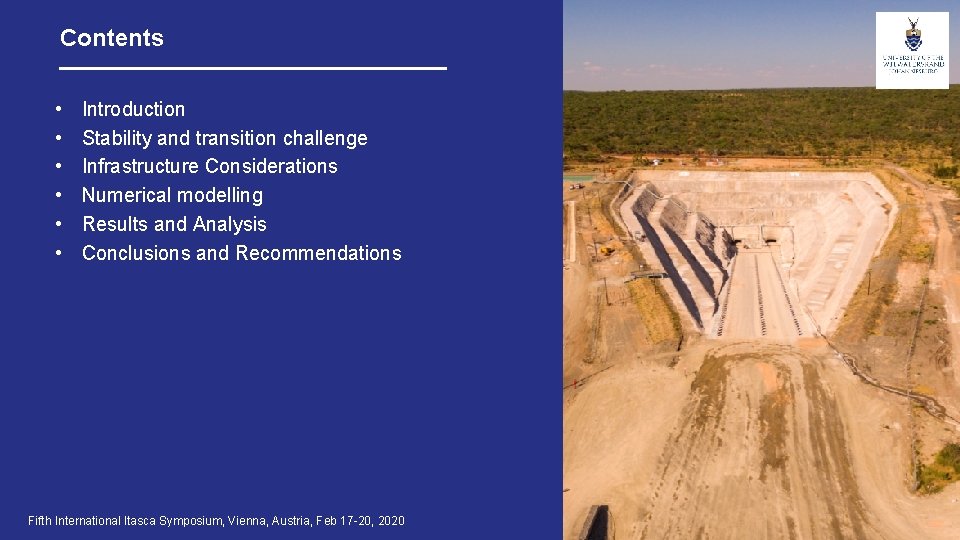
Contents • • • Introduction Stability and transition challenge Infrastructure Considerations Numerical modelling Results and Analysis Conclusions and Recommendations Fifth International Itasca Symposium, Vienna, Austria, Feb 17 -20, 2020
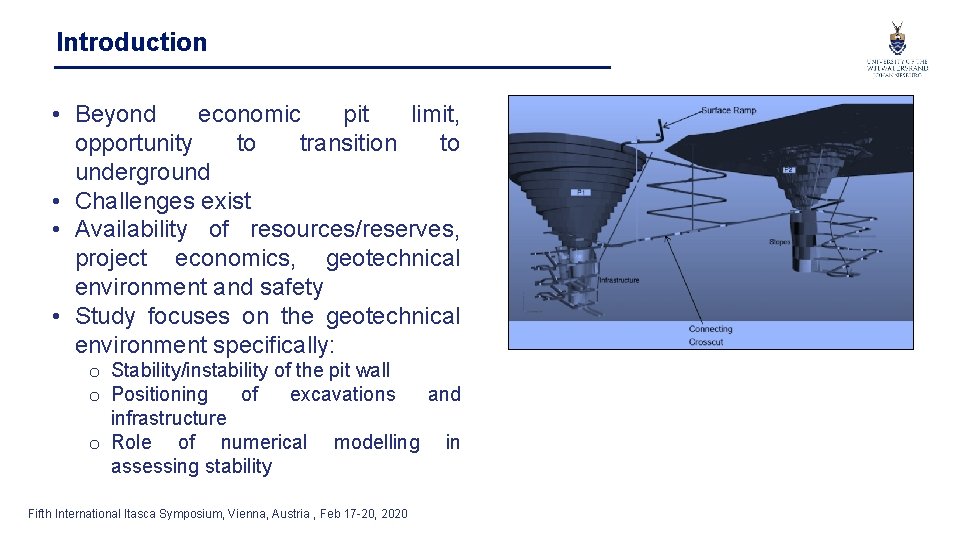
Introduction • Beyond economic pit limit, opportunity to transition to underground • Challenges exist • Availability of resources/reserves, project economics, geotechnical environment and safety • Study focuses on the geotechnical environment specifically: o Stability/instability of the pit wall o Positioning of excavations and infrastructure o Role of numerical modelling in assessing stability Fifth International Itasca Symposium, Vienna, Austria , Feb 17 -20, 2020
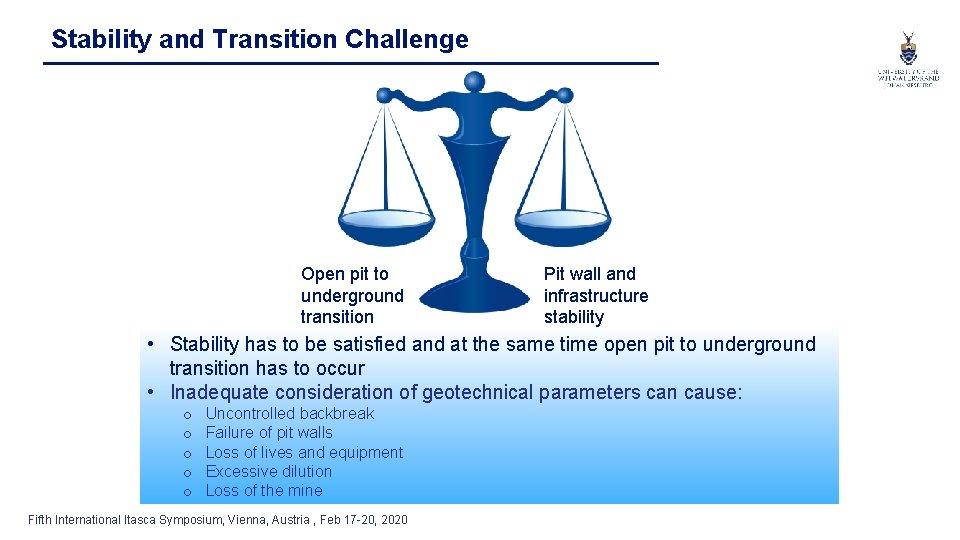
Stability and Transition Challenge Open pit to underground transition Pit wall and infrastructure stability • Stability has to be satisfied and at the same time open pit to underground transition has to occur • Inadequate consideration of geotechnical parameters can cause: o o o Uncontrolled backbreak Failure of pit walls Loss of lives and equipment Excessive dilution Loss of the mine Fifth International Itasca Symposium, Vienna, Austria , Feb 17 -20, 2020
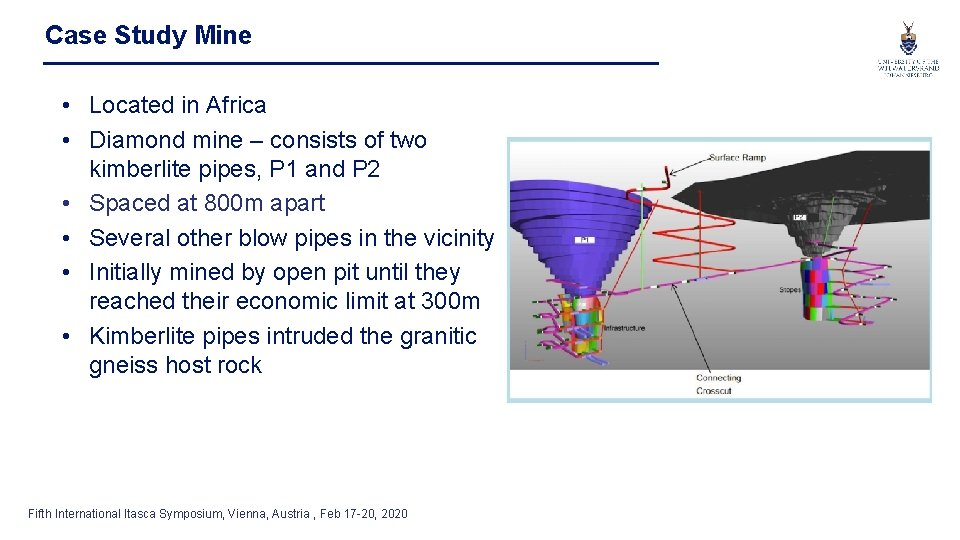
Case Study Mine • Located in Africa • Diamond mine – consists of two kimberlite pipes, P 1 and P 2 • Spaced at 800 m apart • Several other blow pipes in the vicinity • Initially mined by open pit until they reached their economic limit at 300 m • Kimberlite pipes intruded the granitic gneiss host rock Fifth International Itasca Symposium, Vienna, Austria , Feb 17 -20, 2020
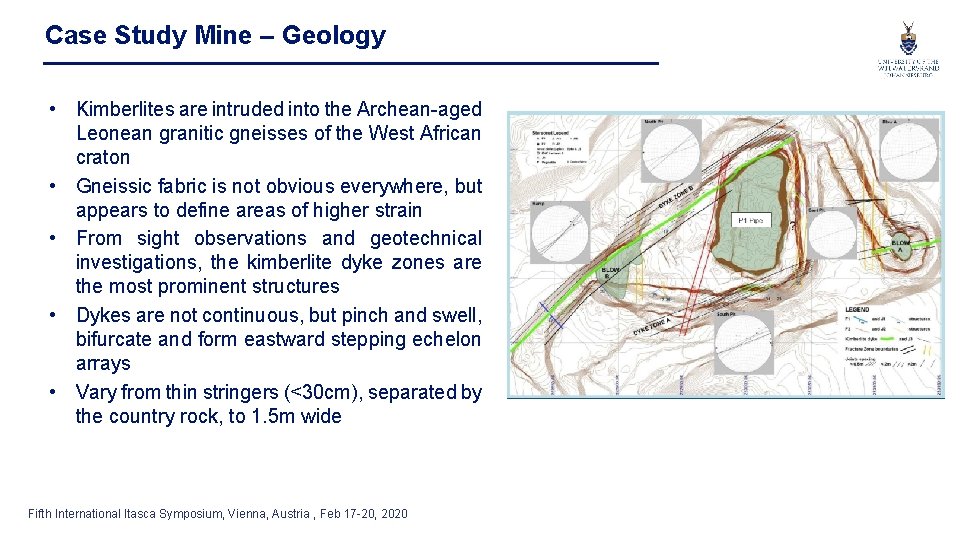
Case Study Mine – Geology • Kimberlites are intruded into the Archean-aged Leonean granitic gneisses of the West African craton • Gneissic fabric is not obvious everywhere, but appears to define areas of higher strain • From sight observations and geotechnical investigations, the kimberlite dyke zones are the most prominent structures • Dykes are not continuous, but pinch and swell, bifurcate and form eastward stepping echelon arrays • Vary from thin stringers (<30 cm), separated by the country rock, to 1. 5 m wide Fifth International Itasca Symposium, Vienna, Austria , Feb 17 -20, 2020
Why Investigating Transition? • Factors that affect mine stability: o Structural Geology § Faults § Bedding § Joints § Foliation § Dykes o Groundwater o Rock mass classification o Geometry o Alteration o Stress conditions o Weathering o Blasting Fifth International Itasca Symposium, Vienna, Austria , Feb 17 -20, 2020
Underground Infrastructure • Considered for the project: o o o o o Ramp development Connecting drive for the two underground workings Ventilation shafts Underground workshop Drilling water reticulation Dewatering system Electrical system Secondary escape route Level drives Fifth International Itasca Symposium, Vienna, Austria , Feb 17 -20, 2020
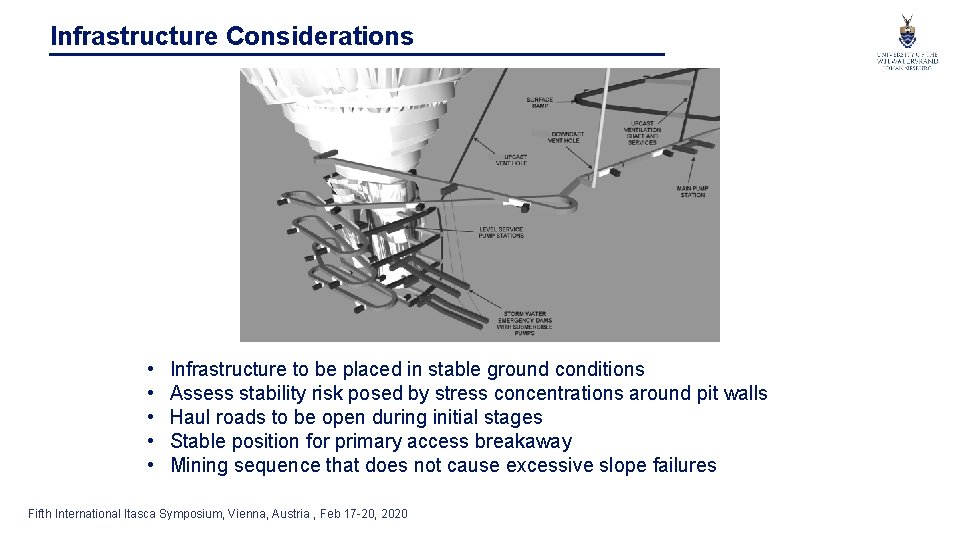
Infrastructure Considerations • • • Infrastructure to be placed in stable ground conditions Assess stability risk posed by stress concentrations around pit walls Haul roads to be open during initial stages Stable position for primary access breakaway Mining sequence that does not cause excessive slope failures Fifth International Itasca Symposium, Vienna, Austria , Feb 17 -20, 2020
Numerical Modelling • FLAC 3 D • Model for predicting the effect of stress changes around the pit wall and underground • Input parameters include geomechanical properties, initial conditions, boundary conditions, groundwater and mining sequence • Top down sub level caving through 40 m slices ü 4 slices for Pipe A ü 5 slices for Pipe B • Hoek-brown failure criterion used • Informed siting of infrastructure Fifth International Itasca Symposium, Vienna, Austria , Feb 17 -20, 2020
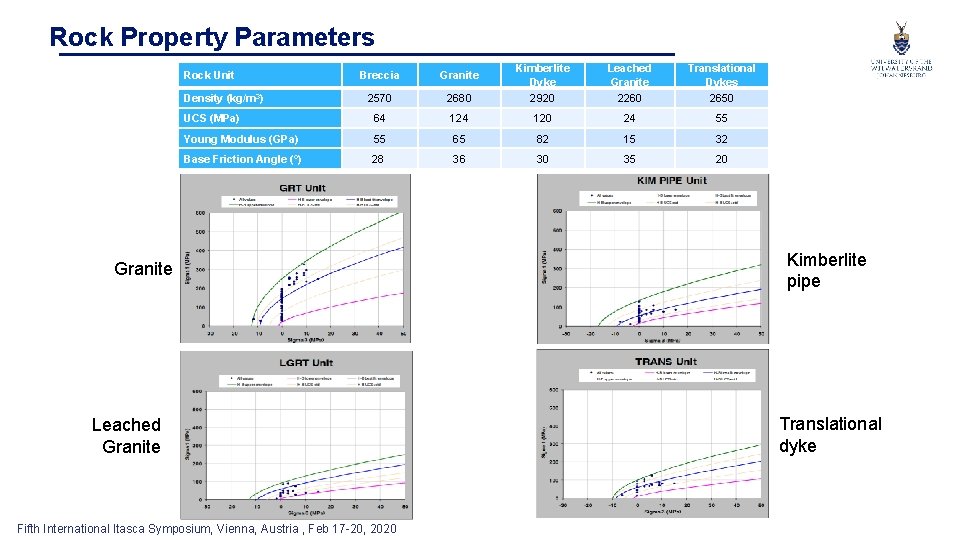
Rock Property Parameters Breccia Granite Kimberlite Dyke Leached Granite Translational Dykes 2570 2680 2920 2260 2650 UCS (MPa) 64 120 24 55 Young Modulus (GPa) 55 65 82 15 32 Base Friction Angle (°) 28 36 30 35 20 Rock Unit Density (kg/m 3) Granite Leached Granite Fifth International Itasca Symposium, Vienna, Austria , Feb 17 -20, 2020 Kimberlite pipe Translational dyke
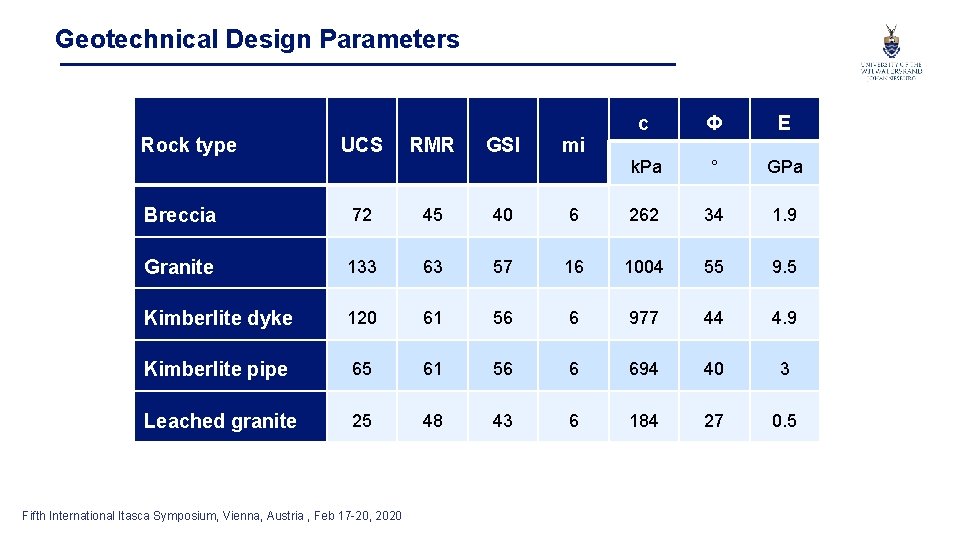
Geotechnical Design Parameters Rock type UCS RMR GSI mi c Φ E k. Pa ° GPa Breccia 72 45 40 6 262 34 1. 9 Granite 133 63 57 16 1004 55 9. 5 Kimberlite dyke 120 61 56 6 977 44 4. 9 Kimberlite pipe 65 61 56 6 694 40 3 Leached granite 25 48 43 6 184 27 0. 5 Fifth International Itasca Symposium, Vienna, Austria , Feb 17 -20, 2020
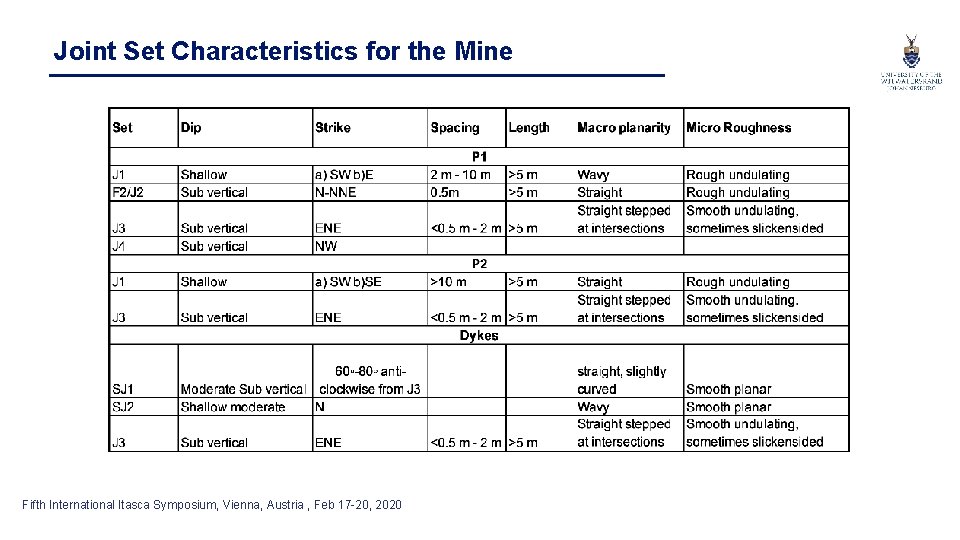
Joint Set Characteristics for the Mine Fifth International Itasca Symposium, Vienna, Austria , Feb 17 -20, 2020
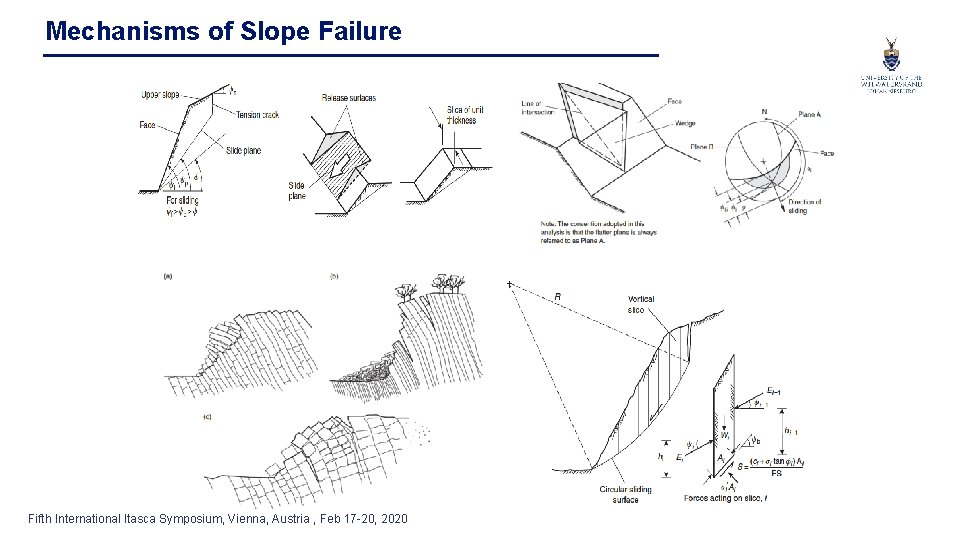
Mechanisms of Slope Failure Fifth International Itasca Symposium, Vienna, Austria , Feb 17 -20, 2020
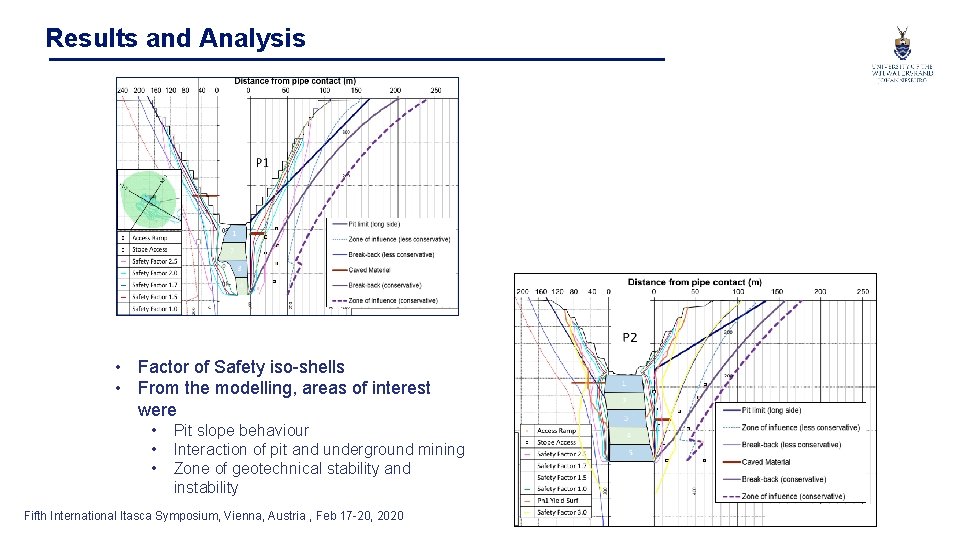
Results and Analysis • Factor of Safety iso-shells • From the modelling, areas of interest were • • • Pit slope behaviour Interaction of pit and underground mining Zone of geotechnical stability and instability Fifth International Itasca Symposium, Vienna, Austria , Feb 17 -20, 2020
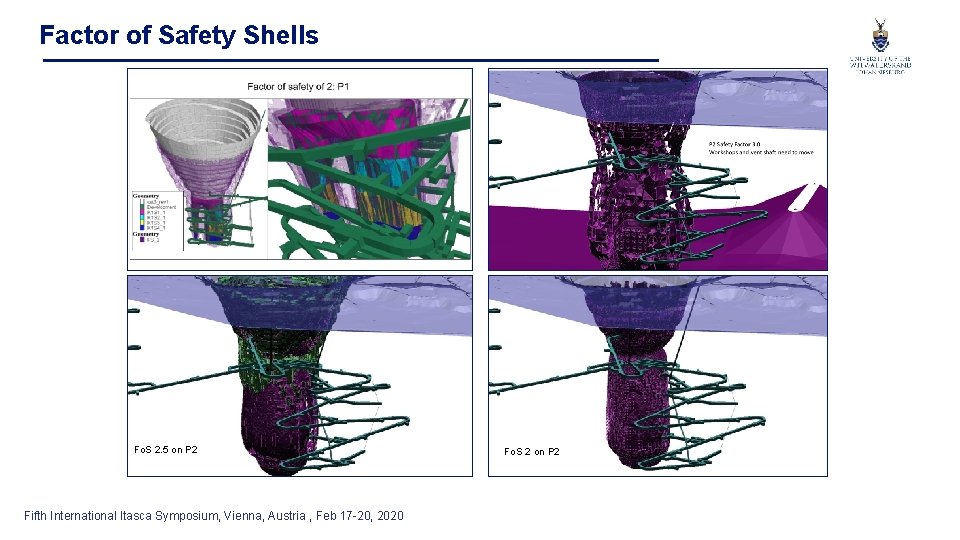
Factor of Safety Shells Fo. S 2. 5 on P 2 Fifth International Itasca Symposium, Vienna, Austria , Feb 17 -20, 2020 Fo. S 2 on P 2
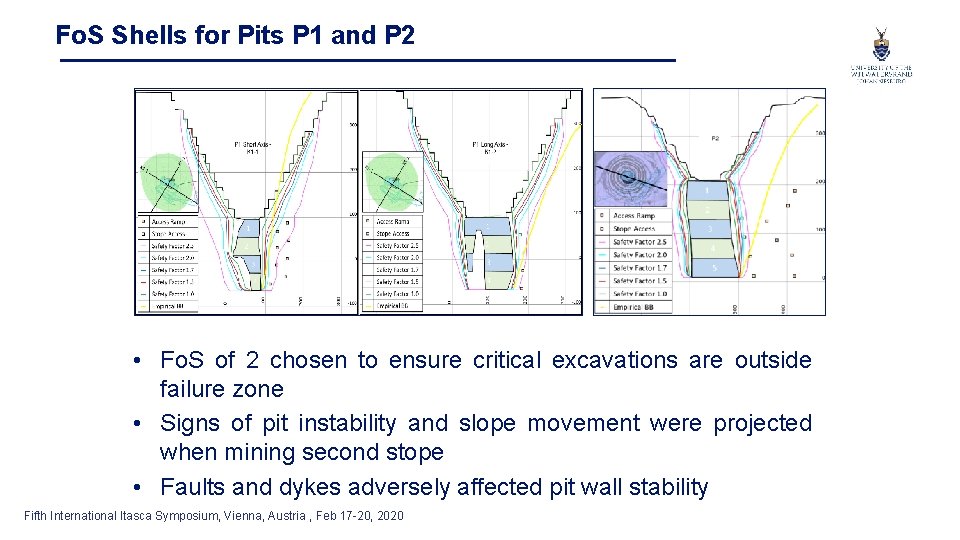
Fo. S Shells for Pits P 1 and P 2 • Fo. S of 2 chosen to ensure critical excavations are outside failure zone • Signs of pit instability and slope movement were projected when mining second stope • Faults and dykes adversely affected pit wall stability Fifth International Itasca Symposium, Vienna, Austria , Feb 17 -20, 2020
Conclusions and Recommendations FLAC 3 D Fo. S iso-shell used for design outside expected zone of influence Conservative Fo. S of 2 was chosen to cater for the unknown rock mass behaviour New conditions discovered during the project should be recorded and added to the numerical model Strong cross-functional approach from both the geotechnical and the mine planning departments Effective monitoring system is required in place around the pit wall, to continuously assess and evaluate displacement and deformation as mining progresses Fifth International Itasca Symposium, Vienna, Austria , Feb 17 -20, 2020
Thank you Fifth International Itasca Symposium, Vienna, Austria , Feb 17 -20, 2020
- Slides: 19