
INFLUENCE OF CLASSROOM DESIGN ON ACADEMICPERFORMANCE Group Members
INFLUENCE OF CLASSROOM DESIGN ON ACADEMICPERFORMANCE. Group Members: Aleezay Fatima Patel, Eesha Wasif, Eleeza Yaqoob, Fatima Mohallilah Shamim, Sephora Louisa Noella Vaz.
INTRODUCTION Studies have shown that classroom design and architecture have significant impacts on learning. Cheryan et. al concluded that insufficient lighting, noise, low air quality and deficient heating contribute to poorer performances. (2014) Suleman et. al also discerned that poor infrastructure also results in institutional malfunction. (2014) Kweon et. al’s study also isolated the impact of greener surroundings, concluding that schools with more trees enabled proficiency in mathematics and reading. (2017) Amicable atmospheres and optimal seating arrangements were also found to promote learning atmospheres and attitudes in students. (Kausar et. al) (2019) It has also been found that the use of certain instructive technologies also prompted class participation, thereby improving performances. (Shi et. al) (2019)
STUDY OBJECTIVES While research has been done on the effects on academic achievement of variables such as different levels of lighting, stimulation, individuality, layout etc. , none have thus far attempted to isolate the impact of different types of lighting and architectural configuration of the classroom, specifically on academic performance. WHAT IS THE FOCUS OF OUR STUDY? To what extent does classroom architecture/size and different types of lighting effect the learning environment in the classroom? What is the nature of those effects? Are they always beneficial or can they be detrimental too? How can these variables be manipulated in order to maximize classroom utility? Which variables should be given preference? What should institutions be mindful of when designing certain classrooms for certain subject/ skill-oriented courses?
METHODS Study Design Field experiment, taking place in the classroom. Independent measures design Independent Variables (IVs): Size of the classroom Type of Lighting Participants Opportunity sample of students aged between 17 -20 years who had previously appeared for the SAT Currently studying in IBA, enrolled in a Math course. 60 participants, of which males and females were in equal ratio. Dependent Variable (DVs): level of student performance (operationalized by a 20% improvement post-intervention) Score of 40 on PARS. Tools and Materials ü Past SAT exam ü Purdue Academic Rating Scale (PARS) ü Fluorescent tubes for artificial lighting
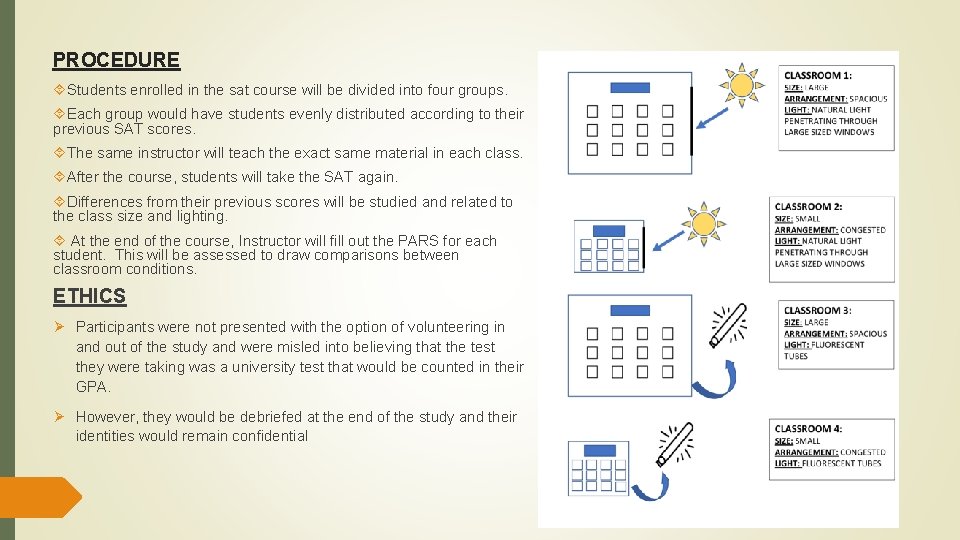
PROCEDURE Students enrolled in the sat course will be divided into four groups. Each group would have students evenly distributed according to their previous SAT scores. The same instructor will teach the exact same material in each class. After the course, students will take the SAT again. Differences from their previous scores will be studied and related to the class size and lighting. At the end of the course, Instructor will fill out the PARS for each student. This will be assessed to draw comparisons between classroom conditions. ETHICS Ø Participants were not presented with the option of volunteering in and out of the study and were misled into believing that the test they were taking was a university test that would be counted in their GPA. Ø However, they would be debriefed at the end of the study and their identities would remain confidential
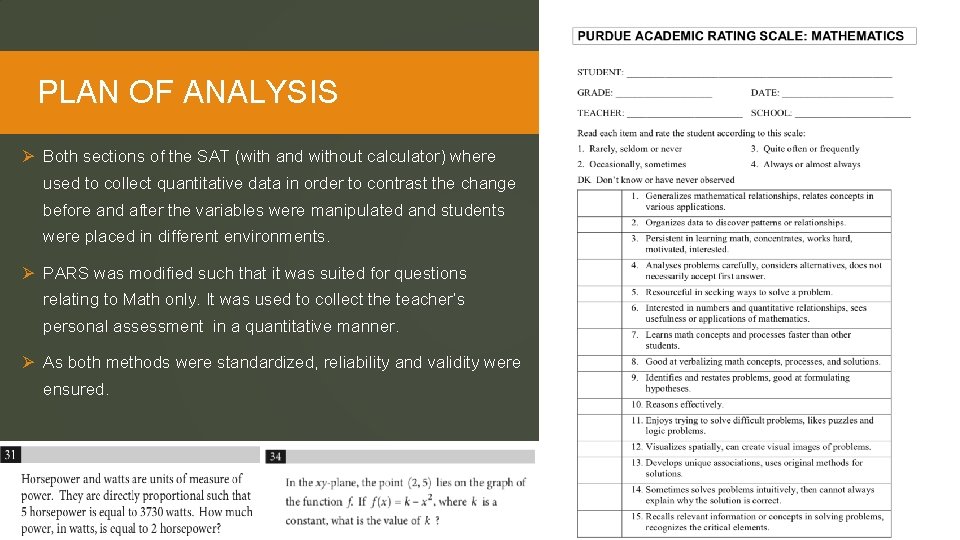
PLAN OF ANALYSIS Ø Both sections of the SAT (with and without calculator) where used to collect quantitative data in order to contrast the change before and after the variables were manipulated and students were placed in different environments. Ø PARS was modified such that it was suited for questions relating to Math only. It was used to collect the teacher’s personal assessment in a quantitative manner. Ø As both methods were standardized, reliability and validity were ensured.
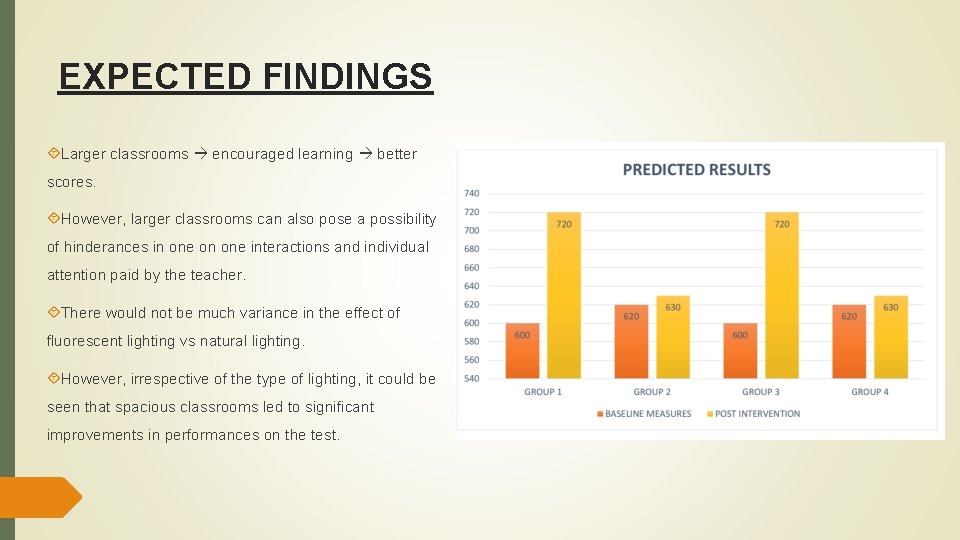
EXPECTED FINDINGS Larger classrooms encouraged learning better scores. However, larger classrooms can also pose a possibility of hinderances in one on one interactions and individual attention paid by the teacher. There would not be much variance in the effect of fluorescent lighting vs natural lighting. However, irrespective of the type of lighting, it could be seen that spacious classrooms led to significant improvements in performances on the test.
DISCUSSION The objective of this proposal was to identify the variations in academic performances of students subject to architectural space and lighting to help create a guide for educational institutions when designing educational facilities. The study will reveal that a positive correlation may exist between academic performances of students on the tests and the size of the classroom. It can also reveal that no correlation existed between the type of lighting and academic performances. However, it could also be seen that larger sized classrooms led to lower classparticipation, while students in smaller classrooms experienced a more positive attitude towards learning and received more individual attention from the instructor. The outcomes of this study can prove helpful for educational institutions as they clearly explain the importance of certain features in the provision of high-quality education, thereby emphasizing the negative impacts that may be seen if these features are overlooked due to budget constraints. Policy makers may also use the results as a criterion for building standards.
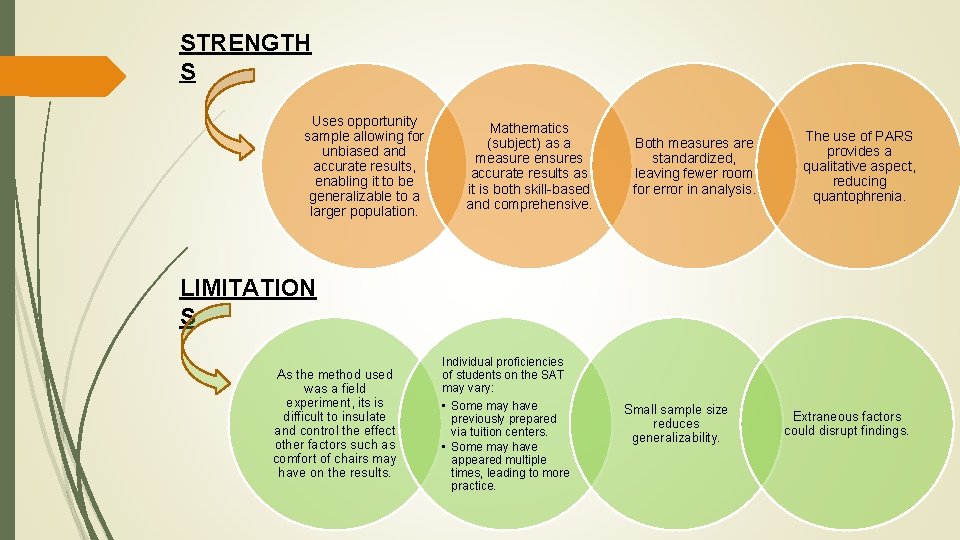
STRENGTH S Uses opportunity sample allowing for unbiased and accurate results, enabling it to be generalizable to a larger population. Mathematics (subject) as a measure ensures accurate results as it is both skill-based and comprehensive. Both measures are standardized, leaving fewer room for error in analysis. The use of PARS provides a qualitative aspect, reducing quantophrenia. LIMITATION S As the method used was a field experiment, its is difficult to insulate and control the effect other factors such as comfort of chairs may have on the results. Individual proficiencies of students on the SAT may vary: • Some may have previously prepared via tuition centers. • Some may have appeared multiple times, leading to more practice. Small sample size reduces generalizability. Extraneous factors could disrupt findings.
- Slides: 9