
Influence of atomic displacement rate neutron spectrum and
- Slides: 49
Influence of atomic displacement rate, neutron spectrum and irradiation temperature on radiation-induced ageing of power reactor components FAST NEUTRON FLUX EFFECT ON VVER RPV’s LIFETIME ASSESSMENT D. Еrak Ya. Shtrombakh, P. Platonov, А. Аmaev, Yu. Kevorkian, А. Chernobaeva Research Institute of Atomic Reactors Dimitrovgrad - Ulianovsk, Russia October 2005 RUSSIAN RESEARCH CENTER “KURCHATOV INSTITUTE”
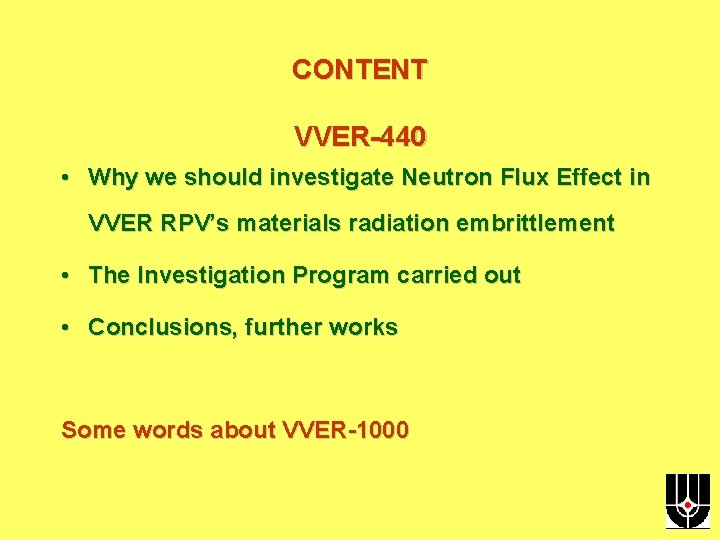
CONTENT VVER-440 • Why we should investigate Neutron Flux Effect in VVER RPV’s materials radiation embrittlement • The Investigation Program carried out • Conclusions, further works Some words about VVER-1000
RPVs VVER-440
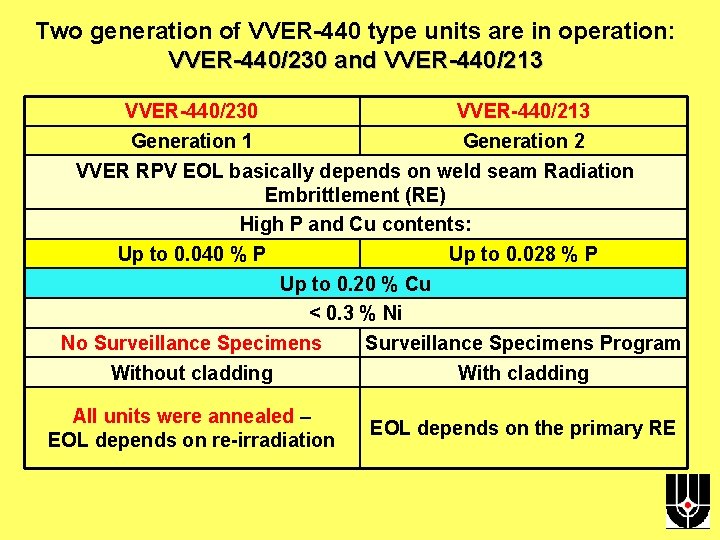
Two generation of VVER-440 type units are in operation: VVER-440/230 and VVER-440/213 VVER-440/230 VVER-440/213 Generation 1 Generation 2 VVER RPV EOL basically depends on weld seam Radiation Embrittlement (RE) High P and Cu contents: Up to 0. 040 % P Up to 0. 028 % P Up to 0. 20 % Cu < 0. 3 % Ni No Surveillance Specimens Program Without cladding With cladding All units were annealed – EOL depends on re-irradiation EOL depends on the primary RE
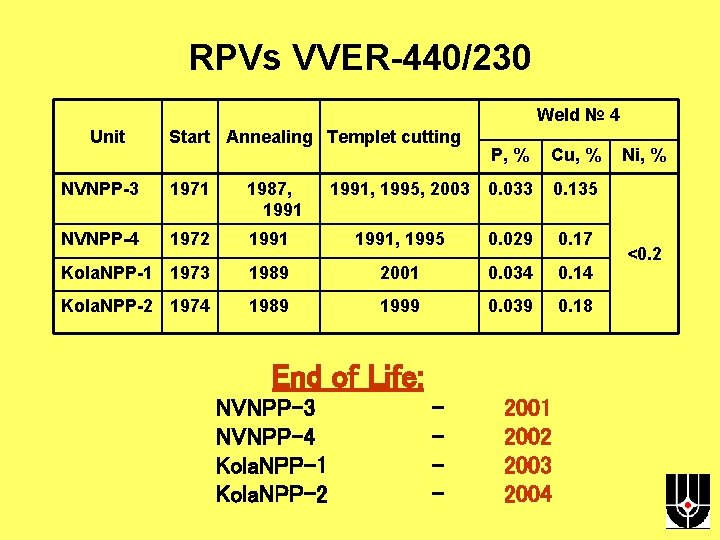
RPVs VVER-440/230 Weld № 4 Unit Start Annealing Templet cutting P, % Cu, % 1991, 1995, 2003 0. 033 0. 135 NVNPP-3 1971 1987, 1991 NVNPP-4 1972 1991, 1995 0. 029 0. 17 Kola. NPP-1 1973 1989 2001 0. 034 0. 14 Kola. NPP-2 1974 1989 1999 0. 039 0. 18 End of Life: NVNPP-3 NVNPP-4 Kola. NPP-1 Kola. NPP-2 - 2001 2002 2003 2004 Ni, % <0. 2
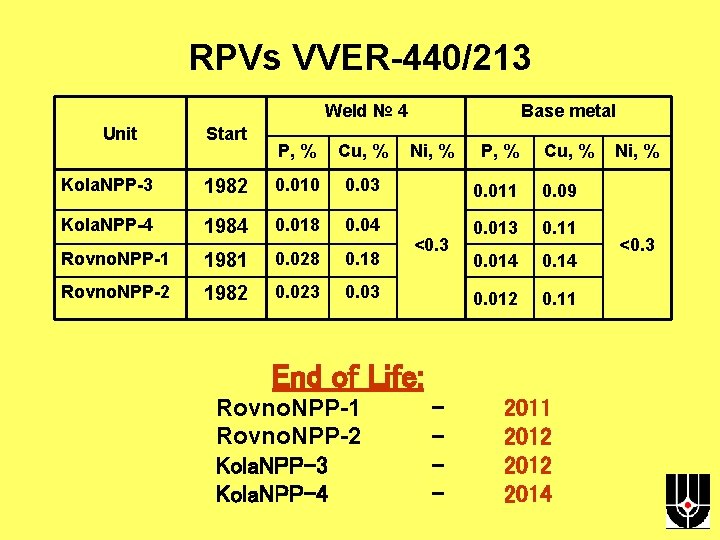
RPVs VVER-440/213 Weld № 4 Unit Start P, % Cu, % Base metal Ni, % P, % Cu, % Kola. NPP-3 1982 0. 010 0. 03 0. 011 0. 09 Kola. NPP-4 1984 0. 018 0. 04 0. 013 0. 11 Rovno. NPP-1 1981 0. 028 0. 18 0. 014 0. 14 Rovno. NPP-2 1982 0. 023 0. 012 0. 11 <0. 3 End of Life: Rovno. NPP-1 Rovno. NPP-2 Kola. NPP-3 Kola. NPP-4 - 2011 2012 2014 Ni, % <0. 3
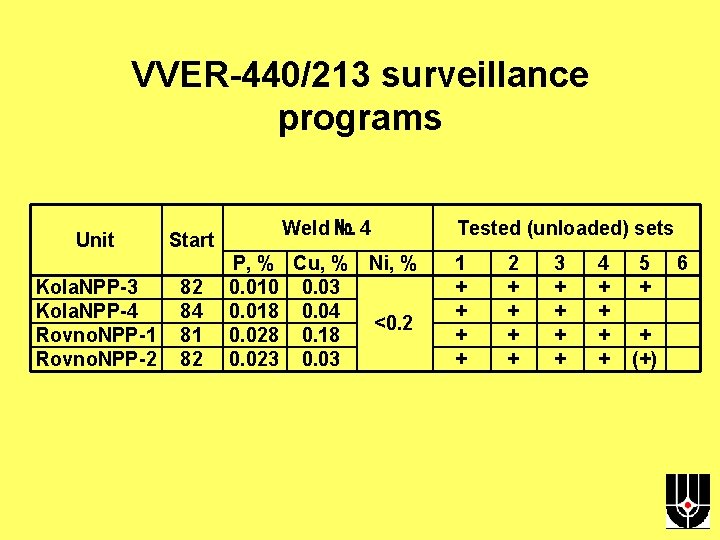
VVER-440/213 surveillance programs Unit Kola. NPP-3 Kola. NPP-4 Rovno. NPP-1 Rovno. NPP-2 Start 82 84 81 82 Weld № 4 P, % Cu, % 0. 010 0. 03 0. 018 0. 04 0. 028 0. 18 0. 023 0. 03 Tested (unloaded) sets Ni, % <0. 2 1 + + 2 + + 3 + + 4 + + 5 + + (+) 6
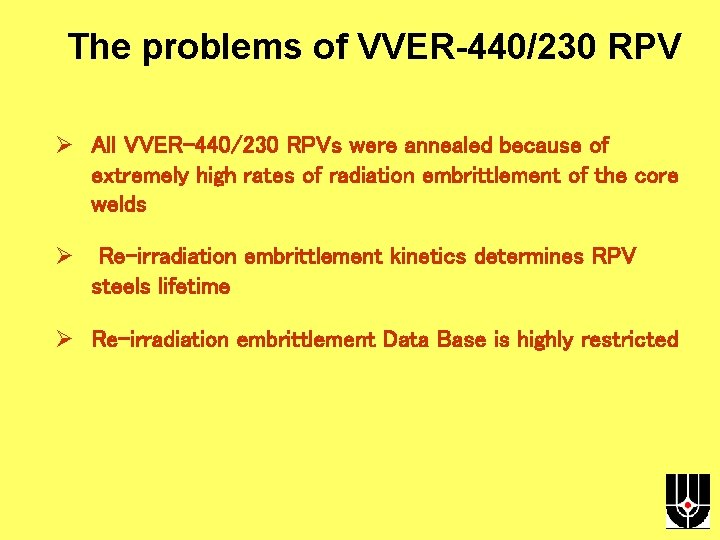
The problems of VVER-440/230 RPV Ø All VVER-440/230 RPVs were annealed because of extremely high rates of radiation embrittlement of the core welds Ø Re-irradiation embrittlement kinetics determines RPV steels lifetime Ø Re-irradiation embrittlement Data Base is highly restricted
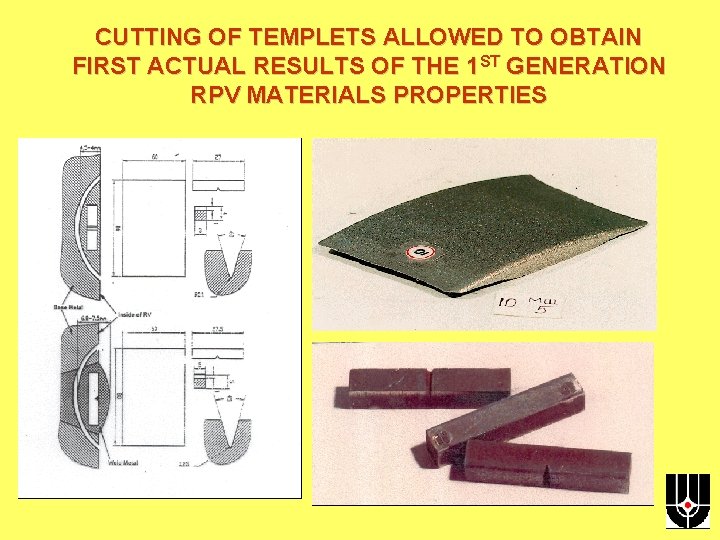
CUTTING OF TEMPLETS ALLOWED TO OBTAIN FIRST ACTUAL RESULTS OF THE 1 ST GENERATION RPV MATERIALS PROPERTIES
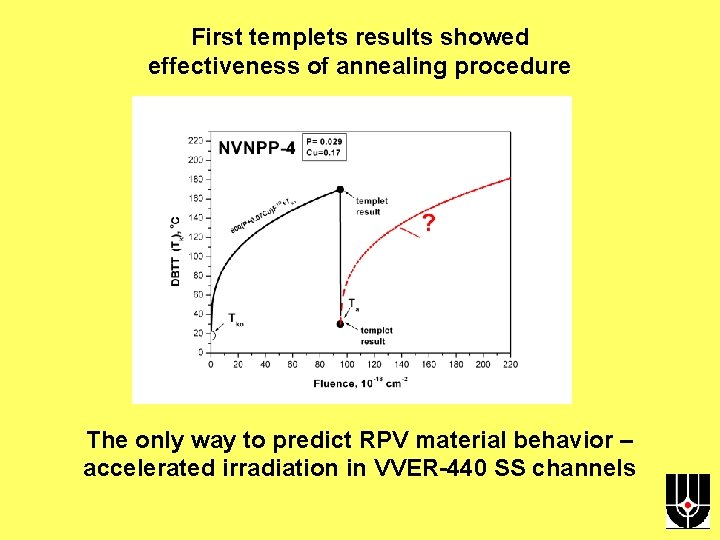
First templets results showed effectiveness of annealing procedure The only way to predict RPV material behavior – accelerated irradiation in VVER-440 SS channels
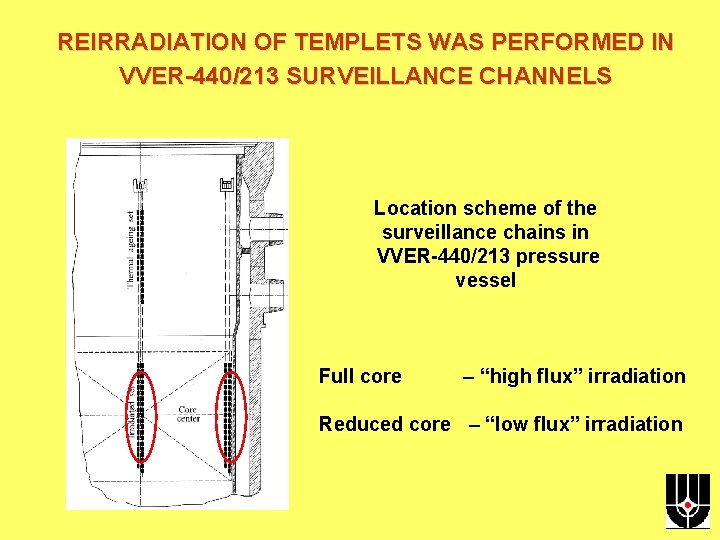
REIRRADIATION OF TEMPLETS WAS PERFORMED IN VVER-440/213 SURVEILLANCE CHANNELS Location scheme of the surveillance chains in VVER-440/213 pressure vessel Full core – “high flux” irradiation Reduced core – “low flux” irradiation
Is it correct to use the results of irradiated specimens for RPV lifetime assessment? Are the irradiation conditions of specimens equal to RPV wall conditions? Temperature Neutron Flux
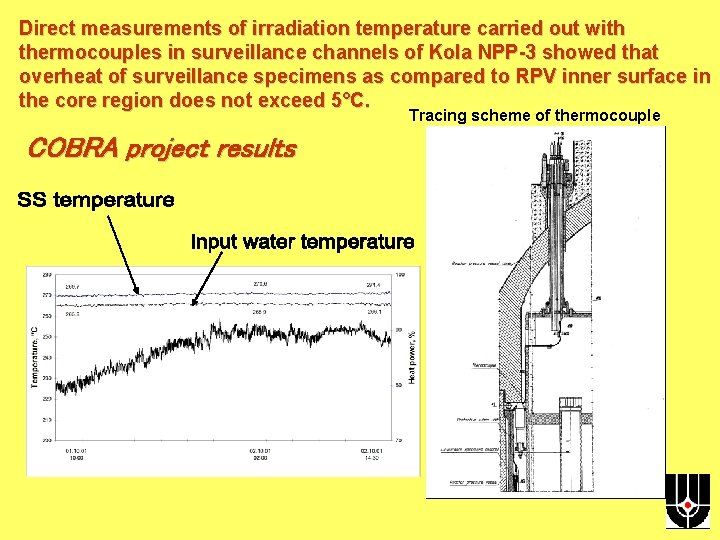
Direct measurements of irradiation temperature carried out with thermocouples in surveillance channels of Kola NPP-3 showed that overheat of surveillance specimens as compared to RPV inner surface in the core region does not exceed 5°C. Tracing scheme of thermocouple COBRA project results
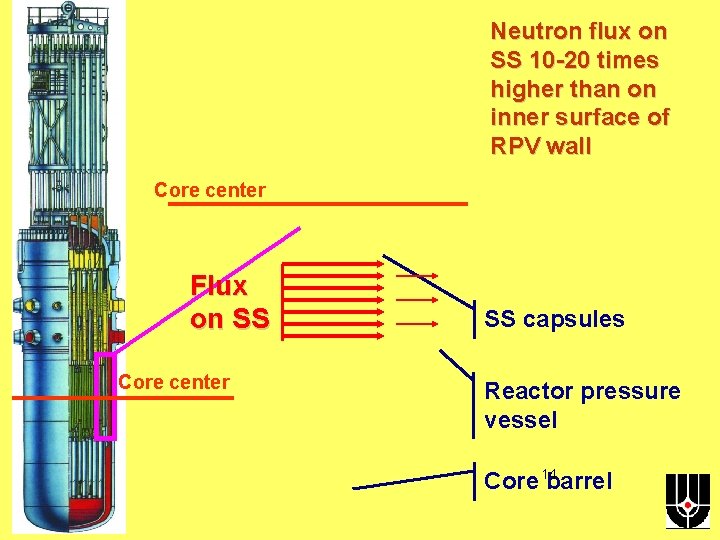
Neutron flux on SS 10 -20 times higher than on inner surface of RPV wall Core center Flux on SS Core center SS capsules Reactor pressure vessel Core 14 barrel
Flux effect study is very important for VVER-440 RPV lifetime assessment. In 1987 special program was started
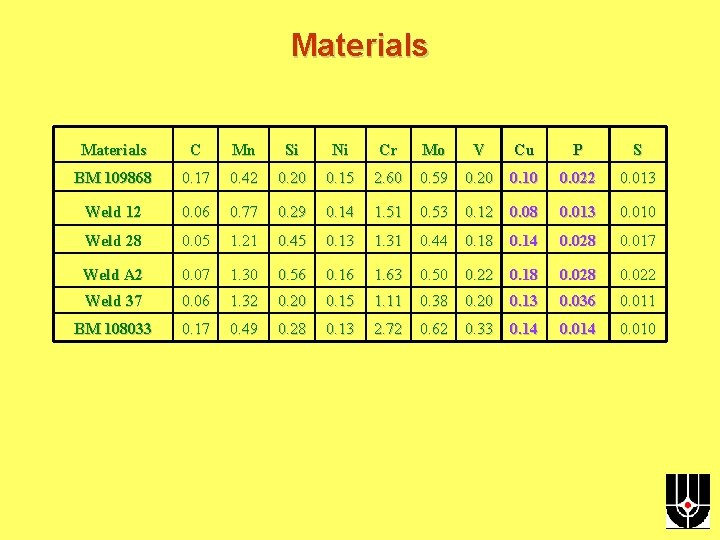
Materials C Mn Si Ni Cr Mo V Cu P S BM 109868 0. 17 0. 42 0. 20 0. 15 2. 60 0. 59 0. 20 0. 10 0. 022 0. 013 Weld 12 0. 06 0. 77 0. 29 0. 14 1. 51 0. 53 0. 12 0. 08 0. 013 0. 010 Weld 28 0. 05 1. 21 0. 45 0. 13 1. 31 0. 44 0. 18 0. 14 0. 028 0. 017 Weld А 2 0. 07 1. 30 0. 56 0. 16 1. 63 0. 50 0. 22 0. 18 0. 022 Weld 37 0. 06 1. 32 0. 20 0. 15 1. 11 0. 38 0. 20 0. 13 0. 036 0. 011 BM 108033 0. 17 0. 49 0. 28 0. 13 2. 72 0. 62 0. 33 0. 14 0. 010
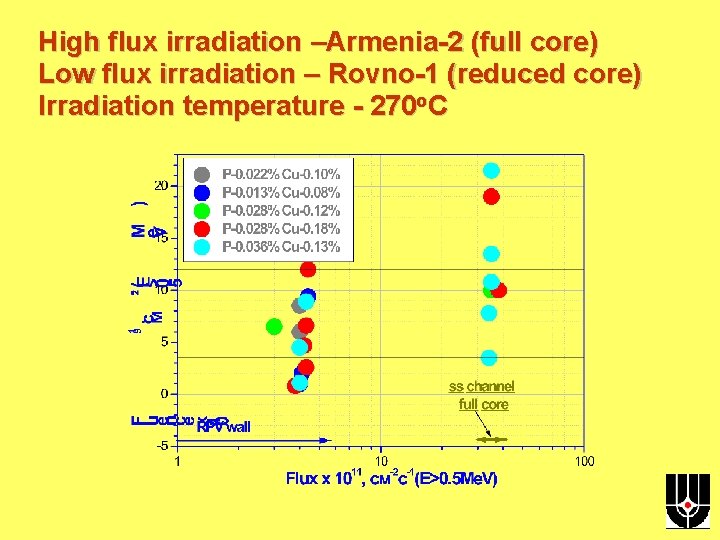
High flux irradiation –Аrmenia-2 (full core) Low flux irradiation – Rovno-1 (reduced core) Irradiation temperature - 270 о. С
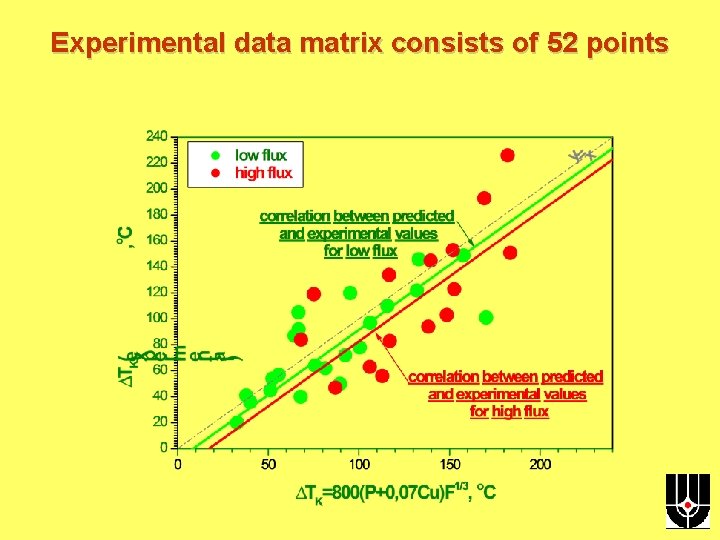
Experimental data matrix consists of 52 points
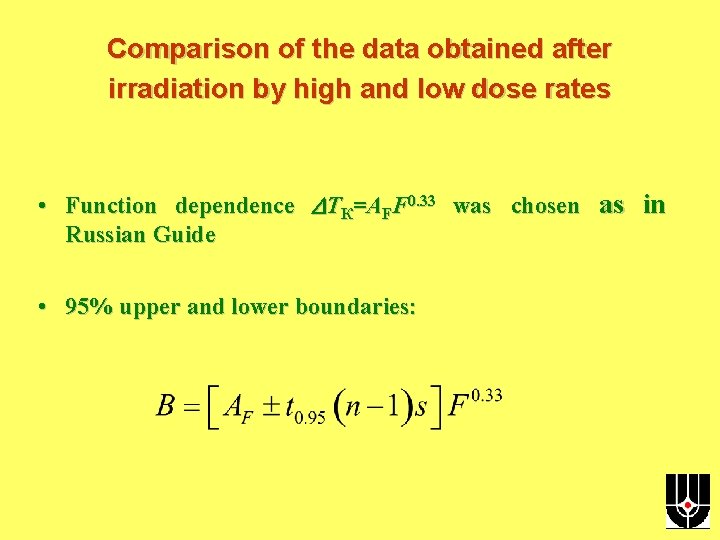
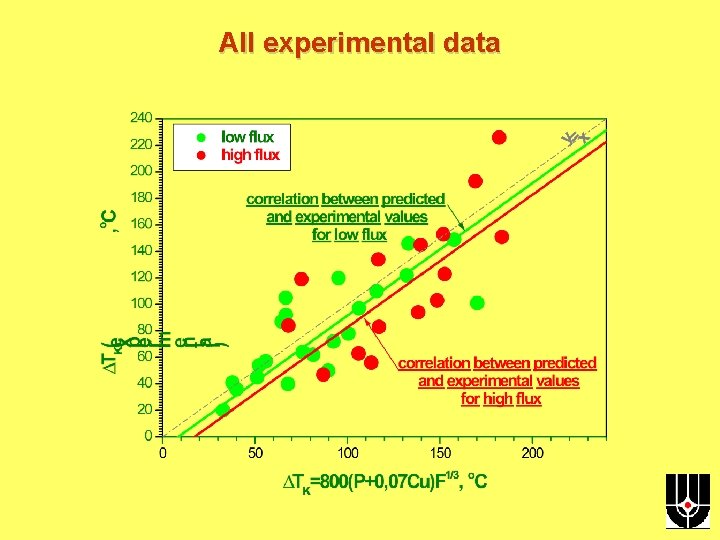
Comparison of the data obtained after irradiation by high and low dose rates • Function dependence DTК=AFF 0. 33 was chosen as in Russian Guide • 95% upper and lower boundaries:
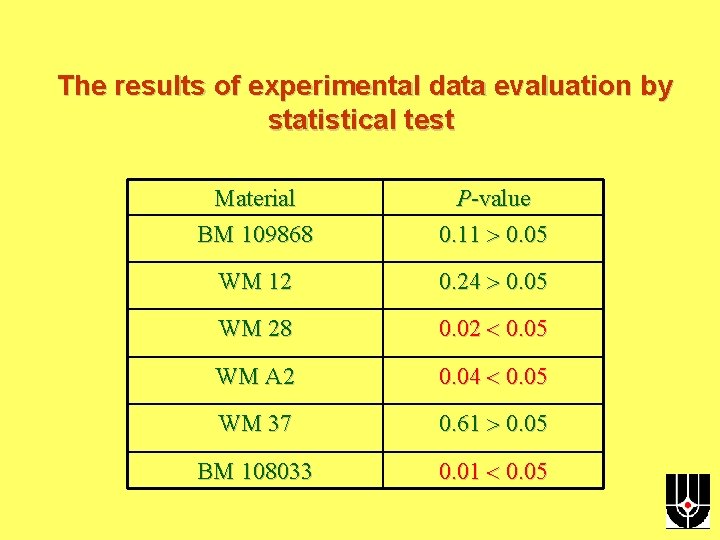
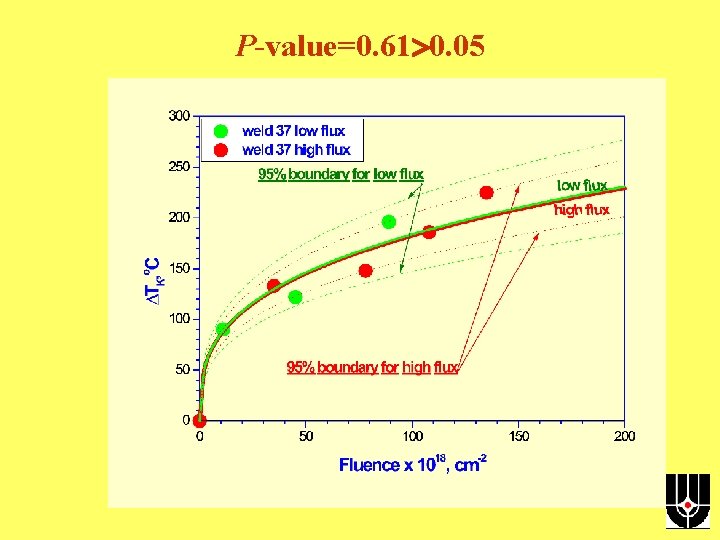
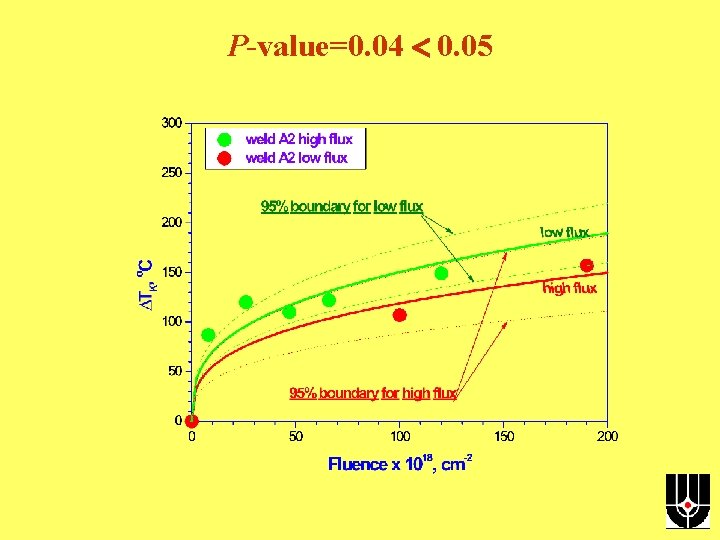
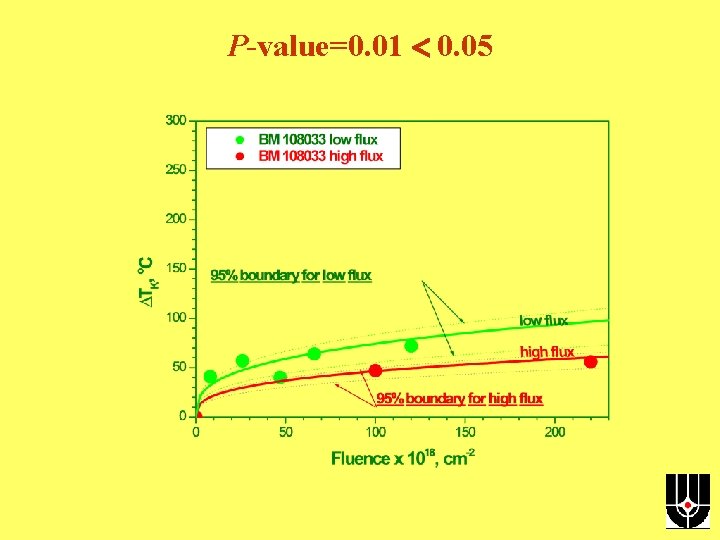
The statistical test was used for the evaluation of difference between high and low fluxes data • It tests the hypothesis that corresponding coefficients (AF) of two models are equal. • Small (< 0. 05) Р-values means that hypothesis should be rejected (on 95% significance level), and each data group should be described by its own model. • Otherwise two data groups should be described by one model.
The results of experimental data evaluation by statistical test Material BM 109868 Р-value 0. 11 0. 05 WМ 12 0. 24 0. 05 WМ 28 0. 02 0. 05 WМ А 2 0. 04 0. 05 WМ 37 0. 61 0. 05 BM 108033 0. 01 0. 05
Р-value=0. 61 0. 05
Р-value=0. 04 0. 05
Р-value=0. 01 0. 05
All experimental data
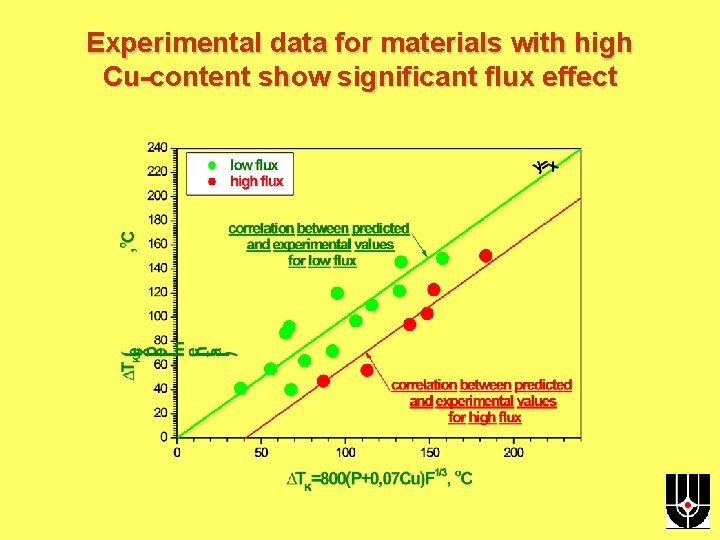
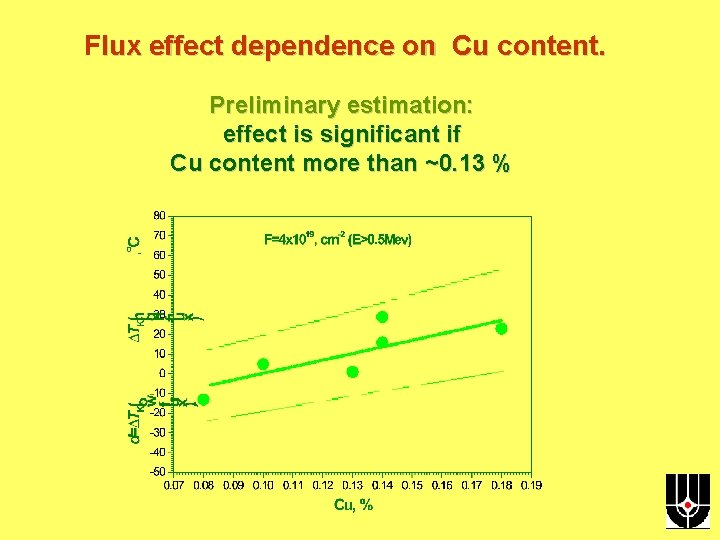
Experimental data for materials with high Cu-content show significant flux effect
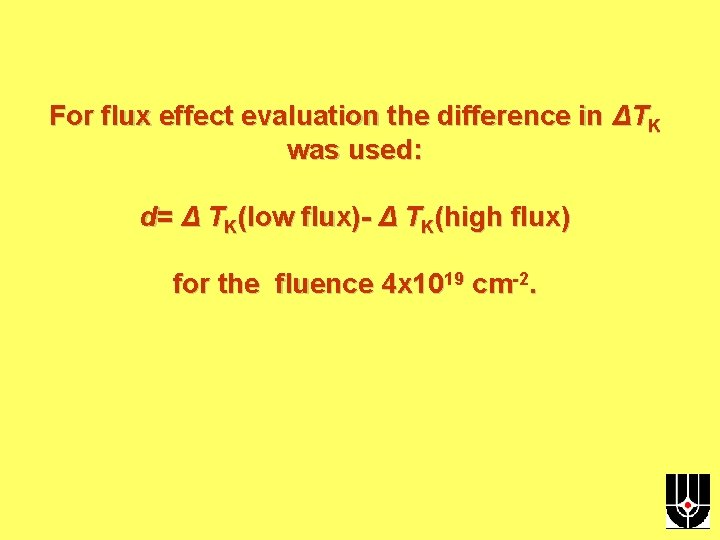
For flux effect evaluation the difference in ΔTK was used: d= Δ TK(low flux)- Δ TK(high flux) for the fluence 4 x 10¹⁹ сm-2.
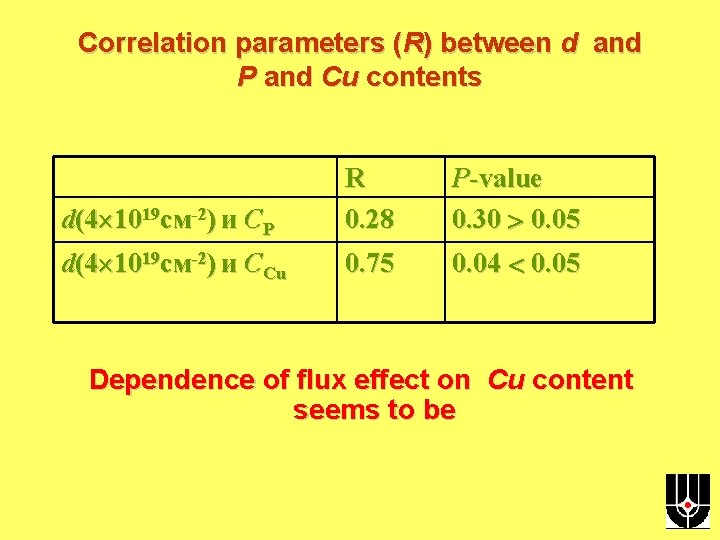
Correlation parameters (R) between d and P and Cu contents d(4 1019 cм-2) и СР R 0. 28 Р-value 0. 30 0. 05 d(4 1019 cм-2) и СCu 0. 75 0. 04 0. 05 Dependence of flux effect on Cu content seems to be
Flux effect dependence on Cu content. Preliminary estimation: effect is significant if Cu content more than ~0. 13 %
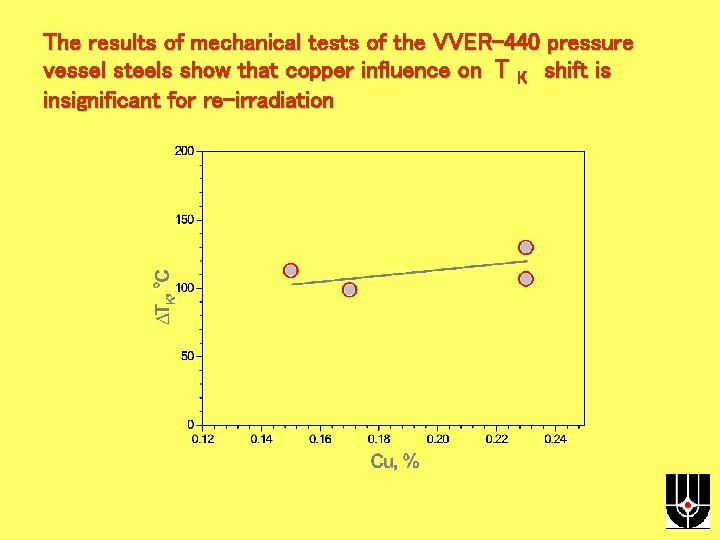
The results of mechanical tests of the VVER-440 pressure vessel steels show that copper influence on ТК shift is insignificant for re-irradiation
It agrees with the data of microstructural studies of the steels in irradiated annealed conditions, and after re-irradiation
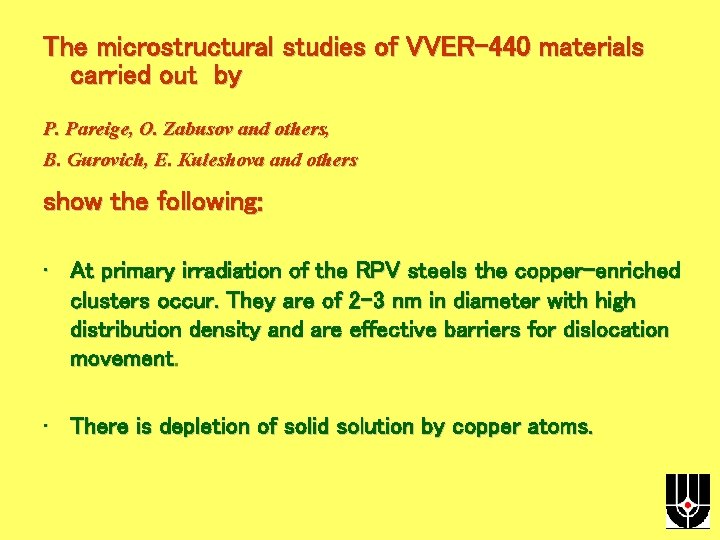
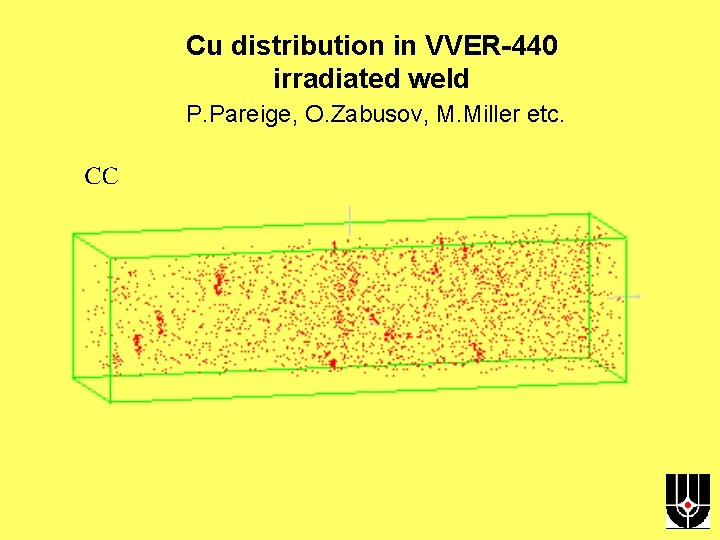
The microstructural studies of VVER-440 materials carried out by P. Pareige, O. Zabusov and others, B. Gurovich, Е. Кuleshova and others show the following: • At primary irradiation of the RPV steels the copper-enriched clusters occur. They are of 2 -3 nm in diameter with high distribution density and are effective barriers for dislocation movement. • There is depletion of solid solution by copper atoms.
Cu distribution in VVER-440 irradiated weld P. Pareige, O. Zabusov, M. Miller etc.
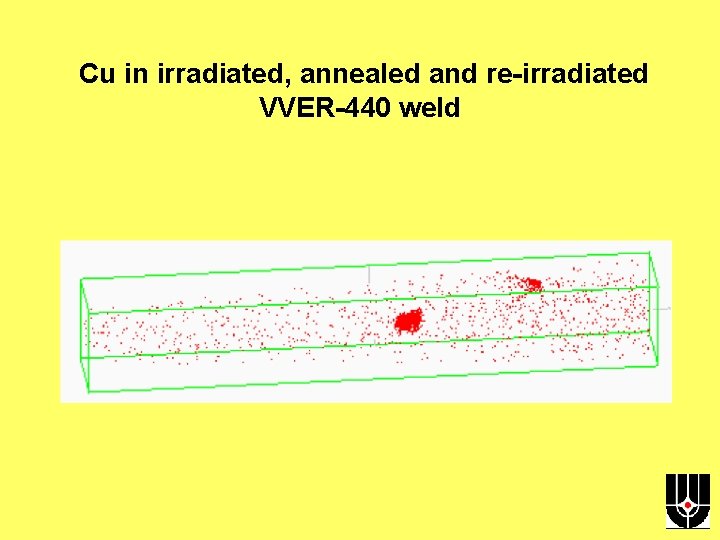
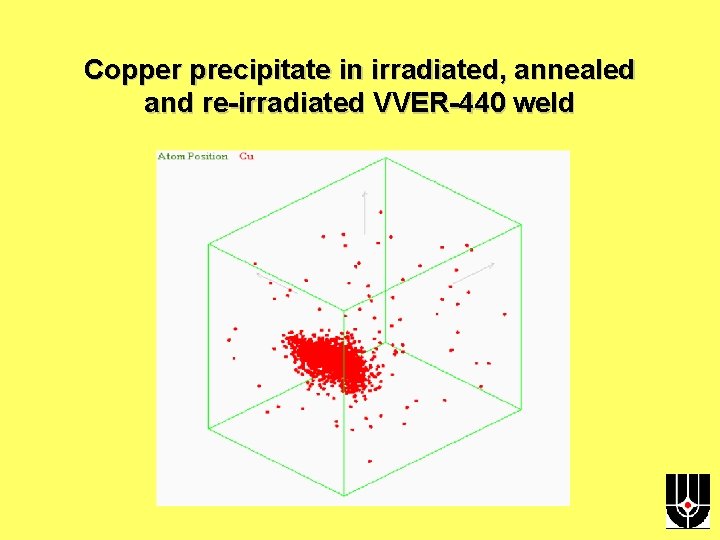
• Copper content does not change in solid solution during annealing, there is coagulation of copper-enriched clusters and formation of copper precipitates of diameter ~ 5 nm with much smaller distribution density. • Large copper precipitates formed during annealing are of low density • They are not effective barriers for dislocation movement • There is no more intensive formation of copper clusters at re-irradiation.
Cu in irradiated, annealed and re-irradiated VVER-440 weld
Copper precipitate in irradiated, annealed and re-irradiated VVER-440 weld
The dependence of transition temperature shift for VVER-440 pressure vessel materials on neutron flux is not expected under re-irradiation.
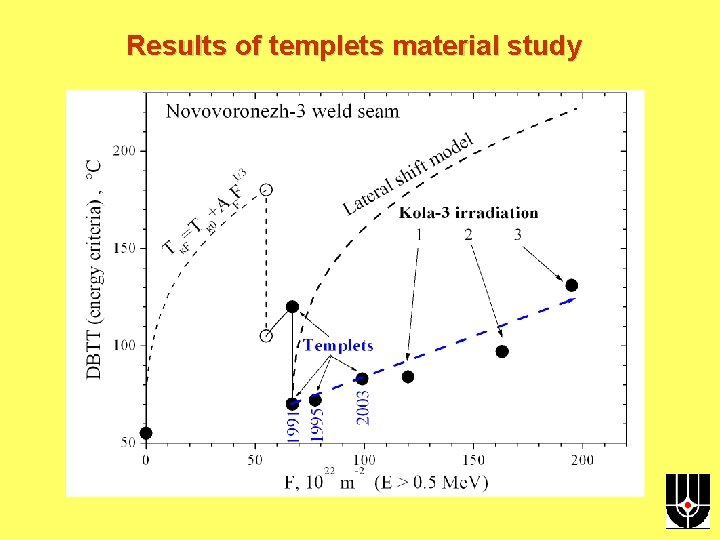
Results of templets material study
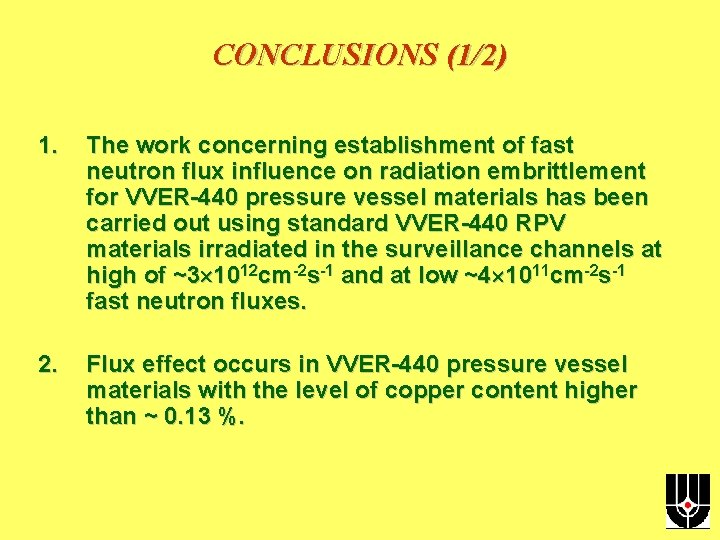
CONCLUSIONS (1/2) 1. The work concerning establishment of fast neutron flux influence on radiation embrittlement for VVER-440 pressure vessel materials has been carried out using standard VVER-440 RPV materials irradiated in the surveillance channels at high of ~3 1012 сm-2 s-1 and at low ~4 1011 сm-2 s-1 fast neutron fluxes. 2. Flux effect occurs in VVER-440 pressure vessel materials with the level of copper content higher than ~ 0. 13 %.
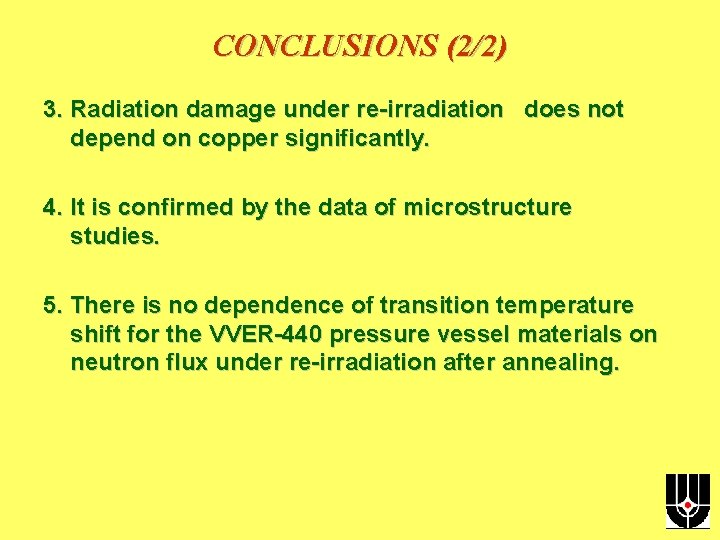
CONCLUSIONS (2/2) 3. Radiation damage under re-irradiation does not depend on copper significantly. 4. It is confirmed by the data of microstructure studies. 5. There is no dependence of transition temperature shift for the VVER-440 pressure vessel materials on neutron flux under re-irradiation after annealing.
The studies made within the last 10 years enables NPPs extend the life time of annealed units for 15 years with licensing for each 5 years
Line of the further works • The quantitative assessment of flux effect for different values of fluence is necessary for the solution of practical problems of VVER-440/213 lifetime assessment. • It requires development of models for radiation embrittlement under irradiation at high and at low fluxes in wide range of fluence , based on modern understanding of mechanisms of microstructural changes under irradiation.
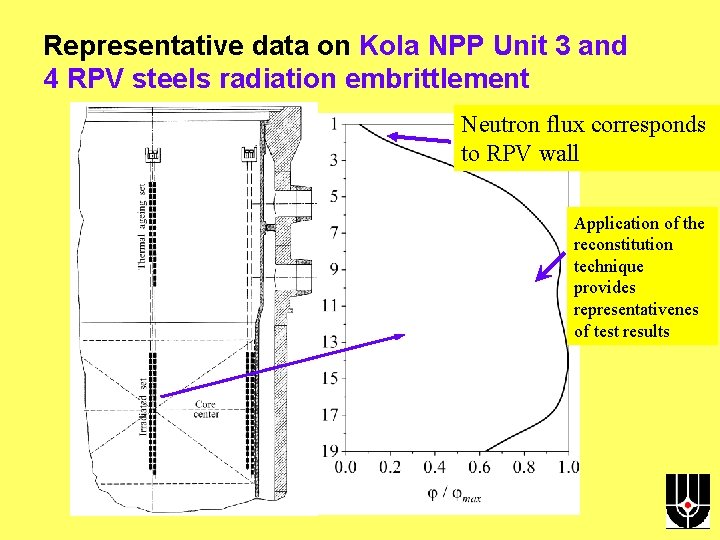
Representative data on Kola NPP Unit 3 and 4 RPV steels radiation embrittlement Neutron flux corresponds to RPV wall Application of the reconstitution technique provides representativenes of test results
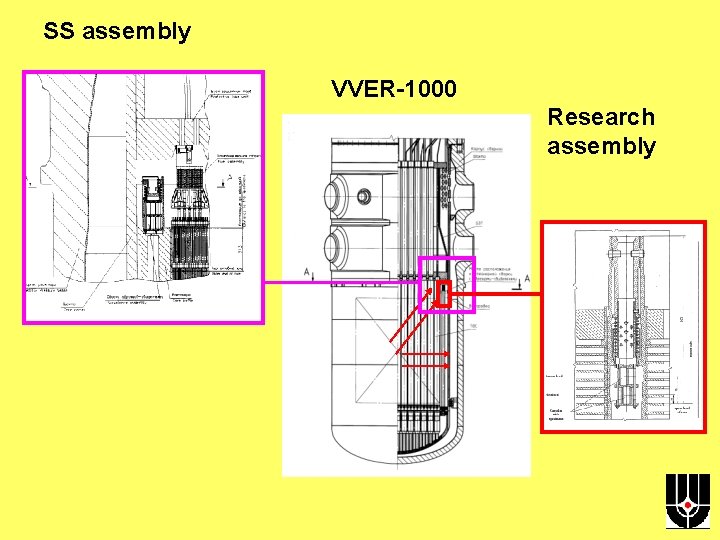
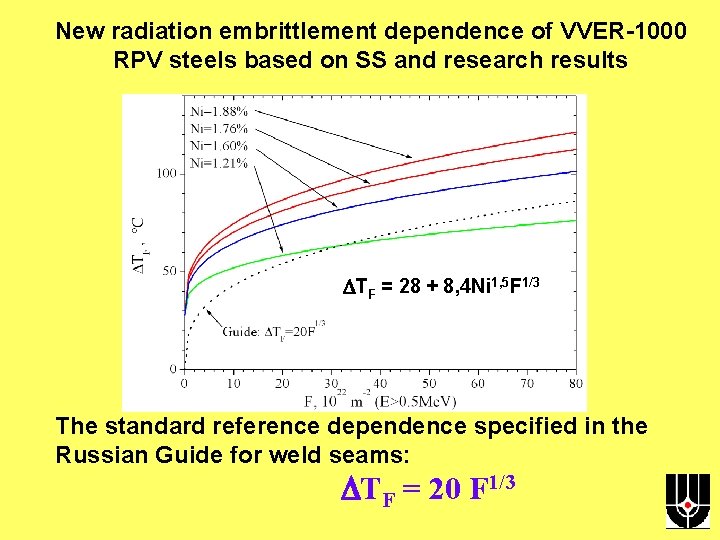
RPVs VVER-1000 Low P and Cu contents High Ni content in weld metal (Up to 1. 9 %) EOF depends on the primary Radiation Embrittlement Elaborating RE depends are based on SS and research results
SS assembly VVER-1000 Research assembly
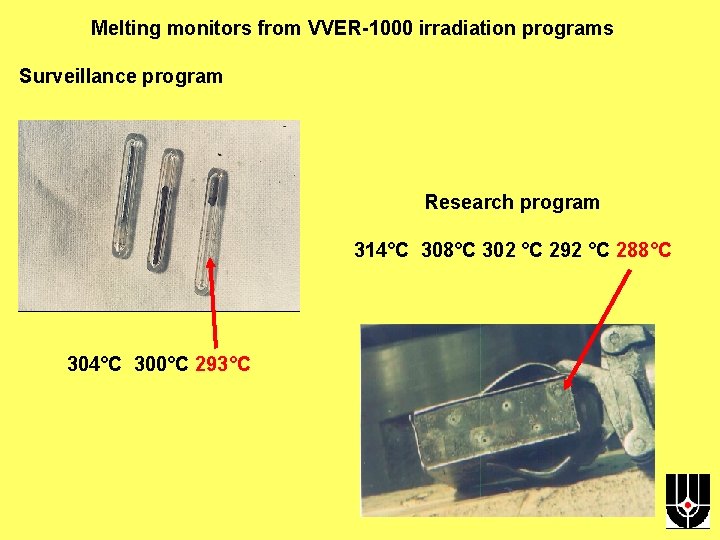
Melting monitors from VVER-1000 irradiation programs Surveillance program Research program 314°C 308°C 302 °C 292 °C 288°C 304°C 300°C 293°C
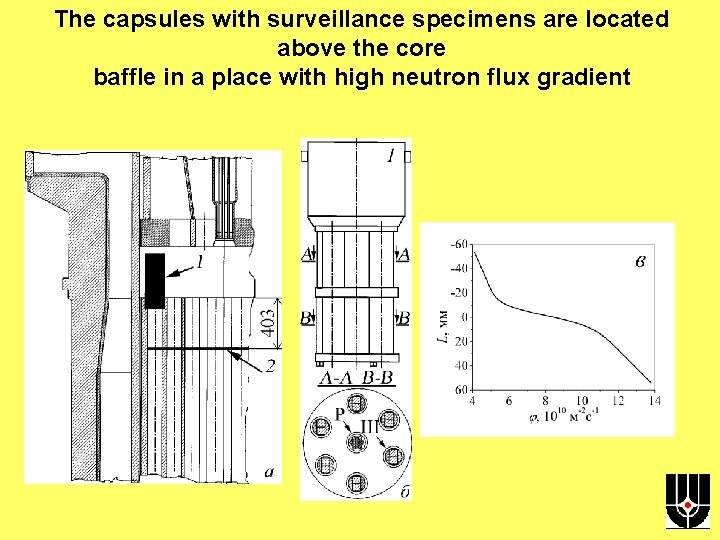
The capsules with surveillance specimens are located above the core baffle in a place with high neutron flux gradient
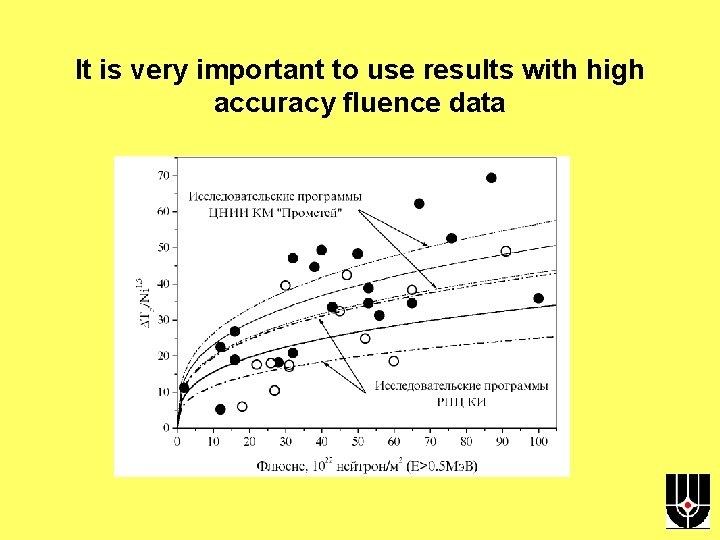
It is very important to use results with high accuracy fluence data
New radiation embrittlement dependence of VVER-1000 RPV steels based on SS and research results TF = 28 + 8, 4 Ni 1, 5 F 1/3 The standard reference dependence specified in the Russian Guide for weld seams: TF = 20 F 1/3