
INFLUENCE OF ANKLE FLEXIBILITY ON THE SINGLE LEG
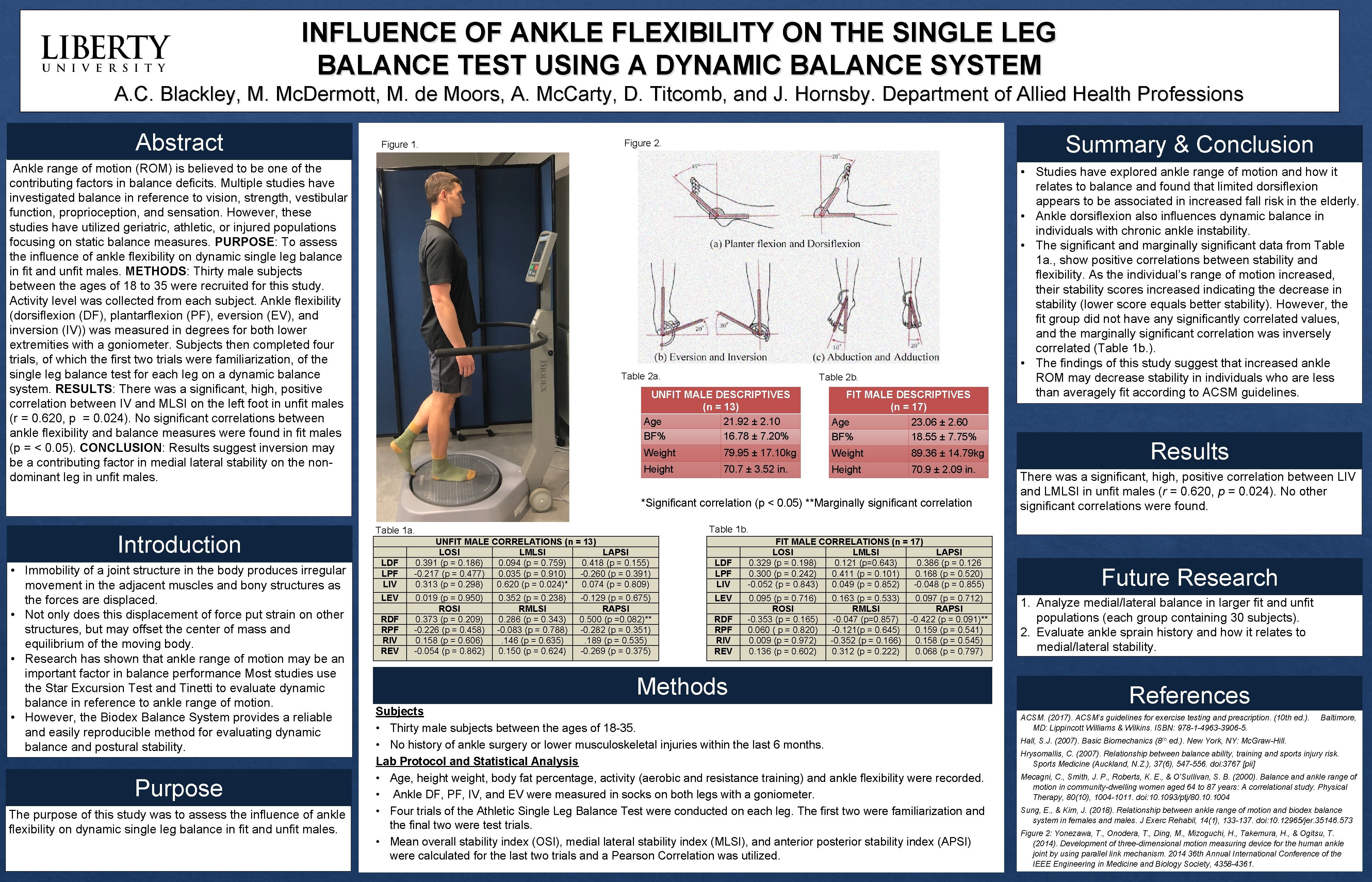
INFLUENCE OF ANKLE FLEXIBILITY ON THE SINGLE LEG BALANCE TEST USING A DYNAMIC BALANCE SYSTEM A. C. Blackley, M. Mc. Dermott, M. de Moors, A. Mc. Carty, D. Titcomb, and J. Hornsby. Department of Allied Health Professions Abstract Summary & Conclusion Figure 2. Figure 1. Ankle range of motion (ROM) is believed to be one of the contributing factors in balance deficits. Multiple studies have investigated balance in reference to vision, strength, vestibular function, proprioception, and sensation. However, these studies have utilized geriatric, athletic, or injured populations focusing on static balance measures. PURPOSE: To assess the influence of ankle flexibility on dynamic single leg balance in fit and unfit males. METHODS: Thirty male subjects between the ages of 18 to 35 were recruited for this study. Activity level was collected from each subject. Ankle flexibility (dorsiflexion (DF), plantarflexion (PF), eversion (EV), and inversion (IV)) was measured in degrees for both lower extremities with a goniometer. Subjects then completed four trials, of which the first two trials were familiarization, of the single leg balance test for each leg on a dynamic balance system. RESULTS: There was a significant, high, positive correlation between IV and MLSI on the left foot in unfit males (r = 0. 620, p = 0. 024). No significant correlations between ankle flexibility and balance measures were found in fit males (p = < 0. 05). CONCLUSION: Results suggest inversion may be a contributing factor in medial lateral stability on the nondominant leg in unfit males. Table 2 a. Table 2 b. UNFIT MALE DESCRIPTIVES (n = 13) Age 21. 92 ± 2. 10 BF% 16. 78 ± 7. 20% FIT MALE DESCRIPTIVES (n = 17) Age 23. 06 ± 2. 60 BF% 18. 55 ± 7. 75% Weight 79. 95 ± 17. 10 kg Weight 89. 36 ± 14. 79 kg Height 70. 7 ± 3. 52 in. Height 70. 9 ± 2. 09 in. *Significant correlation (p < 0. 05) **Marginally significant correlation Introduction • Immobility of a joint structure in the body produces irregular movement in the adjacent muscles and bony structures as the forces are displaced. • Not only does this displacement of force put strain on other structures, but may offset the center of mass and equilibrium of the moving body. • Research has shown that ankle range of motion may be an important factor in balance performance Most studies use the Star Excursion Test and Tinetti to evaluate dynamic balance in reference to ankle range of motion. • However, the Biodex Balance System provides a reliable and easily reproducible method for evaluating dynamic balance and postural stability. Purpose The purpose of this study was to assess the influence of ankle flexibility on dynamic single leg balance in fit and unfit males. LEV RDF RPF RIV REV UNFIT MALE CORRELATIONS (n = 13) LOSI LMLSI LAPSI 0. 391 (p = 0. 186) 0. 094 (p = 0. 759) 0. 418 (p = 0. 155) -0. 217 (p = 0. 477) 0. 035 (p = 0. 910) -0. 260 (p = 0. 391) 0. 313 (p = 0. 298) 0. 620 (p = 0. 024)* 0. 074 (p = 0. 809) 0. 019 (p = 0. 950) ROSI 0. 373 (p = 0. 209) -0. 226 (p = 0. 458) 0. 158 (p = 0. 606) -0. 054 (p = 0. 862) Results There was a significant, high, positive correlation between LIV and LMLSI in unfit males (r = 0. 620, p = 0. 024). No other significant correlations were found. Table 1 b. Table 1 a. LDF LPF LIV • Studies have explored ankle range of motion and how it relates to balance and found that limited dorsiflexion appears to be associated in increased fall risk in the elderly. • Ankle dorsiflexion also influences dynamic balance in individuals with chronic ankle instability. • The significant and marginally significant data from Table 1 a. , show positive correlations between stability and flexibility. As the individual’s range of motion increased, their stability scores increased indicating the decrease in stability (lower score equals better stability). However, the fit group did not have any significantly correlated values, and the marginally significant correlation was inversely correlated (Table 1 b. ). • The findings of this study suggest that increased ankle ROM may decrease stability in individuals who are less than averagely fit according to ACSM guidelines. 0. 352 (p = 0. 238) RMLSI 0. 286 (p = 0. 343) -0. 083 (p = 0. 788). 146 (p = 0. 635) 0. 150 (p = 0. 624) -0. 129 (p = 0. 675) RAPSI 0. 500 (p =0. 082)** -0. 282 (p = 0. 351). 189 (p = 0. 535) -0. 269 (p = 0. 375) LDF LPF LIV LEV RDF RPF RIV REV FIT MALE CORRELATIONS (n = 17) LOSI LMLSI LAPSI 0. 329 (p = 0. 198) 0. 121 (p=0. 643) 0. 386 (p = 0. 126 0. 300 (p = 0. 242) 0. 411 (p = 0. 101) 0. 168 (p = 0. 520) -0. 052 (p = 0. 843) 0. 049 (p = 0. 852) -0. 048 (p = 0. 855) 0. 095 (p = 0. 716) ROSI -0. 353 (p = 0. 165) 0. 060 ( p = 0. 820) 0. 009 (p = 0. 972) 0. 136 (p = 0. 602) 0. 163 (p = 0. 533) RMLSI -0. 047 (p=0. 857) -0. 121(p = 0. 645) -0. 352 (p = 0. 166) 0. 312 (p = 0. 222) 0. 097 (p = 0. 712) RAPSI -0. 422 (p = 0. 091)** 0. 159 (p = 0. 541) 0. 158 (p = 0. 545) 0. 068 (p = 0. 797) Methods Subjects • Thirty male subjects between the ages of 18 -35. • No history of ankle surgery or lower musculoskeletal injuries within the last 6 months. Lab Protocol and Statistical Analysis • Age, height weight, body fat percentage, activity (aerobic and resistance training) and ankle flexibility were recorded. • Ankle DF, PF, IV, and EV were measured in socks on both legs with a goniometer. • Four trials of the Athletic Single Leg Balance Test were conducted on each leg. The first two were familiarization and the final two were test trials. • Mean overall stability index (OSI), medial lateral stability index (MLSI), and anterior posterior stability index (APSI) were calculated for the last two trials and a Pearson Correlation was utilized. Future Research 1. Analyze medial/lateral balance in larger fit and unfit populations (each group containing 30 subjects). 2. Evaluate ankle sprain history and how it relates to medial/lateral stability. References ACSM. (2017). ACSM’s guidelines for exercise testing and prescription. (10 th ed. ). MD: Lippincott Williams & Wilkins. ISBN: 978 -1 -4963 -3906 -5. Baltimore, Hall, S. J. (2007). Basic Biomechanics (8 th ed. ). New York, NY: Mc. Graw-Hill. Hrysomallis, C. (2007). Relationship between balance ability, training and sports injury risk. Sports Medicine (Auckland, N. Z. ), 37(6), 547 -556. doi: 3767 [pii] Mecagni, C. , Smith, J. P. , Roberts, K. E. , & O'Sullivan, S. B. (2000). Balance and ankle range of motion in community-dwelling women aged 64 to 87 years: A correlational study. Physical Therapy, 80(10), 1004 -1011. doi: 10. 1093/ptj/80. 1004 Sung, E. , & Kim, J. (2018). Relationship between ankle range of motion and biodex balance system in females and males. J Exerc Rehabil, 14(1), 133 -137. doi: 10. 12965/jer. 35146. 573 Figure 2: Yonezawa, T. , Onodera, T. , Ding, M. , Mizoguchi, H. , Takemura, H. , & Ogitsu, T. (2014). Development of three-dimensional motion measuring device for the human ankle joint by using parallel link mechanism. 2014 36 th Annual International Conference of the IEEE Engineering in Medicine and Biology Society, 4358 -4361.
- Slides: 1