
Influence of Amorphous Phase Separation on the crystallization
- Slides: 1
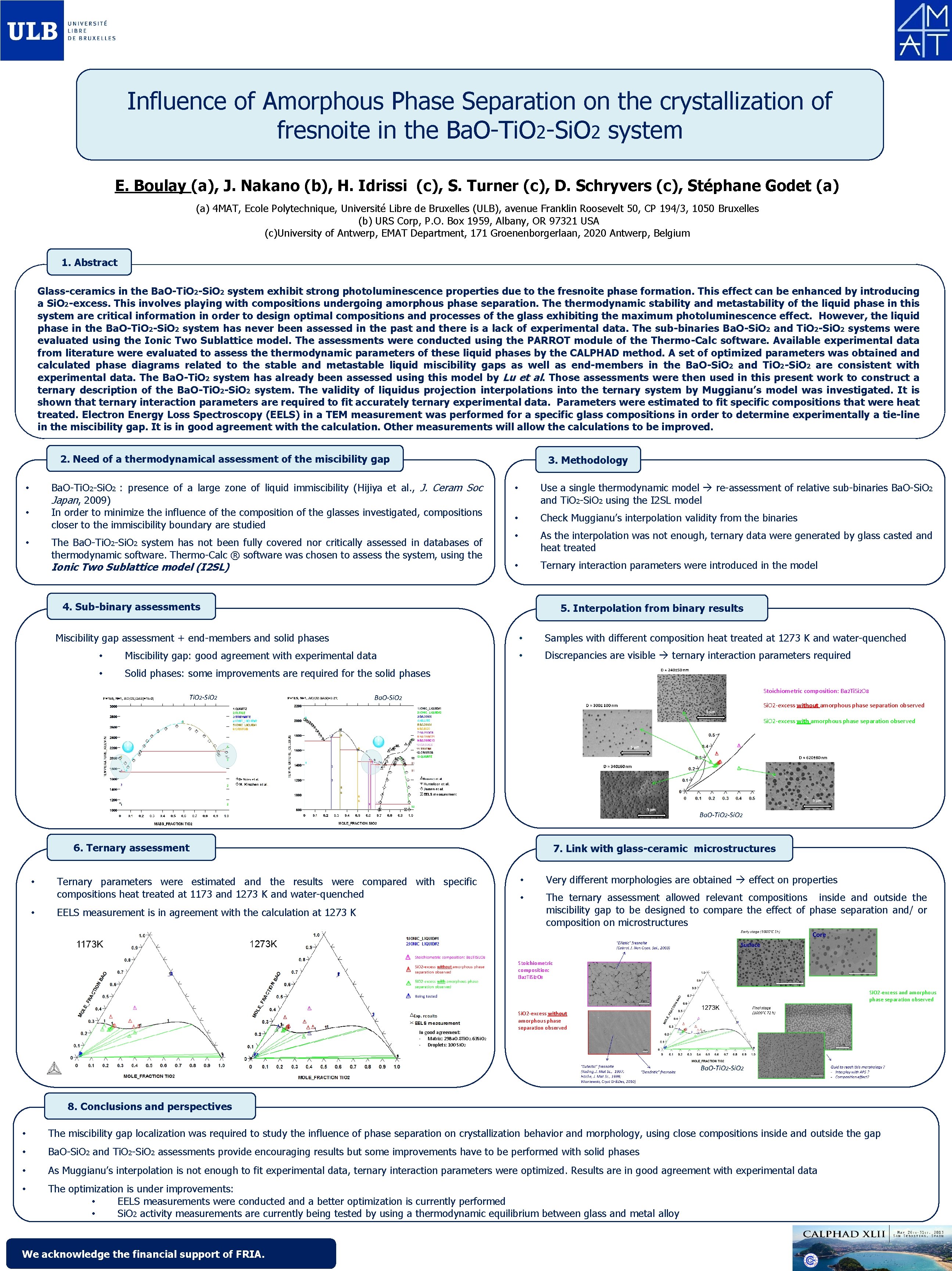
Influence of Amorphous Phase Separation on the crystallization of fresnoite in the Ba. O-Ti. O 2 -Si. O 2 system E. Boulay (a), J. Nakano (b), H. Idrissi (c), S. Turner (c), D. Schryvers (c), Stéphane Godet (a) 4 MAT, Ecole Polytechnique, Université Libre de Bruxelles (ULB), avenue Franklin Roosevelt 50, CP 194/3, 1050 Bruxelles (b) URS Corp, P. O. Box 1959, Albany, OR 97321 USA (c)University of Antwerp, EMAT Department, 171 Groenenborgerlaan, 2020 Antwerp, Belgium 1. Abstract Glass-ceramics in the Ba. O-Ti. O 2 -Si. O 2 system exhibit strong photoluminescence properties due to the fresnoite phase formation. This effect can be enhanced by introducing a Si. O 2 -excess. This involves playing with compositions undergoing amorphous phase separation. The thermodynamic stability and metastability of the liquid phase in this system are critical information in order to design optimal compositions and processes of the glass exhibiting the maximum photoluminescence effect. However, the liquid phase in the Ba. O-Ti. O 2 -Si. O 2 system has never been assessed in the past and there is a lack of experimental data. The sub-binaries Ba. O-Si. O 2 and Ti. O 2 -Si. O 2 systems were evaluated using the Ionic Two Sublattice model. The assessments were conducted using the PARROT module of the Thermo-Calc software. Available experimental data from literature were evaluated to assess thermodynamic parameters of these liquid phases by the CALPHAD method. A set of optimized parameters was obtained and calculated phase diagrams related to the stable and metastable liquid miscibility gaps as well as end-members in the Ba. O-Si. O 2 and Ti. O 2 -Si. O 2 are consistent with experimental data. The Ba. O-Ti. O 2 system has already been assessed using this model by Lu et al. Those assessments were then used in this present work to construct a ternary description of the Ba. O-Ti. O 2 -Si. O 2 system. The validity of liquidus projection interpolations into the ternary system by Muggianu’s model was investigated. It is shown that ternary interaction parameters are required to fit accurately ternary experimental data. Parameters were estimated to fit specific compositions that were heat treated. Electron Energy Loss Spectroscopy (EELS) in a TEM measurement was performed for a specific glass compositions in order to determine experimentally a tie-line in the miscibility gap. It is in good agreement with the calculation. Other measurements will allow the calculations to be improved. 2. Need of a thermodynamical assessment of the miscibility gap 3. Methodology Ba. O-Ti. O 2 -Si. O 2 : presence of a large zone of liquid immiscibility (Hijiya et al. , J. Ceram Soc Japan, 2009) In order to minimize the influence of the composition of the glasses investigated, compositions closer to the immiscibility boundary are studied • • The Ba. O-Ti. O 2 -Si. O 2 system has not been fully covered nor critically assessed in databases of thermodynamic software. Thermo-Calc ® software was chosen to assess the system, using the • Ionic Two Sublattice model (I 2 SL) • Use a single thermodynamic model re-assessment of relative sub-binaries Ba. O-Si. O 2 and Ti. O 2 -Si. O 2 using the I 2 SL model • Check Muggianu’s interpolation validity from the binaries • As the interpolation was not enough, ternary data were generated by glass casted and heat treated • Ternary interaction parameters were introduced in the model 4. Sub-binary assessments • 5. Interpolation from binary results Miscibility gap assessment + end-members and solid phases • Miscibility gap: good agreement with experimental data • Solid phases: some improvements are required for the solid phases Ti. O 2 -Si. O 2 • Samples with different composition heat treated at 1273 K and water-quenched • Discrepancies are visible ternary interaction parameters required Stoichiometric composition: Ba 2 Ti. Si 2 O 8 Ba. O-Si. O 2 -excess without amorphous phase separation observed Si. O 2 -excess with amorphous phase separation observed Ba. O-Ti. O 2 -Si. O 2 6. Ternary assessment • • 7. Link with glass-ceramic microstructures Ternary parameters were estimated and the results were compared with specific compositions heat treated at 1173 and 1273 K and water-quenched EELS measurement is in agreement with the calculation at 1273 K • Very different morphologies are obtained effect on properties • The ternary assessment allowed relevant compositions inside and outside the miscibility gap to be designed to compare the effect of phase separation and/ or composition on microstructures Ba. O-Ti. O 2 -Si. O 2 Stoichiometric composition: Ba 2 Ti. Si 2 O 8 Si. O 2 -excess and amorphous phase separation observed In good agreement: - Matrix: 29 Ba. O. 8 Ti. O 2. 63 Si. O 2 - Droplets: 100 Si. O 2 -excess without amorphous phase separation observed Ba. O-Ti. O 2 -Si. O 2 8. Conclusions and perspectives • The miscibility gap localization was required to study the influence of phase separation on crystallization behavior and morphology, using close compositions inside and outside the gap • Ba. O-Si. O 2 and Ti. O 2 -Si. O 2 assessments provide encouraging results but some improvements have to be performed with solid phases • As Muggianu’s interpolation is not enough to fit experimental data, ternary interaction parameters were optimized. Results are in good agreement with experimental data • The optimization is under improvements: • EELS measurements were conducted and a better optimization is currently performed • Si. O 2 activity measurements are currently being tested by using a thermodynamic equilibrium between glass and metal alloy We acknowledge the financial support of FRIA.