
Influence of Acid Treatment on Characterization And Methanol
- Slides: 1
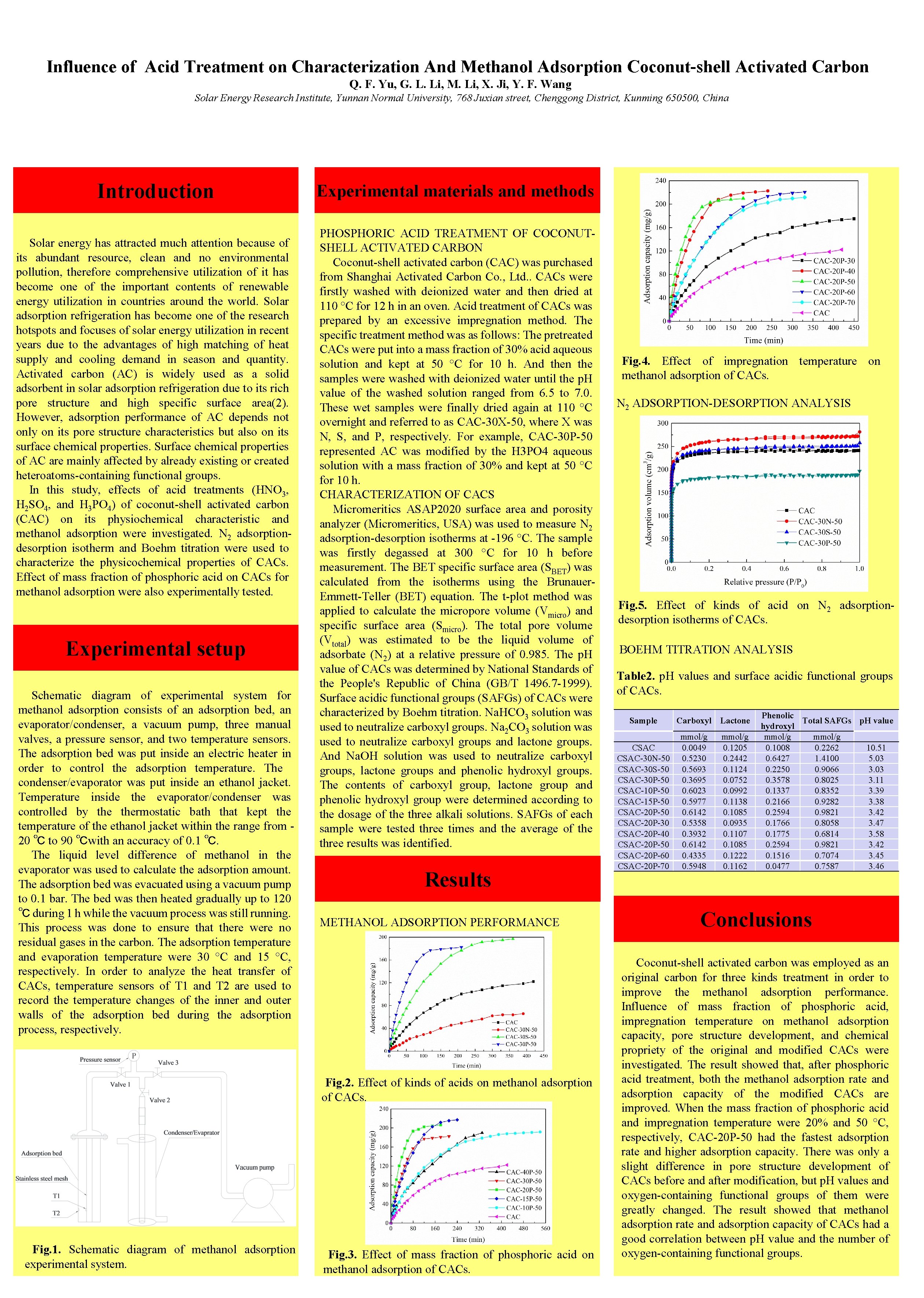
Influence of Acid Treatment on Characterization And Methanol Adsorption Coconut-shell Activated Carbon Q. F. Yu, G. L. Li, M. Li, X. Ji, Y. F. Wang Solar Energy Research Institute, Yunnan Normal University, 768 Juxian street, Chenggong District, Kunming 650500, China Introduction Solar energy has attracted much attention because of its abundant resource, clean and no environmental pollution, therefore comprehensive utilization of it has become one of the important contents of renewable energy utilization in countries around the world. Solar adsorption refrigeration has become one of the research hotspots and focuses of solar energy utilization in recent years due to the advantages of high matching of heat supply and cooling demand in season and quantity. Activated carbon (AC) is widely used as a solid adsorbent in solar adsorption refrigeration due to its rich pore structure and high specific surface area(2). However, adsorption performance of AC depends not only on its pore structure characteristics but also on its surface chemical properties. Surface chemical properties of AC are mainly affected by already existing or created heteroatoms-containing functional groups. In this study, effects of acid treatments (HNO 3, H 2 SO 4, and H 3 PO 4) of coconut-shell activated carbon (CAC) on its physiochemical characteristic and methanol adsorption were investigated. N 2 adsorptiondesorption isotherm and Boehm titration were used to characterize the physicochemical properties of CACs. Effect of mass fraction of phosphoric acid on CACs for methanol adsorption were also experimentally tested. Experimental setup Schematic diagram of experimental system for methanol adsorption consists of an adsorption bed, an evaporator/condenser, a vacuum pump, three manual valves, a pressure sensor, and two temperature sensors. The adsorption bed was put inside an electric heater in order to control the adsorption temperature. The condenser/evaporator was put inside an ethanol jacket. Temperature inside the evaporator/condenser was controlled by thermostatic bath that kept the temperature of the ethanol jacket within the range from 20 ℃ to 90 ℃with an accuracy of 0. 1 ℃. The liquid level difference of methanol in the evaporator was used to calculate the adsorption amount. The adsorption bed was evacuated using a vacuum pump to 0. 1 bar. The bed was then heated gradually up to 120 ℃ during 1 h while the vacuum process was still running. This process was done to ensure that there were no residual gases in the carbon. The adsorption temperature and evaporation temperature were 30 °C and 15 °C, respectively. In order to analyze the heat transfer of CACs, temperature sensors of T 1 and T 2 are used to record the temperature changes of the inner and outer walls of the adsorption bed during the adsorption process, respectively. Experimental materials and methods PHOSPHORIC ACID TREATMENT OF COCONUTSHELL ACTIVATED CARBON Coconut-shell activated carbon (CAC) was purchased from Shanghai Activated Carbon Co. , Ltd. . CACs were firstly washed with deionized water and then dried at 110 °C for 12 h in an oven. Acid treatment of CACs was prepared by an excessive impregnation method. The specific treatment method was as follows: The pretreated CACs were put into a mass fraction of 30% acid aqueous solution and kept at 50 °C for 10 h. And then the samples were washed with deionized water until the p. H value of the washed solution ranged from 6. 5 to 7. 0. These wet samples were finally dried again at 110 °C overnight and referred to as CAC-30 X-50, where X was N, S, and P, respectively. For example, CAC-30 P-50 represented AC was modified by the H 3 PO 4 aqueous solution with a mass fraction of 30% and kept at 50 °C for 10 h. CHARACTERIZATION OF CACS Micromeritics ASAP 2020 surface area and porosity analyzer (Micromeritics, USA) was used to measure N 2 adsorption-desorption isotherms at -196 °C. The sample was firstly degassed at 300 °C for 10 h before measurement. The BET specific surface area (SBET) was calculated from the isotherms using the Brunauer. Emmett-Teller (BET) equation. The t-plot method was applied to calculate the micropore volume (Vmicro) and specific surface area (Smicro). The total pore volume (Vtotal) was estimated to be the liquid volume of adsorbate (N 2) at a relative pressure of 0. 985. The p. H value of CACs was determined by National Standards of the People's Republic of China (GB/T 1496. 7 -1999). Surface acidic functional groups (SAFGs) of CACs were characterized by Boehm titration. Na. HCO 3 solution was used to neutralize carboxyl groups. Na 2 CO 3 solution was used to neutralize carboxyl groups and lactone groups. And Na. OH solution was used to neutralize carboxyl groups, lactone groups and phenolic hydroxyl groups. The contents of carboxyl group, lactone group and phenolic hydroxyl group were determined according to the dosage of the three alkali solutions. SAFGs of each sample were tested three times and the average of the three results was identified. Results METHANOL ADSORPTION PERFORMANCE Fig. 2. Effect of kinds of acids on methanol adsorption of CACs. Fig. 1. Schematic diagram of methanol adsorption experimental system. Fig. 3. Effect of mass fraction of phosphoric acid on methanol adsorption of CACs. Fig. 4. Effect of impregnation temperature on methanol adsorption of CACs. N 2 ADSORPTION-DESORPTION ANALYSIS Fig. 5. Effect of kinds of acid on N 2 adsorptiondesorption isotherms of CACs. BOEHM TITRATION ANALYSIS Table 2. p. H values and surface acidic functional groups of CACs. Sample CSAC-30 N-50 CSAC-30 S-50 CSAC-30 P-50 CSAC-15 P-50 CSAC-20 P-30 CSAC-20 P-40 CSAC-20 P-50 CSAC-20 P-60 CSAC-20 P-70 Carboxyl Lactone mmol/g 0. 0049 0. 5230 0. 5693 0. 3695 0. 6023 0. 5977 0. 6142 0. 5358 0. 3932 0. 6142 0. 4335 0. 5948 mmol/g 0. 1205 0. 2442 0. 1124 0. 0752 0. 0992 0. 1138 0. 1085 0. 0935 0. 1107 0. 1085 0. 1222 0. 1162 Phenolic Total SAFGs p. H value hydroxyl mmol/g 0. 1008 0. 2262 10. 51 0. 6427 1. 4100 5. 03 0. 2250 0. 9066 3. 03 0. 3578 0. 8025 3. 11 0. 1337 0. 8352 3. 39 0. 2166 0. 9282 3. 38 0. 2594 0. 9821 3. 42 0. 1766 0. 8058 3. 47 0. 1775 0. 6814 3. 58 0. 2594 0. 9821 3. 42 0. 1516 0. 7074 3. 45 0. 0477 0. 7587 3. 46 Conclusions Coconut-shell activated carbon was employed as an original carbon for three kinds treatment in order to improve the methanol adsorption performance. Influence of mass fraction of phosphoric acid, impregnation temperature on methanol adsorption capacity, pore structure development, and chemical propriety of the original and modified CACs were investigated. The result showed that, after phosphoric acid treatment, both the methanol adsorption rate and adsorption capacity of the modified CACs are improved. When the mass fraction of phosphoric acid and impregnation temperature were 20% and 50 °C, respectively, CAC-20 P-50 had the fastest adsorption rate and higher adsorption capacity. There was only a slight difference in pore structure development of CACs before and after modification, but p. H values and oxygen-containing functional groups of them were greatly changed. The result showed that methanol adsorption rate and adsorption capacity of CACs had a good correlation between p. H value and the number of oxygen-containing functional groups.