
Influence Empowerment and Organisational Politics An overview Influence
- Slides: 18
Influence, Empowerment and Organisational Politics An overview - Influence - Empowerment - politics
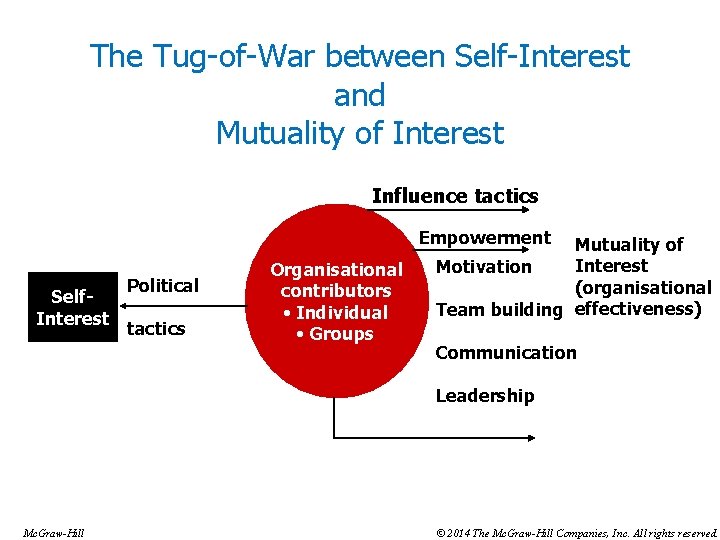
The Tug-of-War between Self-Interest and Mutuality of Interest Influence tactics Empowerment Self. Interest Political tactics Organisational contributors • Individual • Groups Mutuality of Interest Motivation (organisational Team building effectiveness) Communication Leadership Mc. Graw-Hill © 2014 The Mc. Graw-Hill Companies, Inc. All rights reserved.
Generic Influence Tactics 1) Rational persuasion 2) Inspirational appeals 3) Consultation 4) Ingratiation 5) Personal appeals 6) Exchange 7) Coalition tactics 8) Pressure 9) Legitimising tactics Mc. Graw-Hill © 2014 The Mc. Graw-Hill Companies, Inc. All rights reserved.
How to Do a Better Job of Influencing and Persuading Others 1) Liking people tend to like those who like them 2) Reciprocity the belief that both good and bad deeds should be repaid in kind—virtually universal 3) Social proof people tend to follow the lead of those most like themselves 4) Consistency people tend to do what they are personally committed to do 5) Authority people tend to defer to and respect credible experts 6) Scarcity people want items, information, and opportunities that have limited availability Mc. Graw-Hill © 2014 The Mc. Graw-Hill Companies, Inc. All rights reserved.
POWER • • • DEFINITION WHO POWER vs AUTHORITY POWER & LEADERSHIP DEPENDENCY – IMPORTANCE – SCARCITY – NON-SUBSTITUTABILITY
Five Bases of Power 1) 2) 3) 4) 5) Mc. Graw-Hill Reward Power Coercive Power Legitimate Power Expert Power Referent Power © 2014 The Mc. Graw-Hill Companies, Inc. All rights reserved.
Types of Power § § Mc. Graw-Hill Socialised Power directed at helping others (why are women more inclined to use socialised power than men? ) Personalised Power directed at helping oneself (Why are men more inclined to use personalised power than women? ) © 2014 The Mc. Graw-Hill Companies, Inc. All rights reserved.
Empowerment • Empowerment sharing varying degrees of power with lower-level employees to tap their full potential Mc. Graw-Hill © 2014 The Mc. Graw-Hill Companies, Inc. All rights reserved.
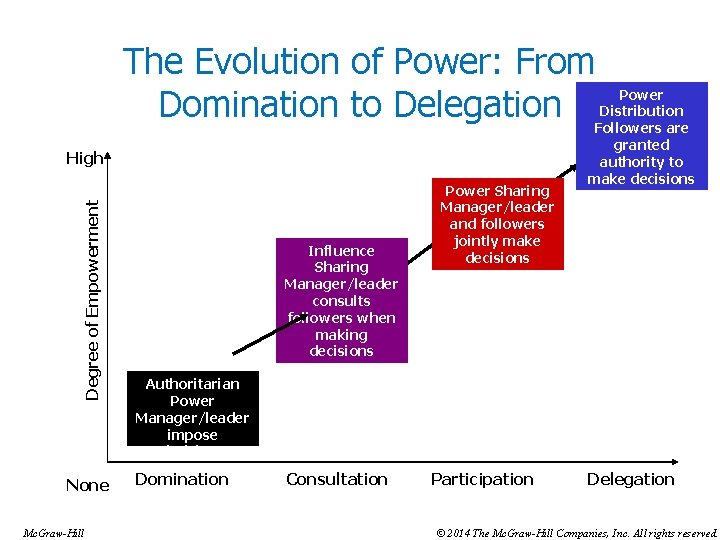
The Evolution of Power: From Domination to Delegation Degree of Empowerment High None Mc. Graw-Hill Influence Sharing Manager/leader consults followers when making decisions Power Sharing Manager/leader and followers jointly make decisions Power Distribution Followers are granted authority to make decisions Authoritarian Power Manager/leader impose decisions Domination Consultation Participation Delegation © 2014 The Mc. Graw-Hill Companies, Inc. All rights reserved.
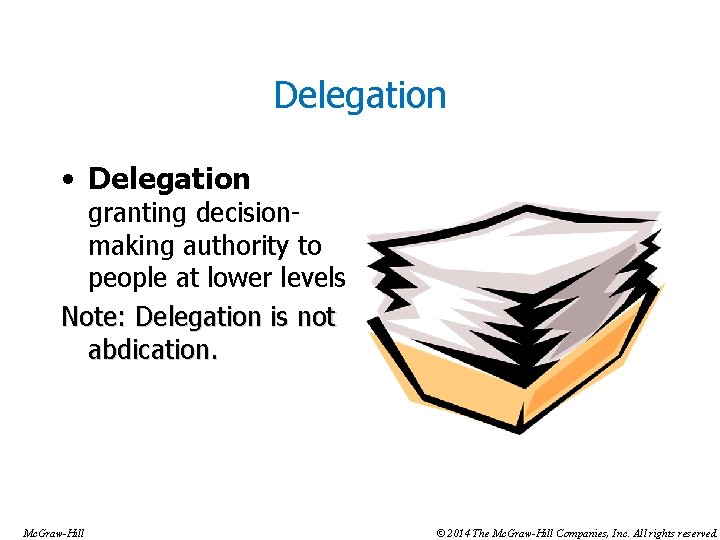
Delegation • Delegation granting decisionmaking authority to people at lower levels Note: Delegation is not abdication. Mc. Graw-Hill © 2014 The Mc. Graw-Hill Companies, Inc. All rights reserved.
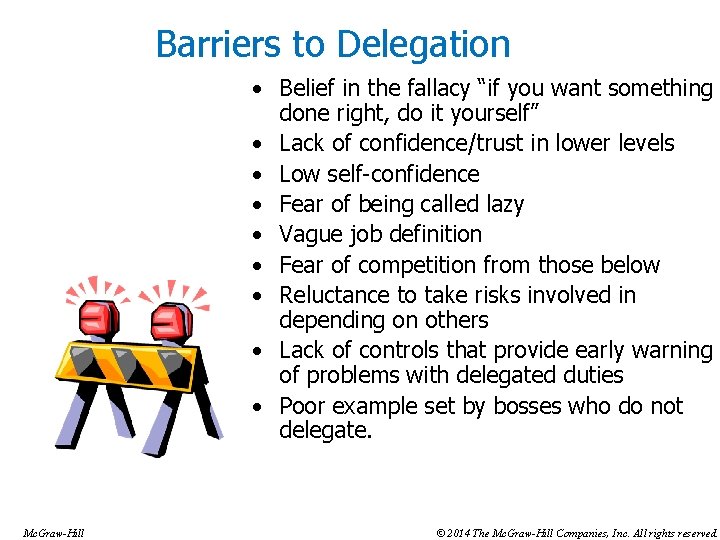
Barriers to Delegation • Belief in the fallacy “if you want something done right, do it yourself” • Lack of confidence/trust in lower levels • Low self-confidence • Fear of being called lazy • Vague job definition • Fear of competition from those below • Reluctance to take risks involved in depending on others • Lack of controls that provide early warning of problems with delegated duties • Poor example set by bosses who do not delegate. Mc. Graw-Hill © 2014 The Mc. Graw-Hill Companies, Inc. All rights reserved.
• POWER TACTICS – – – – REASON FRIENDLINESS COALITION BARGAINING ASSERTIVENESS HIGHER AUTHORITY SANCTIONS • POWER RELATIONS • POWERLESSNESS
Organisational Politics • Organisational Politics intentional enhancement of selfinterest • What does research tell us? Mc. Graw-Hill © 2014 The Mc. Graw-Hill Companies, Inc. All rights reserved.
Political behaviours/activities • LEGITIMATE & ILLEGITIMATE BEHAVIOUR • MANAGERS’ ACTIVITIES • INDIVIDUAL FACTORS • POLITICAL BEHAVIOUR
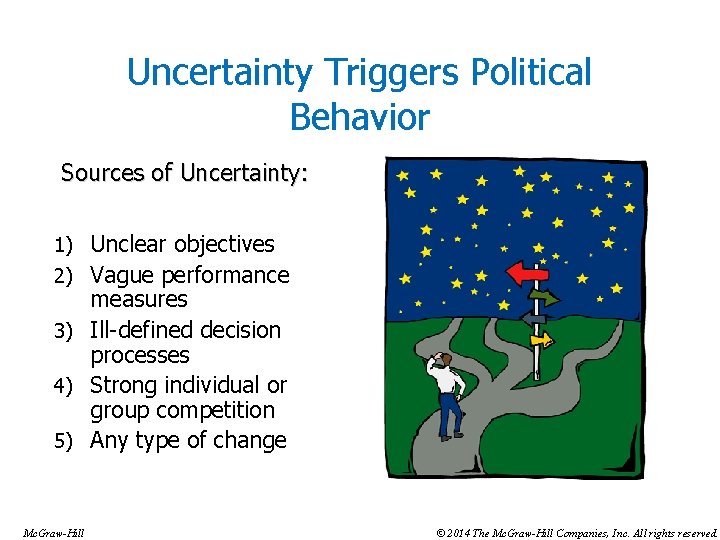
Uncertainty Triggers Political Behavior Sources of Uncertainty: 1) Unclear objectives 2) Vague performance measures 3) Ill-defined decision processes 4) Strong individual or group competition 5) Any type of change Mc. Graw-Hill © 2014 The Mc. Graw-Hill Companies, Inc. All rights reserved.
Political Tactics 1) Attacking or blaming others 2) Using information as a political tool 3) Creating a favourable image (impression management) 4) Developing a base of support 5) Praising others (ingratiation) 6) Forming political coalitions with strong allies 7) Associating with influential people 8) Creating obligations (reciprocity) Mc. Graw-Hill © 2014 The Mc. Graw-Hill Companies, Inc. All rights reserved.
Impression Management • Impression Management getting others to see us in a certain manner Mc. Graw-Hill © 2014 The Mc. Graw-Hill Companies, Inc. All rights reserved.
• POLITICAL BLUNDERS • MANAGING POLITICAL BEHAVIOUR • COPING WITH POLITICS Reading for next week: Textbook chapter 16.