
Influence Diagram Modeling of Decision Making in a

- Slides: 4
Influence Diagram Modeling of Decision Making in a Dynamic Game Setting Kai Virtanen, Tuomas Raivio and Raimo P. Hämäläinen Systems Analysis Laboratory Helsinki University of Technology S ystems Analysis Laboratory Helsinki University of Technology 1
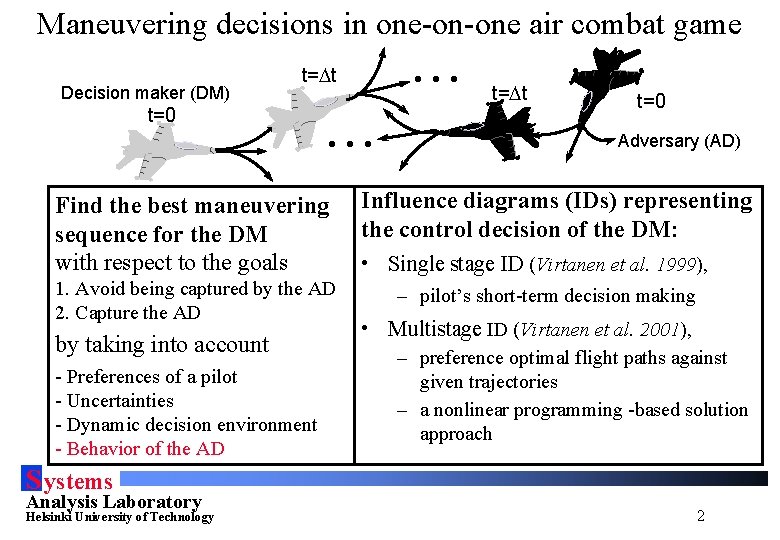
Maneuvering decisions in one-on-one air combat game Decision maker (DM) t=Dt t=0 ¼ Find the best maneuvering sequence for the DM with respect to the goals 1. Avoid being captured by the AD 2. Capture the AD by taking into account - Preferences of a pilot - Uncertainties - Dynamic decision environment - Behavior of the AD ¼ t=Dt t=0 Adversary (AD) Influence diagrams (IDs) representing the control decision of the DM: • Single stage ID (Virtanen et al. 1999), – pilot’s short-term decision making • Multistage ID (Virtanen et al. 2001), – preference optimal flight paths against given trajectories – a nonlinear programming -based solution approach S ystems Analysis Laboratory Helsinki University of Technology 2
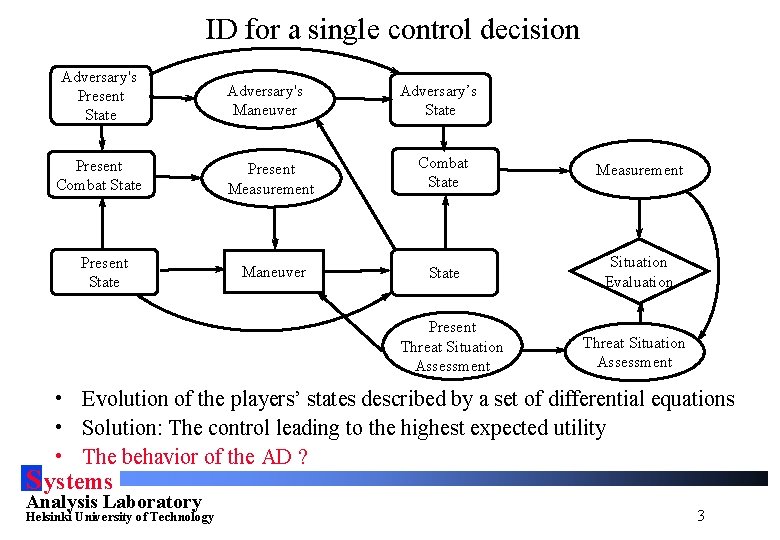
ID for a single control decision Adversary's Present State Present Combat State Present State Adversary's Maneuver Adversary’s State Present Measurement Combat State Measurement Maneuver State Situation Evaluation Present Threat Situation Assessment • Evolution of the players’ states described by a set of differential equations • Solution: The control leading to the highest expected utility • The behavior of the AD ? S ystems Analysis Laboratory Helsinki University of Technology 3
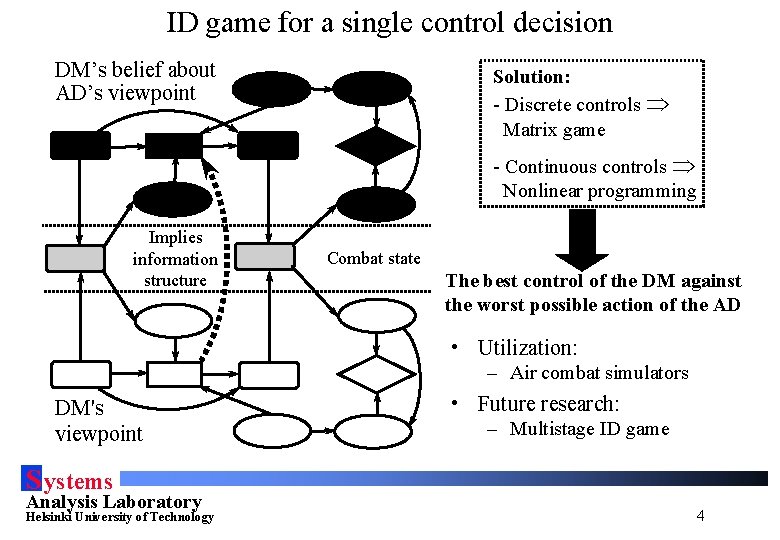
ID game for a single control decision DM’s belief about AD’s viewpoint Solution: - Discrete controls Þ Matrix game - Continuous controls Þ Nonlinear programming Implies information structure Combat state The best control of the DM against the worst possible action of the AD • Utilization: – Air combat simulators DM's viewpoint • Future research: – Multistage ID game S ystems Analysis Laboratory Helsinki University of Technology 4