
Inflight neutral kaon beams for precision kaon decay
In-flight neutral kaon beams for precision kaon decay studies L. Littenberg 17 April 2013
KL Beam Desiderata • • Pure (no neutrons or other unwanted particles) Mono-energetic Energy adjustable between 200 Me. V and 70 Ge. V Adjustable solid angle, each dimension for 0. 1 mr to 100 mr Time structure adjustable from dead flat to 10 ps bunches spaced by an adjustable interval, 10 ns to 100 ns Macro duty-cycle 100% Instantaneous intensity adjustable up to 1 GHz Thank you!
KL Beam Desiderata -2 • Actually most of these characteristics have been achieved or at least shown to be possible in simulation. • Just not all at the same time or in the same beamline. • Most of the work has_ been directed at observing and measuring KL 0 • The pure CP-violating, so-called “golden mode”, most attractive target in the kaon system • Terrible signature, BR < 10 -10, a real challenge!
_ The Challenge of KL 0 • “Nothing in – Nothing out” _ 0 • B(KL ) ~ 3 10 -11, need huge flux of K’s – rates inevitably rather high • Kinematic signature weak (2 particles undetectable) • Backgrounds with 0 up to 1010 times larger – e. g. KL 0 0 where one 0 or one from each 0 is lost. • Veto inefficiency on extra particles must be 10 -4 • Most “K” beams have huge flux of neutrons – can make 0 off residual gas – require high vacuum – halo must be very small – hermeticity requires photon veto in this beam • Need convincing measurement of background 4
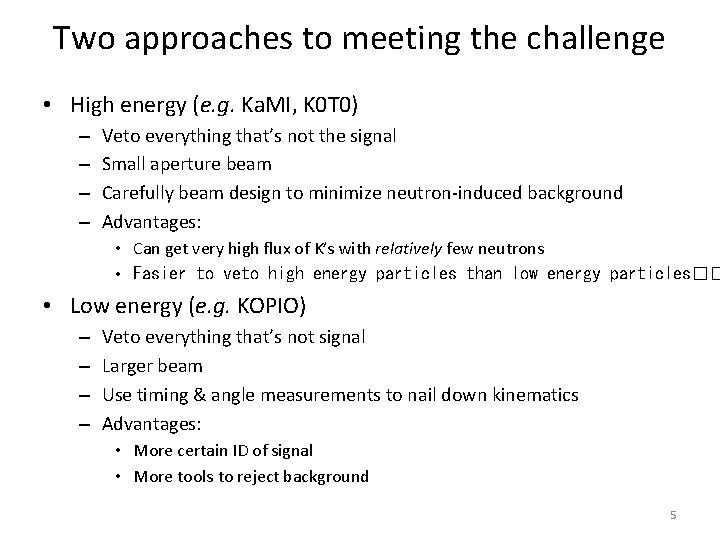
Two approaches to meeting the challenge • High energy (e. g. Ka. MI, K 0 T 0) – – Veto everything that’s not the signal Small aperture beam Carefully beam design to minimize neutron-induced background Advantages: • Can get very high flux of K’s with relatively few neutrons • Easier to veto high energy particles than low energy particles�� • Low energy (e. g. KOPIO) – – Veto everything that’s not signal Larger beam Use timing & angle measurements to nail down kinematics Advantages: • More certain ID of signal • More tools to reject background 5
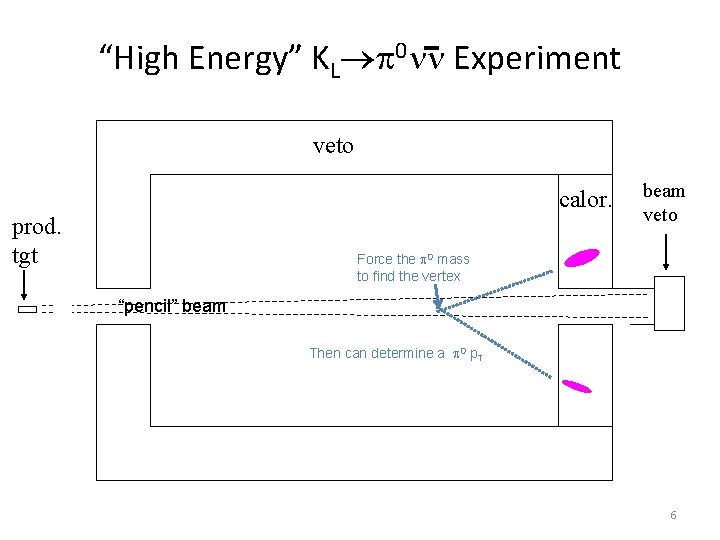
“High Energy” KL 0 Experiment veto calor. prod. tgt beam veto Force the 0 mass to find the vertex “pencil” beam Then can determine a 0 p. T 6
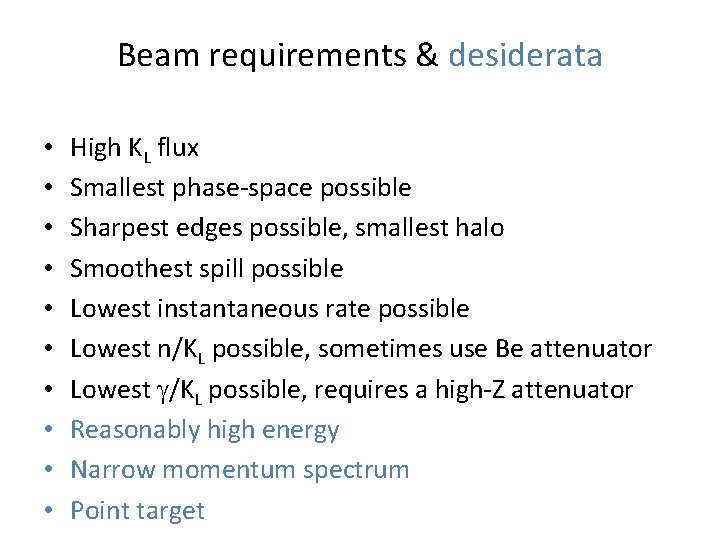
Beam requirements & desiderata • • • High KL flux Smallest phase-space possible Sharpest edges possible, smallest halo Smoothest spill possible Lowest instantaneous rate possible Lowest n/KL possible, sometimes use Be attenuator Lowest /KL possible, requires a high-Z attenuator Reasonably high energy Narrow momentum spectrum Point target
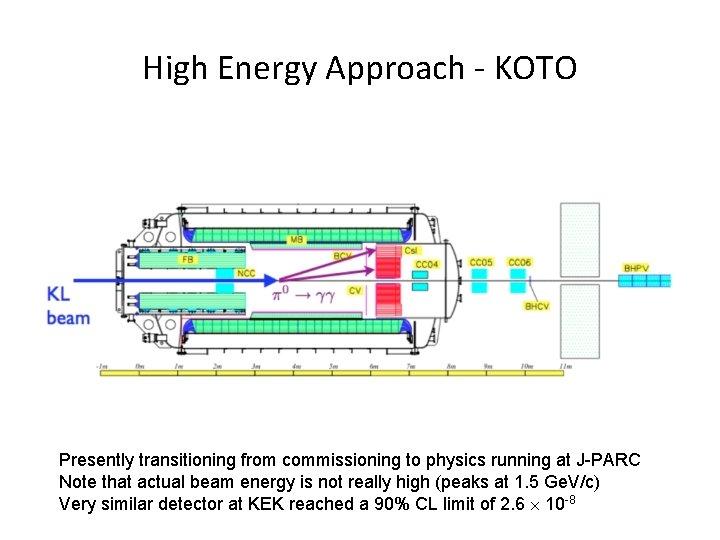
High Energy Approach - KOTO Presently transitioning from commissioning to physics running at J-PARC Note that actual beam energy is not really high (peaks at 1. 5 Ge. V/c) Very similar detector at KEK reached a 90% CL limit of 2. 6 10 -8
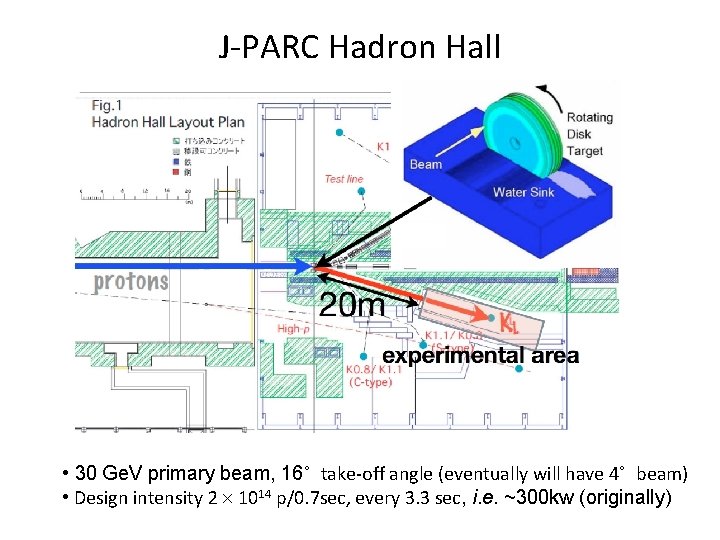
J-PARC Hadron Hall • 30 Ge. V primary beam, 16˚ take-off angle (eventually will have 4˚ beam) • Design intensity 2 1014 p/0. 7 sec, every 3. 3 sec, i. e. ~300 kw (originally)
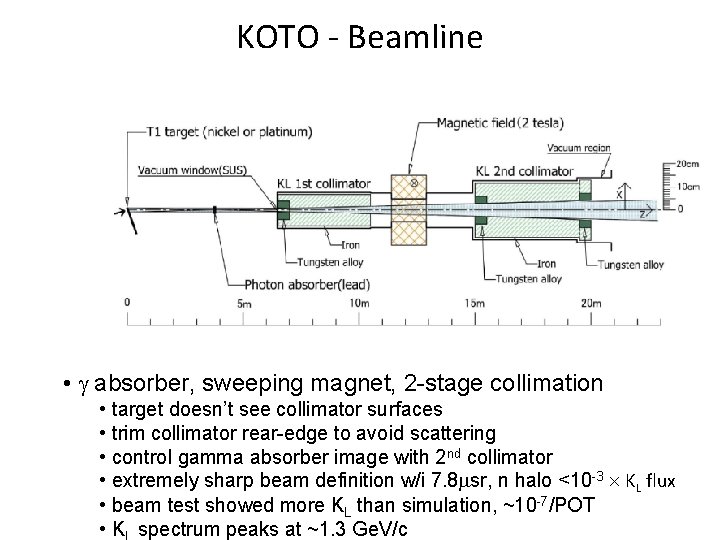
KOTO - Beamline • absorber, sweeping magnet, 2 -stage collimation • target doesn’t see collimator surfaces • trim collimator rear-edge to avoid scattering • control gamma absorber image with 2 nd collimator • extremely sharp beam definition w/i 7. 8 msr, n halo <10 -3 KL flux • beam test showed more KL than simulation, ~10 -7/POT • K spectrum peaks at ~1. 3 Ge. V/c
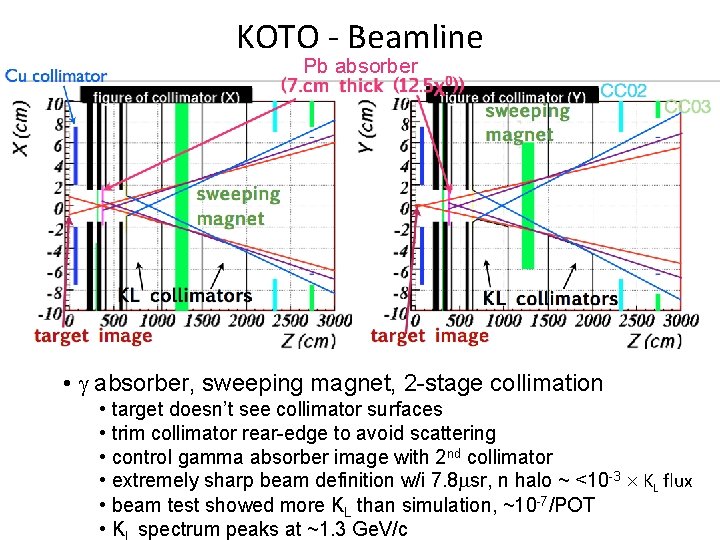
KOTO - Beamline Pb absorber • absorber, sweeping magnet, 2 -stage collimation • target doesn’t see collimator surfaces • trim collimator rear-edge to avoid scattering • control gamma absorber image with 2 nd collimator • extremely sharp beam definition w/i 7. 8 msr, n halo ~ <10 -3 KL flux • beam test showed more KL than simulation, ~10 -7/POT • K spectrum peaks at ~1. 3 Ge. V/c
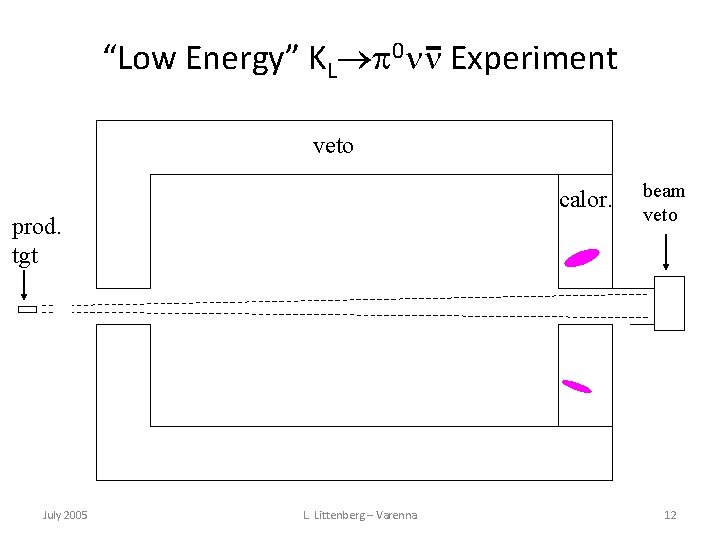
“Low Energy” KL 0 Experiment veto calor. prod. tgt July 2005 L. Littenberg – Varenna beam veto 12
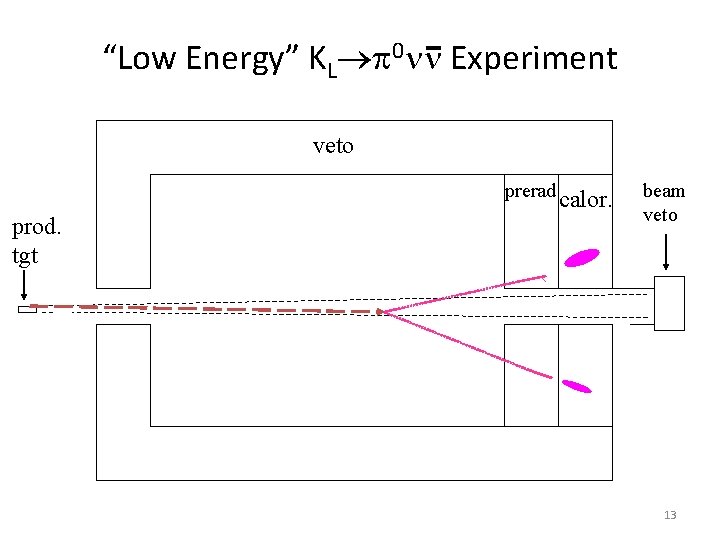
“Low Energy” KL 0 Experiment veto prerad calor. prod. tgt beam veto 13
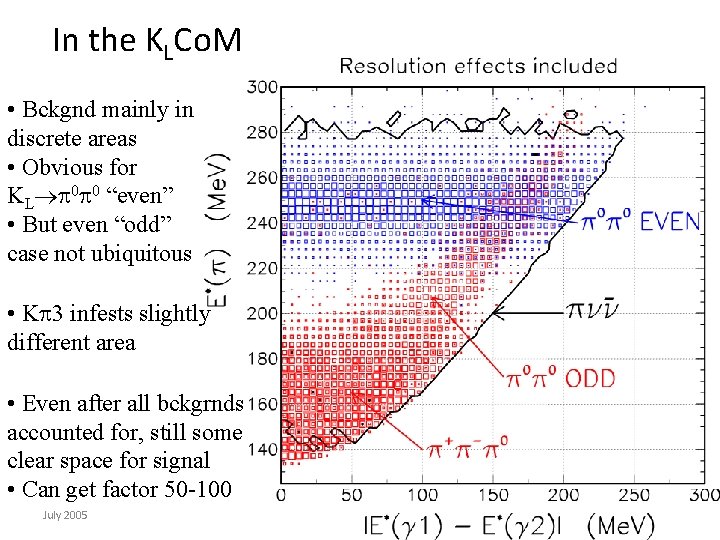
In the KLCo. M • Bckgnd mainly in discrete areas • Obvious for KL 0 0 “even” • But even “odd” case not ubiquitous • K 3 infests slightly different area • Even after all bckgrnds accounted for, still some clear space for signal • Can get factor 50 -100 July 2005 L. Littenberg – Varenna 14
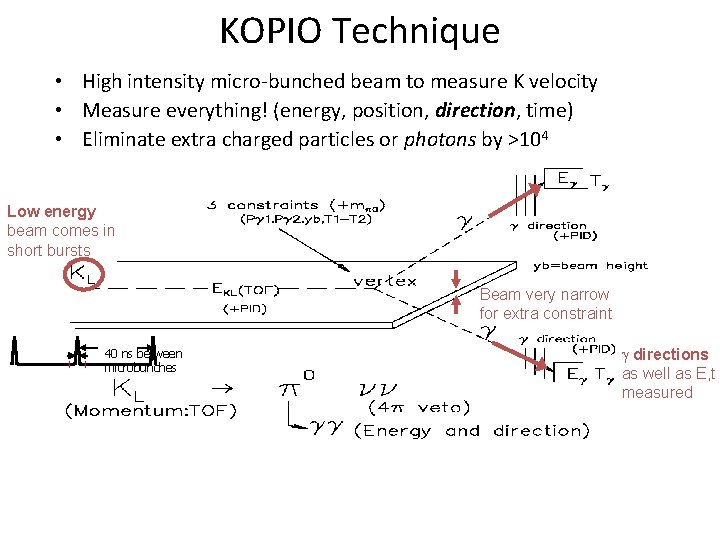
KOPIO Technique • High intensity micro-bunched beam to measure K velocity • Measure everything! (energy, position, direction, time) • Eliminate extra charged particles or photons by >104 Low energy beam comes in short bursts Beam very narrow for extra constraint 40 ns between microbunches directions as well as E, t measured
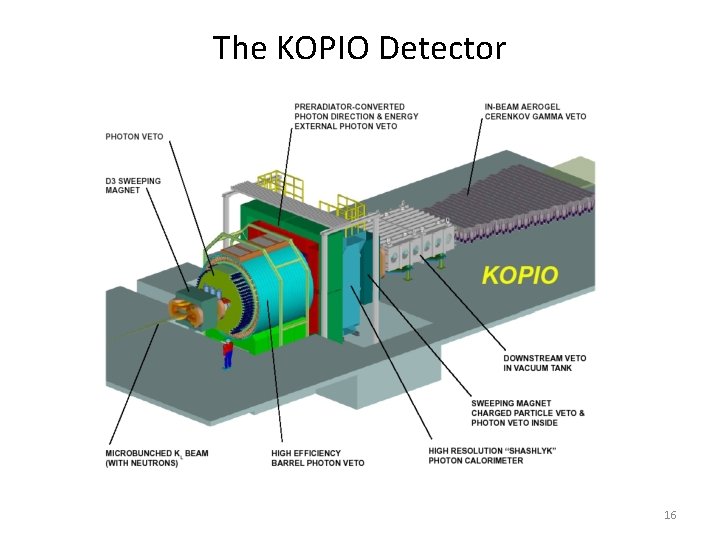
The KOPIO Detector 16
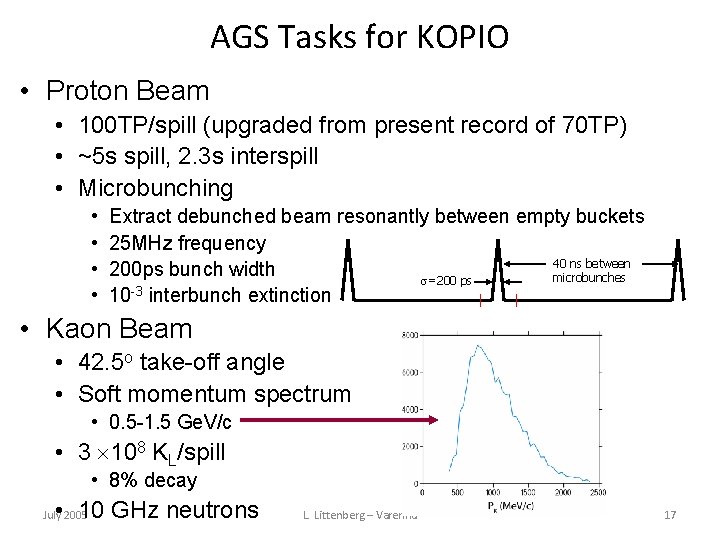
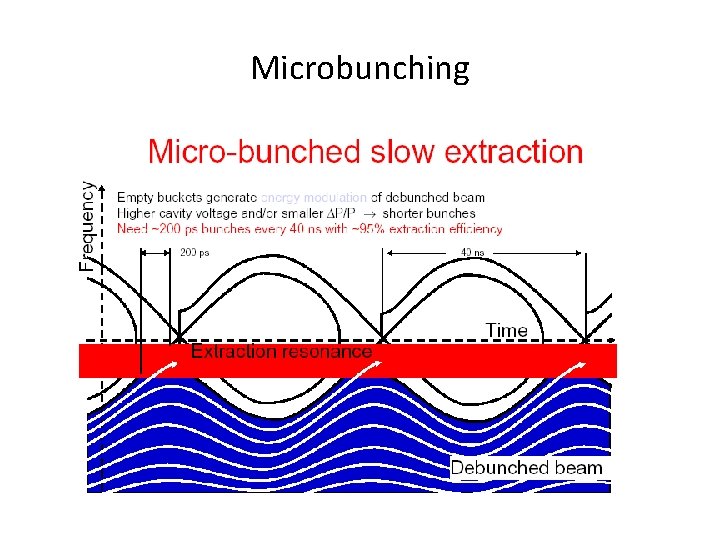
AGS Tasks for KOPIO • Proton Beam • 100 TP/spill (upgraded from present record of 70 TP) • ~5 s spill, 2. 3 s interspill • Microbunching • • Extract debunched beam resonantly between empty buckets 25 MHz frequency 40 ns between 200 ps bunch width microbunches =200 ps 10 -3 interbunch extinction • Kaon Beam • 42. 5 o take-off angle • Soft momentum spectrum • 0. 5 -1. 5 Ge. V/c • 3 108 KL/spill • 8% decay • 10 GHz neutrons July 2005 L. Littenberg – Varenna 17
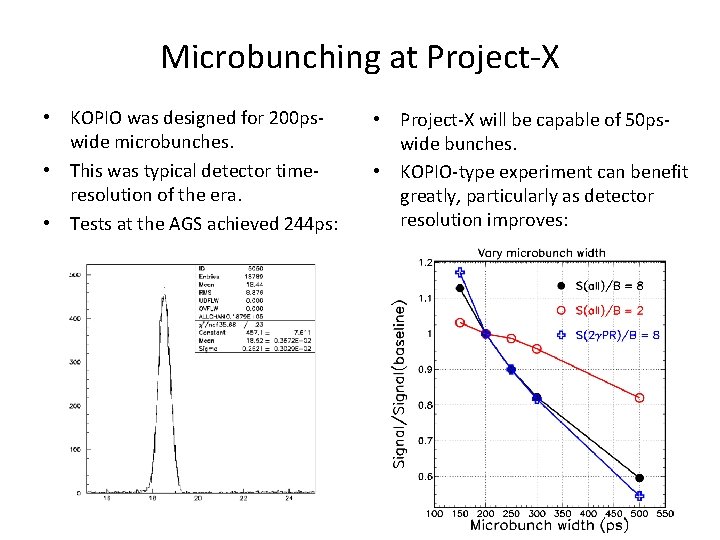
Microbunching at Project-X • KOPIO was designed for 200 pswide microbunches. • This was typical detector timeresolution of the era. • Tests at the AGS achieved 244 ps: • Project-X will be capable of 50 pswide bunches. • KOPIO-type experiment can benefit greatly, particularly as detector resolution improves:
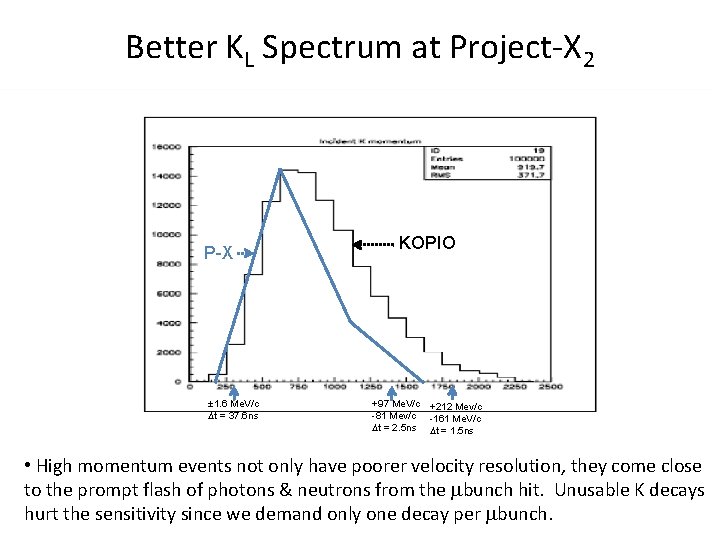
Better KL Spectrum at Project-X 2 P-X ± 1. 6 Me. V/c Dt = 37. 6 ns KOPIO +97 Me. V/c +212 Mev/c -81 Mev/c -161 Me. V/c Dt = 2. 5 ns Dt = 1. 5 ns • High momentum events not only have poorer velocity resolution, they come close to the prompt flash of photons & neutrons from the mbunch hit. Unusable K decays hurt the sensitivity since we demand only one decay per mbunch.
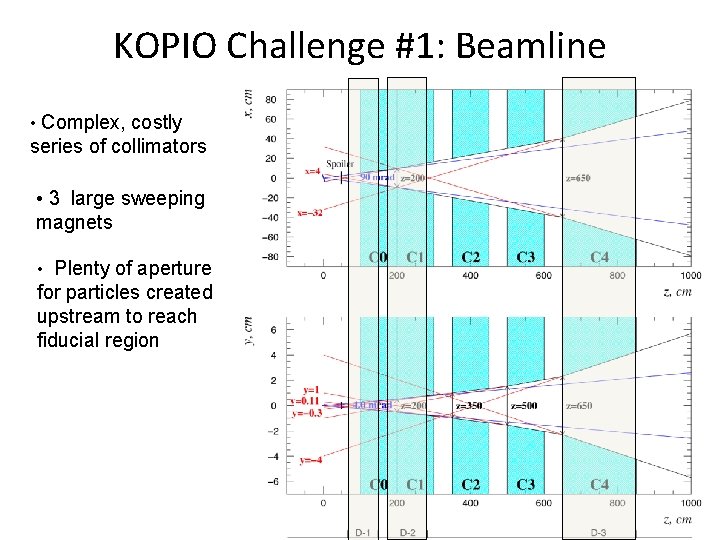
KOPIO Challenge #1: Beamline • Complex, costly series of collimators • 3 large sweeping magnets • Plenty of aperture for particles created upstream to reach fiducial region
The biggest advantage of Project-X is that there are many more KL available! • 8 x more flux allows symmetrizing the beam – 4 mr 90 mr could go to say 6. 5 mr square – Huge horizontal aperture is gone • Too many good consequences to discuss them all • I’ll try to give a flavor • But warning – no simulation work has been done!
Project-X 2 Version • K spectrum better for timing • Smaller beam has enormous benefits: – – – – – Nearly impossible vacuum vessel disappears Geometric acceptance increases since horizontal plane accessible Makes beam-line simpler, cheaper, better Upstream background disappears, so do some types of background in the fiducial volume Same micro-bunch event spoilage diminished Random vetoes much reduced Extra kinematic constraint increases S/B In-beam veto probably unnecessary Apparatus shorter, DS vetoes simpler, less lossy Beam spoiler probably unnecessary • Gives 72% more kaons/proton • Much reduces neutron spreading • Crude estimate ~ 300 events/year
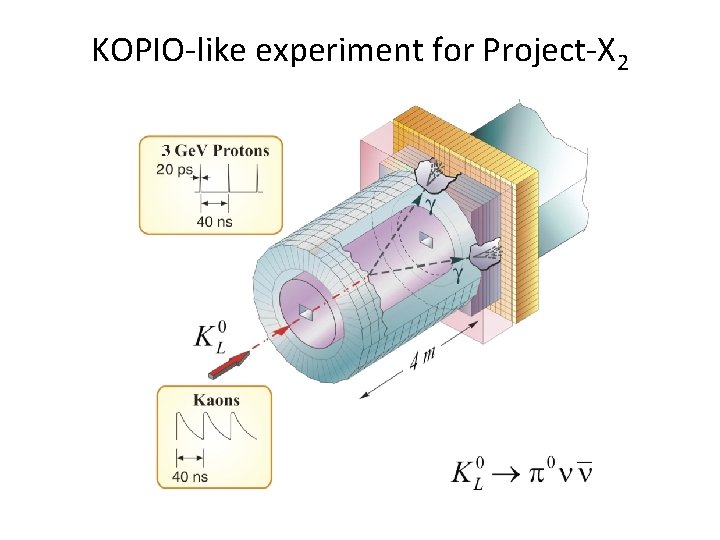
KOPIO-like experiment for Project-X 2
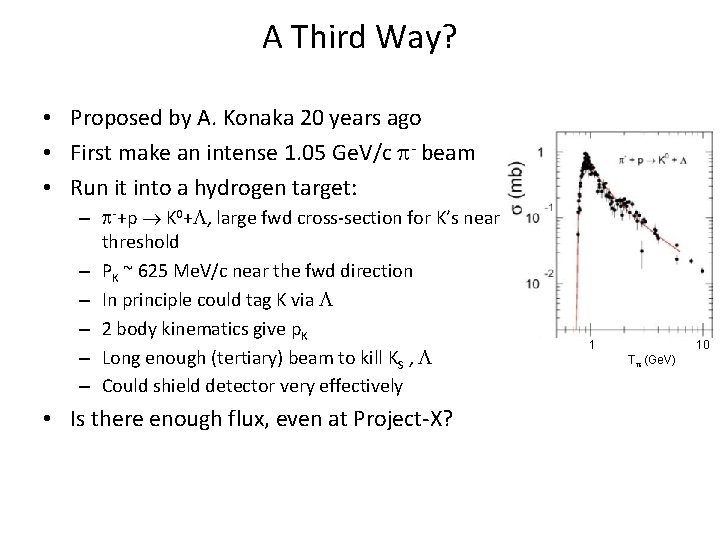
A Third Way? • Proposed by A. Konaka 20 years ago • First make an intense 1. 05 Ge. V/c - beam • Run it into a hydrogen target: – -+p K 0+L, large fwd cross-section for K’s near threshold – PK ~ 625 Me. V/c near the fwd direction – In principle could tag K via L – 2 body kinematics give p. K – Long enough (tertiary) beam to kill KS , L – Could shield detector very effectively • Is there enough flux, even at Project-X? 1 10 T (Ge. V)
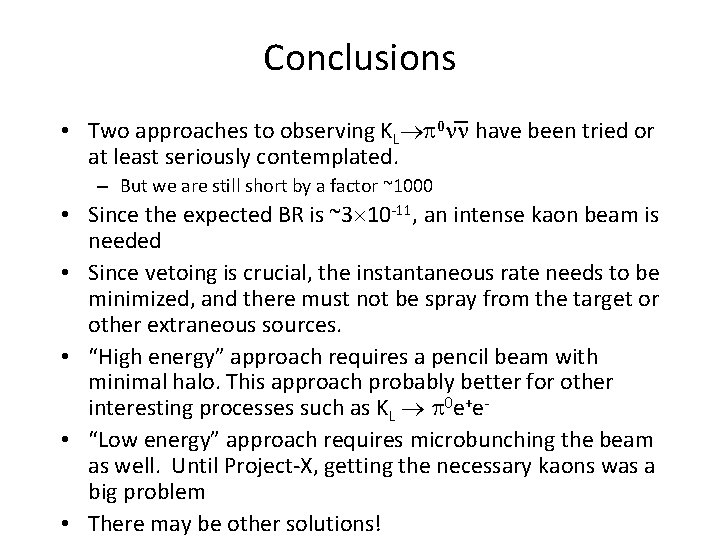
Conclusions • Two approaches to observing KL at least seriously contemplated. _ 0 have been tried or – But we are still short by a factor ~1000 • Since the expected BR is ~3 10 -11, an intense kaon beam is needed • Since vetoing is crucial, the instantaneous rate needs to be minimized, and there must not be spray from the target or other extraneous sources. • “High energy” approach requires a pencil beam with minimal halo. This approach probably better for other interesting processes such as KL 0 e+e • “Low energy” approach requires microbunching the beam as well. Until Project-X, getting the necessary kaons was a big problem • There may be other solutions!
Backup
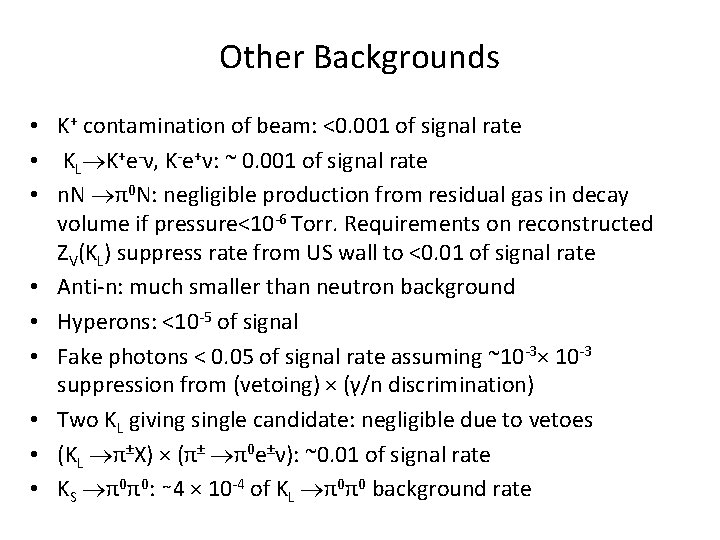
Other Backgrounds • K+ contamination of beam: <0. 001 of signal rate • KL K+e-ν, K-e+ν: ~ 0. 001 of signal rate • n. N π0 N: negligible production from residual gas in decay volume if pressure<10 -6 Torr. Requirements on reconstructed ZV(KL) suppress rate from US wall to <0. 01 of signal rate • Anti-n: much smaller than neutron background • Hyperons: <10 -5 of signal • Fake photons < 0. 05 of signal rate assuming ~10 -3× 10 -3 suppression from (vetoing) × (γ/n discrimination) • Two KL giving single candidate: negligible due to vetoes • (KL π±X) × (π± π0 e±ν): ~0. 01 of signal rate • KS π0π0: ∼ 4 × 10 -4 of KL π0π0 background rate
Microbunching
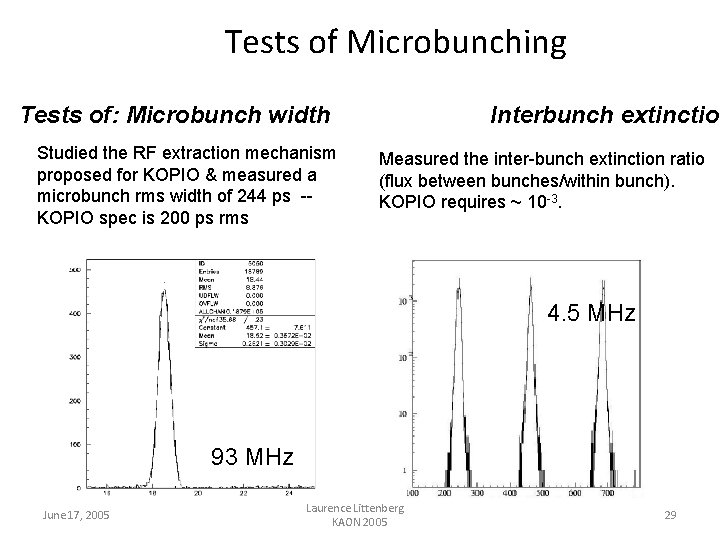
Tests of Microbunching Tests of: Microbunch width Studied the RF extraction mechanism proposed for KOPIO & measured a microbunch rms width of 244 ps -KOPIO spec is 200 ps rms Interbunch extinction Measured the inter-bunch extinction ratio (flux between bunches/within bunch). KOPIO requires ~ 10 -3. 4. 5 MHz 93 MHz June 17, 2005 Laurence Littenberg KAON 2005 29
- Slides: 29