
Inflationary multiverse Andrei Linde Contents From the Big
Inflationary multiverse Andrei Linde
Contents: From the Big Bang theory to Inflationary Cosmology Eternal inflation, multiverse, string theory landscape, anthropic principle, what else?
Why multiverse ? It was proposed more than 25 years ago. Why so much interest NOW ?
Historicaly, the question was opposite: Why UNIverse? Uniformity of our world is explained by inflation: Exponential stretching of the new-born universe makes it almost exactly uniform. However, inflationary fluctuations eternally produce new parts of the universe with different properties. Inflationary universe becomes a multiverse
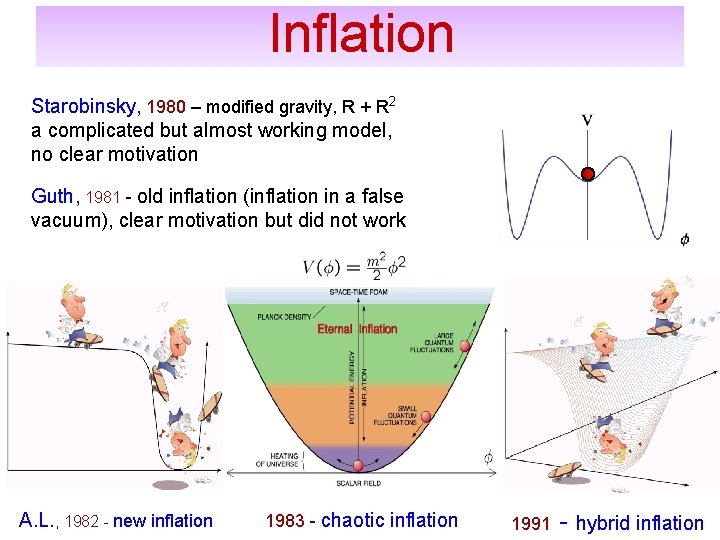
Inflation Starobinsky, 1980 – modified gravity, R + R 2 a complicated but almost working model, no clear motivation Guth, 1981 - old inflation (inflation in a false vacuum), clear motivation but did not work A. L. , 1982 - new inflation 1983 - chaotic inflation 1991 - hybrid inflation
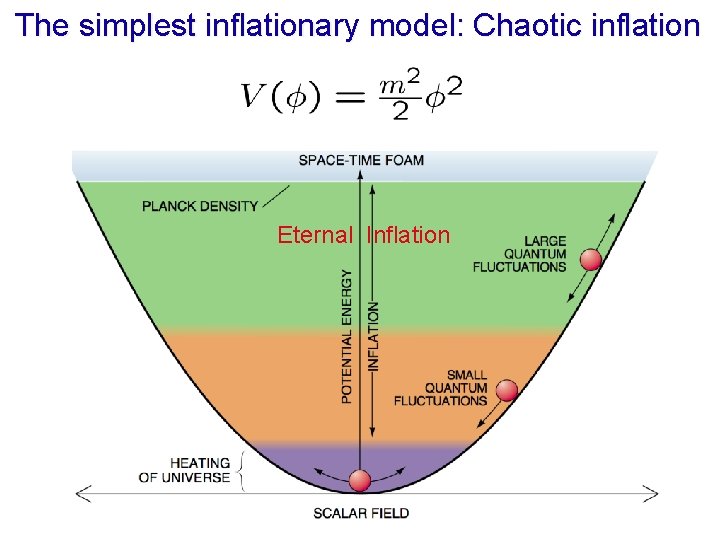
The simplest inflationary model: Chaotic inflation Eternal Inflation
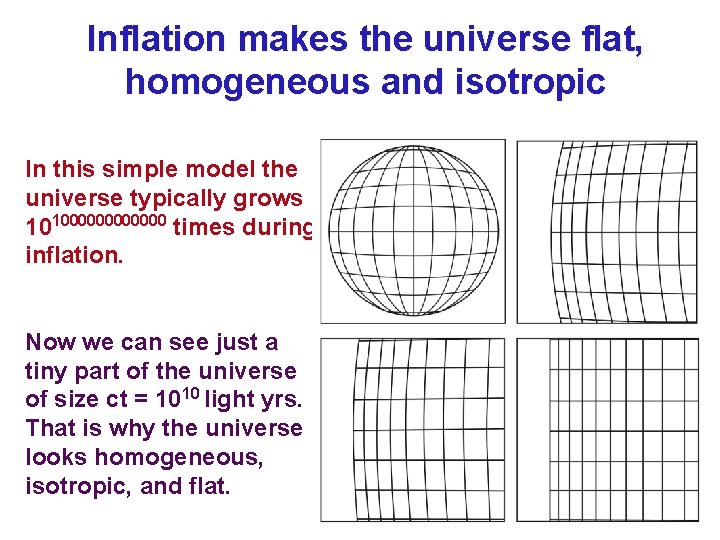
Inflation makes the universe flat, homogeneous and isotropic In this simple model the universe typically grows 101000000 times during inflation. Now we can see just a tiny part of the universe of size ct = 1010 light yrs. That is why the universe looks homogeneous, isotropic, and flat.
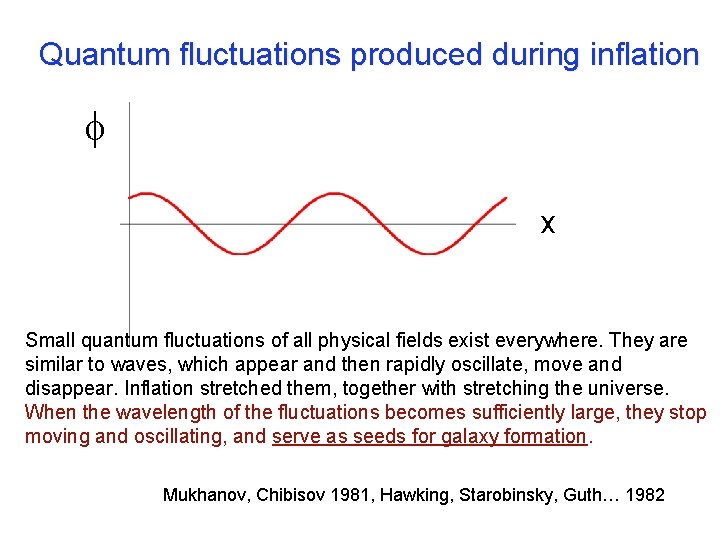
Quantum fluctuations produced during inflation x Small quantum fluctuations of all physical fields exist everywhere. They are similar to waves, which appear and then rapidly oscillate, move and disappear. Inflation stretched them, together with stretching the universe. When the wavelength of the fluctuations becomes sufficiently large, they stop moving and oscillating, and serve as seeds for galaxy formation. Mukhanov, Chibisov 1981, Hawking, Starobinsky, Guth… 1982
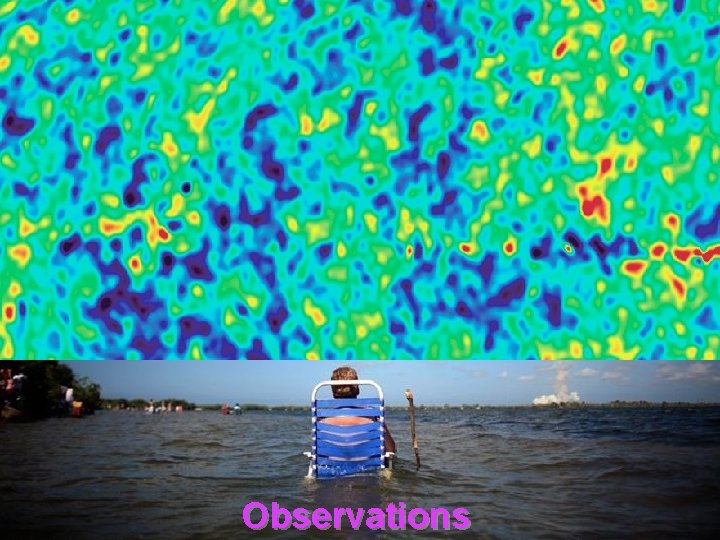
Observations
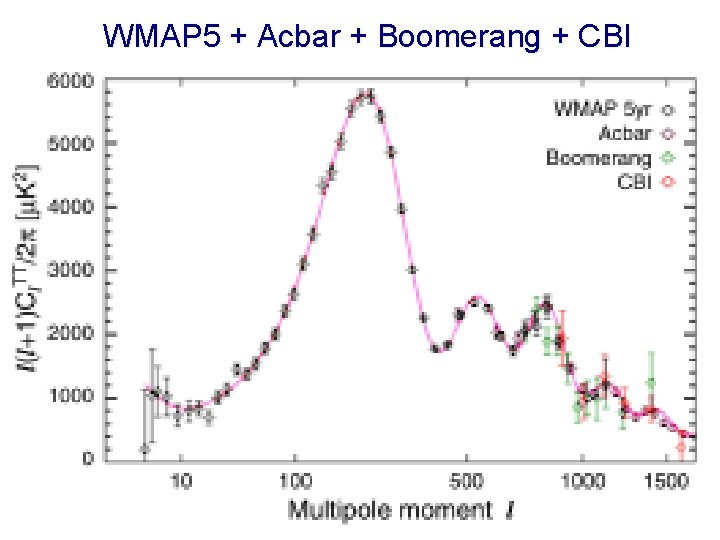
WMAP 5 + Acbar + Boomerang + CBI
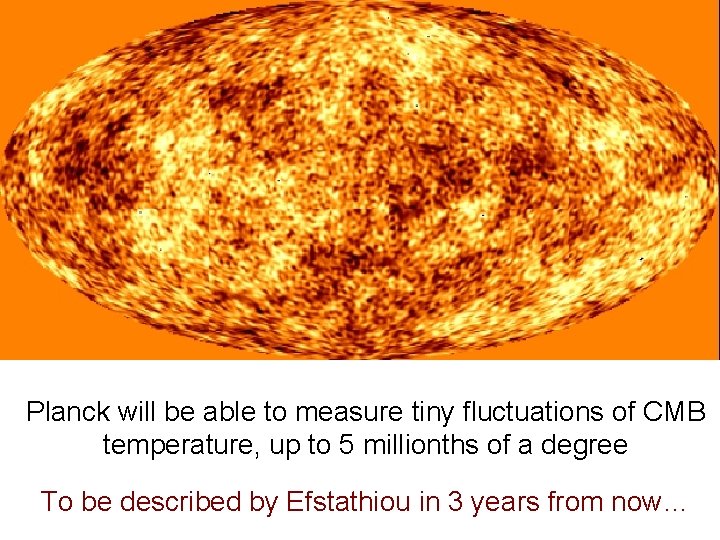
Planck will be able to measure tiny fluctuations of CMB temperature, up to 5 millionths of a degree To be described by Efstathiou in 3 years from now…
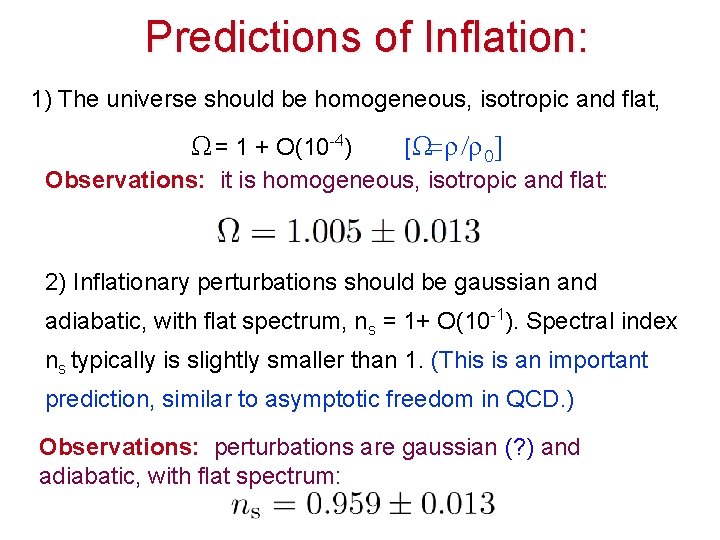
Predictions of Inflation: 1) The universe should be homogeneous, isotropic and flat, [Ω=ρ /ρ 0] Observations: it is homogeneous, isotropic and flat: Ω = 1 + O(10 -4) 2) Inflationary perturbations should be gaussian and adiabatic, with flat spectrum, ns = 1+ O(10 -1). Spectral index ns typically is slightly smaller than 1. (This is an important prediction, similar to asymptotic freedom in QCD. ) Observations: perturbations are gaussian (? ) and adiabatic, with flat spectrum:
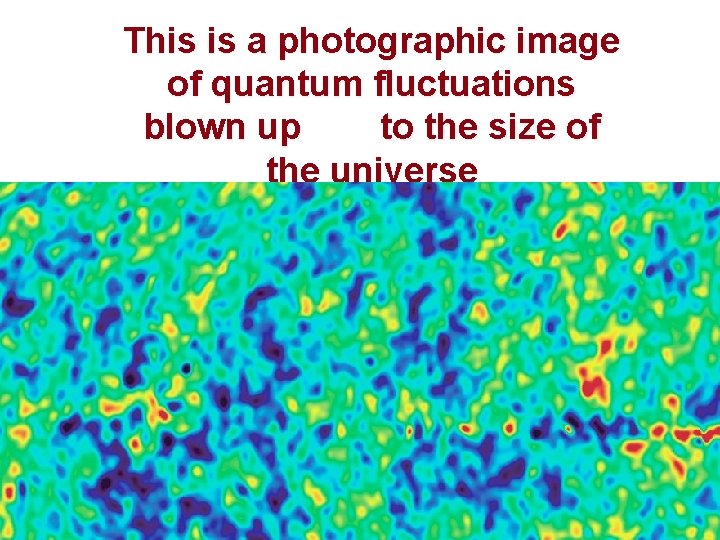
This is a photographic image of quantum fluctuations blown up to the size of the universe
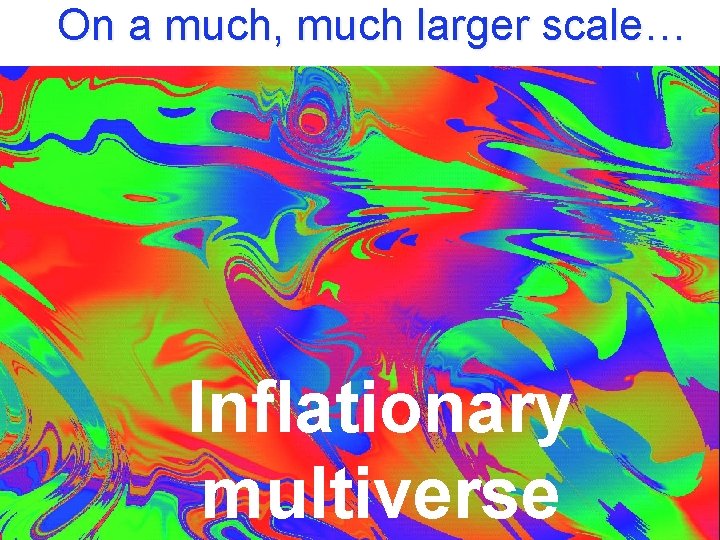
On a much, much larger scale… Inflationary multiverse
Genetic code of the Universe There may be one fundamental law of physics, like a single genetic code for the whole Universe. However, this law may have different realizations. For example, water can be liquid, solid or gas. In elementary particle physics, the effective laws of physics depend on the values of the scalar fields. Quantum fluctuations during inflation can take the scalar fields from one minimum of their potential energy to another, altering its genetic code. Once it happens in a small part of the universe, inflation makes this part exponentially big. This is the cosmological mutation mechanism
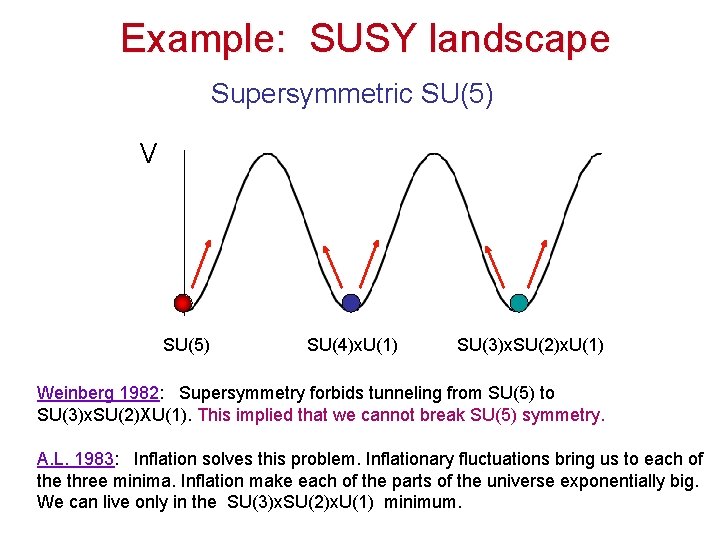
Example: SUSY landscape Supersymmetric SU(5) V SU(5) SU(4)x. U(1) SU(3)x. SU(2)x. U(1) Weinberg 1982: Supersymmetry forbids tunneling from SU(5) to SU(3)x. SU(2)XU(1). This implied that we cannot break SU(5) symmetry. A. L. 1983: Inflation solves this problem. Inflationary fluctuations bring us to each of the three minima. Inflation make each of the parts of the universe exponentially big. We can live only in the SU(3)x. SU(2)x. U(1) minimum.
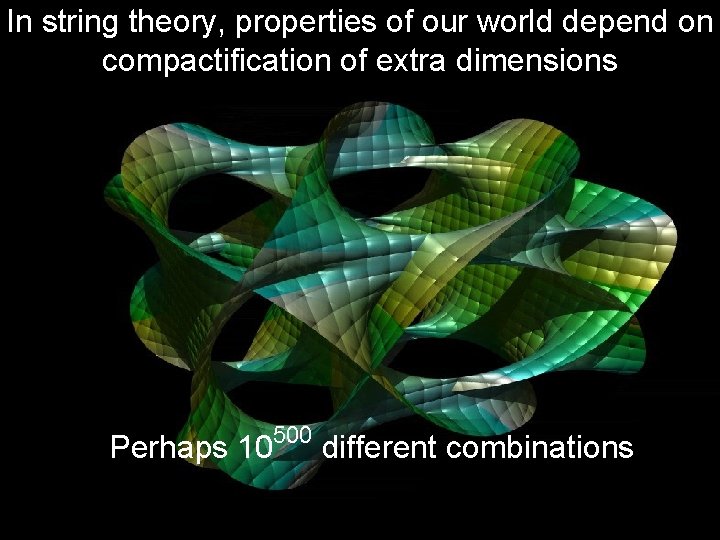
In string theory, properties of our world depend on compactification of extra dimensions Perhaps 10 500 different combinations
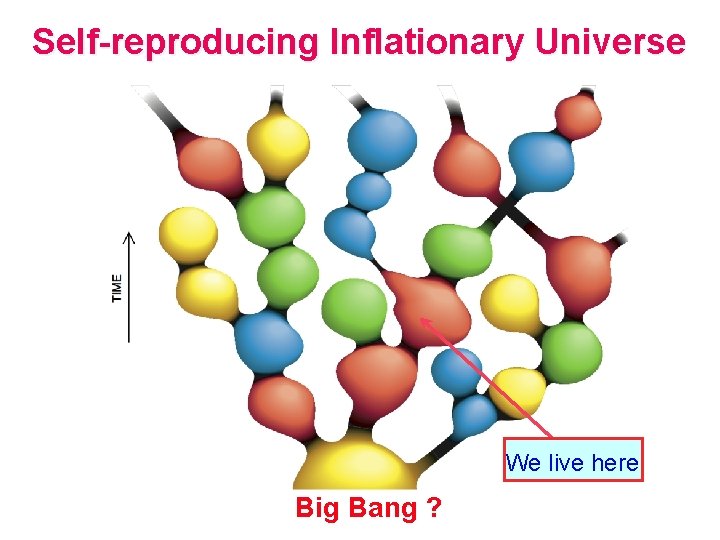
Self-reproducing Inflationary Universe We live here Big Bang ?
In our own words: "It is said that there is no such thing as a free lunch. But the universe is the ultimate free lunch". Alan Guth, 1981 "Now we can add that inflationary universe is the only lunch at which ALL possible dishes are served". A. L. 1982
Eternal inflation and string theory landscape An enormously large number of possible types of compactification which exist e. g. in theories of superstrings should be considered not as a difficulty but as a virtue of these theories, since it increases the probability of the existence of mini-universes in which life of our type may appear. A. L. 1986 Various versions of this idea appeared in the papers of Alex Vilenkin, A. L. and Andrei Sakharov since 1982. Now, Dr. Witten allowed, dark energy might have transformed this from a vice into a virtue, a way to generate universes where you can find any cosmological constant you want. We just live in one where life is possible, just as fish only live in water. June 3, 2008
Why did it take 20 years until people started taking this idea seriously? 1. Inflationary theory received strong observational support 2. Acceleration of the universe and existence of dark energy (cosmological constant) was firmly established 3. String theory could not explain these observational data. This was a creative crisis which was resolved in 2003 with finding the mechanism of vacuum stabilization in string theory (KKLT construction and other related mechanisms). Kallosh, Kachru, A. L. , Trivedi 2003
4. Immediately after that, we learned that this mechanism 500 allows vacuum to be in 10 different states. This established the picture of inflationary multiverse consisting of infinitely many “universes” of 10500 types (string theory landscape). Lerche, Lust and Schellekens 1987, Bousso, Polchinski 2000 After KKLT stabilization: Douglas 2003, Susskind 2003 More about it - in the talk by Bousso 5. These developments provided the framework for solving the cosmological constant problem using anthropic principle A. L. 1984, CC as a function of fluxes A. Sakharov 1984, CC as a function of compactification S. Weinberg 1987, anthropic bound on CC Recent detailed treatment by Weinberg, Vilenkin, Garriga, Bousso, Polchinski….
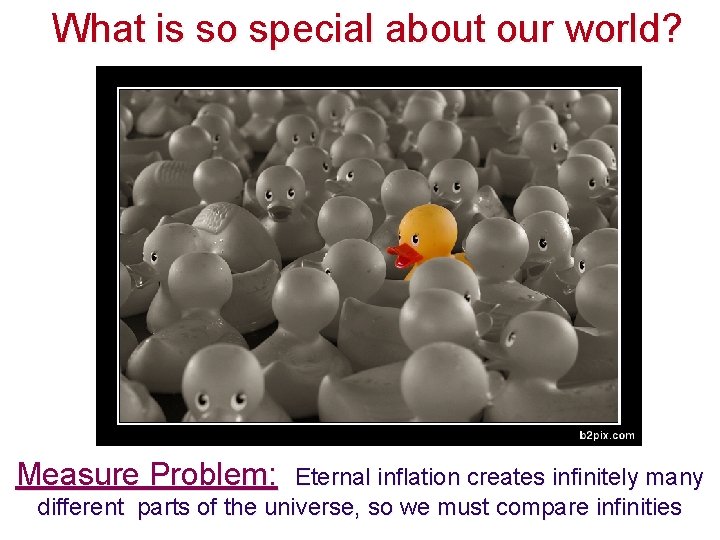
What is so special about our world? Measure Problem: Eternal inflation creates infinitely many different parts of the universe, so we must compare infinities
Examples of measures 1. Volume-weighted: a) proper time cutoff (A. L. , Mezhlumian, Bellido 1993, 1994, Vilenkin 1994) Youngness paradox, ruled out b) scale factor cutoff (A. L. , Mezhlumian, Bellido 1993, 1994, Vilenkin 1994) Difficulties with Boltzmann brains c) pocket based (Vilenkin, Garriga and collaborators) Q-problem, BBs d) stationary measure (A. L. 2006, A. L. , Vanchurin and Winitzki 2008) Q-problem 2. Comoving (Starobinsky 1985, A. L. 1986) Difficulties with Boltzmann brains 3. Causal diamond or causal patch (Bousso 2006) Difficulties with Boltzmann brains Other measures by Garriga, Vilenkin, Susskind, Hartle…
Is it a multiverse or a multimind, or both? Are we too anthropocentric? When we are calculating probabilities of OUR existence in a given universe, what do we mean by “us”? Are we talking about people just like us, or about highly developed carbon based life, or about any kind of computers which can run programs similar to ones running in our brains?
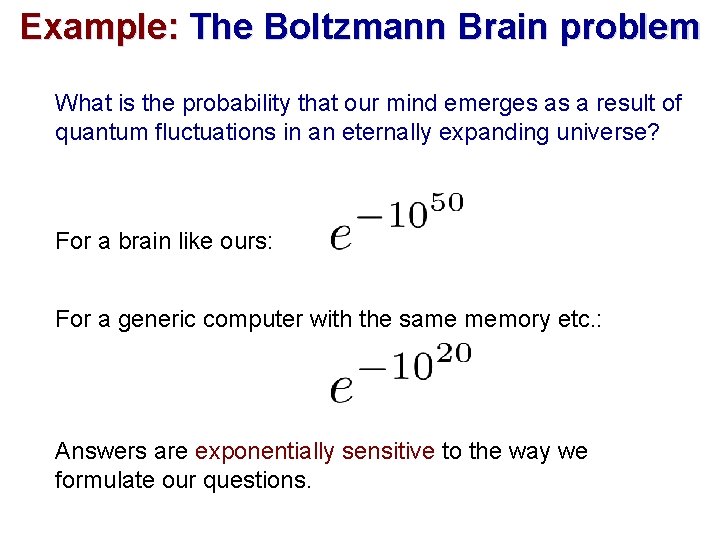
Example: The Boltzmann Brain problem What is the probability that our mind emerges as a result of quantum fluctuations in an eternally expanding universe? For a brain like ours: For a generic computer with the same memory etc. : Answers are exponentially sensitive to the way we formulate our questions.
Even if one attempts to reduce mind to a computer program, a lot of complexities arise: Not every program corresponds to a human mind. Not every computer can run a given program (Mac versus Windows) Not every universe can incorporate a given computer Thus we must investigate a combined multiverse – multimind problem. Are we ready?
Is it physics or metaphysics? Can it be experimentally tested?
Inflation answered almost metaphysical questions: Why is our universe so homogeneous (better than 1 part in 10000)? Why is it isotropic (the same in all directions)? Why all of its parts started expanding simultaneously? Why is it flat? flat Why parallel lines do not intersect? Why is it so big? Why it contains so many particles?
New questions: How can we compare infinities and use anthropic considerations productively? How far away from us are our EXACT copies? Can consciousness emerge from nothing? Can a wooden computer be offended? Can black holes think? Can they feel anything? Does consciousness matter? Can an unobserved universe exist? Can physics describe everything, or it must be extended?
Can we test the multiverse theory ? 1. This theory provides the only known explanation of numerous anthropic coincidences (extremely small vacuum energy, strange masses of elementary particles, etc. ) In this sense, it was already tested. “When you have eliminated the impossible, whatever remains, however improbable, must be the truth. ” Sherlock Holmes
2. Most of the recent versions of theory of the multiverse predict that dark energy is vacuum energy (does not change in time until it decays), not a quintessence (which slowly evolves). This is a testable prediction. 3. It increases the probability that dark matter is in axions, not in SUSY WIMPs. Can be confirmed by finding superlight axions or ruled out by finding WIMPs. A. L. 1988; Tegmark, Aguirre, Rees and Wilczek 2005; Freivogel 2008 4. Most of the existing versions of this theory can be ruled out by a simultaneous discovery of supersymmetry on LHC and B-modes in CMB polarization (Planck satellite). Note that these are the two most popular scientific projects now. A. L. , Kallosh, 2007
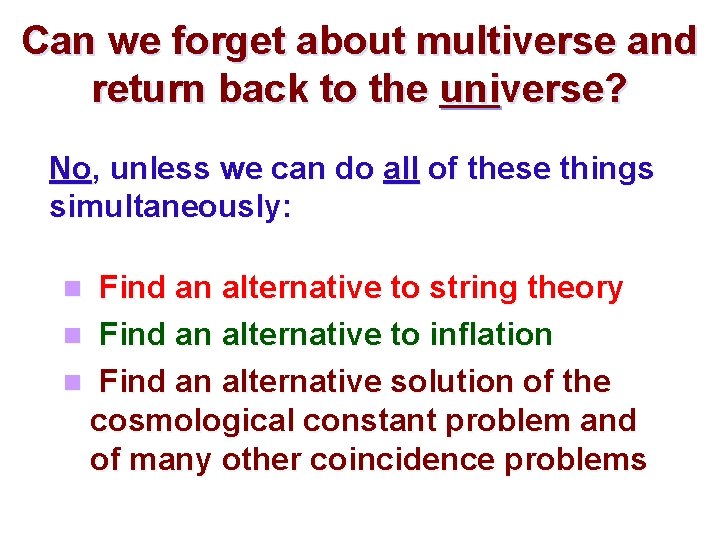
Can we forget about multiverse and return back to the universe? No, unless we can do all of these things simultaneously: Find an alternative to string theory Find an alternative to inflation Find an alternative solution of the cosmological constant problem and of many other coincidence problems
- Slides: 33