
Inflation Basics Dr D Foster ECO 285 Inflation
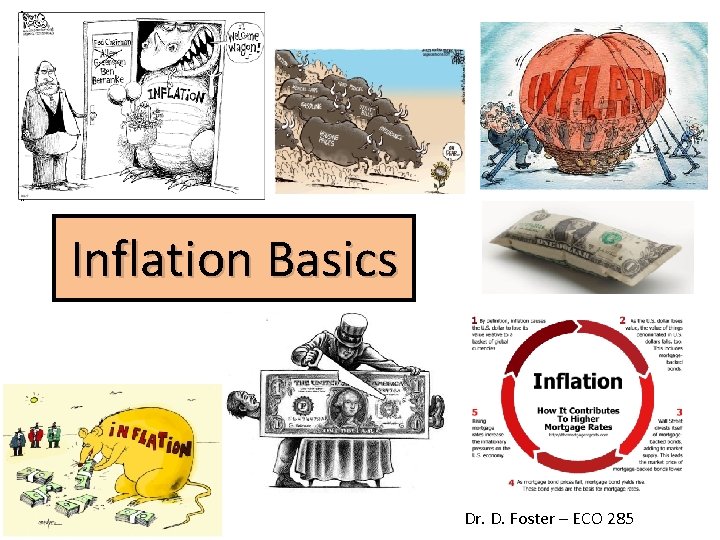
Inflation Basics Dr. D. Foster – ECO 285
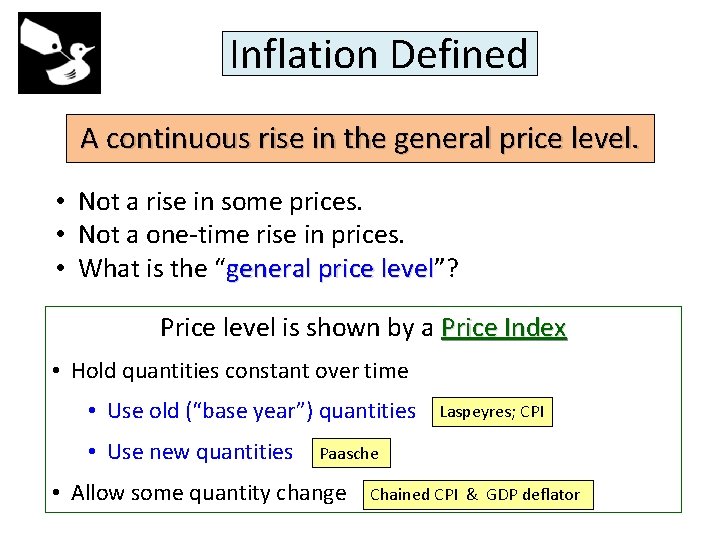
Inflation Defined A continuous rise in the general price level. • Not a rise in some prices. • Not a one-time rise in prices. • What is the “general price level”? level Price level is shown by a Price Index • Hold quantities constant over time • Use old (“base year”) quantities • Use new quantities Laspeyres; CPI Paasche • Allow some quantity change Chained CPI & GDP deflator
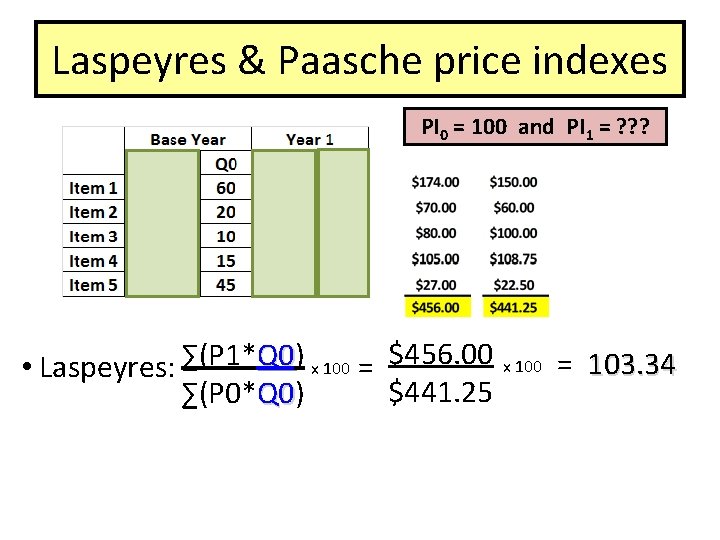
Laspeyres & Paasche price indexes PI 0 = 100 and PI 1 = ? ? ? $456. 00 ∑(P 1* Q 0) Q 0 x 100 = 103. 34 x 100 • Laspeyres: = $441. 25 ∑(P 0*Q 0) Q 0
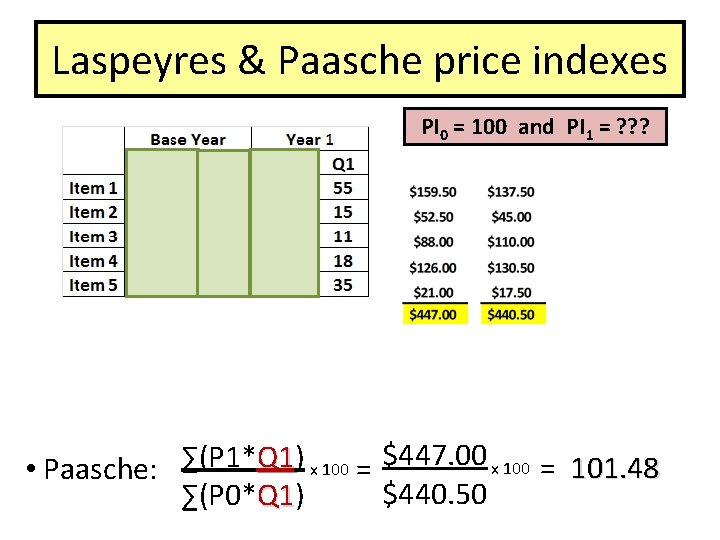
Laspeyres & Paasche price indexes PI 0 = 100 and PI 1 = ? ? ? Q 1 x 100 = $447. 00 x 100 = 101. 48 • Paasche: ∑(P 1*Q 1) $440. 50 ∑(P 0*Q 1) Q 1
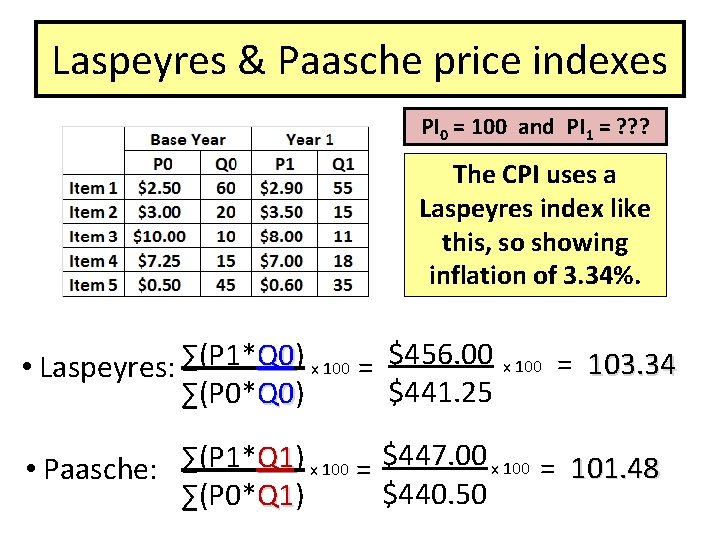
Laspeyres & Paasche price indexes PI 0 = 100 and PI 1 = ? ? ? The CPI uses a Laspeyres index like this, so showing inflation of 3. 34%. $456. 00 ∑(P 1* Q 0) Q 0 x 100 = 103. 34 x 100 • Laspeyres: = $441. 25 ∑(P 0*Q 0) Q 0 Q 1 x 100 = $447. 00 x 100 = 101. 48 • Paasche: ∑(P 1*Q 1) $440. 50 ∑(P 0*Q 1) Q 1
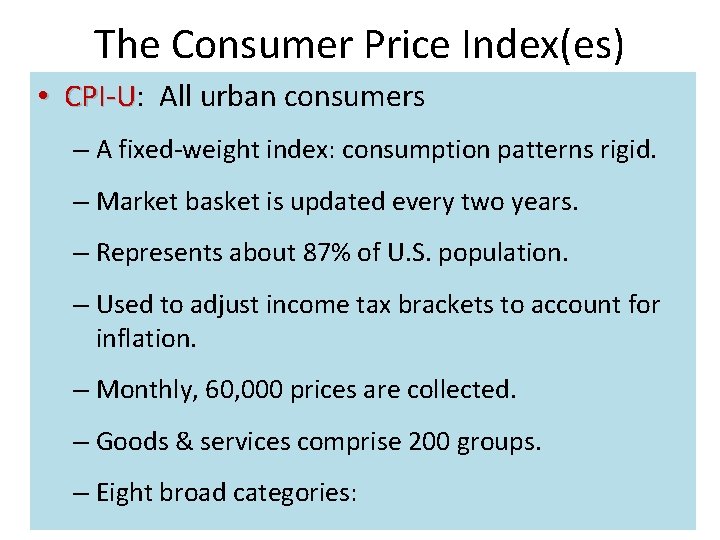
The Consumer Price Index(es) • CPI-U: CPI-U All urban consumers – A fixed-weight index: consumption patterns rigid. – Market basket is updated every two years. – Represents about 87% of U. S. population. – Used to adjust income tax brackets to account for inflation. – Monthly, 60, 000 prices are collected. – Goods & services comprise 200 groups. – Eight broad categories:
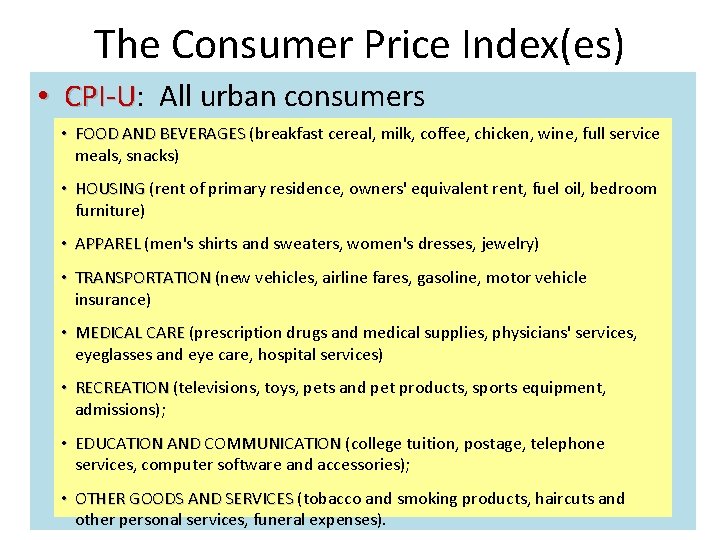
The Consumer Price Index(es) • CPI-U: CPI-U All urban consumers • FOOD AND BEVERAGES (breakfast cereal, milk, coffee, chicken, wine, full service – A fixed-weight index: consumption patterns rigid. meals, snacks) • HOUSING (rent of primary residence, owners' equivalent rent, fuel oil, bedroom – Market basket is updated every two years. furniture) • APPAREL (men's shirts and sweaters, women's dresses, jewelry) – Represents about 87% of U. S. population. • TRANSPORTATION (new vehicles, airline fares, gasoline, motor vehicle insurance) – Used to adjust income tax brackets to account for • MEDICAL CARE (prescription drugs and medical supplies, physicians' services, inflation. eyeglasses and eye care, hospital services) • – RECREATION (televisions, toys, pets andare pet products, sports equipment, Monthly, 60, 000 prices collected. admissions); • – EDUCATION COMMUNICATION (college tuition, postage, telephone Goods. AND & services comprise 200 groups. services, computer software and accessories); Eight broad categories: • – OTHER GOODS AND SERVICES (tobacco and smoking products, haircuts and other personal services, funeral expenses).
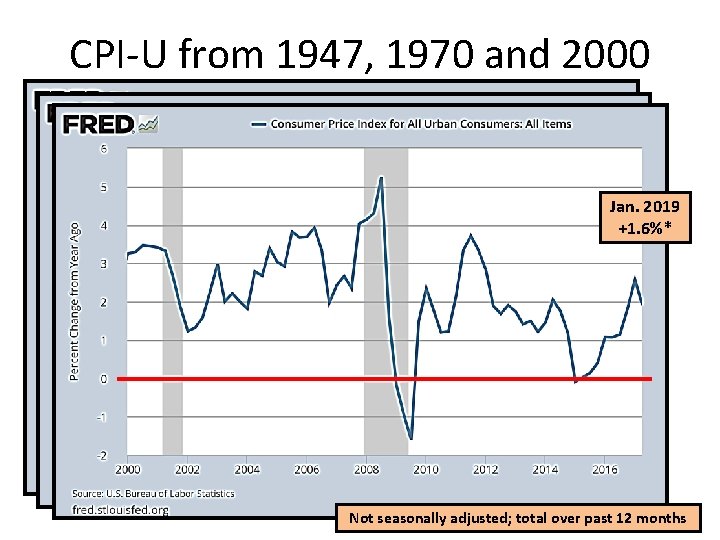
CPI-U from 1947, 1970 and 2000 Jan. 2019 +1. 6%* Not seasonally adjusted; total over past 12 months
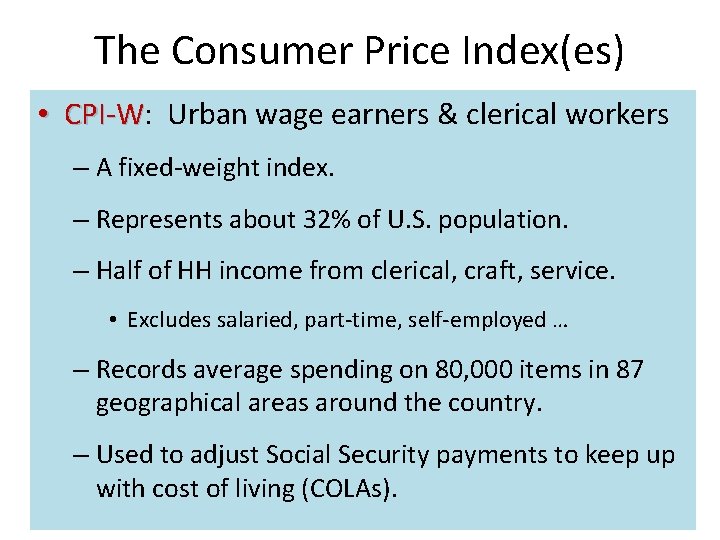
The Consumer Price Index(es) • CPI-W: CPI-W Urban wage earners & clerical workers – A fixed-weight index. – Represents about 32% of U. S. population. – Half of HH income from clerical, craft, service. • Excludes salaried, part-time, self-employed … – Records average spending on 80, 000 items in 87 geographical areas around the country. – Used to adjust Social Security payments to keep up with cost of living (COLAs).
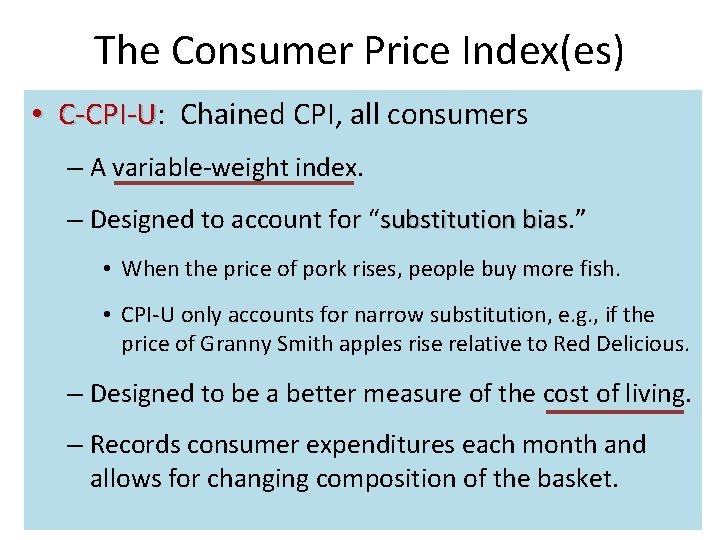
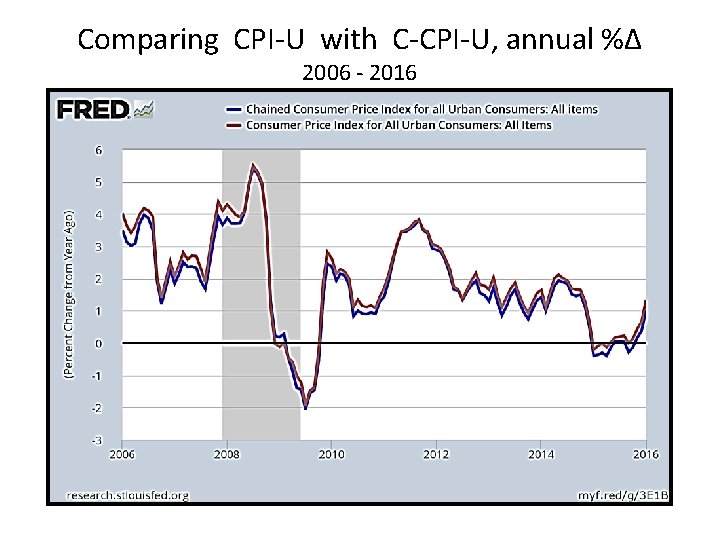
The Consumer Price Index(es) • C-CPI-U: C-CPI-U Chained CPI, all consumers – A variable-weight index. – Designed to account for “substitution bias. ” bias • When the price of pork rises, people buy more fish. • CPI-U only accounts for narrow substitution, e. g. , if the price of Granny Smith apples rise relative to Red Delicious. – Designed to be a better measure of the cost of living. – Records consumer expenditures each month and allows for changing composition of the basket.
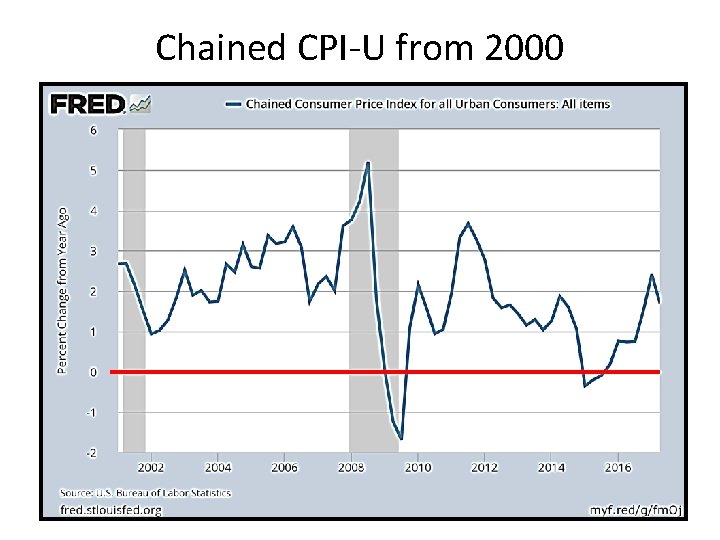
Chained CPI-U from 2000
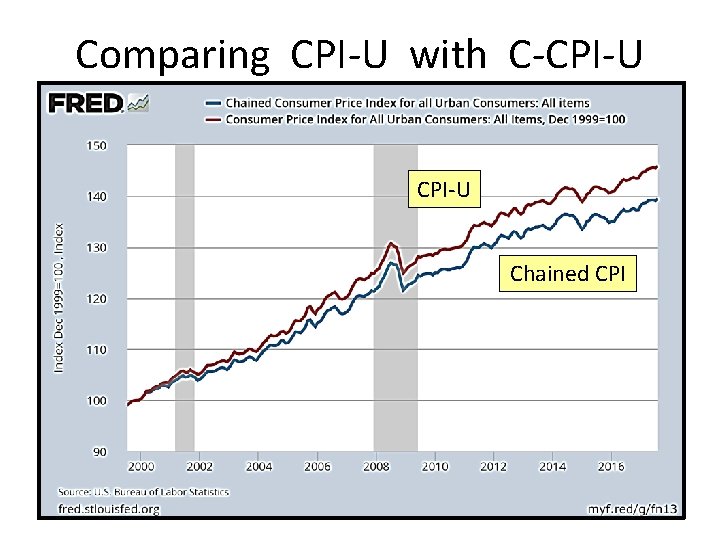
Comparing CPI-U with C-CPI-U Chained CPI
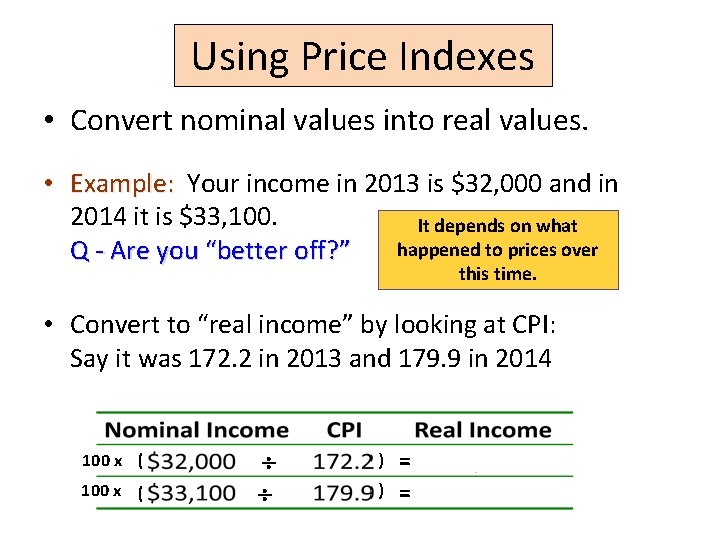
Using Price Indexes • Convert nominal values into real values. • Example: Your income in 2013 is $32, 000 and in 2014 it is $33, 100. It depends on what happened to prices over Q - Are you “better off? ” this time. • Convert to “real income” by looking at CPI: Say it was 172. 2 in 2013 and 179. 9 in 2014 100 x ( ) ) = =
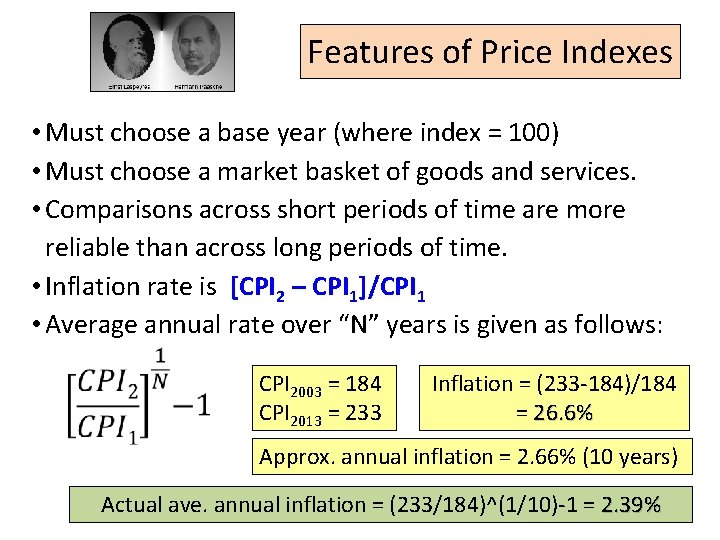
Features of Price Indexes • Must choose a base year (where index = 100) • Must choose a market basket of goods and services. • Comparisons across short periods of time are more reliable than across long periods of time. • Inflation rate is [CPI 2 – CPI 1]/CPI 1 • Average annual rate over “N” years is given as follows: • CPI 2003 = 184 CPI 2013 = 233 Inflation = (233 -184)/184 = 26. 6% Approx. annual inflation = 2. 66% (10 years) Actual ave. annual inflation = (233/184)^(1/10)-1 = 2. 39%
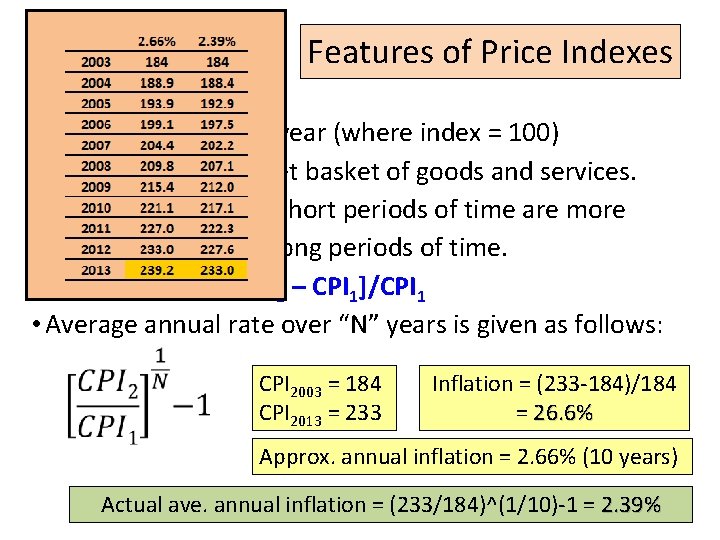
Features of Price Indexes • Must choose a base year (where index = 100) • Must choose a market basket of goods and services. • Comparisons across short periods of time are more reliable than across long periods of time. • Inflation rate is [CPI 2 – CPI 1]/CPI 1 • Average annual rate over “N” years is given as follows: • CPI 2003 = 184 CPI 2013 = 233 Inflation = (233 -184)/184 = 26. 6% Approx. annual inflation = 2. 66% (10 years) Actual ave. annual inflation = (233/184)^(1/10)-1 = 2. 39%
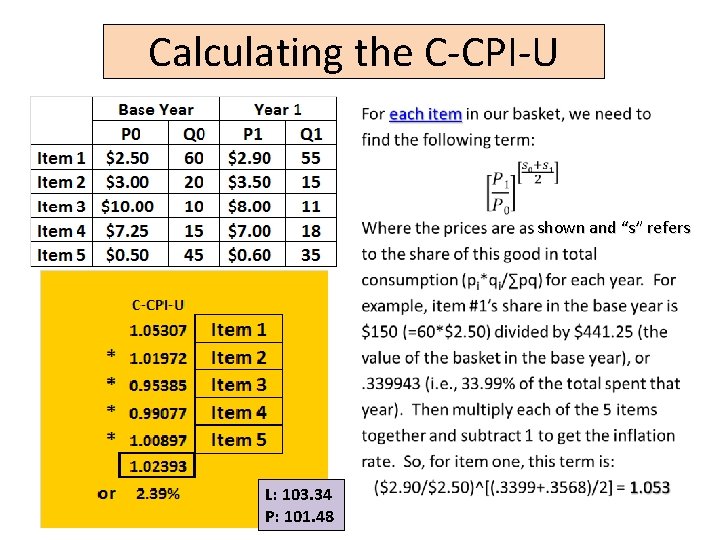
Calculating the C-CPI-U shown and “s” refers L: 103. 34 P: 101. 48
Inflation Basics Dr. D. Foster – ECO 285
Comparing CPI-U with C-CPI-U, annual %∆ 2006 - 2016
- Slides: 18