
Infinite Models for Propositional Calculi Zachary Ernst University
- Slides: 23
Infinite Models for Propositional Calculi Zachary Ernst University of Missouri-Columbia ernstz@missouri. edu
The Gist Finite matrix models are equivalent to finite state bottom-up tree automata. n So perhaps, more powerful automata can play the role of infinite matrix models. n
The Problem Finite matrix models are good for showing that formulae are not theorems of propositional logics. n But many systems require infinite models. n These are hard to enumerate, and there is no good, flexible framework for describing them. n
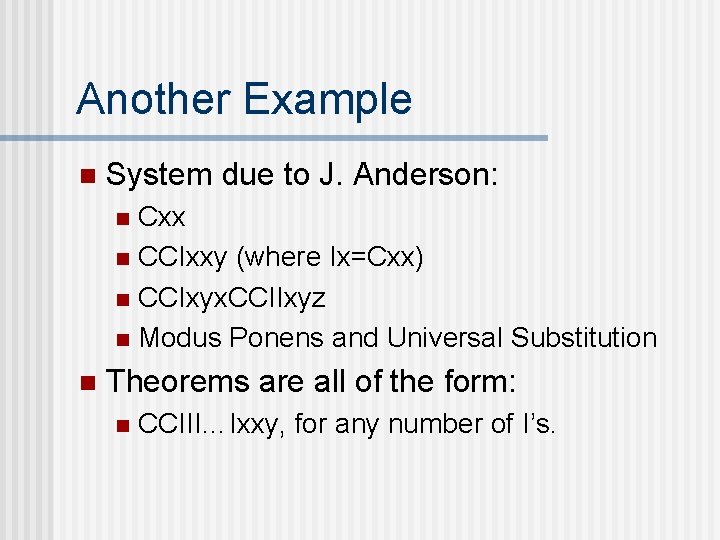
Another Example n System due to J. Anderson: Cxx n CCIxxy (where Ix=Cxx) n CCIxyx. CCIIxyz n Modus Ponens and Universal Substitution n n Theorems are all of the form: n CCIII…Ixxy, for any number of I’s.
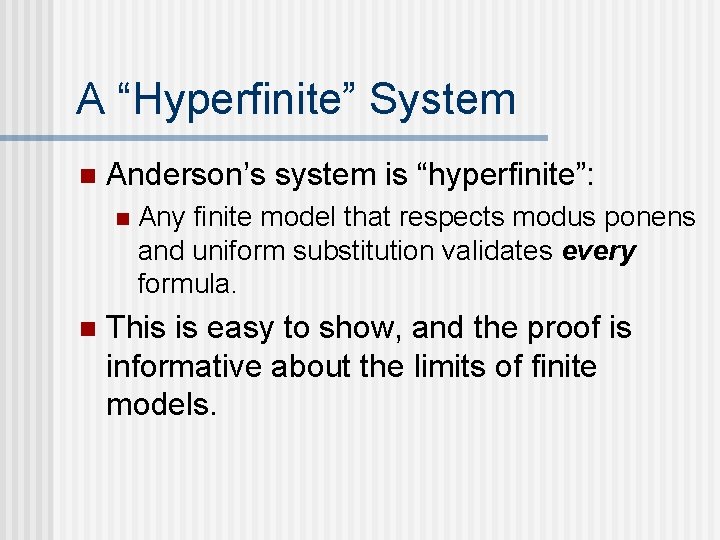
A “Hyperfinite” System n Anderson’s system is “hyperfinite”: n n Any finite model that respects modus ponens and uniform substitution validates every formula. This is easy to show, and the proof is informative about the limits of finite models.
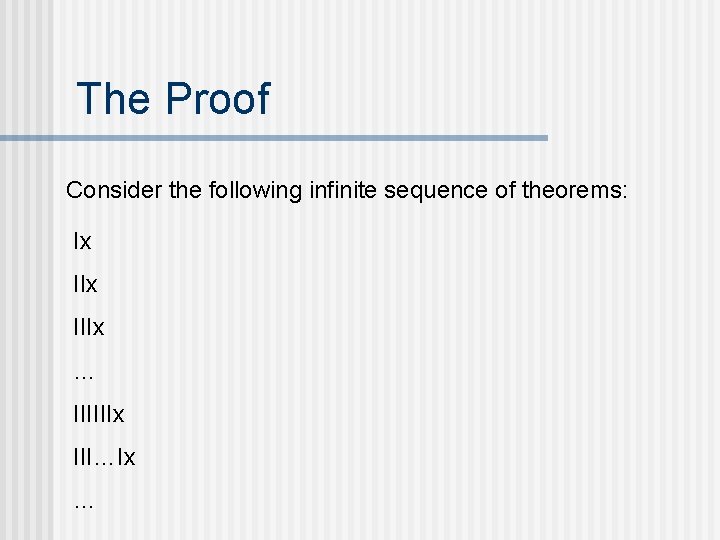
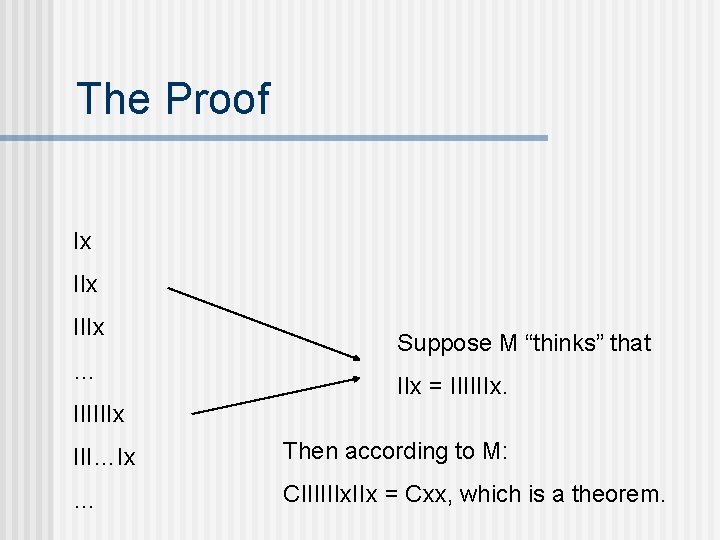
The Proof Consider the following infinite sequence of theorems: Ix IIIx … IIIIIIx III…Ix …
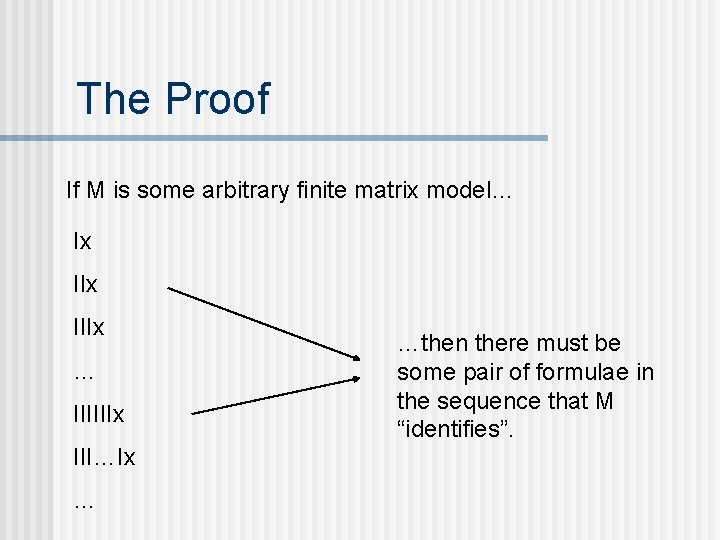
The Proof If M is some arbitrary finite matrix model… Ix IIIx … IIIIIIx III…Ix … …then there must be some pair of formulae in the sequence that M “identifies”.
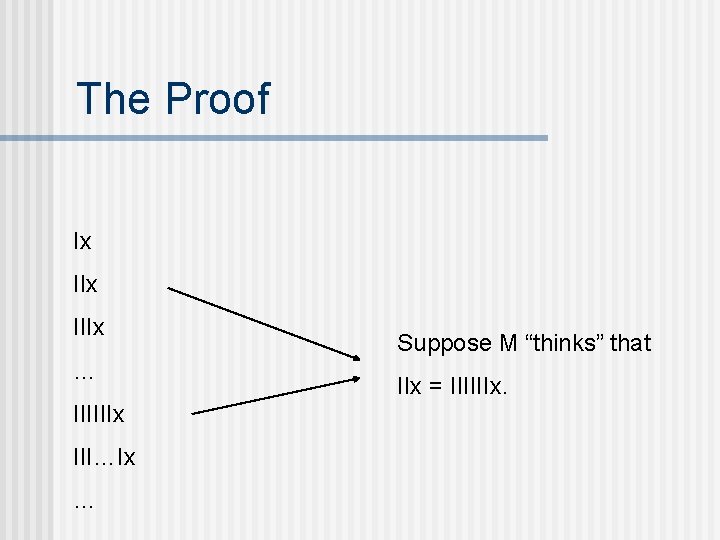
The Proof Ix IIIx … IIIIIIx III…Ix … Suppose M “thinks” that IIx = IIIIIIx.
The Proof Ix IIIx … Suppose M “thinks” that IIx = IIIIIIx III…Ix Then according to M: … CIIIIIIx. IIx = Cxx, which is a theorem.
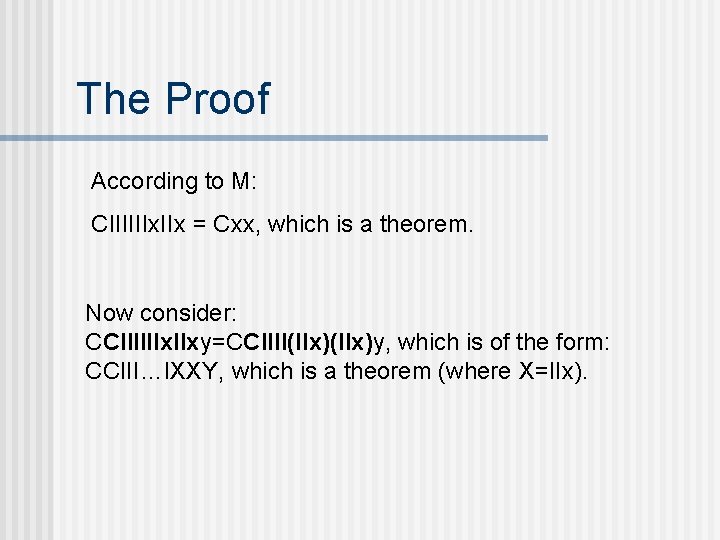
The Proof According to M: CIIIIIIx. IIx = Cxx, which is a theorem. Now consider: CCIIIIIIx. IIxy=CCIIII(IIx)y, which is of the form: CCIII…IXXY, which is a theorem (where X=IIx).
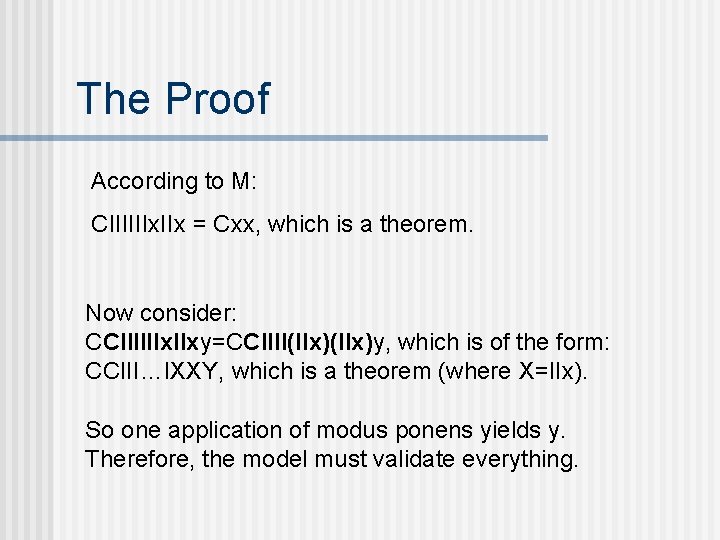
The Proof According to M: CIIIIIIx. IIx = Cxx, which is a theorem. Now consider: CCIIIIIIx. IIxy=CCIIII(IIx)y, which is of the form: CCIII…IXXY, which is a theorem (where X=IIx). So one application of modus ponens yields y. Therefore, the model must validate everything.
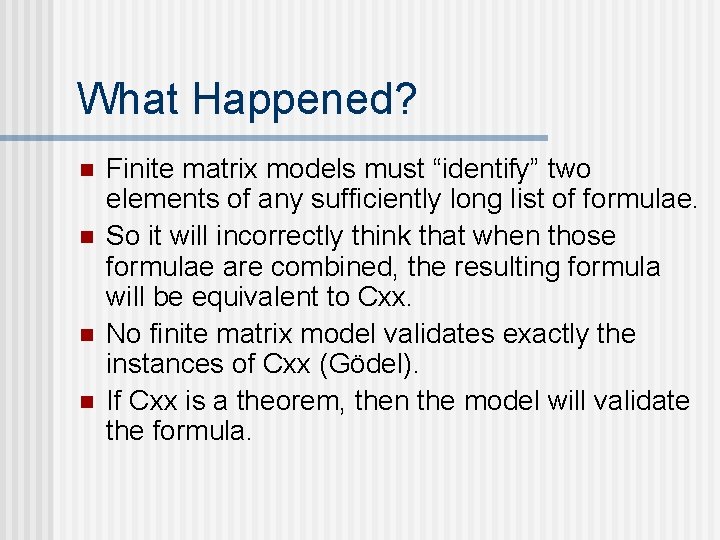
What Happened? n n Finite matrix models must “identify” two elements of any sufficiently long list of formulae. So it will incorrectly think that when those formulae are combined, the resulting formula will be equivalent to Cxx. No finite matrix model validates exactly the instances of Cxx (Gödel). If Cxx is a theorem, then the model will validate the formula.
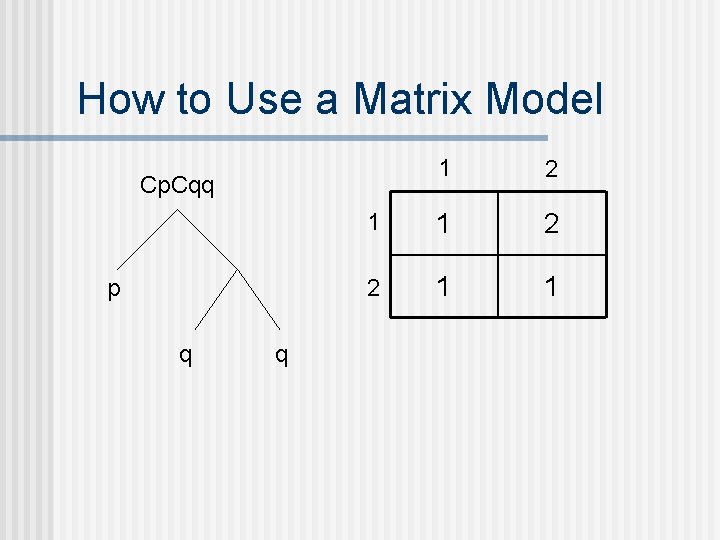
How to Use a Matrix Model 1 2 1 1 2 2 1 1 Cp. Cqq p q q
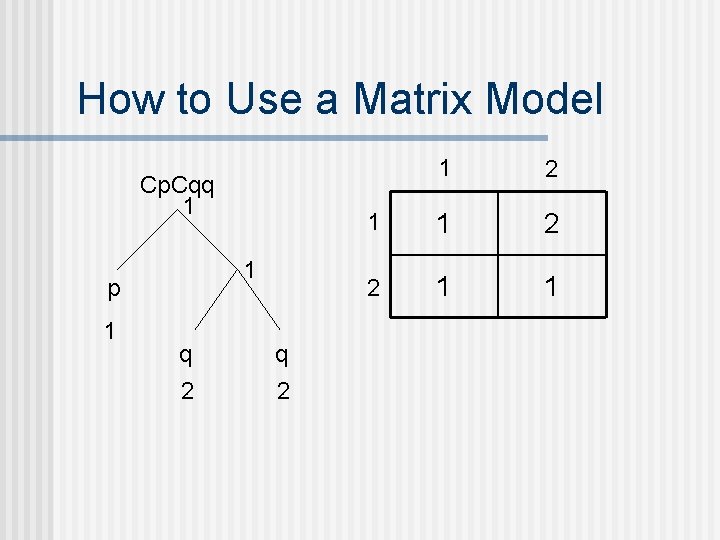
How to Use a Matrix Model Cp. Cqq 1 1 p 1 q q 2 2 1 1
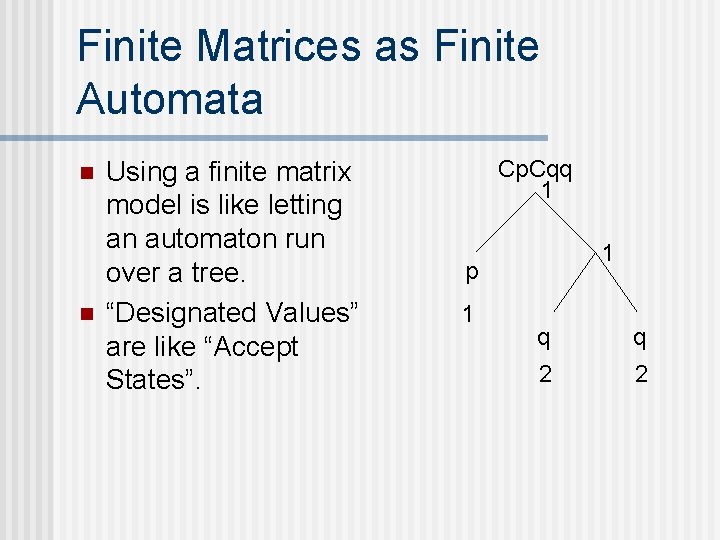
Finite Matrices as Finite Automata n n Using a finite matrix model is like letting an automaton run over a tree. “Designated Values” are like “Accept States”. Cp. Cqq 1 1 p 1 q q 2 2
The Disanalogy -- Vocabulary Finite tree automata have a finite input language. n Logics have an infinite language with countably many variables. n n This matters for models, but not for countermodels.
Restricting the Input Vocabulary n n Suppose {Cpq, r} s, by condensed detachment, and suppose s has fewer distinct variables than one of the premises. Then there is a substitution such that: n n n p= r; q=s, and Cpq and r have no variables not appearing in s. Therefore, if P is a set of premises, and there is a proof of C from P, then there is a proof of C from P containing only variables occurring in C.
Restricting the Input Vocabulary n n n So we know in advance how many variables are necessary for a proof of C from P, if such a proof exists. Thus, we do not need a countermodel containing infinitely many variables; if C has a single variable, then the countermodel is only required have an interpretation for only one variable. So it does not matter that tree automata have a finite input language; they still might serve as countermodels.
A Stronger Automaton n Weighted Tree Automata use weights from a semiring: n n n Suppose semiring is Every transition has a transition cost from The costs for each successful run are multiplied using the semiring multiplication. The total costs for all runs are added using the semiring addition. The automaton accepts a tree if the cost associated with the tree is in some subset
Are Weighted Automata Strong Enough for Infinite Models? For some infinite sequence of formulae, a weighted automaton must be able to assign a different weight to each member of the sequence. n It is easy to construct an automaton that calculates the binary value of a tree. In other words, there is an automaton such that n
Weighted Automata and Reflexivity Recall that Gödel showed that no finite model accepts exactly the instances of Cxx. n But if the binary value of then there is an automaton such that: n Terminology: We say that A “ 0 -accepts” only the instances of Cxx.
Weighted Automata and Anderson’s Hyperfinite System Recall that theorems of Anderson’s system are n We can construct an automaton such that: n n So let
YQE Show that CCxy. CCxz. Cyz does not imply Cx. Cy. Cxy, with the rule modus ponens and uniform substitution. n Ted Ulrich has shown that if YQE does not imply Cx. Cy. Cxy, then it will take an infinite model to show this. n