
INFILTRATION v the process by which water on
INFILTRATION v the process by which water on the ground surface enters the soil. v Infiltration rate in soil science is a measure of the rate at which soil is able to absorb rainfall or irrigation. v It is measured in inches per hour or millimeters per hour. v. The rate decreases as the soil becomes saturated. If the precipitation rate exceeds the infiltration rate, runoff will usually occur unless there is some physical barrier. v. The rate of infiltration can be measured using an infiltrometer
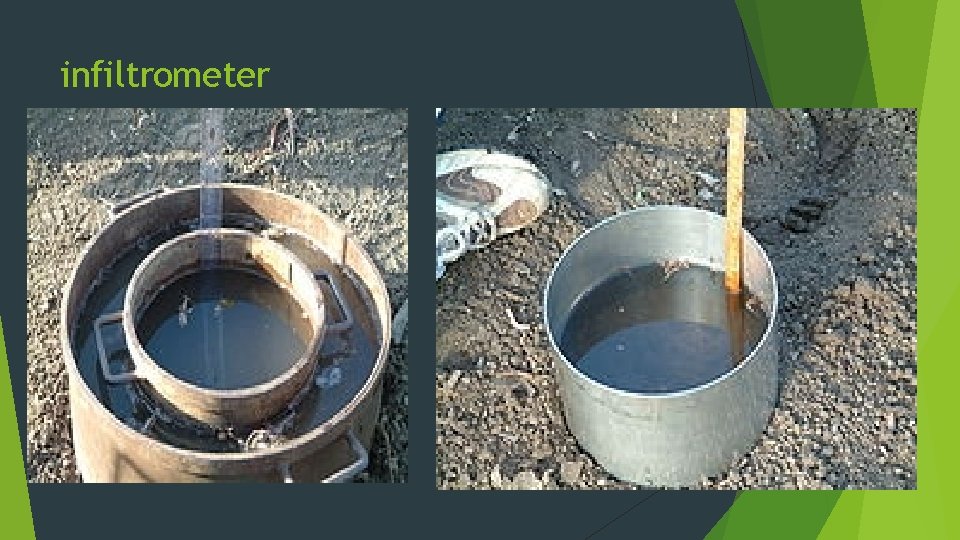
infiltrometer
Factors affecting infiltration; Infiltration is governed by two forces: gravity and capillary action. While smaller pores offer greater resistance to gravity, very small pores pull water through capillary action in addition to and even against the force of gravity The rate of infiltration is determined by soil characteristics including: ease of entry, storage capacity, and transmission rate through the soil. The soil texture and structure, vegetation types and cover, water content of the soil, soil temperature, and rainfall intensity all play a role in controlling infiltration rate and capacity

Process The process of infiltration can continue only if there is room available for additional water at the soil surface. The available volume for additional water in the soil depends on the porosity of the soil and the rate at which previously infiltrated water can move away from the surface through the soil. The maximum rate that water can enter a soil in a given condition is the infiltration capacity. If the arrival of the water at the soil surface is less than the infiltration capacity, is sometimes analyzed using hydrology transport models, mathematical models that consider infiltration, runoff and channel flow to predict river flow rates and stream water quality
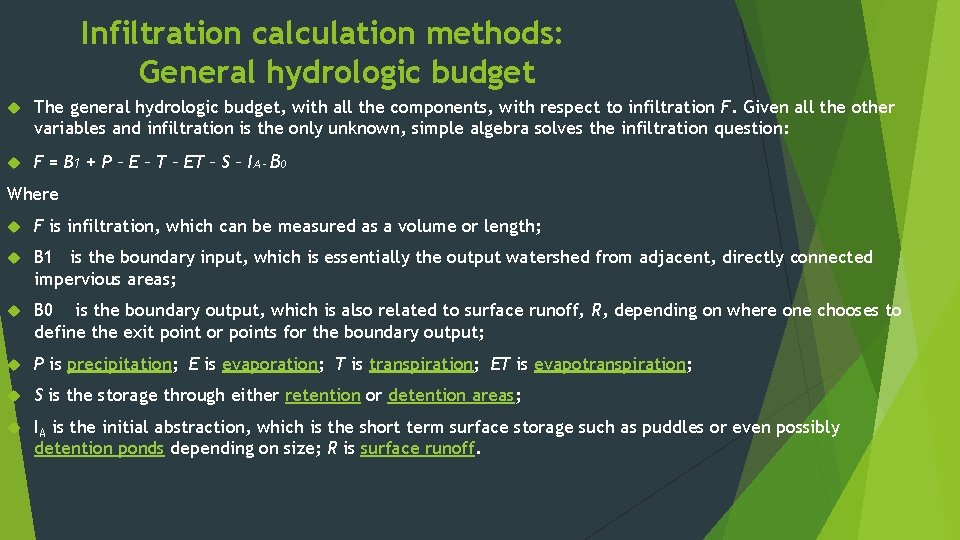
Infiltration calculation methods: General hydrologic budget The general hydrologic budget, with all the components, with respect to infiltration F. Given all the other variables and infiltration is the only unknown, simple algebra solves the infiltration question: F = B 1 + P – E – T – ET – S – IA – B 0 Where F is infiltration, which can be measured as a volume or length; B 1 is the boundary input, which is essentially the output watershed from adjacent, directly connected impervious areas; B 0 is the boundary output, which is also related to surface runoff, R, depending on where one chooses to define the exit point or points for the boundary output; P is precipitation; E is evaporation; T is transpiration; ET is evapotranspiration; S is the storage through either retention or detention areas; IA is the initial abstraction, which is the short term surface storage such as puddles or even possibly detention ponds depending on size; R is surface runoff.
FLOODS A flood is an overflow of water that submerges land which is usually dry. The European Union (EU) Floods Directive defines a flood as a covering by water of land not normally covered by water. Flooding may occur as an overflow of water from water bodies, such as a river or lake, in which the water overtops or breaks levees, resulting in some of that water escaping its usual boundaries.
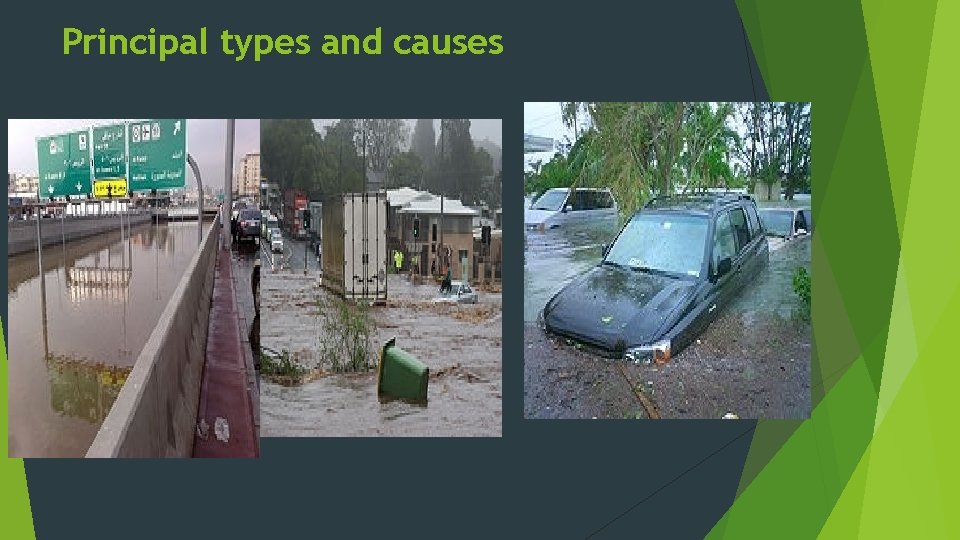
Principal types and causes
Areal (rainfall related) Floods can happen on flat or low-lying areas when the ground is saturated and water either cannot run off or cannot run off quickly enough to stop accumulating. Urban flooding Catastrophic flooding is usually associated with major infrastructure failures such as the collapse of a dam, but they may also be caused by damage sustained in an earthquake or volcanic eruption. See outburst flood
Effects Primary effects e primary effects of flooding include loss of life, damage to buildings and other structures, including bridges, sewerage tems, roadways, and canals. Floods also frequently damage power transmission and sometimes power generation, which then has knock-on effects caused by the loss of power. This includes loss of drinking water treatment and water supply, which may result in loss of drinking water or severe water contamination. It may also cause the loss of sewage disposal facilities. Lack of clean water combined with human sewage in the flood waters raises the risk of waterborne diseases, which can include typhoid, giardia, cryptosporidium, cholera and many other diseases depending upon the location of the flood. Damage to roads and transport infrastructure may make it difficult to mobilize aid to those affected or to provide emergency health treatment. Flood waters typically inundate farm land, making the land unworkable and preventing crops from being planted or harvested, which can lead to shortages of food both for humans and farm animals. Entire harvests for a country can be lost in extreme flood circumstances. Some tree species may not survive prolonged flooding of their root systems
Secondary and long-term effects Economic hardship due to a temporary decline in tourism, rebuilding costs, or food shortages leading to price increases is a common after-effect of severe flooding. The impact on those affected may cause psychological damage to those affected, in particular where deaths, serious injuries and loss of property occur. Urban flooding can lead to chronically wet houses, which are linked to an increase in respiratory problems and other illnesses. Urban flooding also has significant economic implications for affected neighborhoods. In the United States, industry experts estimate that wet basements can lower property values by 10 -25 percent and are cited among the top reasons for not purchasing a home. According to the U. S. Federal Emergency Management Agency (FEMA), almost 40 percent of small businesses never reopen their doors following a flooding disaster

- Slides: 11