
Infiltration Infiltration Process Infiltration Process of water entry




- Slides: 20
Infiltration
Infiltration Process Infiltration : Process of water entry into the soil through the soil surface When water is ponded on a homogeneous soil, characteristic zones of saturation, water transmission, and soil wetting, develop as the wetting front propagates downward
Definition • It is a process of water penetrating from the ground surface into the ground
Infiltration Process Infiltration Capacity Maximum rate water is absorbed by the soil Infiltration Rate Infiltration occurring at less than capacity
Infiltration Process Moisture Zones during Infiltration
Infiltration Process The factors affecting infiltration are: 1) precipitation. 2) soil types. 3) water contents in the soil. 4) vegetation cover. 5) ground slope.
Infiltration Process Effect of soil types It is measured in inches per hour or millimeters per hour. The rate decreases as the soil becomes saturated. If the precipitation rate exceeds the infiltration rate, runoff will usually occur
Measurement Of Infiltration Rainfall simulator Flooding infiltrometer Hydrograph analysis 3 methods to determine infiltration rate
Infiltration Measurement Infiltrometer: Infiltrometer is a device used to measure the rate of water infiltration into soil or other porous media. Commonly used infiltrometers are single ring or double ring infiltrometer. It is easy to use, but soil structure could be disturbed.
Infiltration Measurement Infiltrometer:
Infiltration Measurement Artificial rain simulation No disturbance to soil, close to true rainfall impact, but high cost.
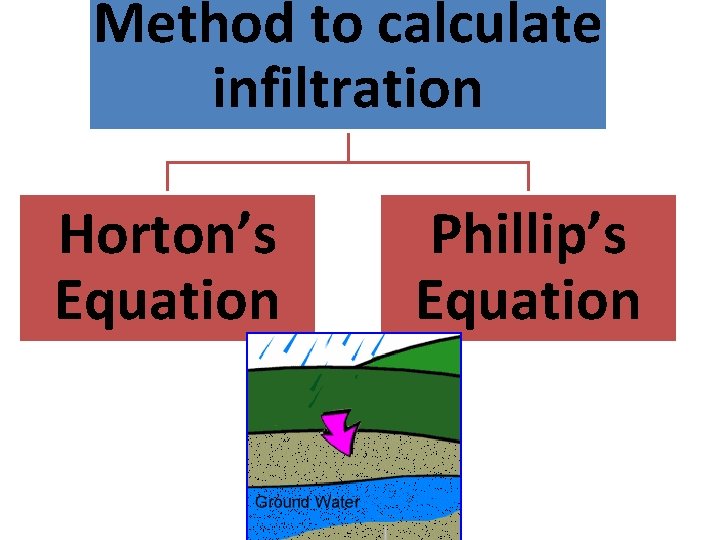
Method to calculate infiltration Horton’s Equation Phillip’s Equation
Horton’s equation f(t) = fc + (f 0 – fc) e-kt - Infiltration start at rate f 0 and exponentially decreases until it reaches constent rate fc - k = delay constant - f 0 = initial infiltration - fc = constant infiltration - f(t) = infiltration rate
Phillip’s equation F(t) = St 1/2 + Kt Where S is a parameter called sorptivity, which is a function of the soil suction potential, and K is the hydraulic conductivity By differentiation f(t) = ½ St-1/2 + K
Estimation of Infiltration Rate Horton’s Equation
Estimation of Infiltration Rate
Rain that fall in watershed will flow on the ground, into river and discharged out downstream. Some of the water will infiltrate into ground and this reduce surface runoff. In soil in watershed is mostly sand, infiltration rate will be high and surface runoff will be low. This allow us to make optimum design of drainage facilities Example: i. how big and wider river need to be i. Allowable obstruction to water flow by briges.
Estimation of Infiltration Rate Ex 1: The initial infiltration capacity fo of a catchment is estimated as 4. 5 mm/hr, the time constant as 0. 35 /hour, and capacity fc as 0. 4 mm/hour. Apply Horton's equation to find the following: a) The value ft at t=10 min, 30 min, 1 hr, 2 hr and 6 hr. b) The total volume of infiltration over the 6 hours period. Assume continuously ponded conditions
EX: 2 Suppose that the parameters for Horton’s equation are fo=3. 5 mm/hr, fc=0. 6 mm/hr and k=4. 1 hr-1. Determine the infiltration rates after 0, 10 min, 20 min, 1 hr, 1. 5 hr and 2 hr and the cumulative infiltration after 2 hours. Assume continuously ponded conditions.