
Infiltration Evapotranspiration and Soil Water Processes Lecture Goals




- Slides: 46
Infiltration Evapotranspiration and Soil Water Processes
Lecture Goals Ü Identify the factors, such as soil type, moisture content, vegetative and surface cover, and time, that affect the cumulative infiltration and infiltration rates. Ü Define the following terms: • Moisture content: – Gravimetric – Volumetric – Saturated • Pore Volume • Field Capacity • Available Water • Wilt Point Ü Discuss empirically and theoretically models for cumulative infiltration and infiltration rates via the Horton, Phillips and Green -Ampt equations. Ü Discuss Darcy’s Law for simple saturated flow scenarios. Ü Conduct a soil water balance
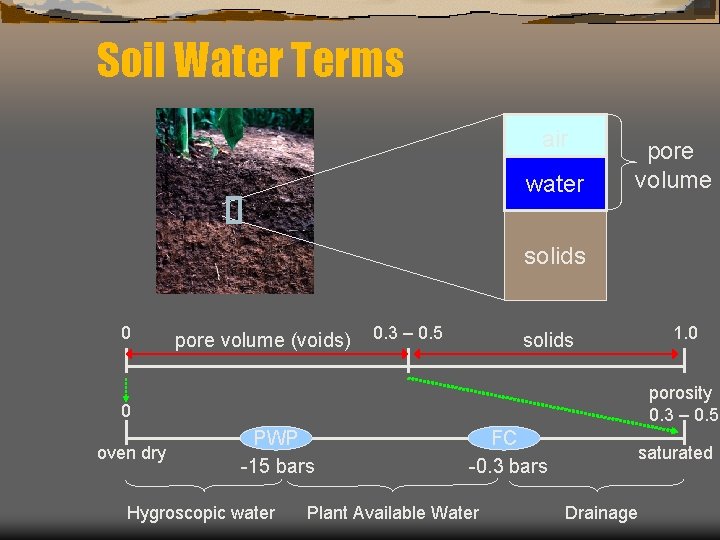
Definitions Ü Water Content Ü Field Capacity Gravimetric Ü Permanent Wilt Volumetric Point Ü Porosity Ü Available Water Ü Degree of Saturation Ü Hygroscopic Water Ü Bulk Density Ü Capillary Water Ü Particle Density Ü Gravity Water Ü Specific Gravity
Soil Water Terms air water pore volume solids 0 pore volume (voids) 0. 3 – 0. 5 1. 0 solids porosity 0. 3 – 0. 5 0 oven dry PWP -15 bars Hygroscopic water FC -0. 3 bars Plant Available Water saturated Drainage
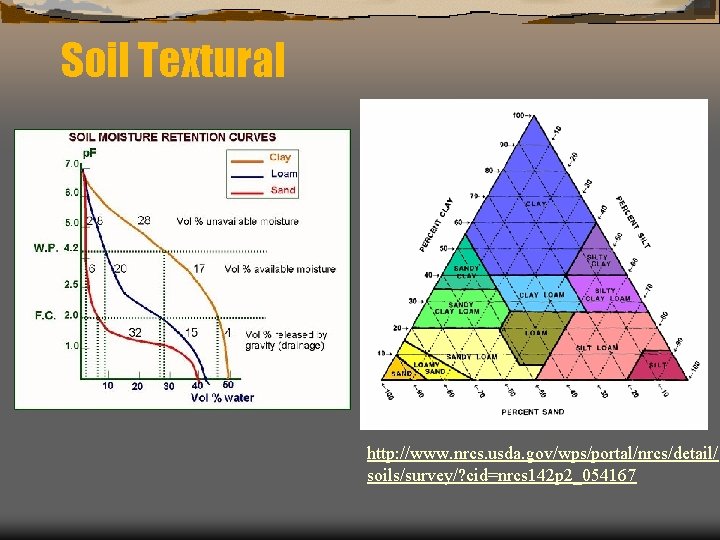
Soil Textural http: //www. nrcs. usda. gov/wps/portal/nrcs/detail/ soils/survey/? cid=nrcs 142 p 2_054167
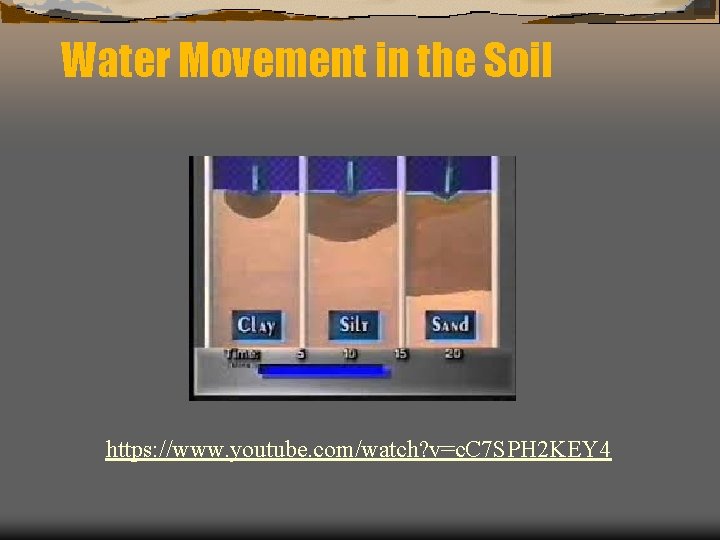
Water Movement in the Soil https: //www. youtube. com/watch? v=c. C 7 SPH 2 KEY 4
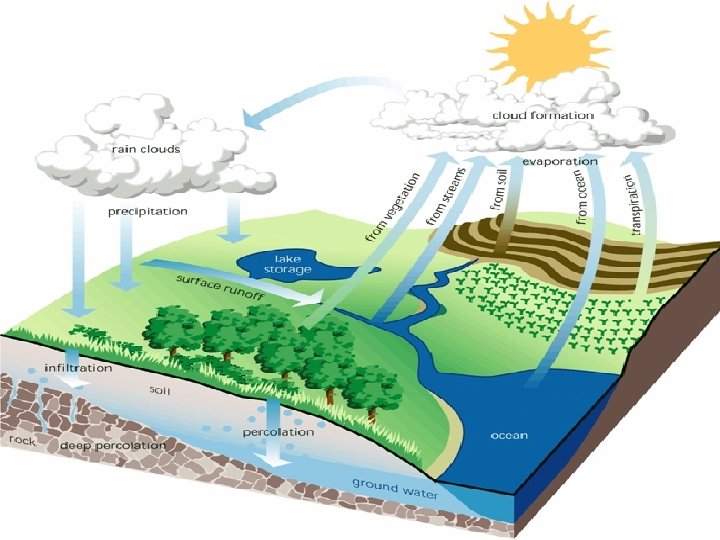
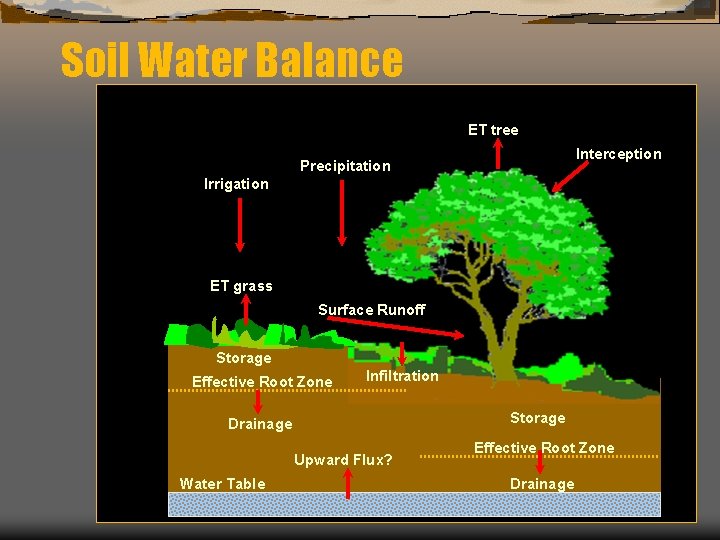
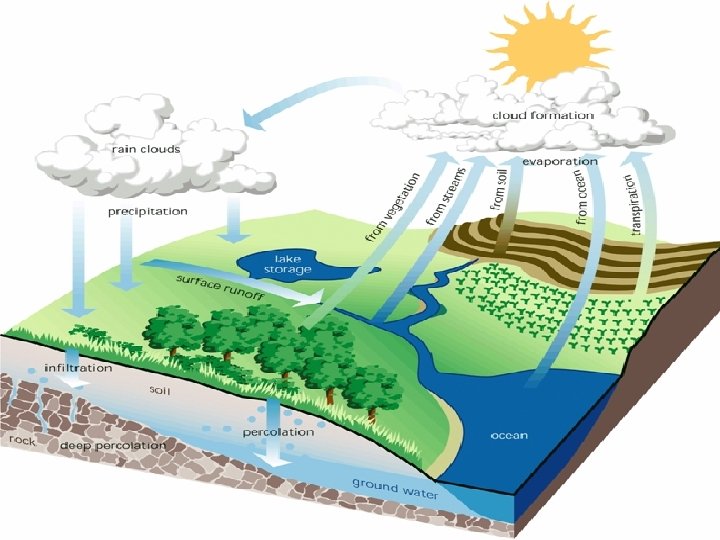
Soil Water Balance ET tree Interception Precipitation Irrigation ET grass Surface Runoff Storage INFILTRATION Infiltration Effective Root Zone Storage Drainage Upward Flux? Water Table Effective Root Zone Drainage
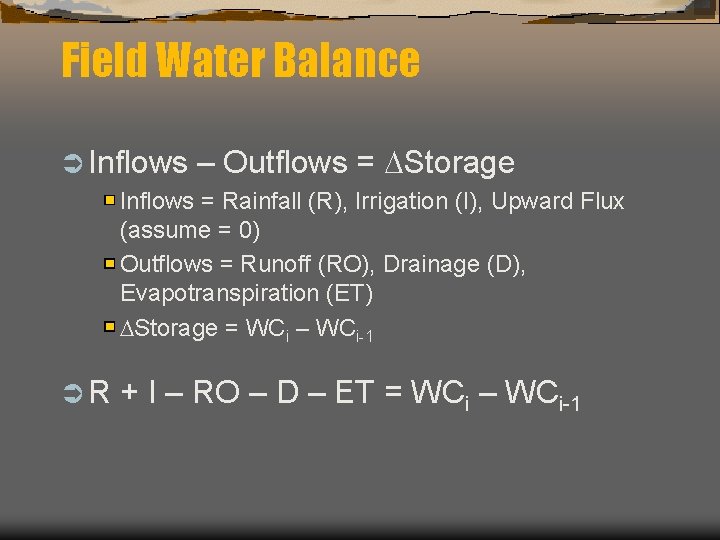
Field Water Balance Ü Inflows – Outflows = Storage Inflows = Rainfall (R), Irrigation (I), Upward Flux (assume = 0) Outflows = Runoff (RO), Drainage (D), Evapotranspiration (ET) Storage = WCi – WCi-1 ÜR + I – RO – D – ET = WCi – WCi-1
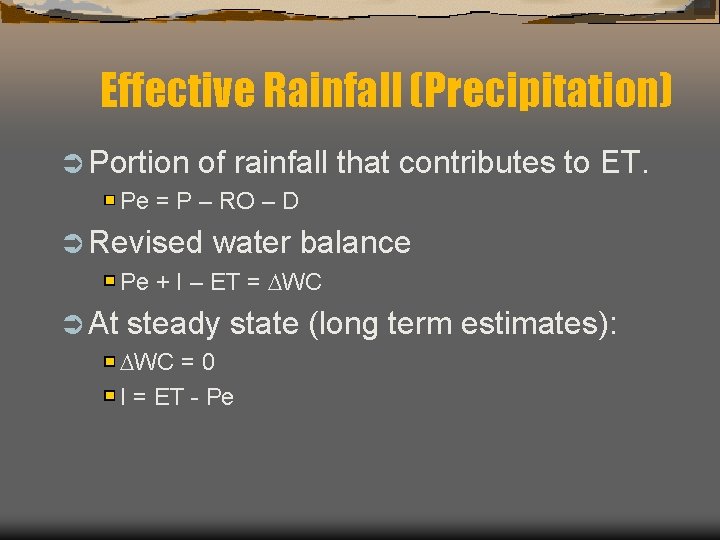
Effective Rainfall (Precipitation) Ü Portion of rainfall that contributes to ET. Pe = P – RO – D Ü Revised water balance Pe + I – ET = WC Ü At steady state (long term estimates): WC = 0 I = ET - Pe
Infiltration Ü The movement of water across the air-soil surface interface or the entry of water into the soil surface. affected by conditions above and below the soil surface. Ü Infiltration is one of the most heavily researched components of the hydrologic cycle but remains the most difficult component to quantify.
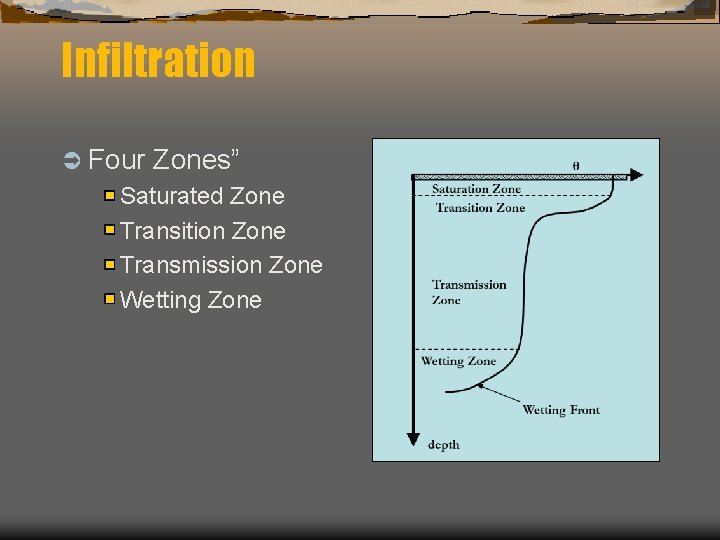
Infiltration Ü Four Zones” Saturated Zone Transition Zone Transmission Zone Wetting Zone
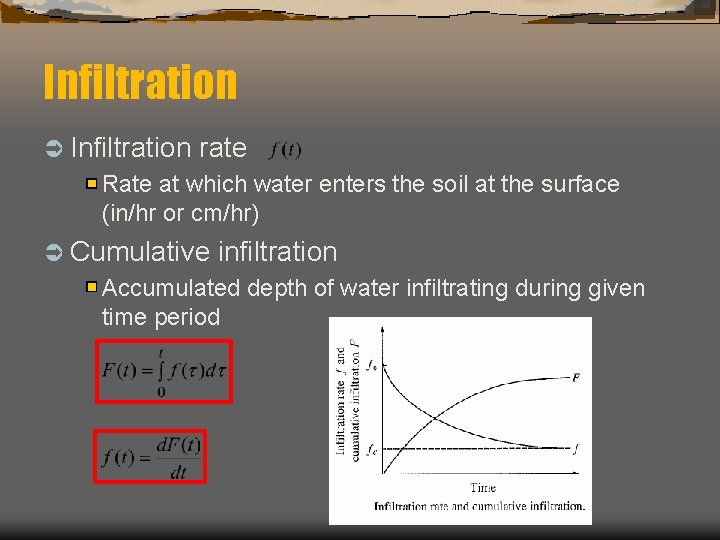
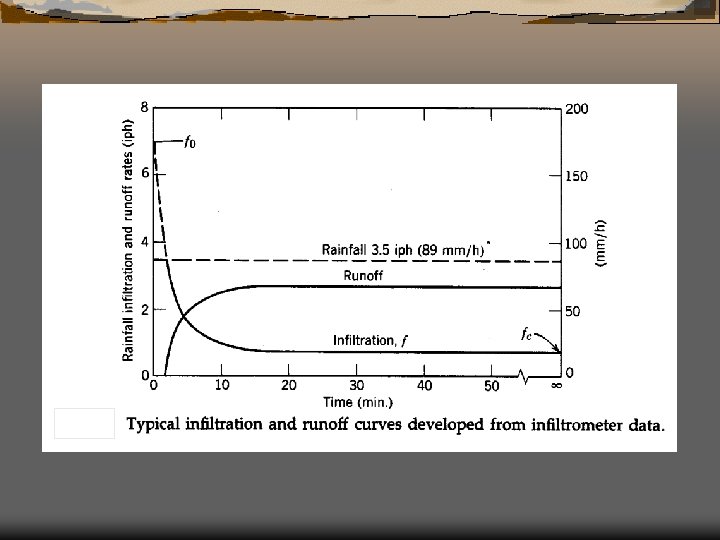
Infiltration Ü Infiltration rate Rate at which water enters the soil at the surface (in/hr or cm/hr) Ü Cumulative infiltration Accumulated depth of water infiltrating during given time period
Infiltration Ü Governed by: Effects of gravity Effects of capillary forces Ü Concerned with: Saturated systems (i. e. pond liners) Unsaturated systems (i. e. fields, lawns).
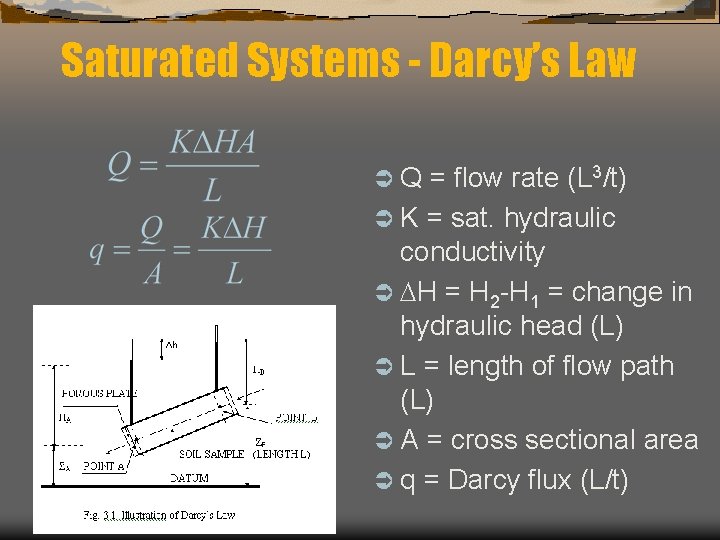
Saturated Systems - Darcy’s Law ÜQ = flow rate (L 3/t) Ü K = sat. hydraulic conductivity Ü H = H 2 -H 1 = change in hydraulic head (L) Ü L = length of flow path (L) Ü A = cross sectional area Ü q = Darcy flux (L/t)
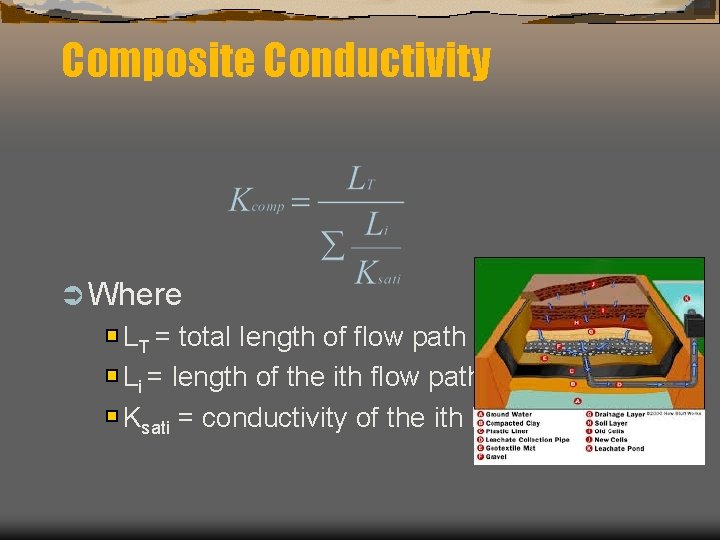
Composite Conductivity Ü Where LT = total length of flow path Li = length of the ith flow path Ksati = conductivity of the ith layer
Factors Affecting Infiltration
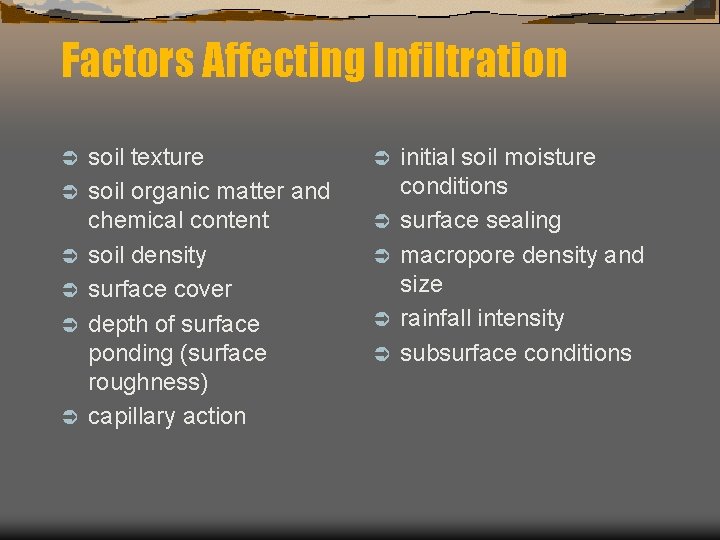
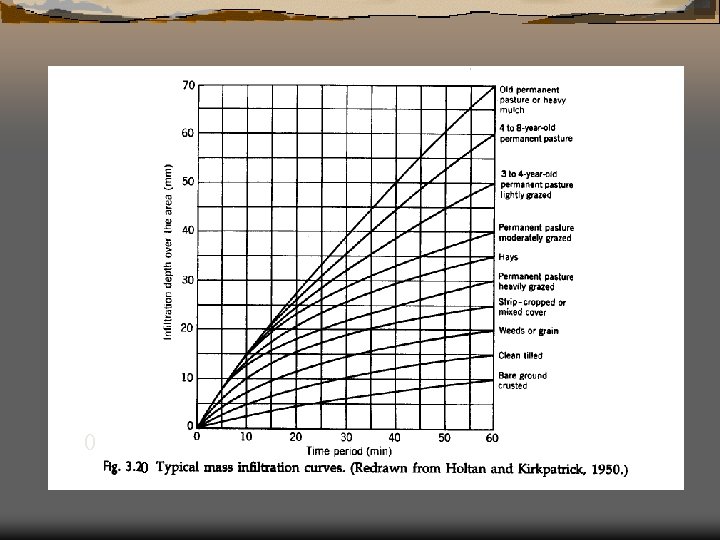
Factors Affecting Infiltration Ü Ü Ü soil texture soil organic matter and chemical content soil density surface cover depth of surface ponding (surface roughness) capillary action Ü Ü Ü initial soil moisture conditions surface sealing macropore density and size rainfall intensity subsurface conditions
0 0
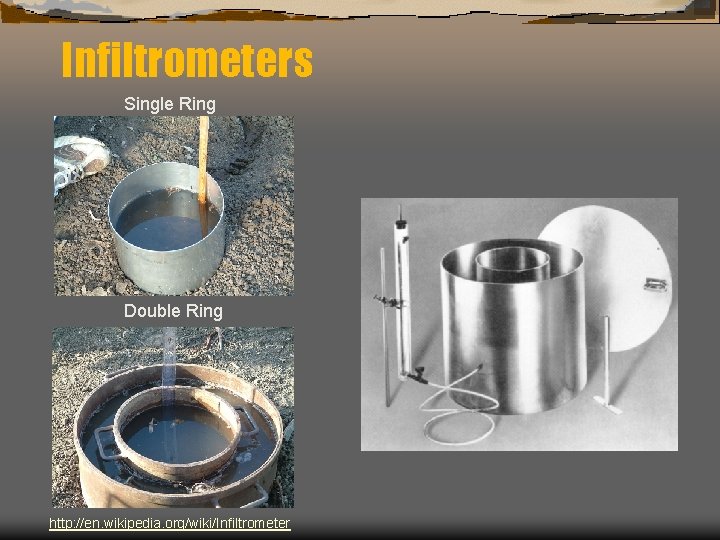
Infiltrometers Single Ring Double Ring http: //en. wikipedia. org/wiki/Infiltrometer
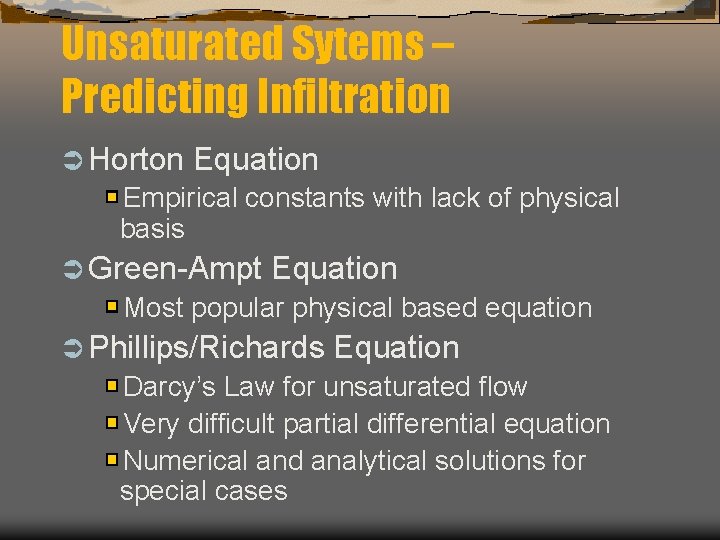
Unsaturated Sytems – Predicting Infiltration Ü Horton Equation Empirical constants with lack of physical basis Ü Green-Ampt Equation Most popular physical based equation Ü Phillips/Richards Equation Darcy’s Law for unsaturated flow Very difficult partial differential equation Numerical and analytical solutions for special cases
Horton Equation f = fc + (fo - fc)e-Kt Ü Ü Ü f = Horton infiltration (L/t) fc = steady state infiltration rate (L/t) fo = initial infiltration rate (L/t) K = empirical constant (1/t) t = time (t)
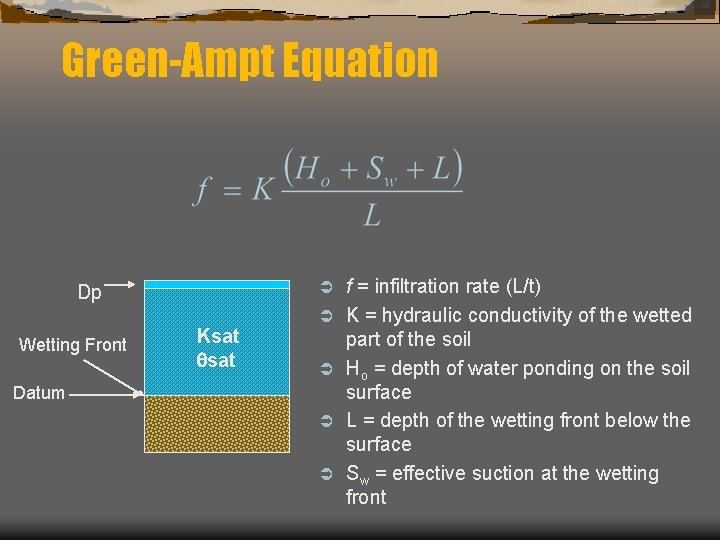
Green-Ampt Equation Ü Dp Wetting Front Ksat Ü Ü Datum Ü Ü f = infiltration rate (L/t) K = hydraulic conductivity of the wetted part of the soil Ho = depth of water ponding on the soil surface L = depth of the wetting front below the surface Sw = effective suction at the wetting front
Lecture Goals ¬Understand several empirical and physically based models for predicting evaporation from climatological data and evaporation pans. ¬Predict evapotranspiration of crops by calculating evaporation from nearby water bodies and transpiration from well-watered crops.
Read and Explain Pairs What is ET? http: //www. ksre. ksu. edu/bookstore/
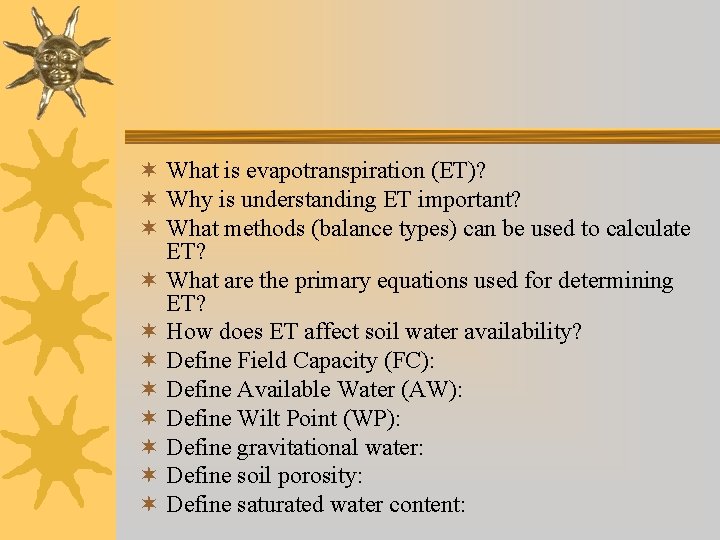
¬ What is evapotranspiration (ET)? ¬ Why is understanding ET important? ¬ What methods (balance types) can be used to calculate ET? ¬ What are the primary equations used for determining ET? ¬ How does ET affect soil water availability? ¬ Define Field Capacity (FC): ¬ Define Available Water (AW): ¬ Define Wilt Point (WP): ¬ Define gravitational water: ¬ Define soil porosity: ¬ Define saturated water content:
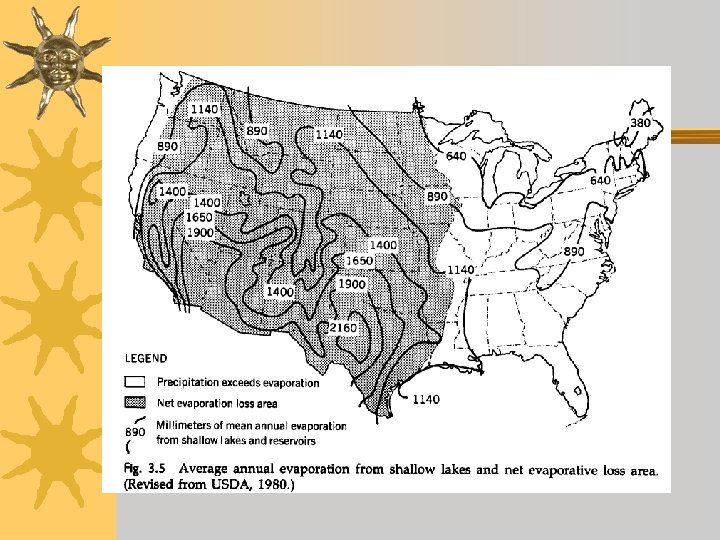
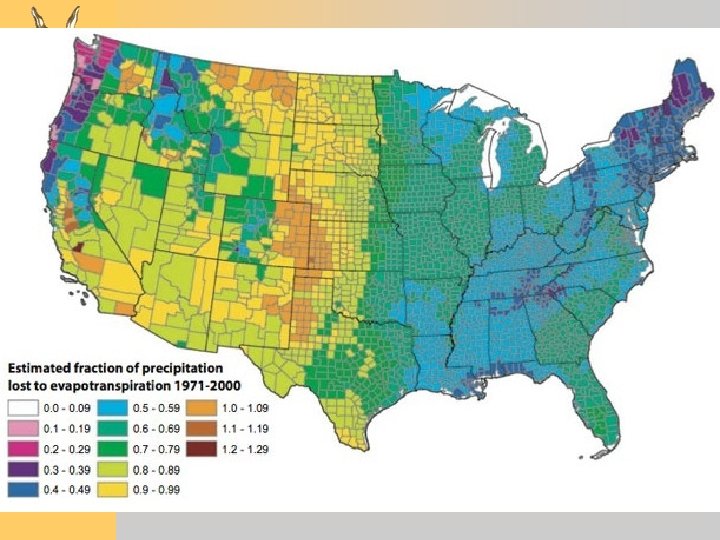
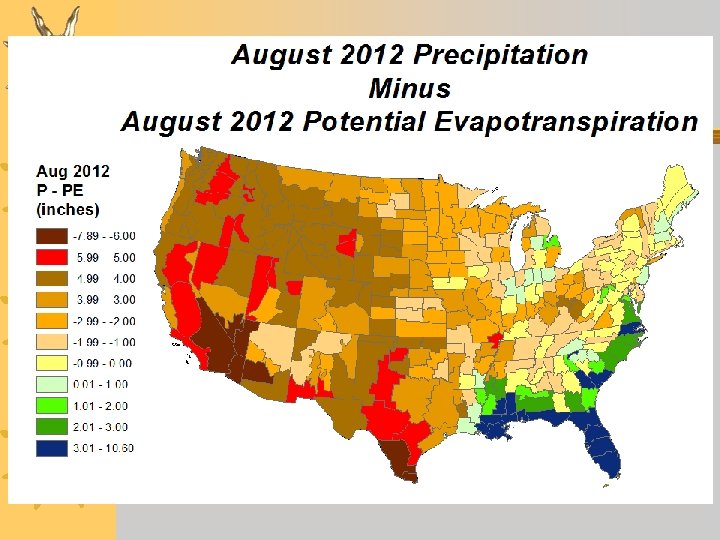
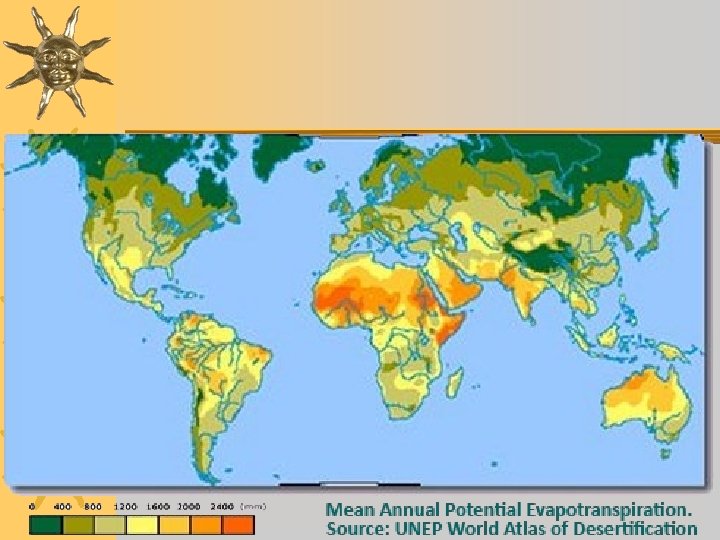
Evaporation / Transpiration ¬Evaporation – The transfer of liquid water into the atmosphere. – Driven by solar energy. – Dependent on mass transfer relationships. ¬Transpiration – Process through which water vapor passes into the atmosphere through plant tissue.
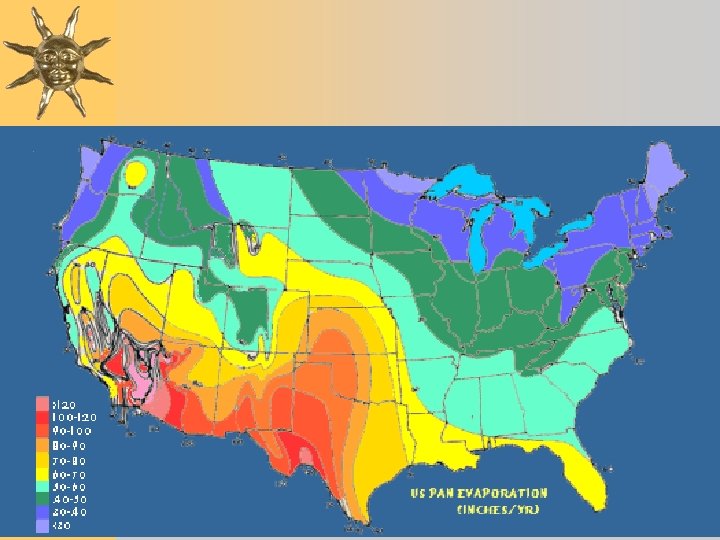
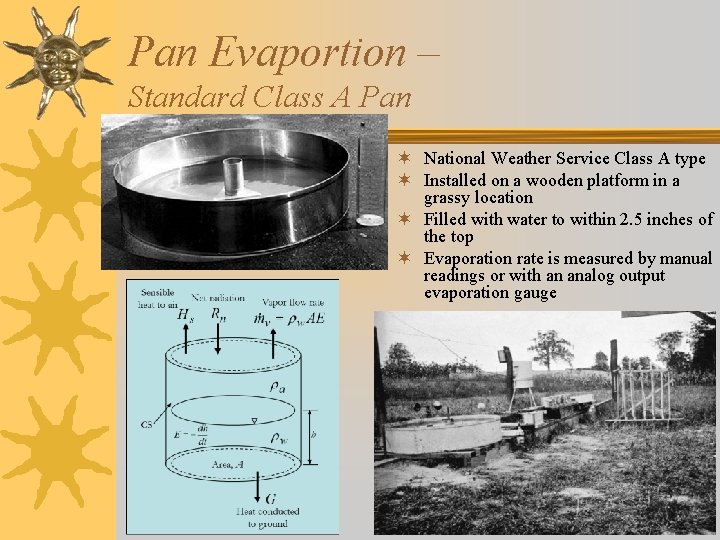
Pan Evaportion – Standard Class A Pan ¬ National Weather Service Class A type ¬ Installed on a wooden platform in a grassy location ¬ Filled with water to within 2. 5 inches of the top ¬ Evaporation rate is measured by manual readings or with an analog output evaporation gauge
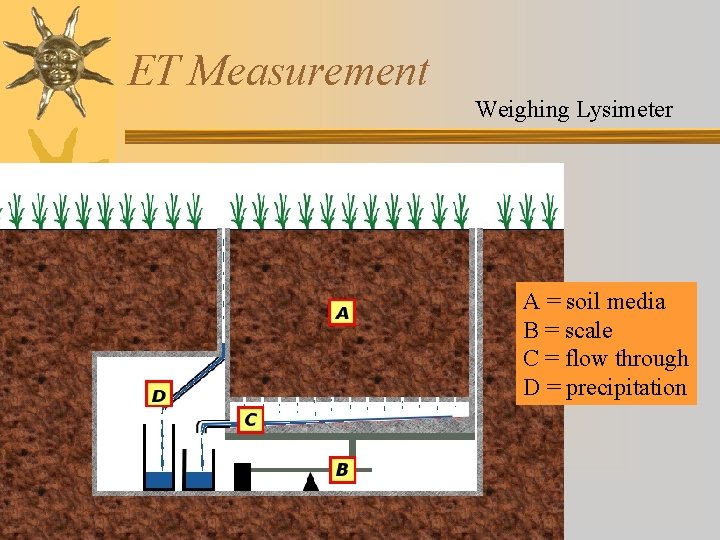
ET Measurement Weighing Lysimeter A = soil media B = scale C = flow through D = precipitation
Prediction Methods ¬ Mass Transfer – i. e. Thornthwaite Holzman • Based on variations of Fick’s Law • A vapor concentration transport model ¬ Energy Balance – Most practical methods (i. e. Penman) ¬ Empirical Radiation Methods – i. e. Blaney-Criddle and Jensen-Haise ¬ Combination Methods – i. e. Penman Montheith (Energy Balance-Mass Transfer)
Evapotranspiration ¬Main factor controlling soil moisture – Significant effect on infiltration and runoff. ¬Greatest during the growing season. ¬Estimations important for continuous simulation models. ¬Not important for single event analysis.
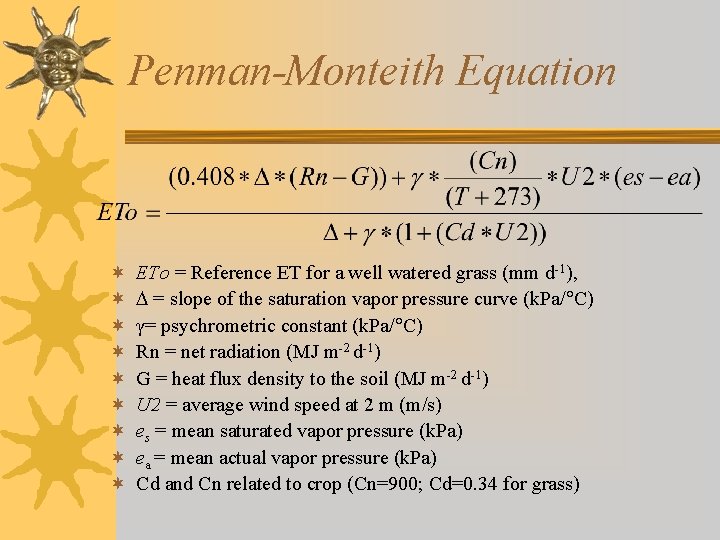
Penman-Monteith Equation ¬ ¬ ¬ ¬ ¬ ETo = Reference ET for a well watered grass (mm d-1), = slope of the saturation vapor pressure curve (k. Pa/ C) γ= psychrometric constant (k. Pa/ C) Rn = net radiation (MJ m-2 d-1) G = heat flux density to the soil (MJ m-2 d-1) U 2 = average wind speed at 2 m (m/s) es = mean saturated vapor pressure (k. Pa) ea = mean actual vapor pressure (k. Pa) Cd and Cn related to crop (Cn=900; Cd=0. 34 for grass)
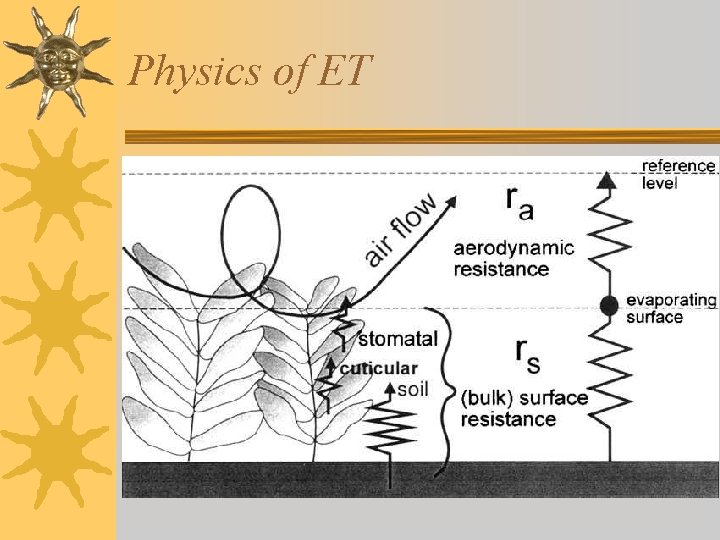
Physics of ET
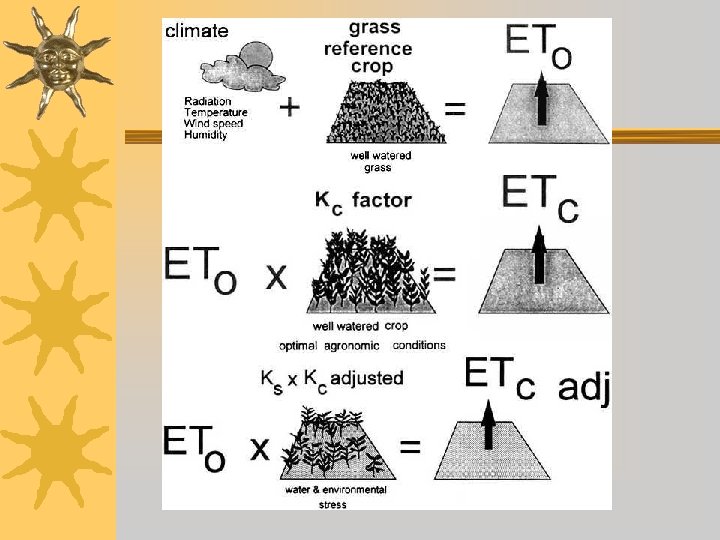
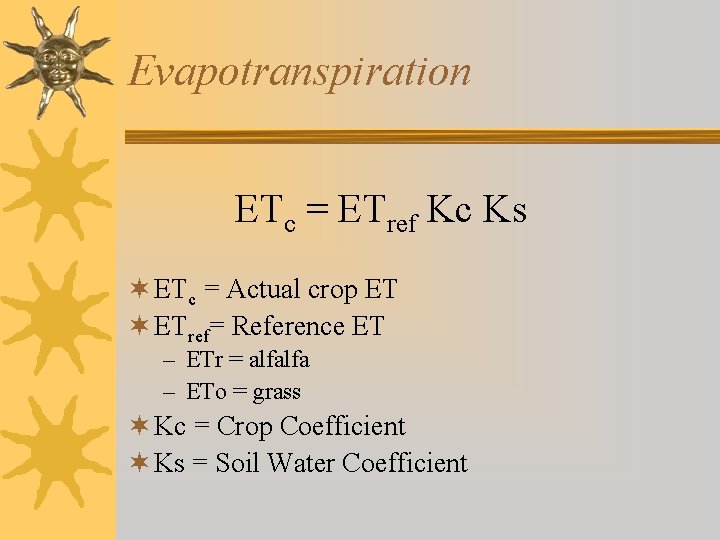
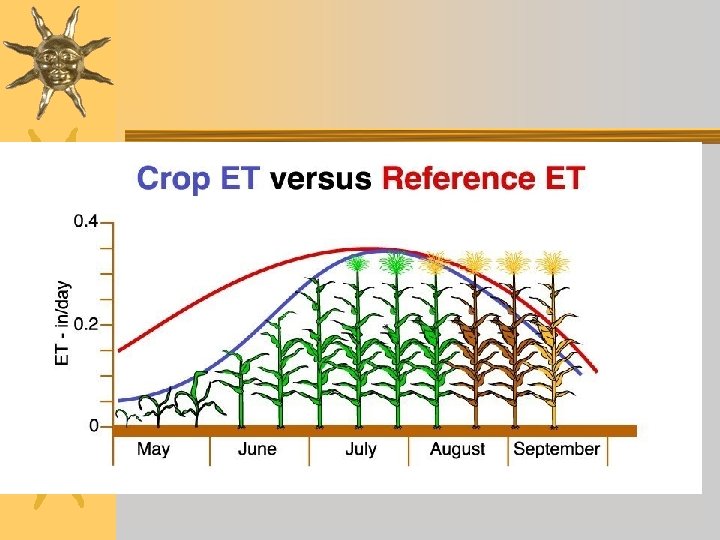
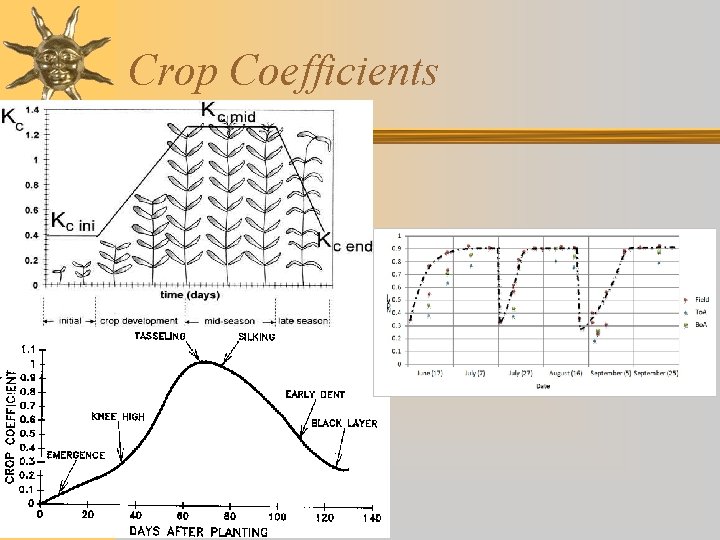
Evapotranspiration ETc = ETref Kc Ks ¬ ETc = Actual crop ET ¬ ETref= Reference ET – ETr = alfalfa – ETo = grass ¬ Kc = Crop Coefficient ¬ Ks = Soil Water Coefficient
Crop Coefficients