
Infezioni e Globalizzazione Massimo Galli Infectious Disease Unit
Infezioni e Globalizzazione Massimo Galli Infectious Disease Unit DIBIC L. Sacco, University of. Milano
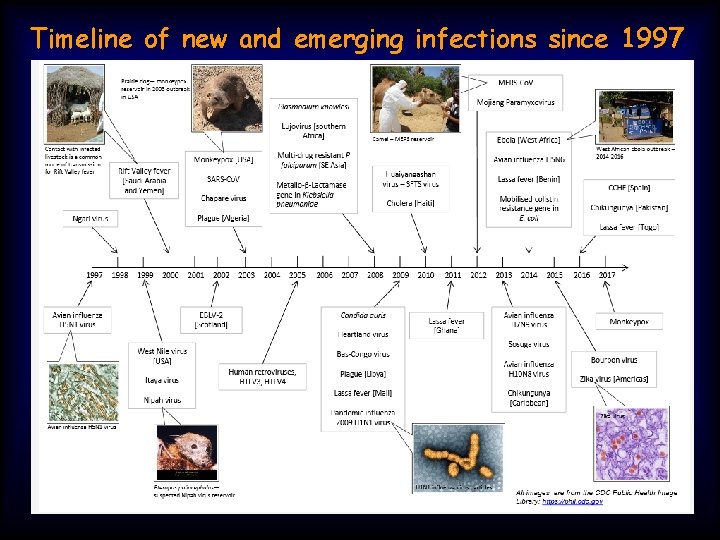
Timeline of new and emerging infections since 1997
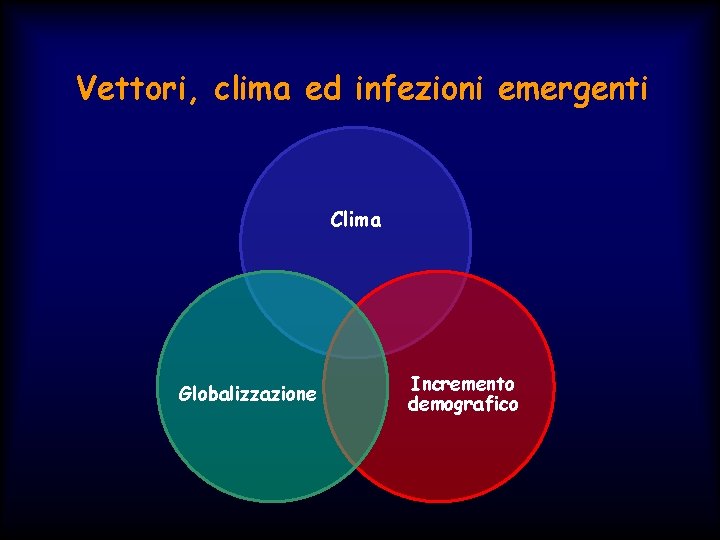
Vettori, clima ed infezioni emergenti Clima Globalizzazione Incremento demografico
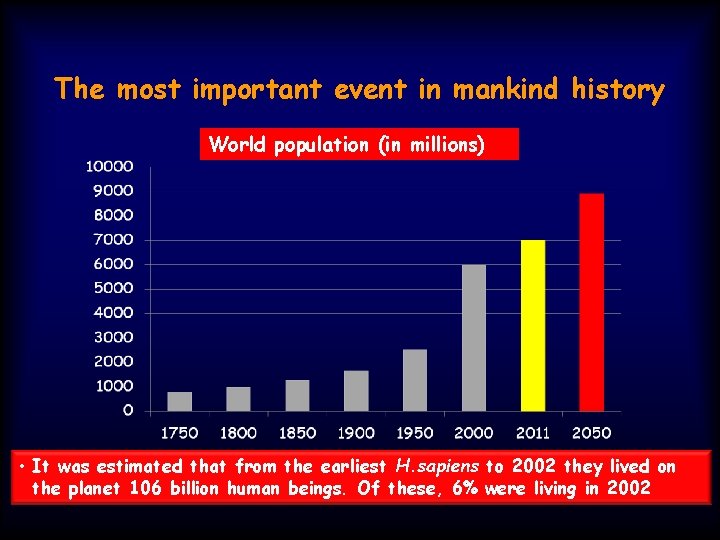
The most important event in mankind history World population (in millions) • It was estimated that from the earliest H. sapiens to 2002 they lived on the planet 106 billion human beings. Of these, 6% were living in 2002

Air transport passenger carried per year Source: World Bank 2017
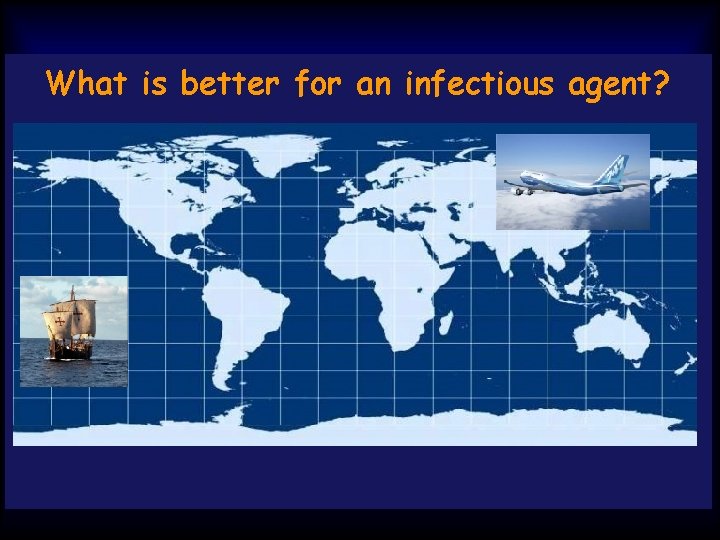
What is better for an infectious agent? • WNV landed for the first time in America in 1999 and then quickly spread to much of North America • CHICKV has been adapting to a new carrier in just a few years, has caused epidemics in geographic areas that have never been touched before and has been steadily rooted in the Americas • ZIKV, another African virus, has caused epidemics in Polynesia and then in the Americas, assuming the connotations of a global emergency • In recent years, various tick-borne infections have increased incidence, extended their spatial area, or emerged for the first time
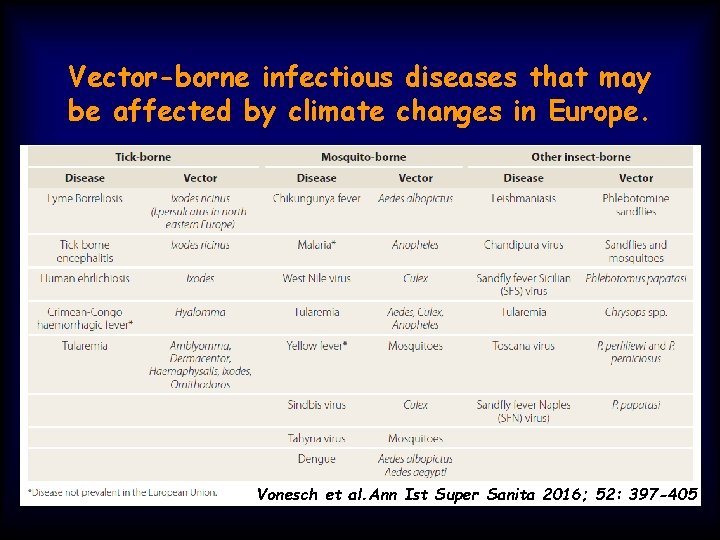
Vector-borne infectious diseases that may be affected by climate changes in Europe. Vonesch et al. Ann Ist Super Sanita 2016; 52: 397 -405
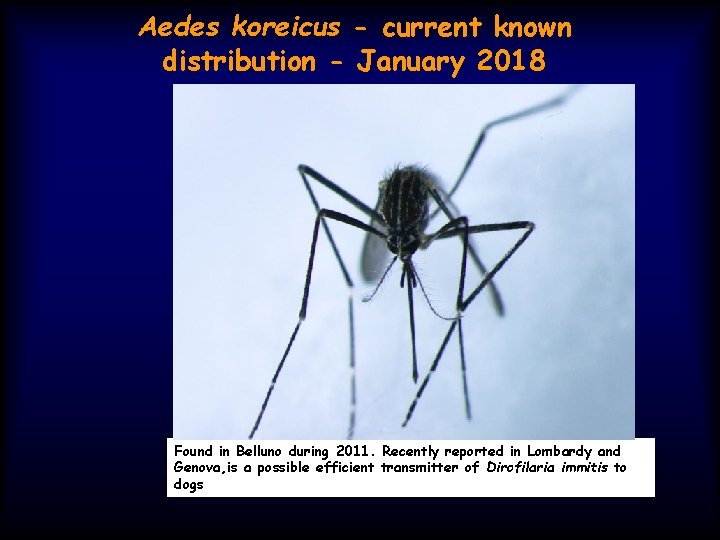
Aedes koreicus - current known distribution - January 2018 Found in Belluno during 2011. Recently reported in Lombardy and Genova, is a possible efficient transmitter of Dirofilaria immitis to dogs
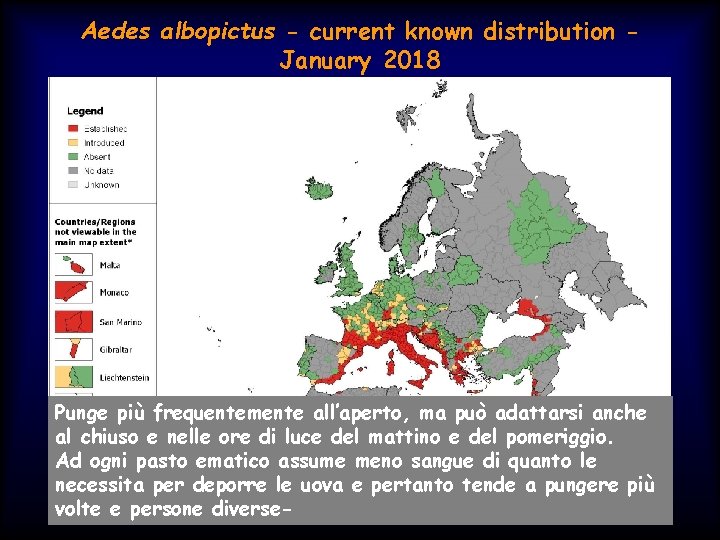
Aedes albopictus - current known distribution January 2018 Punge più frequentemente all’aperto, ma può adattarsi anche al chiuso e nelle ore di luce del mattino e del pomeriggio. Ad ogni pasto ematico assume meno sangue di quanto le necessita per deporre le uova e pertanto tende a pungere più volte e persone diverse-
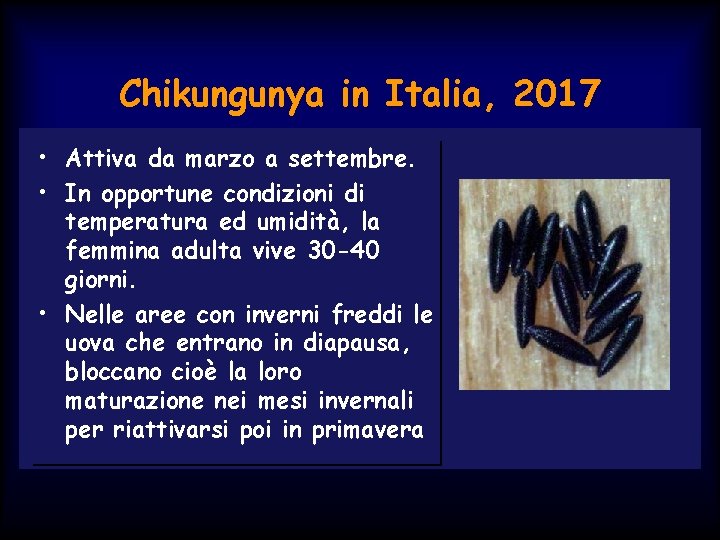
Chikungunya in Italia, 2017 da marzo settembre. • • Al. Attiva 6 ottobre 2017, a 282 notifiche (156 confermati e probabili) in Lazio (Anzio, Roma e Latina-242 • 126 In opportune condizioni di casi probabili eedconfermati) temperatura umidità, lae Calabria (Guardavalle Marina-33 casi probabili e confermati). femmina adulta vive 30 -40 giorni. • Casi ‘importati’ in Emilia-Romagna (4 casi di malattia probabili Guardavalle Marina • 3 Nelle areeda con inverni freddi le e uno confermato aduova Anzio), Marche in (undiapausa, caso da Anzio), Francia (1 che entrano caso confermato Anzio) e Germania (un caso bloccano cioè la da loro probabile con storia di invernali viaggio a Roma). maturazione nei mesi per riattivarsi poi in primavera
Geographic distribution of H 7 N 9 cases and the number of live poultry markets (LPM). The background represents the number of LPM. The 3 D bars are for the collective cases of H 7 N 9 from 2013 to 2017 for individual provinces Liu Q et al Front. Med. 2018; 12: 3– 22
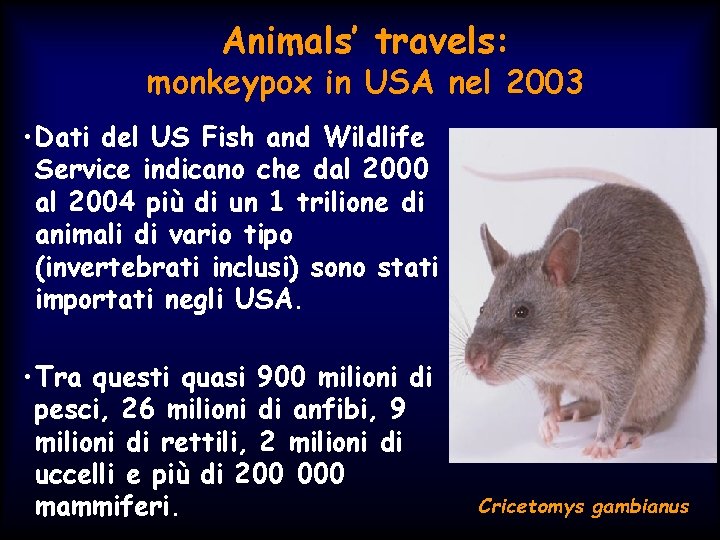
Animals’ travels: monkeypox in USA nel 2003 • Dati del US Fish and Wildlife Service indicano che dal 2000 al 2004 più di un 1 trilione di animali di vario tipo (invertebrati inclusi) sono stati importati negli USA. • Tra questi quasi 900 milioni di pesci, 26 milioni di anfibi, 9 milioni di rettili, 2 milioni di uccelli e più di 200 000 mammiferi. Cricetomys gambianus

Monkeypox Outbreak 2003 Rodent Shipment Ghana TX-2 GR NJ RS, BP TS, SM Texas 50 Gambian giant rats (GR) 53 rope squirrels (RS) 2 brushtail porcupines (BP) 47 tree squirrels (TS) 100 striped mice (SM) ~510 dormice (DM) WI Human cases: 17 confirmed 22 probable/ suspect TX-3 42 PDs traced RS, SM DM Human cases: 8 confirmed 4 probable/ suspect 14 PDs traced IL-1§ GR, DM IA† IL‡ IN Human cases: 7 confirmed 24 PDs 9 probable/ traced suspect GR, DM TX-4 DM 200 prairie dogs (PDs) at facility TX-5 DM 1 PD traced TX-6 TS, SM DM TX-9 11 PDs traced DM TX-7 DM TX-8 DM No human cases MI Human cases: 2 confirmed KS Human cases: 1 confirmed No human cases TX-10 DM SC MO IL-2 DM Japan DM MN DM WI DM ML Washington, 2009 Adapted from G. Gerberding
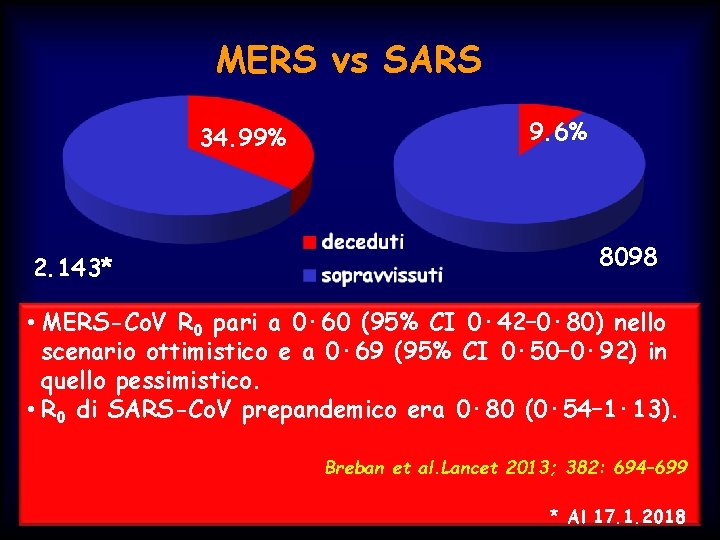
MERS vs SARS 34. 99% 2. 143* 9. 6% 8098 • • La SARS è stata fermata in pochi corso del 2003, MERS-Co. V R 0 pari a 0· 60 (95%mesi CI nel 0· 42– 0· 80) nello nonostante avesse interessato più (95% continenti e causato unin scenario ottimistico e a 0· 69 CI 0· 50– 0· 92) elevato numero di casi, tra cui 1707 (21. 1%) in HCW. quello pessimistico. • La MERS è in circolazione da più di tre anni e colpisce • prevalentemente R 0 di SARS-Co. V prepandemico era 0· 80 (0· 54– 1· 13). persone con comorbosità, il che spiega la più elevata letalità. Deve essere ancora chiarito se la malattia Breban et al. Lancet 2013; animale 382: 694– 699 sia mantenuta successive immissioni dal reservoir o dalla trasmissione inter-umana. * Al 17. 1. 2018
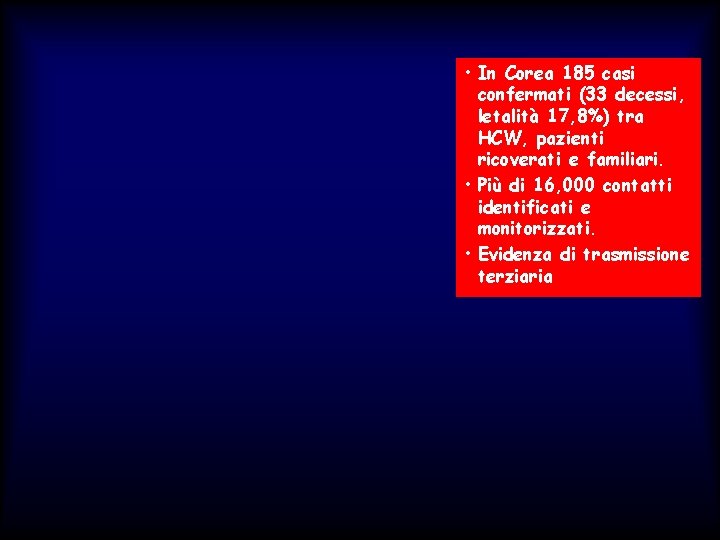
• In Corea 185 casi confermati (33 decessi, letalità 17, 8%) tra HCW, pazienti ricoverati e familiari. • Più di 16, 000 contatti identificati e monitorizzati. • Evidenza di trasmissione terziaria
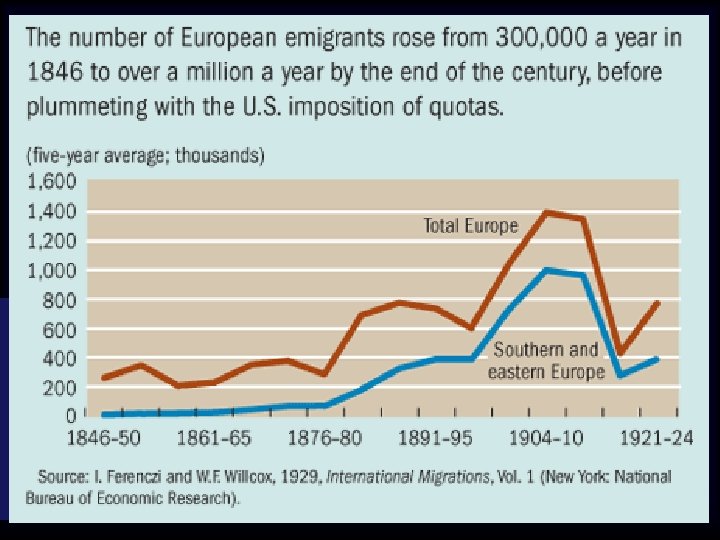
Population increase and infectious agents • The current distribution of genotypes and subtypes of many pathogens genotypes and subtypes follows the pathways of recent human dispersion • The demographic explosion has probably favored their evolutionary speed and geographical differentiation • The Yarawa paradox: can the same virus exhibits a • The Iarawa, an Andamanese tribe of about much lower evolution rate in a small and isolated 275 individuals remaining in absolute and population in which is predominantly vertically hostile isolation until 1997, has a HBV transmitted than in a large, rapidly growing in which the (65. 6%) hyperendemia caused by a HBV-C 2 transmission is predominantly horizontal ? closely related to strains circulating on the Indochinese peninsula. How was it possible?
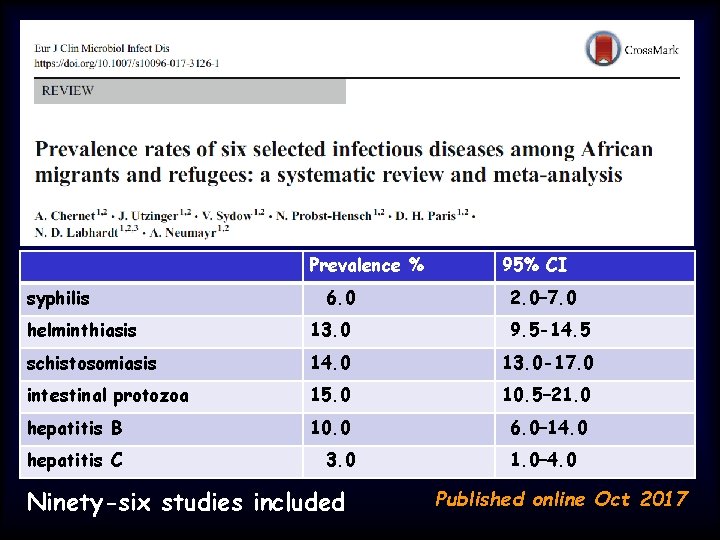
Prevalence % syphilis 6. 0 95% CI 2. 0– 7. 0 helminthiasis 13. 0 9. 5 -14. 5 schistosomiasis 14. 0 13. 0 -17. 0 intestinal protozoa 15. 0 10. 5– 21. 0 hepatitis B 10. 0 6. 0– 14. 0 hepatitis C 3. 0 Ninety-six studies included 1. 0– 4. 0 Published online Oct 2017
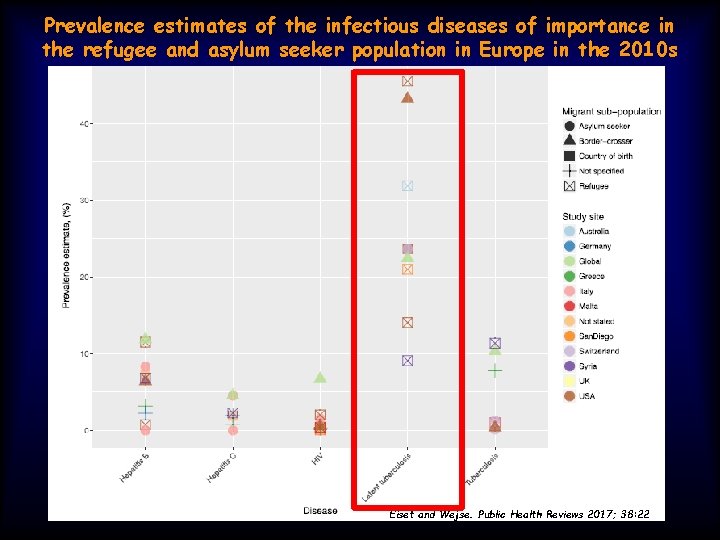
Prevalence estimates of the infectious diseases of importance in the refugee and asylum seeker population in Europe in the 2010 s Eiset and Wejse. Public Health Reviews 2017; 38: 22
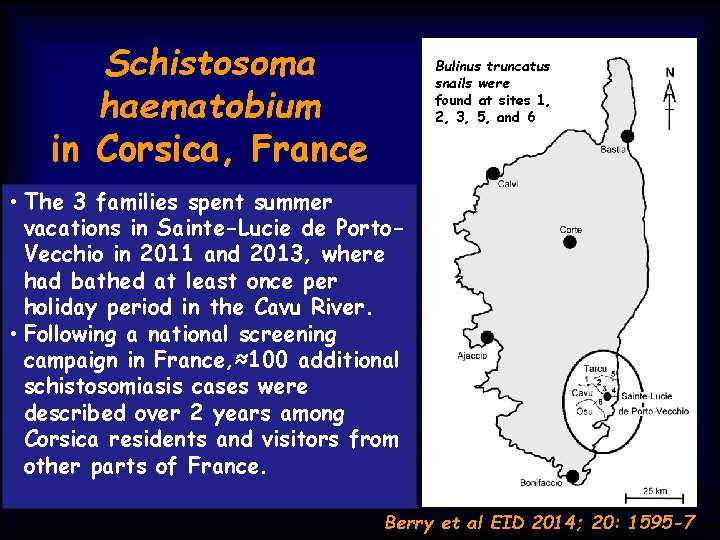
Schistosoma haematobium in Corsica, France Bulinus truncatus snails were found at sites 1, 2, 3, 5, and 6 summer • • The Of 311 families Frenchspent native born vacations Sainte-Lucie de Portomembersinof the 3 families, 6 Vecchio in 2011 results and 2013, had positive for where had bathed at least S. haematobium byonce urineper holiday period in the Cavu River. examination. • Following a national screening • campaign In addition, 2 family members in France, ≈100 additional who had a negative result by schistosomiasis cases were urine examination hadamong a positive described over 2 years Corsica residents serologic result. and visitors from other parts of France. Berry et al EID 2014; 20: 1595 -7
• Prevalence was 1% among migrants from endemic areas and 10% in those from. Mali and Senegal.
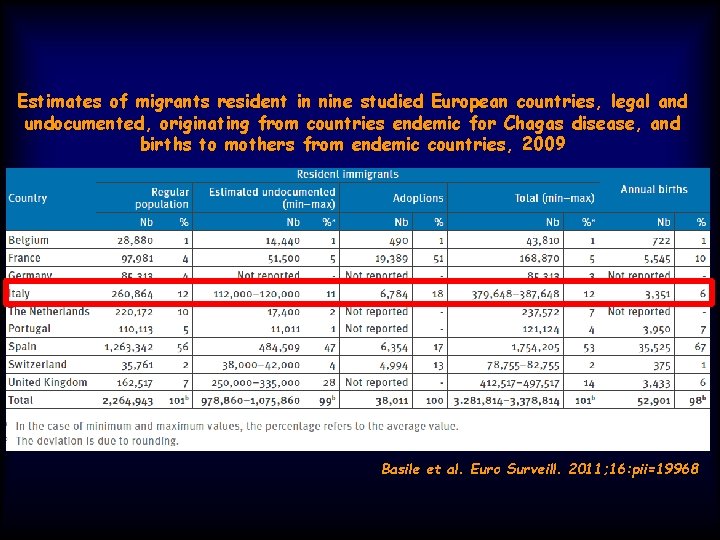
Estimates of migrants resident in nine studied European countries, legal and undocumented, originating from countries endemic for Chagas disease, and births to mothers from endemic countries, 2009 Basile et al. Euro Surveill. 2011; 16: pii=19968
Chagas disease knocks on our door: A cross-sectional study among latin american immigrants in Milan, Italy. • • Twenty-nine Forty-eight (9. 6%) of the subjects of the 501 with tested CD (60. 4%) subjects were underwent conclusivelydisease diagnosed staging, as having ten of. CD. whom (35. 7%) cardiac and/or digestive involvement. • showed The highest prevalence of CD was among those from • Benznidazole Bolivia (43/169, treatment 25. 4%)was andassociated El Salvador with (4/68, high frequency 5. 9%). of adverse reactions (19/27, 70. 4%) and (8/27, 29. 6%) • permanent Older age discontinuation (a. OR 1. 05, p=0. 004), a Bolivian origin (a. OR 8. 80; p=0. 003), being born in the department of Santa Cruz (a. OR 3. 72, p=0. 047), having lived in mud houses (a. OR 2. 68; p=0. 019), and having an affected relative (a. OR 12. 77, p=0. 001) were independently associated with CD. Antinori S. et al. Clin Microbiol Infect. 2018 Mar 16

Grazie per l’attenzione
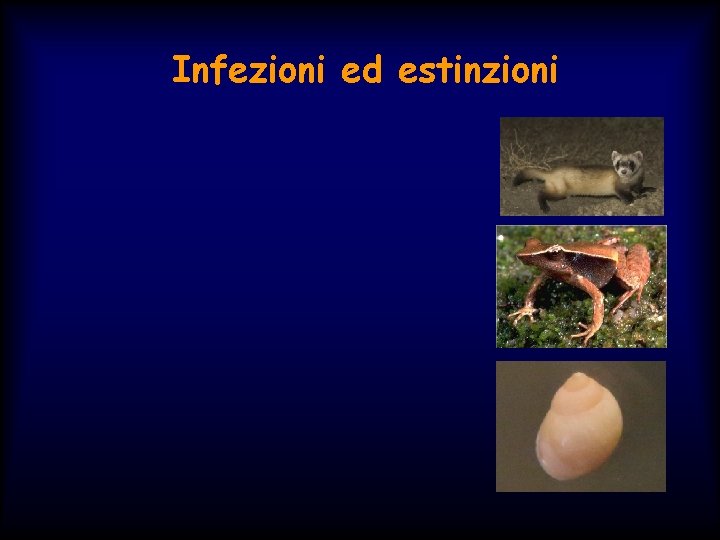
Infezioni ed estinzioni
• Number of animals imported to the United States in 2002: over 38, 000 mammals, 365, 000 birds, 2 million reptiles, 49 million amphibians, and 216 million fish. • Number of primates legally imported into the United States as pets or research animals between 1995 and 2002: 99, 939
- Slides: 25