
Inferring Axon Diameter Sizes using Monte Carlo Simulations

- Slides: 20
Inferring Axon Diameter Sizes using Monte Carlo Simulations of Magnetic Resonance Oscillating Gradient Spin Echo Sequences ME Mercredi 1, TJ Vincent 2, 3 , SL Herrera 1, R Buist 4, CP Bidinosti 1, 2, M Martin 1, 2, 4 1 Physics & Astronomy, University of Manitoba, Winnipeg, Manitoba, Canada, 2 Physics, University of Winnipeg, Manitoba, Canada, 3 Astronomy & Astrophysics, University of Toronto, Ontario, Canada, 4 Radiology, University of Manitoba, Canada
Introduction Diffusion-weighted magnetic resonance imaging (MRI) can be used to infer axon diameter distributions in brain tissue for axons > 5 m. We have developed and are optimizing a new method for the measurement of the size of very small (less than or equal to 1 m) axon diameters. 2
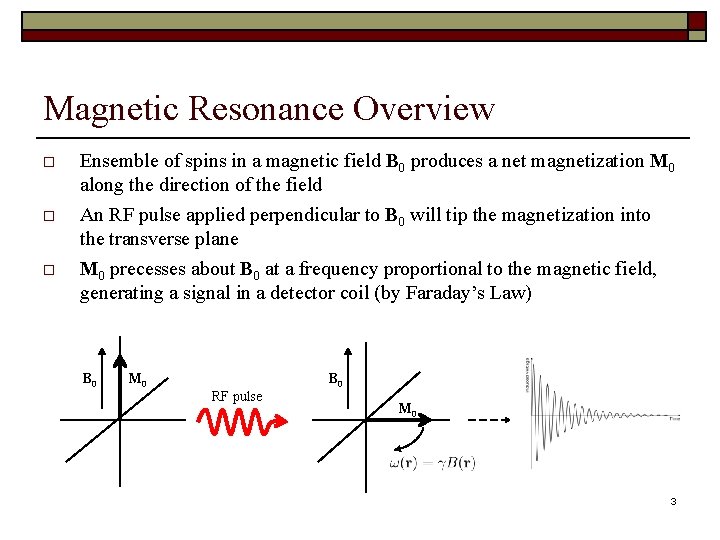
Magnetic Resonance Overview Ensemble of spins in a magnetic field B 0 produces a net magnetization M 0 along the direction of the field An RF pulse applied perpendicular to B 0 will tip the magnetization into the transverse plane M 0 precesses about B 0 at a frequency proportional to the magnetic field, generating a signal in a detector coil (by Faraday’s Law) B 0 M 0 B 0 RF pulse M 0 3
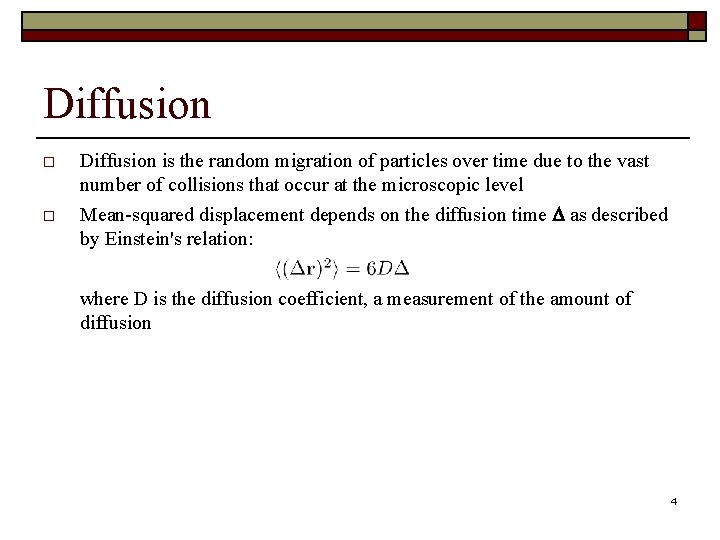
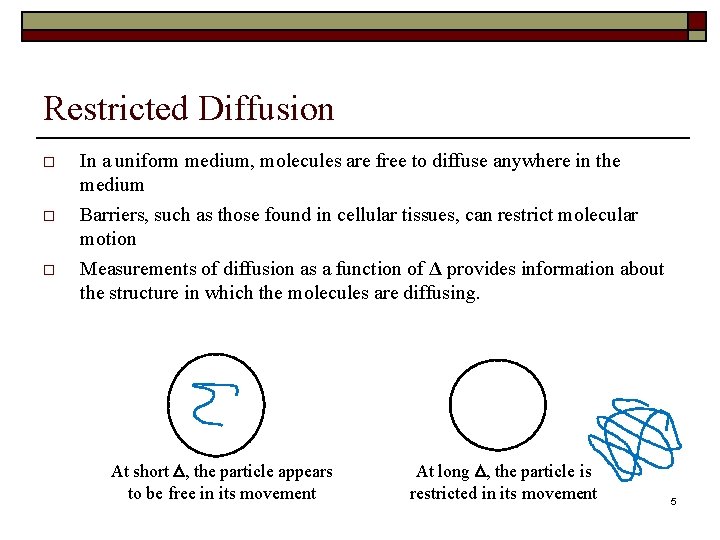
Diffusion is the random migration of particles over time due to the vast number of collisions that occur at the microscopic level Mean-squared displacement depends on the diffusion time D as described by Einstein's relation: where D is the diffusion coefficient, a measurement of the amount of diffusion 4
Restricted Diffusion In a uniform medium, molecules are free to diffuse anywhere in the medium Barriers, such as those found in cellular tissues, can restrict molecular motion Measurements of diffusion as a function of Δ provides information about the structure in which the molecules are diffusing. At short D, the particle appears to be free in its movement At long D, the particle is restricted in its movement 5
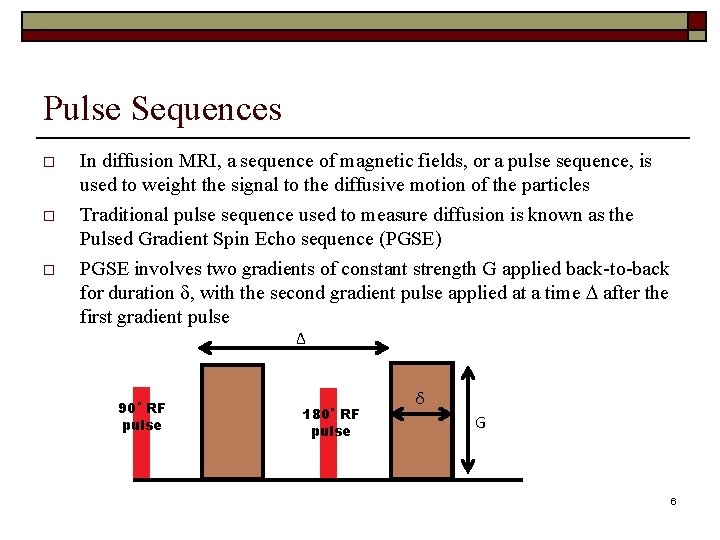
Pulse Sequences In diffusion MRI, a sequence of magnetic fields, or a pulse sequence, is used to weight the signal to the diffusive motion of the particles Traditional pulse sequence used to measure diffusion is known as the Pulsed Gradient Spin Echo sequence (PGSE) PGSE involves two gradients of constant strength G applied back-to-back for duration d, with the second gradient pulse applied at a time D after the first gradient pulse Δ 90˚ RF pulse 180˚ RF pulse 90˚ RF pulse δ G G δ 6
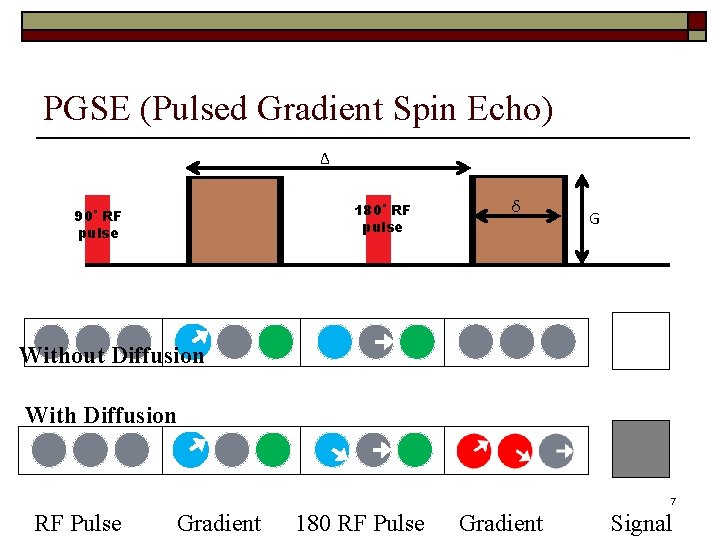
PGSE (Pulsed Gradient Spin Echo) Δ 180˚ RF pulse 90˚ RF pulse δ G Without Diffusion With Diffusion 7 RF Pulse Gradient 180 RF Pulse Gradient Signal
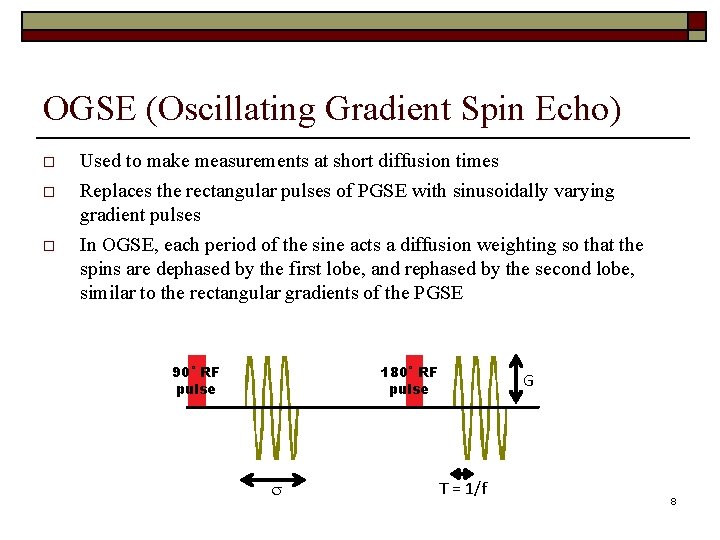
OGSE (Oscillating Gradient Spin Echo) Used to make measurements at short diffusion times Replaces the rectangular pulses of PGSE with sinusoidally varying gradient pulses In OGSE, each period of the sine acts a diffusion weighting so that the spins are dephased by the first lobe, and rephased by the second lobe, similar to the rectangular gradients of the PGSE 90˚ RF pulse 180˚ RF pulse G T = 1/f 8
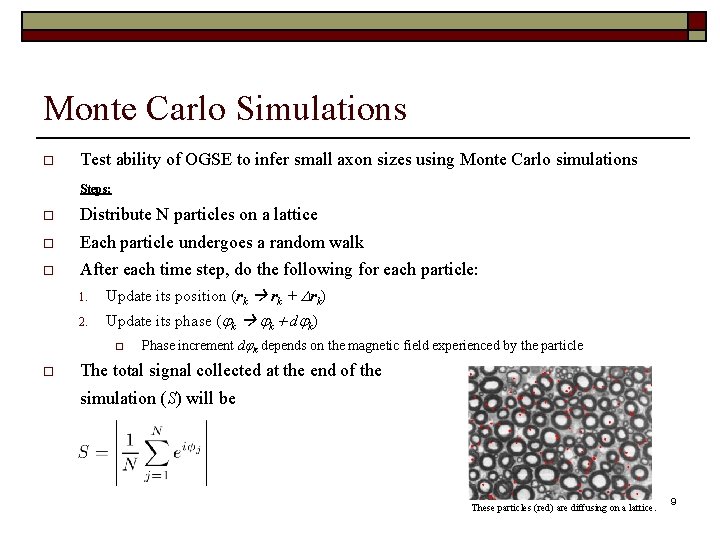
Monte Carlo Simulations Test ability of OGSE to infer small axon sizes using Monte Carlo simulations Steps: Distribute N particles on a lattice Each particle undergoes a random walk After each time step, do the following for each particle: 1. Update its position (rk rk + Drk) 2. Update its phase (jk jk + djk) Phase increment djk depends on the magnetic field experienced by the particle The total signal collected at the end of the simulation (S) will be These particles (red) are diffusing on a lattice. 9
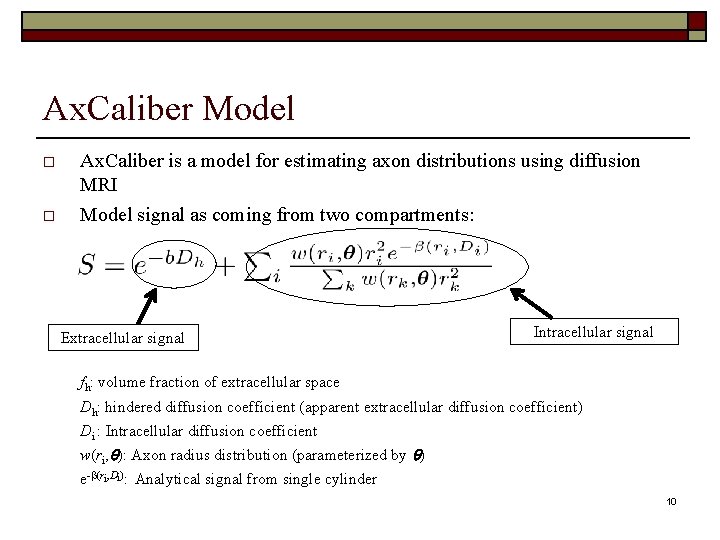
Ax. Caliber Model Ax. Caliber is a model for estimating axon distributions using diffusion MRI Model signal as coming from two compartments: Extracellular signal Intracellular signal fh: volume fraction of extracellular space Dh: hindered diffusion coefficient (apparent extracellular diffusion coefficient) Di : Intracellular diffusion coefficient w(ri, ): Axon radius distribution (parameterized by ) e- (ri, Di): Analytical signal from single cylinder 10
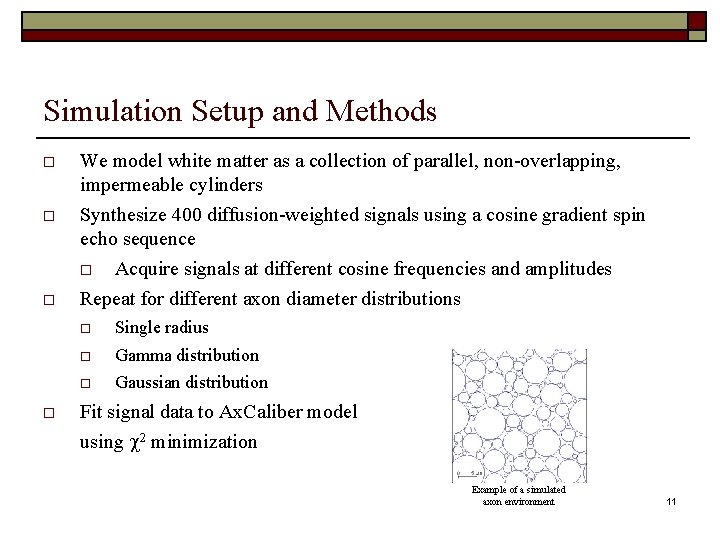
Simulation Setup and Methods We model white matter as a collection of parallel, non-overlapping, impermeable cylinders Synthesize 400 diffusion-weighted signals using a cosine gradient spin echo sequence Acquire signals at different cosine frequencies and amplitudes Repeat for different axon diameter distributions Single radius Gamma distribution Gaussian distribution Fit signal data to Ax. Caliber model using c 2 minimization Example of a simulated axon environment 11
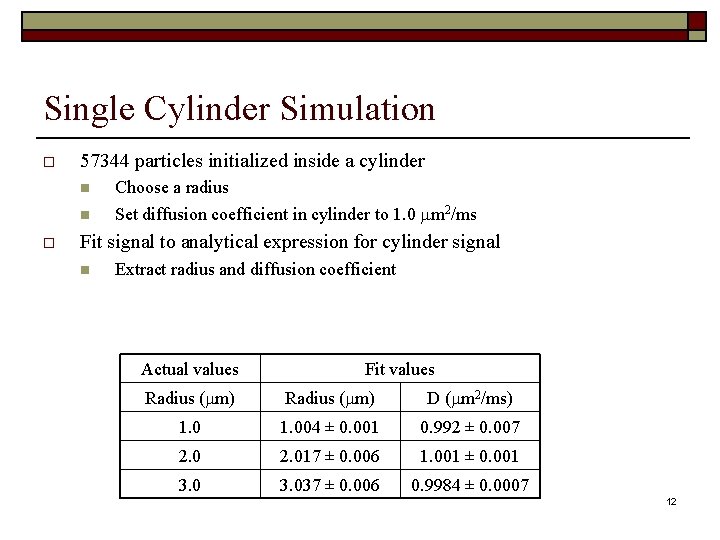
Single Cylinder Simulation 57344 particles initialized inside a cylinder Choose a radius Set diffusion coefficient in cylinder to 1. 0 m 2/ms Fit signal to analytical expression for cylinder signal Extract radius and diffusion coefficient Actual values Fit values Radius ( m) D ( m 2/ms) 1. 004 ± 0. 001 0. 992 ± 0. 007 2. 017 ± 0. 006 1. 001 ± 0. 001 3. 037 ± 0. 006 0. 9984 ± 0. 0007 12
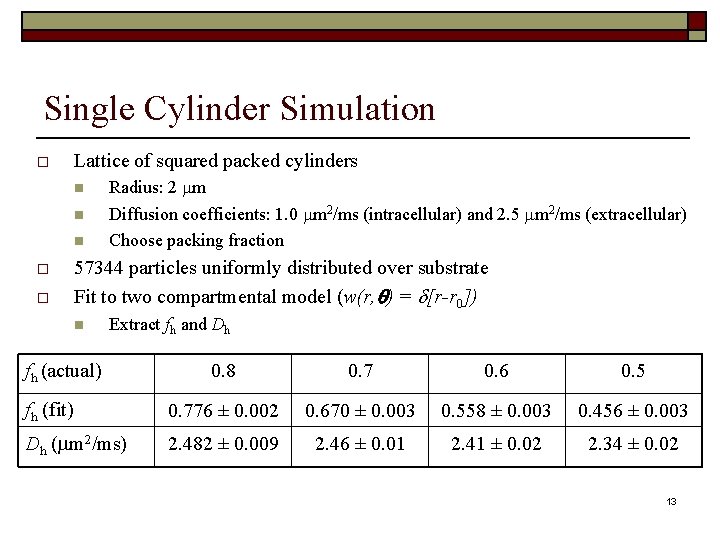
Single Cylinder Simulation Lattice of squared packed cylinders Radius: 2 m Diffusion coefficients: 1. 0 m 2/ms (intracellular) and 2. 5 m 2/ms (extracellular) Choose packing fraction 57344 particles uniformly distributed over substrate Fit to two compartmental model (w(r, ) = d[r-r 0]) Extract fh and Dh fh (actual) 0. 8 0. 7 0. 6 0. 5 fh (fit) 0. 776 ± 0. 002 0. 670 ± 0. 003 0. 558 ± 0. 003 0. 456 ± 0. 003 Dh ( m 2/ms) 2. 482 ± 0. 009 2. 46 ± 0. 01 2. 41 ± 0. 02 2. 34 ± 0. 02 13
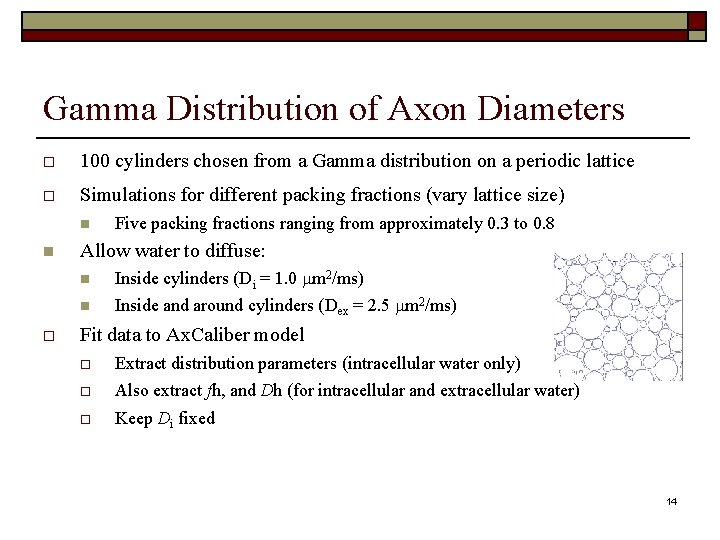
Gamma Distribution of Axon Diameters 100 cylinders chosen from a Gamma distribution on a periodic lattice Simulations for different packing fractions (vary lattice size) Allow water to diffuse: Five packing fractions ranging from approximately 0. 3 to 0. 8 Inside cylinders (Di = 1. 0 m 2/ms) Inside and around cylinders (Dex = 2. 5 m 2/ms) Fit data to Ax. Caliber model Extract distribution parameters (intracellular water only) Also extract fh, and Dh (for intracellular and extracellular water) Keep Di fixed 14
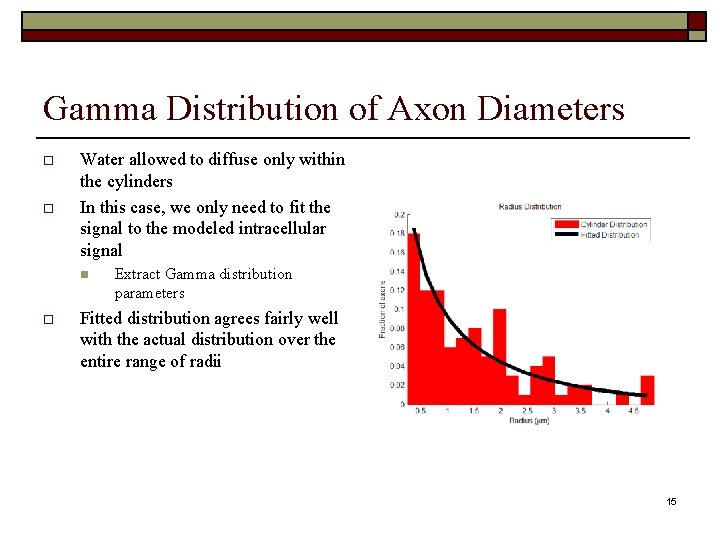
Gamma Distribution of Axon Diameters Water allowed to diffuse only within the cylinders In this case, we only need to fit the signal to the modeled intracellular signal Extract Gamma distribution parameters Fitted distribution agrees fairly well with the actual distribution over the entire range of radii 15
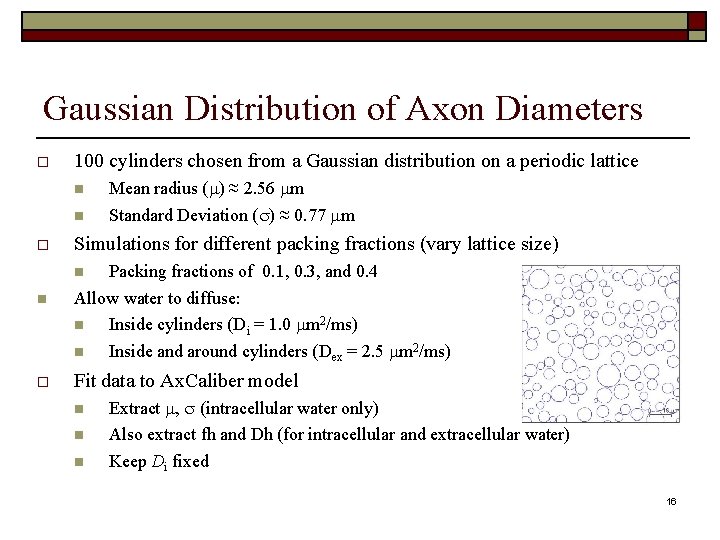
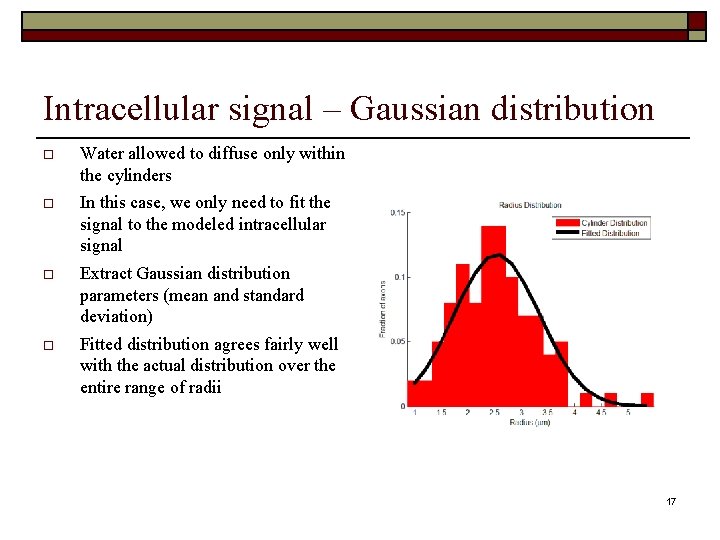
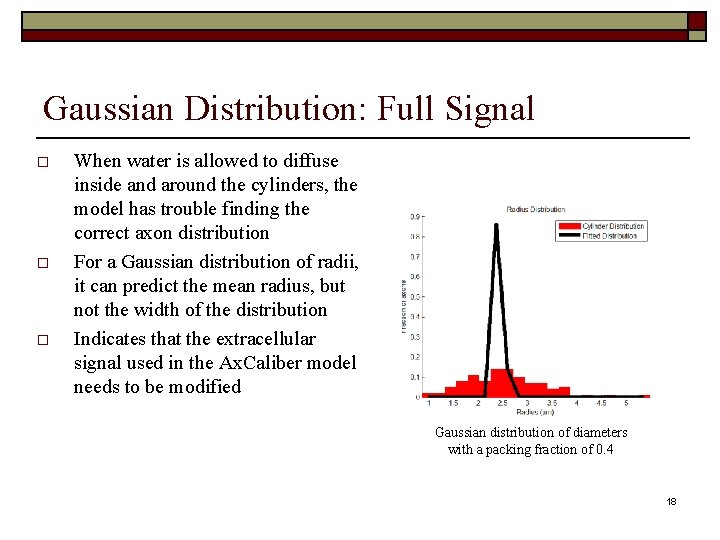
Gaussian Distribution of Axon Diameters 100 cylinders chosen from a Gaussian distribution on a periodic lattice Mean radius ( ) ≈ 2. 56 m Standard Deviation ( ) ≈ 0. 77 m Simulations for different packing fractions (vary lattice size) Packing fractions of 0. 1, 0. 3, and 0. 4 Allow water to diffuse: Inside cylinders (Di = 1. 0 m 2/ms) Inside and around cylinders (Dex = 2. 5 m 2/ms) Fit data to Ax. Caliber model Extract , (intracellular water only) Also extract fh and Dh (for intracellular and extracellular water) Keep Di fixed 16
Intracellular signal – Gaussian distribution Water allowed to diffuse only within the cylinders In this case, we only need to fit the signal to the modeled intracellular signal Extract Gaussian distribution parameters (mean and standard deviation) Fitted distribution agrees fairly well with the actual distribution over the entire range of radii 17
Gaussian Distribution: Full Signal When water is allowed to diffuse inside and around the cylinders, the model has trouble finding the correct axon distribution For a Gaussian distribution of radii, it can predict the mean radius, but not the width of the distribution Indicates that the extracellular signal used in the Ax. Caliber model needs to be modified Gaussian distribution of diameters with a packing fraction of 0. 4 18
Conclusions First step towards combining oscillating gradient measurements with axon diameter distribution models to infer distributions of small axon diameters in tissues Accurately predicted mean diameters of various models of white matter using oscillating gradients. These diameters were at least a factor of two smaller than the smallest possible inferred diameters used in other simulations. We will improve the model of extracellular space to infer the total distributions more accurately Eventually would like to compare white matter fibre integrity in healthy and diseased mouse brains 19
Acknowledgments Funding: NSERC, MHRC, CFI, and MRIF. 20