
Inferential Statistics Testing for Differences Introduction n Whether
- Slides: 16
Inferential Statistics Testing for Differences
Introduction n Whether the research design is experimental, quasi-experimental, or nonexperimental, many researchers develop their studies to look for differences u they look for differences between or among the group or categories of the IV in relationship to the DV
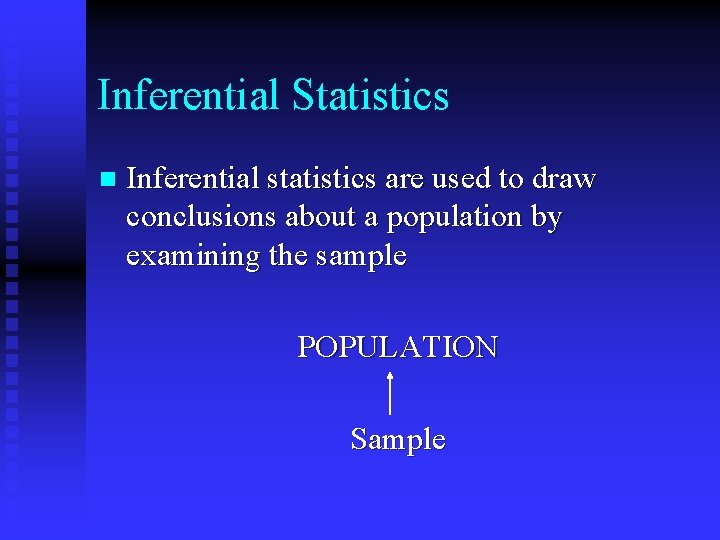
Inferential Statistics n Inferential statistics are used to draw conclusions about a population by examining the sample POPULATION Sample
Inferential Statistics Accuracy of inference depends on representativeness of sample from population n random selection u equal chance for anyone to be selected makes sample more representative n
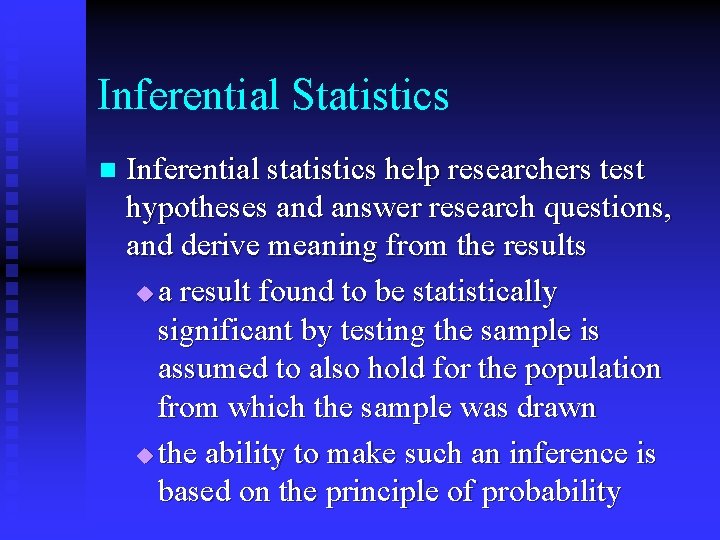
Inferential Statistics n Inferential statistics help researchers test hypotheses and answer research questions, and derive meaning from the results u a result found to be statistically significant by testing the sample is assumed to also hold for the population from which the sample was drawn u the ability to make such an inference is based on the principle of probability
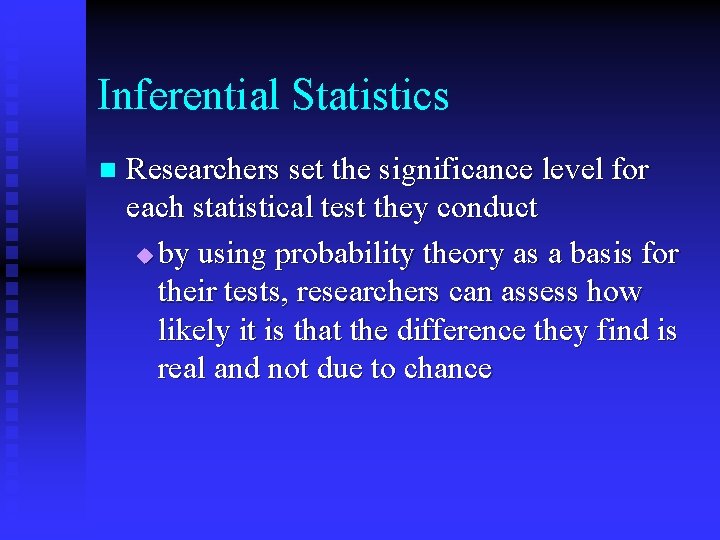
Inferential Statistics n Researchers set the significance level for each statistical test they conduct u by using probability theory as a basis for their tests, researchers can assess how likely it is that the difference they find is real and not due to chance
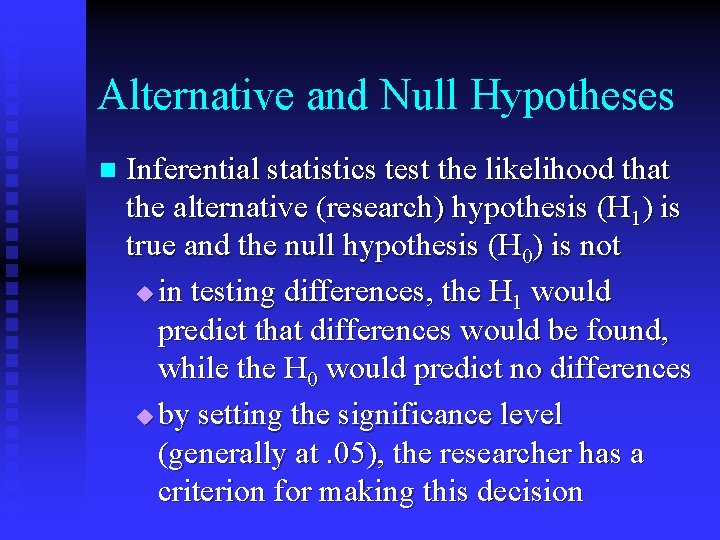
Alternative and Null Hypotheses n Inferential statistics test the likelihood that the alternative (research) hypothesis (H 1) is true and the null hypothesis (H 0) is not u in testing differences, the H 1 would predict that differences would be found, while the H 0 would predict no differences u by setting the significance level (generally at. 05), the researcher has a criterion for making this decision
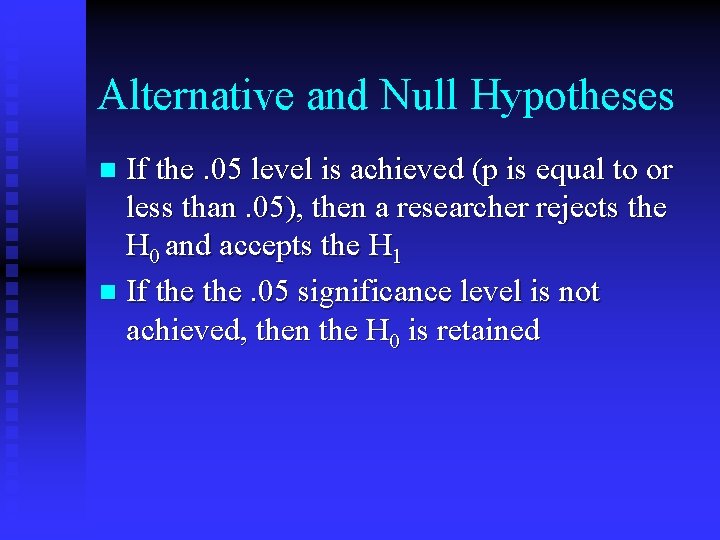
Alternative and Null Hypotheses If the. 05 level is achieved (p is equal to or less than. 05), then a researcher rejects the H 0 and accepts the H 1 n If the. 05 significance level is not achieved, then the H 0 is retained n
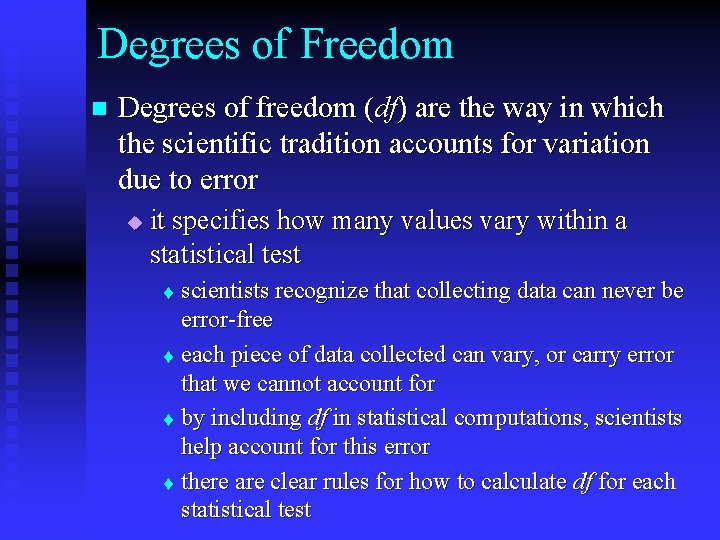
Degrees of Freedom n Degrees of freedom (df) are the way in which the scientific tradition accounts for variation due to error u it specifies how many values vary within a statistical test scientists recognize that collecting data can never be error-free t each piece of data collected can vary, or carry error that we cannot account for t by including df in statistical computations, scientists help account for this error t there are clear rules for how to calculate df for each statistical test t
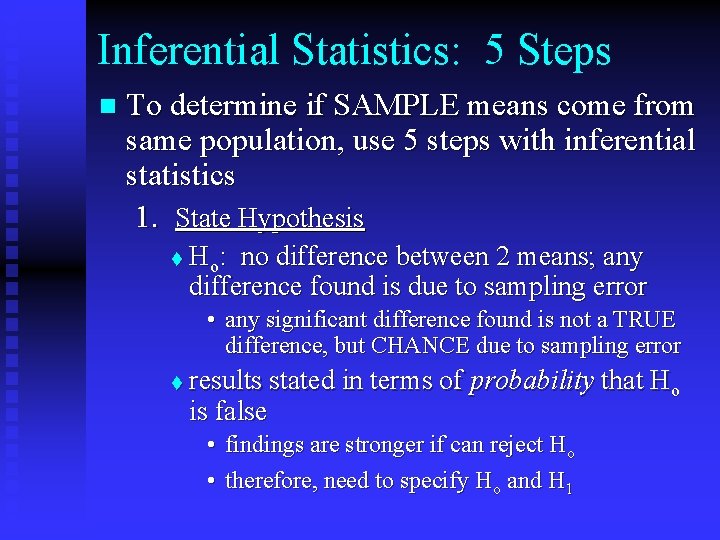
Inferential Statistics: 5 Steps n To determine if SAMPLE means come from same population, use 5 steps with inferential statistics 1. State Hypothesis t Ho: no difference between 2 means; any difference found is due to sampling error • any significant difference found is not a TRUE difference, but CHANCE due to sampling error t results stated in terms of probability that Ho is false • findings are stronger if can reject Ho • therefore, need to specify Ho and H 1
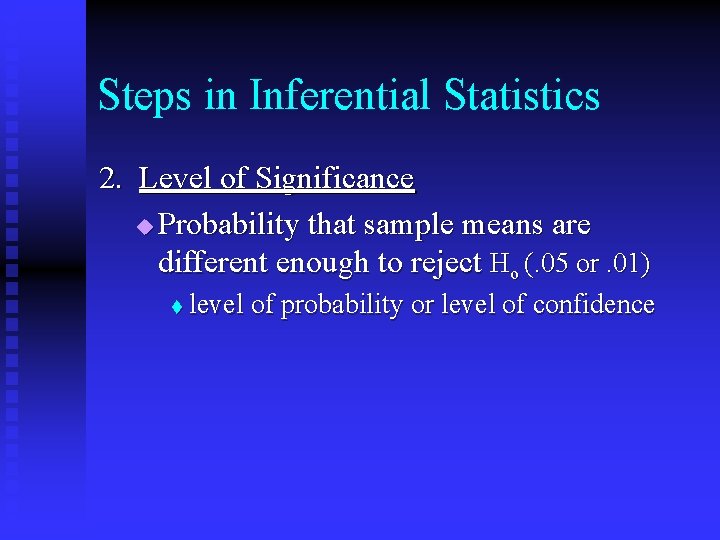
Steps in Inferential Statistics 2. Level of Significance u Probability that sample means are different enough to reject Ho (. 05 or. 01) t level of probability or level of confidence
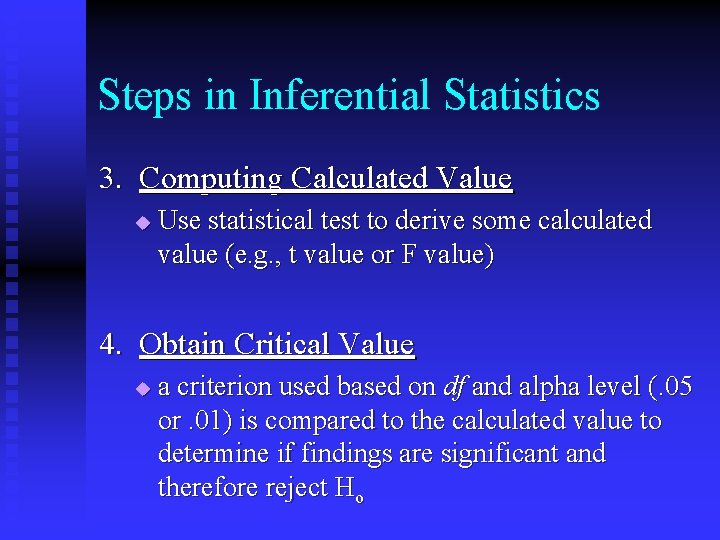
Steps in Inferential Statistics 3. Computing Calculated Value u Use statistical test to derive some calculated value (e. g. , t value or F value) 4. Obtain Critical Value u a criterion used based on df and alpha level (. 05 or. 01) is compared to the calculated value to determine if findings are significant and therefore reject Ho
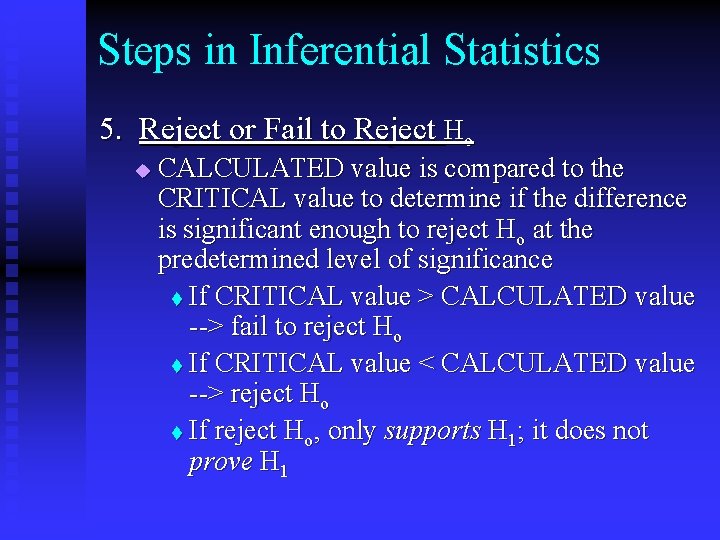
Steps in Inferential Statistics 5. Reject or Fail to Reject Ho u CALCULATED value is compared to the CRITICAL value to determine if the difference is significant enough to reject Ho at the predetermined level of significance t If CRITICAL value > CALCULATED value --> fail to reject Ho t If CRITICAL value < CALCULATED value --> reject Ho t If reject Ho, only supports H 1; it does not prove H 1
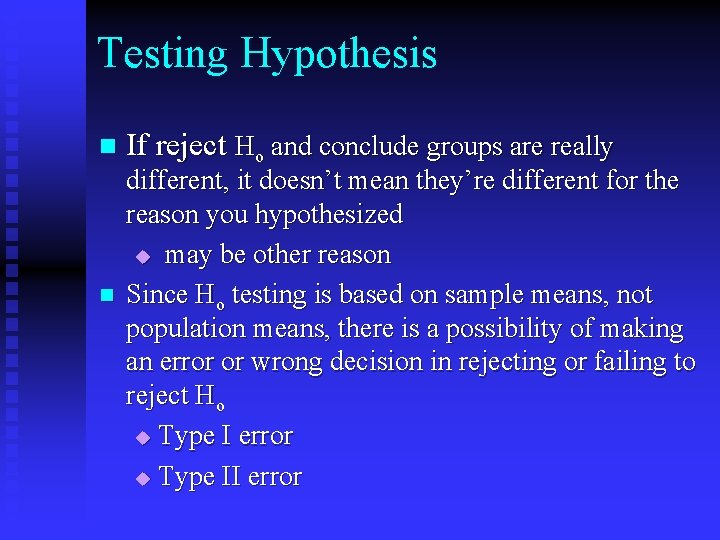
Testing Hypothesis n n If reject Ho and conclude groups are really different, it doesn’t mean they’re different for the reason you hypothesized u may be other reason Since Ho testing is based on sample means, not population means, there is a possibility of making an error or wrong decision in rejecting or failing to reject Ho u Type I error u Type II error
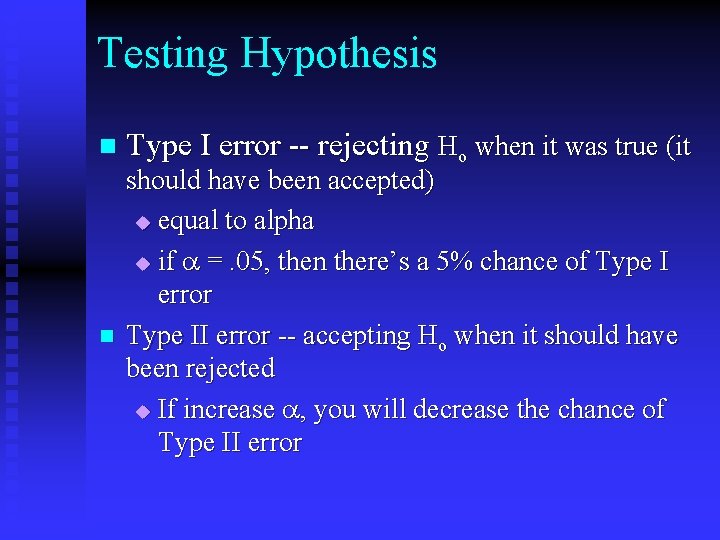
Testing Hypothesis n n Type I error -- rejecting Ho when it was true (it should have been accepted) u equal to alpha u if =. 05, then there’s a 5% chance of Type I error Type II error -- accepting Ho when it should have been rejected u If increase , you will decrease the chance of Type II error
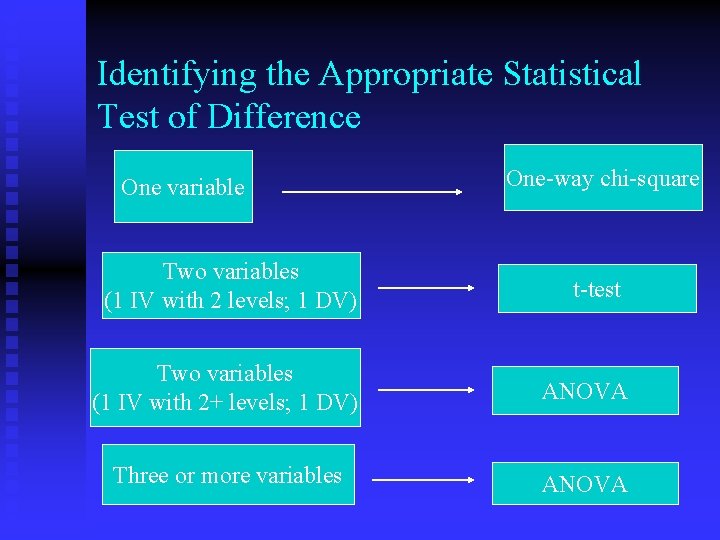
Identifying the Appropriate Statistical Test of Difference One variable Two variables (1 IV with 2 levels; 1 DV) One-way chi-square t-test Two variables (1 IV with 2+ levels; 1 DV) ANOVA Three or more variables ANOVA