
Inferential Statistics and Probability a Holistic Approach Chapter
Inferential Statistics and Probability a Holistic Approach Chapter 9 One Population Hypothesis Testing This Course Material by Maurice Geraghty is licensed under a Creative Commons Attribution -Share. Alike 4. 0 International License. Conditions for use are shown here: https: //creativecommons. org/licenses/by-sa/4. 0/ 1
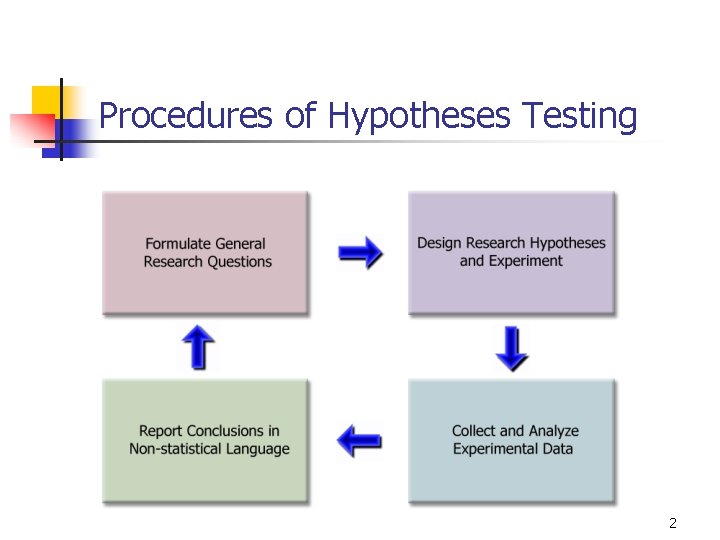
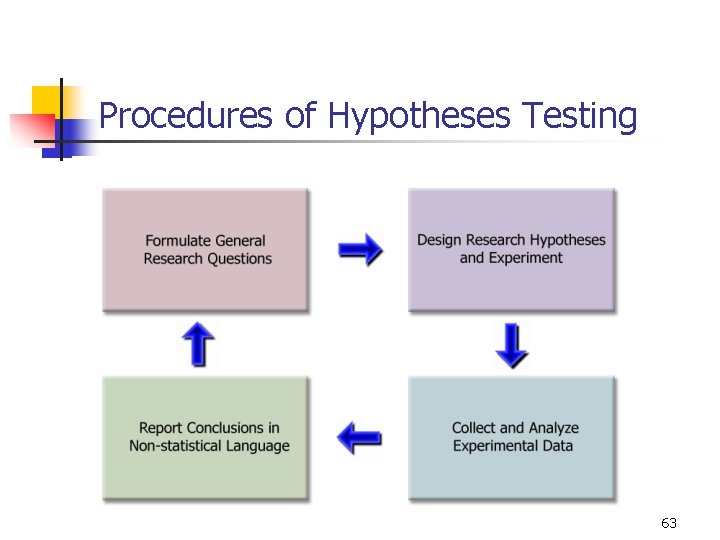
Procedures of Hypotheses Testing 2
Hypotheses Testing – Procedure 1 3
General Research Question n Decide on a topic or phenomena that you want to research. Formulate general research questions based on the topic. Example: n n Topic: Health Care Reform Some General Questions: n n n Would a Single Payer Plan be less expensive than Private Insurance? Do HMOs provide the same quality care as PPOs? Would the public support mandated health coverage? 4
9 -13 EXAMPLE – General Question n n n A food company has a policy that the stated contents of a product match the actual results. A General Question might be “Does the stated net weight of a food product match (on average) the actual weight? ” The quality control statistician could then decide to test various food products for accuracy. 5
Hypotheses Testing – Procedure 2 6
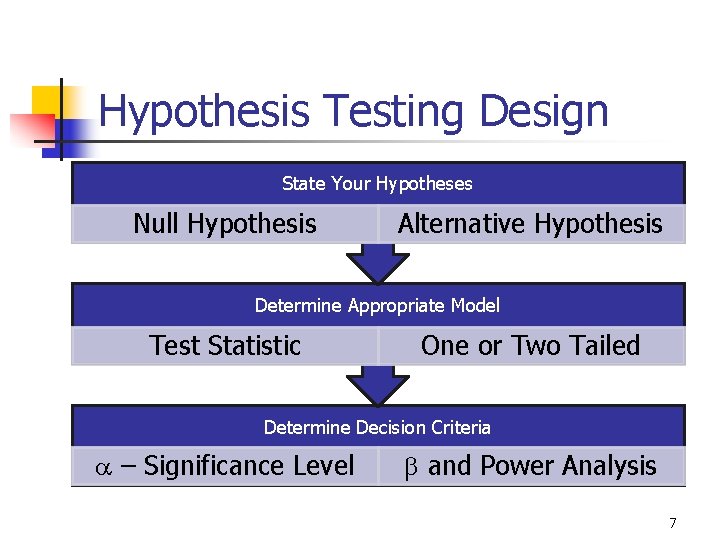
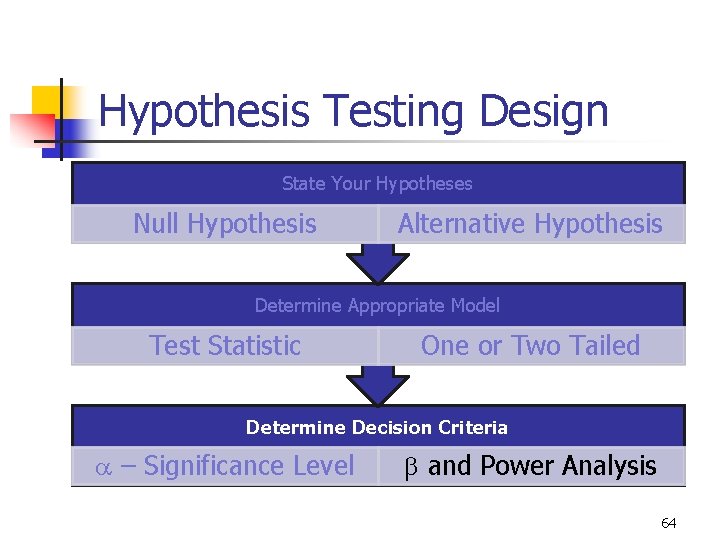
Hypothesis Testing Design State Your Hypotheses Null Hypothesis Alternative Hypothesis Determine Appropriate Model Test Statistic One or Two Tailed Determine Decision Criteria a – Significance Level b and Power Analysis 7
9 -3 What is a Hypothesis? n n Hypothesis: A statement about the value of a population parameter developed for the purpose of testing. Examples of hypotheses made about a population parameter are: n n n The mean monthly income for programmers is $9, 000. At least twenty percent of all juvenile offenders are caught and sentenced to prison. The standard deviation for an investment portfolio is no more than 10 percent per month. 8
9 -4 What is Hypothesis Testing? n Hypothesis testing: A procedure, based on sample evidence and probability theory, used to determine whether the hypothesis is a reasonable statement and should not be rejected, or is unreasonable and should be rejected. 9
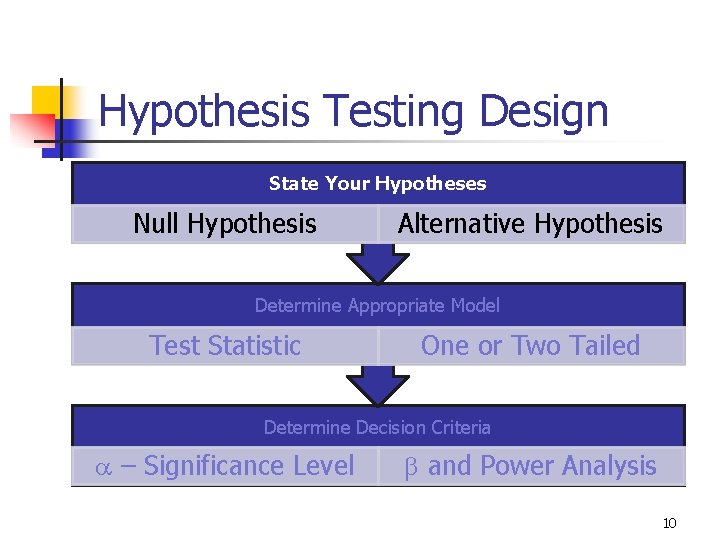
Hypothesis Testing Design State Your Hypotheses Null Hypothesis Alternative Hypothesis Determine Appropriate Model Test Statistic One or Two Tailed Determine Decision Criteria a – Significance Level b and Power Analysis 10
9 -6 Definitions n n Null Hypothesis H 0: A statement about the value of a population parameter that is assumed to be true for the purpose of testing. Alternative Hypothesis Ha: A statement about the value of a population parameter that is assumed to be true if the Null Hypothesis is rejected during testing. 11
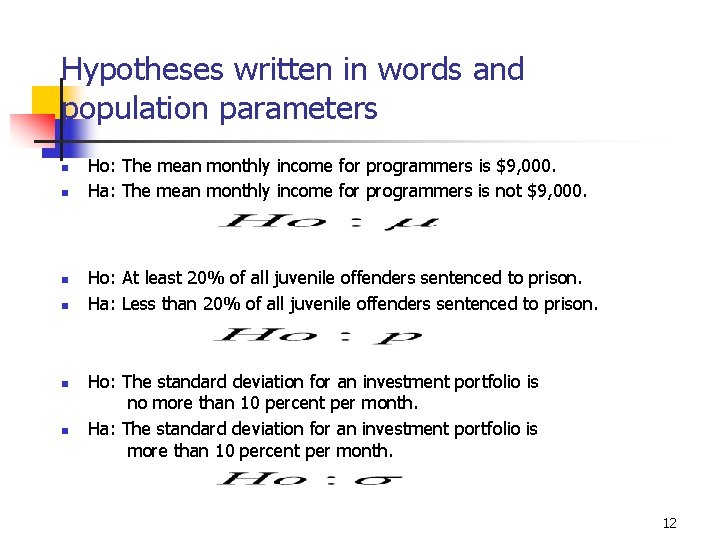
9 -3 Hypotheses written in words and population parameters n n n Ho: The mean monthly income for programmers is $9, 000. Ha: The mean monthly income for programmers is not $9, 000. Ho: At least 20% of all juvenile offenders sentenced to prison. Ha: Less than 20% of all juvenile offenders sentenced to prison. Ho: The standard deviation for an investment portfolio is no more than 10 percent per month. Ha: The standard deviation for an investment portfolio is more than 10 percent per month. 12
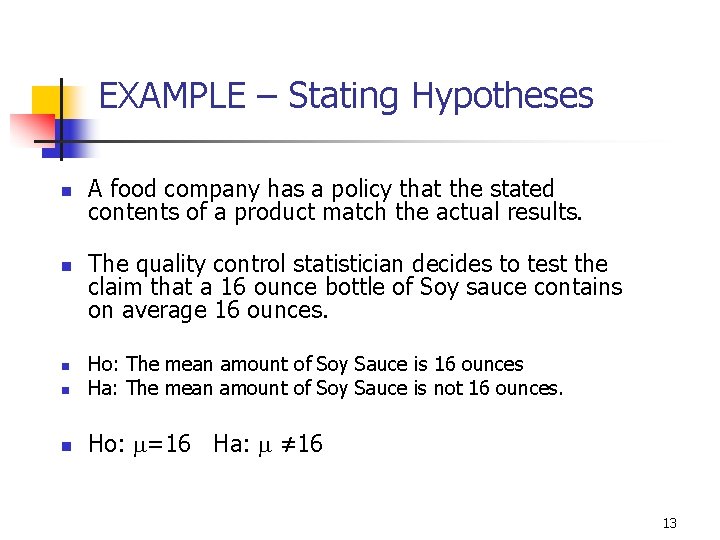
9 -13 EXAMPLE – Stating Hypotheses n n A food company has a policy that the stated contents of a product match the actual results. The quality control statistician decides to test the claim that a 16 ounce bottle of Soy sauce contains on average 16 ounces. n Ho: The mean amount of Soy Sauce is 16 ounces Ha: The mean amount of Soy Sauce is not 16 ounces. n Ho: m=16 Ha: m ≠ 16 n 13
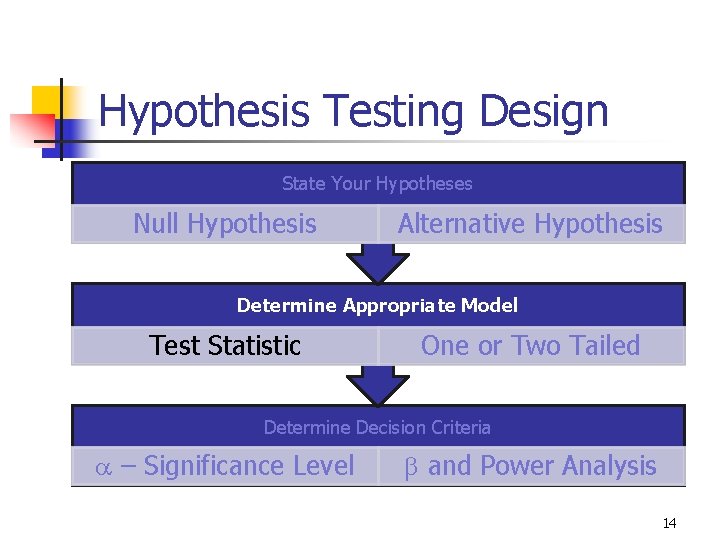
Hypothesis Testing Design State Your Hypotheses Null Hypothesis Alternative Hypothesis Determine Appropriate Model Test Statistic One or Two Tailed Determine Decision Criteria a – Significance Level b and Power Analysis 14
9 -7 Definitions n n Statistical Model: A mathematical model that describes the behavior of the data being tested. Normal Family = the Standard Normal Distribution (Z) and functions of independent Standard Normal Distributions (eg: t, c 2, F). n Most Statistical Models will be from the Normal Family due to the Central Limit Theorem. Model Assumptions: Criteria which must be satisfied to appropriately use a chosen Statistical Model. Test statistic: A value, determined from sample information, used to determine whether or not to reject the null hypothesis. 15
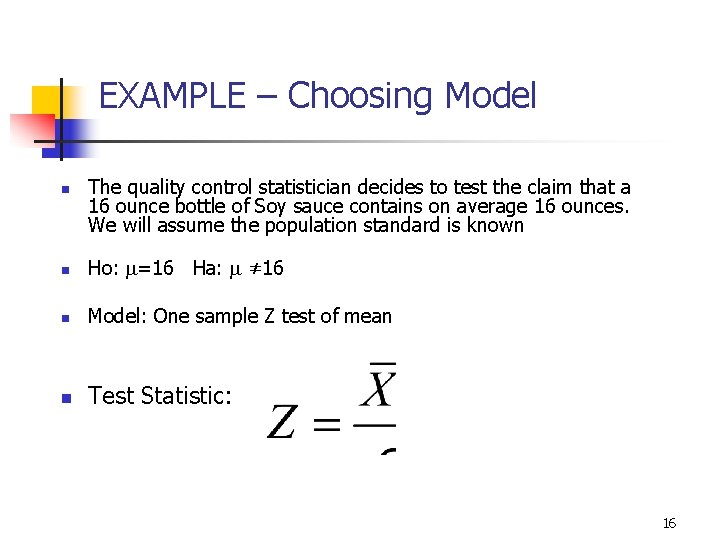
9 -13 EXAMPLE – Choosing Model n The quality control statistician decides to test the claim that a 16 ounce bottle of Soy sauce contains on average 16 ounces. We will assume the population standard is known n Ho: m=16 Ha: m ≠ 16 n Model: One sample Z test of mean n Test Statistic: 16
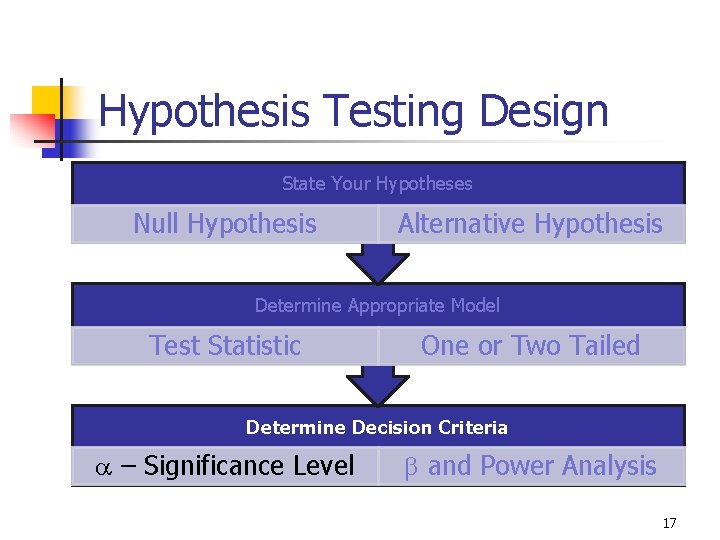
Hypothesis Testing Design State Your Hypotheses Null Hypothesis Alternative Hypothesis Determine Appropriate Model Test Statistic One or Two Tailed Determine Decision Criteria a – Significance Level b and Power Analysis 17
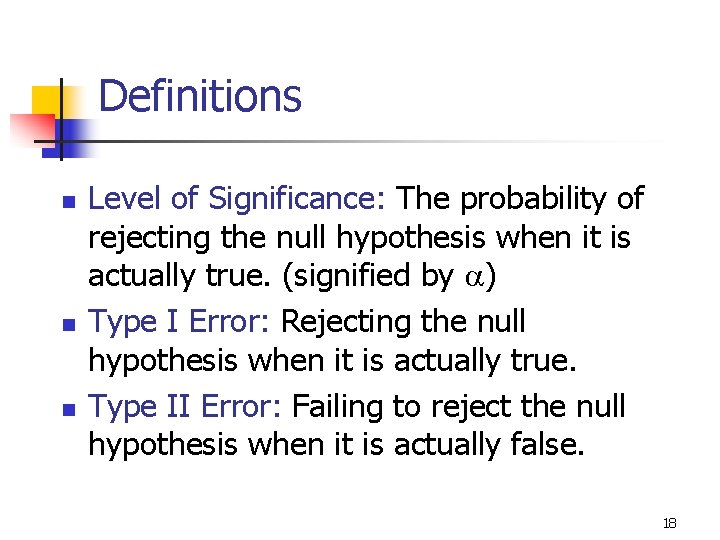
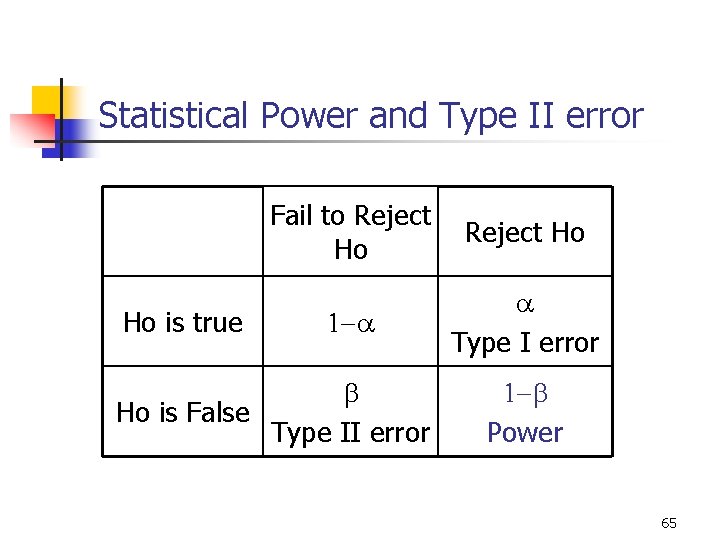
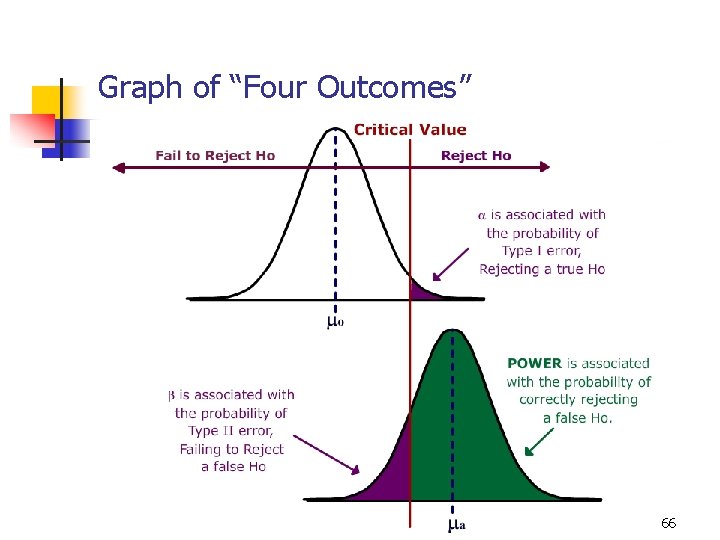
9 -6 Definitions n n n Level of Significance: The probability of rejecting the null hypothesis when it is actually true. (signified by a) Type I Error: Rejecting the null hypothesis when it is actually true. Type II Error: Failing to reject the null hypothesis when it is actually false. 18
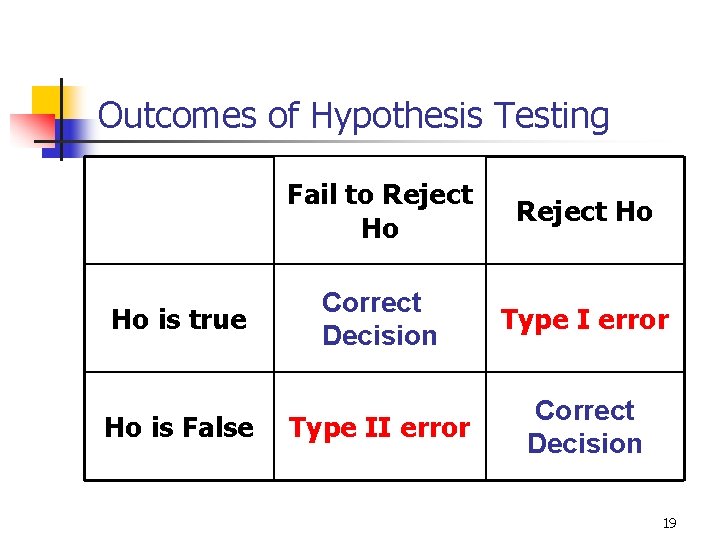
Outcomes of Hypothesis Testing Ho is true Ho is False Fail to Reject Ho Correct Decision Type I error Type II error Correct Decision 19
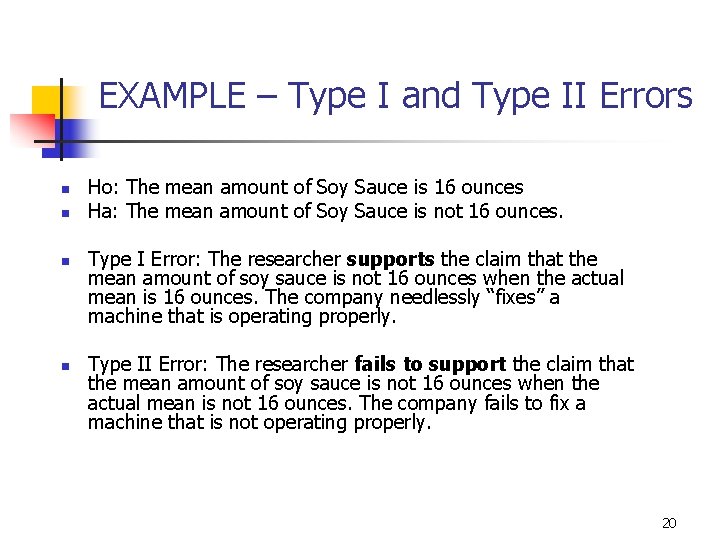
9 -13 EXAMPLE – Type I and Type II Errors n n Ho: The mean amount of Soy Sauce is 16 ounces Ha: The mean amount of Soy Sauce is not 16 ounces. Type I Error: The researcher supports the claim that the mean amount of soy sauce is not 16 ounces when the actual mean is 16 ounces. The company needlessly “fixes” a machine that is operating properly. Type II Error: The researcher fails to support the claim that the mean amount of soy sauce is not 16 ounces when the actual mean is not 16 ounces. The company fails to fix a machine that is not operating properly. 20
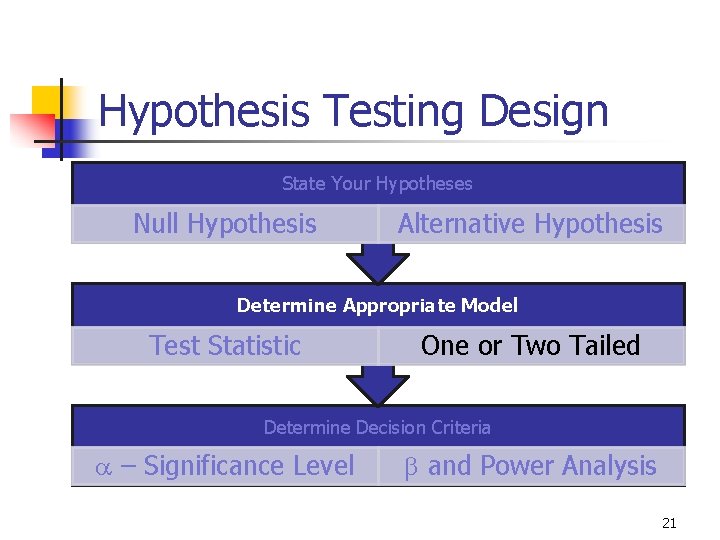
Hypothesis Testing Design State Your Hypotheses Null Hypothesis Alternative Hypothesis Determine Appropriate Model Test Statistic One or Two Tailed Determine Decision Criteria a – Significance Level b and Power Analysis 21
9 -7 Definitions n n Critical value(s): The dividing point(s) between the region where the null hypothesis is rejected and the region where it is not rejected. The critical value determines the decision rule. Rejection Region: Region(s) of the Statistical Model which contain the values of the Test Statistic where the Null Hypothesis will be rejected. The area of the Rejection Region = a 22
9 -8 One-Tailed Tests of Significance n A test is one-tailed when the alternate hypothesis, Ha , states a direction, such as: n n H 0 : The mean income of females is less than or equal to the mean income of males. Ha : The mean income of females is greater than males. Equality is part of H 0 Ha determines which tail to test n n Ha: m>m 0 means test upper tail. Ha: m<m 0 means test lower tail. 23
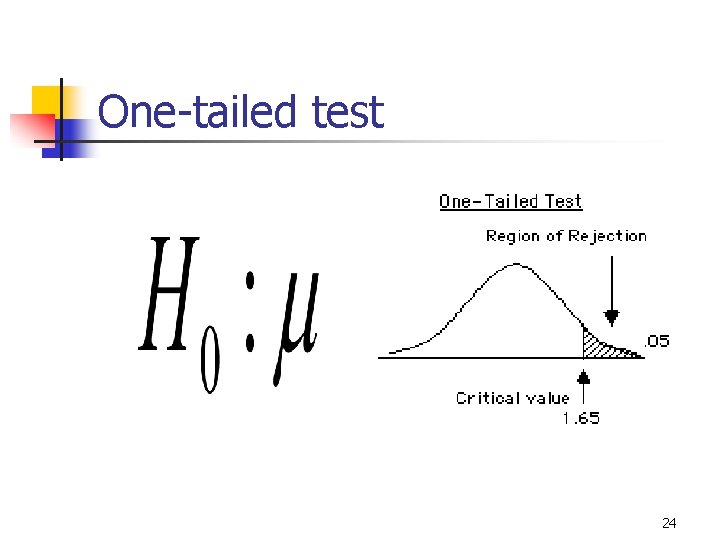
One-tailed test 24
9 -10 Two-Tailed Tests of Significance n A test is two-tailed when no direction is specified in the alternate hypothesis Ha , such as: n n H 0 : The mean income of females is equal to the mean income of males. Ha : The mean income of females is not equal to the mean income of the males. Equality is part of H 0 Ha determines which tail to test n Ha: m≠m 0 means test both tails. 25

Two-tailed test 26
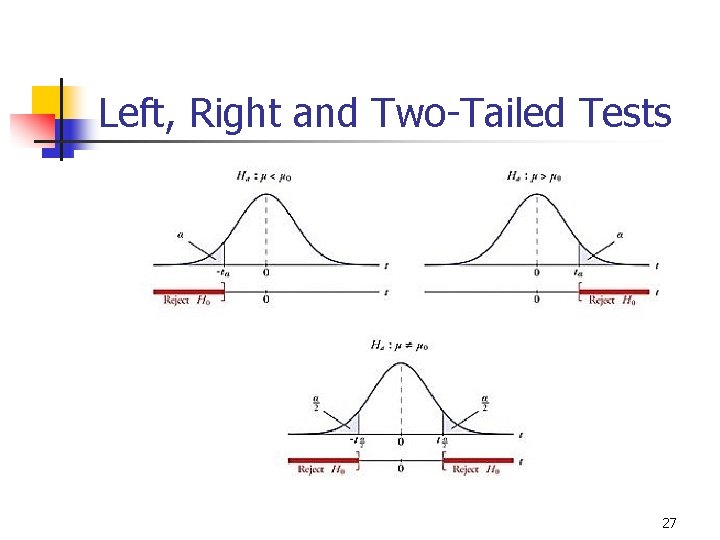
Left, Right and Two-Tailed Tests 27
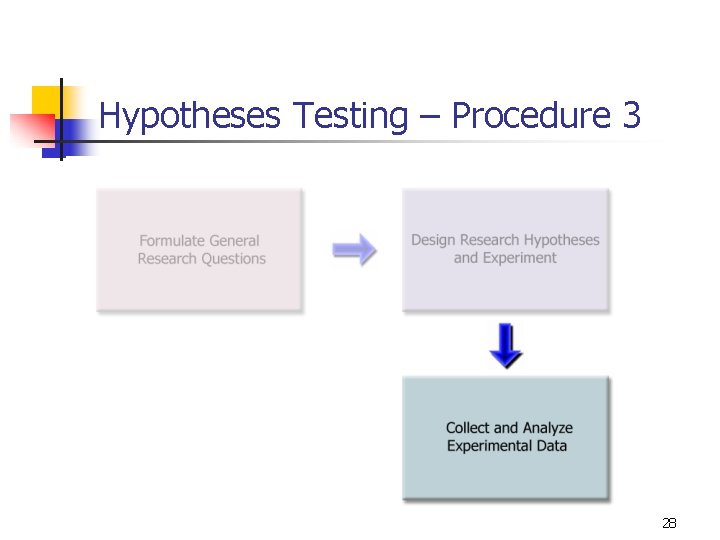
Hypotheses Testing – Procedure 3 28
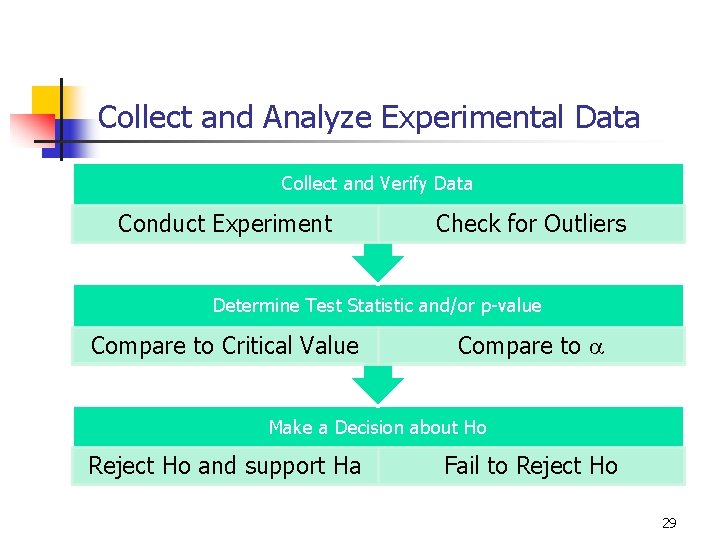
Collect and Analyze Experimental Data Collect and Verify Data Conduct Experiment Check for Outliers Determine Test Statistic and/or p-value Compare to Critical Value Compare to a Make a Decision about Ho Reject Ho and support Ha Fail to Reject Ho 29
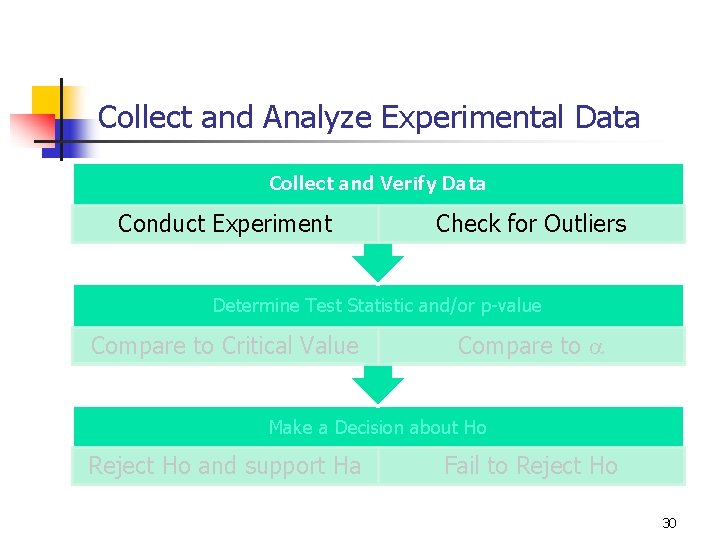
Collect and Analyze Experimental Data Collect and Verify Data Conduct Experiment Check for Outliers Determine Test Statistic and/or p-value Compare to Critical Value Compare to a Make a Decision about Ho Reject Ho and support Ha Fail to Reject Ho 30
Outliers n n An outlier is data point that is far removed from the other entries in the data set. Outliers could be n n n Mistakes made in recording data Data that don’t belong in population True rare events 31
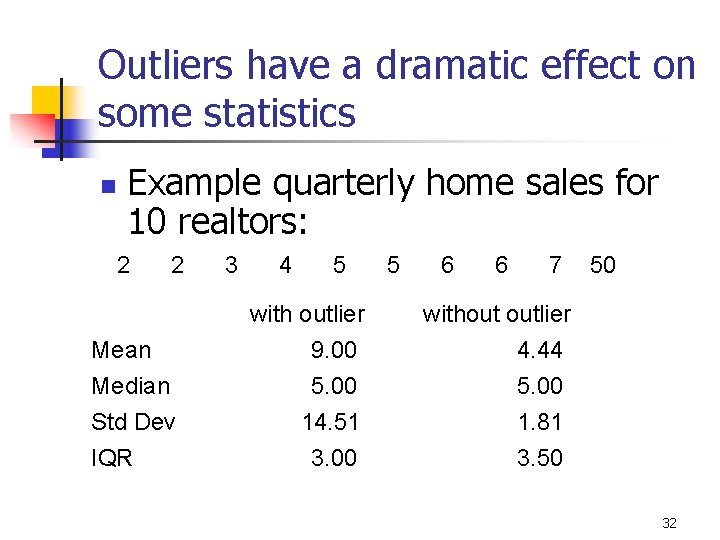
Outliers have a dramatic effect on some statistics n Example quarterly home sales for 10 realtors: 2 2 3 4 5 with outlier 5 6 6 7 50 without outlier Mean Median 9. 00 5. 00 4. 44 5. 00 Std Dev IQR 14. 51 3. 00 1. 81 3. 50 32
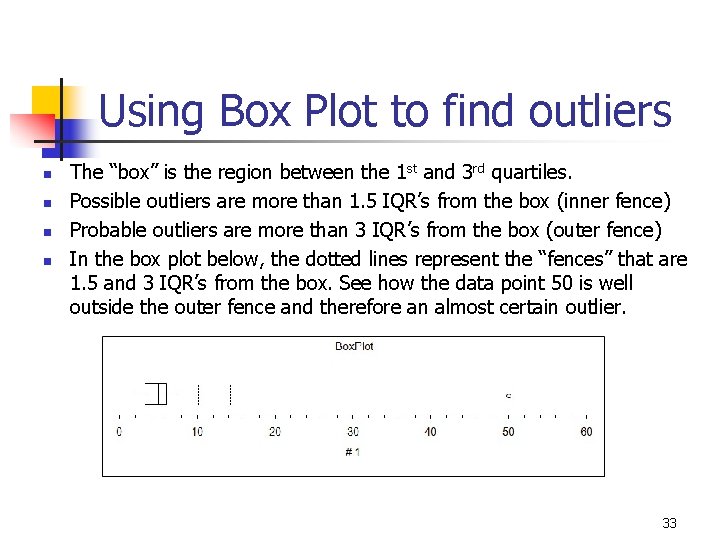
Using Box Plot to find outliers n n The “box” is the region between the 1 st and 3 rd quartiles. Possible outliers are more than 1. 5 IQR’s from the box (inner fence) Probable outliers are more than 3 IQR’s from the box (outer fence) In the box plot below, the dotted lines represent the “fences” that are 1. 5 and 3 IQR’s from the box. See how the data point 50 is well outside the outer fence and therefore an almost certain outlier. 33
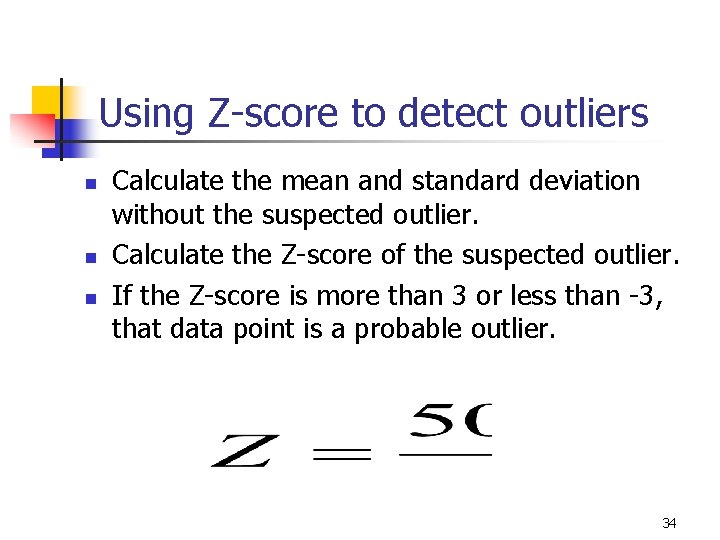
Using Z-score to detect outliers n n n Calculate the mean and standard deviation without the suspected outlier. Calculate the Z-score of the suspected outlier. If the Z-score is more than 3 or less than -3, that data point is a probable outlier. 34
Outliers – what to do n n n Remove or not remove, there is no clear answer. For some populations, outliers don’t dramatically change the overall statistical analysis. Example: the tallest person in the world will not dramatically change the mean height of 10000 people. However, for some populations, a single outlier will have a dramatic effect on statistical analysis (called “Black Swan” by Nicholas Taleb) and inferential statistics may be invalid in analyzing these populations. Example: the richest person in the world will dramatically change the mean wealth of 10000 people. 35
Example – Analyze Data n n n n In the Soy Sauce Example, a 36 bottles were measured, volume is in fluid ounces 14. 51 15. 16 15. 28 15. 33 15. 36 15. 42 15. 43 15. 45 15. 49 15. 59 15. 60 15. 61 15. 62 15. 63 15. 71 15. 87 16. 00 16. 01 16. 02 16. 05 16. 06 16. 09 16. 11 16. 16 16. 27 16. 31 16. 35 16. 36 16. 45 16. 72 16. 75 16. 79 36
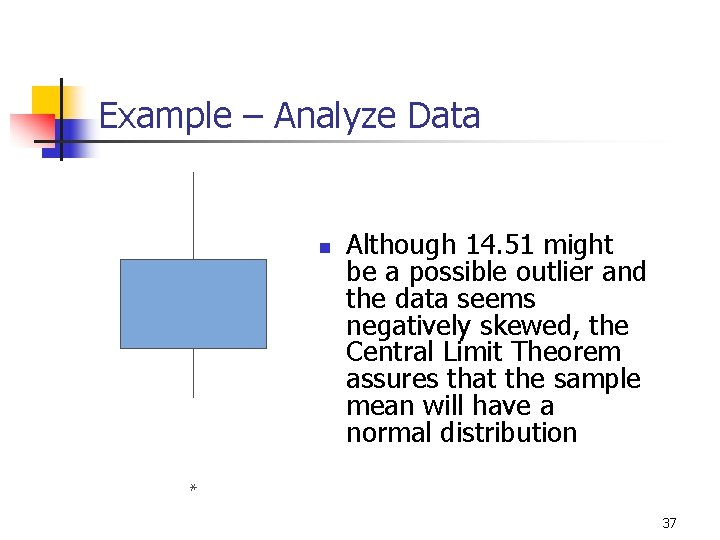
Example – Analyze Data n Although 14. 51 might be a possible outlier and the data seems negatively skewed, the Central Limit Theorem assures that the sample mean will have a normal distribution 37
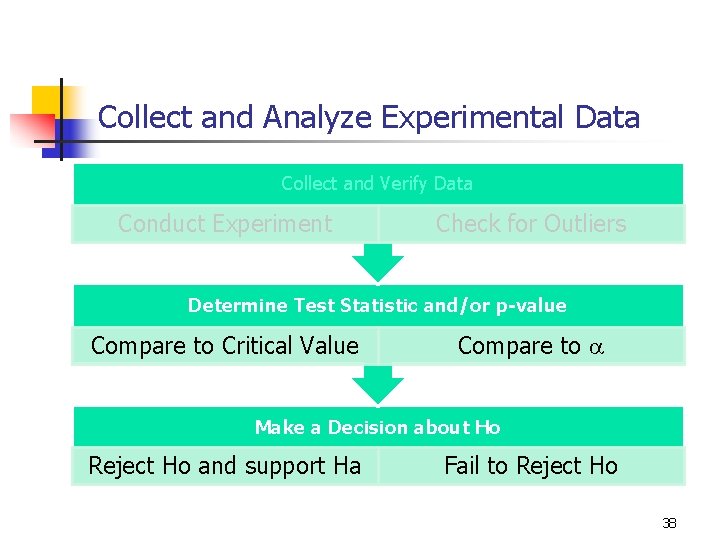
Collect and Analyze Experimental Data Collect and Verify Data Conduct Experiment Check for Outliers Determine Test Statistic and/or p-value Compare to Critical Value Compare to a Make a Decision about Ho Reject Ho and support Ha Fail to Reject Ho 38
The logic of Hypothesis Testing n This is a “Proof” by contradiction. n n n n We assume Ho is true before observing data and design Ha to be the complement of Ho. Observe the data (evidence). How unusual are these data under H o? If the data are too unusual, we have “proven” Ho is false: Reject Ho and go with Ha (Strong Statement) If the data are not too unusual, we fail to reject Ho. This “proves” nothing and we say data are inconclusive. (Weak Statement) We can never “prove” Ho , only “disprove” it. “Prove” in statistics means support with the Alternative Hypothesis. Note: It is never correct to say (1 -a)100% certain of our decision. (example: if a=. 05, then we are not 95% certain. ) 39
Test Statistic n n n Test Statistic: A value calculated from the Data under the appropriate Statistical Model from the Data that can be compared to the Critical Value of the Hypothesis test If the Test Statistic fall in the Rejection Region, Ho is rejected. The Test Statistic will also be used to calculate the p-value as will be defined next. 40
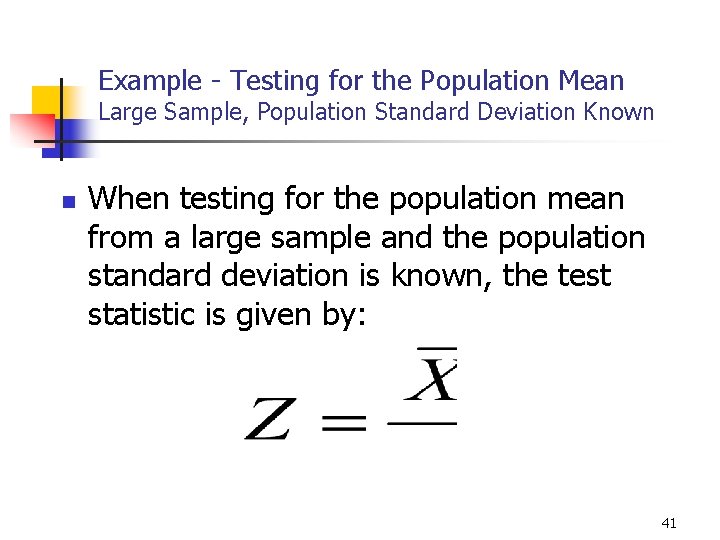
9 -12 Example - Testing for the Population Mean Large Sample, Population Standard Deviation Known n When testing for the population mean from a large sample and the population standard deviation is known, the test statistic is given by: 41
9 -15 p-Value in Hypothesis Testing n n n p-Value: the probability, assuming that the null hypothesis is true, of getting a value of the test statistic at least as extreme as the computed value for the test. If the p-value is smaller than the significance level, H 0 is rejected. If the p-value is larger than the significance level, H 0 is not rejected. 42
Comparing p-value to a n n Both p-value and a are probabilities. The p-value is determined by the data, and is the probability of getting results as extreme as the data assuming H 0 is true. Small values make one more likely to reject H 0. a is determined by design, and is the maximum probability the experimenter is willing to accept of rejecting a true H 0. Reject H 0 if p-value < a for ALL MODELS. 43

Graphic where decision is to Reject Ho n n n n Ho: m = 10 Ha: m > 10 Design: Critical Value is determined by significance level a. Data Analysis: p-value is determined by Test Statistic falls in Rejection Region. p-value (blue) < a (purple) Reject Ho. Strong statement: Data supports Alternative Hypothesis. 44
Graphic where decision is Fail to Reject Ho n n n n Ho: m = 10 Ha: m > 10 Design: Critical Value is determined by significance level a. Data Analysis: p-value is determined by Test Statistic falls in Non-rejection Region. p-value (blue) > a (purple) Fail to Reject Ho. Weak statement: Data is inconclusive and does not support Alternative Hypothesis. 45
9 -13 EXAMPLE – General Question n A food company has a policy that the stated contents of a product match the actual results. n A General Question might be “Does the stated net weight of a food product match the actual weight? ” n The quality control statistician decides to test the 16 ounce bottle of Soy Sauce. 46
EXAMPLE – Design Experiment n A sample of n=36 bottles will be selected hourly and the contents weighed. Assume s = 0. 5 n Ho: m=16 Ha: m ≠ 16 n The Statistical Model will be the one population test of mean using the Z Test Statistic. n n This model will be appropriate since the sample size insures the sample mean will have a Normal Distribution (Central Limit Theorem) We will choose a significance level of a = 5% 47
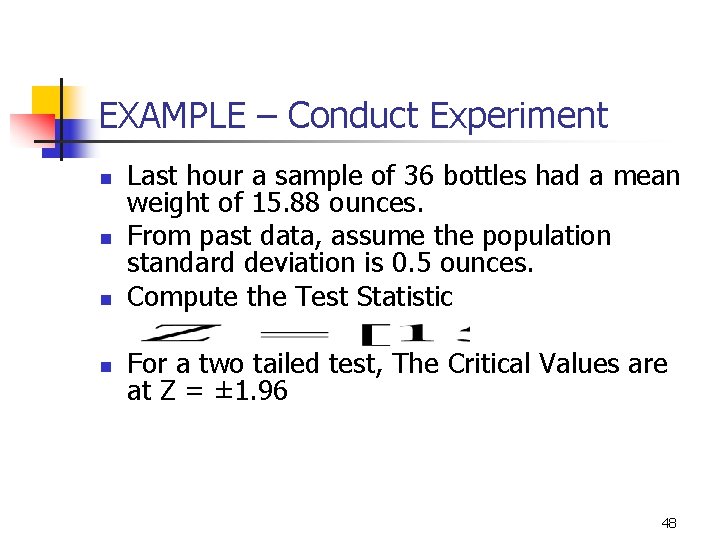
EXAMPLE – Conduct Experiment n n Last hour a sample of 36 bottles had a mean weight of 15. 88 ounces. From past data, assume the population standard deviation is 0. 5 ounces. Compute the Test Statistic For a two tailed test, The Critical Values are at Z = ± 1. 96 48
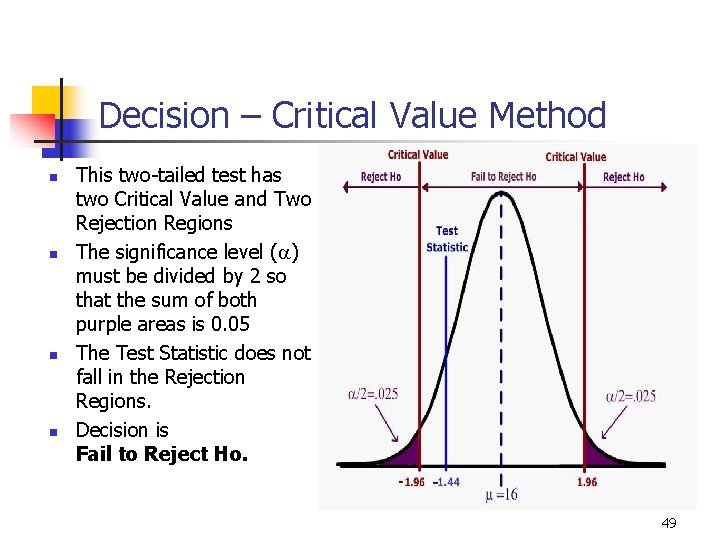
Decision – Critical Value Method n n This two-tailed test has two Critical Value and Two Rejection Regions The significance level (a) must be divided by 2 so that the sum of both purple areas is 0. 05 The Test Statistic does not fall in the Rejection Regions. Decision is Fail to Reject Ho. 49
9 -16 Computation of the p-Value n n n One-Tailed Test: p-Value = P{z absolute value of the computed test statistic value} Two-Tailed Test: p-Value = 2 P{z absolute value of the computed test statistic value} Example: Z= 1. 44, and since it was a two-tailed test, then p-Value = 2 P {z 1. 44} = 0. 0749) =. 1498. Since. 1498 >. 05, do not reject H 0. 50
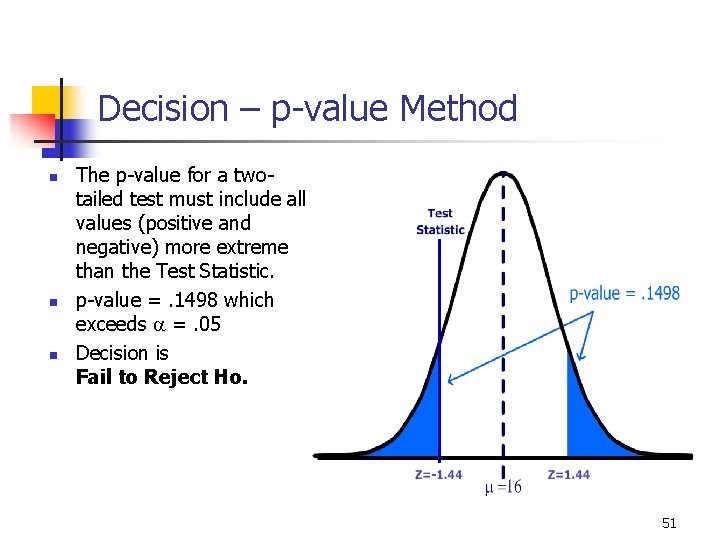
Decision – p-value Method n n n The p-value for a twotailed test must include all values (positive and negative) more extreme than the Test Statistic. p-value =. 1498 which exceeds a =. 05 Decision is Fail to Reject Ho. 51
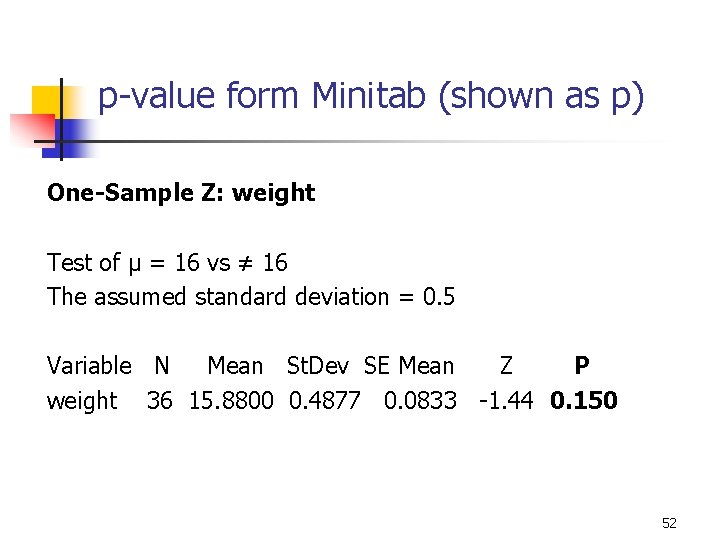
9 -16 p-value form Minitab (shown as p) One-Sample Z: weight Test of μ = 16 vs ≠ 16 The assumed standard deviation = 0. 5 Variable N Mean St. Dev SE Mean Z P weight 36 15. 8800 0. 4877 0. 0833 -1. 44 0. 150 52
Hypotheses Testing – Procedure 4 53
Converting Decision to Conclusion n n Conclusion if Decision is Reject Ho: <Ha in the Context of Problem> Conclusion if Decision is Fail to Reject Ho: “There is insufficient evidence to conclude” <Ha in the Context of Problem> 54
Example - Conclusion n Decision: Fail to Reject Ho There is insufficient evidence to conclude that the mean amount of soy sauce being filled into bottles is not 16 ounces. There is insufficient evidence to conclude machine that fills 16 ounce soy sauce bottles is operating improperly. 55
Conclusions need to n n n Be consistent with the results of the Hypothesis Test. Use language that is clearly understood in the context of the problem. Limit the inference to the population that was sampled. Report sampling methods that could question the integrity of the random sample assumption. Conclusions should address the potential or necessity of further research, sending the process back to the first procedure. 56

Conclusions need to be consistent with the results of the Hypothesis Test. n n n Rejecting Ho requires a strong statement in support of Ha. Failing to Reject Ho does NOT support Ho, but requires a weak statement of insufficient evidence to support Ha. Example: n n The researcher wants to support the claim that, on average, students send more than 1000 text messages per month Ho: m=1000 Ha: m>1000 Conclusion if Ho is rejected: The mean number of text messages sent by students exceeds 1000. Conclusion if Ho is not rejected: There is insufficient evidence to support the claim that the mean number of text messages sent by students exceeds 1000. 57

Conclusions need to use language that is clearly understood in the context of the problem. n n n Avoid technical or statistical language. Refer to the language of the original general question. Compare these two conclusions from a test of correlation between home prices square footage and price. 200 180 160 140 Price Conclusion 1: By rejecting the Null Hypothesis we are inferring that the Alterative Hypothesis is supported and that there exists a significant correlation between the independent and dependent variables in the original problem comparing home prices to square footage. Housing Prices and Square Footage 120 100 80 60 40 Conclusion 2: Homes with more square footage generally have higher prices. 20 0 10 15 20 25 30 Size 58
Conclusions need to limit the inference to the population that was sampled. n n If a survey was taken of a sub-group of population, then the inference applies to the subgroup. Example n n n Studies by pharmaceutical companies will only test adult patients, making it difficult to determine effective dosage and side effects for children. “In the absence of data, doctors use their medical judgment to decide on a particular drug and dose for children. ‘Some doctors stay away from drugs, which could deny needed treatment, ’ Blumer says. "Generally, we take our best guess based on what's been done before. ” “The antibiotic chloramphenicol was widely used in adults to treat infections resistant to penicillin. But many newborn babies died after receiving the drug because their immature livers couldn't break down the antibiotic. ” source: FDA Consumer Magazine – Jan/Feb 2003 59
Conclusions need to report sampling methods that could question the integrity of the random sample assumption. n Be aware of how the sample was obtained. Here are some examples of pitfalls: n n n Telephone polling was found to under-sample young people during the 2008 presidential campaign because of the increase in cell phone only households. Since young people were more likely to favor Obama, this caused bias in the polling numbers. Sampling that didn’t occur over the weekend may exclude many full time workers. Self-selected and unverified polls (like ratemyprofessors. com) could contain immeasurable bias. 60
Conclusions should address the potential or necessity of further research, sending the process back to the first procedure. n n n Answers often lead to new questions. If changes are recommended in a researcher’s conclusion, then further research is usually needed to analyze the impact and effectiveness of the implemented changes. There may have been limitations in the original research project (such as funding resources, sampling techniques, unavailability of data) that warrants more a comprehensive study. n Example: A math department modifies is curriculum based on a performance statistics for an experimental course. The department would want to do further study of student outcomes to assess the effectiveness of the new program. 61
Soy Sauce Example - Conclusion n There is insufficient evidence to conclude that the machine that fills 16 ounce soy sauce bottles is operating improperly. This conclusion is based on 36 measurements taken during a single hour’s production run. We recommend continued monitoring of the machine during different employee shifts to account for the possibility of potential human error. 62
Procedures of Hypotheses Testing 63
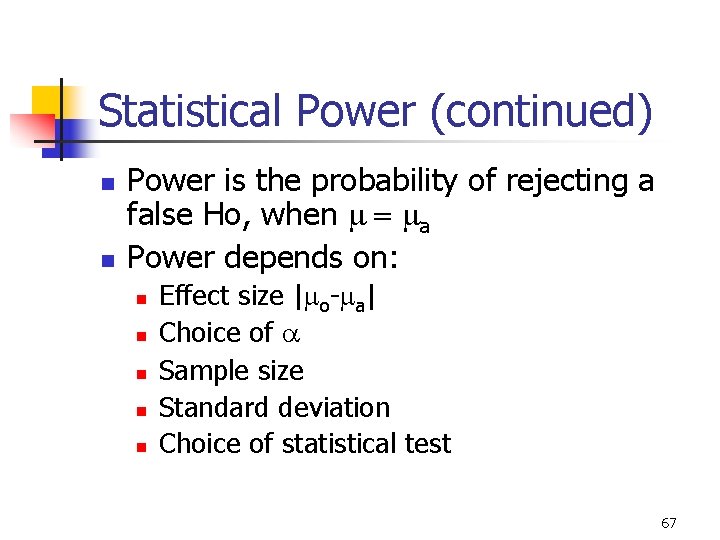
Hypothesis Testing Design State Your Hypotheses Null Hypothesis Alternative Hypothesis Determine Appropriate Model Test Statistic One or Two Tailed Determine Decision Criteria a – Significance Level b and Power Analysis 64
Statistical Power and Type II error Fail to Reject Ho Ho Ho is true 1 -a b Ho is False Type II error a Type I error 1 -b Power 65
Graph of “Four Outcomes” 66
Statistical Power (continued) n n Power is the probability of rejecting a false Ho, when m = ma Power depends on: n n n Effect size |mo-ma| Choice of a Sample size Standard deviation Choice of statistical test 67
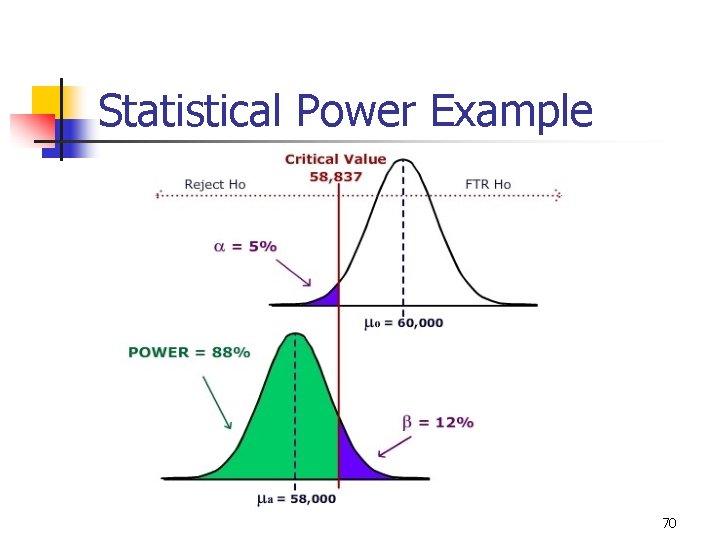
Statistical Power Example n n n Bus brake pads are claimed to last on average at least 60, 000 miles and the company wants to test this claim. The bus company considers a “practical” value for purposes of bus safety to be that the pads at least 58, 000 miles. If the standard deviation is 5, 000 and the sample size is 50, find the Power of the test when the mean is really 58, 000 miles. Assume a =. 05 68
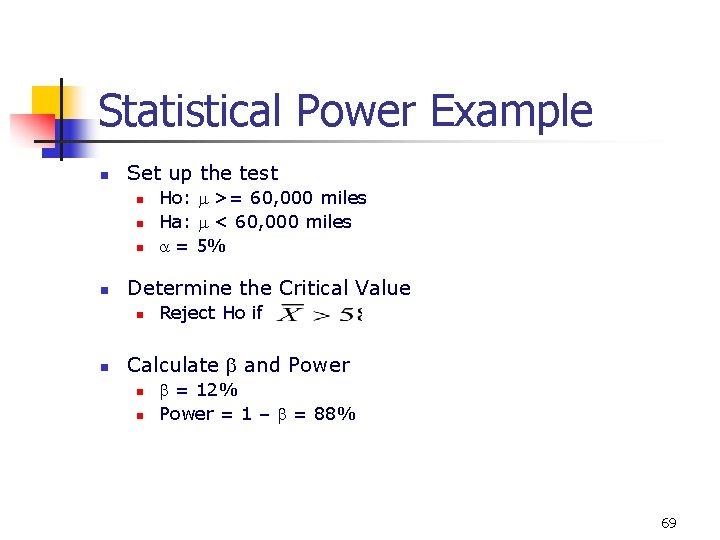
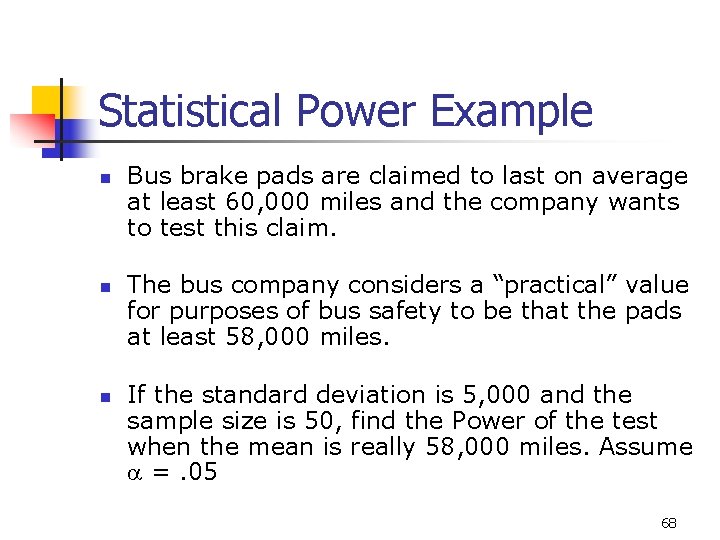
Statistical Power Example n Set up the test n n Determine the Critical Value n n Ho: m >= 60, 000 miles Ha: m < 60, 000 miles a = 5% Reject Ho if Calculate b and Power n n b = 12% Power = 1 – b = 88% 69
Statistical Power Example 70
New Models, Similar Procedures n n The procedures outlined for the test of population mean vs. hypothesized value with known population standard deviation will apply to other models as well. Examples of some other one population models: n n n Test of population mean vs. hypothesized value, population standard deviation unknown. Test of population proportion vs. hypothesized value. Test of population standard deviation (or variance) vs. hypothesized value. 71
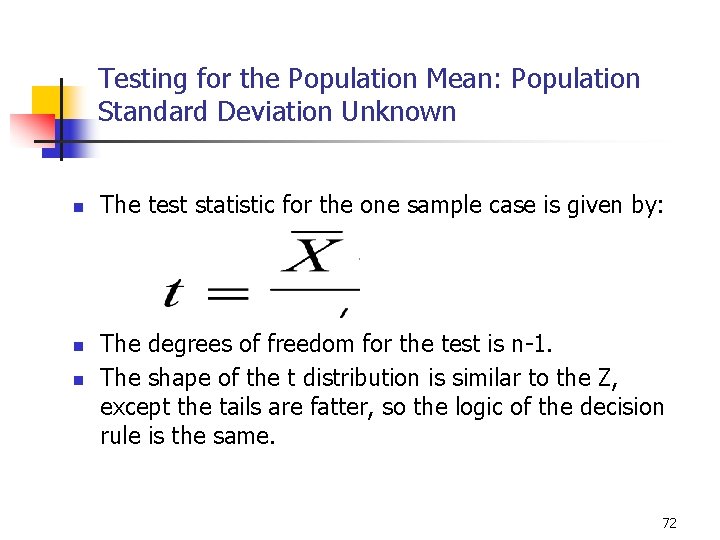
10 -5 Testing for the Population Mean: Population Standard Deviation Unknown n The test statistic for the one sample case is given by: The degrees of freedom for the test is n-1. The shape of the t distribution is similar to the Z, except the tails are fatter, so the logic of the decision rule is the same. 72

10 -9 Decision Rules n n Like the normal distribution, the logic for one and two tail testing is the same. For a two-tail test using the t-distribution, you will reject the null hypothesis when the value of the test statistic is greater than tdf, a/2 or if it is less than - tdf, a/2 For a left-tail test using the t-distribution, you will reject the null hypothesis when the value of the test statistic is less than -tdf, a For a right-tail test using the t-distribution, you will reject the null hypothesis when the value of the test statistic is greater than tdf, a 73
10 -6 Example – one population test of mean, s unknown n n Humerus bones from the same species have approximately the same lengthto-width ratios. When fossils of humerus bones are discovered, archaeologists can determine the species by examining this ratio. It is known that Species A has a mean ratio of 9. 6. A similar Species B has a mean ratio of 9. 1 and is often confused with Species A. 21 humerus bones were unearthed in an area that was originally thought to be inhabited Species A. (Assume all unearthed bones are from the same species. ) Design a hypothesis test where the alternative claim would be the humerus bones were not from Species A. Determine the power of this test if the bones actually came from Species B (assume a standard deviation of 0. 7) Conduct the test using at a 5% significance level and state overall conclusions. 74
10 -7 Example – Designing Test n Research Hypotheses n n n In terms of the population mean n Ho: m = 9. 6 Ha: m ≠ 9. 6 Significance level n n Ho: The humerus bones are from Species A Ha: The humerus bones are not from Species A a =. 05 Test Statistic (Model) n t-test of mean vs. hypothesized value. 75

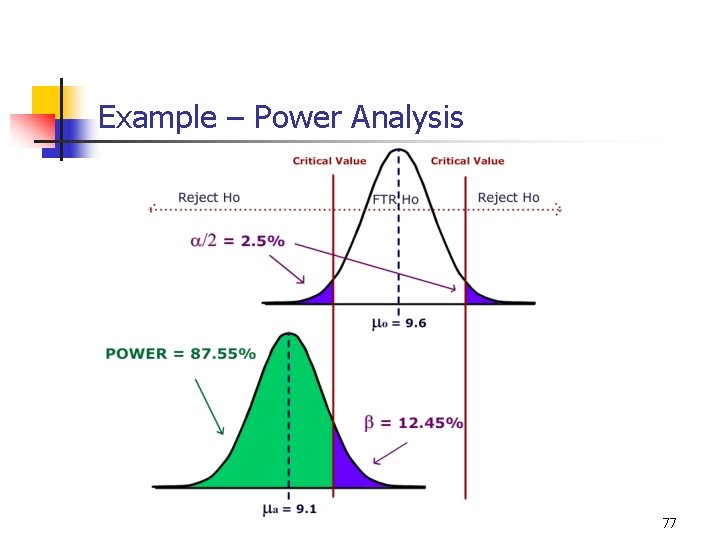
Example - Power Analysis n Information needed for Power Calculation n n n n mo = 9. 6 (Species A) ma = 9. 1 (Species B) Effect Size =| mo - ma | = 0. 5 s = 0. 7 (given) a =. 05 n = 21 (sample size) Two tailed test Results using online Power Calculator* n n n Power =. 8755 b = 1 - Power =. 1245 If humerus bones are from Species B, test has an 87. 55% chance of correctly rejecting Ho and a maximum Type II error of 12. 45% *source: Russ Lenth, University of Iowa – http: //www. stat. uiowa. edu/~rlenth/Power/ 76
Example – Power Analysis 77
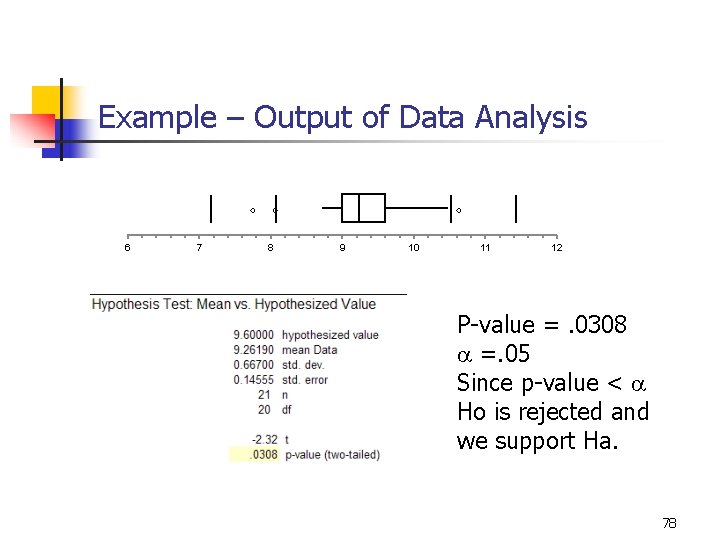
Example – Output of Data Analysis 6 7 8 9 10 11 12 P-value =. 0308 a =. 05 Since p-value < a Ho is rejected and we support Ha. 78
Example - Conclusions n Results: n n Sampling Methodology: n n We are assuming since the bones were unearthed in the same location, they came from the same species. Limitations: n n The evidence supports the claim (pvalue<. 05) that the humerus bones are not from Species A. A small sample size limited the power of the test, which prevented us from making a more definitive conclusion. Further Research n n Test if the bone are from Species B or another unknown species. Test to see if bones are the same age to support the sampling methodology. 79
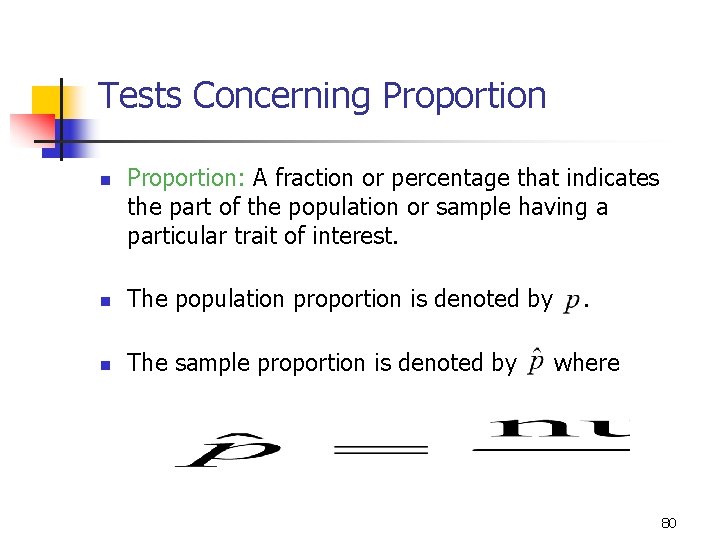
9 -24 Tests Concerning Proportion n Proportion: A fraction or percentage that indicates the part of the population or sample having a particular trait of interest. n The population proportion is denoted by . n The sample proportion is denoted by where 80
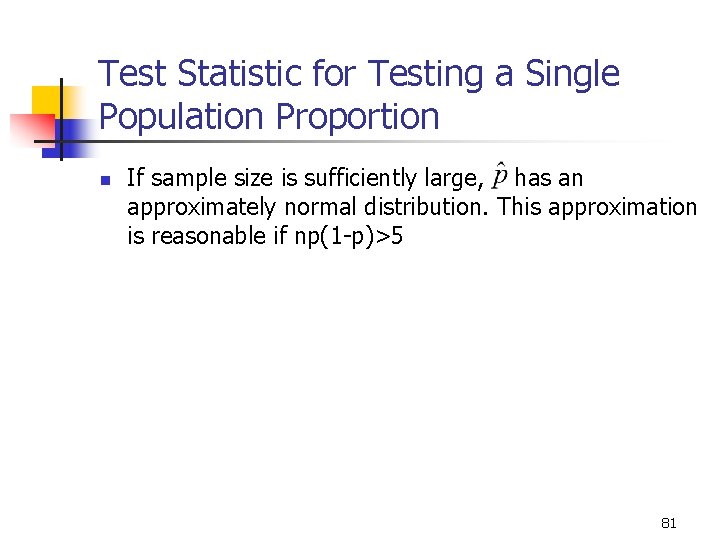
9 -25 Test Statistic for Testing a Single Population Proportion n If sample size is sufficiently large, has an approximately normal distribution. This approximation is reasonable if np(1 -p)>5 81
9 -26 Example n n In the past, 15% of the mail order solicitations for a certain charity resulted in a financial contribution. A new solicitation letter has been drafted and will be sent to a random sample of potential donors. A hypothesis test will be run to determine if the new letter is more effective. Determine the sample size so that: n n n The test can be run at the 5% significance level. If the letter has an 18% success rate, (an effect size of 3%), the power of the test will be 95% After determining the sample size, conduct the test. 82
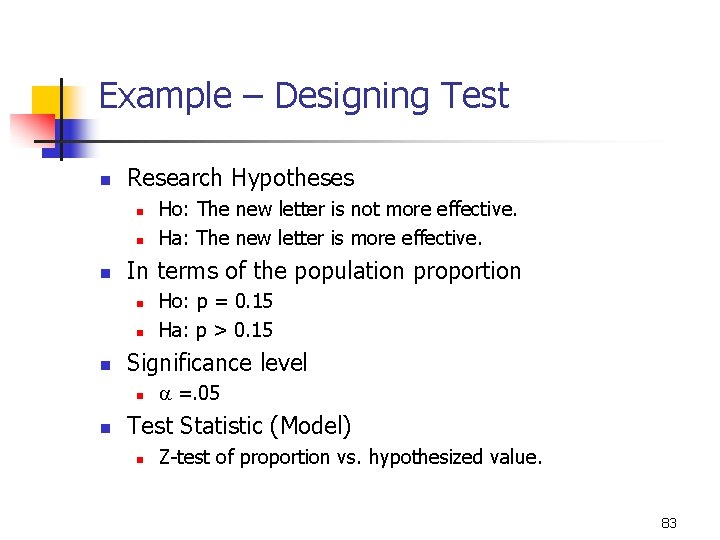
10 -7 Example – Designing Test n Research Hypotheses n n n In terms of the population proportion n Ho: p = 0. 15 Ha: p > 0. 15 Significance level n n Ho: The new letter is not more effective. Ha: The new letter is more effective. a =. 05 Test Statistic (Model) n Z-test of proportion vs. hypothesized value. 83
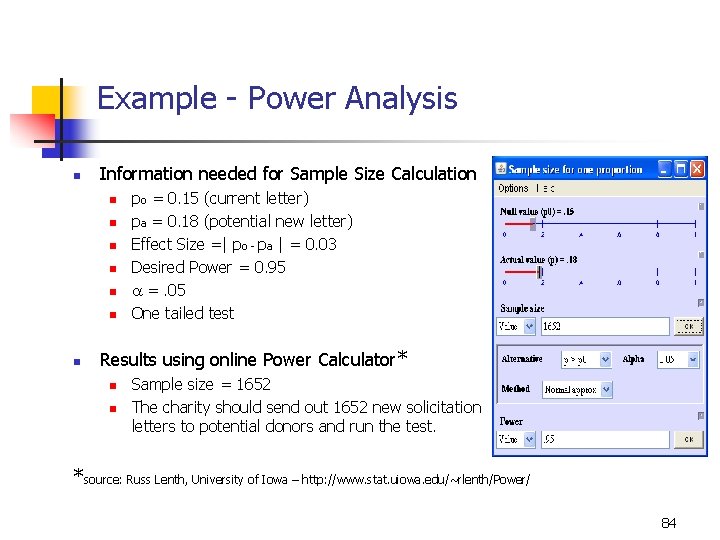
Example - Power Analysis n Information needed for Sample Size Calculation n n n po = 0. 15 (current letter) pa = 0. 18 (potential new letter) Effect Size =| po - pa | = 0. 03 Desired Power = 0. 95 a =. 05 One tailed test Results using online Power Calculator* n n Sample size = 1652 The charity should send out 1652 new solicitation letters to potential donors and run the test. *source: Russ Lenth, University of Iowa – http: //www. stat. uiowa. edu/~rlenth/Power/ 84
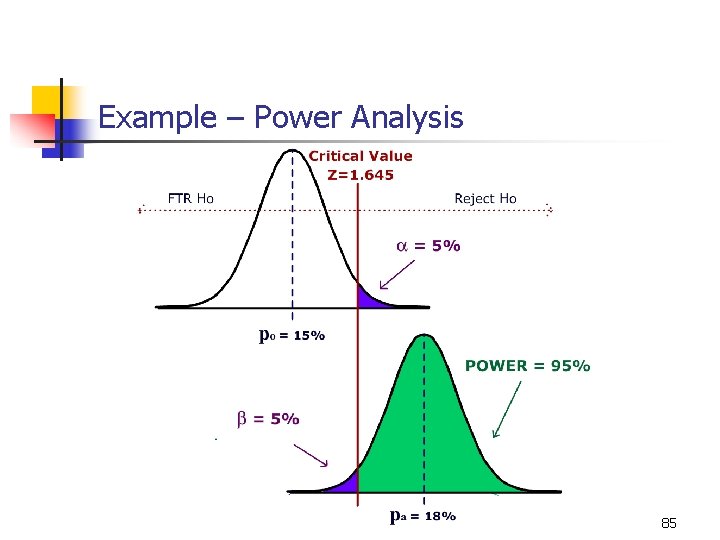
Example – Power Analysis 85
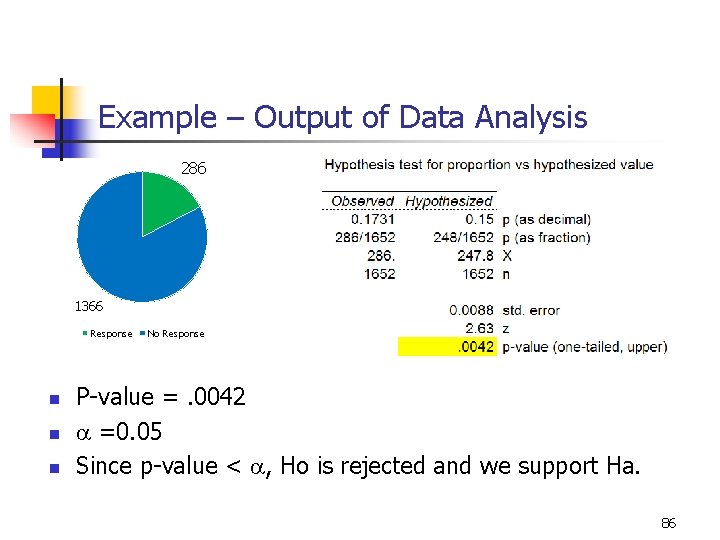
Example – Output of Data Analysis 286 1366 Response n n n No Response P-value =. 0042 a =0. 05 Since p-value < a, Ho is rejected and we support Ha. 86
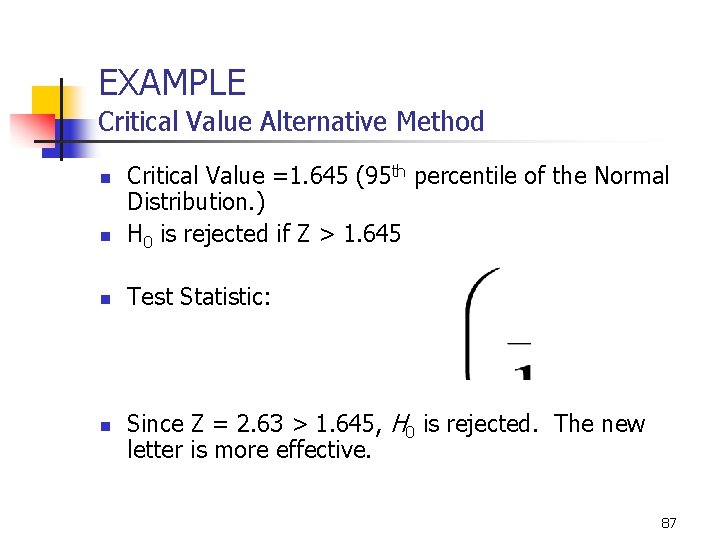
9 -27 EXAMPLE Critical Value Alternative Method n Critical Value =1. 645 (95 th percentile of the Normal Distribution. ) H 0 is rejected if Z > 1. 645 n Test Statistic: n n Since Z = 2. 63 > 1. 645, H 0 is rejected. The new letter is more effective. 87
Example - Conclusions n Results: n n Sampling Methodology: n n The 1652 test letters were selected as a random sample from the charity’s mailing list. All letters were sent at the same time period. Limitations: n n The evidence supports the claim (pvalue<. 01) that the new letter is more effective. The letters needed to be sent in a specific time period, so we were not able to control for seasonal or economic factors. Further Research n n Test both solicitation methods over the entire year to eliminate seasonal effects. Send the old letter to another random sample to create a control group. 88
9 -24 Test for Variance or Standard Deviation vs. Hypothesized Value n n We often want to make a claim about the variability, volatility or consistency of a population random variable. Hypothesized values for population variance s 2 or standard deviation s are tested with the c 2 distribution. Examples of Hypotheses: n Ho: s = 10 Ha: s ≠ 10 2 2 n Ho: s = 100 Ha: s > 100 The sample variance s 2 is used in calculating the Test Statistic. 89
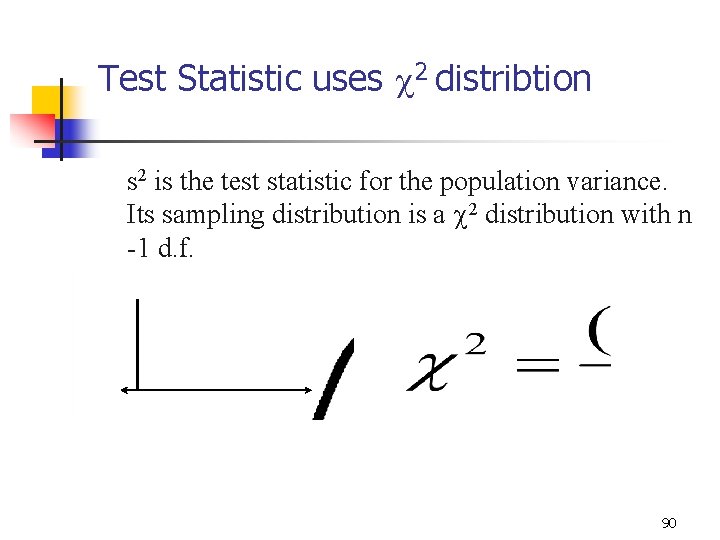
Test Statistic uses c 2 distribtion n s 2 is the test statistic for the population variance. Its sampling distribution is a c 2 distribution with n -1 d. f. 90
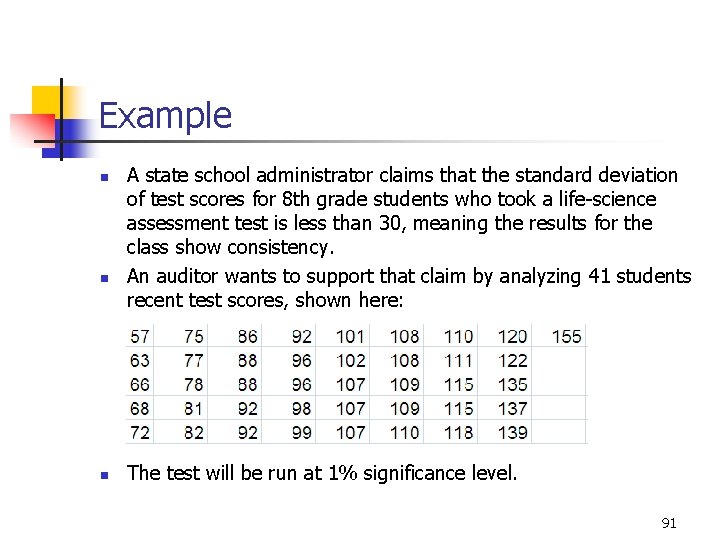
Example n n n A state school administrator claims that the standard deviation of test scores for 8 th grade students who took a life-science assessment test is less than 30, meaning the results for the class show consistency. An auditor wants to support that claim by analyzing 41 students recent test scores, shown here: The test will be run at 1% significance level. 91
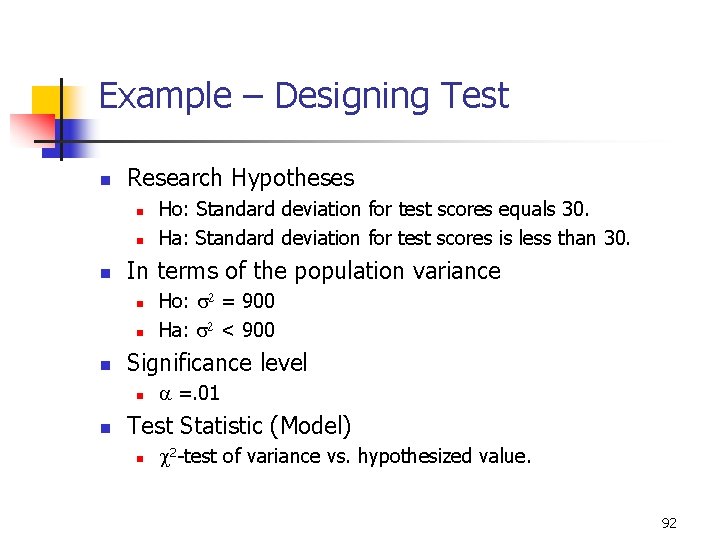
10 -7 Example – Designing Test n Research Hypotheses n n n In terms of the population variance n n n Ho: s 2 = 900 Ha: s 2 < 900 Significance level n n Ho: Standard deviation for test scores equals 30. Ha: Standard deviation for test scores is less than 30. a =. 01 Test Statistic (Model) n c 2 -test of variance vs. hypothesized value. 92
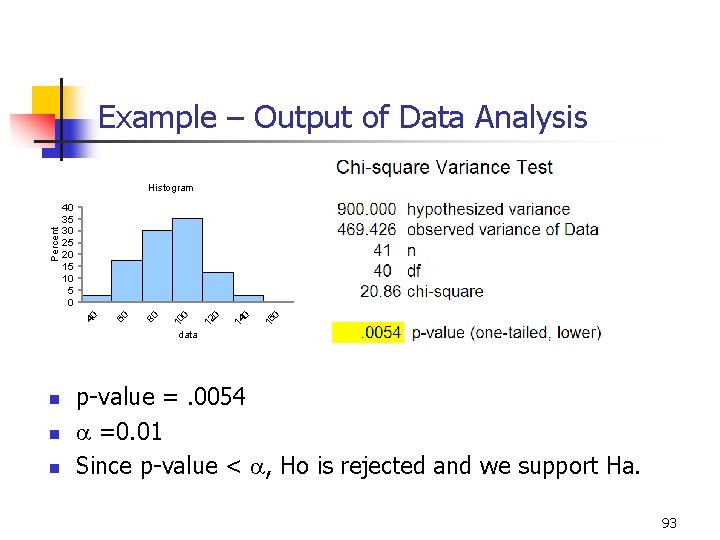
Example – Output of Data Analysis 0 16 0 14 0 12 0 10 80 60 40 35 30 25 20 15 10 5 0 40 Percent Histogram data n n n p-value =. 0054 a =0. 01 Since p-value < a, Ho is rejected and we support Ha. 93
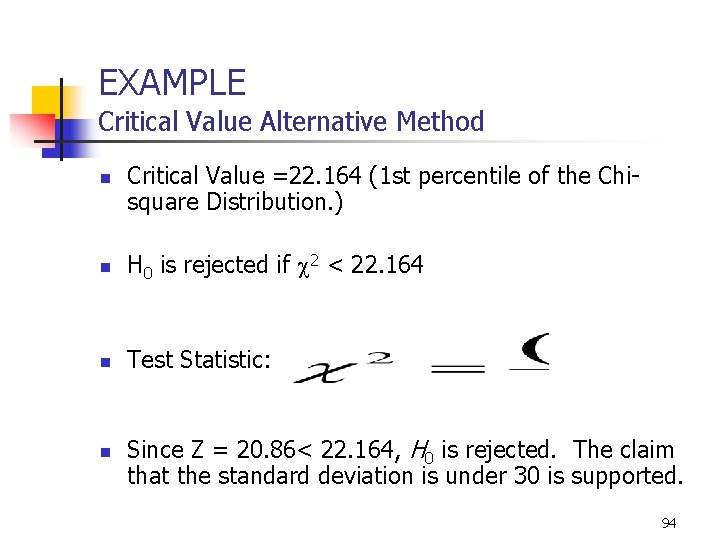
9 -27 EXAMPLE Critical Value Alternative Method n Critical Value =22. 164 (1 st percentile of the Chisquare Distribution. ) n H 0 is rejected if c 2 < 22. 164 n Test Statistic: n Since Z = 20. 86< 22. 164, H 0 is rejected. The claim that the standard deviation is under 30 is supported. 94
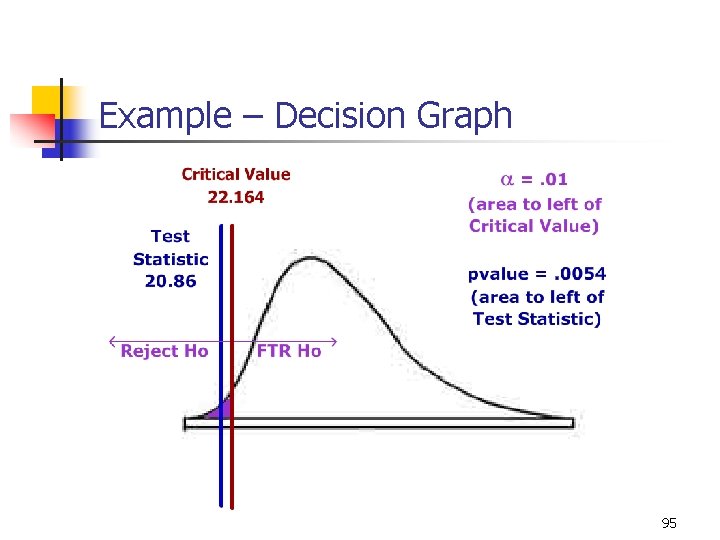
Example – Decision Graph 95
Example - Conclusions n Results: n n Sampling Methodology: n n The 41 test scores were the results of the recently administered exam to the 8 th grade students. Limitations: n n The evidence supports the claim (pvalue<. 01) that the standard deviation for 8 th grade test scores is less than 30. Since the exams were for the current class only, there is no assurance that future classes will achieve similar results. Further Research n n Compare results to other schools that administered the same exam. Continue to analyze future class exams to see if the claim is holding true. 96
- Slides: 96