
Inference in firstorder logic Outline Reducing firstorder inference






- Slides: 74
Inference in firstorder logic
Outline Reducing first-order inference to propositional inference n Unification n Generalized Modus Ponens n Forward chaining n Backward chaining n Resolution n
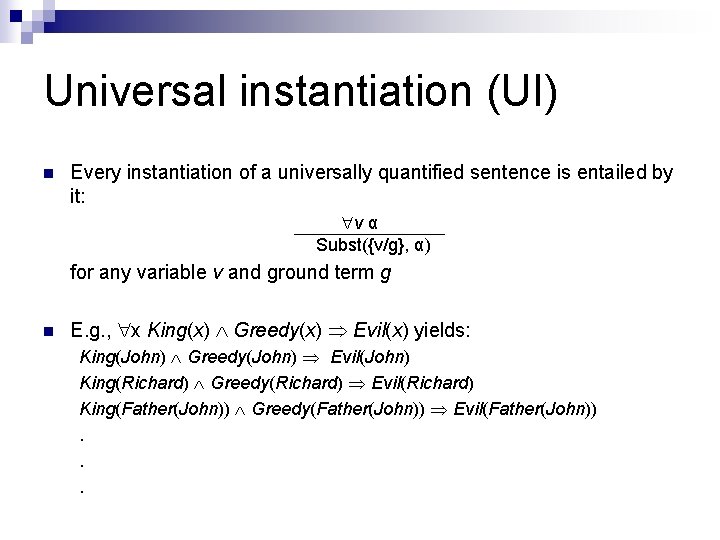
Universal instantiation (UI) n Every instantiation of a universally quantified sentence is entailed by it: v α Subst({v/g}, α) for any variable v and ground term g n E. g. , x King(x) Greedy(x) Evil(x) yields: King(John) Greedy(John) Evil(John) King(Richard) Greedy(Richard) Evil(Richard) King(Father(John)) Greedy(Father(John)) Evil(Father(John)). . .
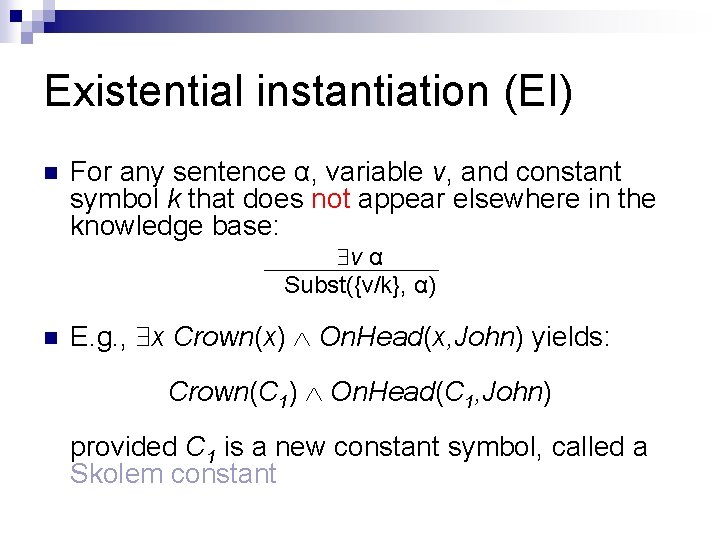
Existential instantiation (EI) n For any sentence α, variable v, and constant symbol k that does not appear elsewhere in the knowledge base: v α Subst({v/k}, α) n E. g. , x Crown(x) On. Head(x, John) yields: Crown(C 1) On. Head(C 1, John) provided C 1 is a new constant symbol, called a Skolem constant
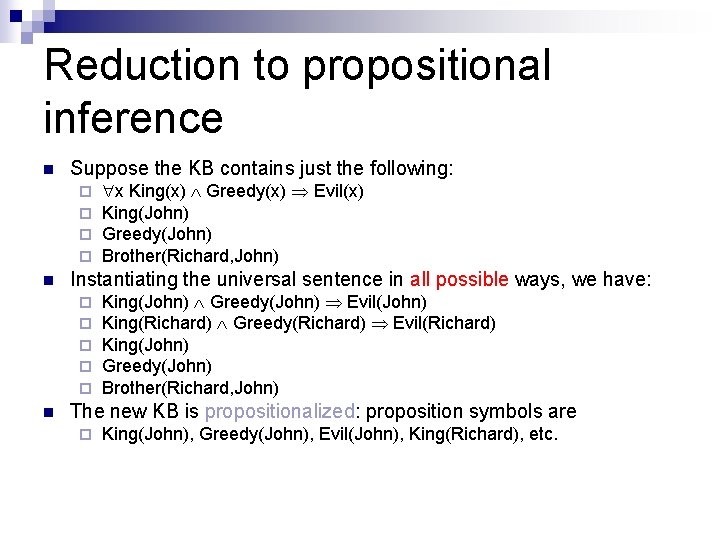
Reduction to propositional inference n Suppose the KB contains just the following: ¨ ¨ n Instantiating the universal sentence in all possible ways, we have: ¨ ¨ ¨ n x King(x) Greedy(x) Evil(x) King(John) Greedy(John) Brother(Richard, John) King(John) Greedy(John) Evil(John) King(Richard) Greedy(Richard) Evil(Richard) King(John) Greedy(John) Brother(Richard, John) The new KB is propositionalized: proposition symbols are ¨ King(John), Greedy(John), Evil(John), King(Richard), etc.
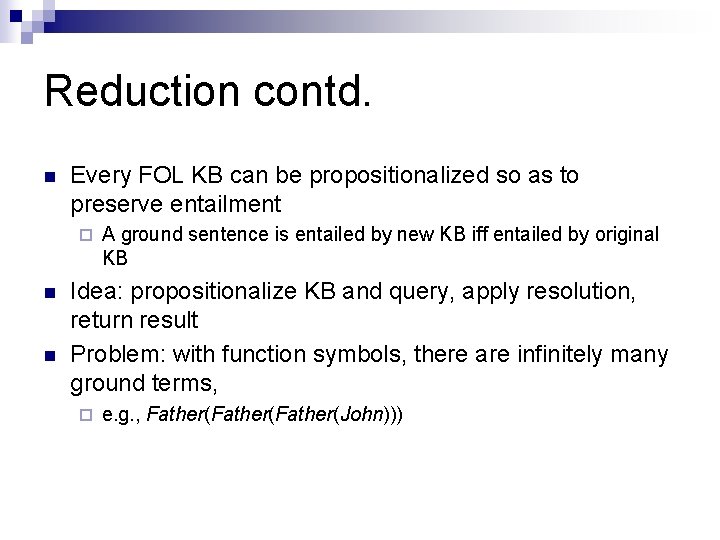
Reduction contd. n Every FOL KB can be propositionalized so as to preserve entailment ¨ n n A ground sentence is entailed by new KB iff entailed by original KB Idea: propositionalize KB and query, apply resolution, return result Problem: with function symbols, there are infinitely many ground terms, ¨ e. g. , Father(Father(John)))
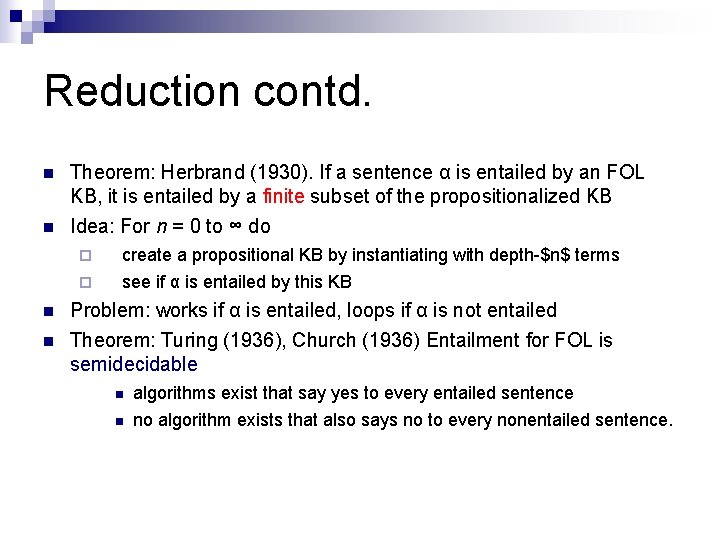
Reduction contd. n Theorem: Herbrand (1930). If a sentence α is entailed by an FOL KB, it is entailed by a finite subset of the propositionalized KB n Idea: For n = 0 to ∞ do n n ¨ create a propositional KB by instantiating with depth-$n$ terms ¨ see if α is entailed by this KB Problem: works if α is entailed, loops if α is not entailed Theorem: Turing (1936), Church (1936) Entailment for FOL is semidecidable n n algorithms exist that say yes to every entailed sentence no algorithm exists that also says no to every nonentailed sentence.
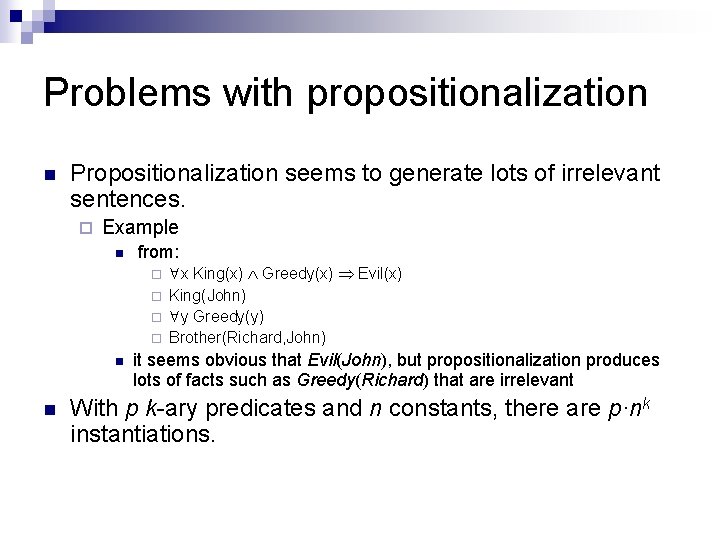
Problems with propositionalization n Propositionalization seems to generate lots of irrelevant sentences. ¨ Example n from: ¨ ¨ n n x King(x) Greedy(x) Evil(x) King(John) y Greedy(y) Brother(Richard, John) it seems obvious that Evil(John), but propositionalization produces lots of facts such as Greedy(Richard) that are irrelevant With p k-ary predicates and n constants, there are p·nk instantiations.
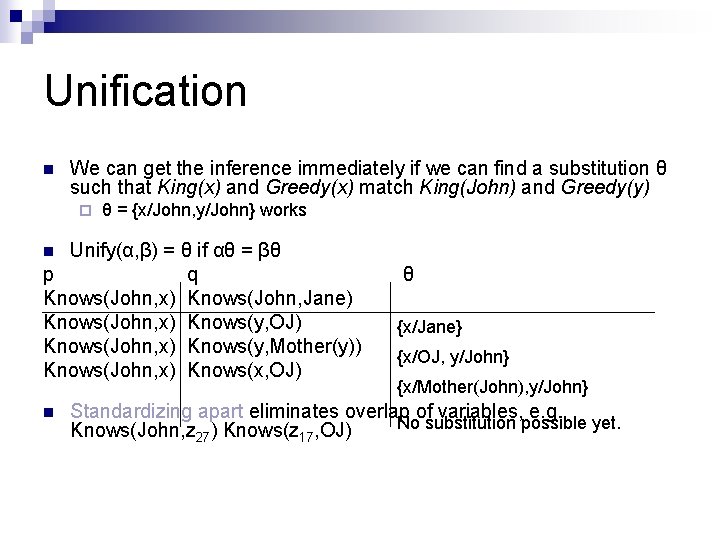
Unification n We can get the inference immediately if we can find a substitution θ such that King(x) and Greedy(x) match King(John) and Greedy(y) ¨ θ = {x/John, y/John} works Unify(α, β) = θ if αθ = βθ p q Knows(John, x) Knows(John, Jane) Knows(John, x) Knows(y, OJ) Knows(John, x) Knows(y, Mother(y)) Knows(John, x) Knows(x, OJ) n n θ {x/Jane} {x/OJ, y/John} {x/Mother(John), y/John} Standardizing apart eliminates overlap of variables, e. g. , No substitution possible yet. Knows(John, z 27) Knows(z 17, OJ)
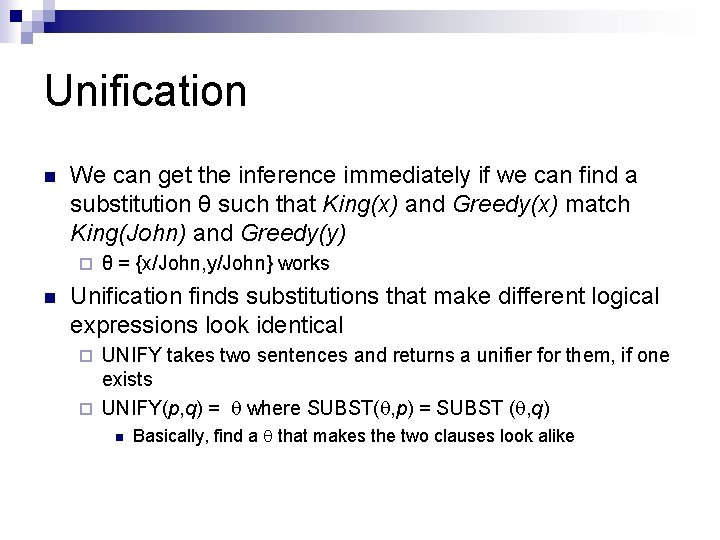
Unification n We can get the inference immediately if we can find a substitution θ such that King(x) and Greedy(x) match King(John) and Greedy(y) ¨ n θ = {x/John, y/John} works Unification finds substitutions that make different logical expressions look identical UNIFY takes two sentences and returns a unifier for them, if one exists ¨ UNIFY(p, q) = where SUBST( , p) = SUBST ( , q) ¨ n Basically, find a that makes the two clauses look alike
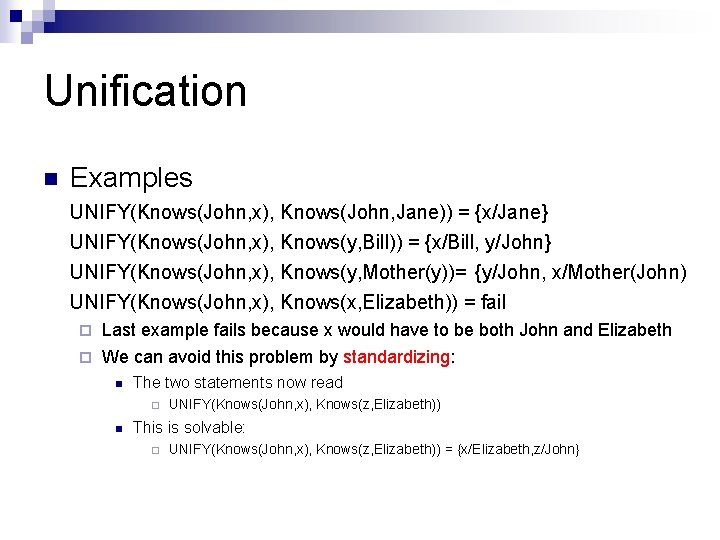
Unification n Examples UNIFY(Knows(John, x), Knows(John, Jane)) = {x/Jane} UNIFY(Knows(John, x), Knows(y, Bill)) = {x/Bill, y/John} UNIFY(Knows(John, x), Knows(y, Mother(y))= {y/John, x/Mother(John) UNIFY(Knows(John, x), Knows(x, Elizabeth)) = fail Last example fails because x would have to be both John and Elizabeth ¨ We can avoid this problem by standardizing: ¨ n The two statements now read ¨ n UNIFY(Knows(John, x), Knows(z, Elizabeth)) This is solvable: ¨ UNIFY(Knows(John, x), Knows(z, Elizabeth)) = {x/Elizabeth, z/John}
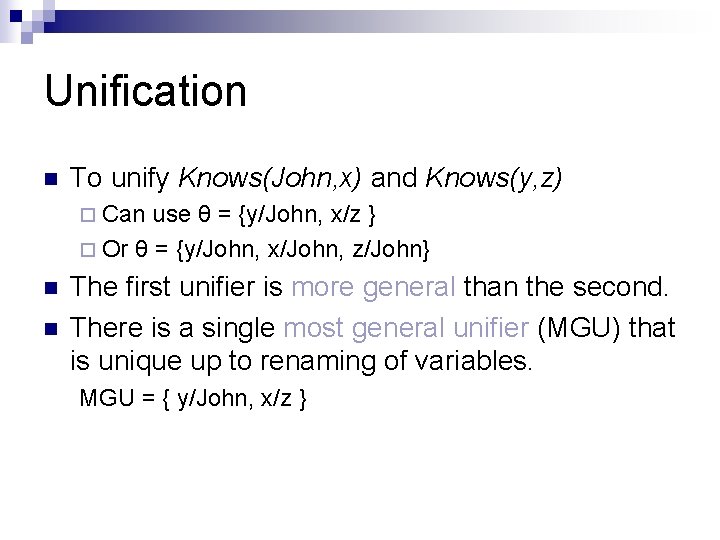
Unification n To unify Knows(John, x) and Knows(y, z) ¨ Can use θ = {y/John, x/z } ¨ Or θ = {y/John, x/John, z/John} n n The first unifier is more general than the second. There is a single most general unifier (MGU) that is unique up to renaming of variables. MGU = { y/John, x/z }
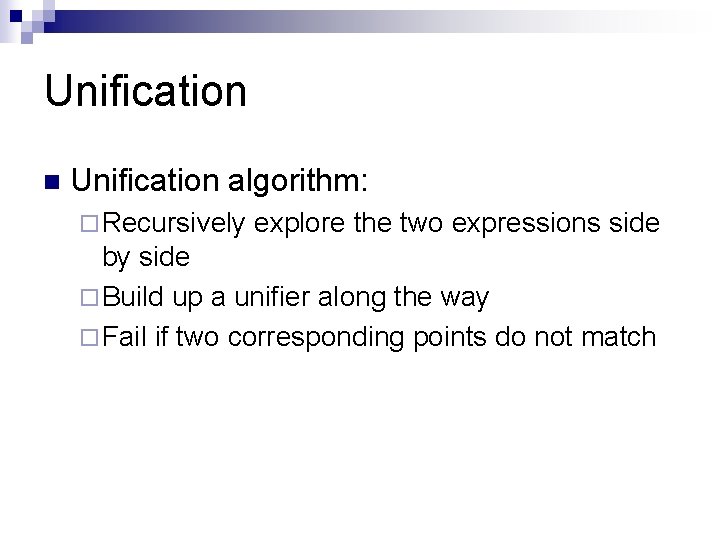
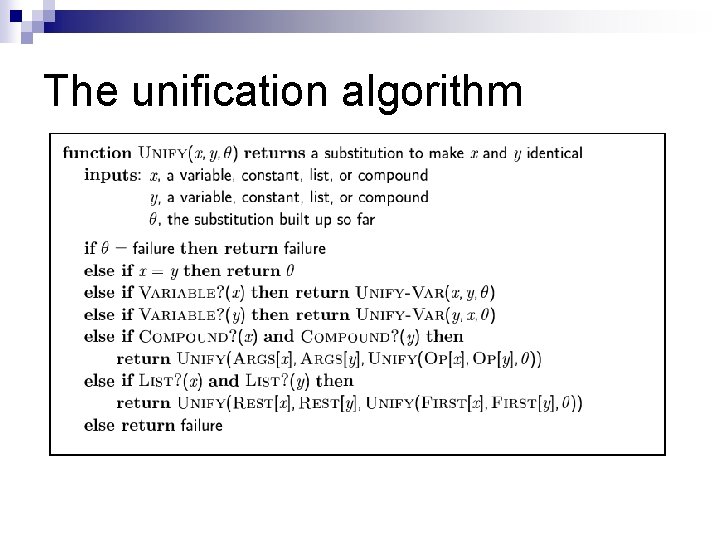
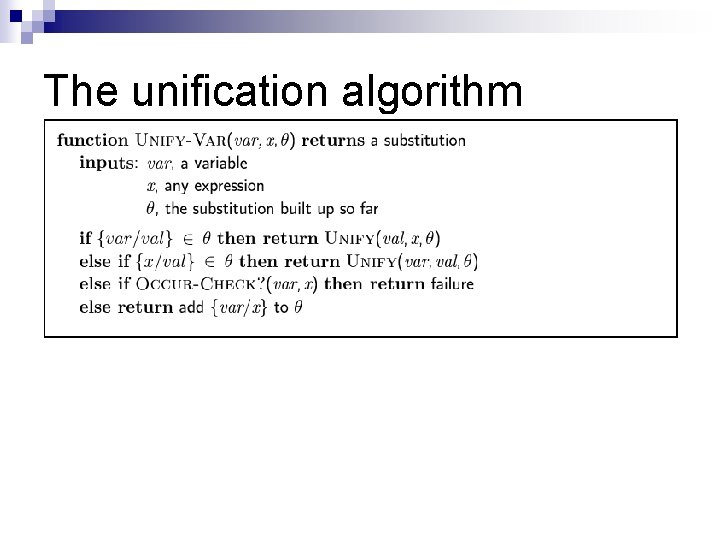
Unification n Unification algorithm: ¨ Recursively explore the two expressions side by side ¨ Build up a unifier along the way ¨ Fail if two corresponding points do not match
The unification algorithm
The unification algorithm
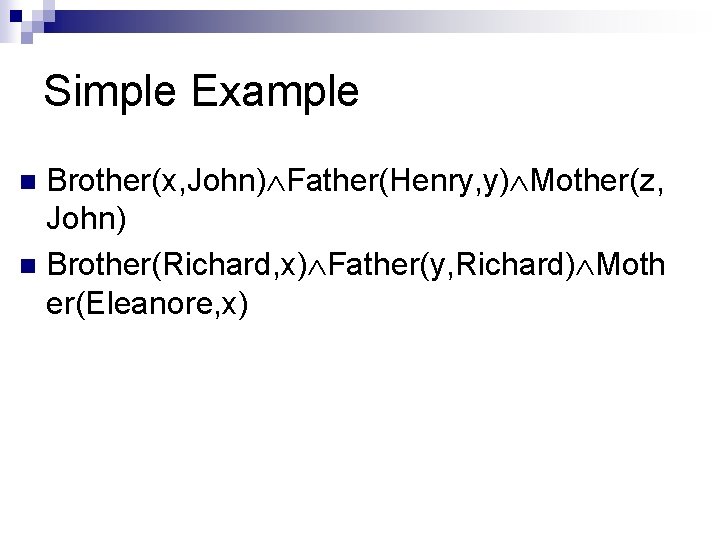
Simple Example Brother(x, John) Father(Henry, y) Mother(z, John) n Brother(Richard, x) Father(y, Richard) Moth er(Eleanore, x) n
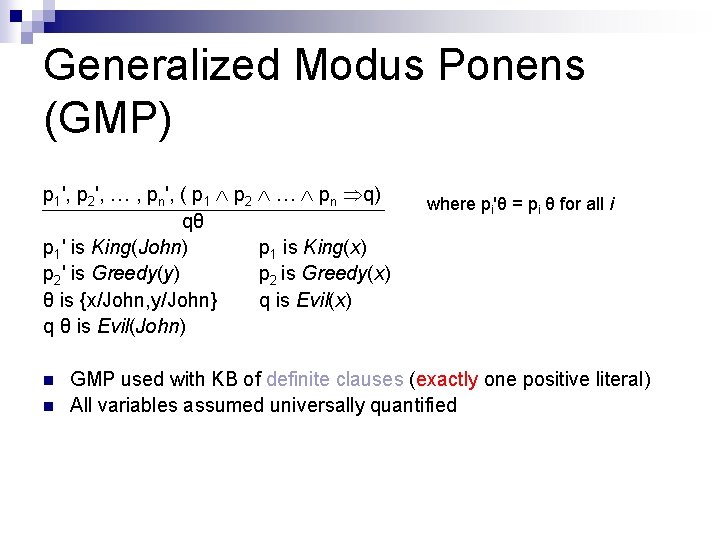
Generalized Modus Ponens (GMP) p 1', p 2', … , pn', ( p 1 p 2 … pn q) qθ p 1' is King(John) p 1 is King(x) p 2' is Greedy(y) p 2 is Greedy(x) θ is {x/John, y/John} q is Evil(x) q θ is Evil(John) n n where pi'θ = pi θ for all i GMP used with KB of definite clauses (exactly one positive literal) All variables assumed universally quantified
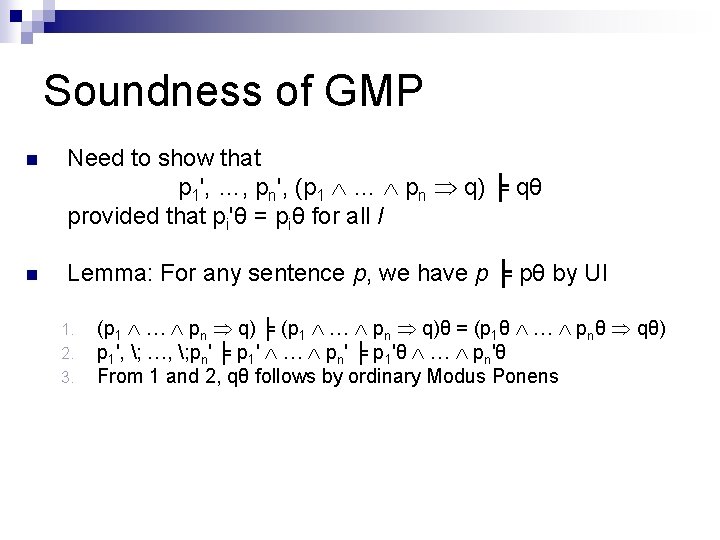
Soundness of GMP n Need to show that p 1', …, pn', (p 1 … pn q) ╞ qθ provided that pi'θ = piθ for all I n Lemma: For any sentence p, we have p ╞ pθ by UI 1. 2. 3. (p 1 … pn q) ╞ (p 1 … pn q)θ = (p 1θ … pnθ qθ) p 1', ; …, ; pn' ╞ p 1' … pn' ╞ p 1'θ … pn'θ From 1 and 2, qθ follows by ordinary Modus Ponens
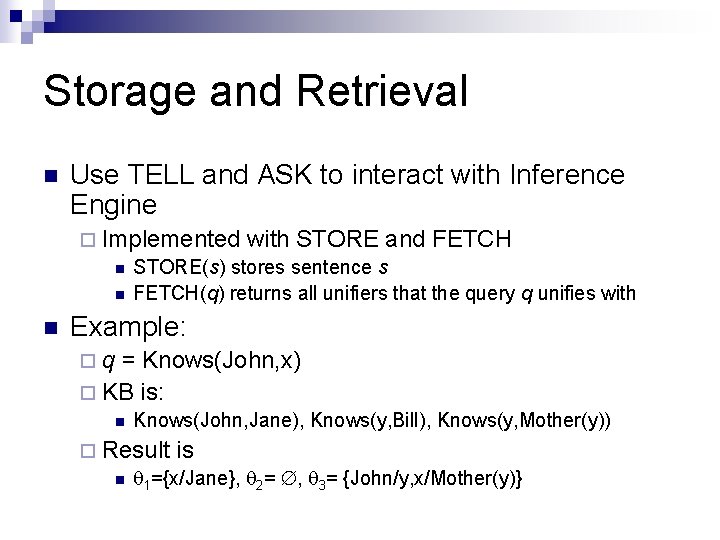
Storage and Retrieval n Use TELL and ASK to interact with Inference Engine ¨ Implemented with STORE and FETCH n STORE(s) stores sentence s n FETCH(q) returns all unifiers that the query q unifies with n Example: ¨q = Knows(John, x) ¨ KB is: n Knows(John, Jane), Knows(y, Bill), Knows(y, Mother(y)) ¨ Result is n 1={x/Jane}, 2= , 3= {John/y, x/Mother(y)}
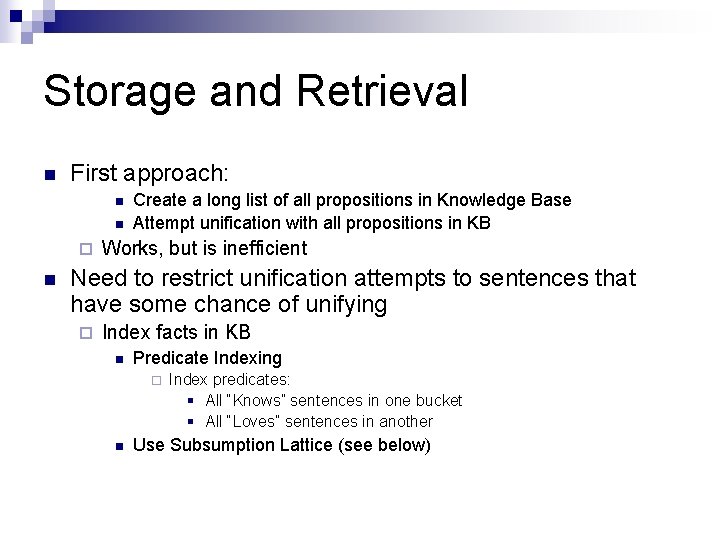
Storage and Retrieval n First approach: n n ¨ n Create a long list of all propositions in Knowledge Base Attempt unification with all propositions in KB Works, but is inefficient Need to restrict unification attempts to sentences that have some chance of unifying ¨ Index facts in KB n Predicate Indexing ¨ n Index predicates: § All “Knows” sentences in one bucket § All “Loves” sentences in another Use Subsumption Lattice (see below)
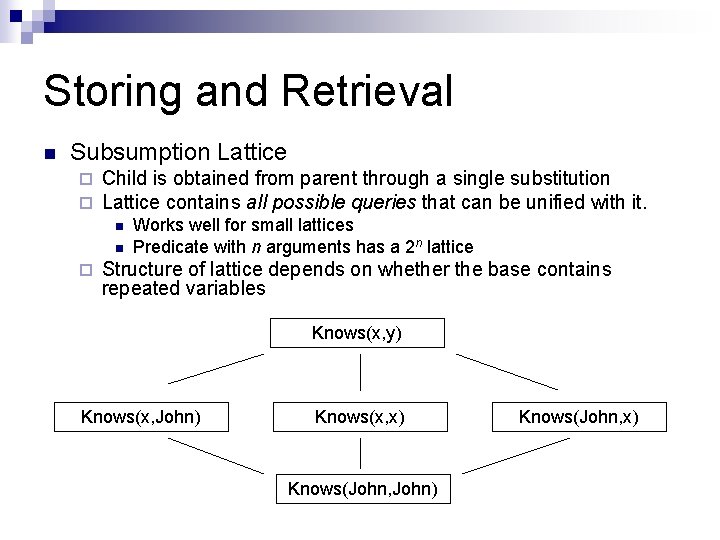
Storing and Retrieval n Subsumption Lattice ¨ ¨ Child is obtained from parent through a single substitution Lattice contains all possible queries that can be unified with it. n n ¨ Works well for small lattices Predicate with n arguments has a 2 n lattice Structure of lattice depends on whether the base contains repeated variables Knows(x, y) Knows(x, John) Knows(x, x) Knows(John, John) Knows(John, x)
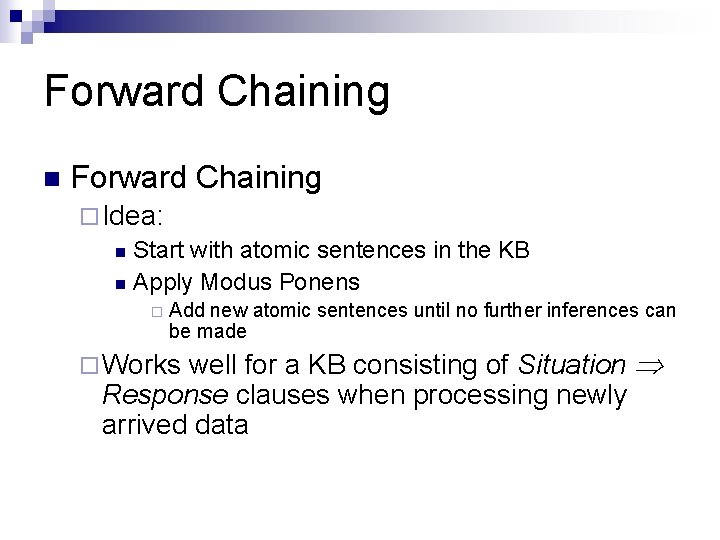
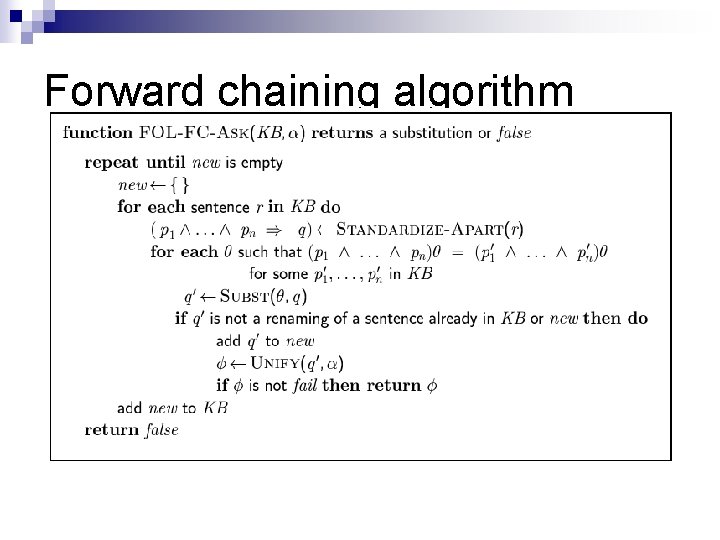
Forward Chaining n Forward Chaining ¨ Idea: n Start with atomic sentences in the KB n Apply Modus Ponens ¨ Add new atomic sentences until no further inferences can be made well for a KB consisting of Situation Response clauses when processing newly arrived data ¨ Works
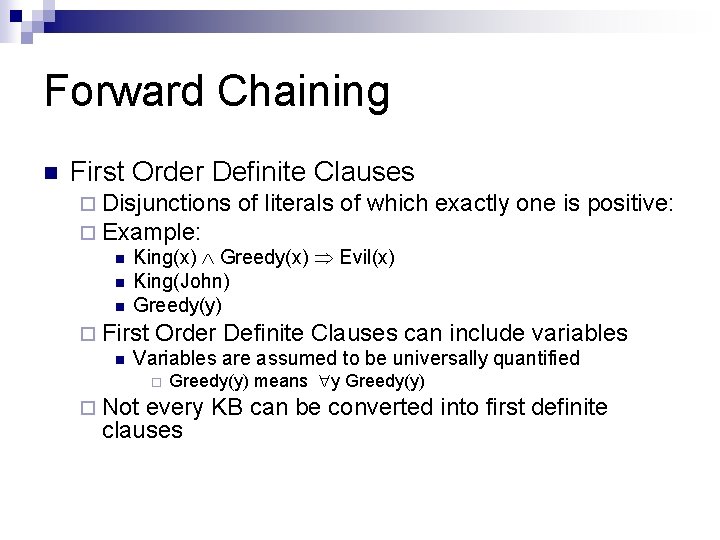
Forward Chaining n First Order Definite Clauses ¨ Disjunctions of literals of which exactly one is positive: ¨ Example: n King(x) Greedy(x) Evil(x) n King(John) n Greedy(y) ¨ First Order Definite Clauses can include variables n Variables are assumed to be universally quantified ¨ ¨ Not Greedy(y) means y Greedy(y) every KB can be converted into first definite clauses
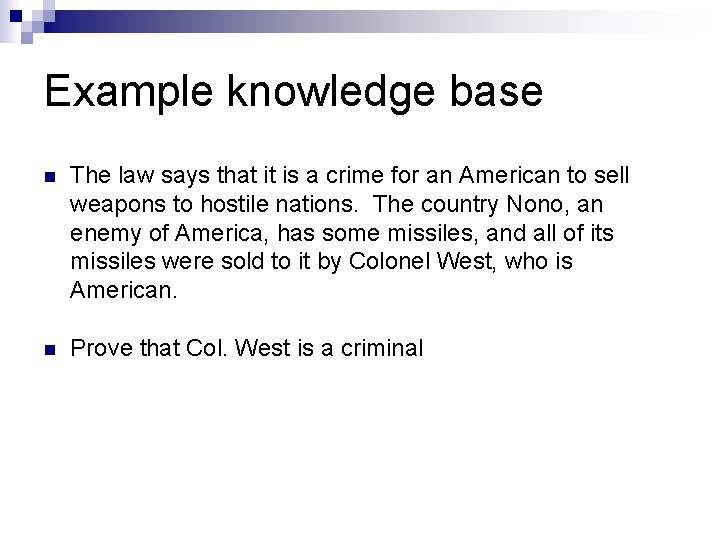
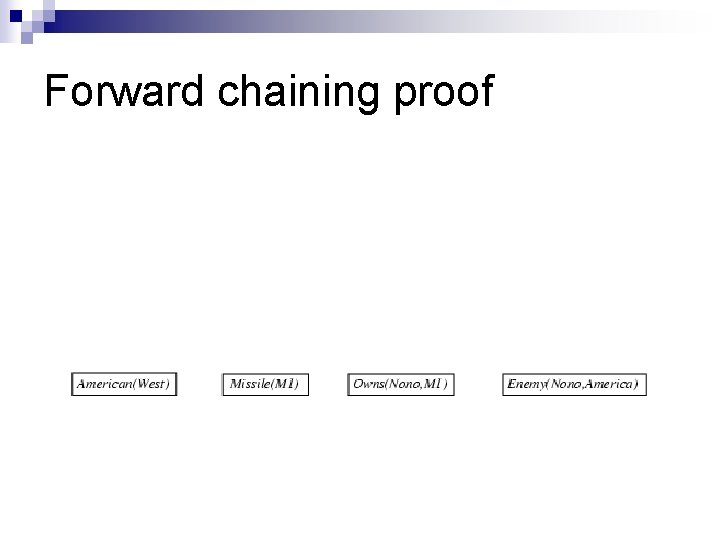
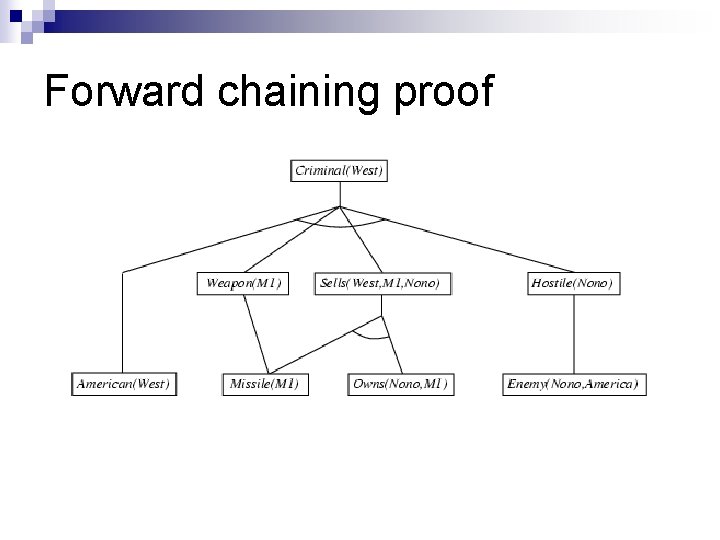
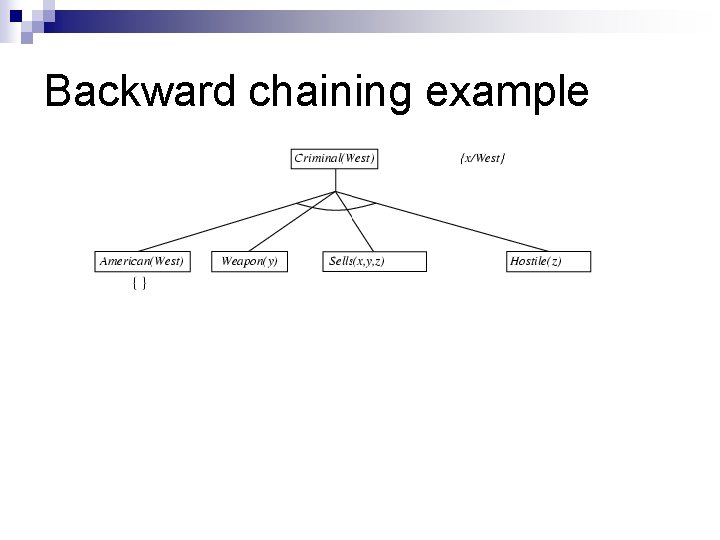
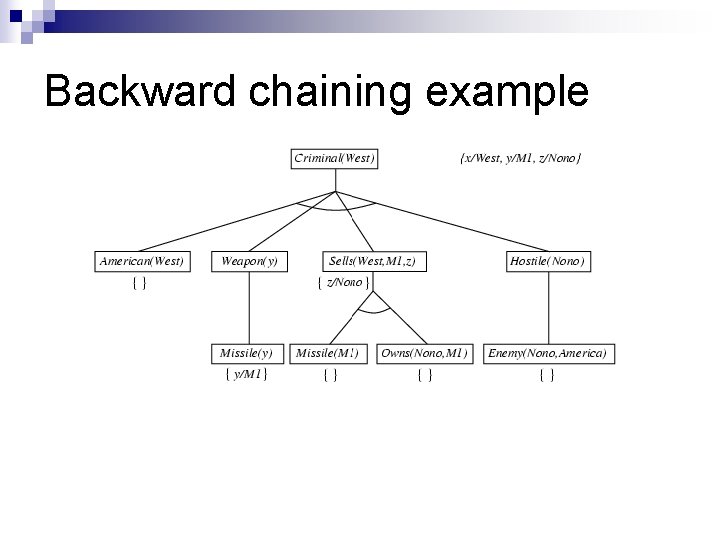
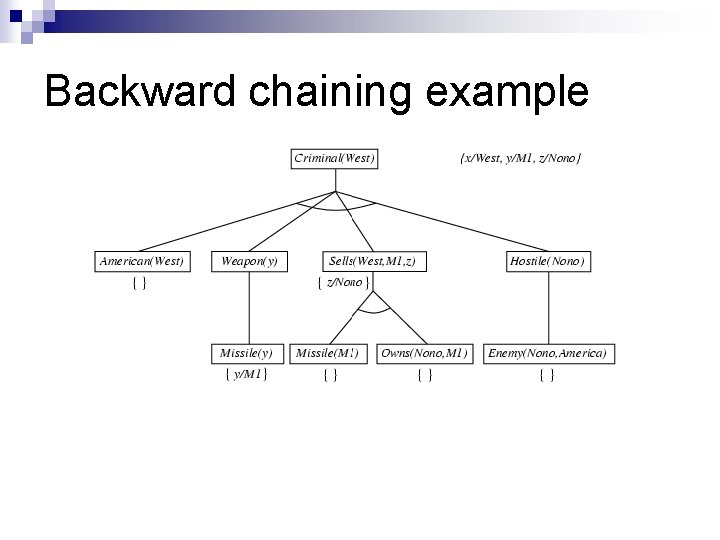
Example knowledge base n The law says that it is a crime for an American to sell weapons to hostile nations. The country Nono, an enemy of America, has some missiles, and all of its missiles were sold to it by Colonel West, who is American. n Prove that Col. West is a criminal
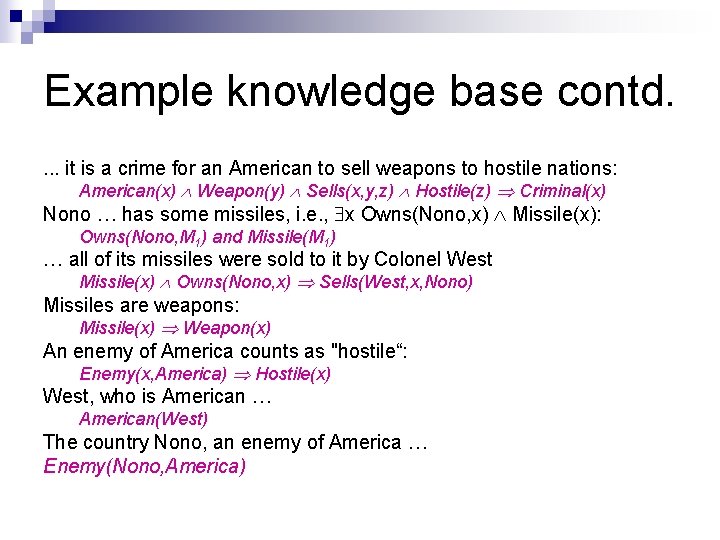
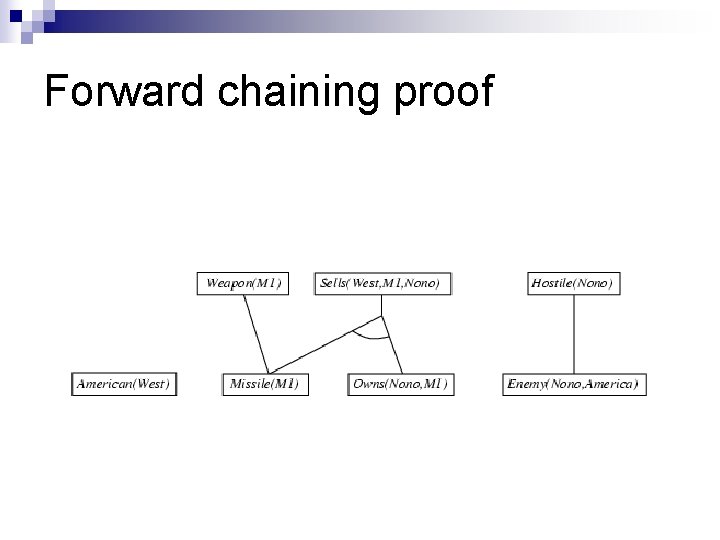
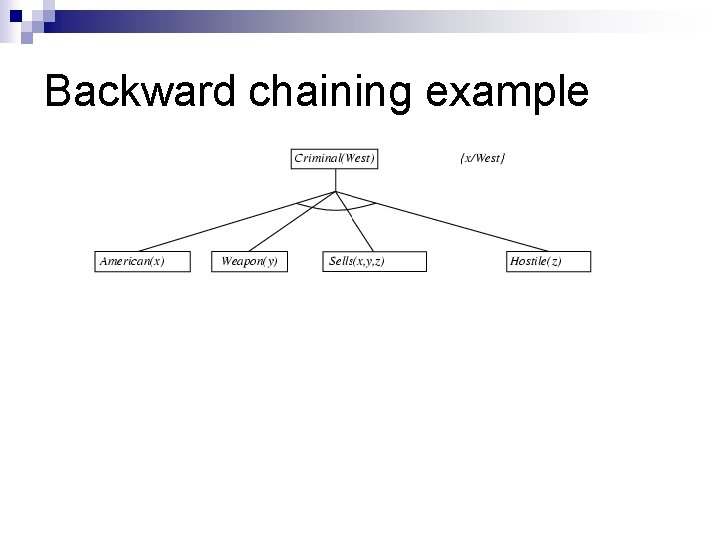
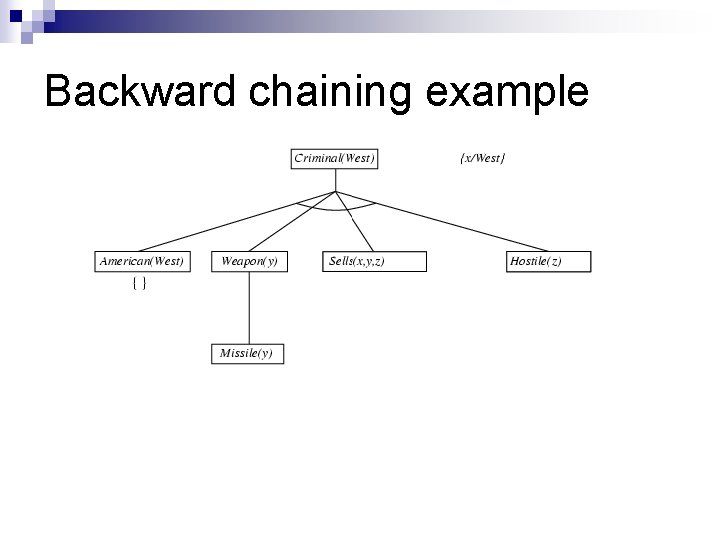
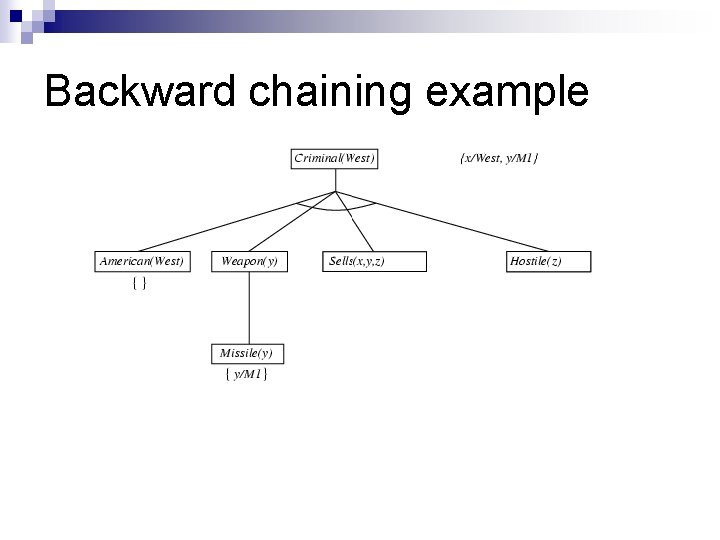
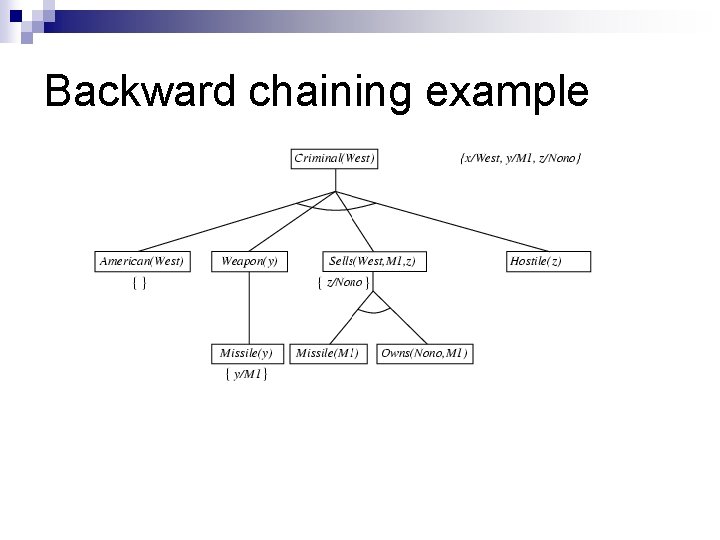
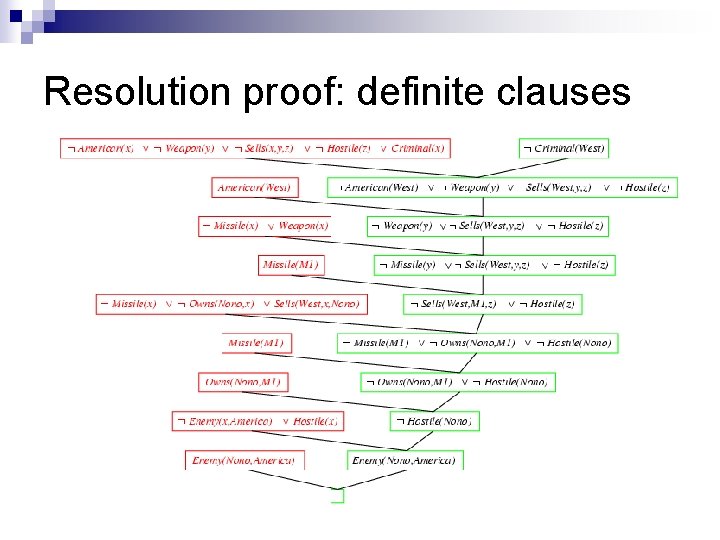
Example knowledge base contd. . it is a crime for an American to sell weapons to hostile nations: American(x) Weapon(y) Sells(x, y, z) Hostile(z) Criminal(x) Nono … has some missiles, i. e. , x Owns(Nono, x) Missile(x): Owns(Nono, M 1) and Missile(M 1) … all of its missiles were sold to it by Colonel West Missile(x) Owns(Nono, x) Sells(West, x, Nono) Missiles are weapons: Missile(x) Weapon(x) An enemy of America counts as "hostile“: Enemy(x, America) Hostile(x) West, who is American … American(West) The country Nono, an enemy of America … Enemy(Nono, America)
Forward chaining algorithm
Forward chaining proof
Forward chaining proof
Forward chaining proof
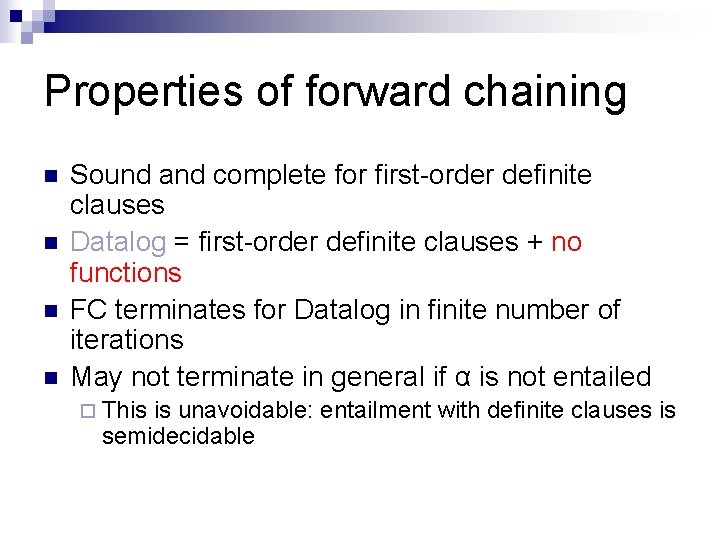
Properties of forward chaining n n Sound and complete for first-order definite clauses Datalog = first-order definite clauses + no functions FC terminates for Datalog in finite number of iterations May not terminate in general if α is not entailed ¨ This is unavoidable: entailment with definite clauses is semidecidable
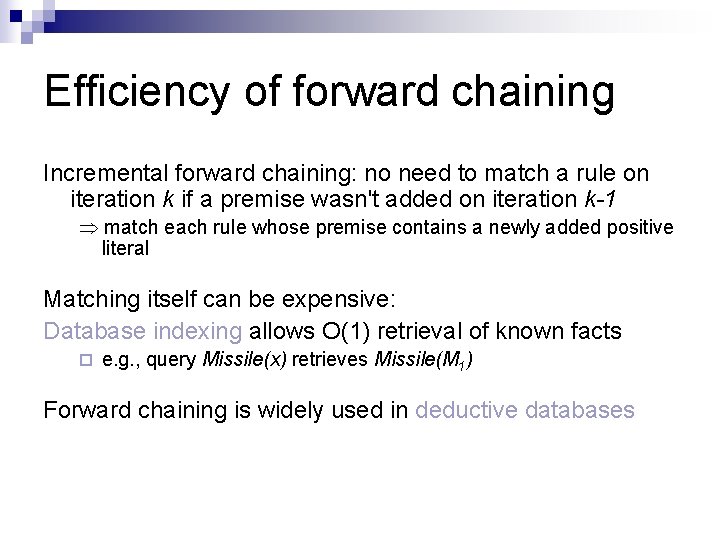
Efficiency of forward chaining Incremental forward chaining: no need to match a rule on iteration k if a premise wasn't added on iteration k-1 match each rule whose premise contains a newly added positive literal Matching itself can be expensive: Database indexing allows O(1) retrieval of known facts ¨ e. g. , query Missile(x) retrieves Missile(M 1) Forward chaining is widely used in deductive databases
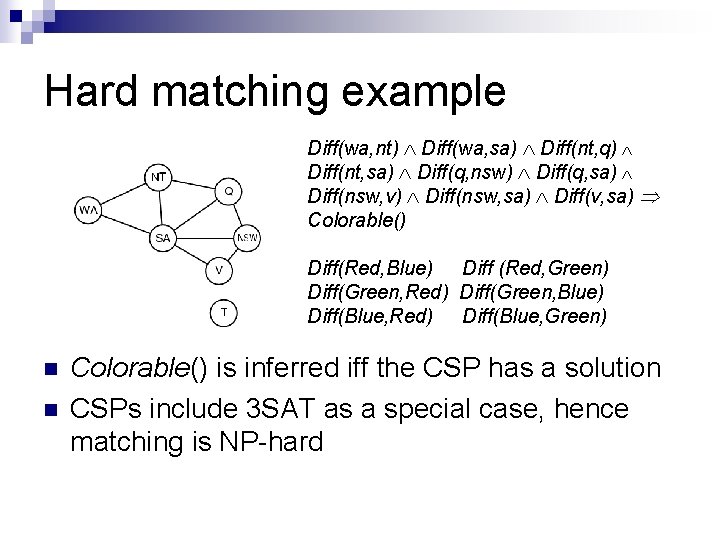
Hard matching example Diff(wa, nt) Diff(wa, sa) Diff(nt, q) Diff(nt, sa) Diff(q, nsw) Diff(q, sa) Diff(nsw, v) Diff(nsw, sa) Diff(v, sa) Colorable() Diff(Red, Blue) Diff (Red, Green) Diff(Green, Red) Diff(Green, Blue) Diff(Blue, Red) Diff(Blue, Green) n n Colorable() is inferred iff the CSP has a solution CSPs include 3 SAT as a special case, hence matching is NP-hard
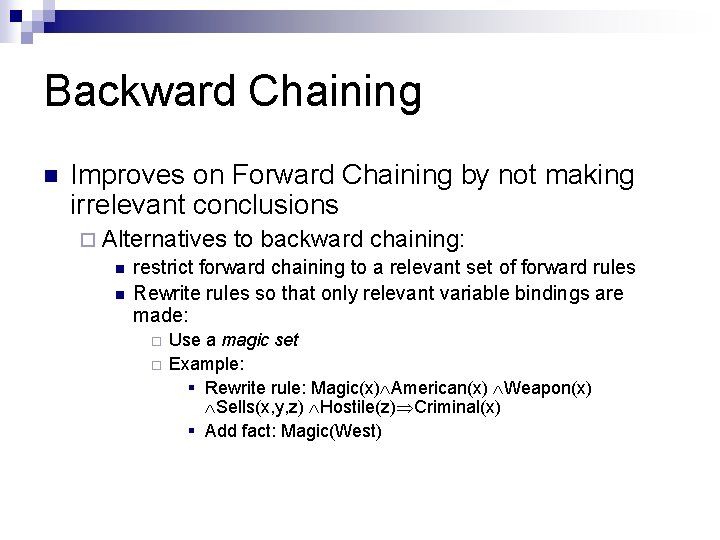
Backward Chaining n Improves on Forward Chaining by not making irrelevant conclusions ¨ Alternatives to backward chaining: n restrict forward chaining to a relevant set of forward rules n Rewrite rules so that only relevant variable bindings are made: ¨ ¨ Use a magic set Example: § Rewrite rule: Magic(x) American(x) Weapon(x) Sells(x, y, z) Hostile(z) Criminal(x) § Add fact: Magic(West)
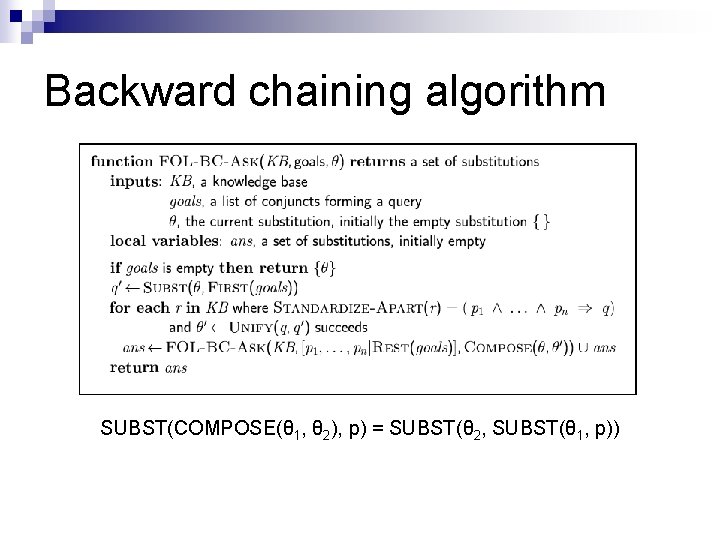
Backward Chaining n Idea: ¨ Given a query, find all substitutions that satisfy the query. ¨ Algorithm: Work on lists of goals, starting with original query n Algo finds every clause in the KB that unifies with the positive literal (head) and adds remainder (body) to list of goals n
Backward chaining algorithm SUBST(COMPOSE(θ 1, θ 2), p) = SUBST(θ 2, SUBST(θ 1, p))
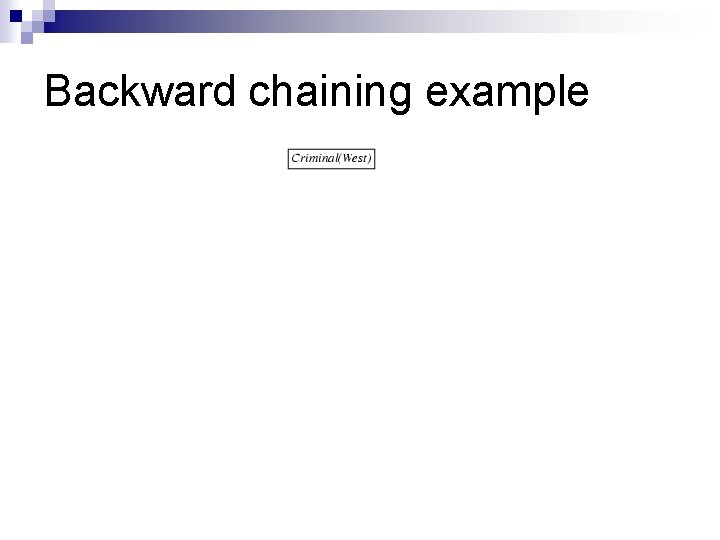
Backward chaining example
Backward chaining example
Backward chaining example
Backward chaining example
Backward chaining example
Backward chaining example
Backward chaining example
Backward chaining example
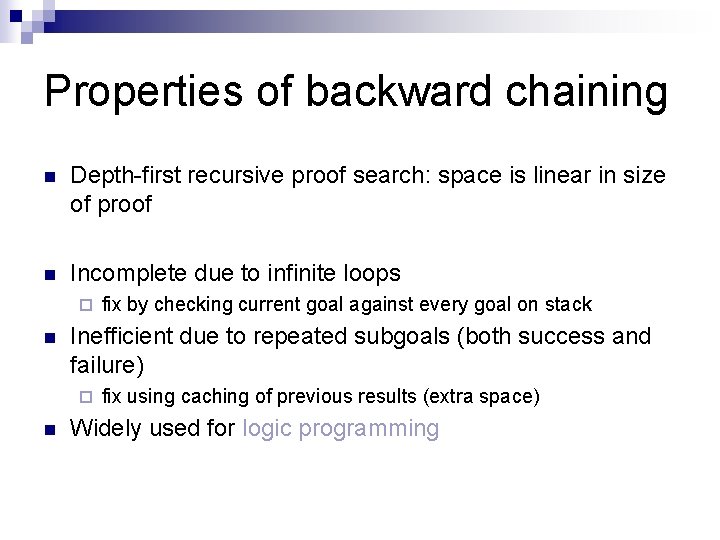
Properties of backward chaining n Depth-first recursive proof search: space is linear in size of proof n Incomplete due to infinite loops ¨ n Inefficient due to repeated subgoals (both success and failure) ¨ n fix by checking current goal against every goal on stack fix using caching of previous results (extra space) Widely used for logic programming
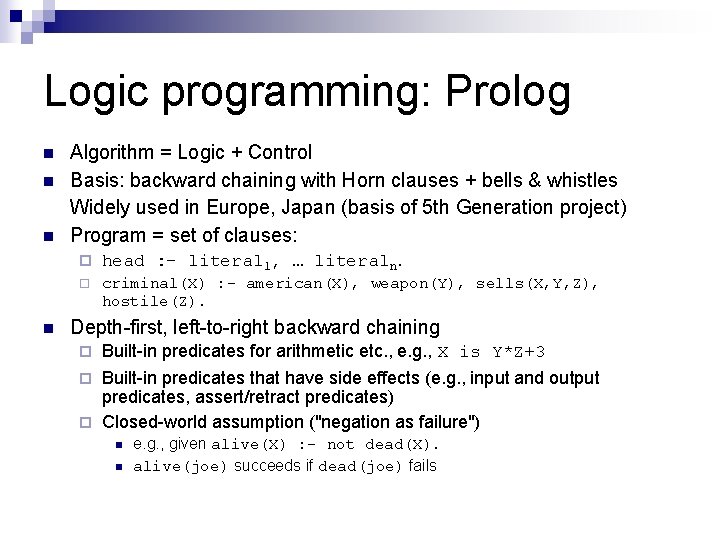
Logic programming: Prolog n n Algorithm = Logic + Control Basis: backward chaining with Horn clauses + bells & whistles Widely used in Europe, Japan (basis of 5 th Generation project) Program = set of clauses: ¨ head : - literal 1, … literaln. ¨ criminal(X) : - american(X), weapon(Y), sells(X, Y, Z), hostile(Z). Depth-first, left-to-right backward chaining Built-in predicates for arithmetic etc. , e. g. , X is Y*Z+3 ¨ Built-in predicates that have side effects (e. g. , input and output predicates, assert/retract predicates) ¨ Closed-world assumption ("negation as failure") ¨ n n e. g. , given alive(X) : - not dead(X). alive(joe) succeeds if dead(joe) fails
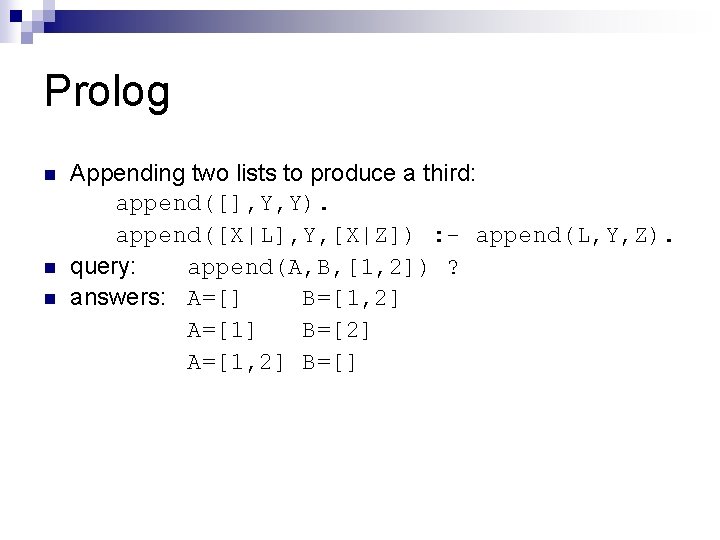
Prolog n n n Appending two lists to produce a third: append([], Y, Y). append([X|L], Y, [X|Z]) : - append(L, Y, Z). query: append(A, B, [1, 2]) ? answers: A=[] B=[1, 2] A=[1] B=[2] A=[1, 2] B=[]
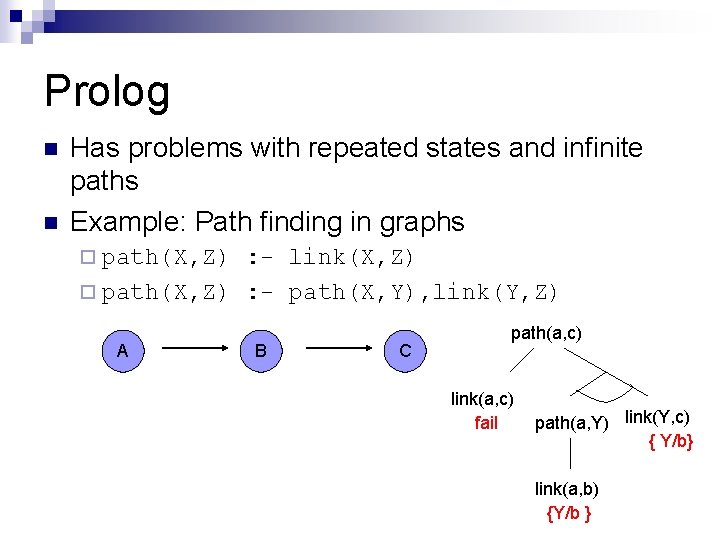
Prolog n n Has problems with repeated states and infinite paths Example: Path finding in graphs ¨ path(X, Z) : - link(X, Z) ¨ path(X, Z) : - path(X, Y), link(Y, Z) A B C path(a, c) link(a, c) fail path(a, Y) link(Y, c) { Y/b} link(a, b) {Y/b }
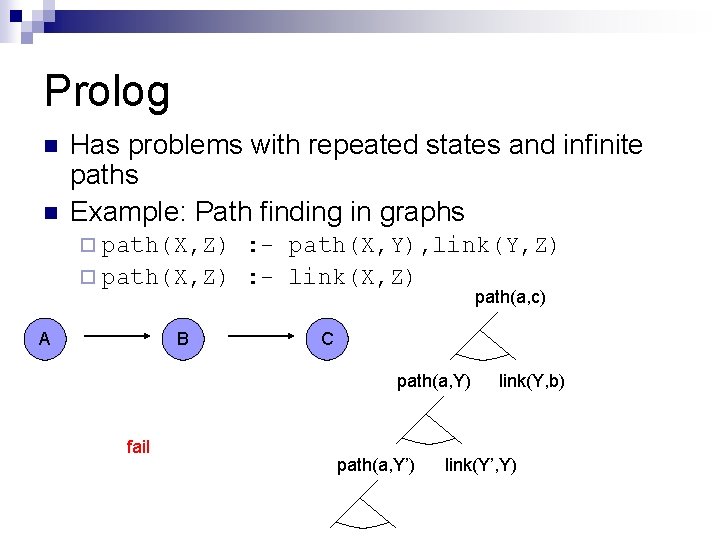
Prolog n n Has problems with repeated states and infinite paths Example: Path finding in graphs ¨ path(X, Z) : - path(X, Y), link(Y, Z) ¨ path(X, Z) : - link(X, Z) path(a, c) A B C path(a, Y) fail path(a, Y’) link(Y, b) link(Y’, Y)
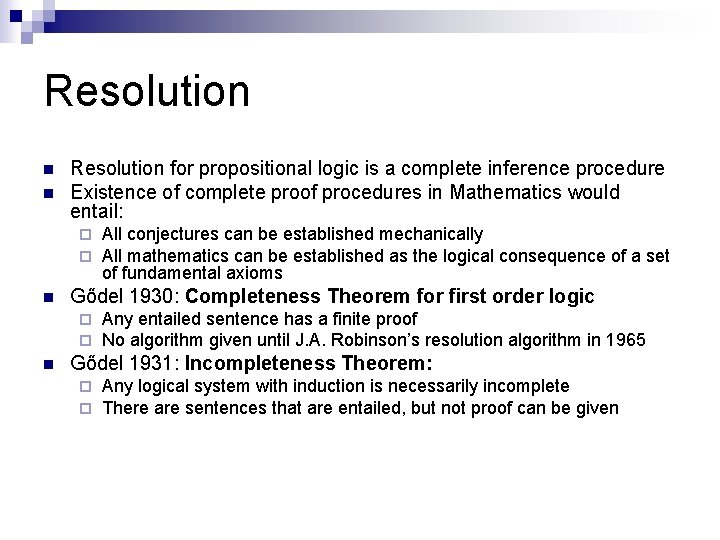
Resolution n n Resolution for propositional logic is a complete inference procedure Existence of complete proof procedures in Mathematics would entail: ¨ ¨ n Gődel 1930: Completeness Theorem for first order logic ¨ ¨ n All conjectures can be established mechanically All mathematics can be established as the logical consequence of a set of fundamental axioms Any entailed sentence has a finite proof No algorithm given until J. A. Robinson’s resolution algorithm in 1965 Gődel 1931: Incompleteness Theorem: ¨ ¨ Any logical system with induction is necessarily incomplete There are sentences that are entailed, but not proof can be given
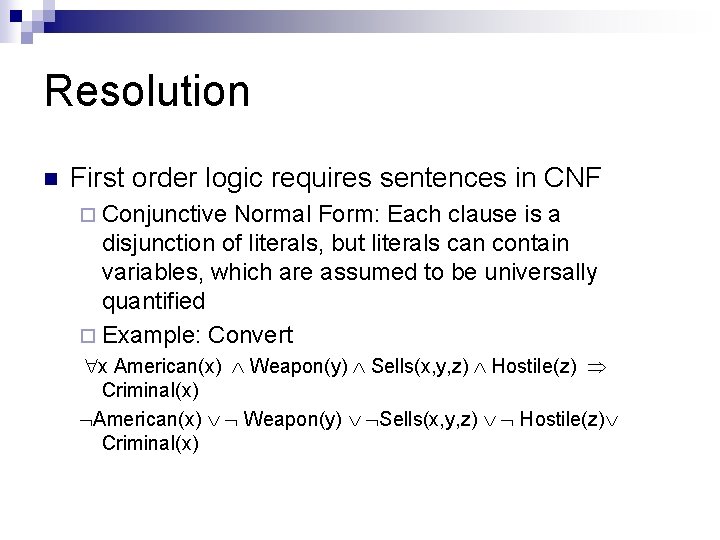
Resolution n First order logic requires sentences in CNF ¨ Conjunctive Normal Form: Each clause is a disjunction of literals, but literals can contain variables, which are assumed to be universally quantified ¨ Example: Convert x American(x) Weapon(y) Sells(x, y, z) Hostile(z) Criminal(x) American(x) Weapon(y) Sells(x, y, z) Hostile(z) Criminal(x)
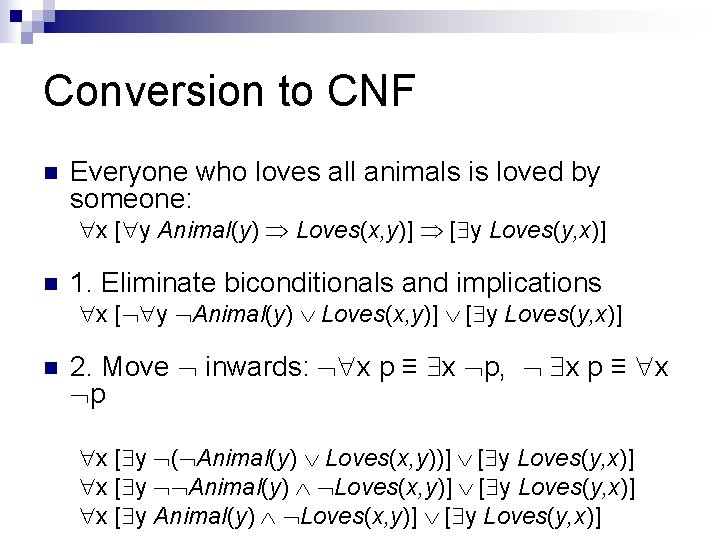
Conversion to CNF n Everyone who loves all animals is loved by someone: x [ y Animal(y) Loves(x, y)] [ y Loves(y, x)] n 1. Eliminate biconditionals and implications x [ y Animal(y) Loves(x, y)] [ y Loves(y, x)] n 2. Move inwards: x p ≡ x p, x p ≡ x p x [ y ( Animal(y) Loves(x, y))] [ y Loves(y, x)] x [ y Animal(y) Loves(x, y)] [ y Loves(y, x)] x [ y Animal(y) Loves(x, y)] [ y Loves(y, x)]
Conversion to CNF 3. Standardize variables: each quantifier should use a different one x [ y Animal(y) Loves(x, y)] [ z Loves(z, x)] 3. Skolemize: a more general form of existential instantiation. Each existential variable is replaced by a Skolem function of the enclosing universally quantified variables: x [Animal(F(x)) Loves(x, F(x))] Loves(G(x), x) 5. Drop universal quantifiers: [Animal(F(x)) Loves(x, F(x))] Loves(G(x), x) 6. Distribute over : [Animal(F(x)) Loves(G(x), x)] [ Loves(x, F(x)) Loves(G(x), x)]
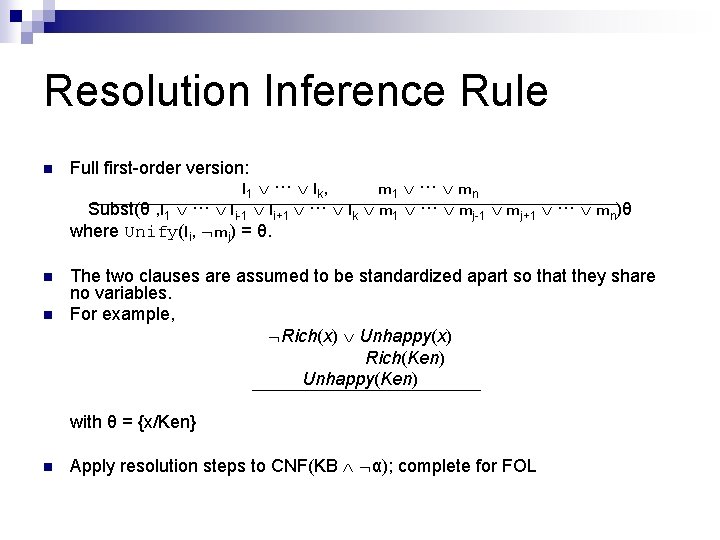
Resolution Inference Rule n Full first-order version: l 1 ··· lk, m 1 ··· mn Subst(θ , l 1 ··· li-1 li+1 ··· lk m 1 ··· mj-1 mj+1 ··· mn)θ where Unify(li, mj) = θ. n The two clauses are assumed to be standardized apart so that they share no variables. For example, Rich(x) Unhappy(x) Rich(Ken) Unhappy(Ken) n with θ = {x/Ken} n Apply resolution steps to CNF(KB α); complete for FOL
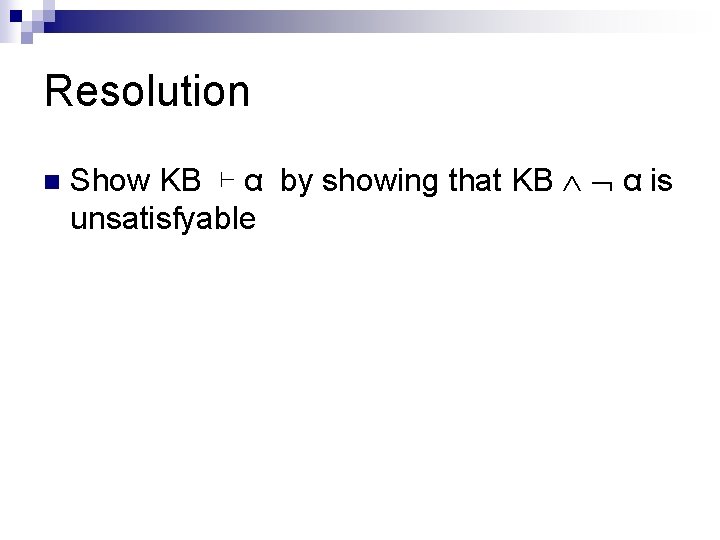
Resolution n Show KB ⊢ α by showing that KB α is unsatisfyable
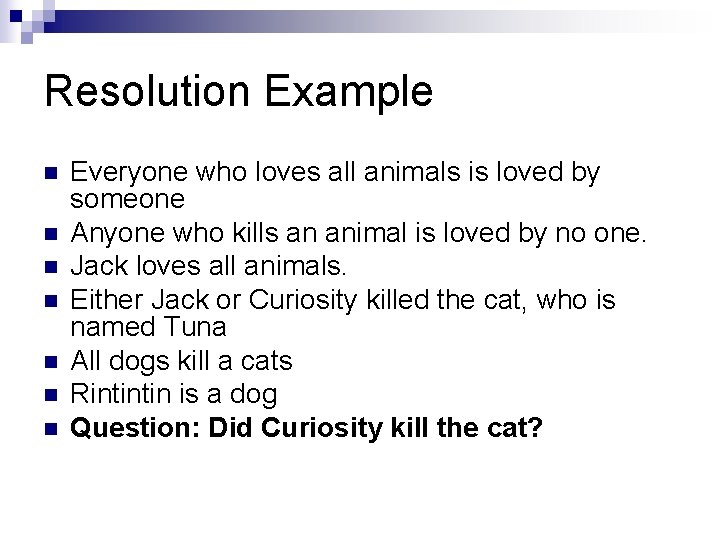
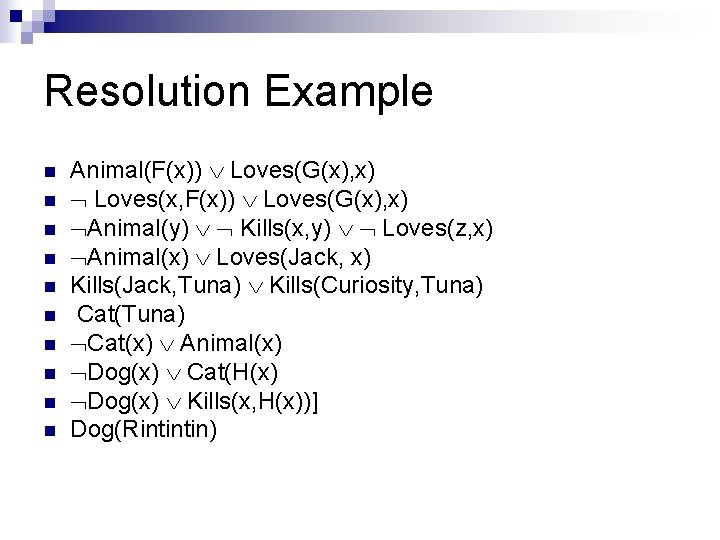
Resolution Example n n n n Everyone who loves all animals is loved by someone Anyone who kills an animal is loved by no one. Jack loves all animals. Either Jack or Curiosity killed the cat, who is named Tuna All dogs kill a cats Rintintin is a dog Question: Did Curiosity kill the cat?
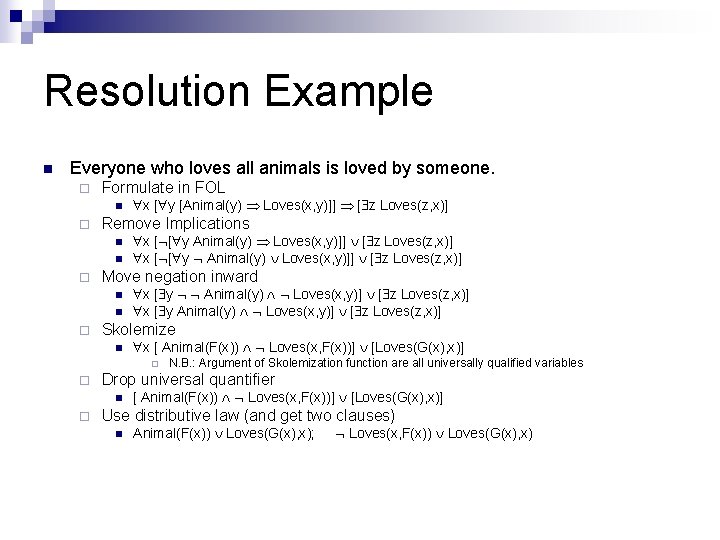
Resolution Example n Everyone who loves all animals is loved by someone. ¨ Formulate in FOL n ¨ Remove Implications n n ¨ x [ [ y Animal(y) Loves(x, y)]] [ z Loves(z, x)] x [ [ y Animal(y) Loves(x, y)]] [ z Loves(z, x)] Move negation inward n n ¨ x [ y [Animal(y) Loves(x, y)]] [ z Loves(z, x)] x [ y Animal(y) Loves(x, y)] [ z Loves(z, x)] Skolemize n x [ Animal(F(x)) Loves(x, F(x))] [Loves(G(x), x)] ¨ ¨ Drop universal quantifier n ¨ N. B. : Argument of Skolemization function are all universally qualified variables [ Animal(F(x)) Loves(x, F(x))] [Loves(G(x), x)] Use distributive law (and get two clauses) n Animal(F(x)) Loves(G(x), x); Loves(x, F(x)) Loves(G(x), x)
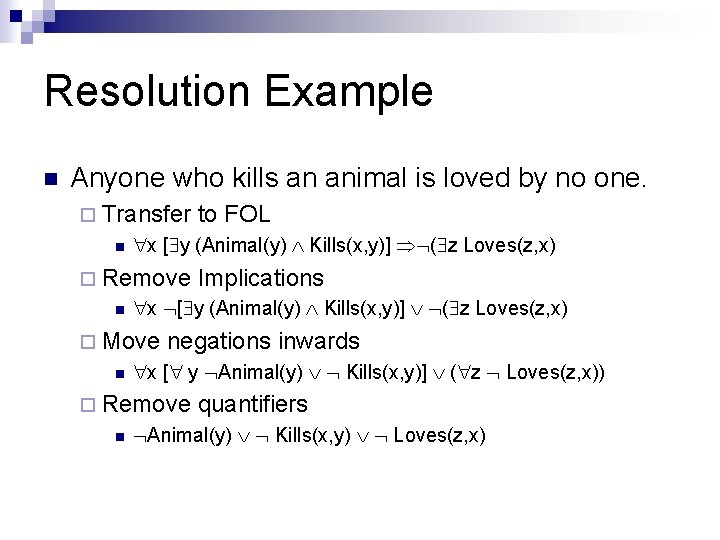
Resolution Example n Anyone who kills an animal is loved by no one. ¨ Transfer n x [ y (Animal(y) Kills(x, y)] ( z Loves(z, x) ¨ Remove n negations inwards x [ y Animal(y) Kills(x, y)] ( z Loves(z, x)) ¨ Remove n Implications x [ y (Animal(y) Kills(x, y)] ( z Loves(z, x) ¨ Move n to FOL quantifiers Animal(y) Kills(x, y) Loves(z, x)
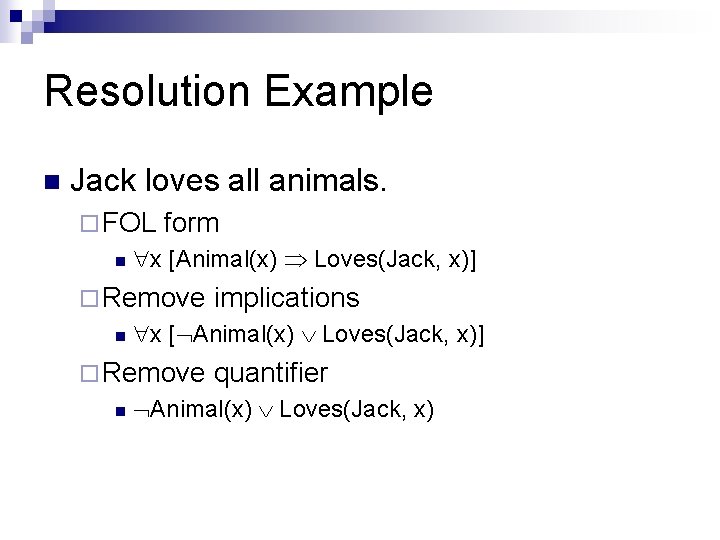
Resolution Example n Jack loves all animals. ¨ FOL n form x [Animal(x) Loves(Jack, x)] ¨ Remove n x [ Animal(x) Loves(Jack, x)] ¨ Remove n implications quantifier Animal(x) Loves(Jack, x)
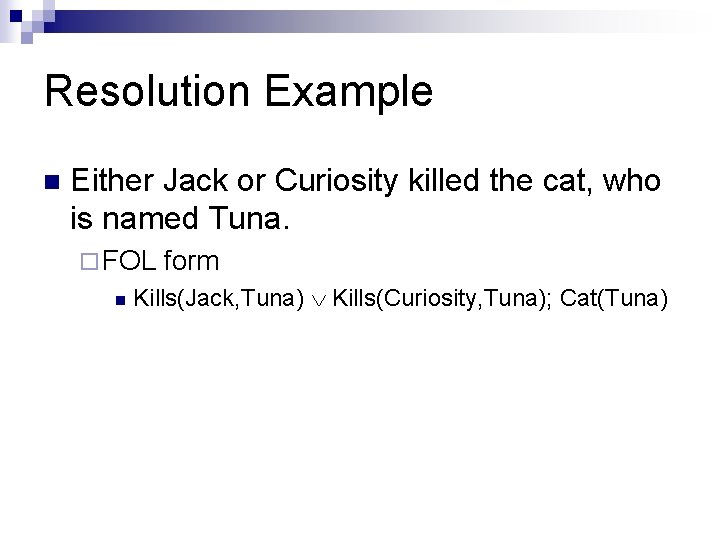
Resolution Example n Either Jack or Curiosity killed the cat, who is named Tuna. ¨ FOL n form Kills(Jack, Tuna) Kills(Curiosity, Tuna); Cat(Tuna)
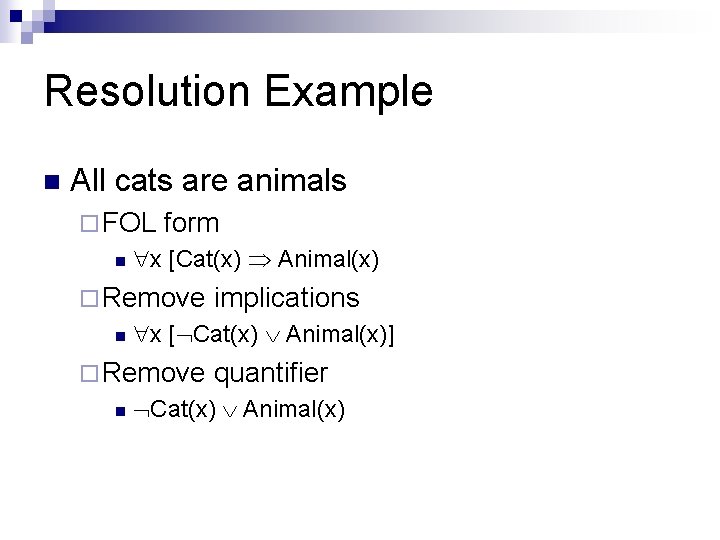
Resolution Example n All cats are animals ¨ FOL n form x [Cat(x) Animal(x) ¨ Remove n x [ Cat(x) Animal(x)] ¨ Remove n implications quantifier Cat(x) Animal(x)
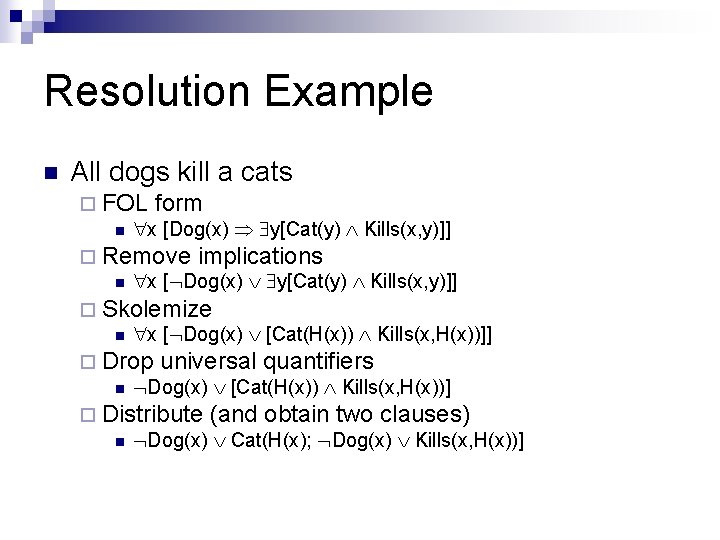
Resolution Example n All dogs kill a cats ¨ FOL form n x [Dog(x) y[Cat(y) Kills(x, y)]] ¨ Remove implications n x [ Dog(x) y[Cat(y) Kills(x, y)]] ¨ Skolemize n x [ Dog(x) [Cat(H(x)) Kills(x, H(x))]] ¨ Drop universal quantifiers n Dog(x) [Cat(H(x)) Kills(x, H(x))] ¨ Distribute (and obtain two clauses) n Dog(x) Cat(H(x); Dog(x) Kills(x, H(x))]
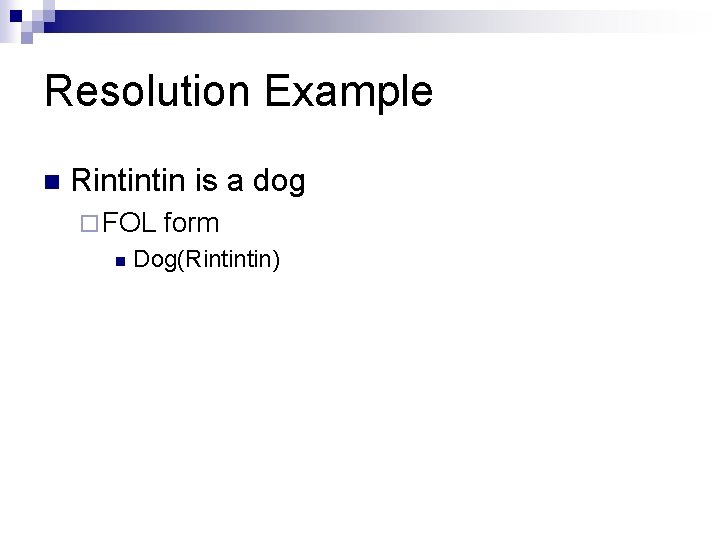
Resolution Example n Rintintin is a dog ¨ FOL n form Dog(Rintintin)
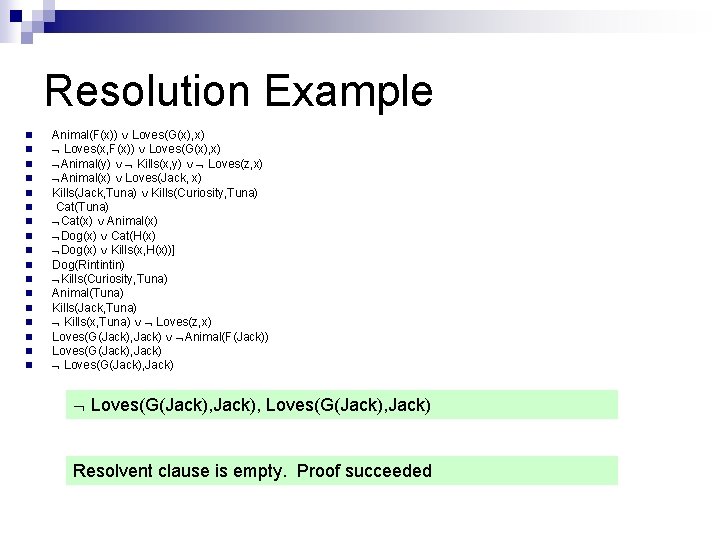
Resolution Example n n n n n Animal(F(x)) Loves(G(x), x) Loves(x, F(x)) Loves(G(x), x) Animal(y) Kills(x, y) Loves(z, x) Animal(x) Loves(Jack, x) Kills(Jack, Tuna) Kills(Curiosity, Tuna) Cat(x) Animal(x) Dog(x) Cat(H(x) Dog(x) Kills(x, H(x))] Dog(Rintintin)
Resolution Example n n n n n Animal(F(x)) Loves(G(x), x) Loves(x, F(x)) Loves(G(x), x) Animal(y) Kills(x, y) Loves(z, x) Animal(x) Loves(Jack, x) Kills(Jack, Tuna) Kills(Curiosity, Tuna) Cat(x) Animal(x) Dog(x) Cat(H(x) Dog(x) Kills(x, H(x))] Dog(Rintintin) Question: Did Curiosity kill the cat? Kills(Curiosity, Tuna)]
Resolution Example n n n Animal(F(x)) Loves(G(x), x) Loves(x, F(x)) Loves(G(x), x) Animal(y) Kills(x, y) Loves(z, x) Animal(x) Loves(Jack, x) Kills(Jack, Tuna) Kills(Curiosity, Tuna) Cat(x) Animal(x) Cat(Tuna) , Cat(x) Animal(x) Dog(x) Cat(H(x) Dog(x) Kills(x, H(x))] Unify(Cat(Tuna), Cat(x)) = { x/Tuna } Dog(Rintintin) First line thus resolves to: Kills(Curiosity, Tuna)] Animal(Tuna)
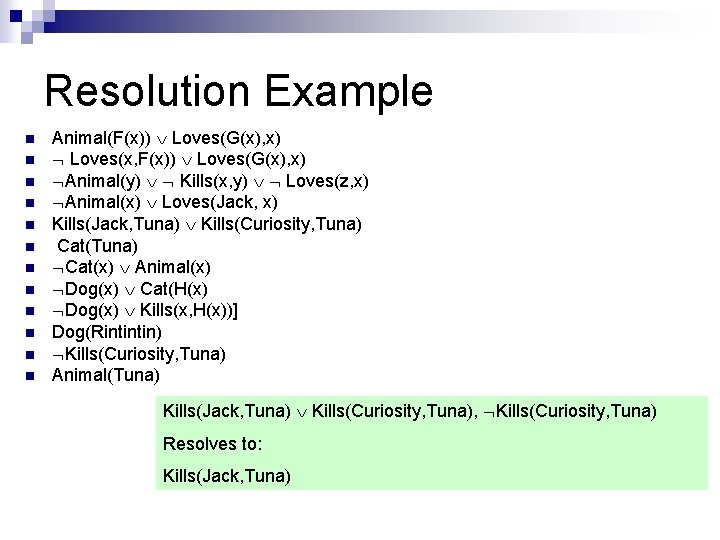
Resolution Example n n n Animal(F(x)) Loves(G(x), x) Loves(x, F(x)) Loves(G(x), x) Animal(y) Kills(x, y) Loves(z, x) Animal(x) Loves(Jack, x) Kills(Jack, Tuna) Kills(Curiosity, Tuna) Cat(x) Animal(x) Dog(x) Cat(H(x) Dog(x) Kills(x, H(x))] Dog(Rintintin) Kills(Curiosity, Tuna) Animal(Tuna) Kills(Jack, Tuna) Kills(Curiosity, Tuna), Kills(Curiosity, Tuna) Resolves to: Kills(Jack, Tuna)
Resolution Example n n n n Animal(F(x)) Loves(G(x), x) Loves(x, F(x)) Loves(G(x), x) Animal(y) Kills(x, y) Loves(z, x) Animal(x) Loves(Jack, x) Kills(Jack, Tuna) Kills(Curiosity, Tuna) Cat(x) Animal(x) Dog(x) Cat(H(x) Dog(x) Kills(x, H(x))] Dog(Rintintin) Kills(Curiosity, Tuna) Animal(Tuna) Kills(Jack, Tuna) Animal(y) Kills(x, y) Loves(z, x), Animal(Tuna) Unify(Animal(Tuna), Animal(y)) = {y/Tuna} Resolves to: Kills(x, Tuna) Loves(z, x),
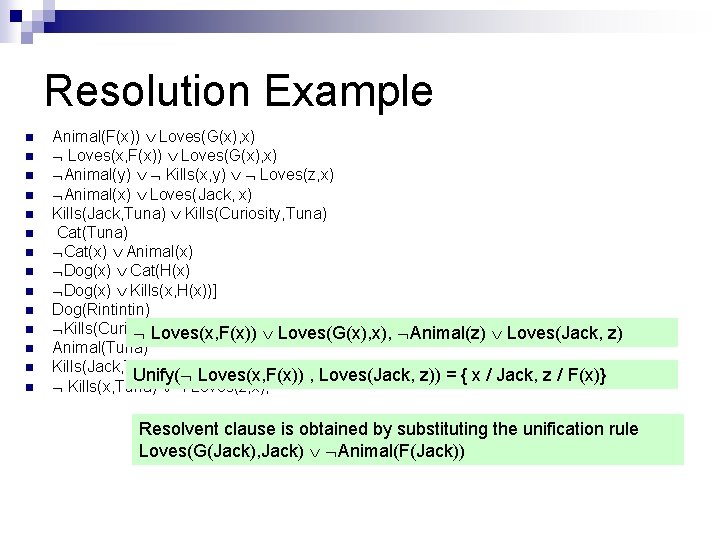
Resolution Example n n n n Animal(F(x)) Loves(G(x), x) Loves(x, F(x)) Loves(G(x), x) Animal(y) Kills(x, y) Loves(z, x) Animal(x) Loves(Jack, x) Kills(Jack, Tuna) Kills(Curiosity, Tuna) Cat(x) Animal(x) Dog(x) Cat(H(x) Dog(x) Kills(x, H(x))] Dog(Rintintin) Kills(Curiosity, Tuna) Loves(x, F(x)) Loves(G(x), Animal(z) Loves(Jack, z) Animal(Tuna) Kills(Jack, Tuna) Unify( Loves(x, F(x)) , Loves(Jack, z)) = { x / Jack, z / F(x)} Kills(x, Tuna) Loves(z, x), Resolvent clause is obtained by substituting the unification rule Loves(G(Jack), Jack) Animal(F(Jack))
Resolution Example n n n n Animal(F(x)) Loves(G(x), x) Loves(x, F(x)) Loves(G(x), x) Animal(y) Kills(x, y) Loves(z, x) Animal(x) Loves(Jack, x) Kills(Jack, Tuna) Kills(Curiosity, Tuna) Cat(x) Animal(x) Dog(x) Cat(H(x) Dog(x) Kills(x, H(x))] Dog(Rintintin) Kills(Curiosity, Tuna) Animal(Tuna) Kills(Jack, Tuna) Kills(x, Tuna) Loves(z, x) Loves(G(Jack), Jack) Animal(F(Jack)) Animal(F(x)) Loves(G(x), Loves(G(Jack), Jack) Animal(F(Jack)) Unify(Animal(F(x)) , Animal(F(Jack)))= { x / Jack} Resolvent clause is obtained by substituting the unification rule Loves(G(Jack), Jack)
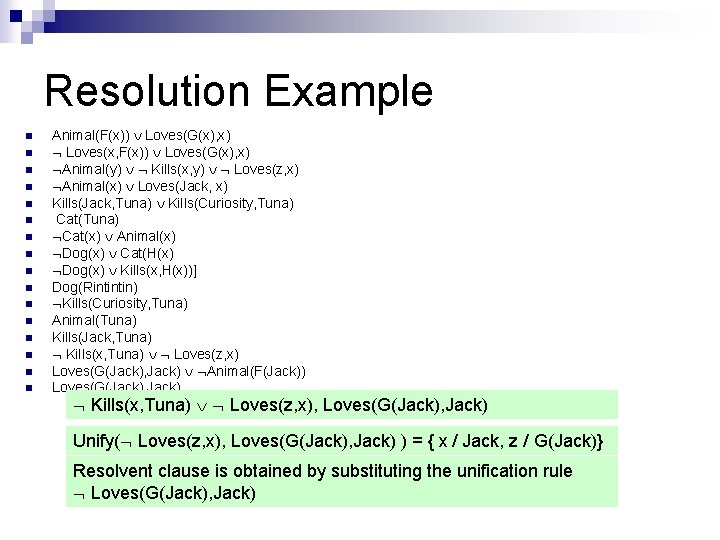
Resolution Example n n n n Animal(F(x)) Loves(G(x), x) Loves(x, F(x)) Loves(G(x), x) Animal(y) Kills(x, y) Loves(z, x) Animal(x) Loves(Jack, x) Kills(Jack, Tuna) Kills(Curiosity, Tuna) Cat(x) Animal(x) Dog(x) Cat(H(x) Dog(x) Kills(x, H(x))] Dog(Rintintin) Kills(Curiosity, Tuna) Animal(Tuna) Kills(Jack, Tuna) Kills(x, Tuna) Loves(z, x) Loves(G(Jack), Jack) Animal(F(Jack)) Loves(G(Jack), Jack) Kills(x, Tuna) Loves(z, x), Loves(G(Jack), Jack) Unify( Loves(z, x), Loves(G(Jack), Jack) ) = { x / Jack, z / G(Jack)} Resolvent clause is obtained by substituting the unification rule Loves(G(Jack), Jack)
Resolution Example n n n n n Animal(F(x)) Loves(G(x), x) Loves(x, F(x)) Loves(G(x), x) Animal(y) Kills(x, y) Loves(z, x) Animal(x) Loves(Jack, x) Kills(Jack, Tuna) Kills(Curiosity, Tuna) Cat(x) Animal(x) Dog(x) Cat(H(x) Dog(x) Kills(x, H(x))] Dog(Rintintin) Kills(Curiosity, Tuna) Animal(Tuna) Kills(Jack, Tuna) Kills(x, Tuna) Loves(z, x) Loves(G(Jack), Jack) Animal(F(Jack)) Loves(G(Jack), Jack) Loves(G(Jack), Jack) Resolvent clause is empty. Proof succeeded
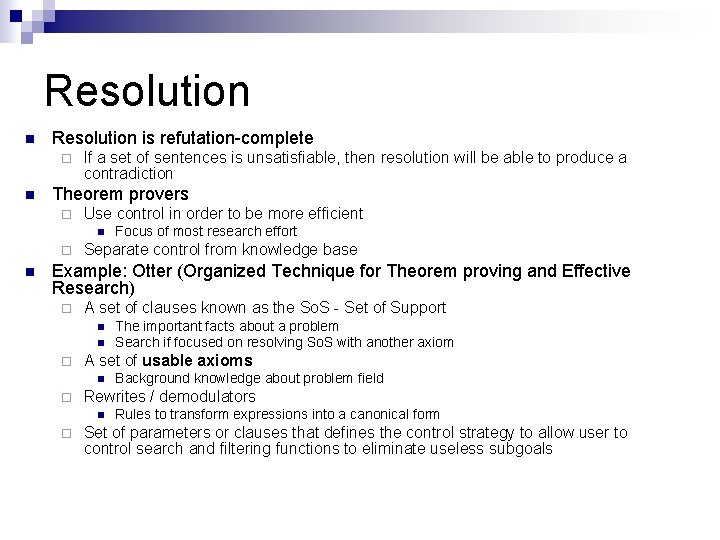
Resolution n Resolution is refutation-complete ¨ n If a set of sentences is unsatisfiable, then resolution will be able to produce a contradiction Theorem provers ¨ Use control in order to be more efficient n ¨ n Focus of most research effort Separate control from knowledge base Example: Otter (Organized Technique for Theorem proving and Effective Research) ¨ A set of clauses known as the So. S - Set of Support n n ¨ A set of usable axioms n ¨ Background knowledge about problem field Rewrites / demodulators n ¨ The important facts about a problem Search if focused on resolving So. S with another axiom Rules to transform expressions into a canonical form Set of parameters or clauses that defines the control strategy to allow user to control search and filtering functions to eliminate useless subgoals
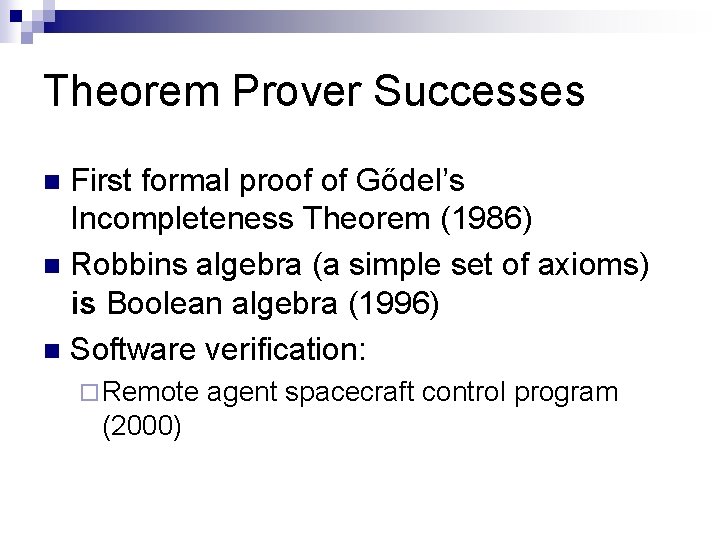
Theorem Prover Successes First formal proof of Gődel’s Incompleteness Theorem (1986) n Robbins algebra (a simple set of axioms) is Boolean algebra (1996) n Software verification: n ¨ Remote (2000) agent spacecraft control program
Resolution proof: definite clauses