
Inference for proportions Comparing 2 proportions IPS chapter
- Slides: 9
Inference for proportions - Comparing 2 proportions IPS chapter 8. 2 © 2006 W. H. Freeman and Company
Objectives (IPS chapter 8. 2) Comparing two proportions p Comparing proportions in two independent samples p Large-sample CI for two proportions p “Plus four” CI for two proportions p Test of statistical significance p Relative risk
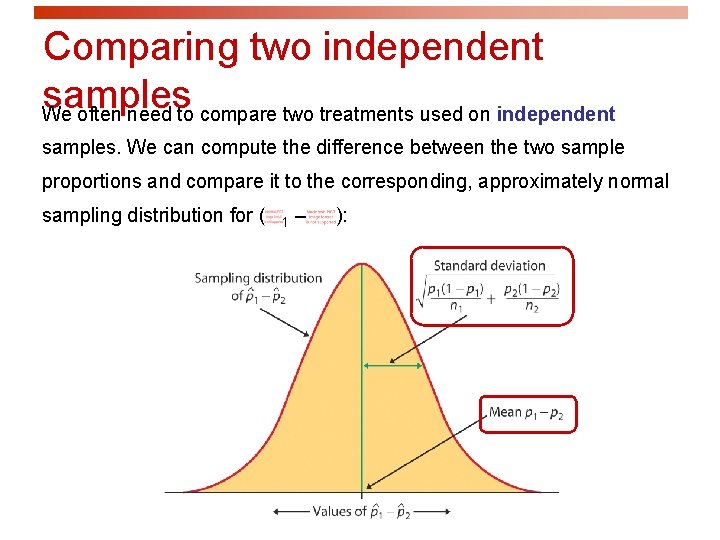
Comparing two independent samples We often need to compare two treatments used on independent samples. We can compute the difference between the two sample proportions and compare it to the corresponding, approximately normal sampling distribution for ( 1 – 2):
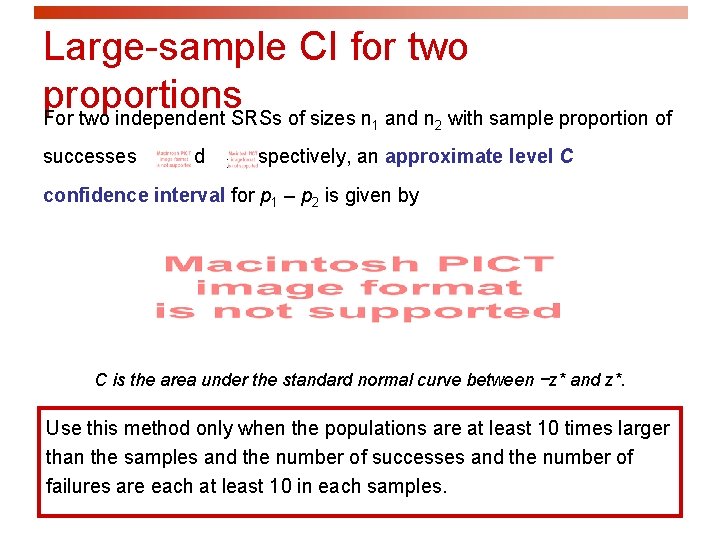
Large-sample CI for two proportions For two independent SRSs of sizes n and n with sample proportion of 1 successes 1 and 2 2 respectively, an approximate level C confidence interval for p 1 – p 2 is given by C is the area under the standard normal curve between −z* and z*. Use this method only when the populations are at least 10 times larger than the samples and the number of successes and the number of failures are each at least 10 in each samples.
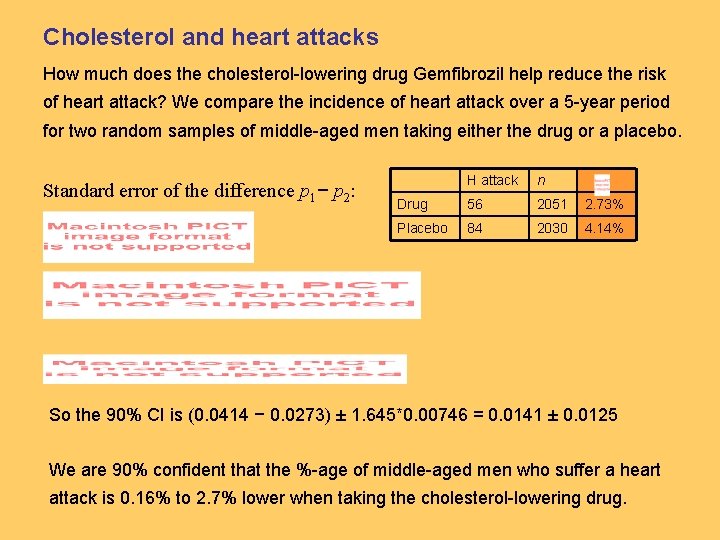
Cholesterol and heart attacks How much does the cholesterol-lowering drug Gemfibrozil help reduce the risk of heart attack? We compare the incidence of heart attack over a 5 -year period for two random samples of middle-aged men taking either the drug or a placebo. Standard error of the difference p 1− p 2: H attack n Drug 56 2051 2. 73% Placebo 84 2030 4. 14% So the 90% CI is (0. 0414 − 0. 0273) ± 1. 645*0. 00746 = 0. 0141 ± 0. 0125 We are 90% confident that the %-age of middle-aged men who suffer a heart attack is 0. 16% to 2. 7% lower when taking the cholesterol-lowering drug.
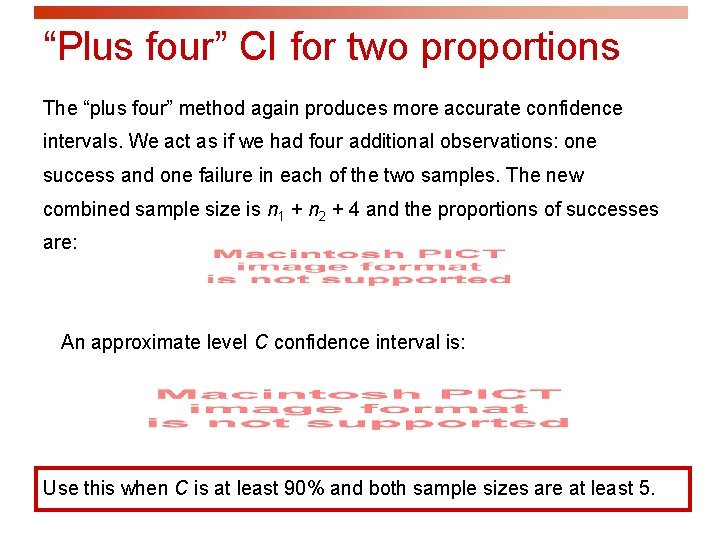
“Plus four” CI for two proportions The “plus four” method again produces more accurate confidence intervals. We act as if we had four additional observations: one success and one failure in each of the two samples. The new combined sample size is n 1 + n 2 + 4 and the proportions of successes are: An approximate level C confidence interval is: Use this when C is at least 90% and both sample sizes are at least 5.
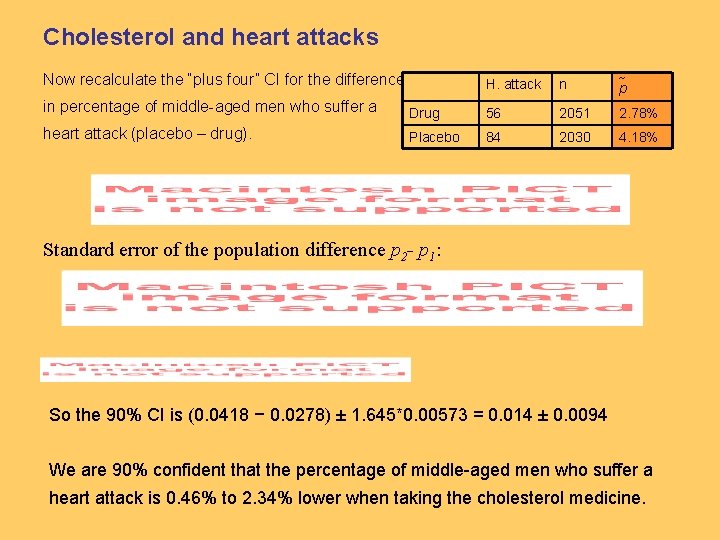
Cholesterol and heart attacks Now recalculate the “plus four” CI for the difference H. attack n p in percentage of middle-aged men who suffer a Drug 56 2051 2. 78% heart attack (placebo – drug). Placebo 84 2030 4. 18% Standard error of the population difference p 2 - p 1: So the 90% CI is (0. 0418 − 0. 0278) ± 1. 645*0. 00573 = 0. 014 ± 0. 0094 We are 90% confident that the percentage of middle-aged men who suffer a heart attack is 0. 46% to 2. 34% lower when taking the cholesterol medicine.
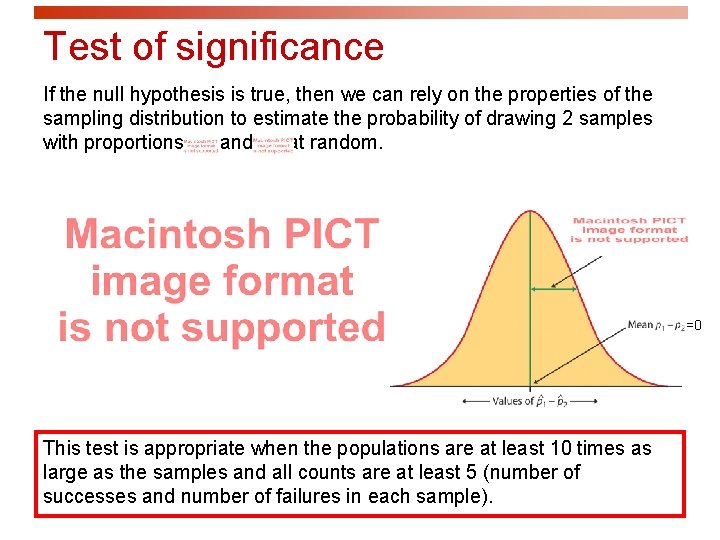
Test of significance If the null hypothesis is true, then we can rely on the properties of the sampling distribution to estimate the probability of drawing 2 samples with proportions 1 and 2 at random. =0 This test is appropriate when the populations are at least 10 times as large as the samples and all counts are at least 5 (number of successes and number of failures in each sample).
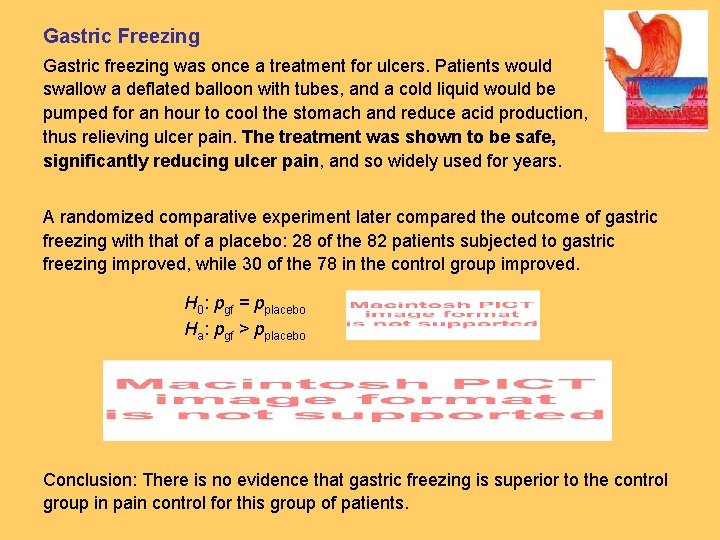
Gastric Freezing Gastric freezing was once a treatment for ulcers. Patients would swallow a deflated balloon with tubes, and a cold liquid would be pumped for an hour to cool the stomach and reduce acid production, thus relieving ulcer pain. The treatment was shown to be safe, significantly reducing ulcer pain, and so widely used for years. A randomized comparative experiment later compared the outcome of gastric freezing with that of a placebo: 28 of the 82 patients subjected to gastric freezing improved, while 30 of the 78 in the control group improved. H 0: pgf = pplacebo Ha: pgf > pplacebo Conclusion: There is no evidence that gastric freezing is superior to the control group in pain control for this group of patients.