
Inference for Chi Square Twoway Tables Chapter 11
Inference for Chi Square Two-way Tables Chapter 11 Section 2
13. 2 Two-Way Tables • There are two types: the Test of Homogeneity, and Test of Independence • Also called Contingency Tables • allows you to do multiple comparisons of proportions • This test is conducted when comparing categorical data and responses are counts of yes or no, success or failure, A, B, C, or D. Etc.
Test of Homogeneity – compares distributions of a single categorical variable across 2 or more populations Or two or more treatments. For example: The distribution of colors of Plain M&Ms to the distribution of colors of Peanut M&Ms to the distribution of Caramel M&Ms etc. State Ho and Ha as such Ho: There is no difference in the distribution of colors between M&M Plain, Peanut or Caramel. Ha: There is a difference in the distribution of colors of M&M Plain, Peanut and Caramel.
Test of Independence Tests of Independence – compares 2 categorical variables to see if there is an association or relationship between them. For example: Is there a association between the level of education of a person and the type of car they drive? State the null and alternative hypotheses as such: Ho: There is no association between level of education of an Individual and the type of car they drive. Ha: There is an association between the level of education of an Individual and the type of car they drive.
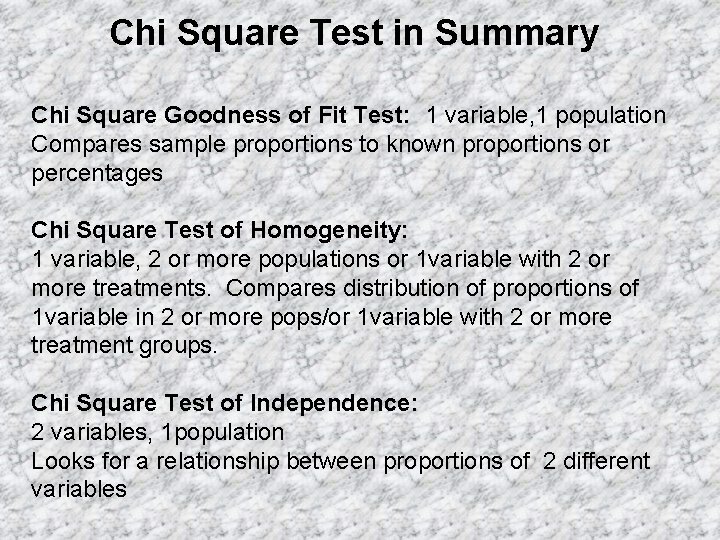
Chi Square Test in Summary Chi Square Goodness of Fit Test: 1 variable, 1 population Compares sample proportions to known proportions or percentages Chi Square Test of Homogeneity: 1 variable, 2 or more populations or 1 variable with 2 or more treatments. Compares distribution of proportions of 1 variable in 2 or more pops/or 1 variable with 2 or more treatment groups. Chi Square Test of Independence: 2 variables, 1 population Looks for a relationship between proportions of 2 different variables

Chi Square distributions are all right skewed and their actual shape depends on their degrees of freedom = (rows-1)(columns -1) Again the larger the number of categories, the closer the distribution comes to being normal. FYI: the mean of a chi square distribution is equal to its degrees of freedom and If df > 2 then the mode of the chi square distribution is (df - 2)
• Use Chi Square Two-way statistics to evaluate if proportions are equal, similar as for Goodness of Fit test – which compares your observed values to some standard values. • Done almost the same as goodness of fit. • Chi Square values and P- values are still interpreted the same way.
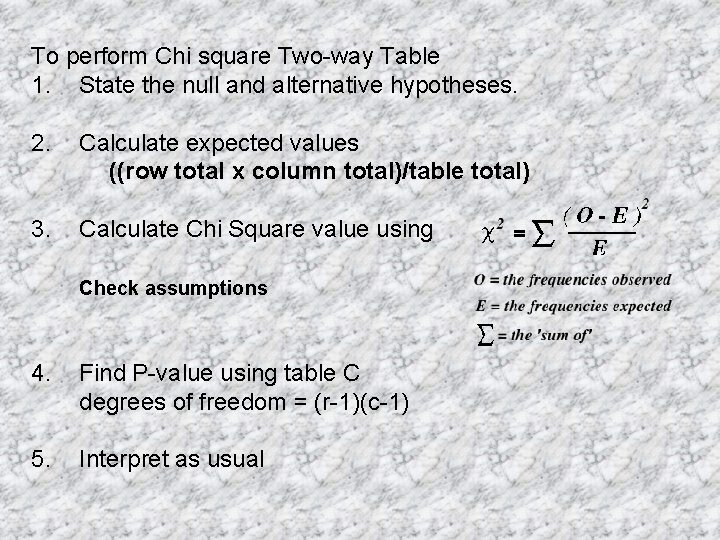
To perform Chi square Two-way Table 1. State the null and alternative hypotheses. 2. Calculate expected values ((row total x column total)/table total) 3. Calculate Chi Square value using Check assumptions 4. Find P-value using table C degrees of freedom = (r-1)(c-1) 5. Interpret as usual
• Remember, these observations only show association not causation. – Only a comparative experiment can show probable cause. – Remember your assumptions: same as goodness of fit test – Random Samples – All expected counts are at least 5 – n ≤ (1/10)N Homework: page 753 -754 probs. 27, 29, 31, 33 & 35
- Slides: 9