
Inference and Deanonymization Attacks against Genomic Privacy ETH
![Privacy Metrics Adversary’s incorrectness [3] Adversary’s uncertainty [4] Mutual information-based metric [5] [3] R.](https://slidetodoc.com/presentation_image/3d4057cde07522b70ec54d639c8eda0d/image-14.jpg "Privacy Metrics Adversary’s incorrectness [3] Adversary’s uncertainty [4] Mutual information-based metric [5] [3] R.")
- Slides: 35
Inference and De-anonymization Attacks against Genomic Privacy ETH Zürich October 1, 2015 Mathias Humbert Joint work with Erman Ayday, Jean-Pierre Hubaux, Kévin Huguenin, Joachim Hugonot, Amalio Telenti
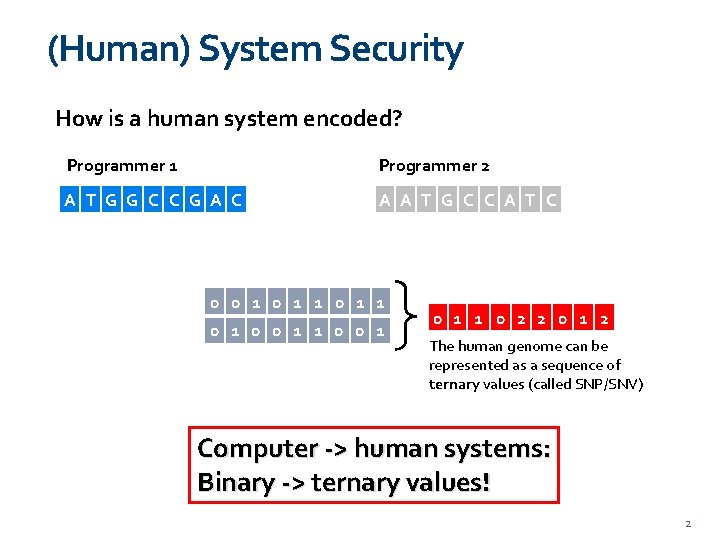
(Human) System Security How is a human system encoded? Programmer 1 Programmer 2 A 0 T 1 G 0 C 1 G 0 A 0 C 1 A 0 T 1 G 0 C 1 A 0 T 1 C 1 0 0 1 1 0 0 1 1 0 2 2 0 1 2 The human genome can be represented as a sequence of ternary values (called SNP/SNV) Computer -> human systems: Binary -> ternary values! 2
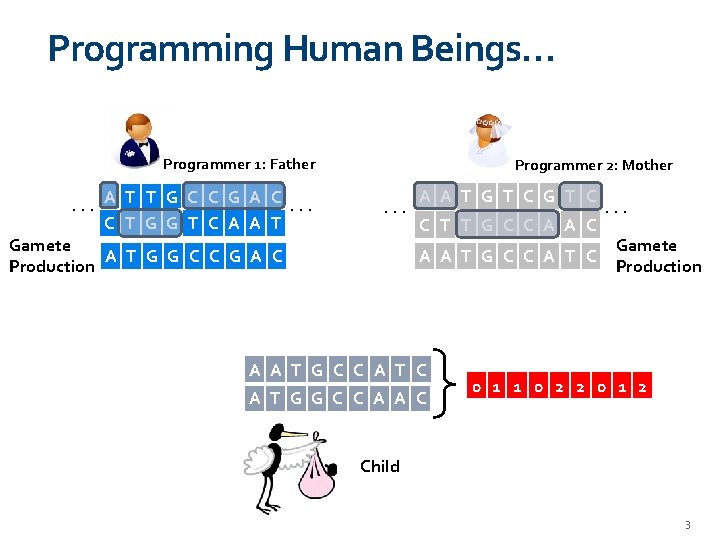
Programming Human Beings… Programmer 1: Father . . . A T T G C C G A C. . . C T G G T C A A T Programmer 2: Mother . . . Gamete A T G G C C G A C Production A A T G T C C T T G C C A A T G C C A T G G C C A A C . . . Gamete Production 0 1 1 0 2 2 0 1 2 Child 3
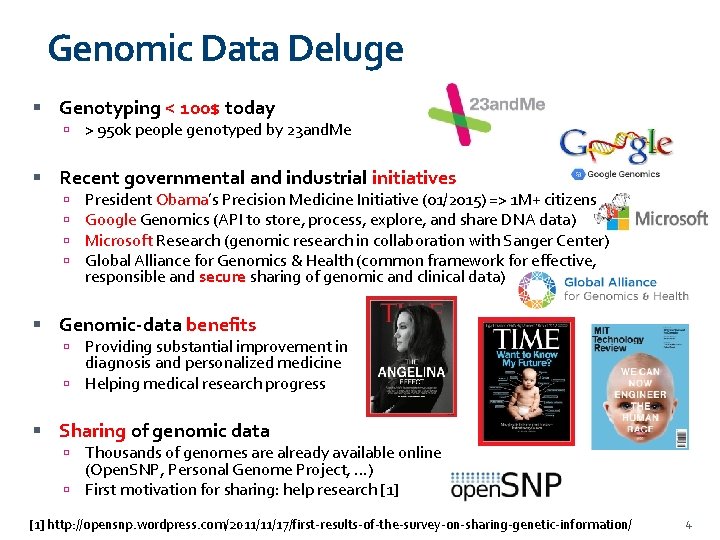
Genomic Data Deluge Genotyping < 100$ today > 950 k people genotyped by 23 and. Me Recent governmental and industrial initiatives President Obama’s Precision Medicine Initiative (01/2015) => 1 M+ citizens Google Genomics (API to store, process, explore, and share DNA data) Microsoft Research (genomic research in collaboration with Sanger Center) Global Alliance for Genomics & Health (common framework for effective, responsible and secure sharing of genomic and clinical data) Genomic-data benefits Providing substantial improvement in diagnosis and personalized medicine Helping medical research progress Sharing of genomic data Thousands of genomes are already available online (Open. SNP, Personal Genome Project, …) First motivation for sharing: help research [1] http: //opensnp. wordpress. com/2011/11/17/first-results-of-the-survey-on-sharing-genetic-information/ 4
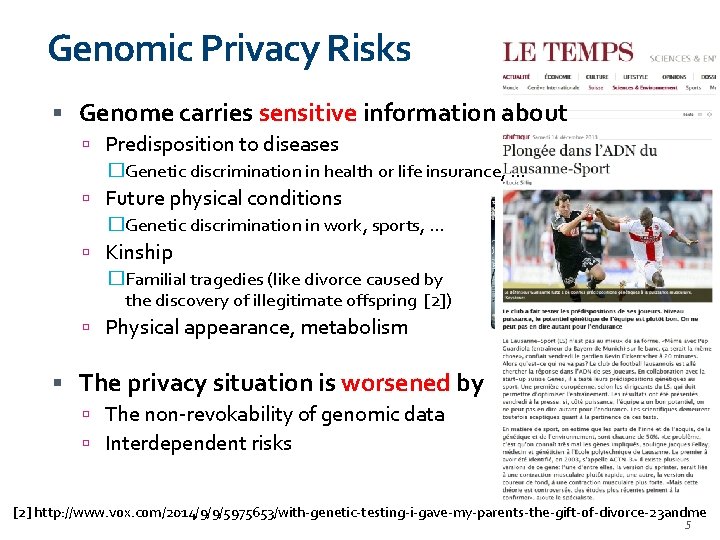
Genomic Privacy Risks Genome carries sensitive information about Predisposition to diseases �Genetic discrimination in health or life insurance, … Future physical conditions �Genetic discrimination in work, sports, . . . Kinship �Familial tragedies (like divorce caused by the discovery of illegitimate offspring [2]) Physical appearance, metabolism The privacy situation is worsened by The non-revokability of genomic data Interdependent risks [2] http: //www. vox. com/2014/9/9/5975653/with-genetic-testing-i-gave-my-parents-the-gift-of-divorce-23 andme 5
Outline Statistical inference Kin genomic privacy �M. Humbert, E. Ayday, J. -P. Hubaux, A. Telenti. Addressing the Concerns of the Lacks Family: Quantification of Kin Genomic Privacy. CCS 2013 De-anonymization Of genomic databases with phenotypic traits ? ? ? �M. Humbert, K. Huguenin, J. Hugonot, E. Ayday, J. -P. Hubaux. De-anonymizing Genomic Databases with Phenotypic Traits. PETS 2015 01/11/2020 6
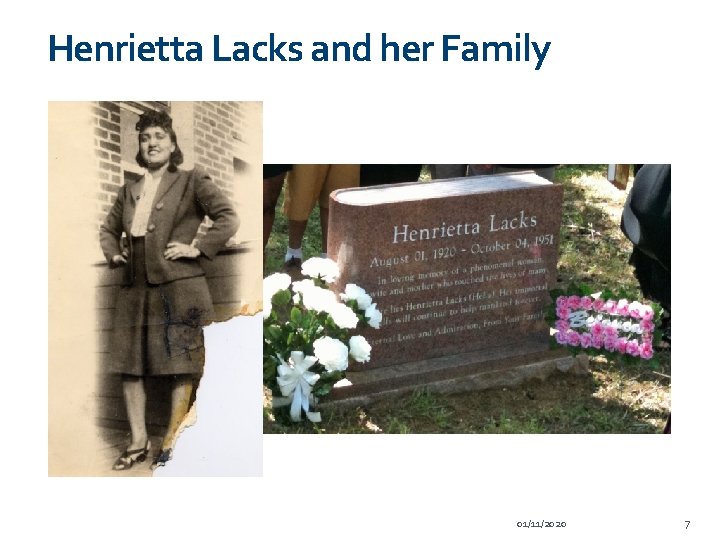
Henrietta Lacks and her Family 01/11/2020 7
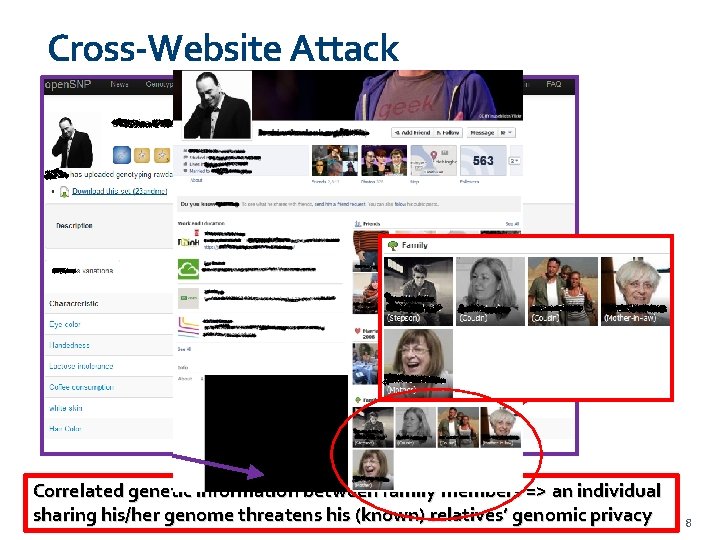
Cross-Website Attack Correlated genetic information between family members => an individual sharing his/her genome threatens his (known) relatives’ genomic privacy 8
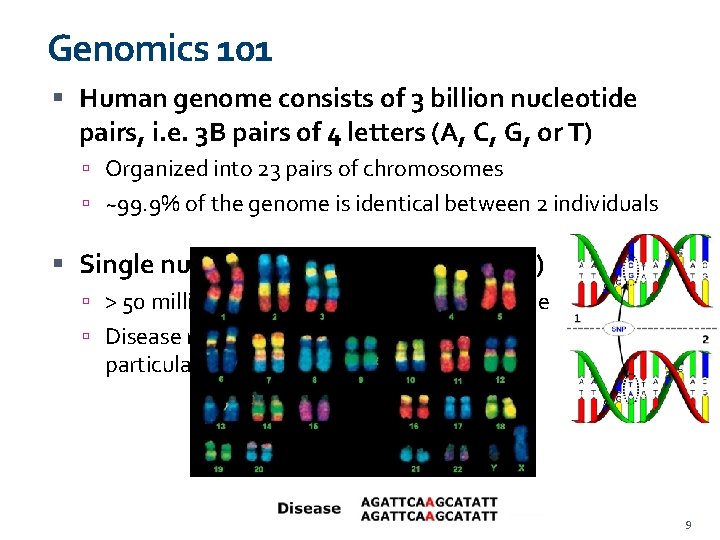
Genomics 101 Human genome consists of 3 billion nucleotide pairs, i. e. 3 B pairs of 4 letters (A, C, G, or T) Organized into 23 pairs of chromosomes ~99. 9% of the genome is identical between 2 individuals Single nucleotide polymorphism (SNP) > 50 million SNP positions in human genome Disease risk can be computed by analyzing particular SNPs 9
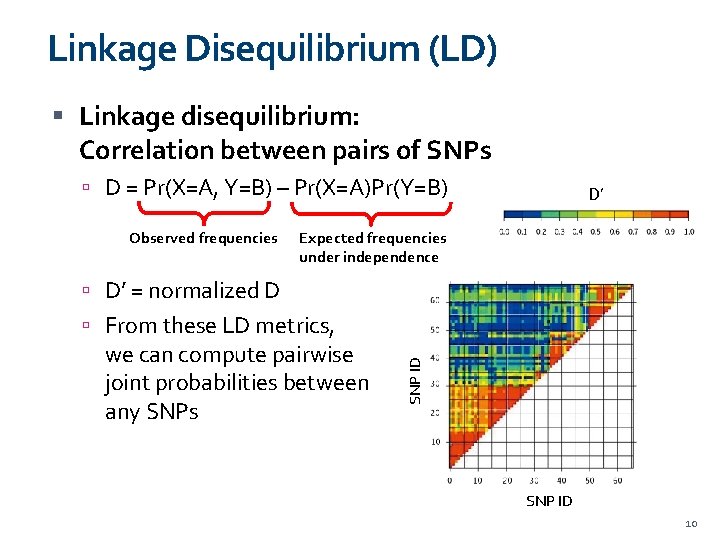
Linkage Disequilibrium (LD) Linkage disequilibrium: Correlation between pairs of SNPs D = Pr(X=A, Y=B) – Pr(X=A)Pr(Y=B) Observed frequencies D’ Expected frequencies under independence D’ = normalized D we can compute pairwise joint probabilities between any SNPs SNP ID From these LD metrics, SNP ID 10
Quantifying Kin Genomic Privacy Quantifying privacy risks With respect to the amount of genomic data that is revealed, and the relative(s) revealing it Considering the background knowledge of the adversary (familial relationships, LD values, minor allele frequencies) Designing efficient inference algorithms that mimic reconstruction attacks given background knowledge In order to propose protection mechanisms to reduce the inherent genomic-privacy risk 11
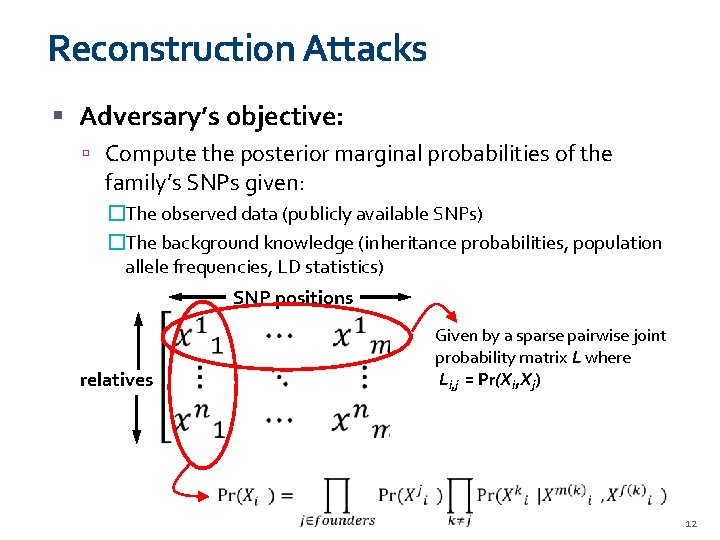
Reconstruction Attacks Adversary’s objective: Compute the posterior marginal probabilities of the family’s SNPs given: �The observed data (publicly available SNPs) �The background knowledge (inheritance probabilities, population allele frequencies, LD statistics) SNP positions Given by a sparse pairwise joint probability matrix L where Li, j = Pr(Xi, Xj) relatives 12
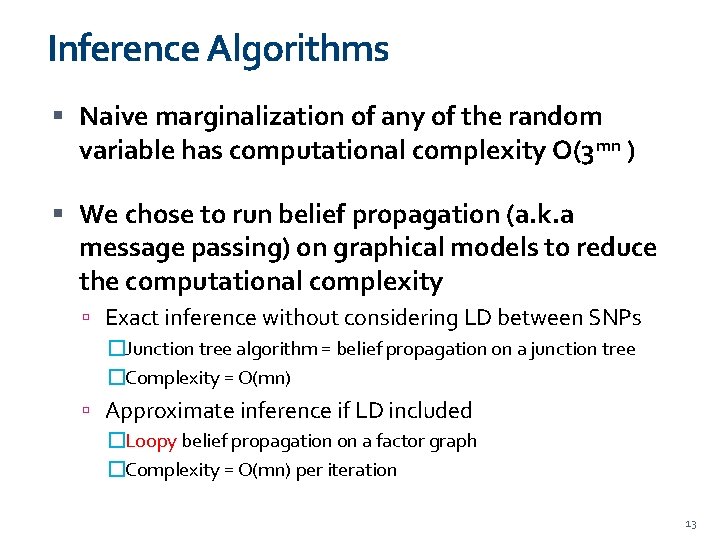
Inference Algorithms Naive marginalization of any of the random variable has computational complexity O(3 mn ) We chose to run belief propagation (a. k. a message passing) on graphical models to reduce the computational complexity Exact inference without considering LD between SNPs �Junction tree algorithm = belief propagation on a junction tree �Complexity = O(mn) Approximate inference if LD included �Loopy belief propagation on a factor graph �Complexity = O(mn) per iteration 13
Privacy Metrics Adversary’s incorrectness [3] Adversary’s uncertainty [4] Mutual information-based metric [5] [3] R. Shokri et al. , Quantifying location privacy, S&P 2011 [4] A. Serjantov, G. Danezis, Towards an information theoretic metric for anonymity, PET 2003 [5] D. Agrawal, C. C. Aggarwal, On the design and quantification of privacy preserving data mining algorithms, PODS 2001 14
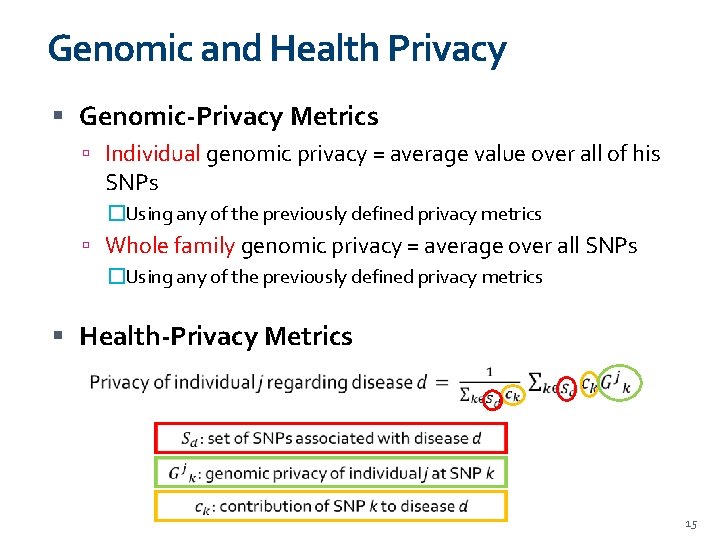
Genomic and Health Privacy Genomic-Privacy Metrics Individual genomic privacy = average value over all of his SNPs �Using any of the previously defined privacy metrics Whole family genomic privacy = average over all SNPs �Using any of the previously defined privacy metrics Health-Privacy Metrics 15
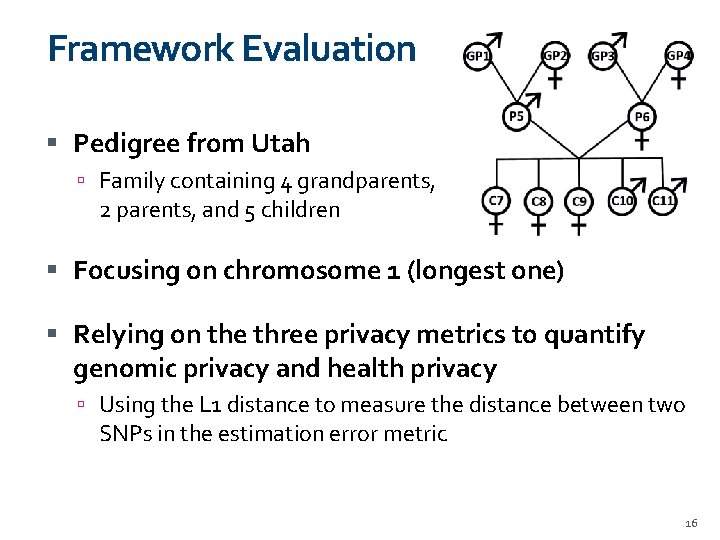
Framework Evaluation Pedigree from Utah Family containing 4 grandparents, 2 parents, and 5 children Focusing on chromosome 1 (longest one) Relying on the three privacy metrics to quantify genomic privacy and health privacy Using the L 1 distance to measure the distance between two SNPs in the estimation error metric 16
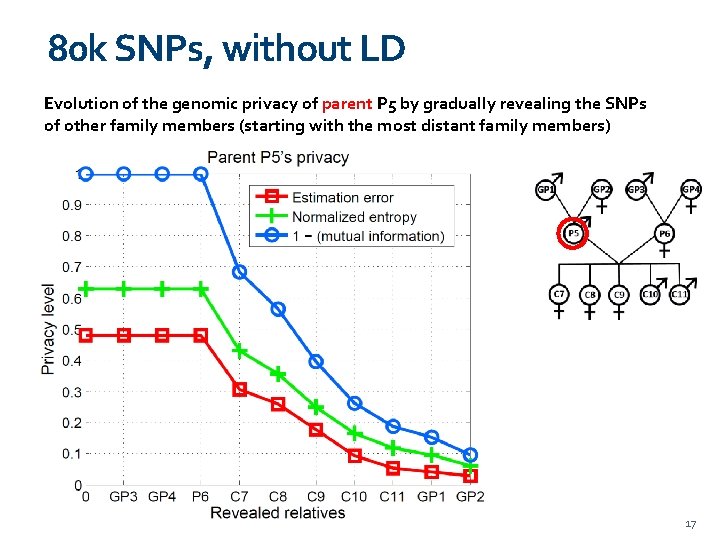
80 k SNPs, without LD Evolution of the genomic privacy of parent P 5 by gradually revealing the SNPs of other family members (starting with the most distant family members) 17
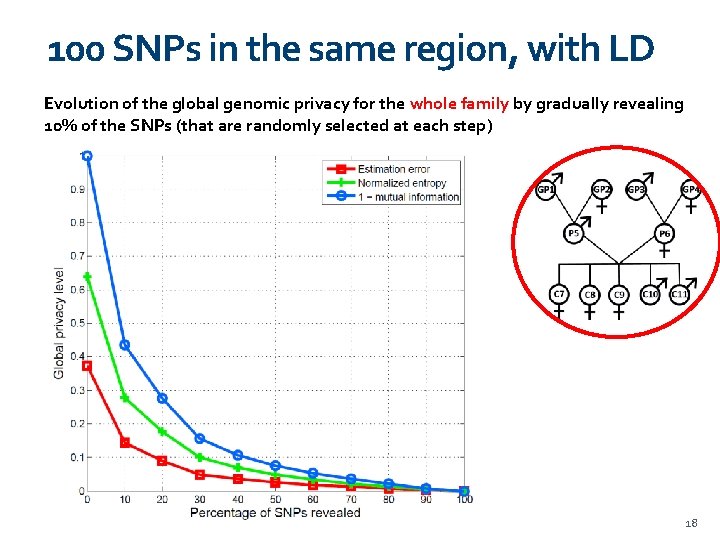
100 SNPs in the same region, with LD Evolution of the global genomic privacy for the whole family by gradually revealing 10% of the SNPs (that are randomly selected at each step) 18
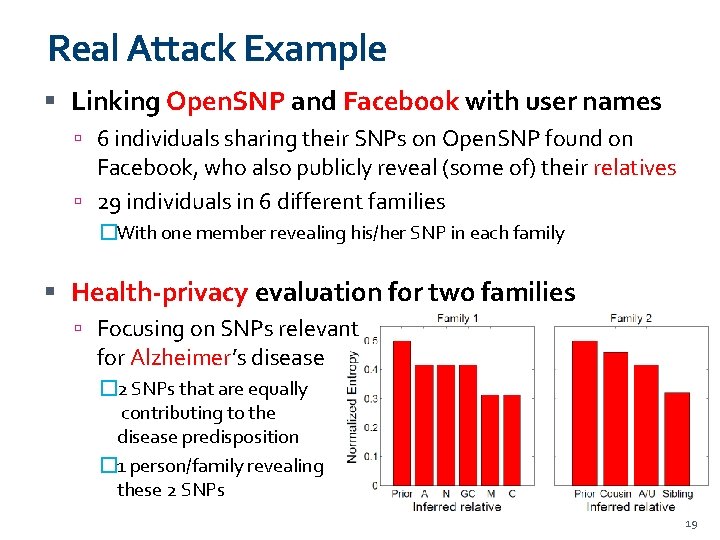
Real Attack Example Linking Open. SNP and Facebook with user names 6 individuals sharing their SNPs on Open. SNP found on Facebook, who also publicly reveal (some of) their relatives 29 individuals in 6 different families �With one member revealing his/her SNP in each family Health-privacy evaluation for two families Focusing on SNPs relevant for Alzheimer’s disease � 2 SNPs that are equally contributing to the disease predisposition � 1 person/family revealing these 2 SNPs 19
Summary Framework to quantify kin genomic privacy given actual observation and background knowledge Trade-off between time efficiency and attack power If the attacker is interested only in a subset of targeted SNPs or if he cannot observe the full set of SNPs of a relative, he would make use of the inference method that includes LD From the decision/policy maker’s point of view, the inference method without LD gives an upperbound on the actual level of genomic privacy of the family members Optimized protection mechanism Obfuscation mechanism and combinatorial optimization 20
Outline Statistical inference Kin genomic privacy �M. Humbert, E. Ayday, J. -P. Hubaux, A. Telenti. Addressing the Concerns of the Lacks Family: Quantification of Kin Genomic Privacy. CCS 2013 De-anonymization Of genomic databases with phenotypic traits ? ? ? �M. Humbert, K. Huguenin, J. Hugonot, E. Ayday, J. -P. Hubaux. De-anonymizing Genomic Databases with Phenotypic Traits. PETS 2015 01/11/2020 21
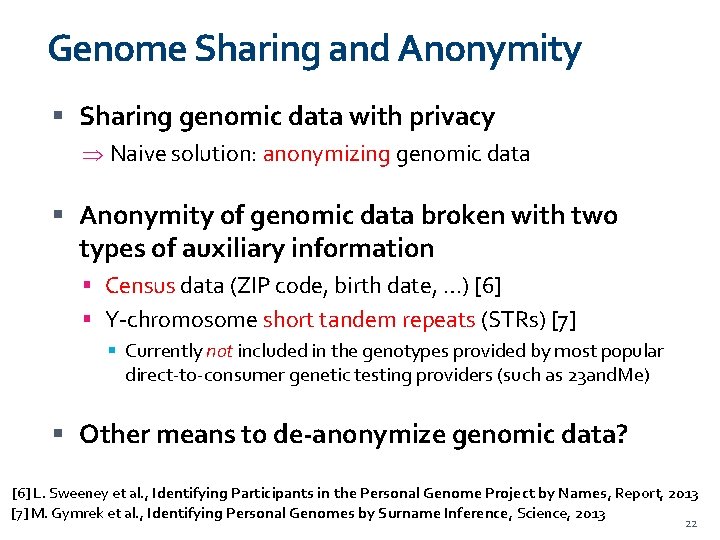
Genome Sharing and Anonymity Sharing genomic data with privacy Þ Naive solution: anonymizing genomic data Anonymity of genomic data broken with two types of auxiliary information Census data (ZIP code, birth date, …) [6] Y-chromosome short tandem repeats (STRs) [7] Currently not included in the genotypes provided by most popular direct-to-consumer genetic testing providers (such as 23 and. Me) Other means to de-anonymize genomic data? [6] L. Sweeney et al. , Identifying Participants in the Personal Genome Project by Names, Report, 2013 [7] M. Gymrek et al. , Identifying Personal Genomes by Surname Inference, Science, 2013 22
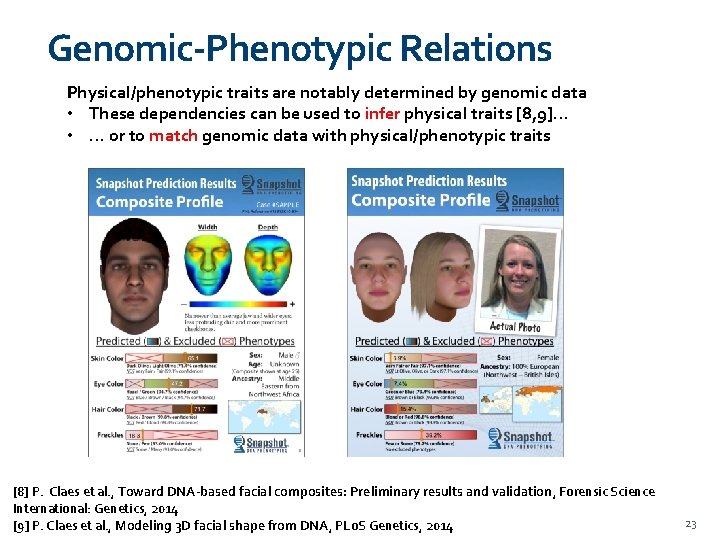
Genomic-Phenotypic Relations Physical/phenotypic traits are notably determined by genomic data • These dependencies can be used to infer physical traits [8, 9]… • … or to match genomic data with physical/phenotypic traits [8] P. Claes et al. , Toward DNA-based facial composites: Preliminary results and validation, Forensic Science International: Genetics, 2014 [9] P. Claes et al. , Modeling 3 D facial shape from DNA, PLo. S Genetics, 2014 23
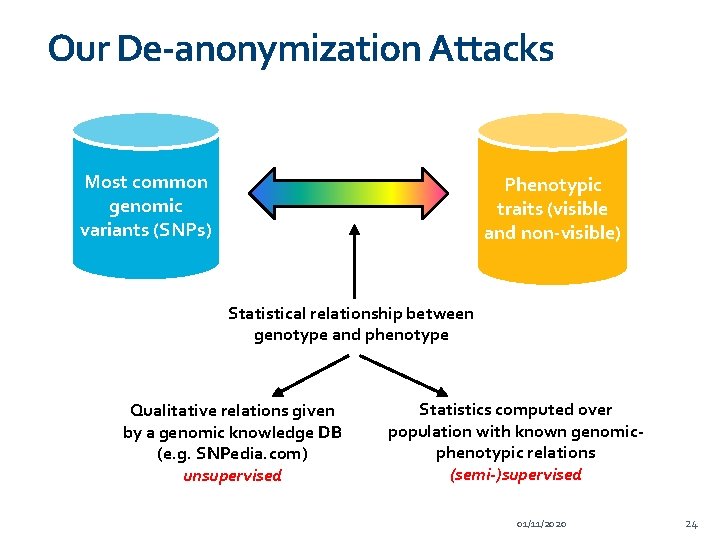
Our De-anonymization Attacks Most common genomic variants (SNPs) Phenotypic traits (visible and non-visible) Statistical relationship between genotype and phenotype Qualitative relations given by a genomic knowledge DB (e. g. SNPedia. com) unsupervised Statistics computed over population with known genomicphenotypic relations (semi-)supervised 01/11/2020 24
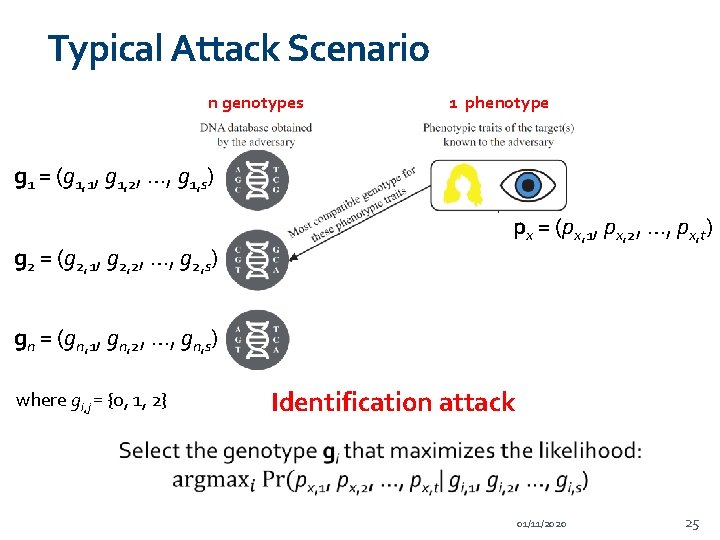
Typical Attack Scenario n genotypes 1 phenotype g 1 = (g 1, 1, g 1, 2, …, g 1, s) g 2 = (g 2, 1, g 2, 2, …, g 2, s) px = (px, 1, px, 2, …, px, t) gn = (gn, 1, gn, 2, …, gn, s) where gi, j = {0, 1, 2} Identification attack 01/11/2020 25
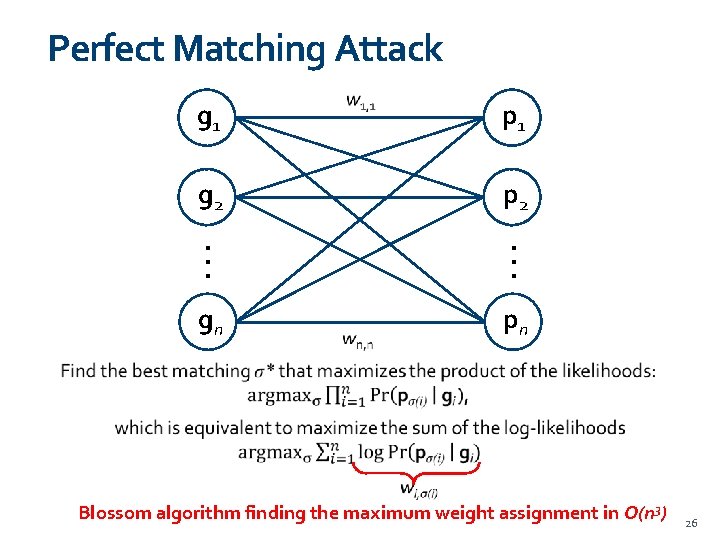
Perfect Matching Attack g 1 p 1 g 2 p 2 . . . gn pn Blossom algorithm finding the maximum weight assignment in O(n 3) 26
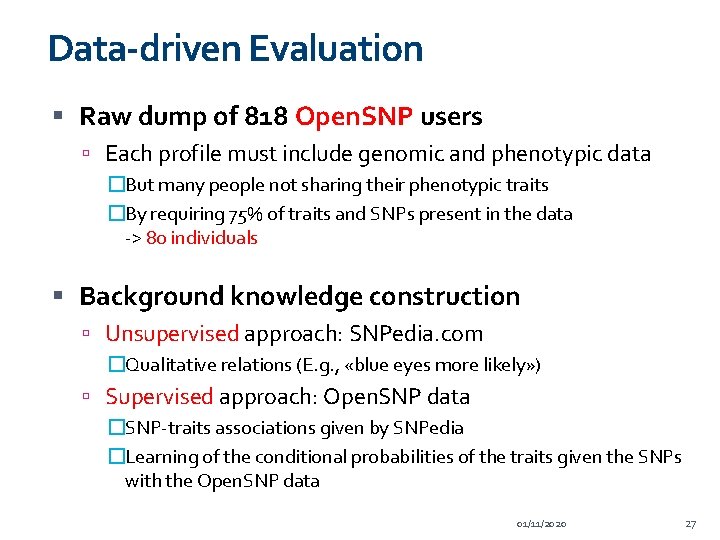
Data-driven Evaluation Raw dump of 818 Open. SNP users Each profile must include genomic and phenotypic data �But many people not sharing their phenotypic traits �By requiring 75% of traits and SNPs present in the data -> 80 individuals Background knowledge construction Unsupervised approach: SNPedia. com �Qualitative relations (E. g. , «blue eyes more likely» ) Supervised approach: Open. SNP data �SNP-traits associations given by SNPedia �Learning of the conditional probabilities of the traits given the SNPs with the Open. SNP data 01/11/2020 27
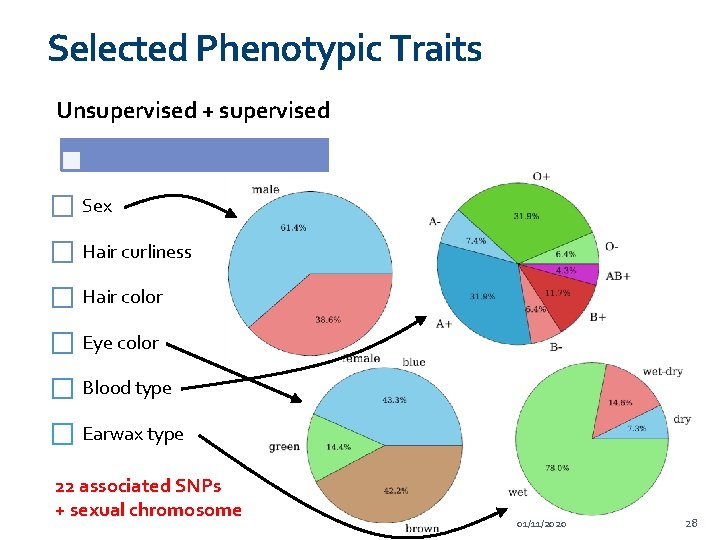
Selected Phenotypic Traits Unsupervised + supervised Supervised only Sex Skin color Hair curliness Freckling Hair color Ability to tan Eye color Asthma Blood type Lactose intolerance Earwax type 22 associated SNPs + sexual chromosome 17 associated SNPs 01/11/2020 28
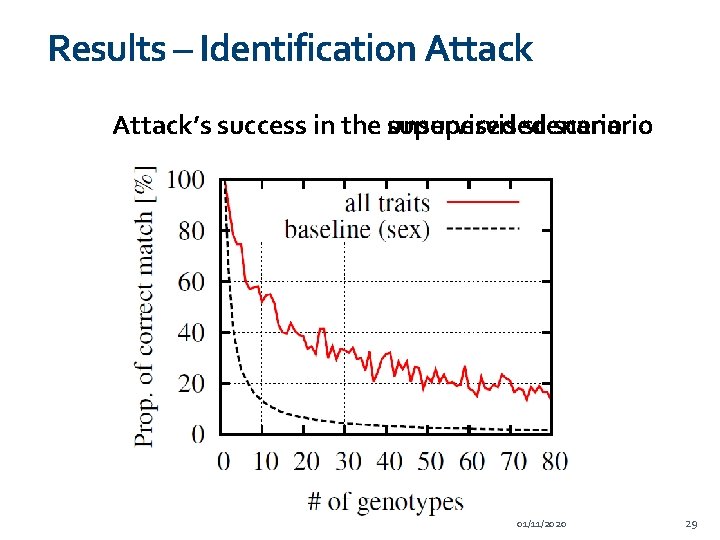
Results – Identification Attack’s success in the supervised unsupervised scenario 01/11/2020 29
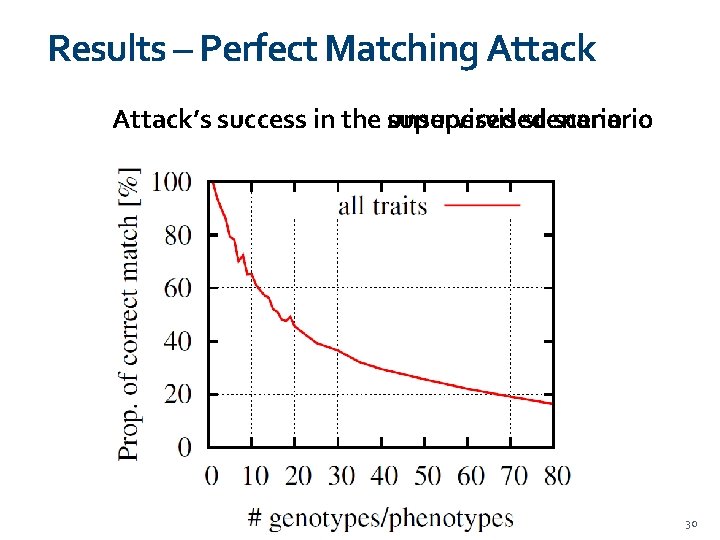
Results – Perfect Matching Attack’s success in the unsupervised scenario 01/11/2020 30
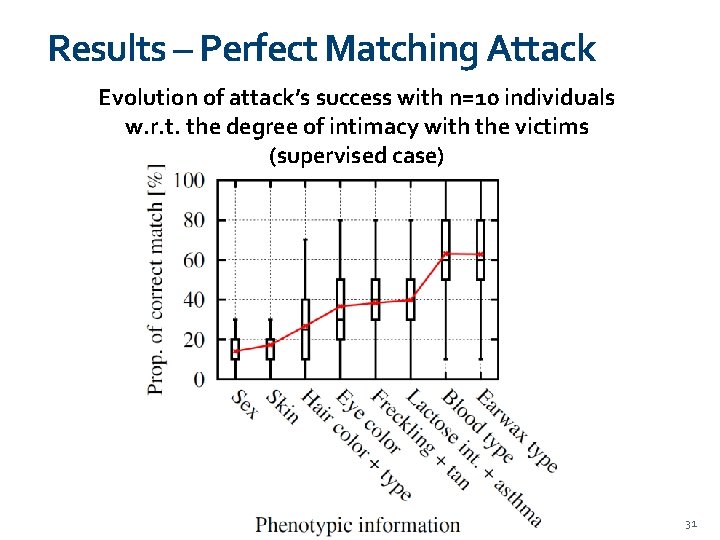
Results – Perfect Matching Attack Evolution of attack’s success with n=10 individuals w. r. t. the degree of intimacy with the victims (supervised case) 31
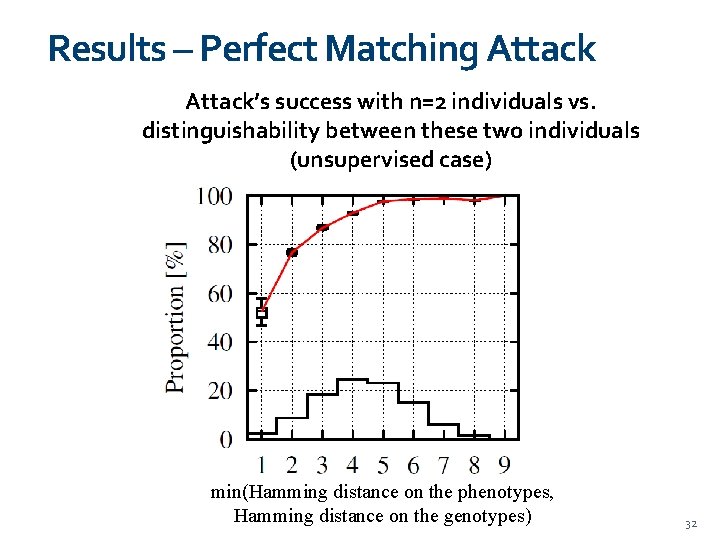
Results – Perfect Matching Attack’s success with n=2 individuals vs. distinguishability between these two individuals (unsupervised case) min(Hamming distance on the phenotypes, Hamming distance on the genotypes) 32
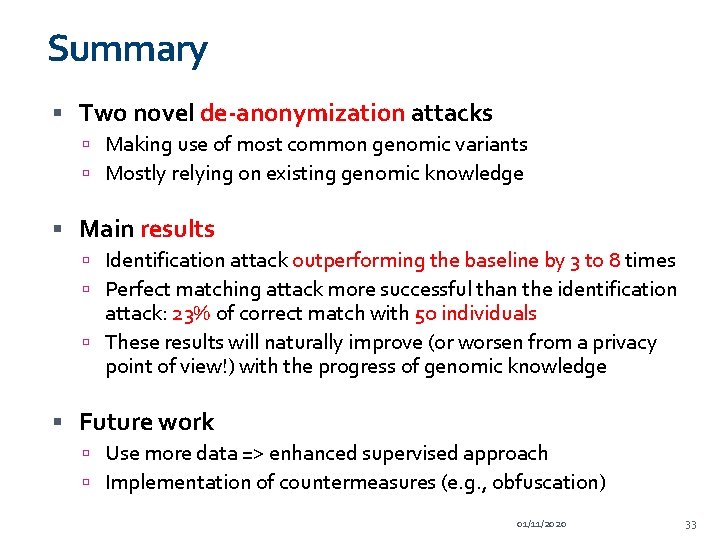
Summary Two novel de-anonymization attacks Making use of most common genomic variants Mostly relying on existing genomic knowledge Main results Identification attack outperforming the baseline by 3 to 8 times Perfect matching attack more successful than the identification attack: 23% of correct match with 50 individuals These results will naturally improve (or worsen from a privacy point of view!) with the progress of genomic knowledge Future work Use more data => enhanced supervised approach Implementation of countermeasures (e. g. , obfuscation) 01/11/2020 33
Conclusion The genomic revolution is coming Millions (if not billions) of people’s DNA will be sequenced in the next decade Given the very sensitive information its contains, the genome must be protected First step towards more genomic privacy: fully characterize and formally quantify the risks in order to �Raise general awareness about the risks �Design proper protection mechanisms Open crucial questions Economic value and legal ownership of the genomic data 01/11/2020 34
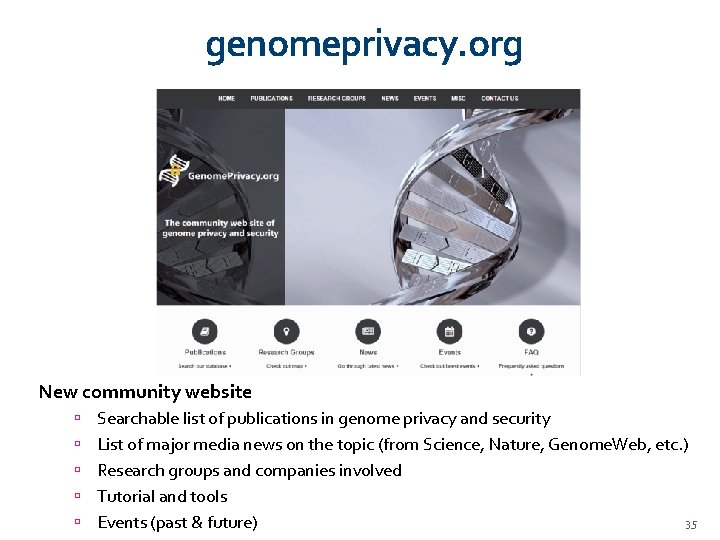
genomeprivacy. org New community website Searchable list of publications in genome privacy and security List of major media news on the topic (from Science, Nature, Genome. Web, etc. ) Research groups and companies involved Tutorial and tools Events (past & future) 35