
Infective Endocarditis Prof Lotfy Hamed Abo dahab Professor
Infective Endocarditis Prof. Lotfy Hamed Abo dahab. Professor Of Internal Medicine and Cardiology. Sohag University. 1
Infective Endocarditis It is an infection of the endocardium and the cardiac valves. IE can occur in 2 ways: 1 -Subacute bacterial endocarditis; when the heart valves and the endocardium are damaged (RHD, congenital HD or artificial valve). Here a low virulence MO as strept viridans can invade them and produce a slowly progressive infection. 2 -Acute bacterial endocarditis: Here normal valves and endocardium can be invaded by MO of high pathogenicity as staph, pneumo and gonococci in the course of fulminant septicemia orginating in other organs 2
n IE most commonly complicates: MR, AS, AR, calcific or sclerotic AV, VSD, PS, PDA, bicusped AV, or artificial valve. -Less common in cases of Fallot’s tetraology, and MS -It is very rare in ASD. -TV affection ocuurs among IV drug abusers who inject drug under septic conditions. Organisms: . ( Bacteria, fungi, and rickettsia) Fungal endocarditis is caused by candida or asperigillus in pts. receiving high doses of antibiotics, steroids, or cytotoxic drugs. Also common in drug abusers, and in infection on prosthetic materials placed in the circulation as prosthetic valve, catheters, . 3
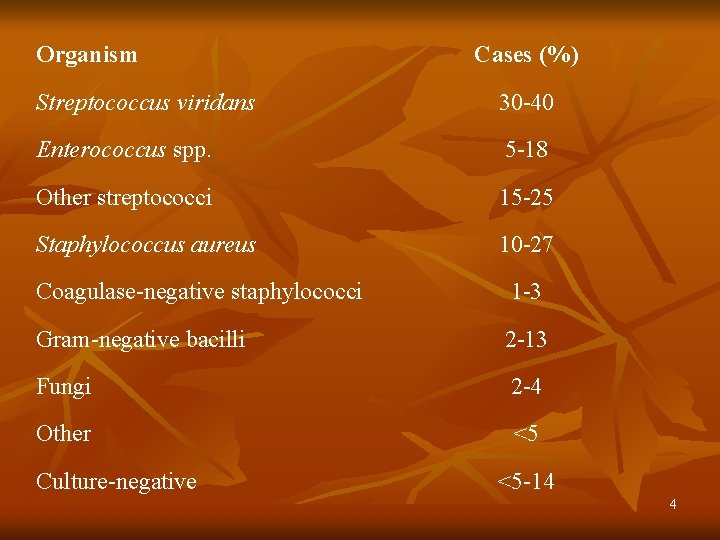
Organism Cases (%) Streptococcus viridans 30 -40 Enterococcus spp. 5 -18 Other streptococci 15 -25 Staphylococcus aureus 10 -27 Coagulase-negative staphylococci 1 -3 Gram-negative bacilli 2 -13 Fungi 2 -4 Other <5 Culture-negative <5 -14 4
n -Pathology: . 1 -Platelets aggregates on the diseased endocardium and form sterile platelet vegetations stabilized by fibrin. Two factors are responsible for the formation of these thrombi: . -Damaged and deformed endocardium. -Strong jet of blood. 2 - MO in the blood then settle in these platelet thrombi start infection and form vegetations. The MO become embeded in the fibrin platelet mesh and become protected from phagocytosis and other body defenses. 5
The effects of infective endocarditis are produced by: . 1 -Contineous release of the MO and their toxins into the blood stream leading to bacteremia, and toxaemia. 2 -Separation of parts of the vegitations in the form of infected emboli that cause metastatic infection, vascular obstruction or mycotic aneurysms in distant organs. 3 -The infection destroy further the already damaged valves, endocardium, … of the heart. Healing causes scar formation and deformities of the valve. 4 -Ag-Ab reactions and formation of immune complexes 6
Clinical picture: . 1 -Insidious onset of fever (low grade, but varies), sweating , arthralgia, malaise, toxic look, and pallor. 2 -The heart may show: -Always there is evidence of pre-existing heart dis. -Change or increase in pre-existing murmurs or development of a new one due to destruction of the cardiac valves by infection -In advanced cases, heart failure results from toxic myocarditis and the effects of cardiac defects. 7
3 -Moderately enlarged, tender spleen. 4 -Finger clubbing after 5 -6 weeks. 5 -Kidney affection may result in: . -Hematuria (macro, or microscopic), proteinurea. -Immune complex acute GN. -Renal failure may complicate advanced cases. -Renal infarction (loin pain, and hematurea). 8
n 6 -Embolism: . May involve any organ (spleen, kidney, limbs, brain, retina, mesentry, …) producing infarction of the affected organ. Pulmonary embolism may complicate the cases involving the Rt. Chambers. Retinal emboli, or immune comlexes cause areas of Hge with pale center “Roth spots”. n 7 -Neurological manifestations include: . -Cerebral embolism, septic infarction may result in cerebral abscess. -Rupture of mycotic aneurysm may result in cerebral or sub-arachnoid Hge. -A picture simulating meningitis or encephalitis may occur. 9
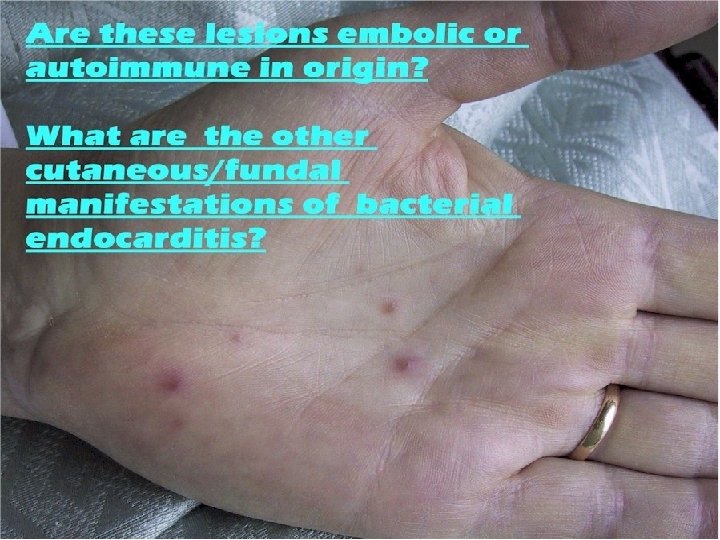
8 -Skin lesions: . -Petechial Hge. -Splinter Hge. (streaks of He under the nail), Janeway lesions (flat erythmatous maculaes in the palms and the soles) are rarely seen. -Osler nodules (tender intracutaneous nodules found in the pulps of the fingers and in thenar and hypothenar eminences) 10
11
Clinical Findings in Infective Endocarditis Patients (%) Fever 75 Weight loss 52 Skin lesions 51 New murmur 33 Splenomegaly 20 12
n Diagnosis: . 1 -Bacterial endocarditis should always be suspected in any pt. with a murmur, or a known heart dis. Who develops an unexplained fever. 2 -Blood culture: . -3 blood samples taken from 3 different sites must be tested on a period of 24 hours before any antibiotic is given. -Culture for aerobic, anaerobic bacteria and fungi. Culture must be incubated for up to 3 weeks to allow slowly growing MO to emerge. -Culture sensitivity for the isolated MO. -If the initial cultures are negative, another set of 3 samples must be taken after 48 hours. 13
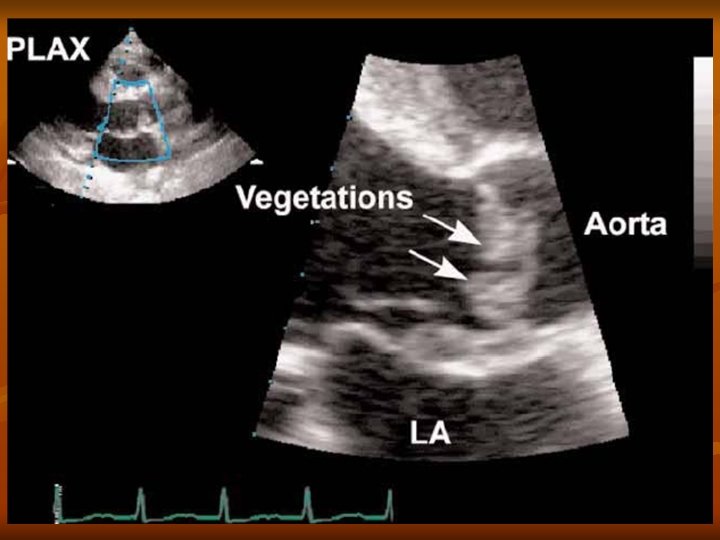
-Causes of –ve cultures are: . -Slowly progressing MO -Fungal endocarditis, -Prior antibiotic ttt 3 - Echocardiography: . Is very essential, it may show: . -vegetation -abscess -leakage TEE is more sensitive than TTE. 14
15
n 4 -Urine examination: . Show micro, or macroscopic hematuria. RBCs casts and heavy proteinuria indicate the presence of immune complex GN. 4 - Blood examination may show elevated ESR, anemia, and sometimes leukocytosis. n 16
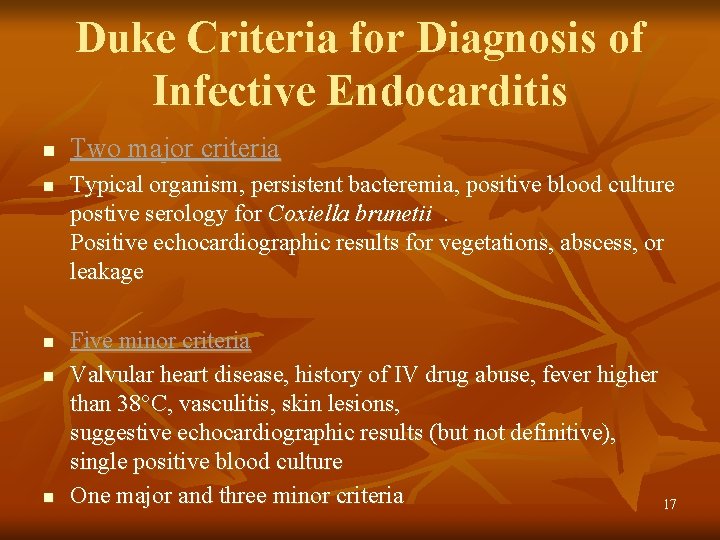
Duke Criteria for Diagnosis of Infective Endocarditis n n n Two major criteria Typical organism, persistent bacteremia, positive blood culture postive serology for Coxiella brunetii. Positive echocardiographic results for vegetations, abscess, or leakage Five minor criteria Valvular heart disease, history of IV drug abuse, fever higher than 38°C, vasculitis, skin lesions, suggestive echocardiographic results (but not definitive), single positive blood culture One major and three minor criteria 17
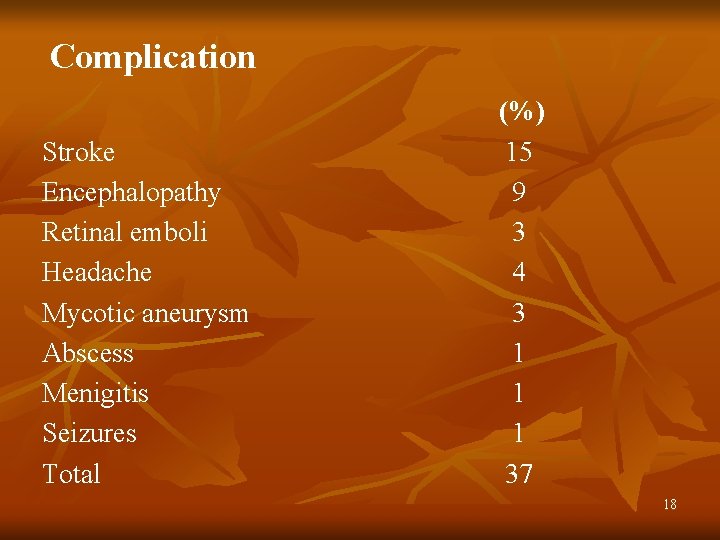
Complication Stroke Encephalopathy Retinal emboli Headache Mycotic aneurysm Abscess Menigitis Seizures Total (%) 15 9 3 4 3 1 1 1 37 18
n Differential diagnosis: . 1 -Rheumatic activity 2 -Intercurrent infections and fevers. Prophylaxis: . 1 -Amoxicillin 2 gm should be given orally to all pts with RHD, or cong. HD one hour before all procedure that may result in bactermia. 19
n In cases of penicillin sensitivity, clindamycin, erythromycin, or vancomycin can be used. 2 -Pts. Who are at high risk for developing endocarditis as: . –Artificial valve or -Previous IE. -GIT, genitourinary surgery, more intensive prophylaxis is required (Ampicillin 2 gm IV or IM 30 minutes before the procedure together with gentamycin 1. 5 mg/kg. This should be repeated 6 hours later). 20
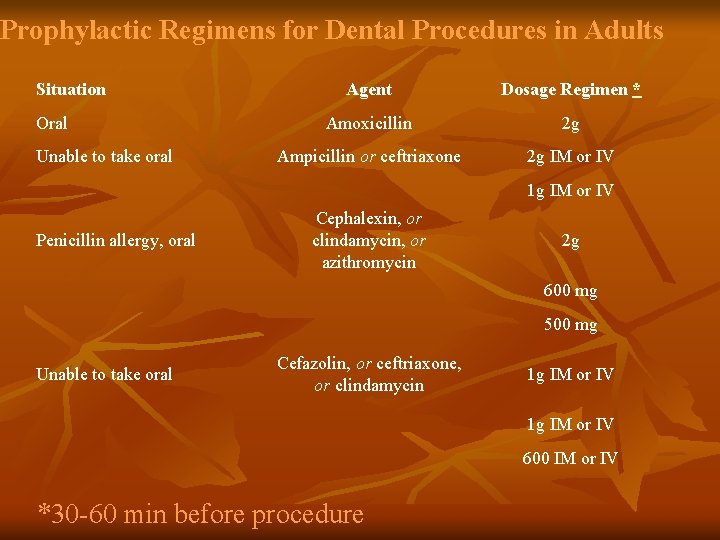
Prophylactic Regimens for Dental Procedures in Adults Situation Oral Unable to take oral Agent Dosage Regimen * Amoxicillin 2 g Ampicillin or ceftriaxone 2 g IM or IV 1 g IM or IV Penicillin allergy, oral Cephalexin, or clindamycin, or azithromycin 2 g 600 mg 500 mg Unable to take oral Cefazolin, or ceftriaxone, or clindamycin 1 g IM or IV 600 IM or IV *30 -60 min before procedure
3 -Early treatment for upper respiratory tract infections and other septic foci. All carious tooth should be removed. 4 -Surgical correction of underlying HD may be indicated only to prevent IE as closure of PDA. 22
n Treatment: . - The aim of treatment is to achieve bactericidal concentration of antibiotic in contact with the infective MO which is localized in avascular tissue or vegetation. That is why we should use High doses of parentral bactericidal antibiotics. -After culture sensitivity, The antibiotic must be given for at least 4 -6 weeks. The commonest causative MO are usually treated as follows: . *Strept viridans: . 3 million units of cryst. Penicillin IV every 4 hours for 4 weeks together with gentamycin 3 mg/kg daily IM for the first 2 weeks. 24
Surgical Treatment n n Surgery during acute infection does not increase mortality; in fact, restoration of a failing pump improves function and outcome. Valve failure causing moderate to severe congestive heart failure (New York Heart Association Class III or IV) is a strong indication for urgent surgery. An endocardial abscess, which can involve the aortic root, valve ring, or ventricular septum, is another indication for urgent intervention. Other conditions favoring surgery include vegetations larger than 1 cm in diameter, a major embolic event, and failure or relapse of medical therapy 25

Thank you 26
- Slides: 26