
Infectious process The Cycle Of Infection Chain of




- Slides: 33
Infectious process (The Cycle Of Infection) Chain of infection Chain of event Part III Prof DR. Waqar Al – Kubaisy 1/19/2022 1
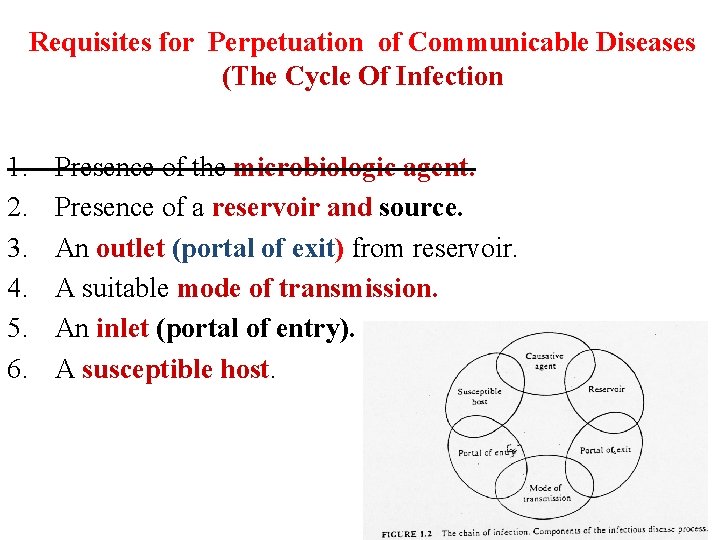
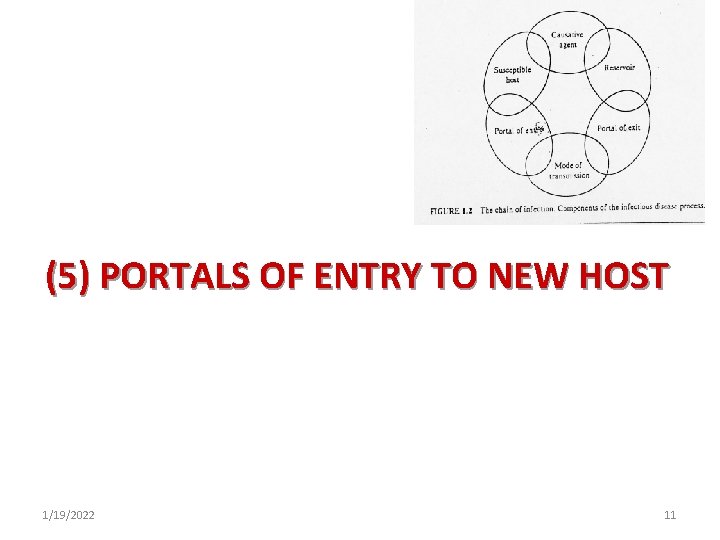
Requisites for Perpetuation of Communicable Diseases (The Cycle Of Infection 1. 2. 3. 4. 5. 6. Presence of the microbiologic agent. Presence of a reservoir and source. An outlet (portal of exit) from reservoir. A suitable mode of transmission. An inlet (portal of entry). A susceptible host.
2. Vector-borne q In infectious disease epidemiology, vector is defined as v an arthropod or any living carrier (e. g. , snail) that v transports an infectious agent to a susceptible individual. q Transmission by a vector may be v Mechanical or v Biological. q In the biological, the disease agent passes through a developmental cycle or multiplication in the vector Propagative, Cyclo-propagative, Cyclo-developmental
Con. …Vector-borne (a)Mechanical transmission : The infectious agent is mechanically transported v by a crawling or flying arthropod Ø through soiling of its feet or proboscis; or Ø by passage of organisms through its gastrointestinal tract and passively excreted. v There is no development or multiplication of the infectious agent on or within the vector. (b) Biological transmission : The infectious agent undergoing replication or development or both in vector and requires an incubation period before vector can transmit. (extrinsic incubation period) Biological transmission is of three types :
Con. …Vector-borne (i) Propagative : The agent merely multiplies in vector, but no change in form, e. g. , plague bacilli in rat fleas. (ii) Cyclo-propagative : The agent changes in form and number, e. g. , malaria parasites in mosquito. (iii) Cyclo-developmental : The disease agent undergoes only development but no multiplication, e. g. , microfilaria in mosquito. Trans ovarian transmission when the infectious agent is transmitted vertically from the infected female to her progeny in the vector, .
The factors which influence the ability of vectors to transmit disease are : (a) host feeding preferences (b) infectivity, that is ability to transmit the disease agent (c) susceptibility, that is ability to become infected (d) survival rate of vectors in the environment (e) domesticity, that is degree of association with man, and (f) suitable environmental factors. Seasonal occurrence of some diseases (e. g. , malaria) may be related to intense breeding and thereby greater density of the insect vector during certain periods of the year.
3. Airborne Droplet nuclei : v "Droplet nuclei" are a type of particles implicated (related) in the spread of airborne infection. v They are tiny particles (1 -10 microns range) that represent the dried residue of droplets. v They may be formed by evaporation of droplets coughed or sneezed into the air or v The droplet nuclei may remain airborne for long periods of time, some retaining and others losing infectivity or virulence. v They not only keep floating in the air but may be v disseminated by air currents from the point of their origin. v Particles in the 1 -5 micron range are liable to be easily drawn into the alveoli of the lungs and may be retained there. v Diseases spread by droplet nuclei include TB, influenza, chickenpox, 1/19/2022 7 measles, Q fever and many respiratory infections.
(2) Dust : Ø Some of the larger droplets which are expelled during talking, v coughing or sneezing, settle down by their sheer weight on the floor, v carpets, furniture, clothes, bedding, linen and other objects in the immediate environment v and become part of the dust. Some of them (e. g. , tubercle bacilli) may survive in the dust for considerable periods under optimum conditions of temperature and moisture. v. Airborne dust is primarily inhaled, but may settle on v uncovered food and milk. q This type of transmission is most common in hospital acquired (nosocomial) infection 1/19/2022 8
4. Fomite-borne Ø Fomites (singular; fomes) are inanimate articles or substances other than water or food contaminated by the infectious discharges from Ø a patient and capable of harbouring and transferring the infectious agent to a healthy person. Fomites include soiled clothes, towels, linen, handkerchiefs, cups, spoons, pencils, books, toys, drinking glasses, door handles, taps, lavatory chains, syringes, instruments and surgical dressings. q The fomites play an important role in indirect infection. Diseases transmitted by fomites include diphtheria, typhoid fever, bacillary dysentery, hepatitis A, eye and skin infections 1/19/2022 9
. 5. Unclean hands and fingers v Hands are the most common medium by which pathogenic agents are transferred to food from the skin, nose, bowel, etc as well as from other foods. v The transmission takes place both v directly (hand-to-mouth) and v indirectly. v Examples include staphylococcal and streptococcal infections, typhoid fever, dysentery, hepatitis A and intestinal parasites. v Unclean hands and fingers imply lack of personal hygiene. Lack of personal hygiene coupled with poor sanitation v favour person-to-person transmission of infection, an 1/19/2022 10
(5) PORTALS OF ENTRY TO NEW HOST 1/19/2022 11
THE CYCLE OF INFECTION) (5) PORTALS OF ENTRY TO NEW HOST v Respiratory tract v Gastro-intestinal tract v Genito-urinary tract v Skin and mucous membranes through: ØAffecting its layers then passing to cause systemic infection v Piercing skin through inoculation by: ØInsects ØDuring blood letting v Trans-placental
Note Some pathogens have: § One portal of entry to new host. § Two or more portals of exit from reservoir. Examples: Poliomyelitis viruses. Salmonella typhi. Time between entrance and start of manifestations is called incubation period Definition of incubation period: Interval between time of contact and entry of agent and onset of illness
Intrinsic incubation period Interval between infection of a susceptible person or animal and appearance of symptoms or signs of disease caused by infecting pathogen Extrinsic incubation period: Period between that time when vector gets infected and time vector becomes infective q Variation in range and duration of incubation period depends on: Ø Ø Resistance of host Dosage and virulence of agent Type of agent with regard to toxin production Route of infection inside body
SUSCEPTIBLE HOST
The Host is a person or other living animal including birds and arthropods that afford maintenance, (survival ) or lodgment to an infectious agent under natural conditions Successful parasitism Four stages have been described in successful parasitism : (a) First, the infectious agent must find a PORTAL OF ENTRY by which it may enter the host. There are many portals of entry, e. g. , respiratory tract, alimentary tract, genitourinary tract, skin, etc. Some organisms may have more than one portal of entry, e. g. , hepatitis B, Q fever, brucellosis. b) On gaining entry into the host, the organisms must reach the appropriate tissue or "SITE OF ELECTION“ in the body of the host where it may find optimum conditions for its multiplication and survival.
Successful parasitism Cont. . . (c) Thirdly, the disease agent must find a way out of the body (PORTAL OF EXIT) in order that it may reach a new host and propagate its species. If there is no portal of exit, the infection becomes a dead-end infection as in rabies, bubonic plague, tetanus and trichinosis. (d) After leaving the human body, the organism must survive in the external environment for sufficient period till a new host is found. q In addition, a successful disease agent should not cause the death of the host but produce only a low-grade immunity so that the host is vulnerable again and again to the same infection. The best example is common cold virus.
Incubation period An infection becomes apparent only after a certain incubation period, which is defined as "the time interval between invasion by an infectious agent and appearance of the first sign or symptom of the disease in question". v During the incubation period, the infectious agent undergoes v multiplication in the host. When a sufficient density of the disease agent is built up in the host, the health equilibrium is disturbed and v the disease becomes overt. The factors which determine the incubation period include Ø the generation time of the particular pathogen, Ø infective dose, Ø portal of entry and Ø individual susceptibility.
§ § In some, the incubation period is of median length ranging from 10 days to 3 weeks; in this category, there are many examples : typhoid infections, virus diseases such as chickenpox, measles and mumps. Then there are infections with longer incubation periods (ranging from weeks to months or years) and whose incubation time is difficult to measure precisely, e. g. , hepatitis A and B, rabies, leprosy and slow virus diseases. Incubation period is of fundamental importance in epidemiological studies
Serial interval In actual practice we seldom know precisely the incubation period of a disease. § But we know, when an outbreak of disease occurs, say in § a family which is the smallest group and also a closed group, there is an initial primary case. § The primary case is followed by 2 or 3 secondary cases within a short time. v The gap in time between the onset of the primary case and the secondary case is called the "serial interval". v By collecting information about a whole series of such onsets, we get a distribution of secondary cases from v which we can guess the incubation period of disease
Communicable period The communicable period is defined as "the time during which an infectious agent may be transferred directly or indirectly from an infected person to another person, from an infected animal to man, or from an infected person to an animal, including arthropods" q Communicability varies in different diseases. Ø Some diseases are more communicable during the incubation period than during actual illness. q Communicability of some diseases can be reduced by early diagnosis and treatment. An important measure of communicability is Secondary attack rate (SAR) is defined as "the number of exposed persons developing the disease within the range of the incubation period, following exposure to the primary case"
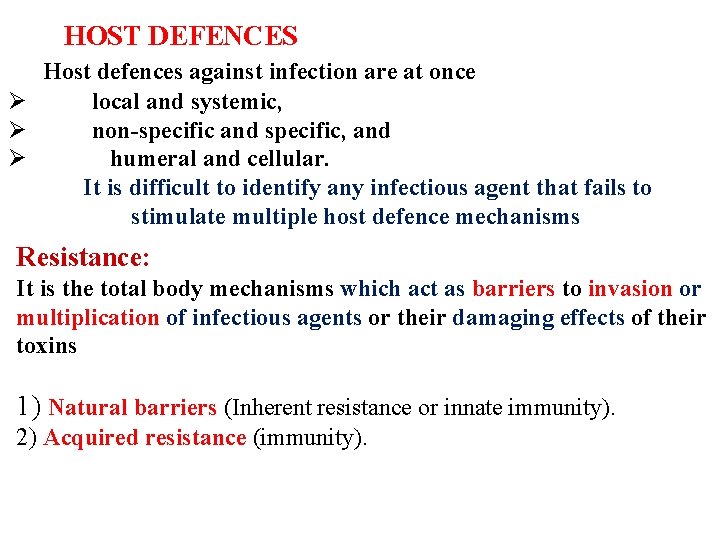
HOST DEFENCES Host defences against infection are at once Ø local and systemic, Ø non-specific and specific, and Ø humeral and cellular. It is difficult to identify any infectious agent that fails to stimulate multiple host defence mechanisms Resistance: It is the total body mechanisms which act as barriers to invasion or multiplication of infectious agents or their damaging effects of their toxins 1) Natural barriers (Inherent resistance or innate immunity). 2) Acquired resistance (immunity).
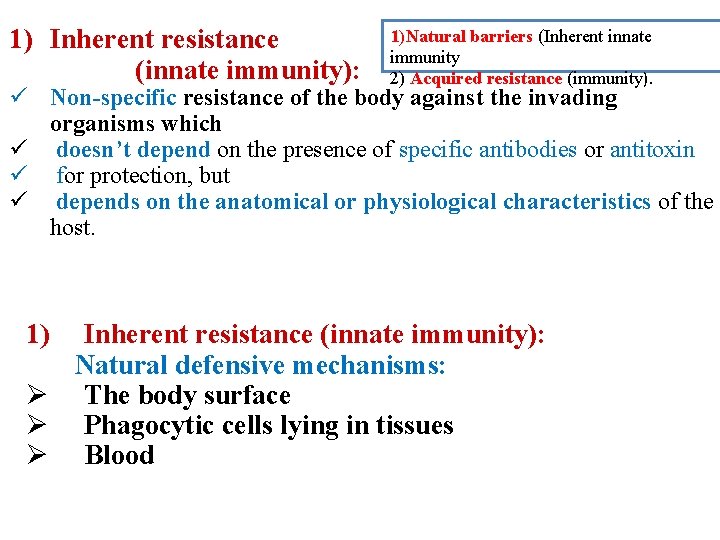
1) Inherent resistance (innate immunity): 1)Natural barriers (Inherent innate immunity 2) Acquired resistance (immunity). ü Non-specific resistance of the body against the invading organisms which ü doesn’t depend on the presence of specific antibodies or antitoxin ü for protection, but ü depends on the anatomical or physiological characteristics of the host. 1) Inherent resistance (innate immunity): Natural defensive mechanisms: Ø The body surface Ø Phagocytic cells lying in tissues Ø Blood
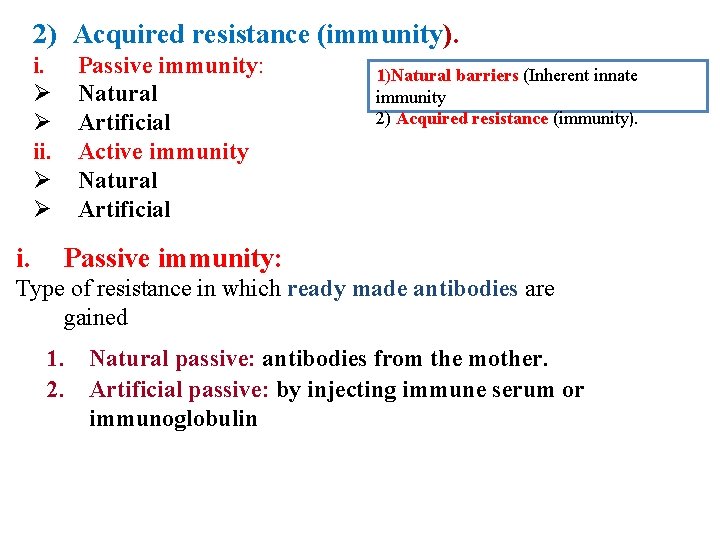
2) Acquired resistance (immunity). i. Ø Ø i. Passive immunity: Natural Artificial Active immunity Natural Artificial 1)Natural barriers (Inherent innate immunity 2) Acquired resistance (immunity). Passive immunity: Type of resistance in which ready made antibodies are gained 1. Natural passive: antibodies from the mother. 2. Artificial passive: by injecting immune serum or immunoglobulin
i. Passive immunity cont. . . : Acquired resistance (immunity). Passive immunity: Natural Artificial Active immunity Natural Artificial 1. Natural passive immunity: (Infant immunity) Ø Infant resistance due to antibodies passed to the fetus through the placenta. Ø The mother should have acquired the infection and/or vaccine & developed specific antibodies against the disease. Ø They are at highest level at birth and decline gradually till disappearance by the 6 th month. Ø Can be induced by immunizing the mother during pregnancy by tetanus toxoid to protect the infant against tetanus neonatorum. Breast milk, specially the colostrums contains § plenty of antibodies (about 95% of colostrums’ proteins) § Antibodies are continuously secreted in breast milk but at lower levels than the colostrums.
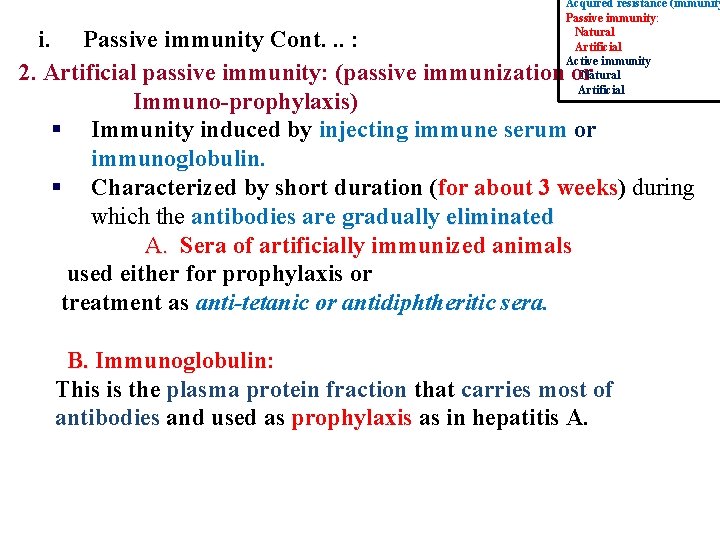
Acquired resistance (immunity Passive immunity: Natural Artificial Active immunity Natural Artificial i. Passive immunity Cont. . . : 2. Artificial passive immunity: (passive immunization or Immuno-prophylaxis) § Immunity induced by injecting immune serum or immunoglobulin. § Characterized by short duration (for about 3 weeks) during which the antibodies are gradually eliminated A. Sera of artificially immunized animals used either for prophylaxis or treatment as anti-tetanic or antidiphtheritic sera. B. Immunoglobulin: This is the plasma protein fraction that carries most of antibodies and used as prophylaxis as in hepatitis A.
ii. Active immunity: Type of resistance in which the person makes or develops his own antibodies. 1. Natural active: post infection immunity. may be solid, long [mumps or measles], moderate [meningitis] or short duration [common cold]) Acquired(immunity). Passive immunity: Natural Artificial Active immunity Natural Artificial 2. Artificial active: post vaccination immunity, where the specific antigen when introduced in the body provoke the formation of antibodies
IDEAL IMMUNIZING AGENT: ü Minimal side effects ü Antigenic stability ü Durable immunity ü Easy administration ü Few injections ü Reasonable cost ü Availability ü Good keeping quality (long shelf life) ü Easy storage
Attenuated vaccines: Here, microorganisms lose their pathogenicity but retain their power of multiplication and antigencity. Methods of attenuation: Ø Repeated subcultures or passage Ø Cultivation under unfavorable conditions Examples: Polio Sabin vaccine. Measles vaccine. German measles vaccine. Mumps vaccine Variant forms of living organisms vaccines: Here, milder species of the organisms that are closely related antigenically to the human disease agent are used. Examples: Small pox vaccine using cow pox virus. BCG vaccine using bovine tubercle bacilli.
1. Killed or inactivated vaccines: § Killed bacterial organisms (using heat or chemicals ) as typhoid or whooping cough vaccines § Inactivated virus as polio salk vaccine. 2. Products of organisms (toxoid): § It is the toxins after losing their toxicity but retaining their antigencity as diphtheria and tetanus toxoid. 3. Parts of the organisms: § HBs. Ag subunit. § Polysaccharide capsule of meningococcal.
Herd immunity q It’s the state of immunity within the community. Ø It’s the factor that decides the epidemiological pattern of any infectious disease among that community. q Herd immunity theory proposes that in diseases passed from individual to individual, it is difficult to maintain a chain of infection when large numbers of a population are immune. q The higher the number of immune individuals, the lower the q likelihood that a susceptible person will come in contact with an infectious agent q Herd immunity provides an immunological barrier to the spread of disease in the human herd q population with a very low or no immunity, the attack and case fatality rates tend to be very high involving practically all susceptible The epidemic wave declined with a build-up of herd immunity following natural infection.
Herd immunity Cont. . . The disease incidence rises at times when the number of susceptible in the population is highest and the herd immunity is lowest. Herd immunity results from either an epidemic or after obligatory immunization schedules Herd immunity may be determined by serological surveys (serological epidemiology). 1. Community protection is governed by: 2. 3. 4. 5. 6. The extent of coverage of the immunization program. The degree of resistance to infection afforded by the vaccine. Duration and degree of infectivity of the organism. Past experience with different infections. Overcrowding and environmental sanitation