
Infectious process The Cycle Of Infection Chain of

- Slides: 39
Infectious process (The Cycle Of Infection) Chain of infection Chain of event Part II Prof DR. Waqar Al – Kubaisy 1/14/2022 1
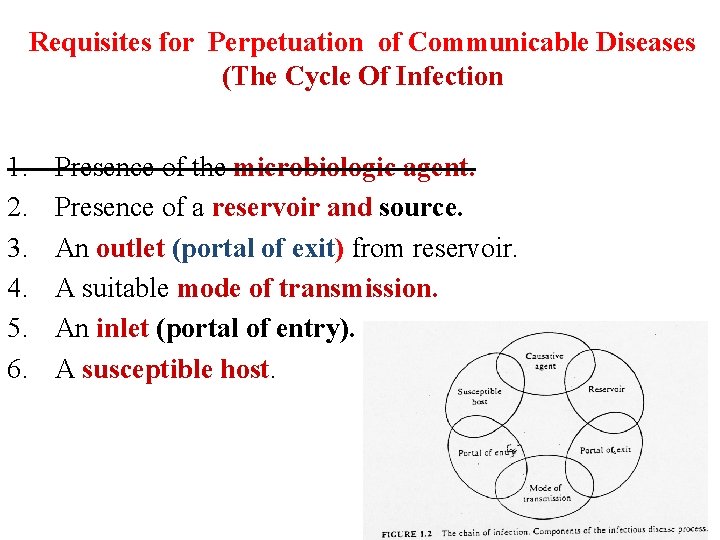
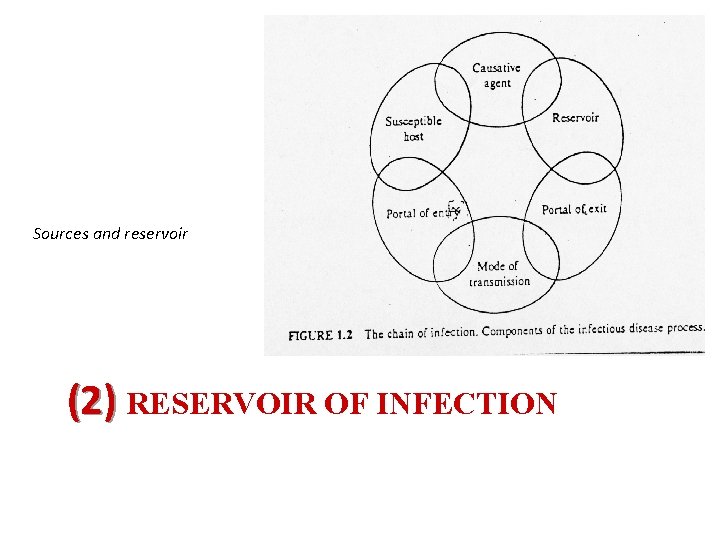
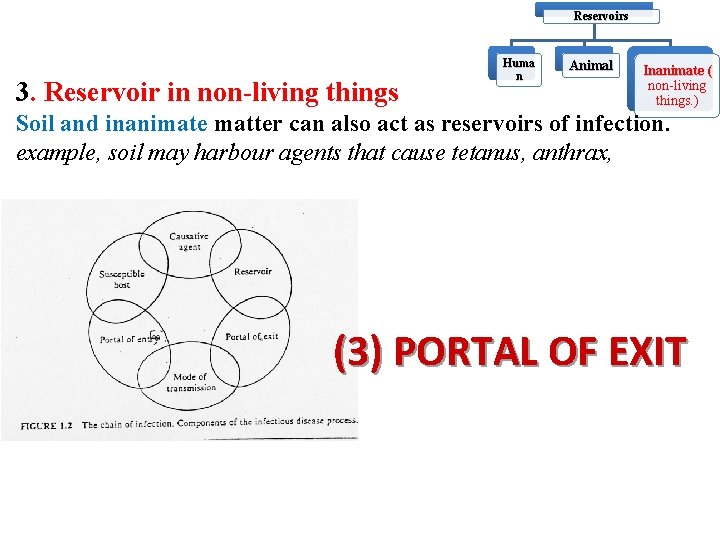
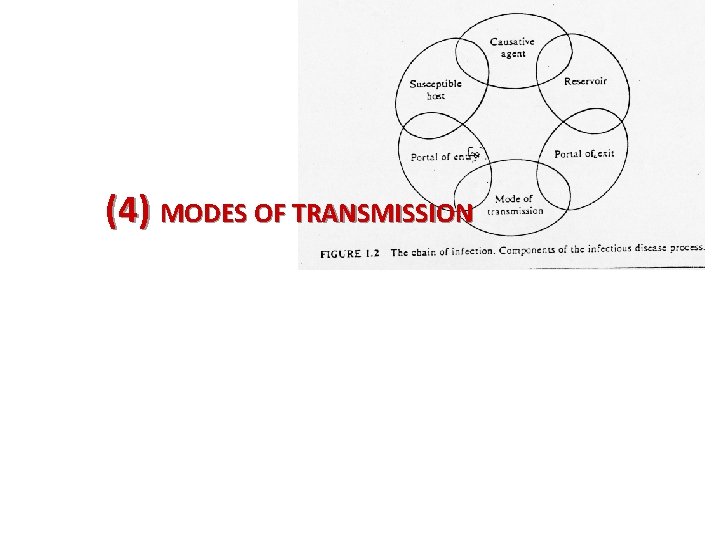
Requisites for Perpetuation of Communicable Diseases (The Cycle Of Infection 1. 2. 3. 4. 5. 6. Presence of the microbiologic agent. Presence of a reservoir and source. An outlet (portal of exit) from reservoir. A suitable mode of transmission. An inlet (portal of entry). A susceptible host.
Sources and reservoir (2) RESERVOIR OF INFECTION
Sources and reservoir v Existence of a reservoir or source of infection is the starting point for the occurrence of a communicable disease v source of infection is defined as “ the person, animal, object or substance from which an infectious agent passes or is disseminated to the host" v A reservoir is defined as “ any person, animal, arthropod, plant, soil or substance {or combination of these) in which an infectious agent Ø lives and multiplies, Ø on which it depends primarily for survival, and Ø where it reproduces itself in such manner that it can be transmitted to a susceptible host" In short, the reservoir is the natural habitat in which the organism metabolizes and replicates.
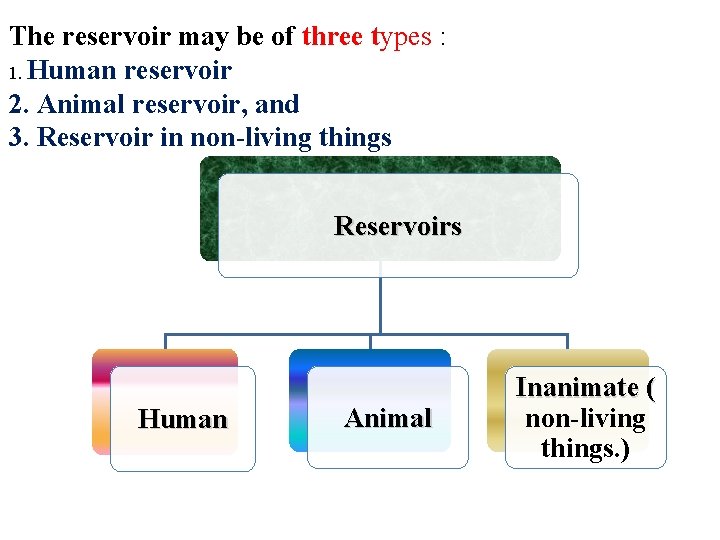
The reservoir may be of three types : 1. Human reservoir 2. Animal reservoir, and 3. Reservoir in non-living things Reservoirs Human Animal Inanimate ( non-living things. )
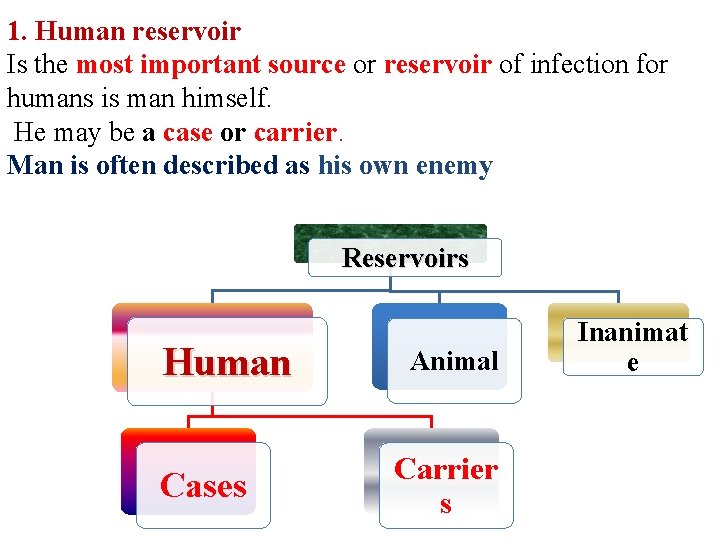
1. Human reservoir Is the most important source or reservoir of infection for humans is man himself. He may be a case or carrier. Man is often described as his own enemy Reservoirs Human Cases Animal Carrier s Inanimat e
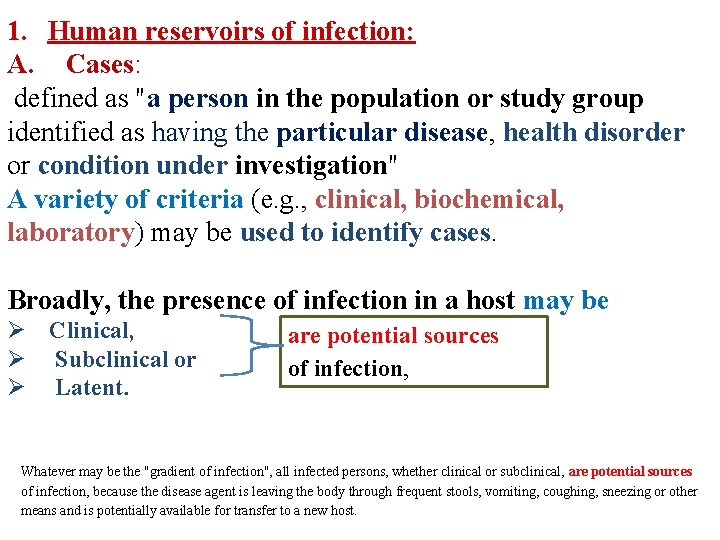
1. Human reservoirs of infection: A. Cases: defined as "a person in the population or study group identified as having the particular disease, health disorder or condition under investigation" A variety of criteria (e. g. , clinical, biochemical, laboratory) may be used to identify cases. Broadly, the presence of infection in a host may be Ø Clinical, Ø Subclinical or Ø Latent. are potential sources of infection, Whatever may be the "gradient of infection", all infected persons, whether clinical or subclinical, are potential sources of infection, because the disease agent is leaving the body through frequent stools, vomiting, coughing, sneezing or other means and is potentially available for transfer to a new host.
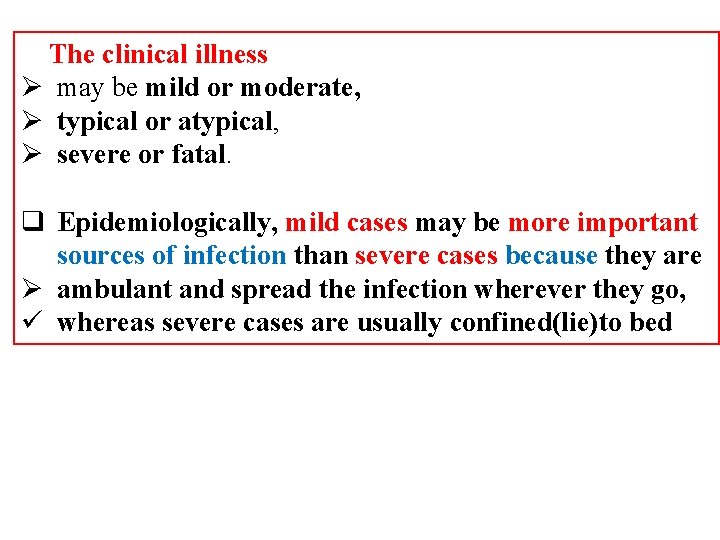
The clinical illness Ø may be mild or moderate, Ø typical or atypical, Ø severe or fatal. q Epidemiologically, mild cases may be more important sources of infection than severe cases because they are Ø ambulant and spread the infection wherever they go, ü whereas severe cases are usually confined(lie)to bed
The subclinical cases in apparent, covert, missed or abortive cases. v The disease agent may multiply in the host but Ø does not manifest itself by signs and symptoms. Ø The disease agent is, contaminates the environment in the same way as clinical cases. v contribute more than symptomatic patients to the transmission of infection to others Ø The persons unbeknown to themselves & others v Subclinical cases play a dominant role in maintaining the chain of infection in the community (endemicity). v detected only by laboratory tests, e. g. , organism, antibody response, biochemical
latent infection must be distinguished from subclinical infection. Ø In latent infection, the host does not shed the infectious agent which lies dormant within the host Ø without symptoms (and often without demonstrable presence in blood, tissues or bodily secretions of the host). For example, latent infection occurs in herpes simplex, Ø latent infection play great role in the perpetuation of certain infectious
In epidemiological terminology, q Primary case is the first case of a communicable disease introduced into the population unit being studied. q index case Is the first case to come to the attention of the investigator; it is not always the primary case. q Secondary cases are those developing from contact with primary case. q A suspect case § is an individual (or a group of individuals) who has all of § the signs and symptoms of a disease , yet has § not been diagnosed as having the disease or had the cause of the symptoms connected to the suspected pathogen
b. Carriers He may be a case or carrier "an infected person or animal that harbours a specific infectious agent in the absence of discernible clinical disease and serves as a potential source of infection for others" v As a rule carriers are less infectious than cases, but v epidemiologically, they are more dangerous than cases Ø because they escape recognition, and Ø continuing as they do to live a normal life among the population or community, and infect the susceptible individuals over a wider area and longer period of time, under favourable conditions.
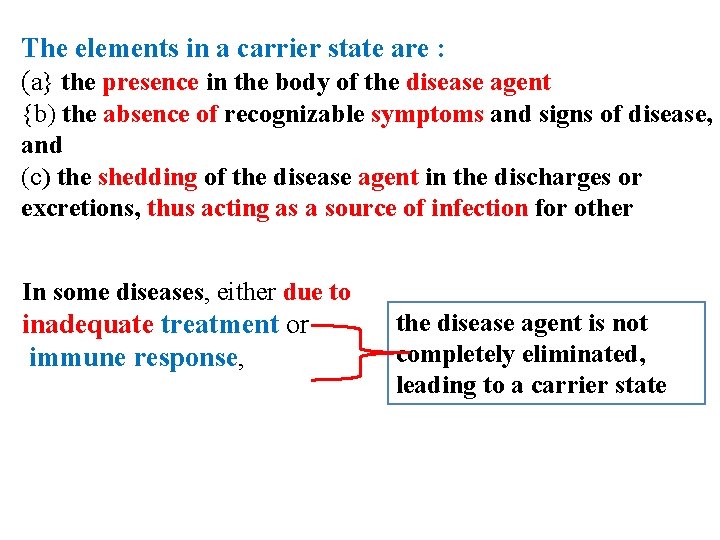
The elements in a carrier state are : (a} the presence in the body of the disease agent {b) the absence of recognizable symptoms and signs of disease, and (c) the shedding of the disease agent in the discharges or excretions, thus acting as a source of infection for other In some diseases, either due to inadequate treatment or immune response, the disease agent is not completely eliminated, leading to a carrier state
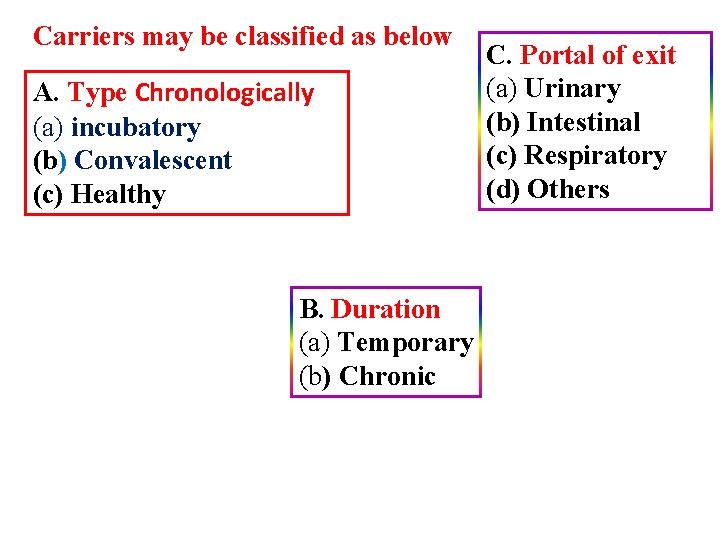
Carriers may be classified as below A. Type Chronologically (a) incubatory (b) Convalescent (c) Healthy B. Duration (a) Temporary (b) Chronic C. Portal of exit (a) Urinary (b) Intestinal (c) Respiratory (d) Others
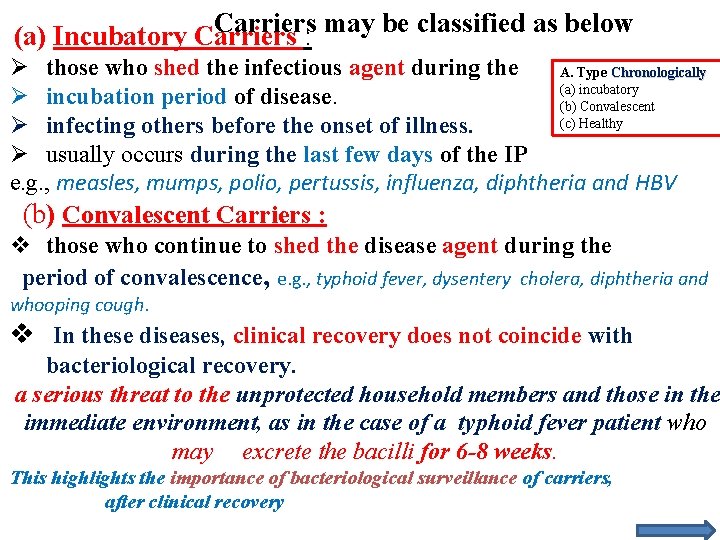
Carriers may be classified as below (a) Incubatory Carriers : Ø those who shed the infectious agent during the A. Type Chronologically (a) incubatory Ø incubation period of disease. (b) Convalescent (c) Healthy Ø infecting others before the onset of illness. Ø usually occurs during the last few days of the IP e. g. , measles, mumps, polio, pertussis, influenza, diphtheria and HBV (b) Convalescent Carriers : v those who continue to shed the disease agent during the period of convalescence, e. g. , typhoid fever, dysentery cholera, diphtheria and whooping cough. v In these diseases, clinical recovery does not coincide with bacteriological recovery. a serious threat to the unprotected household members and those in the immediate environment, as in the case of a typhoid fever patient who may excrete the bacilli for 6 -8 weeks. This highlights the importance of bacteriological surveillance of carriers, after clinical recovery
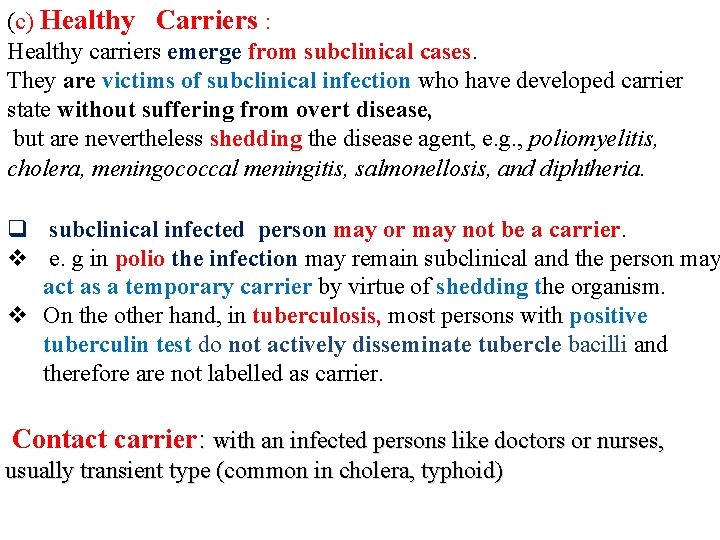
(c) Healthy Carriers : Healthy carriers emerge from subclinical cases. They are victims of subclinical infection who have developed carrier state without suffering from overt disease, but are nevertheless shedding the disease agent, e. g. , poliomyelitis, cholera, meningococcal meningitis, salmonellosis, and diphtheria. q subclinical infected person may or may not be a carrier. v e. g in polio the infection may remain subclinical and the person may act as a temporary carrier by virtue of shedding the organism. v On the other hand, in tuberculosis, most persons with positive tuberculin test do not actively disseminate tubercle bacilli and therefore are not labelled as carrier. Contact carrier: with an infected persons like doctors or nurses, usually transient type (common in cholera, typhoid)
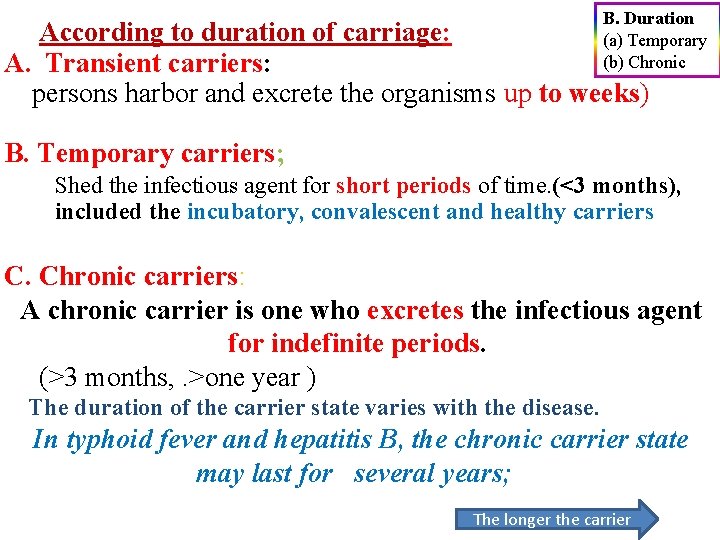
B. Duration (a) Temporary (b) Chronic According to duration of carriage: A. Transient carriers: persons harbor and excrete the organisms up to weeks) B. Temporary carriers; Shed the infectious agent for short periods of time. (<3 months), included the incubatory, convalescent and healthy carriers C. Chronic carriers: A chronic carrier is one who excretes the infectious agent for indefinite periods. (>3 months, . >one year ) The duration of the carrier state varies with the disease. In typhoid fever and hepatitis B, the chronic carrier state may last for several years; The longer the carrier
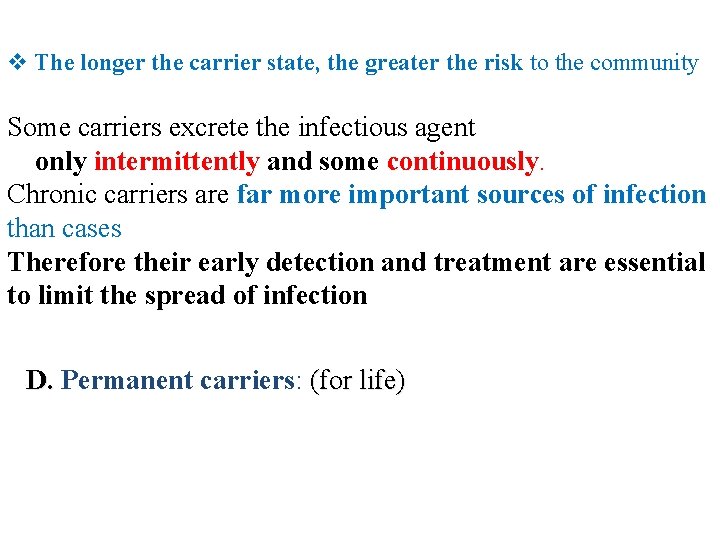
v The longer the carrier state, the greater the risk to the community Some carriers excrete the infectious agent only intermittently and some continuously. Chronic carriers are far more important sources of infection than cases Therefore their early detection and treatment are essential to limit the spread of infection D. Permanent carriers: (for life)
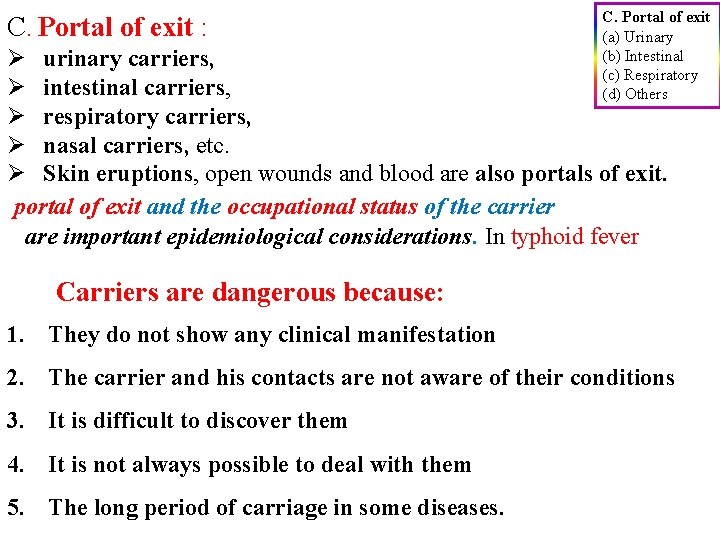
C. Portal of exit : C. Portal of exit (a) Urinary (b) Intestinal (c) Respiratory (d) Others Ø urinary carriers, Ø intestinal carriers, Ø respiratory carriers, Ø nasal carriers, etc. Ø Skin eruptions, open wounds and blood are also portals of exit. portal of exit and the occupational status of the carrier are important epidemiological considerations. In typhoid fever Carriers are dangerous because: 1. They do not show any clinical manifestation 2. The carrier and his contacts are not aware of their conditions 3. It is difficult to discover them 4. It is not always possible to deal with them 5. The long period of carriage in some diseases.
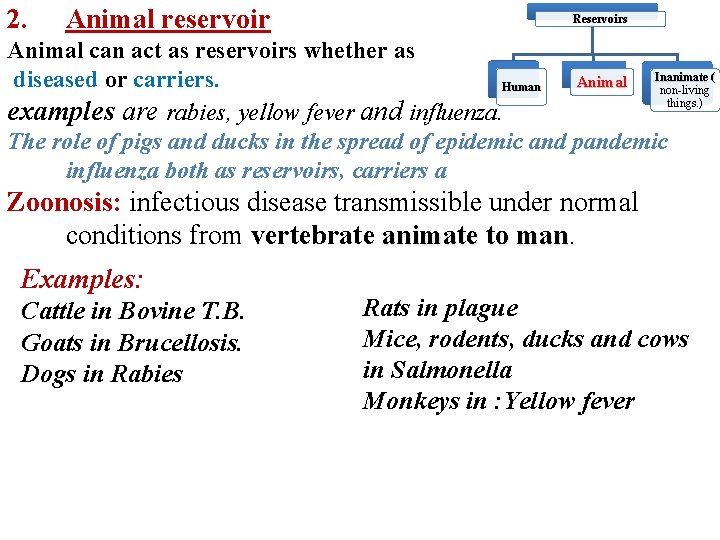
2. Animal reservoir Reservoirs Animal can act as reservoirs whether as Inanimate ( diseased or carriers. Animal Human non-living things. ) examples are rabies, yellow fever and influenza. The role of pigs and ducks in the spread of epidemic and pandemic influenza both as reservoirs, carriers a Zoonosis: infectious disease transmissible under normal conditions from vertebrate animate to man. Examples: Cattle in Bovine T. B. Goats in Brucellosis. Dogs in Rabies Rats in plague Mice, rodents, ducks and cows in Salmonella Monkeys in : Yellow fever
Reservoirs 3. Reservoir in non-living things Huma n Animal Inanimate ( non-living things. ) Soil and inanimate matter can also act as reservoirs of infection. example, soil may harbour agents that cause tetanus, anthrax, (3) PORTAL OF EXIT
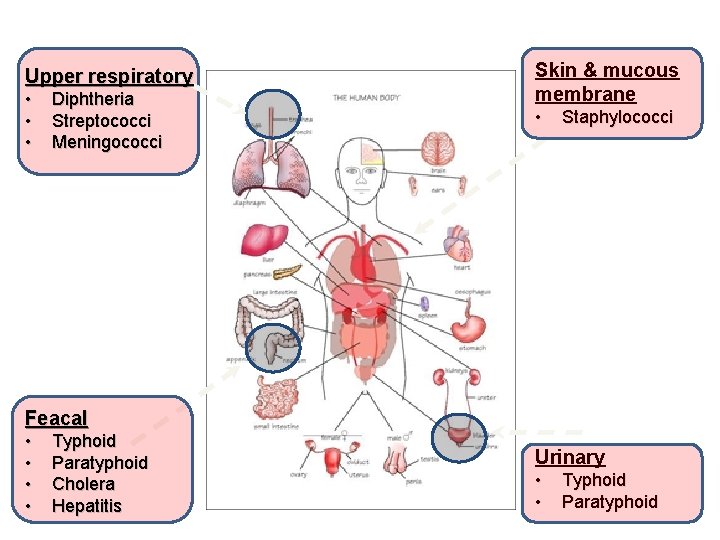
Upper respiratory • • • Diphtheria Streptococci Meningococci Skin & mucous membrane • Staphylococci Feacal • • Typhoid Paratyphoid Cholera Hepatitis Urinary • • Typhoid Paratyphoid
Portal Of Exit The modes of exit from reservoirs are: 1. Alimentary canal: In feces as typhoid, paratyphoid, cholera, In vomitus as in cholera In certain diseases where the primary sites of infection is the bowel, the organisms will pass through the feces e. g. . polio (affects CNS) and hepatitis A. 2. Respiratory tract: organisms will leave the body via the mouth and nose in coughing, sneezing, laughing or even talking. Examples: in measles. Whooping cough, diphtheria, streptococcal sore throat, influenza, common cold, mumps, etc.
3. Urinary tract: This occurs in some diseases where infection is general and organisms are found in blood. Examples: typhoid, bilharziasis , genito-urinary tract 4. Discharges from skin & mucous lesions Discharges from mucous membrane as in purulent conjunctivitis and venereal diseases. 5. Ø Ø Ø 6. Insect bites Mosquitoes: malaria. Lice; typhus Fleas: plague. Syringes and taking blood from donors; viral hepatitis & AIDS. 7. In-utero passage (trans-placental): as in AIDS, Syphilis and German measles.
(4) MODES OF TRANSMISSION
Modes Of Transmission Ø different ways, the transmitted from the reservoir or source of infection to a susceptible individual in depending upon the Ø infectious agent, Ø portal of entry and Ø the local ecological conditions. Ø infectious disease may transmitted Ø by only one route, e. g. , typhoid fever by vehicle transmission Ø others which may be transmitted by several routes e. g. , AIDS, salmonellosis, hepatitis B, brucellosis, Q fever v The multiple transmission routes enhance the survival of the infectious agent.
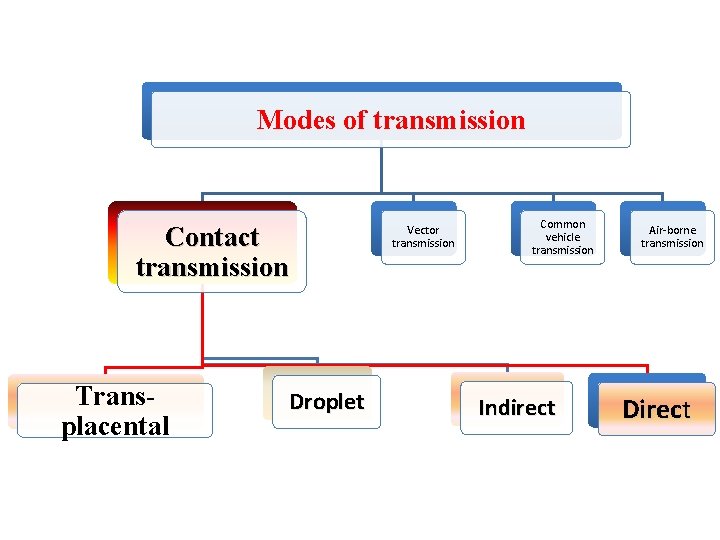
The mode of transmission of infectious diseases may be classified as A Direct Transmission 1. Direct contact 2. Droplet infection 4. Inoculation into skin or mucosa 5. Transplacental (vertical. B Indirect Transmission 1. Vehicle-borne 2. Vector-borne a. Mechanical b. Biological 3. Air-borne a. Droplet nuclei b. Dust 4. Fomite-borne 5. Unclean hands and fingers
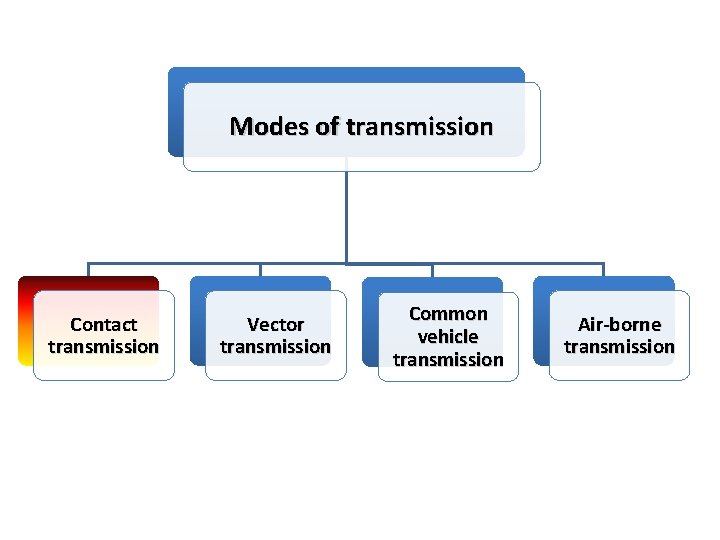
Modes of transmission Contact transmission Vector transmission Common vehicle transmission Air-borne transmission
Modes of transmission Contact transmission Transplacental Droplet Vector transmission Common vehicle transmission Indirect Air-borne transmission Direct
( 1) Direct contact : Infection may be transmitted by direct contact from skin to skin, mucosa to mucosa, or mucosa to skin of the same or another person. This implies direct and essentially immediate transfer of infectious agents from the reservoir or source to a susceptible individual, without an intermediate agency without a third object, e. g. , skin-to-skin contact as by touching, kissing or sexual intercourse or continued close contact. Direct contact not only reduces the period for which the organism will have to survive outside the human host but also ensures a larger dose of infection. Diseases transmitted by direct contact include STI and AIDS, leprosy, skin and eye infections.
(2) Droplet infection : This is direct projection of a spray of droplets of saliva and nasopharyngeal secretions during coughing, sneezing, or speaking and spitting, talking into the surrounding atmosphere. The expelled droplets may hit directly the conjunctiva, or respiratory mucosa or skin of a close contact. Particles of 10 mm or greater in diameter are filtered off by nose. Those 5 mm or less can penetrate deeply and reach the alveoli. v The droplet spread is usually, limited to Ø a distance of 30 -60 cm between source and host. Ø these droplets, which may contain millions of bacteria and viruses Ø can be a source of infection to others. Ø The potential for droplet spread is increased in conditions of Ø close proximity, overcrowding and lack of ventilation Ø Diseases transmitted by droplet spread include many respiratory infections common cold, diphtheria, whooping cough, TB, meningococcal meningitis, etc.
(3) Inoculation into skin or mucosa : The disease agent may be inoculated directly into the skin or mucosa e. g. , rabies virus by dog bite, hepatitis B, C virus through contaminated needles and syringes etc. , and Transplacental (or vertical) transmission In-utero passage : Disease agents can be transmitted transplacentally. This is another form of direct transmission. Examples include the so-called TORCH agents (Toxoplasma gondii, rubella virus, cytomegalo virus and herpes virus), varicella virus, syphilis, hepatitis B, C, and AIDS. In these cases, the disease agent produces malformations of the embryo by disturbing its development. 4)
B Indirect transmission This embraces a variety of mechanisms including the traditional 5 F's - "flies, fingers, fomites, food and fluid". An essential requirement for indirect transmission is that the infectious agent must be capable of surviving outside the human host in the external environment and retain its basic properties of pathogenesis and virulence till it finds a new host. This depends upon the characteristics of the agent, the inanimate object and the influence of environmental factors such as temperature and humidity. If the disease agent acquires drug resistance, it will further facilitate its spread. Indirect transmission can occur in a variety of settings : The spread of infection is though touching contaminated objects as toys, handkerchiefs, soiled clothing towels. Organisms will be transmitted from hands to mouth, or from hands to abraded skin or mucus membranes; Examples: conjunctivitis, skin infections, diphtheria, spreading hospital infections particularly to surgical wounds
B Indirect transmission v This incloud a variety of mechanisms including the traditional 5 F's "flies, fingers, fomites, food and fluid". v An essential requirement for indirect transmission is that the v infectious agent must be capable of surviving outside the human host in the external environment and retain its basic properties of pathogenesis and virulence till it finds a new host. v This depends upon v the characteristics of the agent, v the inanimate object and v the influence of environmental factors such as temperature and humidity. Ø If the disease agent acquires drug resistance, it will further facilitate its spread. Indirect transmission can occur in a variety of settings :
1 Vehicle-borne v v It implies transmission of the infectious agent through the agency of water, food (including raw vegetables, fruits, milk and milk products), ice, blood, serum, plasma or other biological products such as tissues and organs. q Of these water and food are the most frequent vehicles of transmission, because they are used by everyone. q The infectious agent v may have multiplied or developed in the vehicle (e. g. , S. aureus in food) before being transmitted; or v only passively transmitted in the vehicle (e. g. , HAV in water}.
Cont. . . Vehicle-borne v Diseases transmitted by water and food include chiefly infections of the alimentary tract, e. g. , acute diarrhoeas, typhoid fever, cholera, polio, hepatitis A, food poisoning and intestinal parasites. v Those transmitted by blood include hepatitis B, C, malaria, syphilis, brucellosis, infectious mononucleosis and cytomegalovirus infection. v Organ transplantation may result in the introduction of the disease agent such as cytomegalovirus in association with kidney transplants.
The epidemiological features of vehicle transmission are : (a)if the dose of contamination is heavy, the outbreak may be explosive as in the case of cholera and hepatitis A epidemics (b) cases are initially confined to those who are exposed to the contaminated vehicle, in some infections (c) when secondary cases occur, the primary case may be obscured (d) the distance travelled by the infectious agent may be great, e. g. , outbreaks of food poisoning (e) it is not always possible to isolate the infectious agent in the incriminated vehicle, e. g. , typhoid bacilli in contaminated water (f) when the vehicle is controlled or withdrawn, the epidemic subsides, e. g. , epidemics of cholera, and (g} the common source of infection is often traceable.
2. Vector-borne q In infectious disease epidemiology, vector is defined as v an arthropod or any living carrier (e. g. , snail) that v transports an infectious agent to a susceptible individual. q Transmission by a vector may be v mechanical or v biological. v In the latter case, the disease agent passes through a developmental cycle or multiplication in the vector.