
Infectious diseases of the dog and cat The


- Slides: 52
Infectious diseases of the dog and cat
The Respiratory tract u Canine Distemper u Canine Adenovirus type 2 u Parainfluenza virus 2 u Canine Herpesvirus 1
Distemper u Paramyxovirus u Disease of Canidae, seals, dolphins… u Serologically unique u Virus strains differ in virulence u Not very resistant
r e p m e st i D Patogenesis Respiratory infection - aerosol u Primary replication in macrophages of upper respiratory tract (within 24 hours) and subsequently in macrophages and lymphocytes (lymph nodes, tonziles) u 6 days following infection, first wave of fever and lymphopenia u Critical period: 8 -10 days p. i. u Virus dissemination in epithelial cells and CNS u
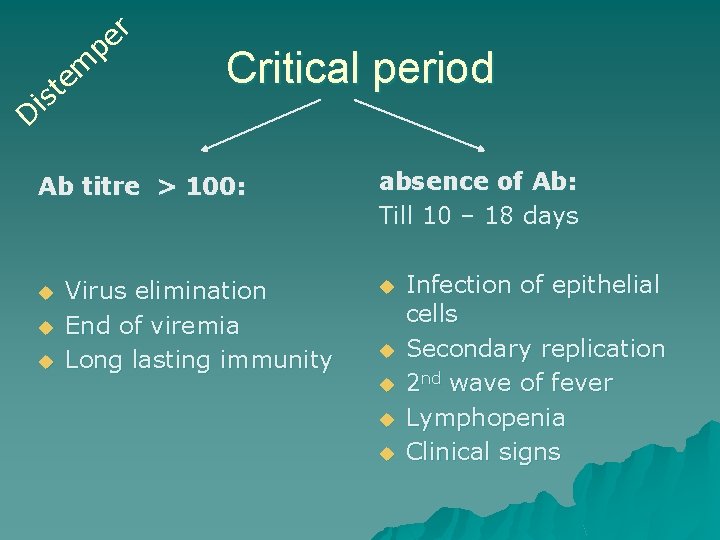
r e p m e st i D Critical period Ab titre > 100: u u u Virus elimination End of viremia Long lasting immunity absence of Ab: Till 10 – 18 days u u u Infection of epithelial cells Secondary replication 2 nd wave of fever Lymphopenia Clinical signs
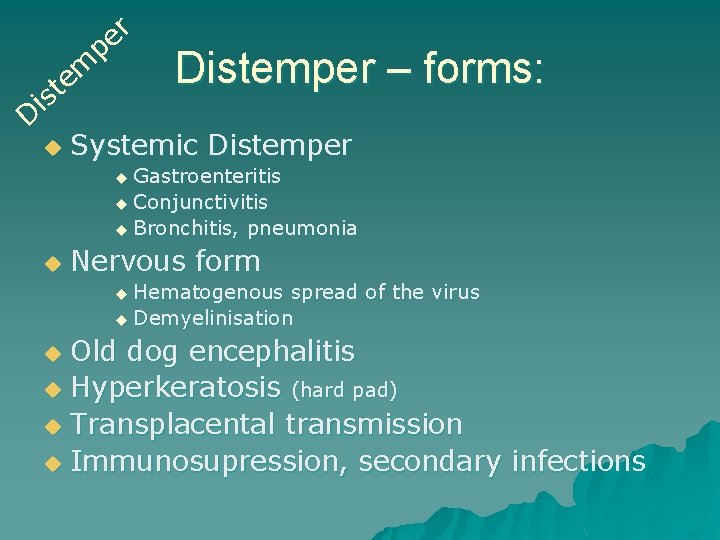
r e p m e st i D u Distemper – forms: Systemic Distemper u Gastroenteritis u Conjunctivitis u Bronchitis, u pneumonia Nervous form u Hematogenous spread of the virus u Demyelinisation Old dog encephalitis u Hyperkeratosis (hard pad) u Transplacental transmission u Immunosupression, secondary infections u
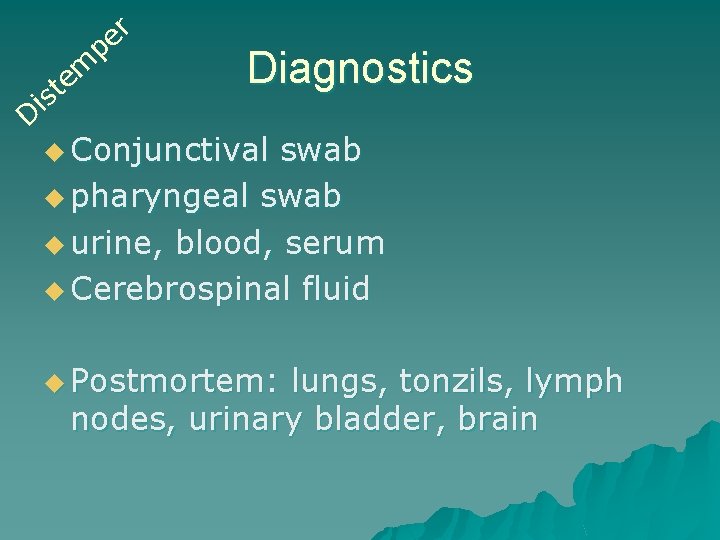
r e p m e st i D Diagnostics u Conjunctival swab u pharyngeal swab u urine, blood, serum u Cerebrospinal fluid u Postmortem: lungs, tonzils, lymph nodes, urinary bladder, brain
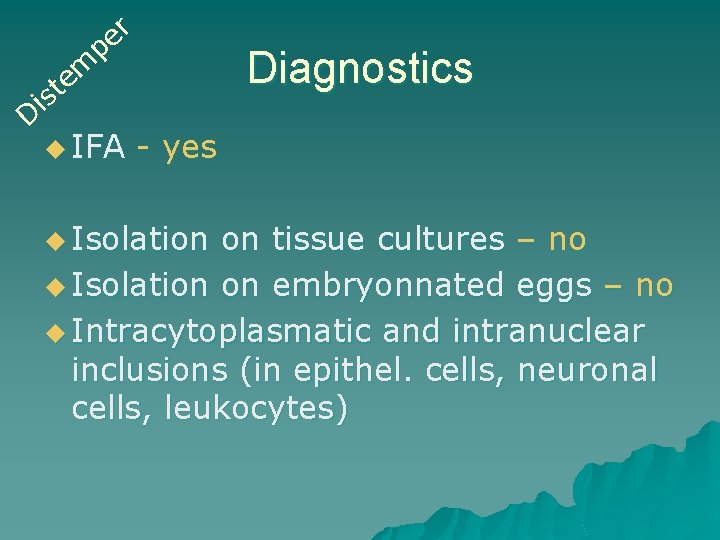
r e p Diagnostics m e st i D u IFA - yes u Isolation on tissue cultures – no u Isolation on embryonnated eggs – no u Intracytoplasmatic and intranuclear inclusions (in epithel. cells, neuronal cells, leukocytes)
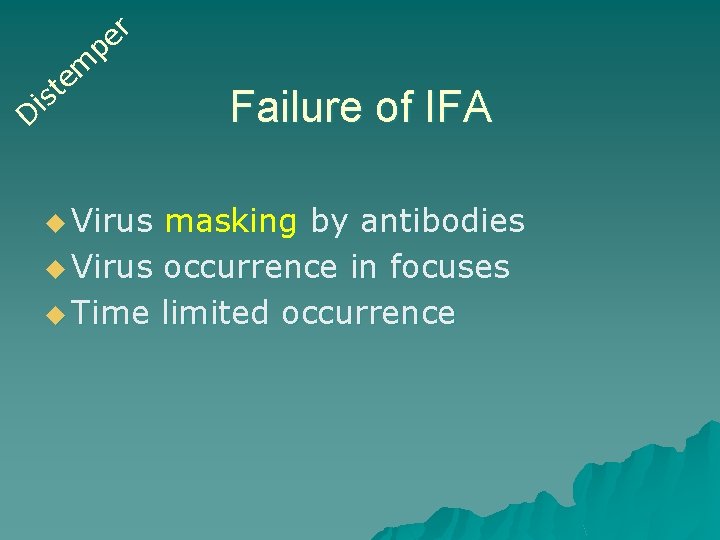
r e p m e st i D u Virus Failure of IFA masking by antibodies u Virus occurrence in focuses u Time limited occurrence
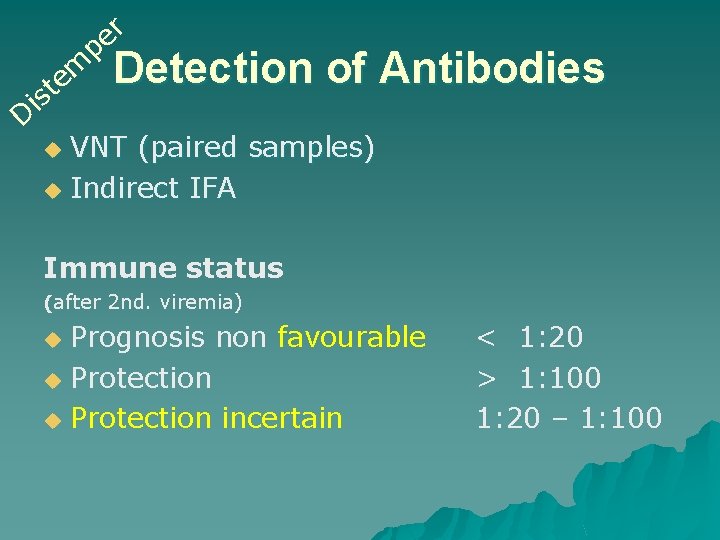
r e p D is m e t Detection of Antibodies VNT (paired samples) u Indirect IFA u Immune status (after 2 nd. viremia) Prognosis non favourable u Protection incertain u < 1: 20 > 1: 100 1: 20 – 1: 100
r e p D is m e t Analysis u Used of cerebrospinal fluid to confirm CDV encephalopathy u Detection of specific Ig. M and Ig. G in the CSF-acute Distemper
Kennel cough u Viruses: – Parainfluenza virus 2 – Adenovirus type 2 u Replication in the lower part of the respiratory tract
Bacterial and fungal infections in the respiratory system (RS) u Nasal infections (acute/ chronic diseases, mycoses) u Upper RT (kennel cough) u Lower RT
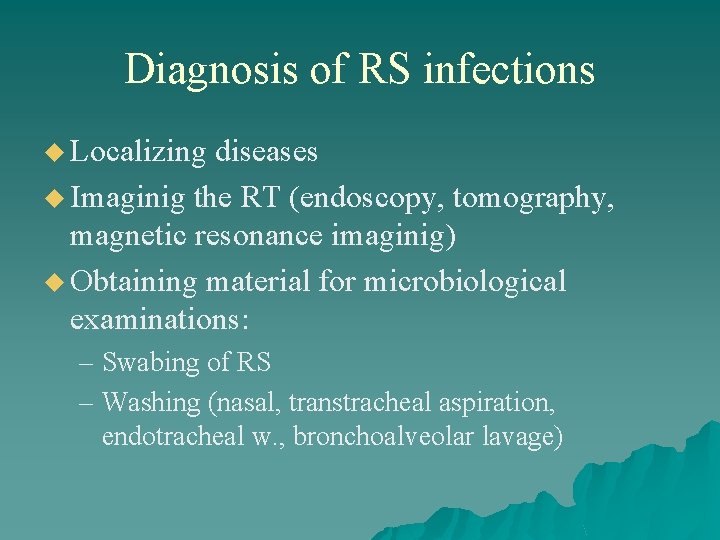
Diagnosis of RS infections u Localizing diseases u Imaginig the RT (endoscopy, tomography, magnetic resonance imaginig) u Obtaining material for microbiological examinations: – Swabing of RS – Washing (nasal, transtracheal aspiration, endotracheal w. , bronchoalveolar lavage)
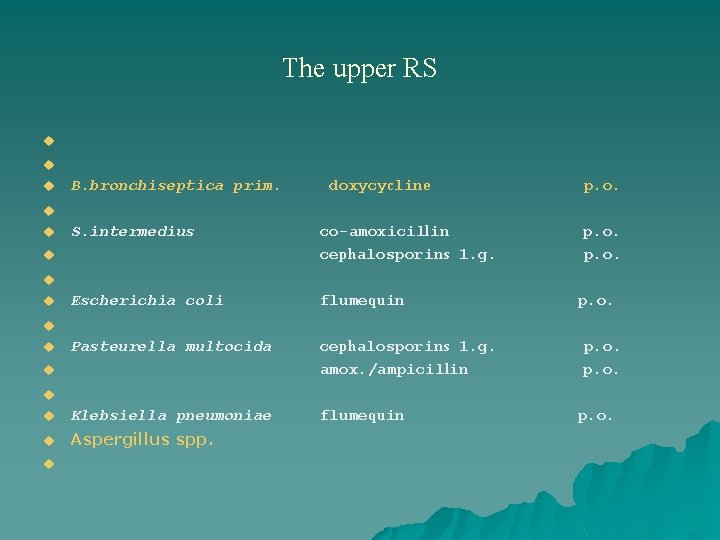
The upper RS u u u B. bronchiseptica prim. doxycycline p. o. u S. intermedius co-amoxicillin cephalosporins 1. g. Escherichia coli flumequin Pasteurella multocida cephalosporins 1. g. amox. /ampicillin u Klebsiella pneumoniae flumequin u Aspergillus spp. u u p. o. u u u p. o.
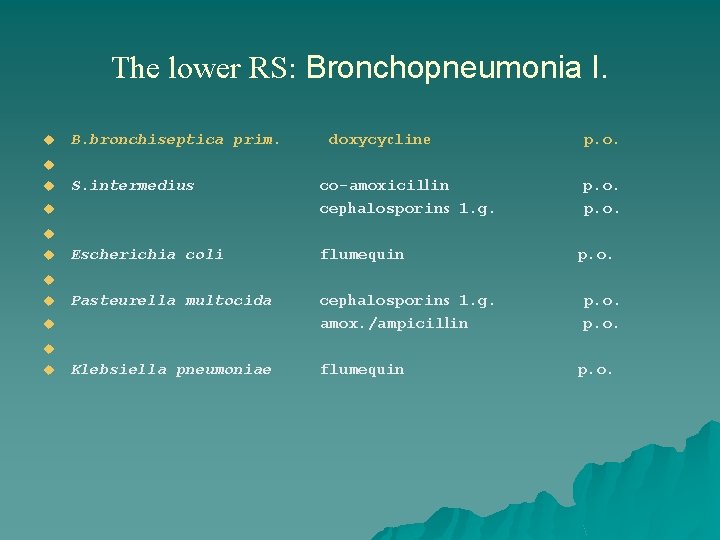
The lower RS: Bronchopneumonia I. u B. bronchiseptica prim. doxycycline p. o. u u S. intermedius co-amoxicillin cephalosporins 1. g. Escherichia coli flumequin Pasteurella multocida cephalosporins 1. g. amox. /ampicillin Klebsiella pneumoniae flumequin u p. o. u u u p. o.
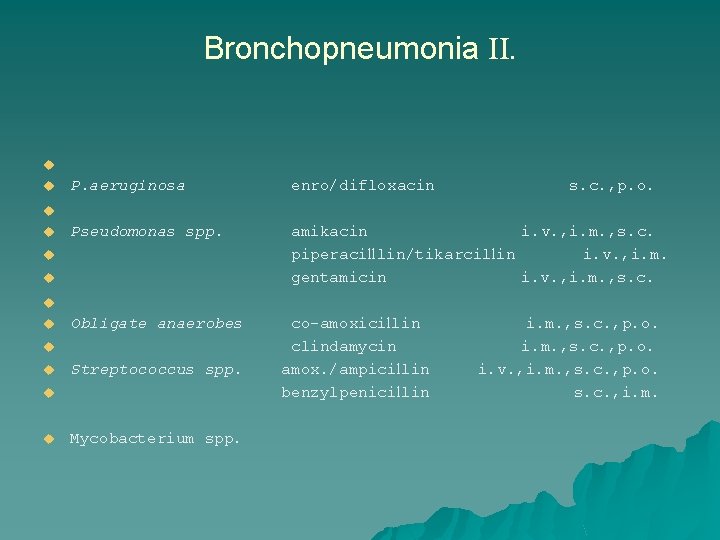
Bronchopneumonia II. u u P. aeruginosa enro/difloxacin s. c. , p. o. Pseudomonas spp. amikacin i. v. , i. m. , s. c. piperacilllin/tikarcillin i. v. , i. m. gentamicin i. v. , i. m. , s. c. u u u Obligate anaerobes u u Streptococcus spp. u u Mycobacterium spp. co-amoxicillin clindamycin amox. /ampicillin benzylpenicillin i. m. , s. c. , p. o. i. v. , i. m. , s. c. , p. o. s. c. , i. m.
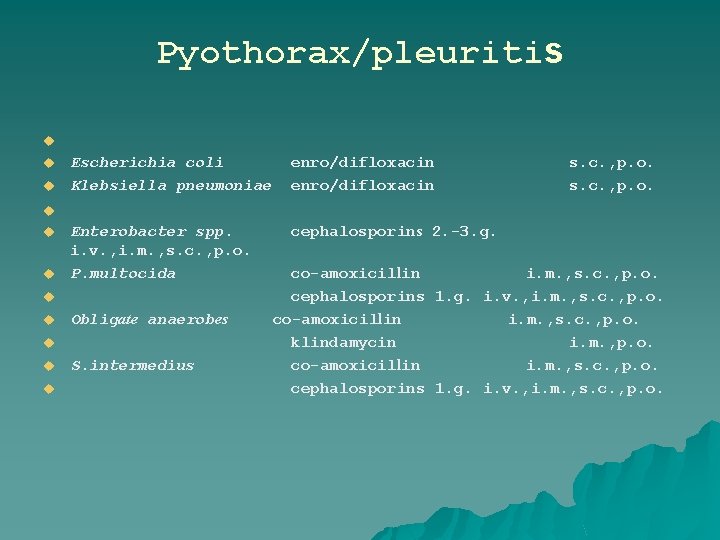
Pyothorax/pleuritis u u u Escherichia coli Klebsiella pneumoniae enro/difloxacin Enterobacter spp. i. v. , i. m. , s. c. , p. o. P. multocida cephalosporins 2. -3. g. s. c. , p. o. u u u Obligate anaerobes u u u S. intermedius co-amoxicillin i. m. , s. c. , p. o. cephalosporins 1. g. i. v. , i. m. , s. c. , p. o. co-amoxicillin i. m. , s. c. , p. o. klindamycin i. m. , p. o. co-amoxicillin i. m. , s. c. , p. o. cephalosporins 1. g. i. v. , i. m. , s. c. , p. o.
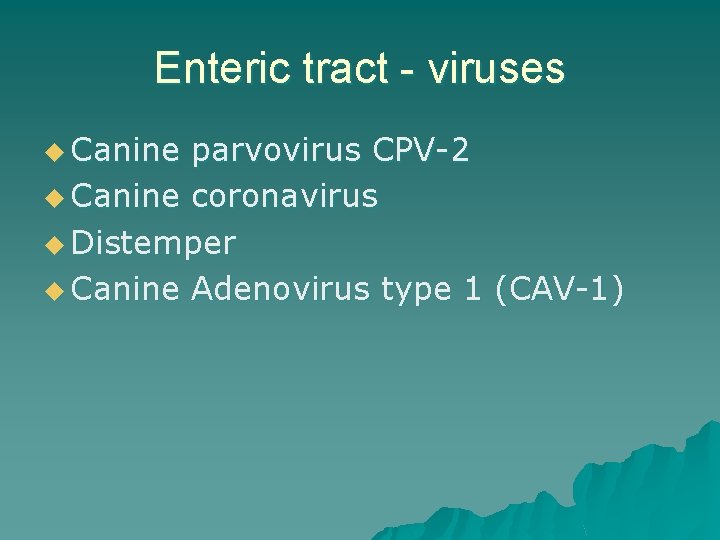
Enteric tract - viruses u Canine parvovirus CPV-2 u Canine coronavirus u Distemper u Canine Adenovirus type 1 (CAV-1)
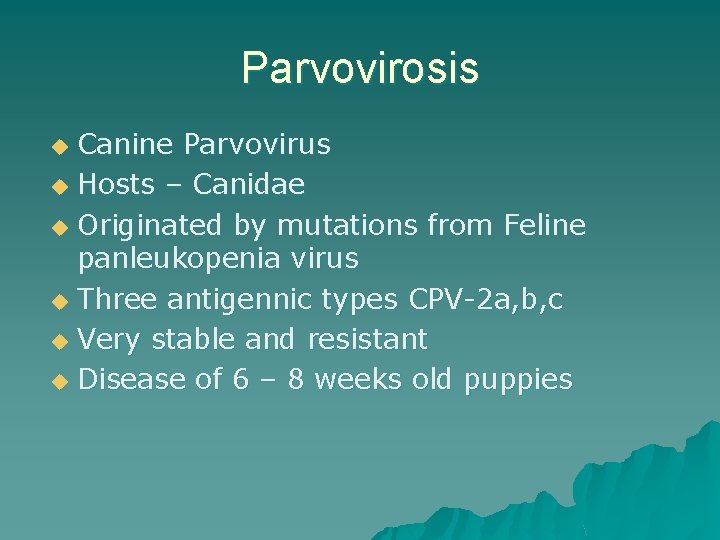
Parvovirosis Canine Parvovirus u Hosts – Canidae u Originated by mutations from Feline panleukopenia virus u Three antigennic types CPV-2 a, b, c u Very stable and resistant u Disease of 6 – 8 weeks old puppies u
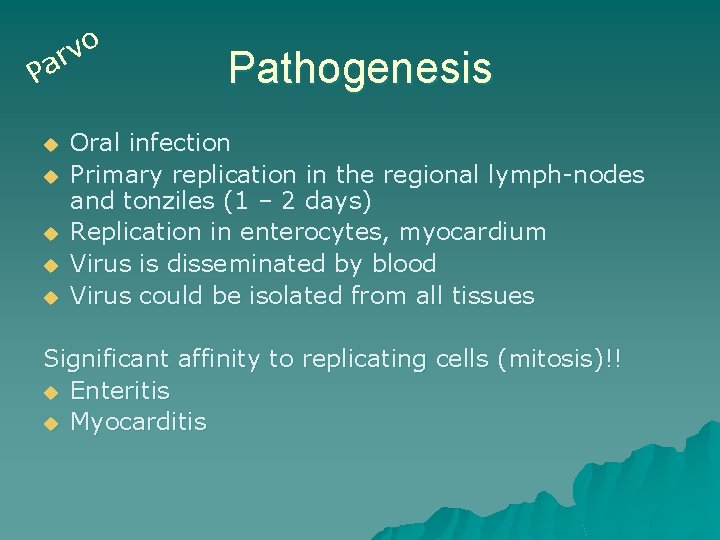
o v r Pa u u u Pathogenesis Oral infection Primary replication in the regional lymph-nodes and tonziles (1 – 2 days) Replication in enterocytes, myocardium Virus is disseminated by blood Virus could be isolated from all tissues Significant affinity to replicating cells (mitosis)!! u Enteritis u Myocarditis
o v r a P Transplacental infection Acute myocarditis in 3 – 8 weeks Mortality 20 – 100%
o v ar P u Virus Pathogenesis replicates in non-mature enterocytes u Transient lymphodepletion and neutropenia…. . bacterias (sepsis) and viruses.
o v r Pa Diagnosis Hemmaglutination test (porcine erytrocytes) u Virus isolation on A 72, CRFK – no! u Rapid immunochromatographic tests u
o v r Pa Serological tests Hemmaglutination inhibition test u titres >80 are protective u Colostral antibodies persist till 8 – 16 weeks of age u 4 fold rise is significant u
a n o r o C Canine Coronavirus Mild infection, often asymptomatic u 70% Ab positive dogs u Age: 1 -3 months u Incubation period 3 -4 days u Involvement of small intestine, replication in mature enterocytes on the apical surface of intestinal villi, virus shedding up to 2 weeks u Watery yellow-green diarrhea u
a n o r o C Diagnosis Serology -meaningless- low titre of systemic Ig. G u Paired samples u u u EM, FA, Cell cutures Inaktivated vaccine – interference with colostral antibodies
The alimentary tract infections u The oral cavity, pharynx u The stomach u The intestine
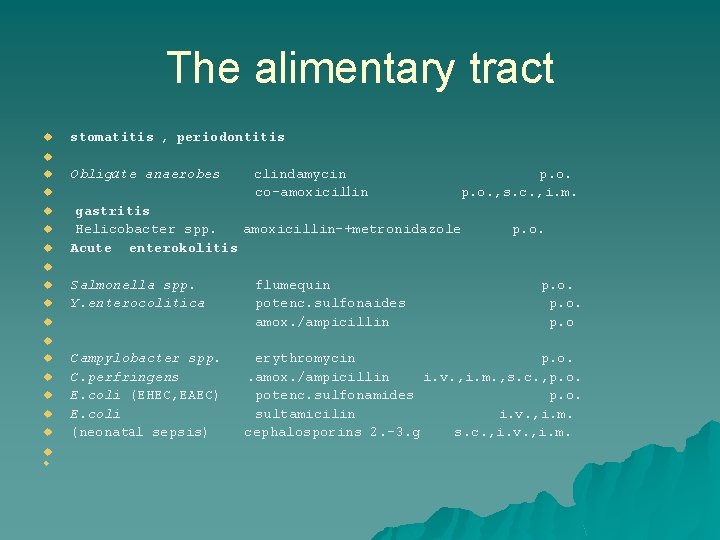
The alimentary tract u stomatitis , periodontitis u u Obligate anaerobes u u clindamycin co-amoxicillin p. o. , s. c. , i. m. gastritis Helicobacter spp. amoxicillin-+metronidazole Acute enterokolitis p. o. u u u Salmonella spp. Y. enterocolitica u flumequin potenc. sulfonaides amox. /ampicillin p. o u u u u Campylobacter spp. C. perfringens E. coli (EHEC, EAEC) E. coli (neonatal sepsis) erythromycin p. o. . amox. /ampicillin i. v. , i. m. , s. c. , p. o. potenc. sulfonamides p. o. sultamicilin i. v. , i. m. cephalosporins 2. -3. g s. c. , i. v. , i. m.
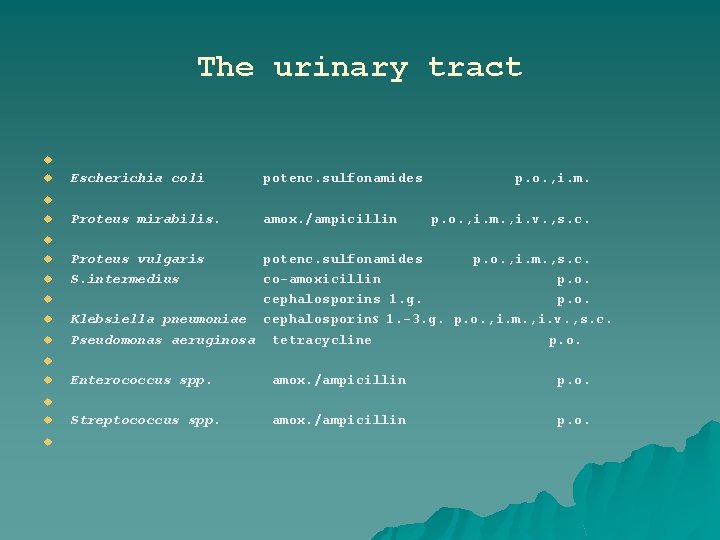
The urinary tract u u Escherichia coli potenc. sulfonamides Proteus mirabilis. amox. /ampicillin p. o. , i. m. u u p. o. , i. m. , i. v. , s. c. u u u Proteus vulgaris S. intermedius potenc. sulfonamides p. o. , i. m. , s. c. co-amoxicillin p. o. cephalosporins 1. g. p. o. Klebsiella pneumoniae cephalosporins 1. -3. g. p. o. , i. m. , i. v. , s. c. Pseudomonas aeruginosa tetracycline p. o. u u Enterococcus spp. amox. /ampicillin p. o. Streptococcus spp. amox. /ampicillin p. o. u u u
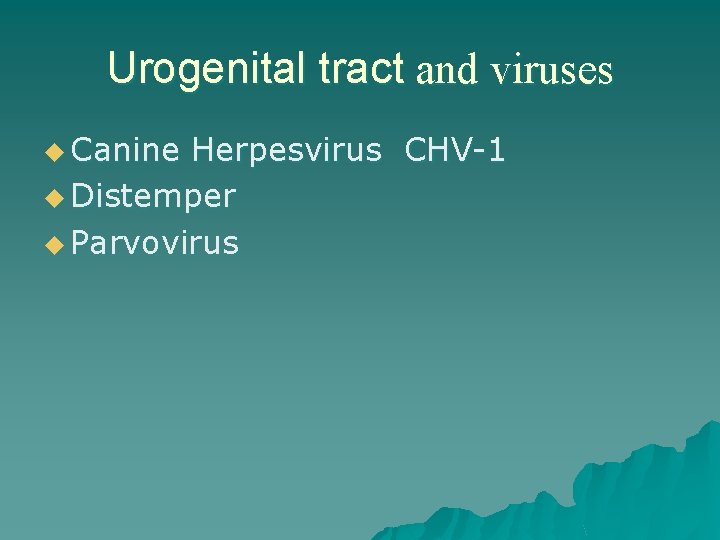
Urogenital tract and viruses u Canine Herpesvirus CHV-1 u Distemper u Parvovirus
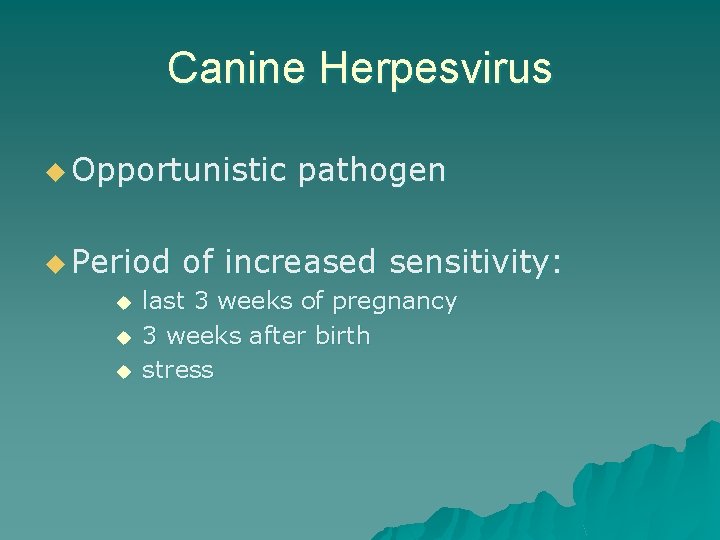
Canine Herpesvirus u Opportunistic u Period u u u pathogen of increased sensitivity: last 3 weeks of pregnancy 3 weeks after birth stress
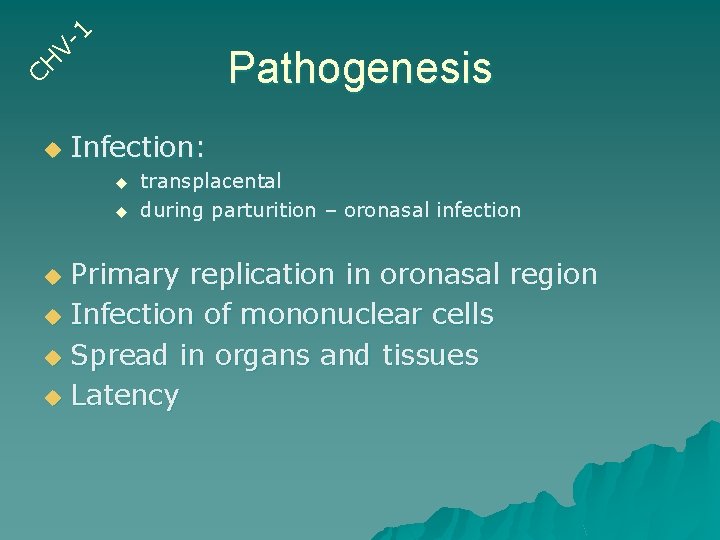
1 CH Vu Pathogenesis Infection: u u transplacental during parturition – oronasal infection Primary replication in oronasal region u Infection of mononuclear cells u Spread in organs and tissues u Latency u
1 CH V- Diagnosis u PCR u Isolation on tissue culture? ? ? (primary canine fibroblasts) CPE within 48 hours u Neutralization u test paired samples
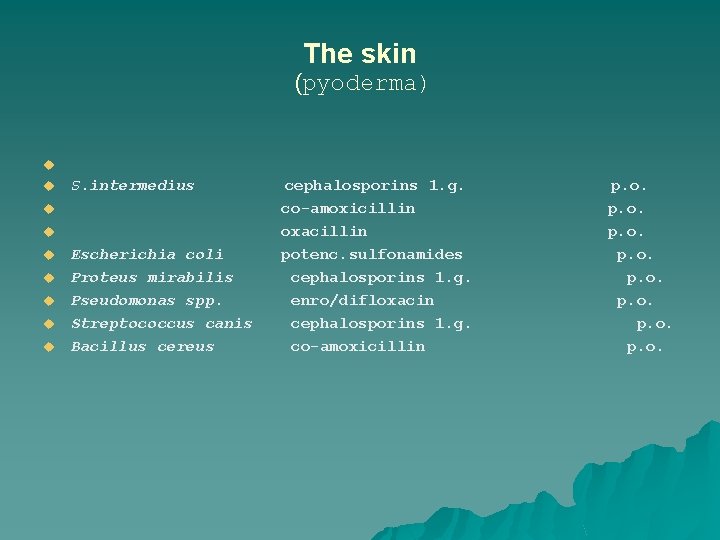
The skin (pyoderma) u u S. intermedius u u u u Escherichia coli Proteus mirabilis Pseudomonas spp. Streptococcus canis Bacillus cereus cephalosporins 1. g. co-amoxicillin oxacillin potenc. sulfonamides cephalosporins 1. g. enro/difloxacin cephalosporins 1. g. co-amoxicillin p. o.
CNS - viruses u Distemper u Rabies
The cat
Enteric Infections u Feline Panleukopenia u Feline infectious peritonitis - FIP
Felina Panleukopenia u Parvovirus u Ag related with other parvoviruses u Oronasal infection u Newborn kittens– systemic or CNS infection u Later – panleukopenia and enteritis
Feline Infectious Peritonitis (FIP) u Coronavirus u Susceptible hosts: felidae u Antigenniv relationship with other coronaviruses (TGEV, CCo. V) u FIP – mutation of ubikvitous feline enteral coronavirus (Fe. CV) u Both viruses differ by macrophage tropism
FI P u Primary Pathogenesis replication – epithelium of tonziles u Replication in enterocytes u Infection of macrophages allows virus spread in the organism
FI P Pathogenesis u Antibodies enhance infection (Fc receptors allows entry into macrophages) u Immunocomplex u Cell mediated response is protective u Effusive - wet form u Non-effusive – dry form (immunity is partially preserved)
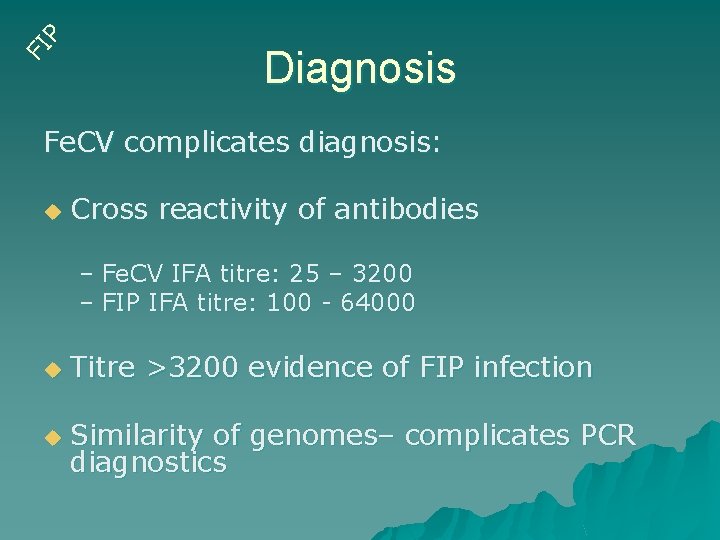
FI P Diagnosis Fe. CV complicates diagnosis: u Cross reactivity of antibodies – Fe. CV IFA titre: 25 – 3200 – FIP IFA titre: 100 - 64000 u Titre >3200 evidence of FIP infection u Similarity of genomes– complicates PCR diagnostics
FIV u Retrovirus u Host – felidae u Main route of infection– bite
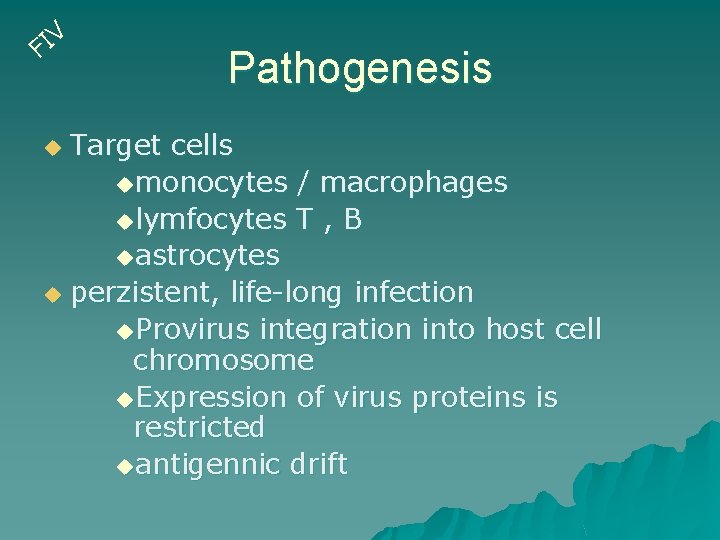
V I F Pathogenesis Target cells umonocytes / macrophages ulymfocytes T , B uastrocytes u perzistent, life-long infection u. Provirus integration into host cell chromosome u. Expression of virus proteins is restricted uantigennic drift u
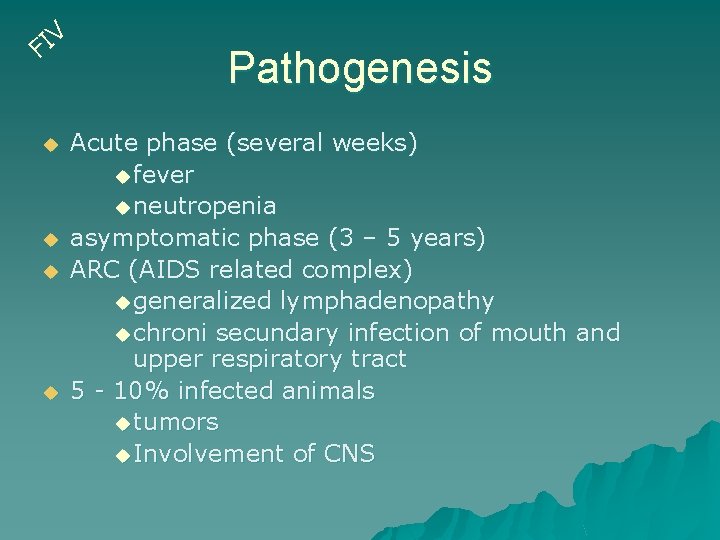
V I F u u Pathogenesis Acute phase (several weeks) u fever u neutropenia asymptomatic phase (3 – 5 years) ARC (AIDS related complex) u generalized lymphadenopathy u chroni secundary infection of mouth and upper respiratory tract 5 - 10% infected animals u tumors u Involvement of CNS
V I F Diagnosis u Antibody detection u ELISA u IFA u Rapid tests u Serological u PCR latency- several weeks – in some laboratories
Feline leukosis virus (Fe. LV) u Retrovirus u Disease of stray animals (1 - 7% of population) u Infection occurs in the first 5 years of life (age resistence) u transmission– salive (bite), urine, feces, in utero
V L e F u 3 Pathogenesis biotypes u Fe. LV-A – Immunosupression, oportunistic infection u Fe. LV-B – Viremia, immunosupression, neoplasia, lymphomas u Fe. LV-C –thymus atrophy, lymphodepletion u permissive cells: macrophages, lymphocytes, non-mature enterocytes u Antibodies are able to eliminate infection
V L e F Pathogenesis Primary replication in macrophages and B lymphocytes in tonziles u Primary viremia (1 -2 weeks), virus is associated with mononuclear cells u Infected cells are in bone marrow, intestine, oesophagus, stomach, kidney, pancreas, urinary bladder u Virus is spread by saliva, urine, tears, feces u
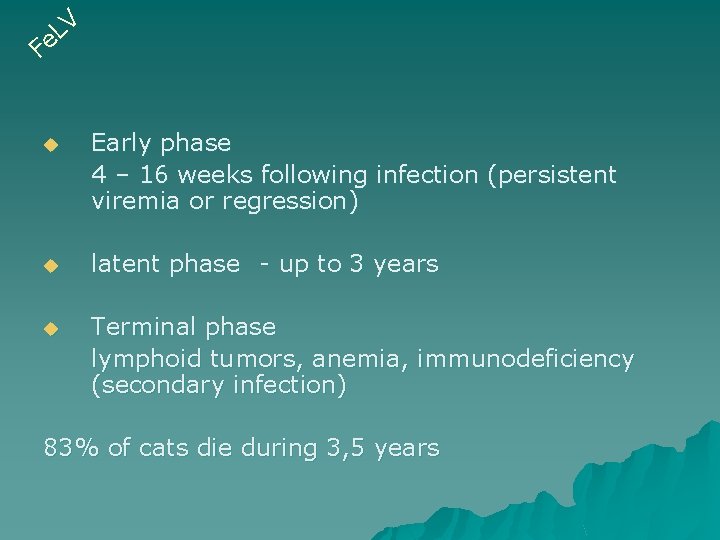
V L e F u Early phase 4 – 16 weeks following infection (persistent viremia or regression) u latent phase - up to 3 years u Terminal phase lymphoid tumors, anemia, immunodeficiency (secondary infection) 83% of cats die during 3, 5 years
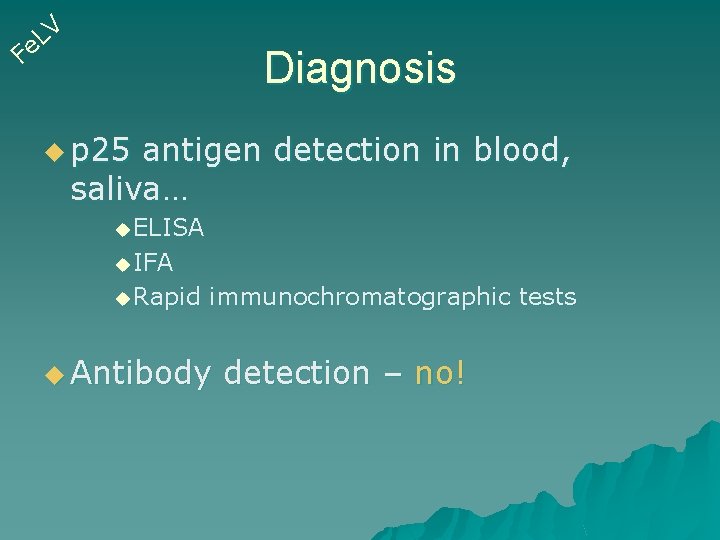
V L e F Diagnosis u p 25 antigen detection in blood, saliva… u ELISA u IFA u Rapid immunochromatographic tests u Antibody detection – no!