
Infectious diseases of Mice and Rats Companion guide
- Slides: 44
Infectious diseases of Mice and Rats Companion guide to infectious diseases of mice and rats, 1991, NRA NDSU-IACUC
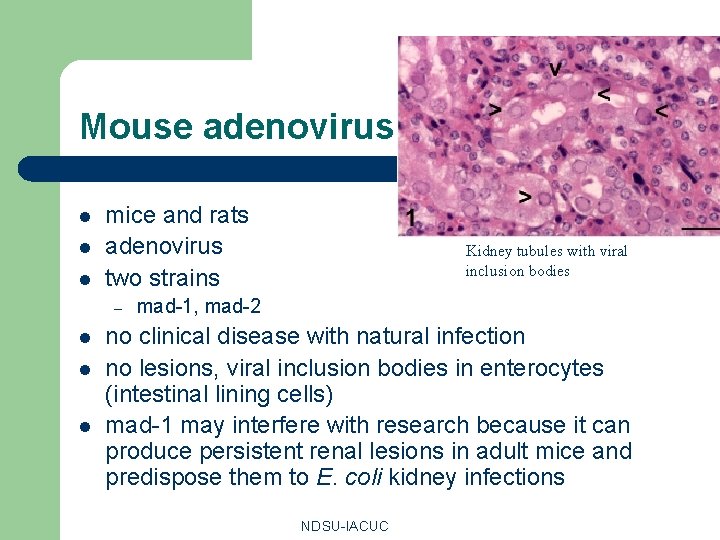
Mouse adenovirus l l l mice and rats adenovirus two strains – l l l Kidney tubules with viral inclusion bodies mad-1, mad-2 no clinical disease with natural infection no lesions, viral inclusion bodies in enterocytes (intestinal lining cells) mad-1 may interfere with research because it can produce persistent renal lesions in adult mice and predispose them to E. coli kidney infections NDSU-IACUC
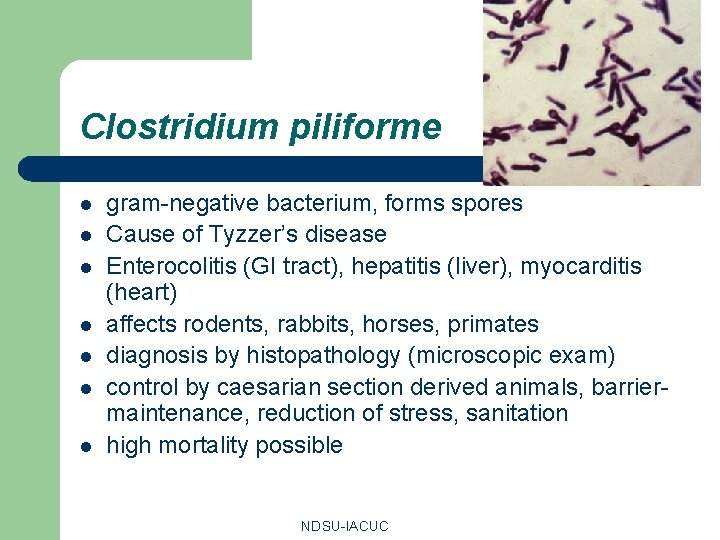
Clostridium piliforme l l l l gram-negative bacterium, forms spores Cause of Tyzzer’s disease Enterocolitis (GI tract), hepatitis (liver), myocarditis (heart) affects rodents, rabbits, horses, primates diagnosis by histopathology (microscopic exam) control by caesarian section derived animals, barriermaintenance, reduction of stress, sanitation high mortality possible NDSU-IACUC
Cilia-associated respiratory (CAR) Bacillus l l l rats, mice and rabbits gram-negative bacterium hunched posture, ruffled coat, inactivity colonizes epithelial cells of airways and causes pulmonary lesions diagnosis by histopathology, electron microscopy affect on research may be a synergism with murine respiratory mycoplasmosis (bacterial respiratory infection) NDSU-IACUC
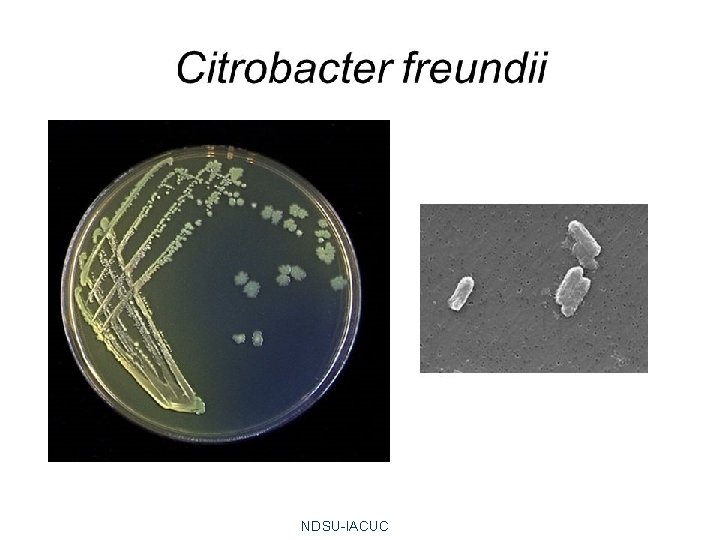
Citrobacter freundii l l l mice gram-negative bacterium fecal/oral transmission causes a hyperplastic (proliferative) and necrotizing colitis (infection of large intestine) diagnosis by histopathology and culture control by depopulation and restocking with csection derived animals NDSU-IACUC
NDSU-IACUC
Corynebacterium kutscheri l l l mice, rats gram positive bacterium pneumonia (rats) and septicemia (mice) renal (kidney) abscesses in mice inapparent and subclinical infections can be a problem clinical disease comes with stress NDSU-IACUC
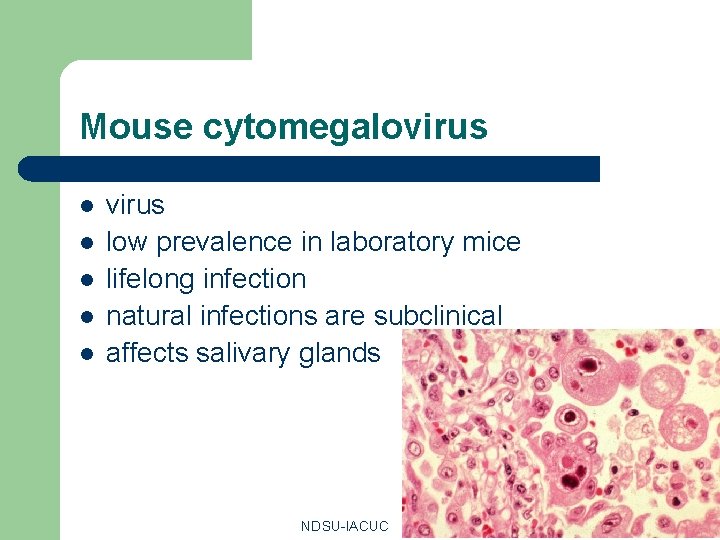
Mouse cytomegalovirus l l l virus low prevalence in laboratory mice lifelong infection natural infections are subclinical affects salivary glands NDSU-IACUC
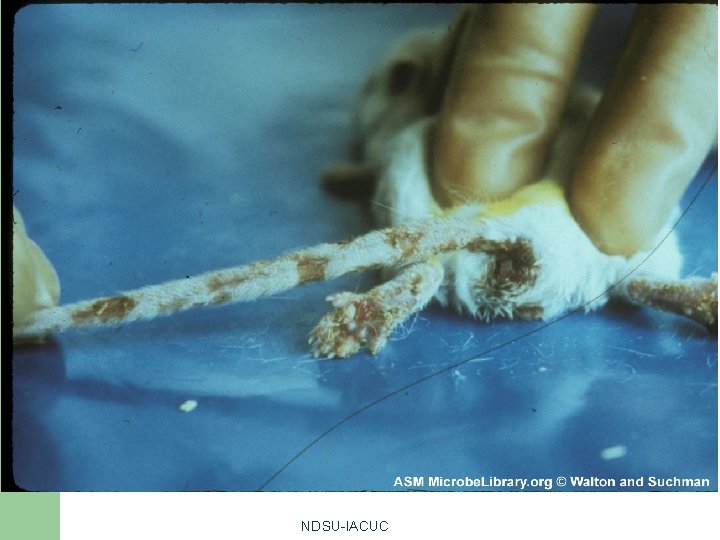
Ectromelia virus (Mousepox) l l l virus affecting mice transmission by contact severity of disease depends upon strain – l l die offs up to 100% papules, erosions, encrustations, tail or limb may fall off necrotizing (destructive) lesions in many organs ELISA test or histopathology for diagnosis Control by quarantine, test, vaccination NDSU-IACUC
NDSU-IACUC
Encephalitozoon cuniculi l l l protozoan rodents, rabbits, humans, many mammals rabbits primary problem – shed in urine Encephalitis (brain) and nephritis (kidney) keep mice and rats away from rabbits diagnosis by FA, immunoperoxidase (special stain), detection of parasites in urine, histopathology NDSU-IACUC
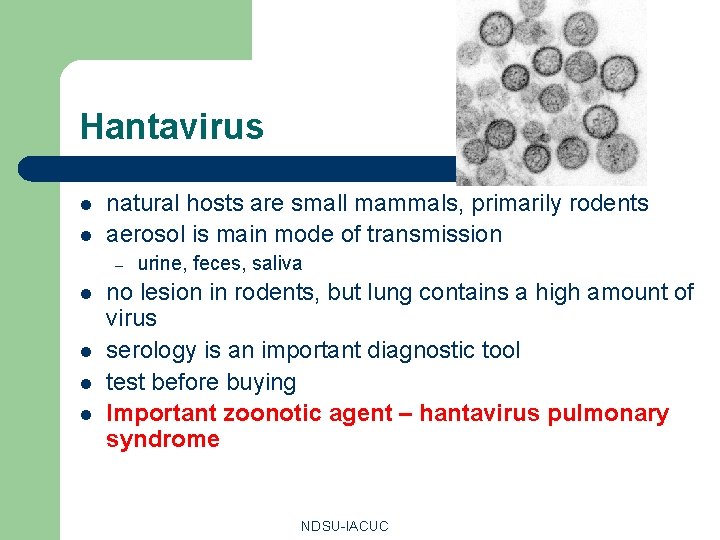
Hantavirus l l natural hosts are small mammals, primarily rodents aerosol is main mode of transmission – l l urine, feces, saliva no lesion in rodents, but lung contains a high amount of virus serology is an important diagnostic tool test before buying Important zoonotic agent – hantavirus pulmonary syndrome NDSU-IACUC
Mouse hepatitis virus l l l l mice contagious, no carrier state exists usually subclinical in immunocompetent mice respiratory pattern and enteric pattern necrotizing hepatitis, giant cells ELISA and FA available Control by barrier protocol, health surveillance, testing NDSU-IACUC
H-1 virus l l lab and wild rats virus shed in urine, feces, nasal secretions, milk natural infections inapparent, no lesions ELISA and FA for screening may interfere with liver research NDSU-IACUC
Kilham rat virus l l l lab and wild rats shed in urine, feces, milk and nasal secretions reproductive inefficiency, cerebellar hypoplasia (reduced in size), jaundice focal necrosis of hepatocytes (liver cells) ELISA and FA can contaminate cell lines and alter cytokine (cellular secretions) responses NDSU-IACUC
Lactate dehydrogenase-elevating virus l l l wild mice are reservoir hosts shed in feces, urine, saliva, milk; transplacental transmission possible natural infections subclinical mild membranous glomerulopathy (kidney damage), age-dependent encephalomyelitis (brain and spinal cord infection) diagnosis by increased plasma lactate dehydrogenase (LDH) (liver enzyme) activity NDSU-IACUC
Murine leukemia virus l l l lab and wild mice vertical transmission (parent to offspring) most common; horizontal (mouse to mouse) through saliva, sputum, urine, feces and milk is possible malignancies occur only 1 -2% of most strains many are solid tumors – lymphomas (lymphocyte tumors) diagnosis by histopathology control not practical since most mice infected NDSU-IACUC
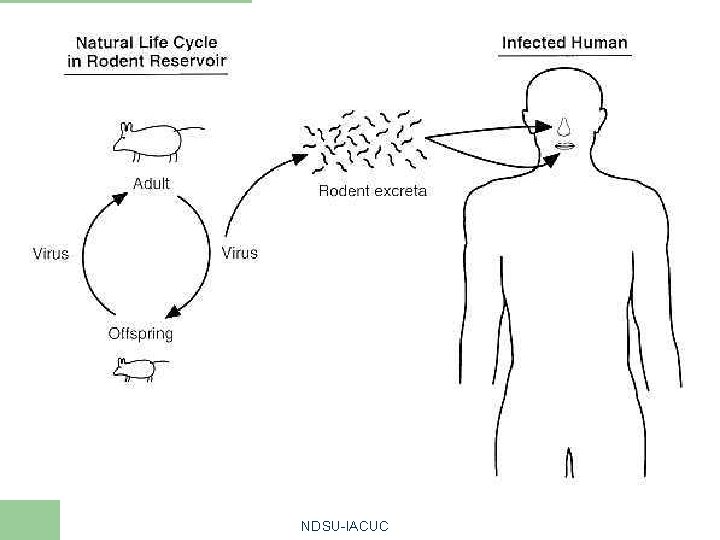
Lymphocytic choriomeningitis virus l l l wild and lab mice, Syrian hamsters are natural hosts humans, monkeys, dogs, rabbits, guinea pigs, rats and chickens susceptible virus shed in urine, saliva, milk lifelong viremia and shedding of virus immune-complex disease, pansystemic – l Virus and antibody deposit in various tissues and cause disease important zoonotic agent NDSU-IACUC
NDSU-IACUC
Mouse mammary tumor virus l l l wild and lab mice four variants identified; milk and germ cell transmission tumors can occur anywhere mammary tissue is located; metastasis to lung is common diagnosis by histopathology control by selecting non-infected strains NDSU-IACUC
Minute virus of mice l l l wild and lab mice wild mice are reservoir hosts highly contagious; transmission by direct contact with urine and feces natural infections inapparent, no pathogenic changes with natural infections ELISA and FA, choose virus free stock NDSU-IACUC
Mycoplasma arthriditis l l l gram-negative bacterium rats and mice affected infection subclinical, disease rare ELISA for screening can cause spontaneous polyarthritis (multiple joint infections) in rats NDSU-IACUC
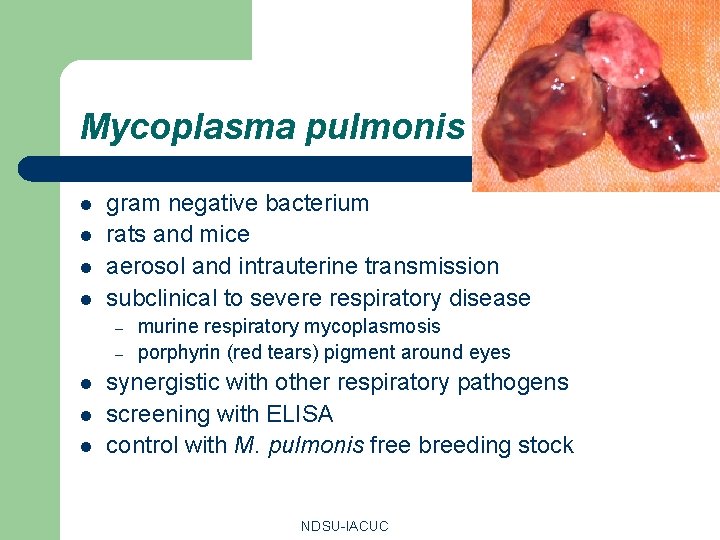
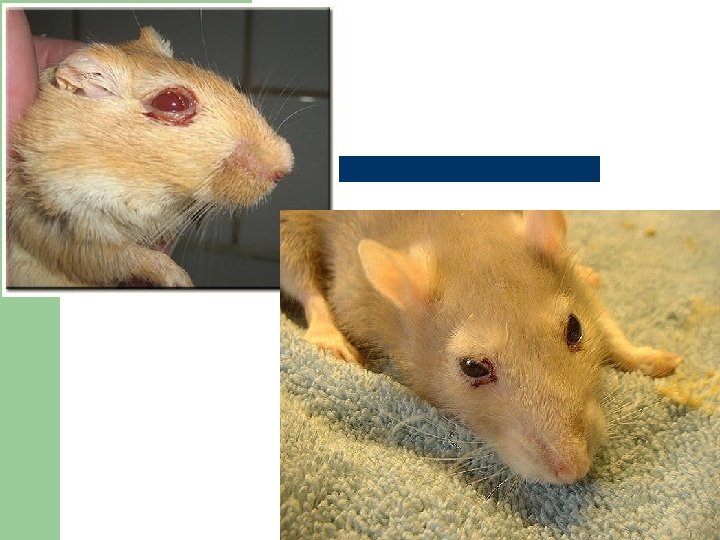
Mycoplasma pulmonis l l gram negative bacterium rats and mice aerosol and intrauterine transmission subclinical to severe respiratory disease – – l l l murine respiratory mycoplasmosis porphyrin (red tears) pigment around eyes synergistic with other respiratory pathogens screening with ELISA control with M. pulmonis free breeding stock NDSU-IACUC
NDSU-IACUC
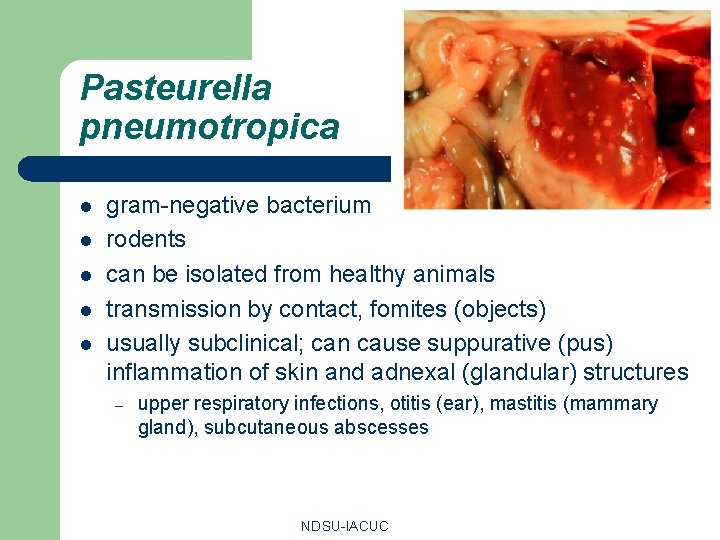
Pasteurella pneumotropica l l l gram-negative bacterium rodents can be isolated from healthy animals transmission by contact, fomites (objects) usually subclinical; can cause suppurative (pus) inflammation of skin and adnexal (glandular) structures – upper respiratory infections, otitis (ear), mastitis (mammary gland), subcutaneous abscesses NDSU-IACUC
Pneumocystis carinii l l l protozoa mice, rats, humans, several mammals ubiquitous, pulmonary disease (pneumonia) in immunocompromised hosts transmission by inhalation of cysts diagnosis by identifying cysts subclinical infections common NDSU-IACUC
Pneumonia virus of mice l l l virus mice, rats, hamsters transmission by aerosol usually subclinical, pneumonia in immunocompromised hosts ELISA available control through barrier maintenance and csection derived animals NDSU-IACUC
Polyomavirus l l l virus wild and lab mice rare; highly contagious; shed in saliva, urine, feces aerosol transmission; feed and bedding as well natural infections inapparent, athymic mice develop wasting syndrome and paralysis of rear legs ELISA available NDSU-IACUC
Pseudomonas aeruginosa l l l l gram-negative bacterium mice, rats, humans, many animal species ubiquitous transmitted by fomites, direct contact fulminant (aggressive and rapid) septicemia and death in immunocompromised hosts isolate and identify control with sanitation NDSU-IACUC
Reovirus-3 l l l l virus rodents fecal/oral transmission natural infections subclinical no lesions ELISA most sensitive test contaminant of some tumor and cell lines NDSU-IACUC
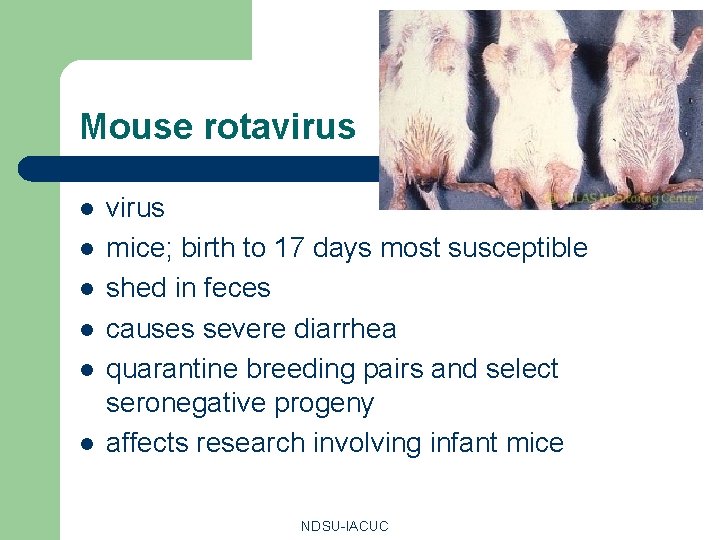
Mouse rotavirus l l l virus mice; birth to 17 days most susceptible shed in feces causes severe diarrhea quarantine breeding pairs and select seronegative progeny affects research involving infant mice NDSU-IACUC
Salmonella enteriditis l l l l gram-negative bacterium mice, rats, humans, many animal species transmission by ingestion asymptomatic chronic shedders acute death to enterocolitis and hepatitis isolate and serotype Important zoonotic agent NDSU-IACUC
Sendai virus l l l l virus mice, rats, hamsters, guinea pigs contagious, respiratory transmission susceptibility strain and species dependent bronchitis, bronchiolitis and pneumonia ELISA serology interference with research NDSU-IACUC
Sialodacryoadenitis virus l l l virus rats, mice contagious, transmitted by contact and aerosol Oculonasal (eye/nose) discharge, corneal ulcers affects cervical (neck) salivary glands, upper respiratory tract ELISA and FA available NDSU-IACUC
Staphylococcus aureus l l l l gram-positive bacterium mice, rats, humans, others environmental pathogen dermatitis, abscesses, purulent (pus) inflammation isolate and identify control with sanitation alters host immune response Potential zoonotic agent NDSU-IACUC
Streptobacillus moniliformis l l l gram-negative bacterium rats, mice, guinea pigs, humans transmission by bites, aerosol, fomites upper respiratory tract, septicemia, chronic arthritis culture and identify control with barrier maintenance NDSU-IACUC
Streptococcus pneumoniae l l l l gram-positive bacterium mice, rats, guinea pigs, monkeys human is natural host aerosol transmission respiratory disease suppurative inflammation culture and identify NDSU-IACUC
Theiler’s murine encephalomyelitis virus l l l virus rats and mice fecal/oral transmission clinical disease rare, flaccid paralysis of rear legs Poliomyelitis (infection of spinal cord grey matter) ELISA available NDSU-IACUC
Mouse thymic virus l l l virus wild and lab mice virus shed in saliva natural infections subclinical, no lesions ELISA available alter research involving the passage of tissue in neonatal mice NDSU-IACUC
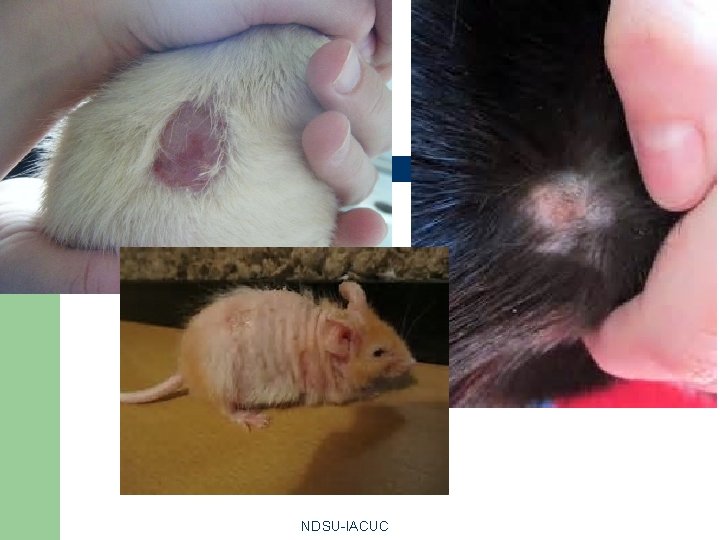
Dermatophytes (ringworm) l l l l fungi Trichophyton, Microsporum affect hair and superficial layers of skin hair loss, scaling, crusting culture and identification cull affected animals, treatment not recommended zoonotic agent NDSU-IACUC
NDSU-IACUC
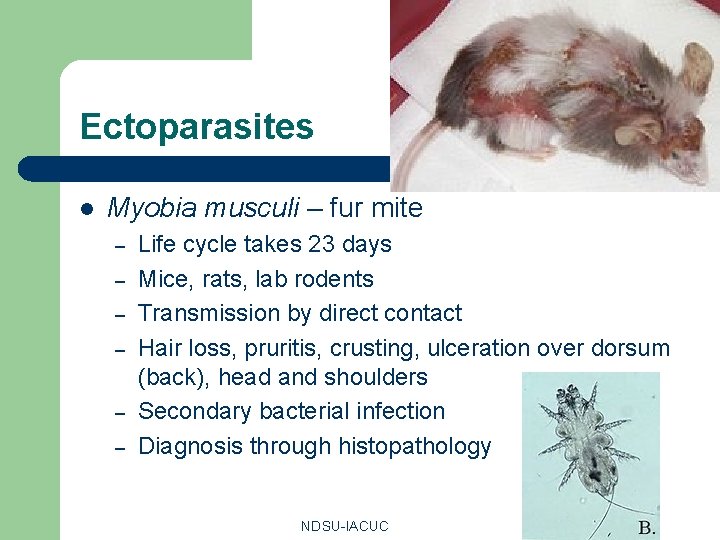
Ectoparasites l Myobia musculi – fur mite – – – Life cycle takes 23 days Mice, rats, lab rodents Transmission by direct contact Hair loss, pruritis, crusting, ulceration over dorsum (back), head and shoulders Secondary bacterial infection Diagnosis through histopathology NDSU-IACUC
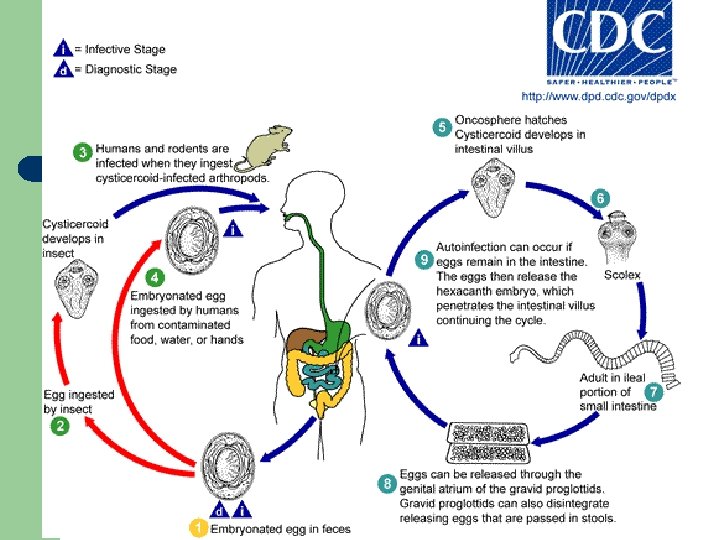
Endoparasites l l l l Aspicularis tetraptera – mouse pinworm Entamoeba muris – protozoa Giardia muris – flagellate Hymenolepis nana – tapeworm (zoonoses) Spironucleus muris – flagellate Syphacia obvelata (mouse) s. muris (rat) – pinworm Trichomonas muris - flagellate NDSU-IACUC
NDSU-IACUC