
INFECTIOUS DISEASES How might disease organisms be spread
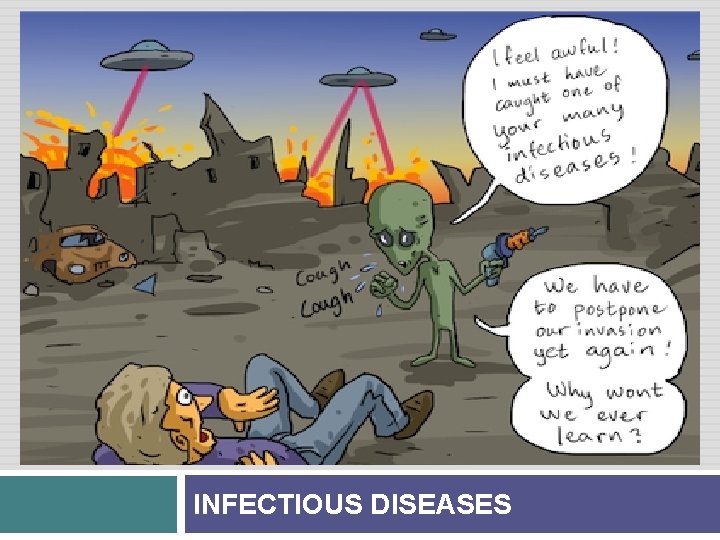
INFECTIOUS DISEASES
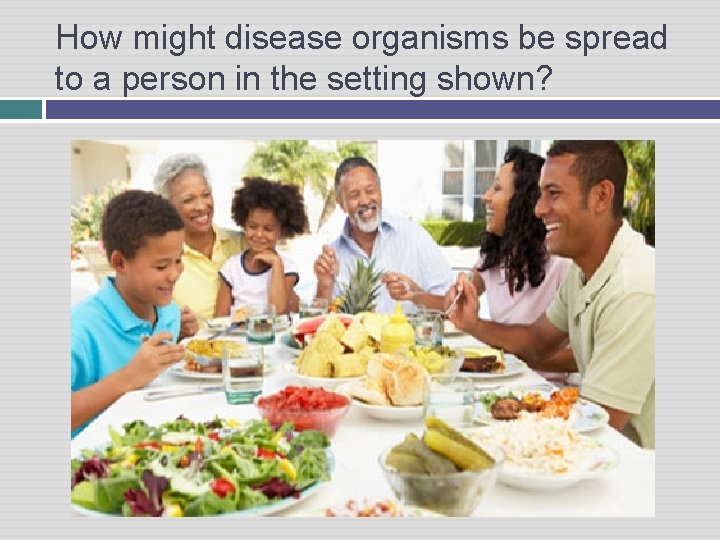
How might disease organisms be spread to a person in the setting shown?
Possible answers include. . . Person to person �Sharing drinks, handling plates/utensils Food to people �Undercooked, cross-contamination Environment to people �Fork dropped on the ground Insects to people �Mosquito/tick bites
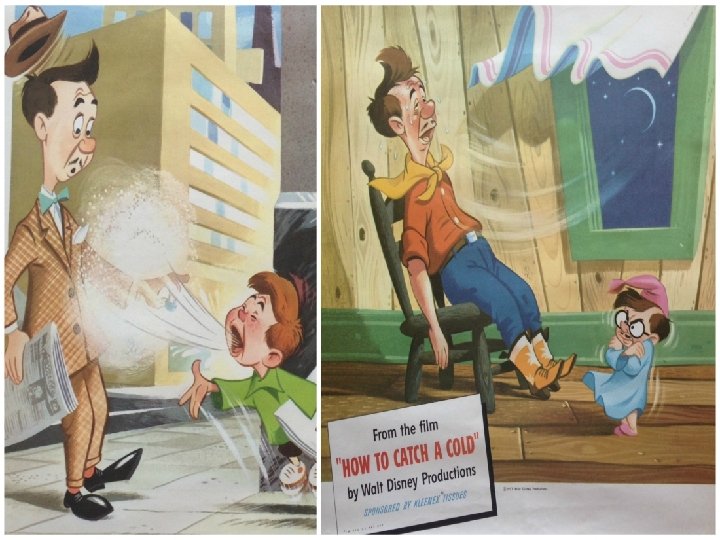
How do you catch a cold? MYTH: You do NOT catch a cold from being cold/exposure to cold temperatures! Could lower immune resistance and make you susceptible though You catch colds from contagious strains of viruses!
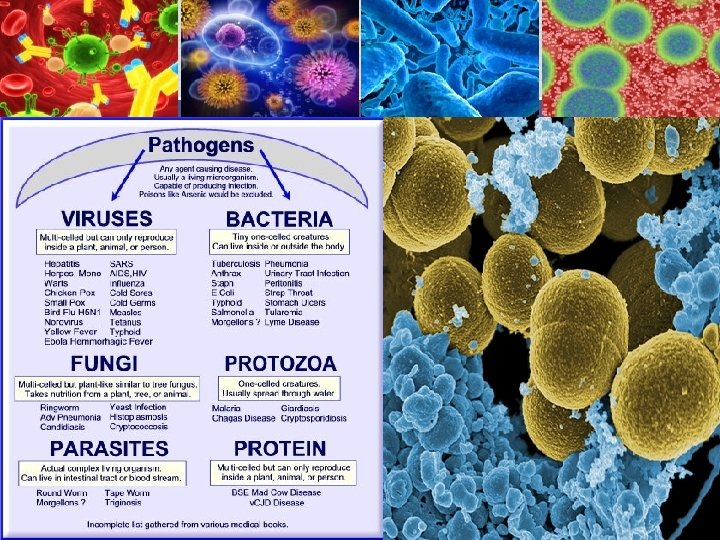
Pathogens Cause Infectious Disease: caused when a pathogen is passed from one organism to another, disrupting homeostasis Pathogens: causes of infectious disease Includes some types of bacteria, viruses, protozoans, fungi, and parasites
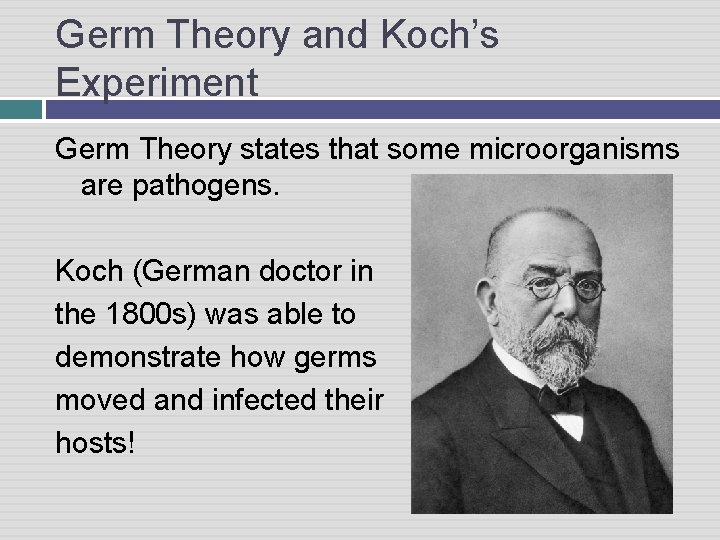
Germ Theory and Koch’s Experiment Germ Theory states that some microorganisms are pathogens. Koch (German doctor in the 1800 s) was able to demonstrate how germs moved and infected their hosts!
I. Identification of 1 st Disease Pathogen Isolated bacteria from blood of dead, infected cattle Grew bacteria in a lab, then injected it into healthy cattle Isolated blood of newly infected cattle and compared to originals CONCLUSION: The bacteria was identical! The same bacteria that was originally isolated caused illness in both groups!
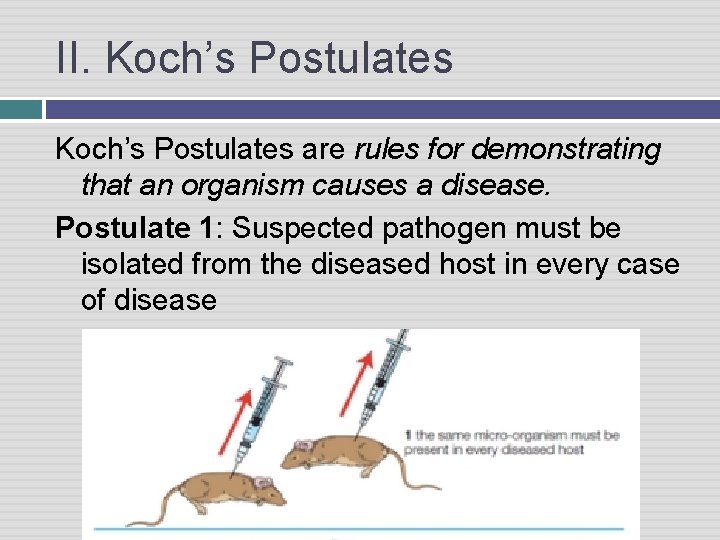
II. Koch’s Postulates are rules for demonstrating that an organism causes a disease. Postulate 1: Suspected pathogen must be isolated from the diseased host in every case of disease
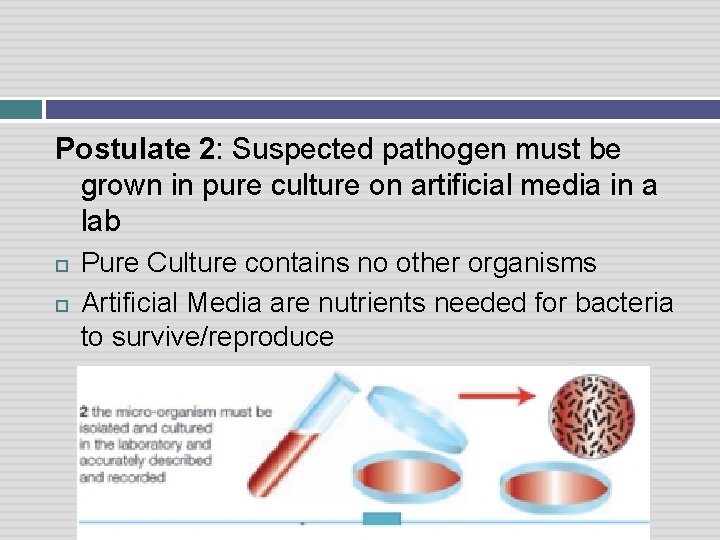
Postulate 2: Suspected pathogen must be grown in pure culture on artificial media in a lab Pure Culture contains no other organisms Artificial Media are nutrients needed for bacteria to survive/reproduce

Postulate 3: Suspected pathogen from pure culture must cause the disease when placed in a healthy new host
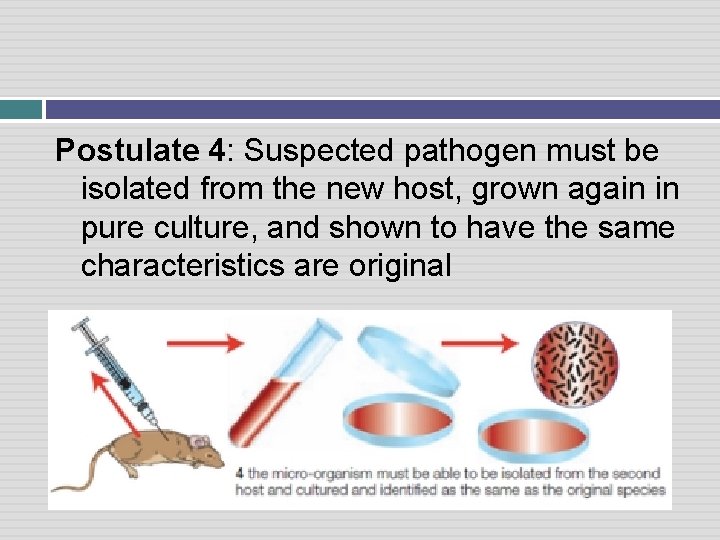
Postulate 4: Suspected pathogen must be isolated from the new host, grown again in pure culture, and shown to have the same characteristics are original
Exceptions: Some pathogens can’t be grown in pure culture or artificial media � ex. syphilis and other viruses
Spread of Disease For a pathogen to spread it must have both a reservoir and a way to spread! Reservoir: a source of the pathogen in the environment (humans, animals, inanimate objects) CORNY JOKE TIME! An infectious disease enters a bar. The bartender says, “We don’t serve your kind in here. ” The disease replies “Well, you’re not a very good host!”
I. Human Reservoirs Humans are main reservoir for pathogens affecting humans Carrier: person who is symptom-free, but capable of passing the pathogen Can be passed on without knowing that you’re infected (ex. flu, cold, STDs, HIV)
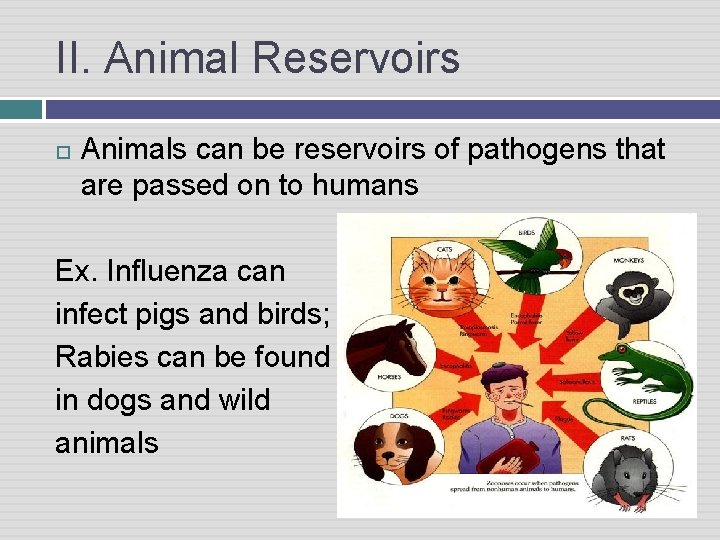
II. Animal Reservoirs Animals can be reservoirs of pathogens that are passed on to humans Ex. Influenza can infect pigs and birds; Rabies can be found in dogs and wild animals
III. Other Reservoirs Bacteria found in the soil can infect humans �Tetanus bacteria �Major causes of death before antibiotics and vaccines Contaminated food/water �Human feces �Food preparation with contaminated water �Food contamination through contact with humans or insects (flies)
IV. Transmission of Pathogens 4 main methods: Direct contact Indirectly through the air Indirectly through touching contaminated objects Vectors (organisms that carry pathogens)
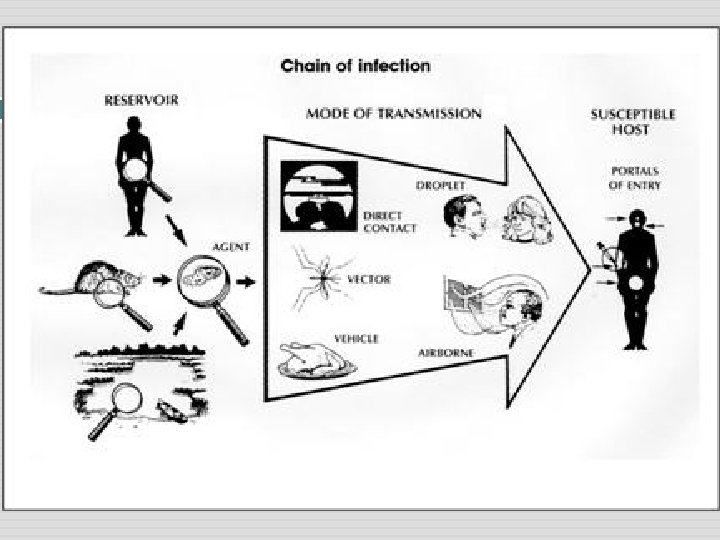
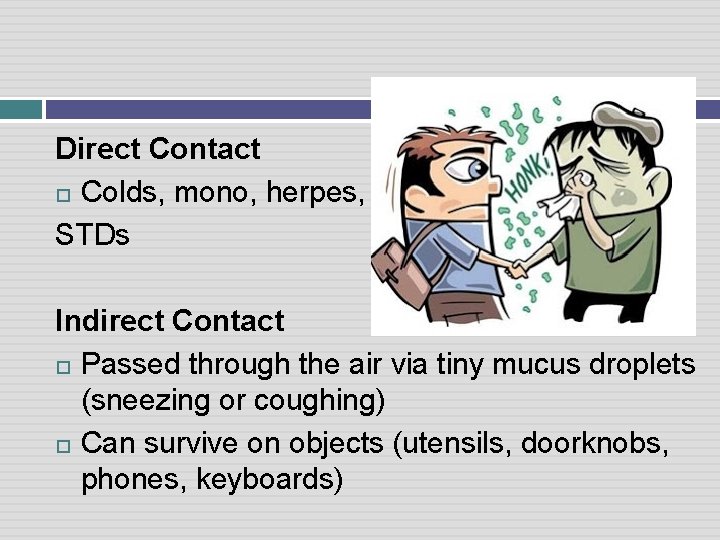
Direct Contact Colds, mono, herpes, STDs Indirect Contact Passed through the air via tiny mucus droplets (sneezing or coughing) Can survive on objects (utensils, doorknobs, phones, keyboards)
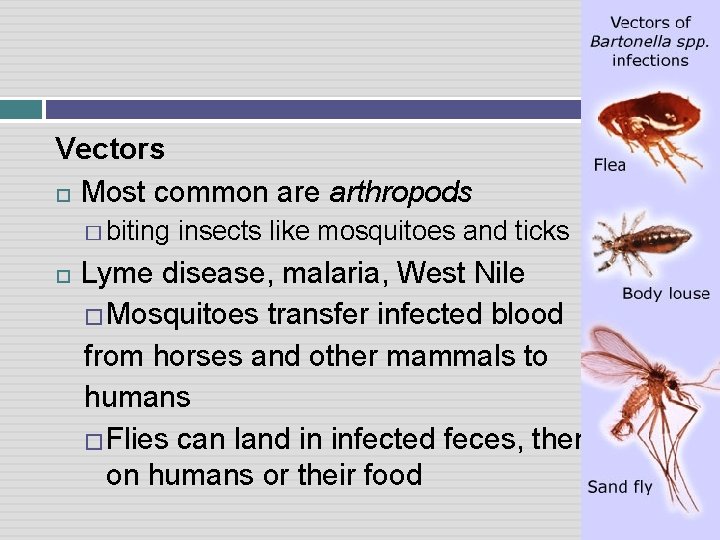
Vectors Most common are arthropods � biting insects like mosquitoes and ticks Lyme disease, malaria, West Nile �Mosquitoes transfer infected blood from horses and other mammals to humans �Flies can land in infected feces, then land on humans or their food
Symptoms of Disease Pathogen infects body, then multiplies in cells (spreads through exocytosis or cell bursting) damages tissues and even kills cells Harmful toxins/chemicals could be produced, then spread via bloodstream �Could affect specific organs (tetanus= muscle spasms, botulism= paralyzes nerves) Cell death could cause coughing and
Disease Patterns Community health depts, Centers for Disease Control (CDC), and World Health Organization (WHO) track outbreaks and disease patterns. Endemic Diseases: continually found in small amounts within population (ex. common cold) Epidemic: when a particular disease has a large outbreak in an area, afflicting many people
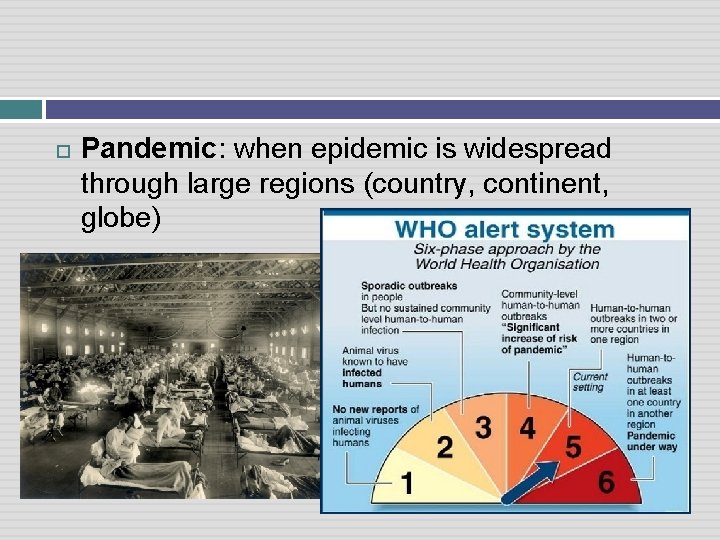
Pandemic: when epidemic is widespread through large regions (country, continent, globe)
Treating and Fighting Diseases Antibiotics: substance that can kill or inhibit growth of microorganisms �Penicillin (from the fungus penicillium) kills competing bacteria Chemical agents also used �Anti-viral drugs used to treat herpes, influenza, and HIV Most viruses handled by immune system
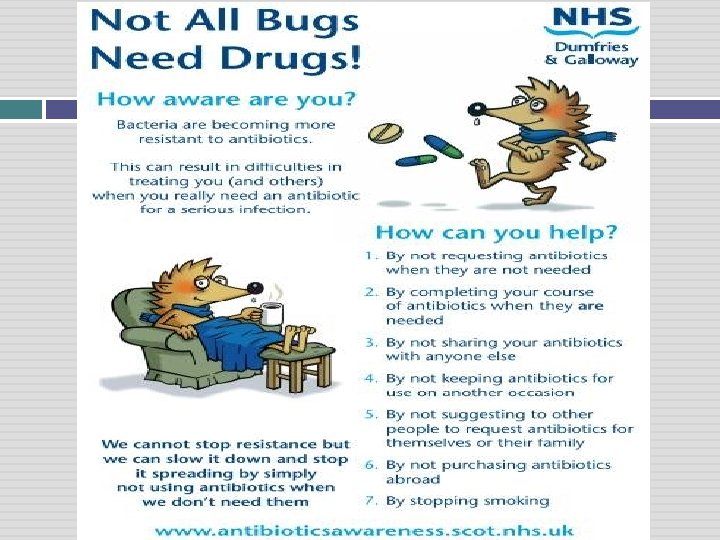
PROBLEM! Antibiotic Resistance! Natural selection: organisms with favorable variations/traits survive, passing traits to offspring Bacteria/virus that survive treatment reproduce, creating offspring that are more resistant Example: Strains of STDs and STAPH infections that are resistant to treatment
- Slides: 29