
INFECTIOUS COMPLICATIONS FOLLOWING KIDNEY TRANSPLANTATION Walid AbouJaoude M
INFECTIOUS COMPLICATIONS FOLLOWING KIDNEY TRANSPLANTATION Walid Abou-Jaoude M. D Head of Nephrology and Hypertension Middle East Inst. Of Health- Bsalim June 15, 2019 Beirut- Lebanon
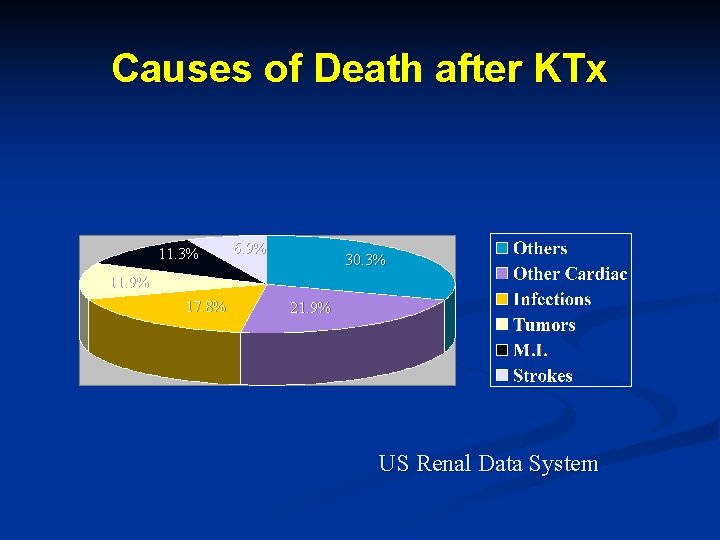
Causes of Death after KTx 11. 3% 6. 9% 30. 3% 11. 9% 17. 8% 21. 9% US Renal Data System
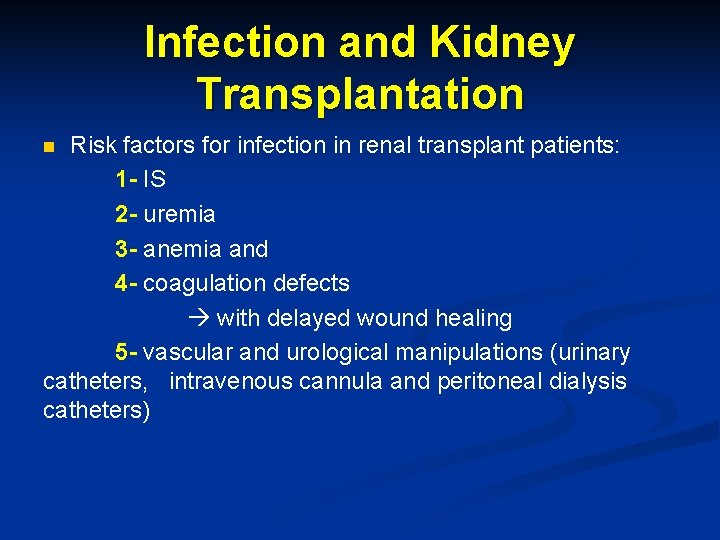
Infection and Kidney Transplantation Risk factors for infection in renal transplant patients: 1 - IS 2 - uremia 3 - anemia and 4 - coagulation defects with delayed wound healing 5 - vascular and urological manipulations (urinary catheters, intravenous cannula and peritoneal dialysis catheters) n
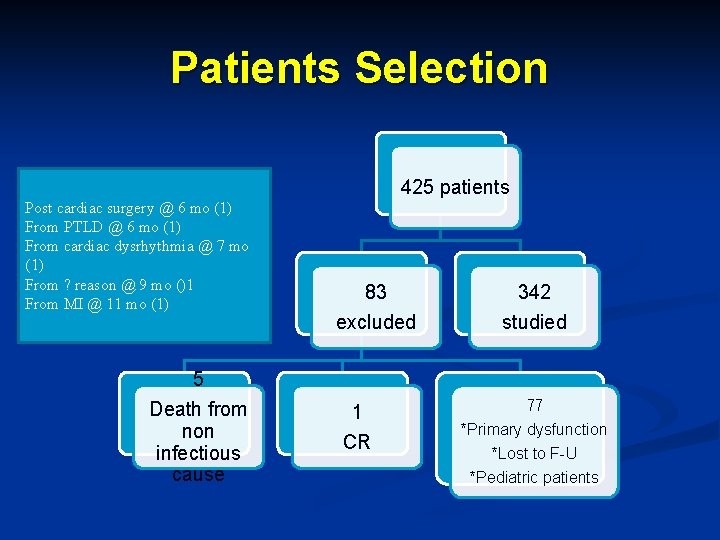
Patients Selection 425 patients Post cardiac surgery @ 6 mo (1) From PTLD @ 6 mo (1) From cardiac dysrhythmia @ 7 mo (1) From ? reason @ 9 mo ()1 From MI @ 11 mo (1) 5 Death from non infectious cause 83 excluded 1 CR 342 studied 77 *Primary dysfunction *Lost to F-U *Pediatric patients
Infection Diagnosis n n All episodes of infections during the first year after KT, were analyzed. These infections were divided into 2 groups: In hospital infections and out of hospital infections.
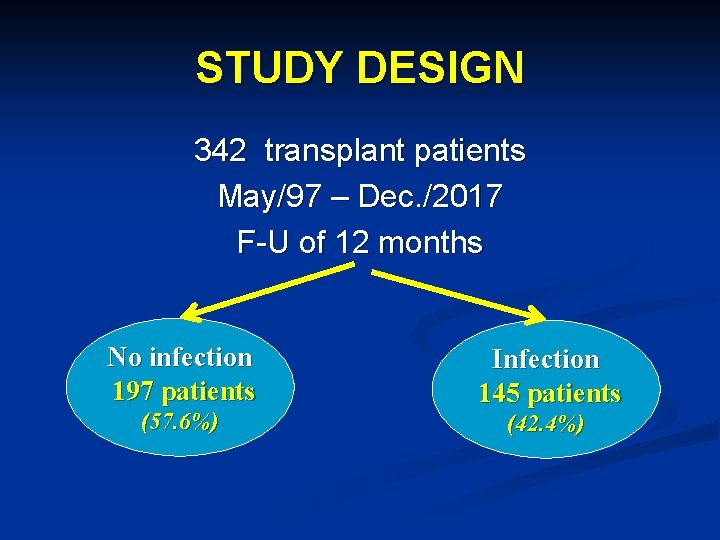
STUDY DESIGN 342 transplant patients May/97 – Dec. /2017 F-U of 12 months No infection 197 patients (57. 6%) Infection 145 patients (42. 4%)
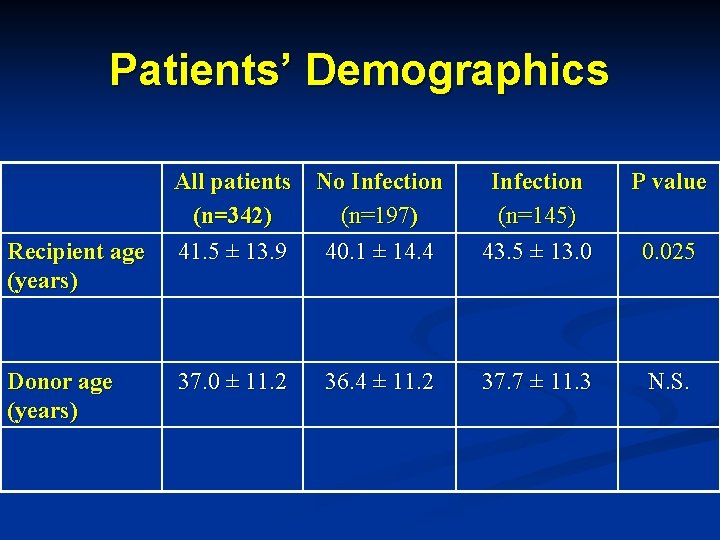
Patients’ Demographics Recipient age (years) Donor age (years) All patients No Infection (n=342) (n=197) 41. 5 ± 13. 9 40. 1 ± 14. 4 Infection (n=145) 43. 5 ± 13. 0 P value 37. 0 ± 11. 2 37. 7 ± 11. 3 N. S. 36. 4 ± 11. 2 0. 025
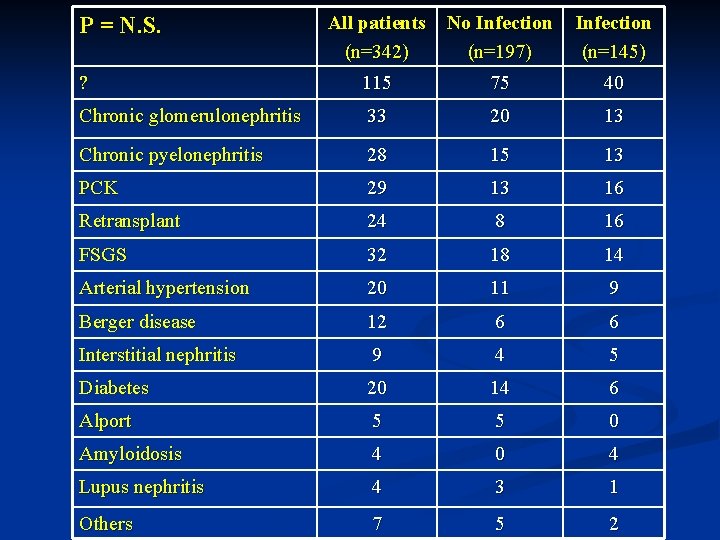
All patients (n=342) No Infection (n=197) Infection (n=145) ? 115 75 40 Chronic glomerulonephritis 33 20 13 Chronic pyelonephritis 28 15 13 PCK 29 13 16 Retransplant 24 8 16 FSGS 32 18 14 Arterial hypertension 20 11 9 Berger disease 12 6 6 Interstitial nephritis 9 4 5 Diabetes 20 14 6 Alport 5 5 0 Amyloidosis 4 0 4 Lupus nephritis 4 3 1 Others 7 5 2 P = N. S.
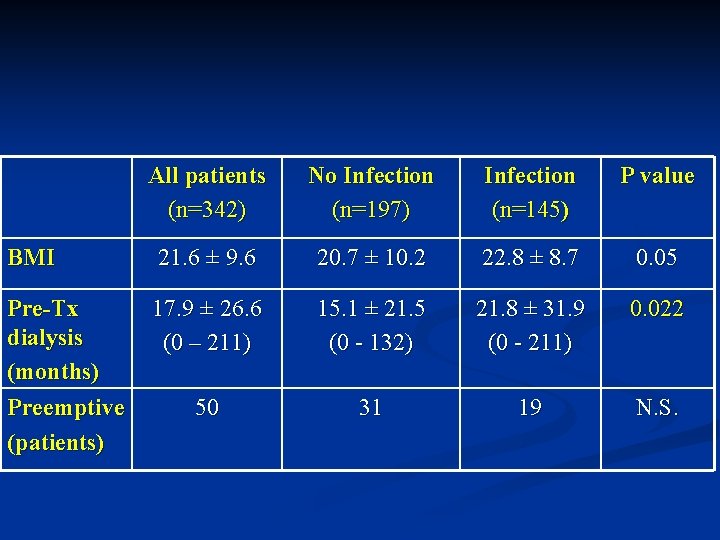
All patients (n=342) No Infection (n=197) Infection (n=145) P value BMI 21. 6 ± 9. 6 20. 7 ± 10. 2 22. 8 ± 8. 7 0. 05 Pre-Tx dialysis (months) Preemptive (patients) 17. 9 ± 26. 6 (0 – 211) 15. 1 ± 21. 5 (0 - 132) 21. 8 ± 31. 9 (0 - 211) 0. 022 50 31 19 N. S.
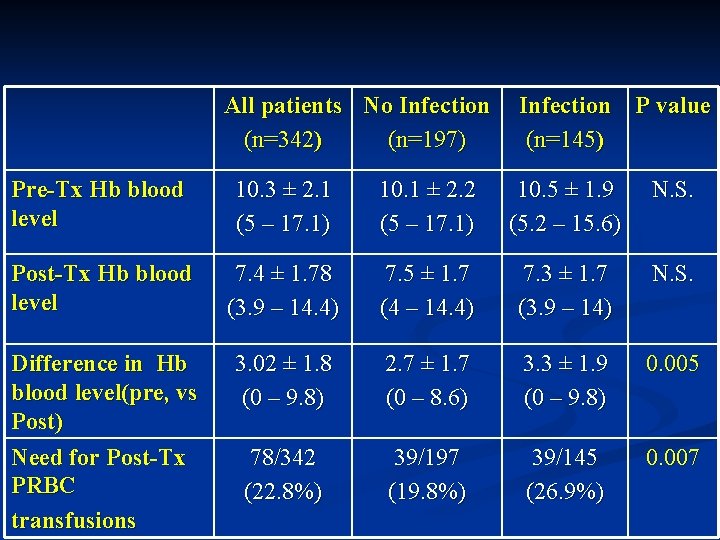
All patients No Infection (n=342) (n=197) Infection P value (n=145) Pre-Tx Hb blood level 10. 3 ± 2. 1 (5 – 17. 1) 10. 1 ± 2. 2 (5 – 17. 1) 10. 5 ± 1. 9 (5. 2 – 15. 6) N. S. Post-Tx Hb blood level 7. 4 ± 1. 78 (3. 9 – 14. 4) 7. 5 ± 1. 7 (4 – 14. 4) 7. 3 ± 1. 7 (3. 9 – 14) N. S. Difference in Hb blood level(pre, vs Post) Need for Post-Tx PRBC transfusions 3. 02 ± 1. 8 (0 – 9. 8) 2. 7 ± 1. 7 (0 – 8. 6) 3. 3 ± 1. 9 (0 – 9. 8) 0. 005 78/342 (22. 8%) 39/197 (19. 8%) 39/145 (26. 9%) 0. 007
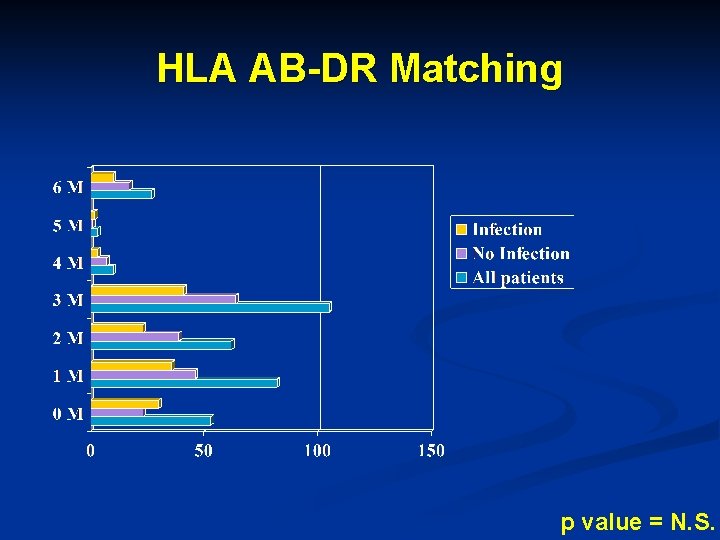
HLA AB-DR Matching p value = N. S.
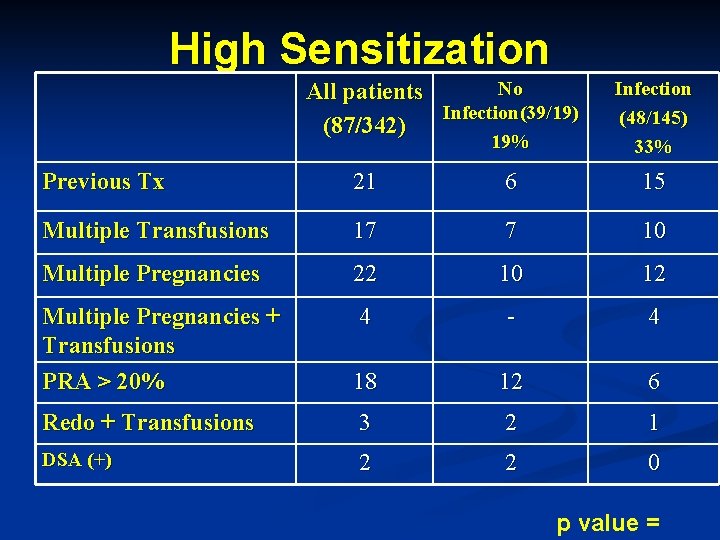
High Sensitization No All patients Infection(39/19) (87/342) 19% Infection (48/145) 33% Previous Tx 21 6 15 Multiple Transfusions 17 7 10 Multiple Pregnancies 22 10 12 Multiple Pregnancies + Transfusions PRA > 20% 4 - 4 18 12 6 Redo + Transfusions 3 2 1 DSA (+) 2 2 0 p value =
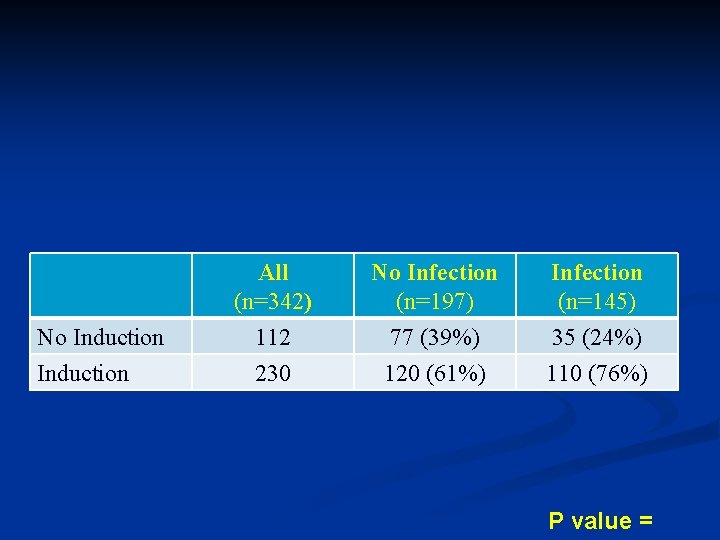
No Induction All (n=342) 112 230 No Infection (n=197) 77 (39%) 120 (61%) Infection (n=145) 35 (24%) 110 (76%) P value =
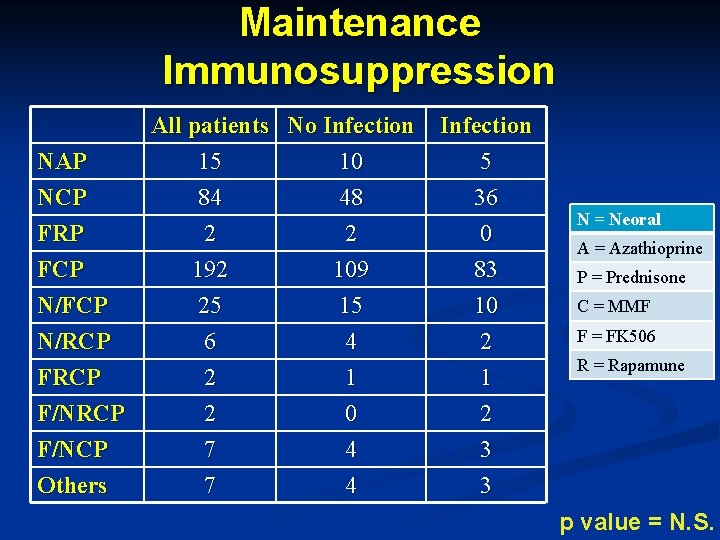
Maintenance Immunosuppression NAP NCP FRP FCP N/RCP F/NRCP F/NCP Others All patients No Infection 15 10 84 48 2 2 192 109 25 15 6 4 2 1 2 0 7 4 Infection 5 36 0 83 10 2 1 2 3 3 N = Neoral A = Azathioprine P = Prednisone C = MMF F = FK 506 R = Rapamune p value = N. S.
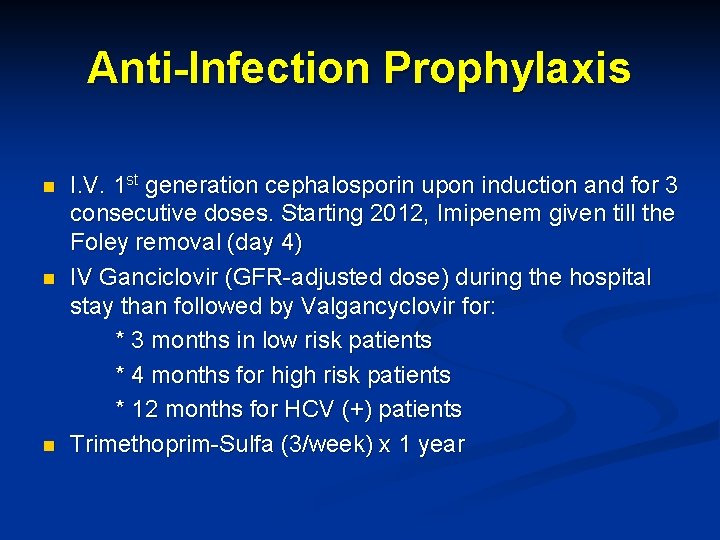
Anti-Infection Prophylaxis n n n I. V. 1 st generation cephalosporin upon induction and for 3 consecutive doses. Starting 2012, Imipenem given till the Foley removal (day 4) IV Ganciclovir (GFR-adjusted dose) during the hospital stay than followed by Valgancyclovir for: * 3 months in low risk patients * 4 months for high risk patients * 12 months for HCV (+) patients Trimethoprim-Sulfa (3/week) x 1 year
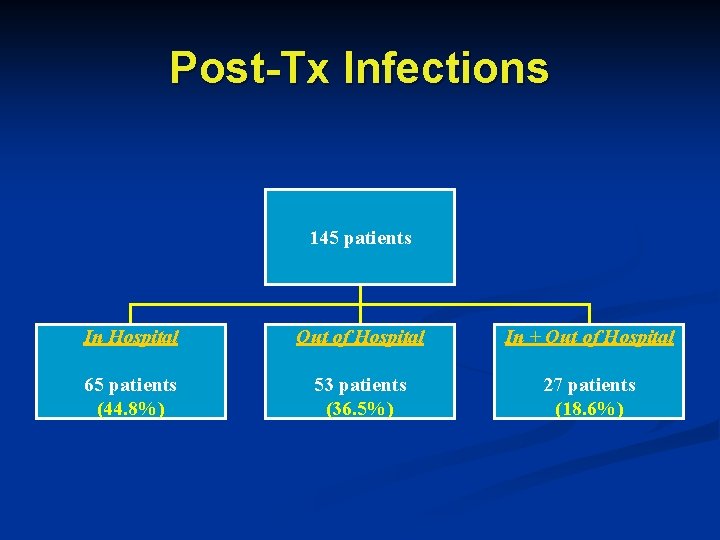
Post-Tx Infections 145 patients In Hospital Out of Hospital In + Out of Hospital 65 patients (44. 8%) 53 patients (36. 5%) 27 patients (18. 6%)
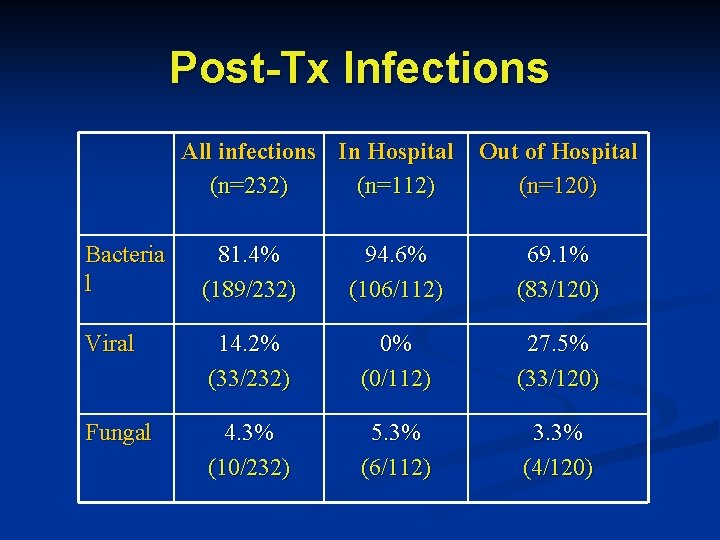
Post-Tx Infections All infections In Hospital (n=232) (n=112) Out of Hospital (n=120) Bacteria l 81. 4% (189/232) 94. 6% (106/112) 69. 1% (83/120) Viral 14. 2% (33/232) 0% (0/112) 27. 5% (33/120) Fungal 4. 3% (10/232) 5. 3% (6/112) 3. 3% (4/120)
In Hospital Infections
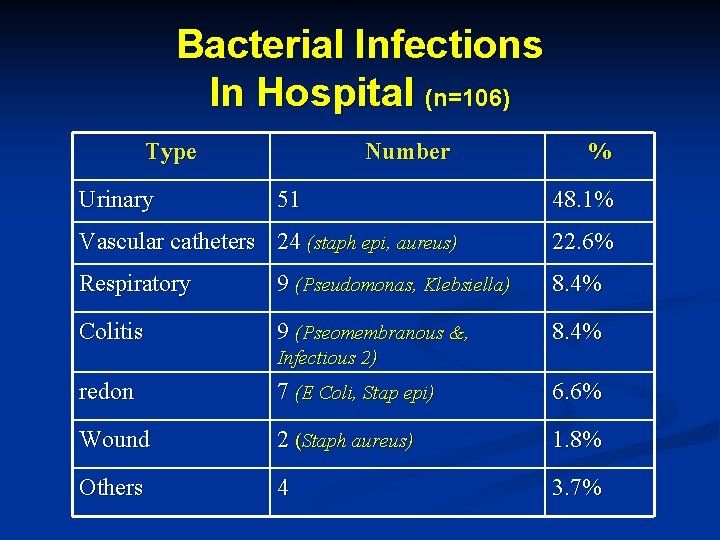
Bacterial Infections In Hospital (n=106) Type Urinary Number 51 % 48. 1% Vascular catheters 24 (staph epi, aureus) 22. 6% Respiratory 9 (Pseudomonas, Klebsiella) 8. 4% Colitis 9 (Pseomembranous &, 8. 4% Infectious 2) redon 7 (E Coli, Stap epi) 6. 6% Wound 2 (Staph aureus) 1. 8% Others 4 3. 7%
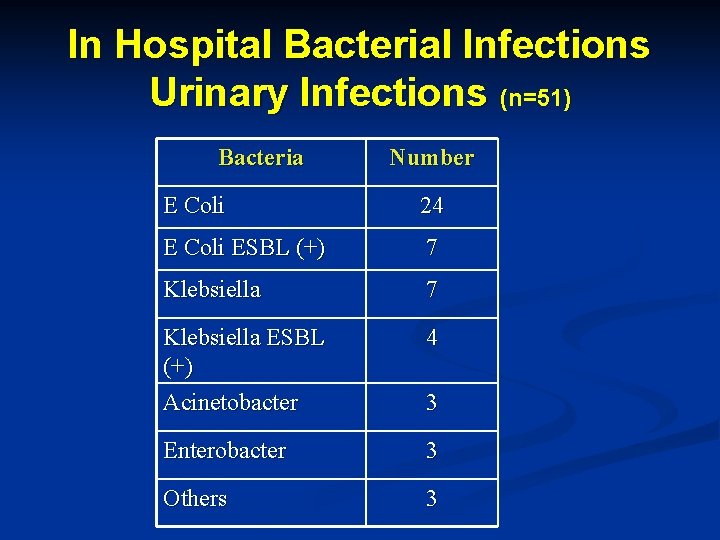
In Hospital Bacterial Infections Urinary Infections (n=51) Bacteria Number E Coli 24 E Coli ESBL (+) 7 Klebsiella ESBL (+) Acinetobacter 4 Enterobacter 3 Others 3 3
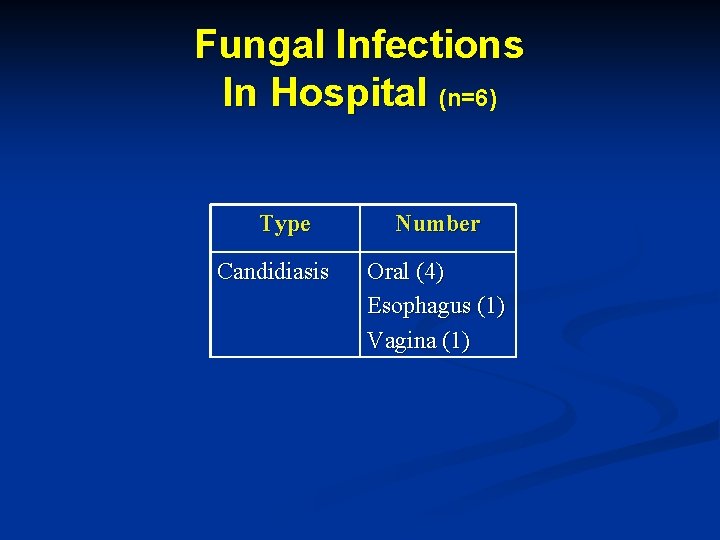
Fungal Infections In Hospital (n=6) Type Candidiasis Number Oral (4) Esophagus (1) Vagina (1)
Out Of Hospital Infections
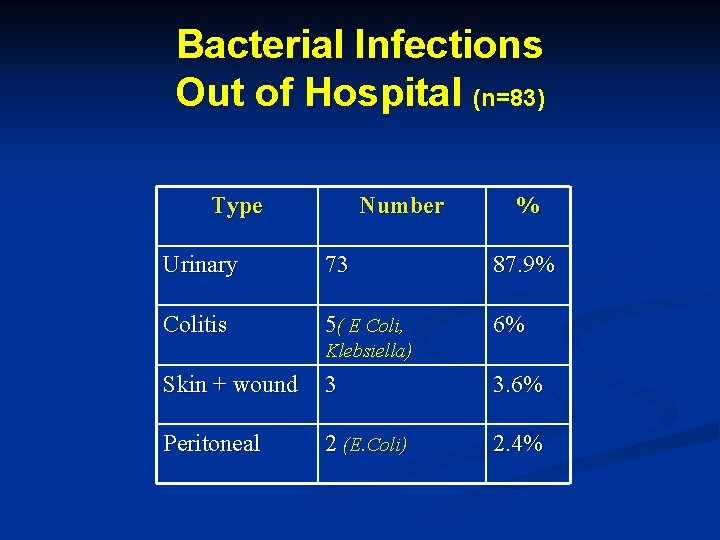
Bacterial Infections Out of Hospital (n=83) Type Number % Urinary 73 87. 9% Colitis 5( E Coli, 6% Klebsiella) Skin + wound 3 3. 6% Peritoneal 2 (E. Coli) 2. 4%
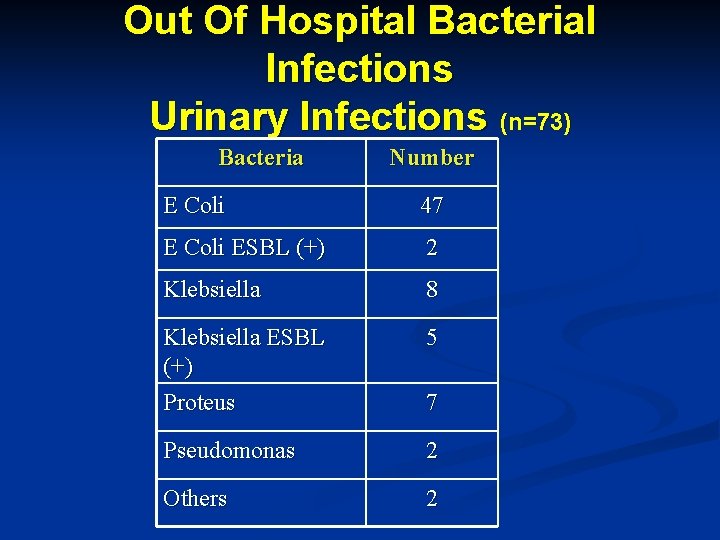
Out Of Hospital Bacterial Infections Urinary Infections (n=73) Bacteria Number E Coli 47 E Coli ESBL (+) 2 Klebsiella 8 Klebsiella ESBL (+) Proteus 5 Pseudomonas 2 Others 2 7
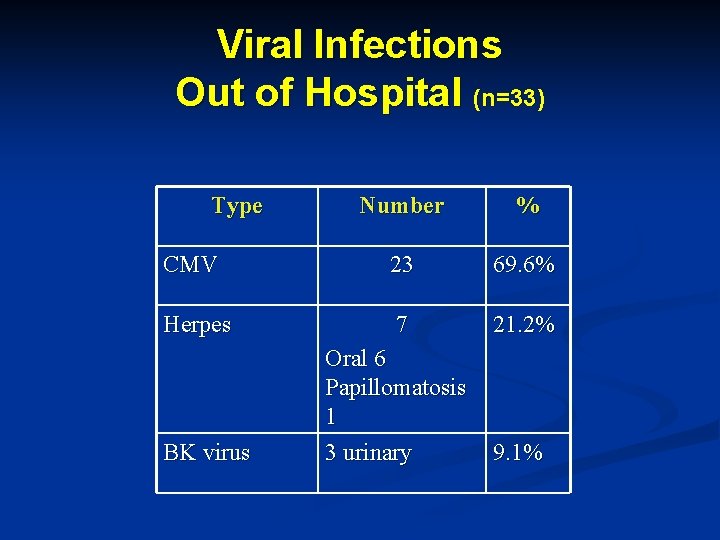
Viral Infections Out of Hospital (n=33) Type Number % CMV 23 69. 6% Herpes 7 21. 2% Oral 6 Papillomatosis 1 3 urinary 9. 1% BK virus
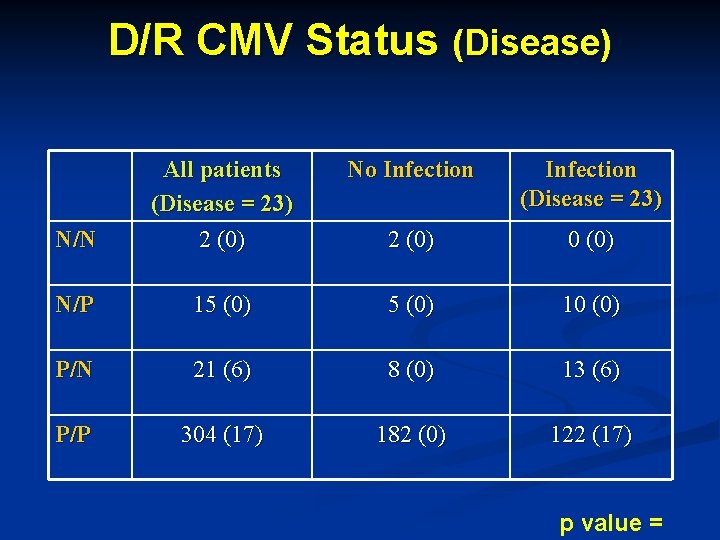
D/R CMV Status (Disease) No Infection (Disease = 23) N/N All patients (Disease = 23) 2 (0) 0 (0) N/P 15 (0) 10 (0) P/N 21 (6) 8 (0) 13 (6) P/P 304 (17) 182 (0) 122 (17) p value =
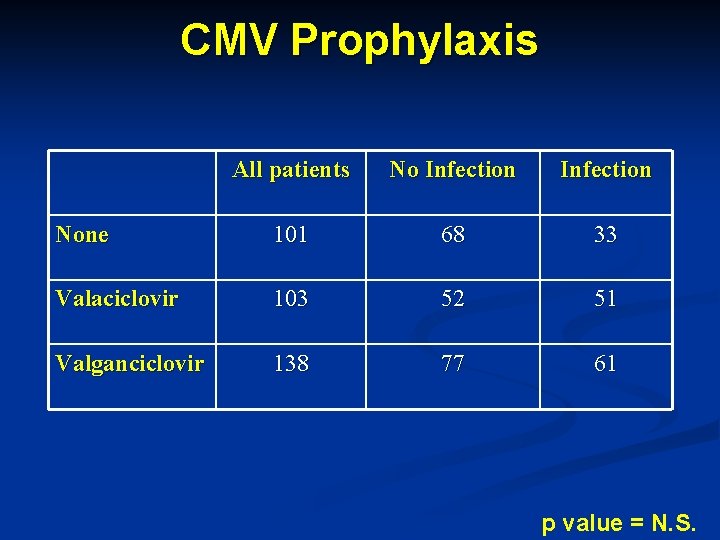
CMV Prophylaxis All patients No Infection None 101 68 33 Valaciclovir 103 52 51 Valganciclovir 138 77 61 p value = N. S.
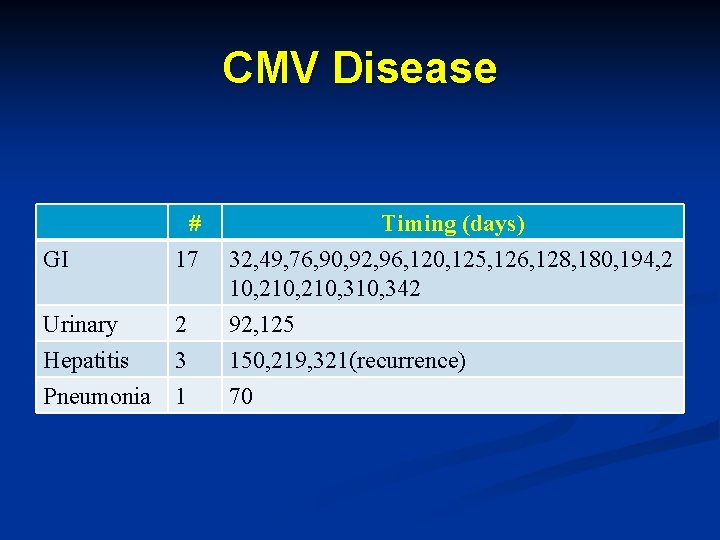
CMV Disease GI # 17 Urinary Hepatitis Pneumonia 2 3 1 Timing (days) 32, 49, 76, 90, 92, 96, 120, 125, 126, 128, 180, 194, 2 10, 210, 342 92, 125 150, 219, 321(recurrence) 70
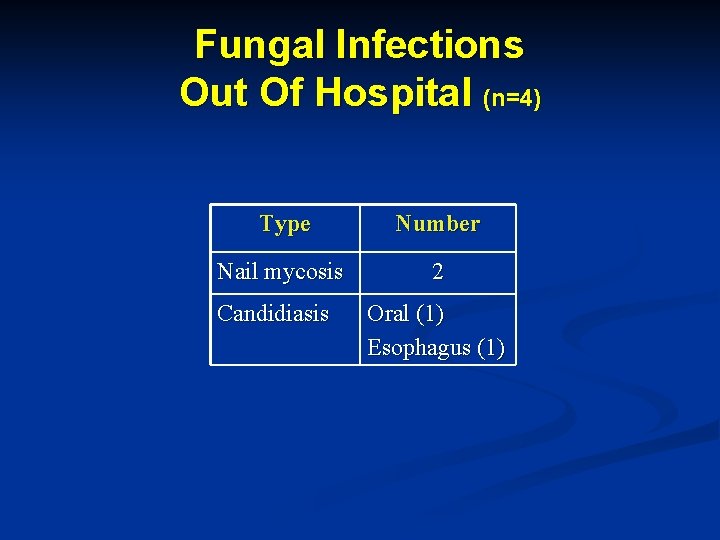
Fungal Infections Out Of Hospital (n=4) Type Number Nail mycosis 2 Candidiasis Oral (1) Esophagus (1)
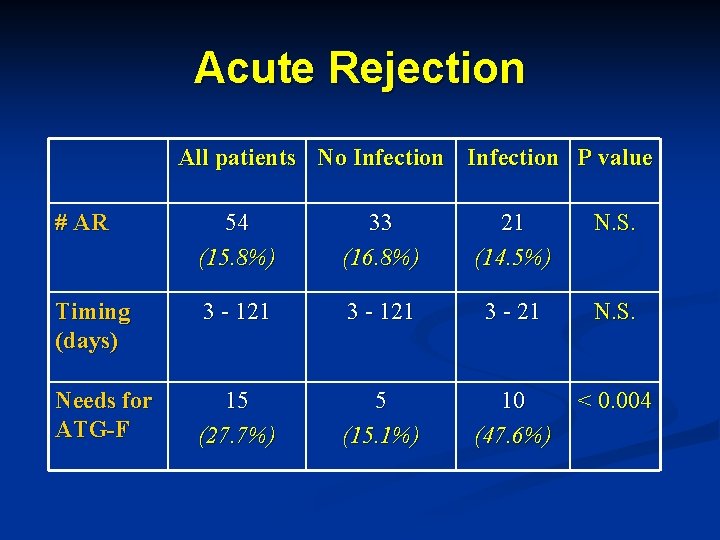
Acute Rejection All patients No Infection P value # AR 54 (15. 8%) 33 (16. 8%) 21 (14. 5%) N. S. Timing (days) 3 - 121 3 - 21 N. S. Needs for ATG-F 15 (27. 7%) 5 (15. 1%) 10 (47. 6%) < 0. 004
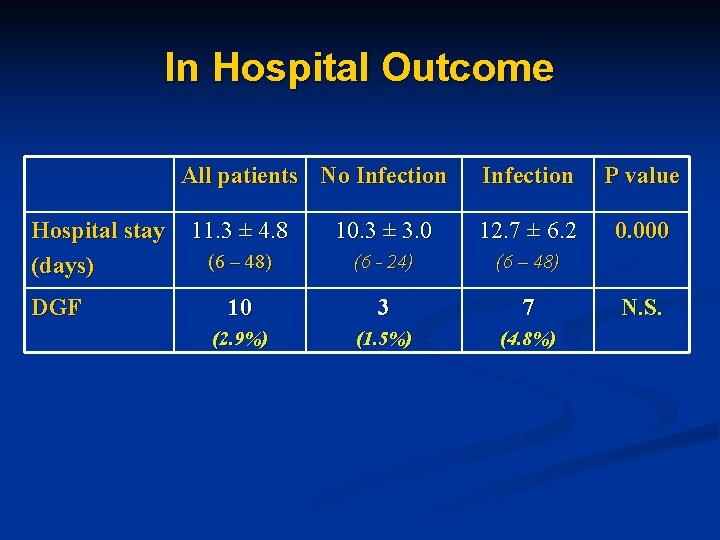
In Hospital Outcome All patients No Infection Hospital stay (days) DGF Infection P value 0. 000 11. 3 ± 4. 8 10. 3 ± 3. 0 12. 7 ± 6. 2 (6 – 48) (6 - 24) (6 – 48) 10 3 7 (2. 9%) (1. 5%) (4. 8%) N. S.
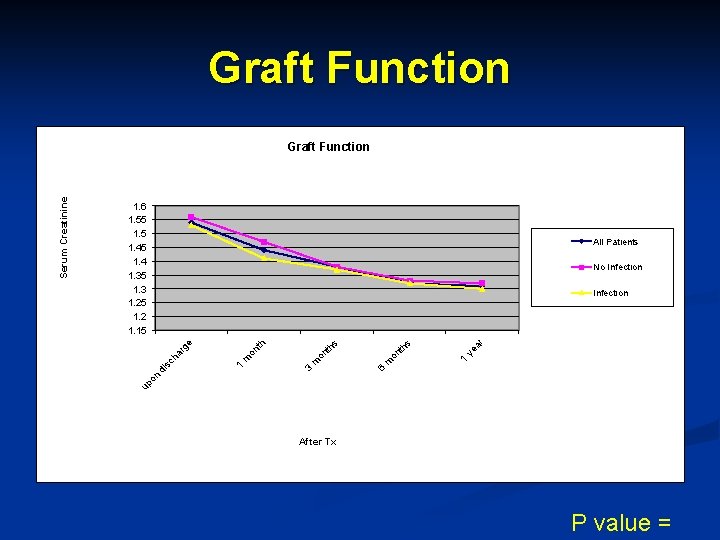
Graft Function 1. 6 1. 55 1. 45 1. 4 1. 35 1. 3 1. 25 1. 2 1. 15 All Patients No Infection ar ye 1 th s m on 6 th s 3 m on th on m 1 di sc ha rg e Infection up on Serum Creatinine Graft Function After Tx P value =
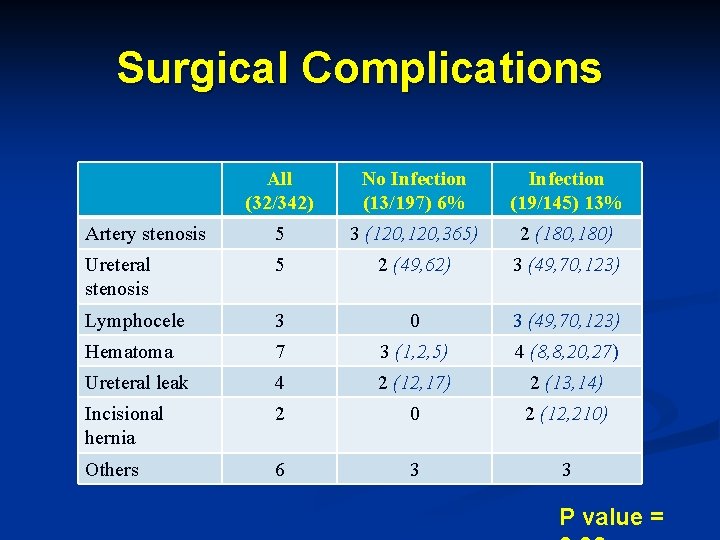
Surgical Complications All (32/342) No Infection (13/197) 6% Infection (19/145) 13% Artery stenosis 5 3 (120, 365) 2 (180, 180) Ureteral stenosis 5 2 (49, 62) 3 (49, 70, 123) Lymphocele 3 0 3 (49, 70, 123) Hematoma 7 3 (1, 2, 5) 4 (8, 8, 20, 27) Ureteral leak 4 2 (12, 17) 2 (13, 14) Incisional hernia 2 0 2 (12, 210) Others 6 3 3 P value =
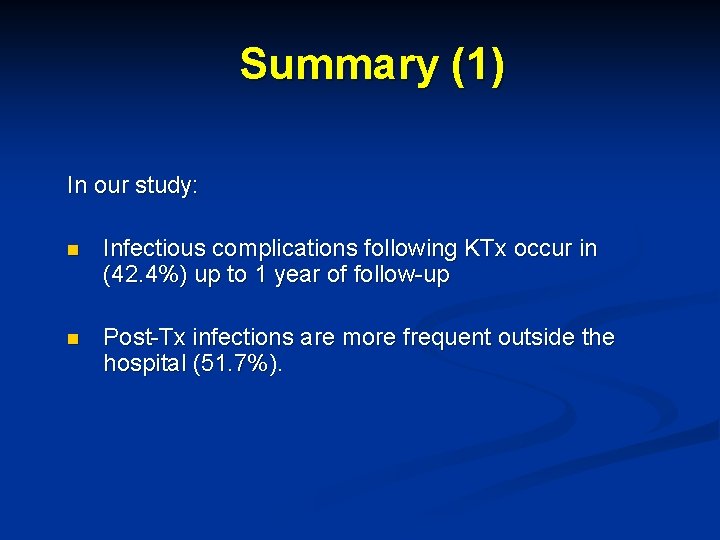
Summary (1) In our study: n Infectious complications following KTx occur in (42. 4%) up to 1 year of follow-up n Post-Tx infections are more frequent outside the hospital (51. 7%).
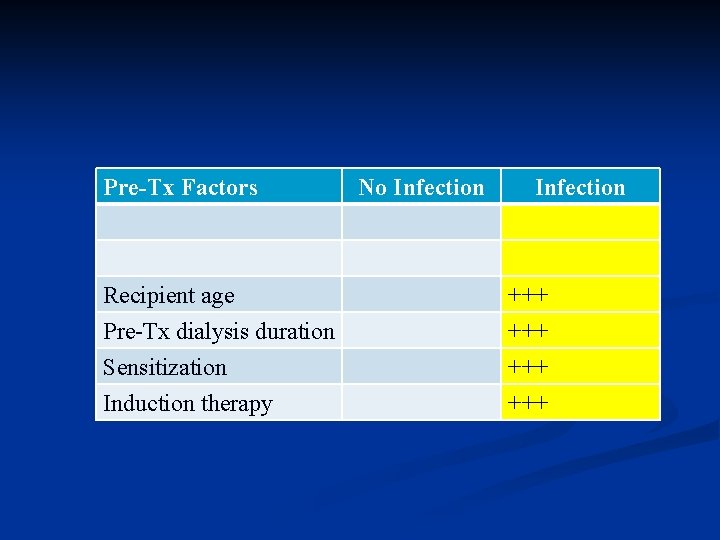
Pre-Tx Factors No Infection Recipient age +++ Pre-Tx dialysis duration Sensitization Induction therapy +++ +++
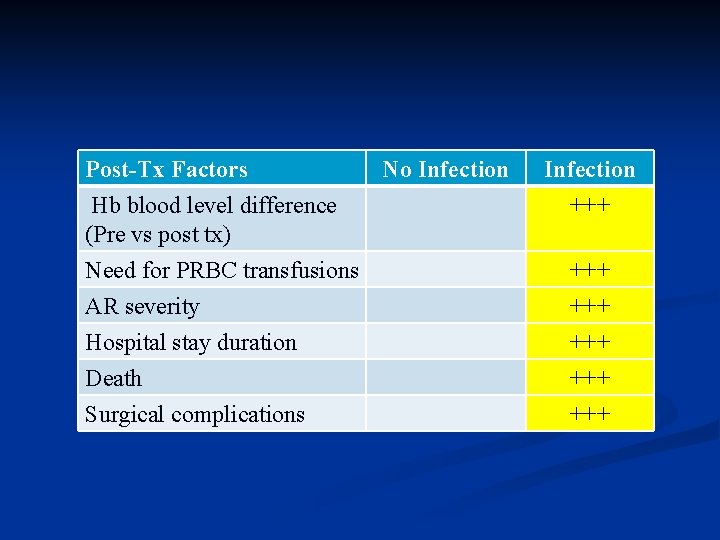
Post-Tx Factors Hb blood level difference (Pre vs post tx) No Infection +++ Need for PRBC transfusions +++ AR severity Hospital stay duration Death Surgical complications +++ +++
Summary (2) n Bacterial infections were most commonly encountered (88. 4%) followed by viral infections (8. 4%) n Most bacterial infections were urinary in origin (70. 2%). n Most viral infections were due to CMV disease
Conclusions 1) Almost half of our transplant population present an infectious episode sometime during 1 year after the transplantation 2) Good patient preparation before transplantation and appropriate infection prophylaxis are as needed as effective immunosuppression. 3) Longer follow-up is needed to evaluate the long term effect of infection on graft survival, especially for CMV infected patients.
Collaborators n n MEIH * Saadeh Abboud MD * Alain Khalaf MD Sacré-Coeur Hospital * Joseph Chahine MD * Naji Nawfal MD * Hassan Jouni MD n n SGH-UMC * Imad Ghantous MD Lebanese Hospital * Robert Najm MD * José Khabout MD Balamand University * Ziad Daoud Syria * Ayham El. Melhem MD * Mustapha Habash MD

Thank You
- Slides: 40