
Infections of the External Ear Anatomy and Physiology




- Slides: 54
Infections of the External Ear
Anatomy and Physiology • • Consists of the auricle and EAM Skin-lined apparatus Approximately 2. 5 cm in length Ends at tympanic membrane
Anatomy and Physiology • Auricle is mostly skinlined cartilage • External auditory meatus – – Cartilage: ~40% Bony: ~60% S-shaped Narrowest portion at bony-cartilage junction
Anatomy and Physiology
Anatomy and Physiology • EAC is related to various contiguous structures – – – Tympanic membrane Mastoid Glenoid fossa Cranial fossa Infratemporal fossa
Anatomy and Physiology • Innervation: cranial nerves V, VII, IX, X, and greater auricular nerve • Arterial supply: superficial temporal, posterior and deep auricular branches • Venous drainage: superficial temporal and posterior auricular veins • Lymphatics
Anatomy and Physiology • Squamous epithelium • Bony skin – 0. 2 mm • Cartilage skin – 0. 5 to 1. 0 mm – Apopilosebaceous unit
Otitis Externa • Bacterial infection of external auditory canal • Categorized by time course – Acute – Subacute – Chronic
Acute Otitis Externa (AOE) • “swimmer’s ear” • Preinflammatory stage • Acute inflammatory stage – Mild – Moderate – Severe
AOE: Preinflammatory Stage • Edema of stratum corneum and plugging of apopilosebaceous unit • Symptoms: pruritus and sense of fullness • Signs: mild edema • Starts the itch/scratch cycle
AOE: Mild to Moderate Stage • Progressive infection • Symptoms – Pain – Increased pruritus • Signs – Erythema – Increasing edema – Canal debris, discharge
AOE: Severe Stage • Severe pain, worse with ear movement • Signs – Lumen obliteration – Purulent otorrhea – Involvement of periauricular soft tissue
AOE: Treatment • Most common pathogens: P. aeruginosa and S. aureus • Four principles – Frequent canal cleaning – Topical antibiotics – Pain control – Instructions for prevention
Chronic Otitis Externa (COE) • Chronic inflammatory process • Persistent symptoms (> 2 months) • Bacterial, fungal, dermatological etiologies
COE: Symptoms • Unrelenting pruritus • Mild discomfort • Dryness of canal skin
COE: Signs • • Asteatosis Dry, flaky skin Hypertrophied skin Mucopurulent otorrhea (occasional)
COE: Treatment • • Similar to that of AOE Topical antibiotics, frequent cleanings Topical Steroids Surgical intervention – Failure of medical treatment – Goal is to enlarge and resurface the EAC
Furunculosis • • Acute localized infection Lateral 1/3 of posterosuperior canal Obstructed apopilosebaceous unit Pathogen: S. aureus
Furunculosis: Symptoms • Localized pain • Pruritus • Hearing loss (if lesion occludes canal)
Furunculosis: Signs • • Edema Erythema Tenderness Occasional fluctuance
Furunculosis: Treatment • • Local heat Analgesics Oral anti-staphylococcal antibiotics Incision and drainage reserved for localized abscess • IV antibiotics for soft tissue extension
Otomycosis • Fungal infection of EAC skin • Primary or secondary • Most common organisms: Aspergillus and Candida
Otomycosis: Symptoms • • • Often indistinguishable from bacterial OE Pruritus deep within the ear Dull pain Hearing loss (obstructive) Tinnitus
Otomycosis: Signs • Canal erythema • Mild edema • White, gray or black fungal debris
Otomycosis
Otomycosis: Treatment • Thorough cleaning and drying of canal • Topical antifungals
Granular Myringitis (GM) • Localized chronic inflammation of pars tensa with granulation tissue • Toynbee described in 1860 • Sequela of primary acute myringitis, previous OE, perforation of TM • Common organisms: Pseudomonas, Proteus
GM: Symptoms • • Foul smelling discharge from one ear Often asymptomatic Slight irritation or fullness No hearing loss or significant pain
GM: Signs • TM obscured by pus • “peeping” granulations • No TM perforations
GM: Treatment • • • Careful and frequent debridement Topical anti-pseudomonal antibiotics Occasionally combined with steroids At least 2 weeks of therapy May warrant careful destruction of granulation tissue if no response
Bullous Myringitis • Viral infection • Confined to tympanic membrane • Primarily involves younger children
Bullous Myringitis: Symptoms • • Sudden onset of severe pain No fever No hearing impairment Bloody otorrhea (significant) if rupture
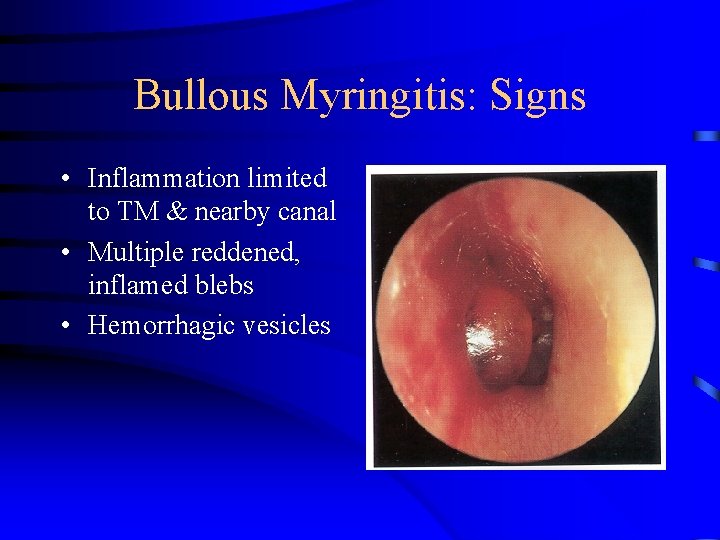
Bullous Myringitis: Signs • Inflammation limited to TM & nearby canal • Multiple reddened, inflamed blebs • Hemorrhagic vesicles
Bullous Myringitis: Treatment • Self-limiting • Analgesics • Topical antibiotics to prevent secondary infection • Incision of blebs is unnecessary
Necrotizing External Otitis(NEO) • Potentially lethal infection of EAC and surrounding structures • Typically seen in diabetics and immunocompromised patients • Pseudomonas aeruginosa is the usual culprit
NEO: History • Meltzer and Kelemen, 1959 • Chandler, 1968 – credited with naming
NEO: Symptoms • • Poorly controlled diabetic with h/o OE Deep-seated aural pain Chronic otorrhea Aural fullness
NEO: Signs • Inflammation and granulation • Purulent secretions • Occluded canal and obscured TM • Cranial nerve involvement
NEO: Imaging • • • Plain films Computerized tomography – most used Technetium-99 – reveals osteomyelitis Gallium scan – useful for evaluating Rx Magnetic Resonance Imaging
NEO: Diagnosis • • • Clinical findings Laboratory evidence Imaging Physician’s suspicion Cohen and Friedman – criteria from review
NEO: Treatment • Intravenous antibiotics for at least 4 weeks – with serial gallium scans monthly • Local canal debridement until healed • Pain control • Use of topical agents controversial • Hyperbaric oxygen experimental • Surgical debridement for refractory cases
NEO: Mortality • Death rate essentially unchanged despite newer antibiotics (37% to 23%) • Higher with multiple cranial neuropathies (60%) • Recurrence not uncommon (9% to 27%) • May recur up to 12 months after treatment
Perichondritis/Chondritis • Infection of perichondrium/cartilage • Result of trauma to auricle • May be spontaneous (overt diabetes)
Perichondritis: Symptoms • Pain over auricle and deep in canal • Pruritus
Perichondritis: Signs • • Tender auricle Induration Edema Advanced cases – Crusting & weeping – Involvement of soft tissues
Relapsing Polychondritis • Episodic and progressive inflammation of cartilages • Autoimmune etiology? • External ear, larynx, trachea, bronchi, and nose may be involved • Involvement of larynx and trachea causes increasing respiratory obstruction
Relapsing Polychondritis • • Fever, pain Swelling, erythema Anemia, elevated ESR Treat with oral corticosteroids
Herpes Zoster Oticus • J. Ramsay Hunt described in 1907 • Viral infection caused by varicella zoster • Infection along one or more cranial nerve dermatomes (shingles) • Ramsey Hunt syndrome: herpes zoster of the pinna with otalgia and facial paralysis
Herpes Zoster Oticus: Symptoms • Early: burning pain in one ear, headache, malaise and fever • Late (3 to 7 days): vesicles, facial paralysis
Herpes Zoster Oticus: Treatment • Corneal protection • Oral steroid taper (10 to 14 days) • Antivirals
Erysipelas • Acute superficial cellulitis • Group A, beta hemolytic streptococci • Skin: bright red; welldemarcated, advancing margin • Rapid treatment with oral or IV antibiotics if insufficient response
Perichondritis: Treatment • Mild: debridement, topical & oral antibiotic • Advanced: hospitalization, IV antibiotics • Chronic: surgical intervention with excision of necrotic tissue and skin coverage
Radiation-Induced Otitis Externa • OE occurring after radiotherapy • Often difficult to treat • Limited infection treated like COE • Involvement of bone requires surgical debridement and skin coverage
Conclusions • Careful History • Thorough physical exam • Understanding of various disease processes common to this area • Vigilant treatment and patience