
INFECTION PREVENTION In The Healthcare Setting Part 3


- Slides: 24
INFECTION PREVENTION In The Healthcare Setting Part 3
2 Transmission Based Precautions
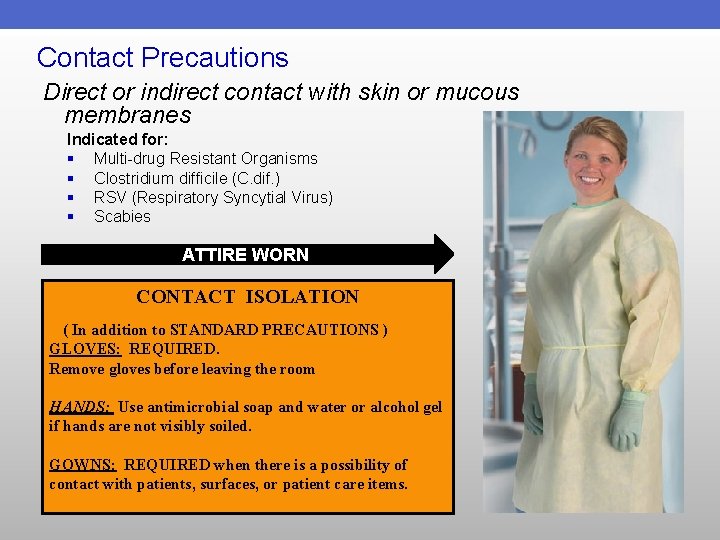
Contact Precautions Direct or indirect contact with skin or mucous membranes Indicated for: § Multi-drug Resistant Organisms § Clostridium difficile (C. dif. ) § RSV (Respiratory Syncytial Virus) § Scabies ATTIRE WORN CONTACT ISOLATION ( In addition to STANDARD PRECAUTIONS ) GLOVES: REQUIRED. Remove gloves before leaving the room HANDS: Use antimicrobial soap and water or alcohol gel if hands are not visibly soiled. GOWNS: REQUIRED when there is a possibility of contact with patients, surfaces, or patient care items.
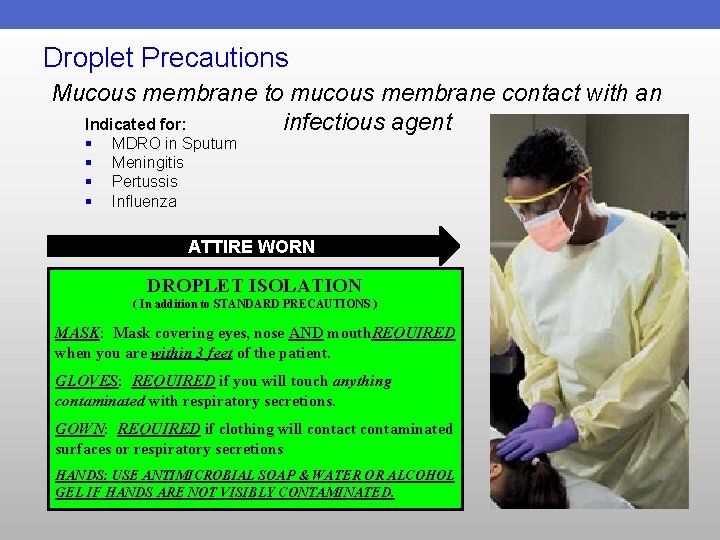
Droplet Precautions Mucous membrane to mucous membrane contact with an Indicated for: infectious agent § § MDRO in Sputum Meningitis Pertussis Influenza ATTIRE WORN DROPLET ISOLATION ( In addition to STANDARD PRECAUTIONS ) MASK: Mask covering eyes, nose AND mouth. REQUIRED when you are within 3 feet of the patient. GLOVES: REQUIRED if you will touch anything contaminated with respiratory secretions. GOWN: REQUIRED if clothing will contact contaminated surfaces or respiratory secretions HANDS: USE ANTIMICROBIAL SOAP & WATER OR ALCOHOL GEL IF HANDS ARE NOT VISIBLY CONTAMINATED.
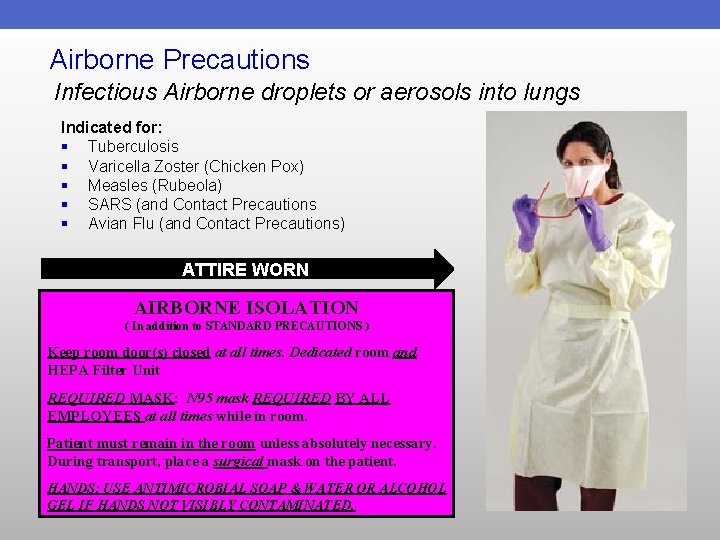
Airborne Precautions Infectious Airborne droplets or aerosols into lungs Indicated for: § Tuberculosis § Varicella Zoster (Chicken Pox) § Measles (Rubeola) § SARS (and Contact Precautions § Avian Flu (and Contact Precautions) ATTIRE WORN AIRBORNE ISOLATION ( In addition to STANDARD PRECAUTIONS ) Keep room door(s) closed at all times. Dedicated room and HEPA Filter Unit REQUIRED MASK: N 95 mask REQUIRED BY ALL EMPLOYEES at all times while in room. Patient must remain in the room unless absolutely necessary. During transport, place a surgical mask on the patient. HANDS: USE ANTIMICROBIAL SOAP & WATER OR ALCOHOL GEL IF HANDS NOT VISIBLY CONTAMINATED.
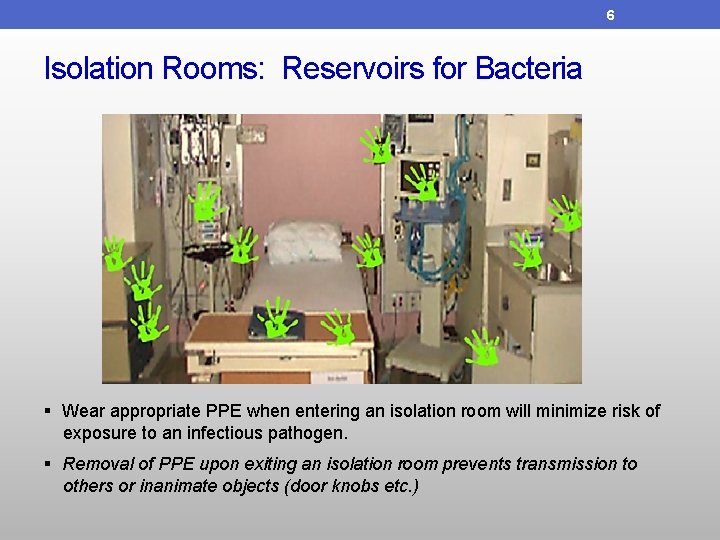
6 Isolation Rooms: Reservoirs for Bacteria § Wear appropriate PPE when entering an isolation room will minimize risk of exposure to an infectious pathogen. § Removal of PPE upon exiting an isolation room prevents transmission to others or inanimate objects (door knobs etc. )
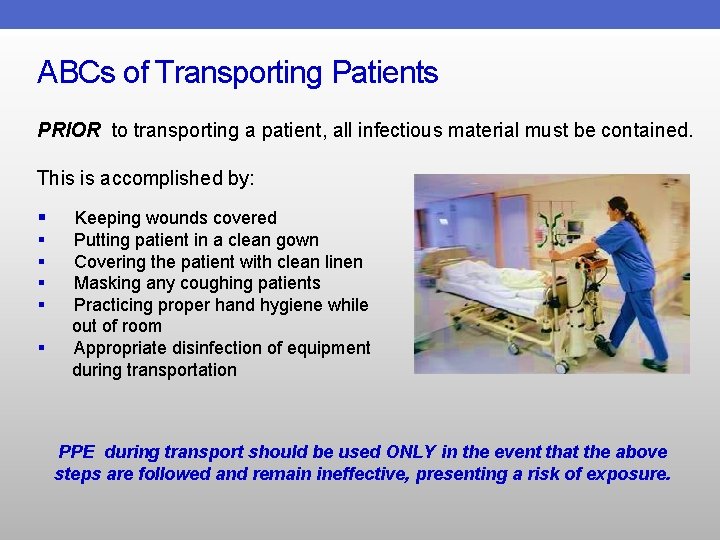
ABCs of Transporting Patients PRIOR to transporting a patient, all infectious material must be contained. This is accomplished by: § Keeping wounds covered § Putting patient in a clean gown § Covering the patient with clean linen § Masking any coughing patients § Practicing proper hand hygiene while out of room § Appropriate disinfection of equipment during transportation PPE during transport should be used ONLY in the event that the above steps are followed and remain ineffective, presenting a risk of exposure.
How to get from point A to point B § Contain infectious material (i. e. , cover wounds, clean gown to patient, clean bed covers, diaper if having diarrhea). § Discard contaminated protective equipment prior to exiting room. § Perform hand hygiene § Transport to destination § Use hand hygiene § Don necessary protective equipment at destination
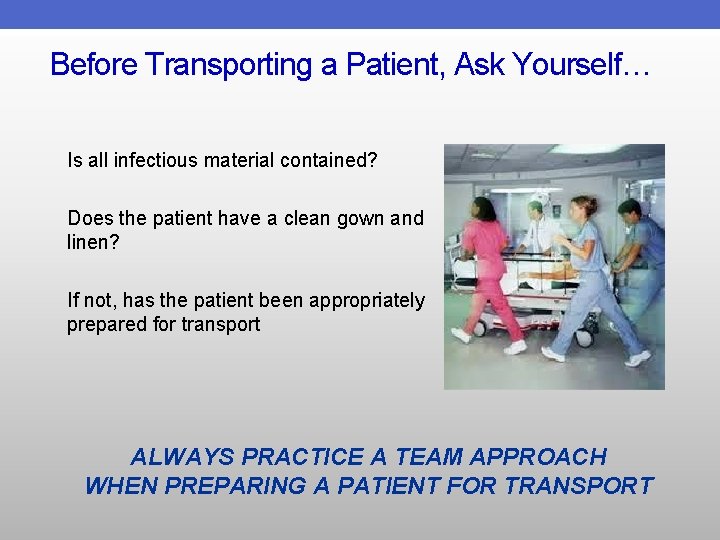
Before Transporting a Patient, Ask Yourself… Is all infectious material contained? Does the patient have a clean gown and linen? If not, has the patient been appropriately prepared for transport ALWAYS PRACTICE A TEAM APPROACH WHEN PREPARING A PATIENT FOR TRANSPORT
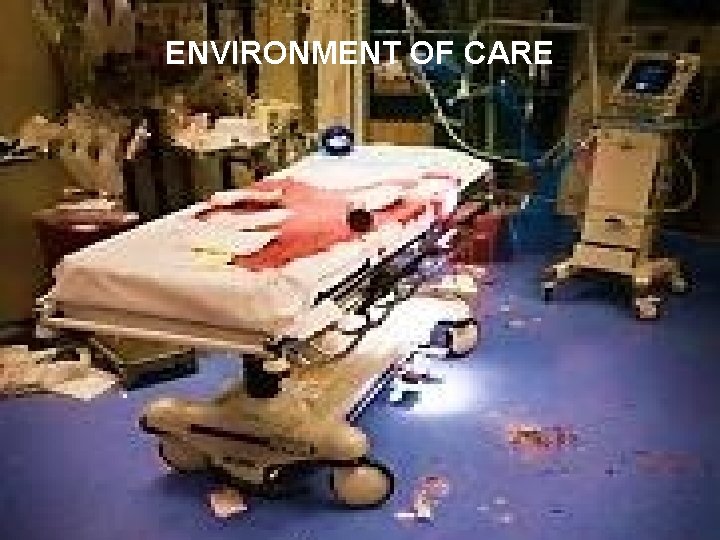
ENVIRONMENT OF CARE ENVIRONMEN T OF CARE
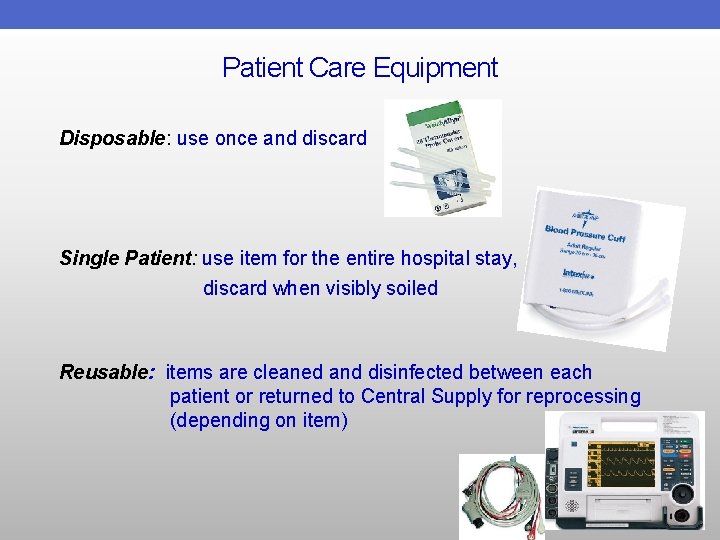
Patient Care Equipment Disposable: use once and discard Single Patient: use item for the entire hospital stay, discard when visibly soiled Reusable: items are cleaned and disinfected between each patient or returned to Central Supply for reprocessing (depending on item)
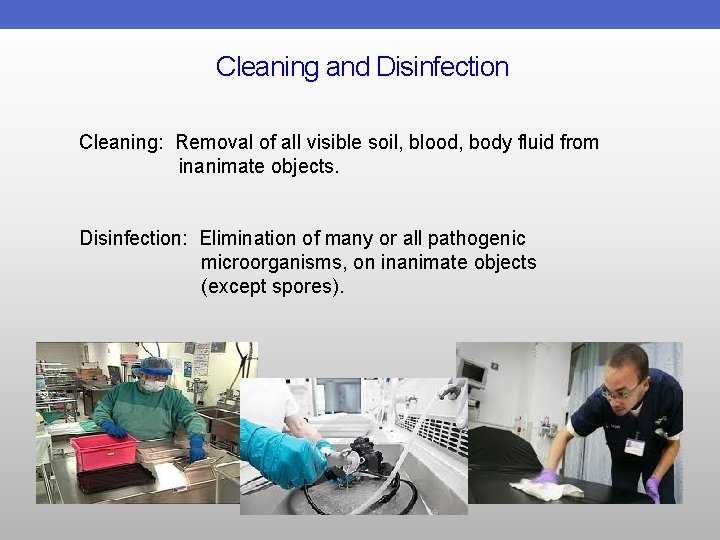
Cleaning and Disinfection Cleaning: Removal of all visible soil, blood, body fluid from inanimate objects. Disinfection: Elimination of many or all pathogenic microorganisms, on inanimate objects (except spores).
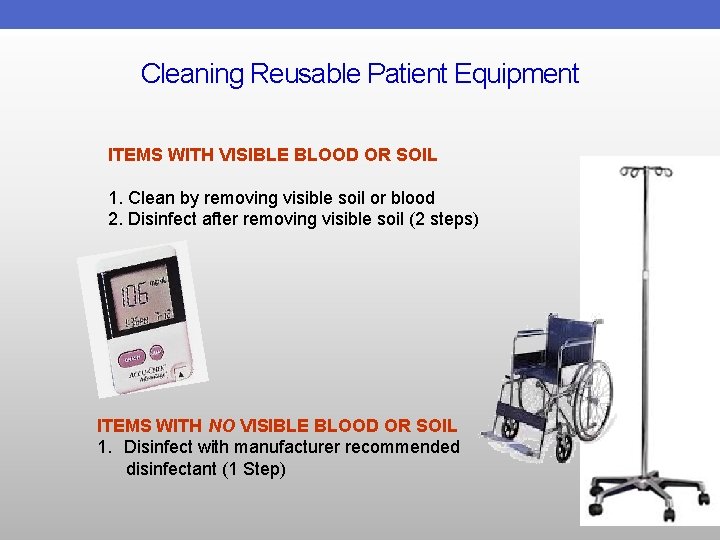
Cleaning Reusable Patient Equipment ITEMS WITH VISIBLE BLOOD OR SOIL 1. Clean by removing visible soil or blood 2. Disinfect after removing visible soil (2 steps) ITEMS WITH NO VISIBLE BLOOD OR SOIL 1. Disinfect with manufacturer recommended disinfectant (1 Step)
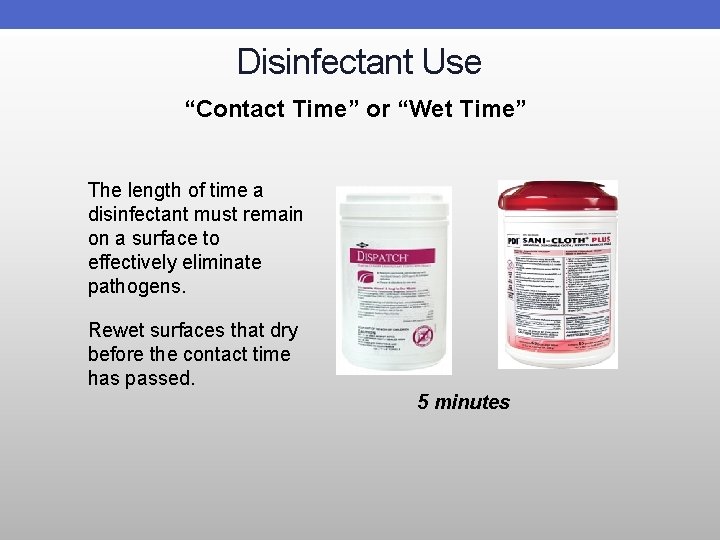
Disinfectant Use “Contact Time” or “Wet Time” The length of time a disinfectant must remain on a surface to effectively eliminate pathogens. Rewet surfaces that dry before the contact time has passed. 5 minutes
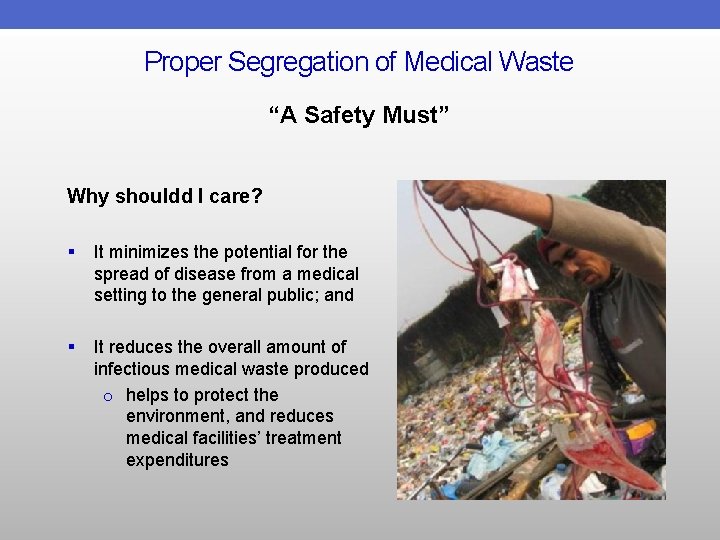
Proper Segregation of Medical Waste “A Safety Must” Why shouldd I care? § It minimizes the potential for the spread of disease from a medical setting to the general public; and § It reduces the overall amount of infectious medical waste produced o helps to protect the environment, and reduces medical facilities’ treatment expenditures
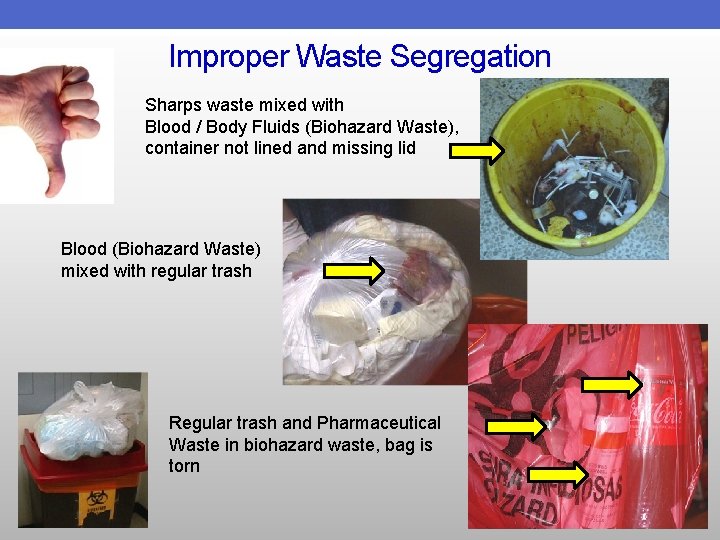
Improper Waste Segregation Sharps waste mixed with Blood / Body Fluids (Biohazard Waste), container not lined and missing lid Blood (Biohazard Waste) mixed with regular trash Regular trash and Pharmaceutical Waste in biohazard waste, bag is torn
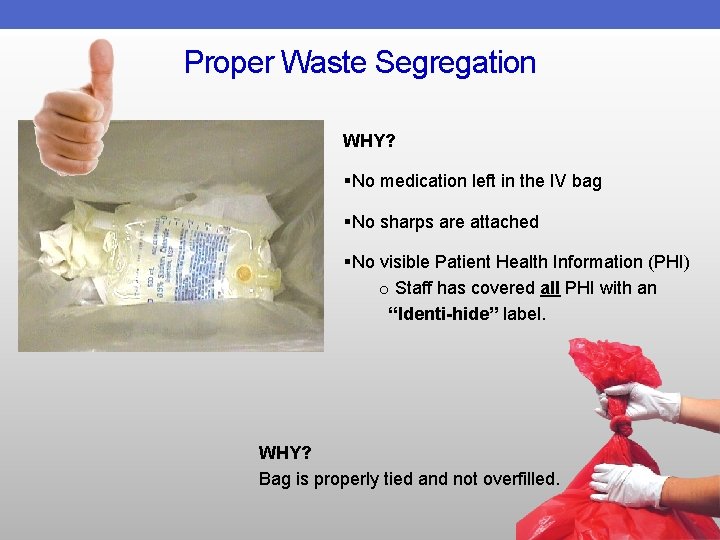
Proper Waste Segregation WHY? §No medication left in the IV bag §No sharps are attached §No visible Patient Health Information (PHI) o Staff has covered all PHI with an “Identi-hide” label. WHY? Bag is properly tied and not overfilled.
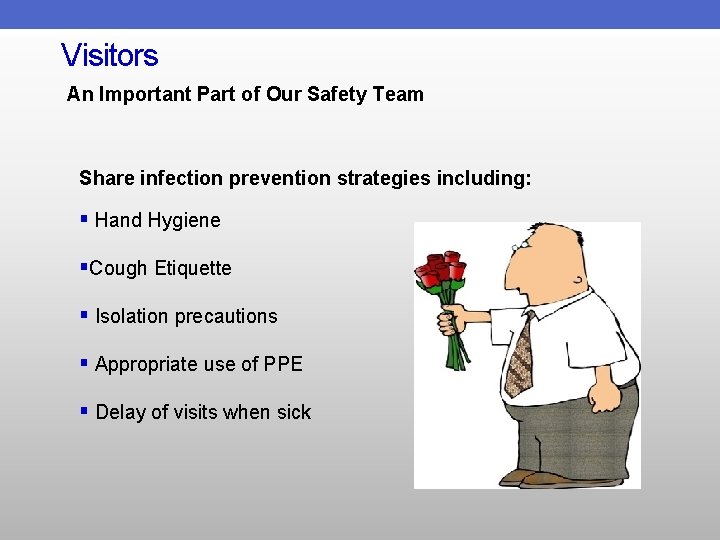
Visitors An Important Part of Our Safety Team Share infection prevention strategies including: § Hand Hygiene §Cough Etiquette § Isolation precautions § Appropriate use of PPE § Delay of visits when sick
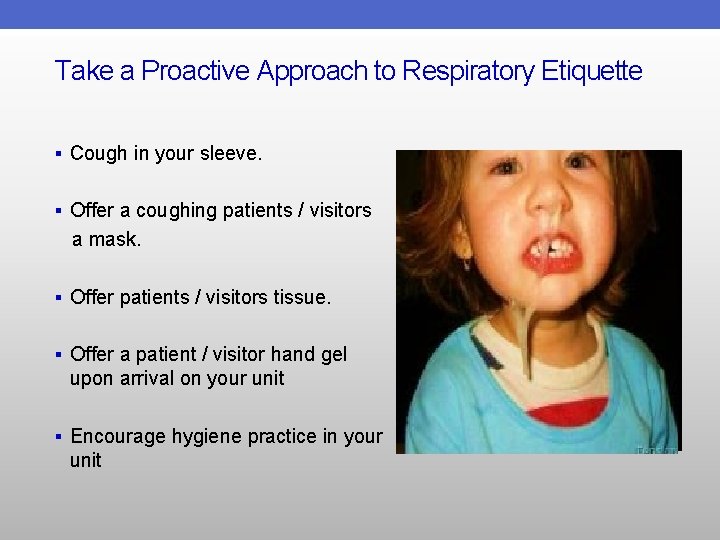
Take a Proactive Approach to Respiratory Etiquette § Cough in your sleeve. § Offer a coughing patients / visitors a mask. § Offer patients / visitors tissue. § Offer a patient / visitor hand gel upon arrival on your unit § Encourage hygiene practice in your unit
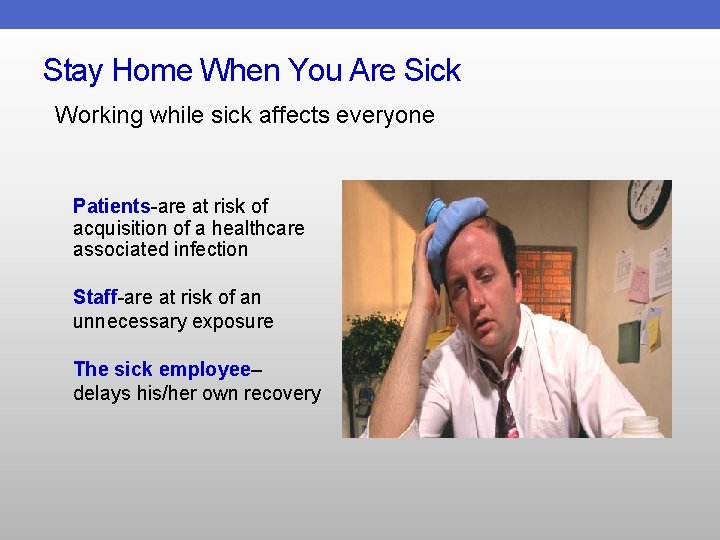
Stay Home When You Are Sick Working while sick affects everyone Patients-are at risk of acquisition of a healthcare associated infection Staff-are at risk of an unnecessary exposure The sick employee– delays his/her own recovery
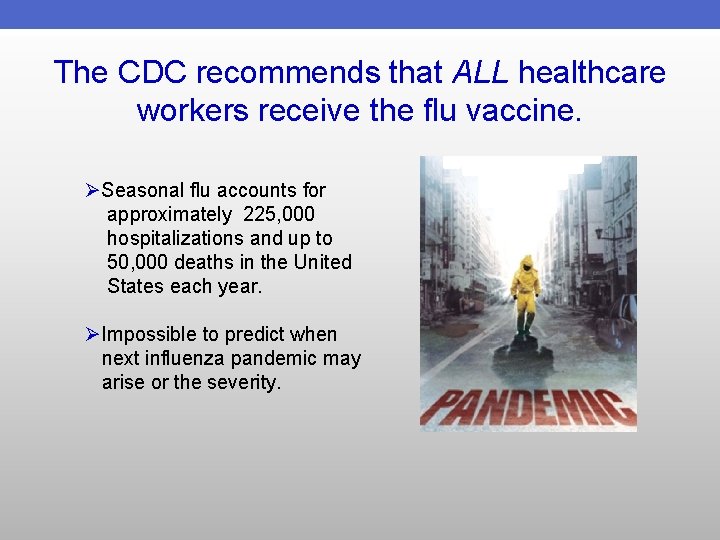
The CDC recommends that ALL healthcare workers receive the flu vaccine. ØSeasonal flu accounts for approximately 225, 000 hospitalizations and up to 50, 000 deaths in the United States each year. ØImpossible to predict when next influenza pandemic may arise or the severity.
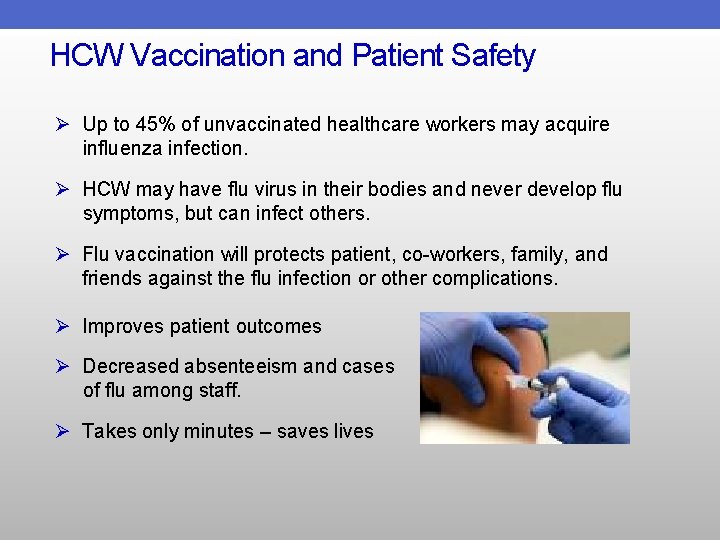
HCW Vaccination and Patient Safety Ø Up to 45% of unvaccinated healthcare workers may acquire influenza infection. Ø HCW may have flu virus in their bodies and never develop flu symptoms, but can infect others. Ø Flu vaccination will protects patient, co-workers, family, and friends against the flu infection or other complications. Ø Improves patient outcomes Ø Decreased absenteeism and cases of flu among staff. Ø Takes only minutes – saves lives
References Guideline for Isolation Precautions: Preventing Transmission of Infectious Agents in Healthcare Settings, 2007. Jane D. Siegel, MD; Emily Rhinehart, RN MPH CIC; Marguerite Jackson, Ph. D; Linda Chiarello, RN MS; the Healthcare Infection Control Practices Advisory Committee. http: //www. cdc. gov/hicpac/pdf/isolation/Isolation 2007. pdf William A. Rutala, Ph. D. , M. P. H. , David J. Weber, M. D. , M. P. H. , and the Healthcare Infection Control Practices Advisory Committee (HICPAC) (2008) Guideline for Disinfection and Sterilization in Healthcare Facilities, Centers for Disease Control and Prevention. http: //www. cdc. gov/hicpac/pdf/guidelines/Disinfection_Nov_2008. pdf Lynne Sehulster, Ph. D. , Raymond Y. W. Chinn, M. D. , Center for Disease Control and Prevention / Healthcare Infection Control Practices Advisory Committee (HICPAC) (2003), Guidelines for Environmental Infection Control in Health-Care Facilities http: //www. cdc. gov/mmwr/preview/mmwrhtml/rr 5210 a 1. htm Centers for Disease Control and Prevention Influenza website http: //www. cdc. gov/flu/about/disease/index. htm CDC Advisory Committee on Immunization Practices (ACIP) 2013 -2014 http: //www. cdc. gov/flu/professionals/acip/index. htm