
Infection Prevention and Surveillance in the ASC Developing



- Slides: 47
Infection Prevention and Surveillance in the ASC Developing an IP Plan and Annual Risk Assessment Deborah Mack, RN, BSN, CASC, CAIP Healthcare Consultant QRS Solutions
Learning Objectives • Explain how to create an Infection Prevention Risk Assessment specific for your facility • List potential risks at your facility that could be included in a Risk Assessment • Create a Program Plan to manage and reduce the identified risks for your facility • Identify two situations that would cause a re-evaluation of the Infection Prevention Risk Assessment and Program Plan
What is a IC Risk Assessment? • A process that examines recognized and potential risk factors for acquiring and transmitting infections in a healthcare facility • Identifies evidence-based measures to reduce these risks • Includes a prioritization of risk factors based on their actual or potential impact on care, treatment, or services • Evidenced based measures and actions are identified from leading authorities in infection prevention
Why do a IC Risk Assessment? • Promote a safe environment for patients and personnel • Identified infection risks are prioritized based on actual or potential impact and severity • Provides the foundation of you IP Plan and related activities; like surveillance and auditing • Geographic areas of risks in your community
Why do a IC Risk Assessment? • Infection and disease prevalence in your community (local, county, national health authorities) • Identify at-risk populations/procedures in your facility – Problem prone, high risk (for infections) procedures – High risk populations that your ASC may serve • Meet regulatory and accreditation requirements
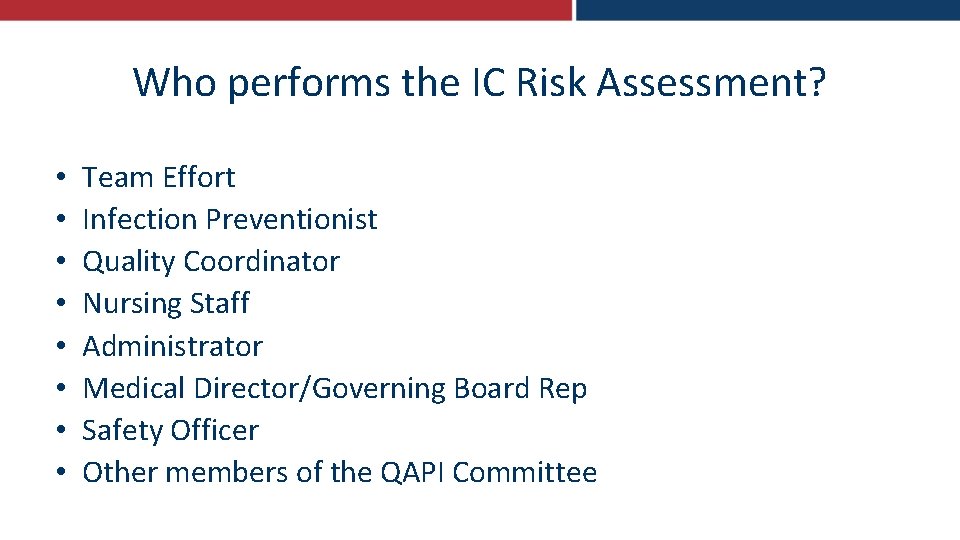
Who performs the IC Risk Assessment? • • Team Effort Infection Preventionist Quality Coordinator Nursing Staff Administrator Medical Director/Governing Board Rep Safety Officer Other members of the QAPI Committee
CONDUCTING A RISK ASSESSMENT 7
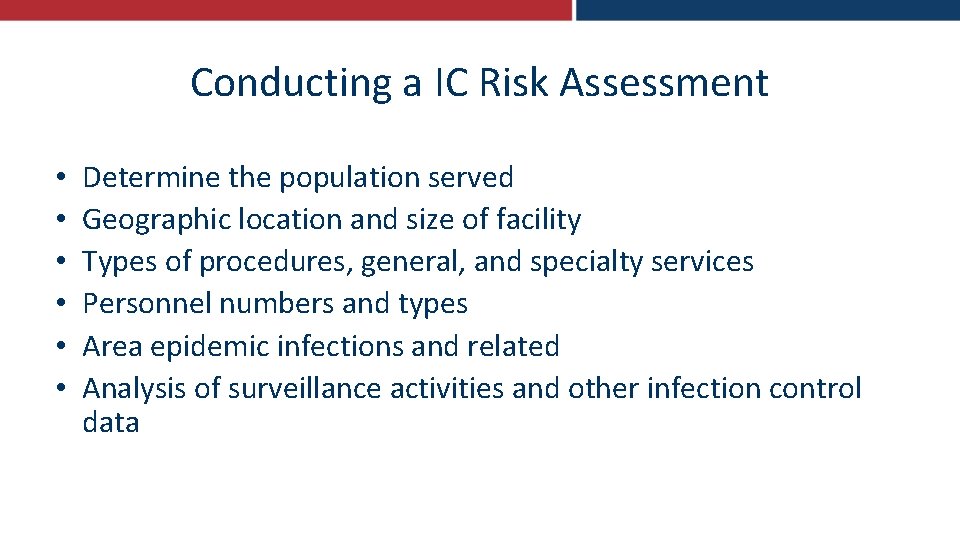
Conducting a IC Risk Assessment • • • Determine the population served Geographic location and size of facility Types of procedures, general, and specialty services Personnel numbers and types Area epidemic infections and related Analysis of surveillance activities and other infection control data
Steps in the Risk Assessment Process Choose a template/tool • Review with others • Assure it meets your needs, including regulatory and accreditation requirements Determine process you will use • Who will be involved? Identify your team • Seek input from the team and others • Review facility IC surveillance data and community data
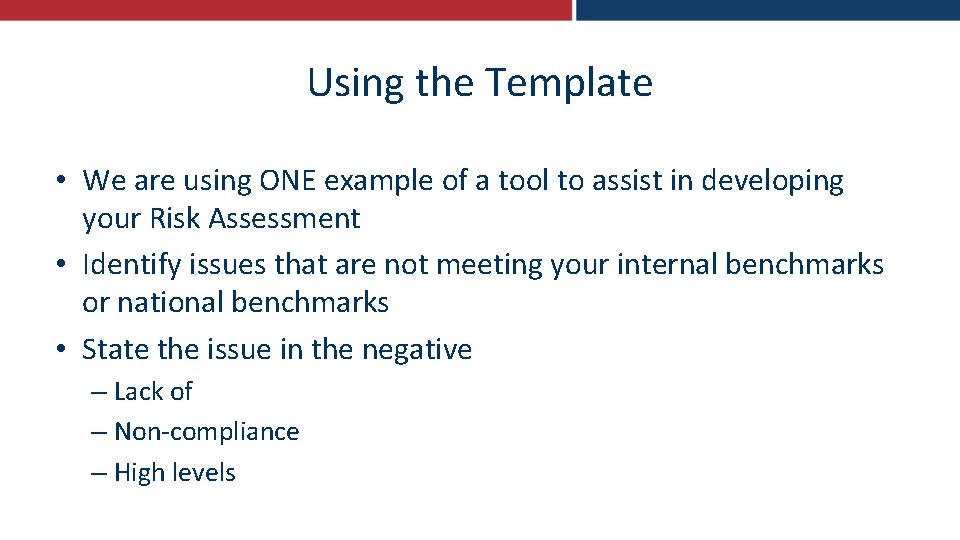
Using the Template • We are using ONE example of a tool to assist in developing your Risk Assessment • Identify issues that are not meeting your internal benchmarks or national benchmarks • State the issue in the negative – Lack of – Non-compliance – High levels
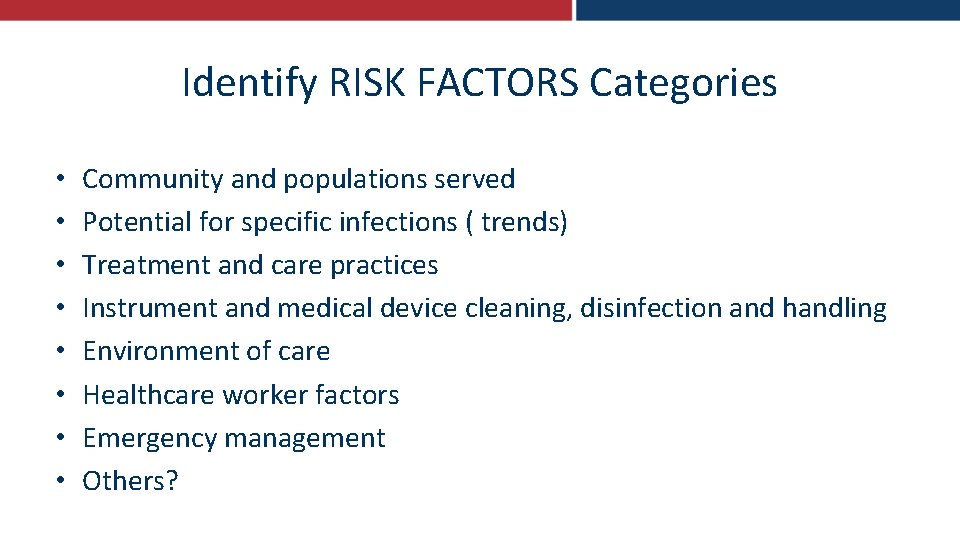
Identify RISK FACTORS Categories • • Community and populations served Potential for specific infections ( trends) Treatment and care practices Instrument and medical device cleaning, disinfection and handling Environment of care Healthcare worker factors Emergency management Others?
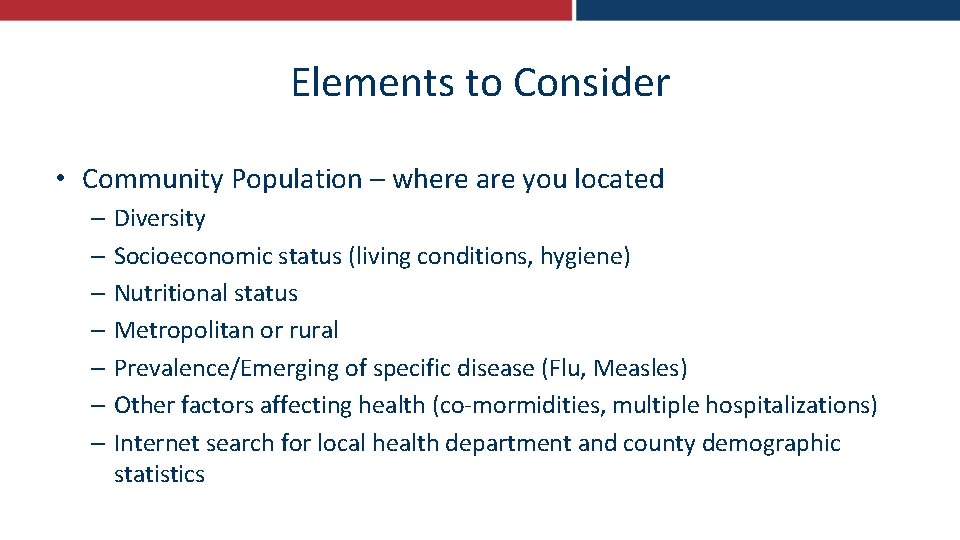
Elements to Consider • Community Population – where are you located – Diversity – Socioeconomic status (living conditions, hygiene) – Nutritional status – Metropolitan or rural – Prevalence/Emerging of specific disease (Flu, Measles) – Other factors affecting health (co-mormidities, multiple hospitalizations) – Internet search for local health department and county demographic statistics
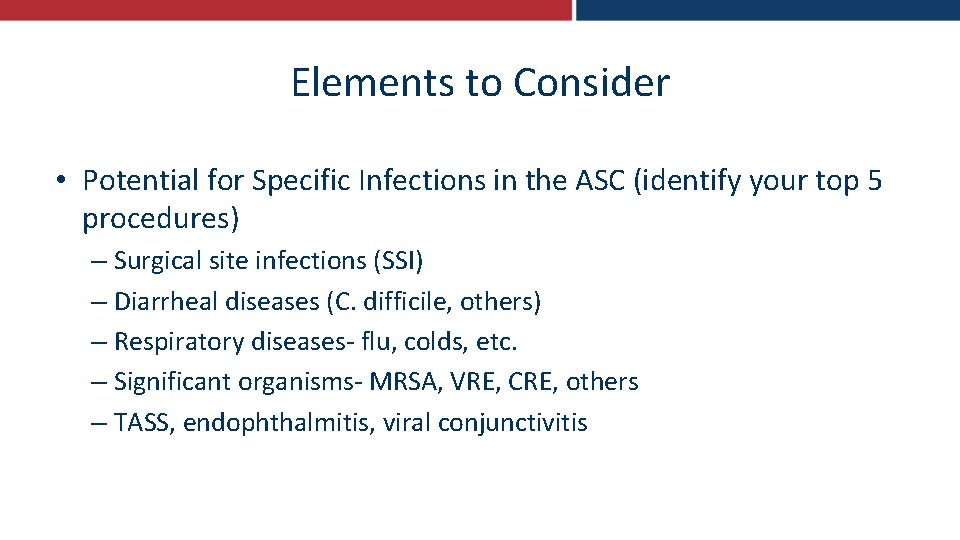
Elements to Consider • Potential for Specific Infections in the ASC (identify your top 5 procedures) – Surgical site infections (SSI) – Diarrheal diseases (C. difficile, others) – Respiratory diseases- flu, colds, etc. – Significant organisms- MRSA, VRE, CRE, others – TASS, endophthalmitis, viral conjunctivitis
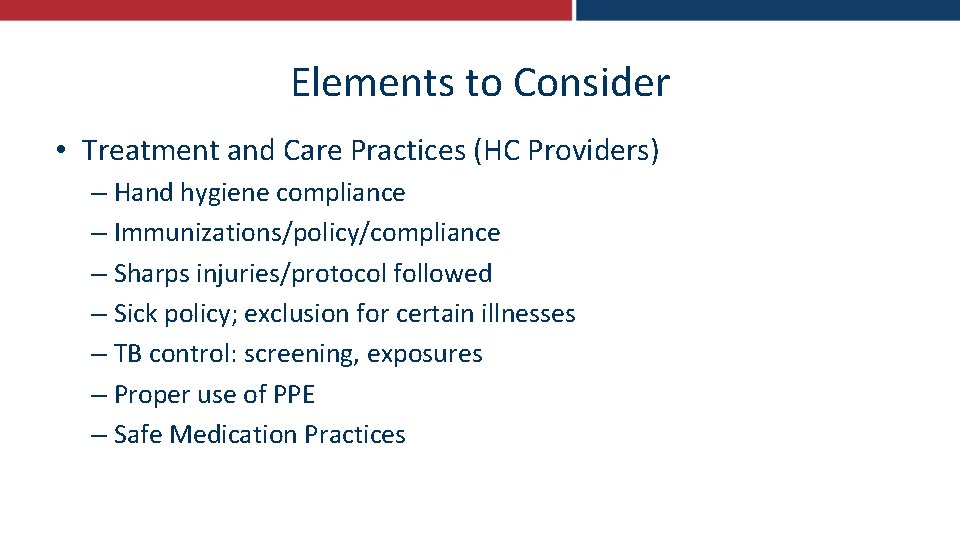
Elements to Consider • Treatment and Care Practices (HC Providers) – Hand hygiene compliance – Immunizations/policy/compliance – Sharps injuries/protocol followed – Sick policy; exclusion for certain illnesses – TB control: screening, exposures – Proper use of PPE – Safe Medication Practices
Elements to Consider • Instrument and Medical Device Cleaning, Disinfection, Sterilization – Following AAMI, AORN, CDC Guidelines – Following IFU’s, policies and procedures – No reuse of disposables/single patient use – Proper monitoring of sterilizers – Proper monitoring of high level disinfection (HLD) practices – Preventive maintenance on all equipment performed and documented – Procedure for failed sterilizer or HLD tests – Staff education and competency
Elements to Consider • Environment of Care – Appropriate for procedures, adequate space for instrument/scope cleaning, disinfection and sterilization – Furnishings can be cleaned/disinfected – Cleaning, disinfection of environment – Biohazard waste management – Construction: ICRA, involvement in planning, barriers, equipment, furnishings – Requirements for ventilation in OR, CS
Elements to Consider • Emergency Management – Infectious patients in the ASC – Flood – contaminated water – Earthquakes, drought – Accessibility to the nearest hospital
Establishing Priorities • Priorities are Based on Relative Risk (high, medium, low, none) – What is the potential impact of event/condition on patients and staff – What is the probability of the event/condition occurring – How prepared is the organization to deal with this event/condition
Potential Impact • For patient illness, injury, infection, death; need for admission to inpatient facility • For personnel illness, injury, infection, shortage • Organization’s ability to function • Degree of clinical and financial impact
Probability of the Event Occurring • Review information regarding historical data, infection surveillance data, reports in the literature • Scope of services provided • Environment of surrounding area (topography, interstate roads, chemical plants, railroad, ports, etc. )
Facility Preparedness • • • Policies and Procedures are in place Staff well prepared to handle IC issues Adequate trained and competent staff Available services and equipment Adequate instrument and equipment
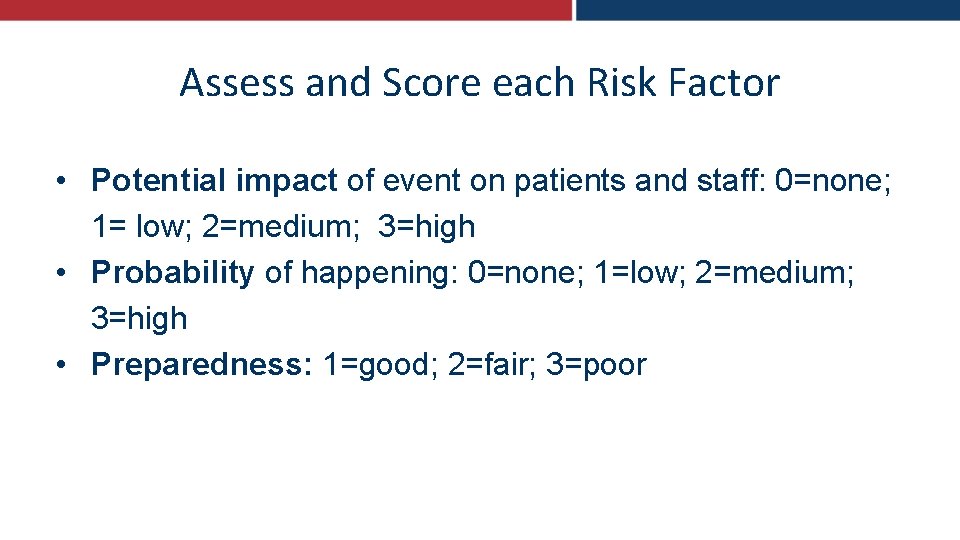
Assess and Score each Risk Factor • Potential impact of event on patients and staff: 0=none; 1= low; 2=medium; 3=high • Probability of happening: 0=none; 1=low; 2=medium; 3=high • Preparedness: 1=good; 2=fair; 3=poor
Numerical Risk Level • Total the numbers in each row • Select the highest risks for your priority goals • Some low risk scores may be chosen because they are regulatory or accreditation requirements • Try to develop at least three goals
Next Steps • For each Prioritized Risk; identify: – Goal • Monitor selected procedures/processes • Compare findings and trends internally over time • Compare data to external benchmarks from national resources – Measurable Objective – Action Plan to achieve Goal – Responsible Person – Time Frame – Method for evaluating the effectiveness of the action plan
Summary • The Risk Assessment is the platform for all IP program activities • Allows for identification and prioritization of activities to reduce risks • Measurable objectives provide a basis for evaluating the effectiveness of your program
Components of IC Plan and Program
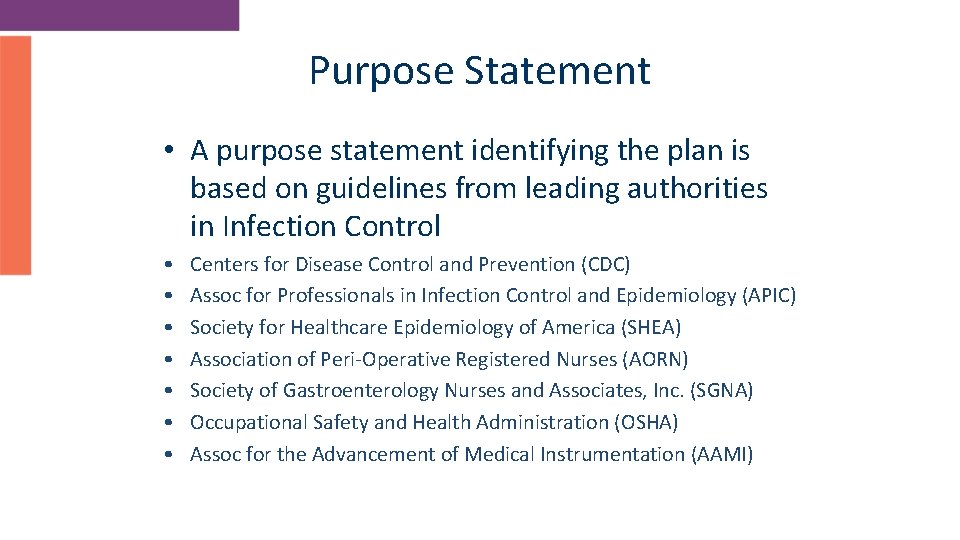
Purpose Statement • A purpose statement identifying the plan is based on guidelines from leading authorities in Infection Control • • Centers for Disease Control and Prevention (CDC) Assoc for Professionals in Infection Control and Epidemiology (APIC) Society for Healthcare Epidemiology of America (SHEA) Association of Peri-Operative Registered Nurses (AORN) Society of Gastroenterology Nurses and Associates, Inc. (SGNA) Occupational Safety and Health Administration (OSHA) Assoc for the Advancement of Medical Instrumentation (AAMI)
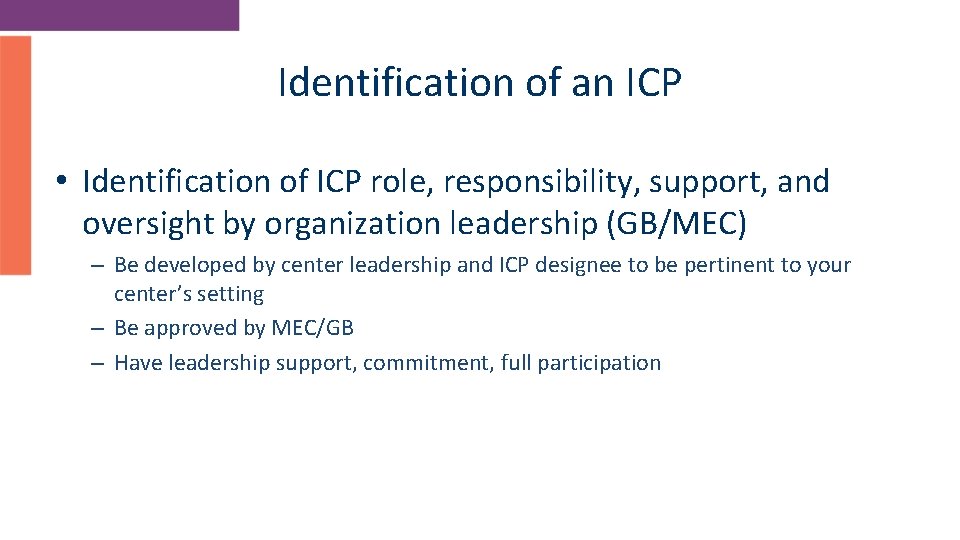
Identification of an ICP • Identification of ICP role, responsibility, support, and oversight by organization leadership (GB/MEC) – Be developed by center leadership and ICP designee to be pertinent to your center’s setting – Be approved by MEC/GB – Have leadership support, commitment, full participation
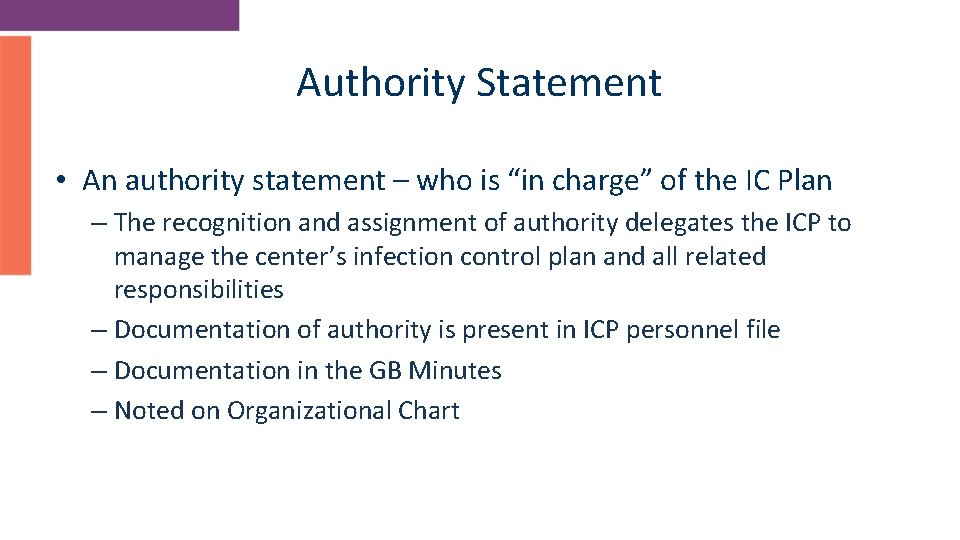
Authority Statement • An authority statement – who is “in charge” of the IC Plan – The recognition and assignment of authority delegates the ICP to manage the center’s infection control plan and all related responsibilities – Documentation of authority is present in ICP personnel file – Documentation in the GB Minutes – Noted on Organizational Chart
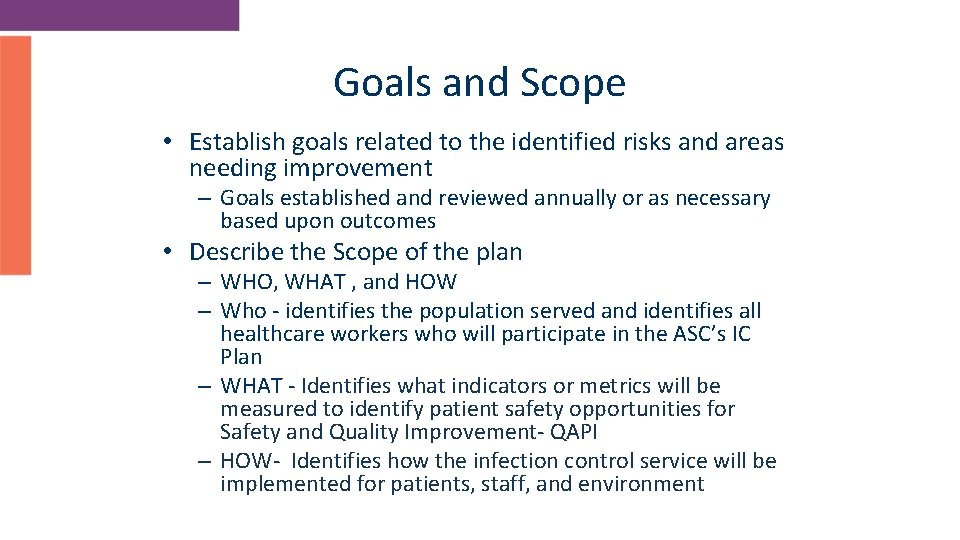
Goals and Scope • Establish goals related to the identified risks and areas needing improvement – Goals established and reviewed annually or as necessary based upon outcomes • Describe the Scope of the plan – WHO, WHAT , and HOW – Who - identifies the population served and identifies all healthcare workers who will participate in the ASC’s IC Plan – WHAT - Identifies what indicators or metrics will be measured to identify patient safety opportunities for Safety and Quality Improvement- QAPI – HOW- Identifies how the infection control service will be implemented for patients, staff, and environment
Investigation and Surveillance • Describe the investigation and surveillance processes – Patient contact or physician letters – Rate of return on surveillance monthly – 30 day surveillance (all cases) – 90 day surveillance (for specific procedures) – Conducting investigations – Focused peer review – Outbreak investigations
Reporting Data • Reporting data and processes – What data are you going to collect – Who will collect the data to be reported and how often – Infection data must be accurately reported internally and externally ( ASCA benchmarking) – Reporting of Communicable Diseases to the appropriate authority
Risks and Strategies • Identified risks and risk assessment processes – Prioritize identified risks – Establish your goals and objectives • Identified strategies to mitigate risks – Monitoring tools and education plan – Collaboration with the EOC/Safety Officer – Collaboration with the Employee Health Nurse – Pre-assessment information (MRSA) – Antibiotic Stewardship Program
Sterilization/Disinfection • • Biological Indicators Chemical Indicators and failed chemical indicators Failed Biological Indicators Operation Maintenance Cleaning of Sterilizers Prep of Instruments and Supplies for Sterilization Processing Contaminated Instruments Rapid Processing of Instruments for Immediate Use
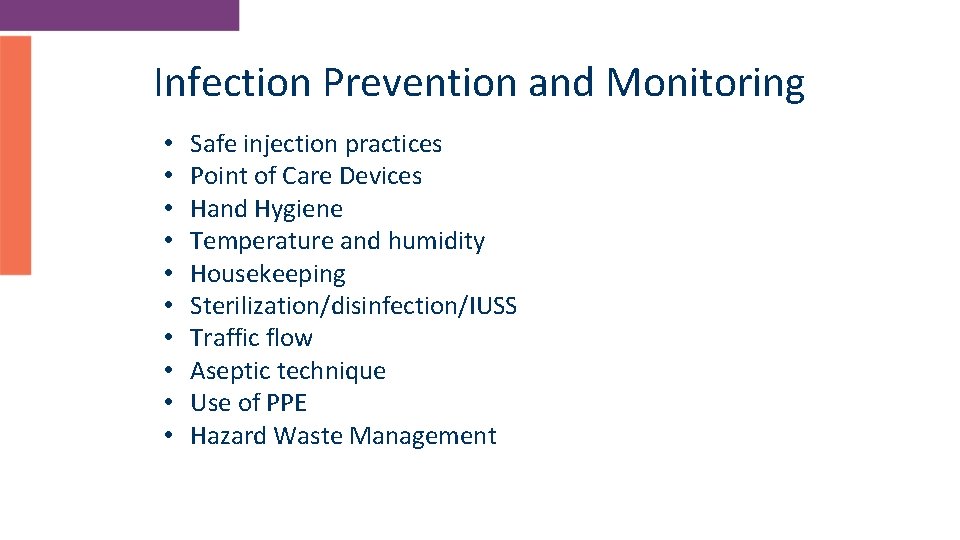
Infection Prevention and Monitoring • • • Safe injection practices Point of Care Devices Hand Hygiene Temperature and humidity Housekeeping Sterilization/disinfection/IUSS Traffic flow Aseptic technique Use of PPE Hazard Waste Management
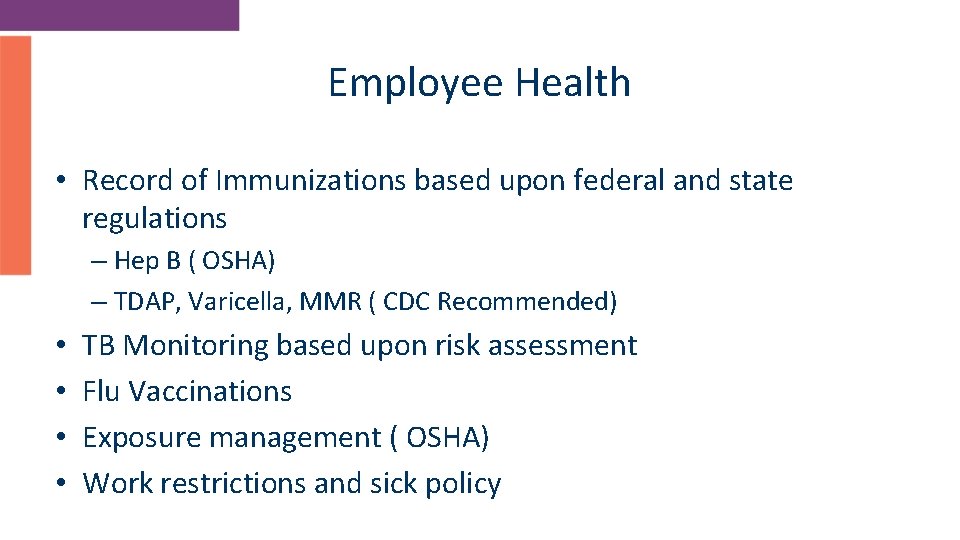
Employee Health • Record of Immunizations based upon federal and state regulations – Hep B ( OSHA) – TDAP, Varicella, MMR ( CDC Recommended) • • TB Monitoring based upon risk assessment Flu Vaccinations Exposure management ( OSHA) Work restrictions and sick policy
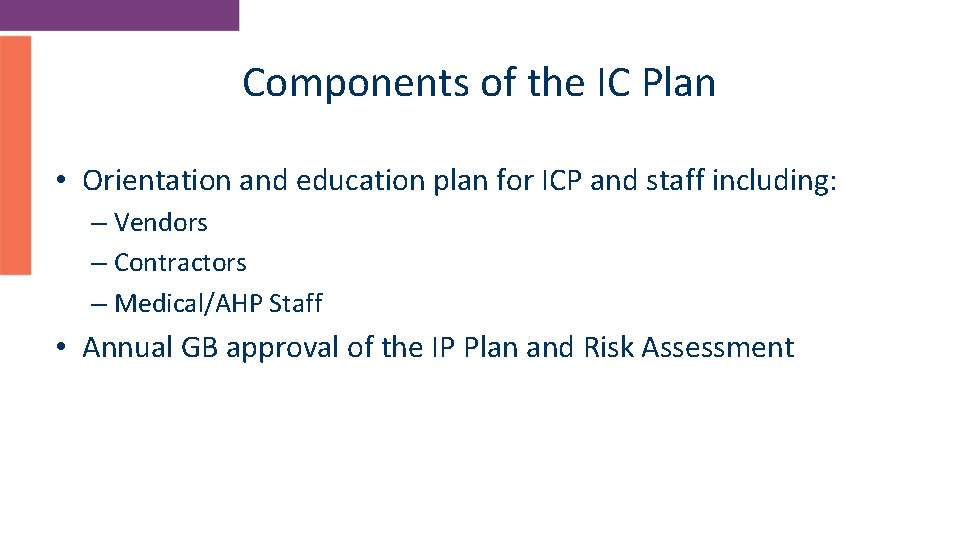
Components of the IC Plan • Orientation and education plan for ICP and staff including: – Vendors – Contractors – Medical/AHP Staff • Annual GB approval of the IP Plan and Risk Assessment
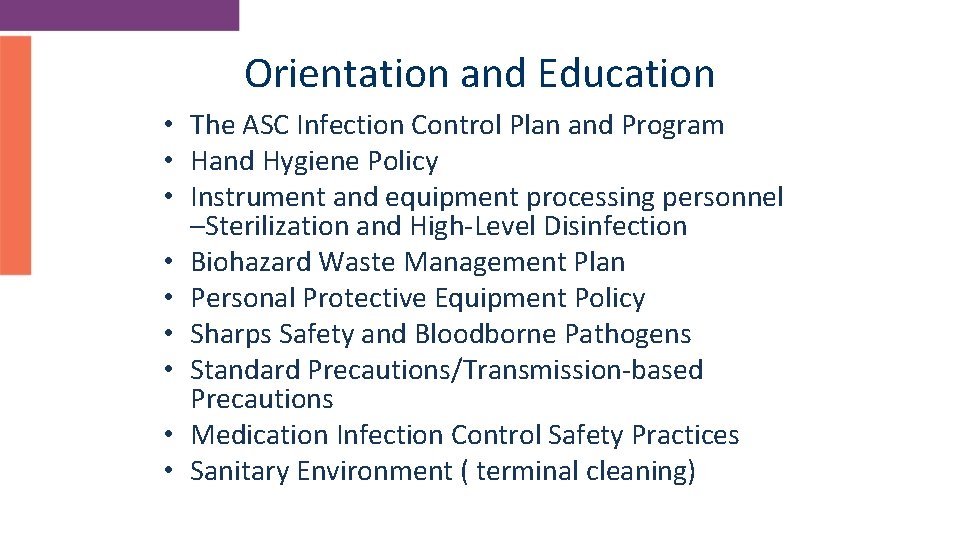
Orientation and Education • The ASC Infection Control Plan and Program • Hand Hygiene Policy • Instrument and equipment processing personnel –Sterilization and High-Level Disinfection • Biohazard Waste Management Plan • Personal Protective Equipment Policy • Sharps Safety and Bloodborne Pathogens • Standard Precautions/Transmission-based Precautions • Medication Infection Control Safety Practices • Sanitary Environment ( terminal cleaning)
Evaluation of the IP Assessment and Plan
When to Re-Evaluate the IP Risk Assessment and Plan • • • Renovation Construction CMS Deficiencies New staff in SPD New Anesthesia providers
ICP Educational Resources • • ASCA: www. asca. org APIC: www. apic. org AORN: www. aorn. org CDC: www. cdc. org OSHA: www. osha. gov AAMI: www. aami. org Accreditation Organizations
Where do I start? • • • Do I have the training to do this job? What processes are already in place? Does Administration and leadership support this role? What resources are available to me? Don’t panic! Stay positive! Don’t attempt this on your own!
Where do I start? Do I have the training to do this job? Do I have the right IC Risk Assessment tool? Will I have help? What resources are available to me? Don’t panic! Stay positive! Don’t attempt this on your own!
Sample Interior Slide (44 pt) QUESTIONS? Sample Caption (32 pt)
References • CMS Cf. C Appendix L – www. cms. gov/Regulations-and. Guidance/Manuals/downloads/som 107 ap l ambulatory. pdf • CMS Exhibit 351 Infection Control Surveyor Worksheet – www. cms. gov/Regulations-and. Guidance/Manuals/downloads/som 107 _exhibit_351. pdf
References • CDC – Hand hygiene – www. cdc. gov/handhygiene/index. html • CDC – Safe Medication Practices – www. cdc. gov/injectionsafety/providers/provider_faqs_med-prep. html • CDC SSI Module – www. cdc. gov/nhsn/pdfs/pscmanual/9 pscssicurrent. pdf • CDC’s National Health and Safety Network (NHSN) website for 5 step enrollment: – www. cdc. gov/nhsn/ambulatory-surgery/enroll. html
Infection Control is Everyone’s Responsibility! Deborah L. Mack, RN, BSN, CASC, CAIP QRS Solutions dmack 1957@gmail. com 925 -899 -0739