
Infection Prevention and Control Saving lives Budapest 6
Infection Prevention and Control Saving lives Budapest, 6 March 2019 Dr Masoud Dara Coordinator, Communicable Diseases WHO Regional Office for Europe

Back to basics Infection prevention and control (IPC) are practices and activities that prevent patients and health workers from being harmed by avoidable infections.
The global and European burden of Healthcare Associated Infections (HAI) is unacceptable Global • 7% of patients in developed and 10% in developing countries will acquire at least one HAI on average ; – death from HAI occurs in about 10% of affected patients; European region • Over 4 million patients are affected by 4. 5 million HAI episodes annually – leading to 16 million extra days of hospital stay, 37 000 attributable deaths and contributing to an additional 110 000 deaths per year. Report on the endemic burden of healthcare-associated infection worldwide. Geneva: World Health Organization; 2011
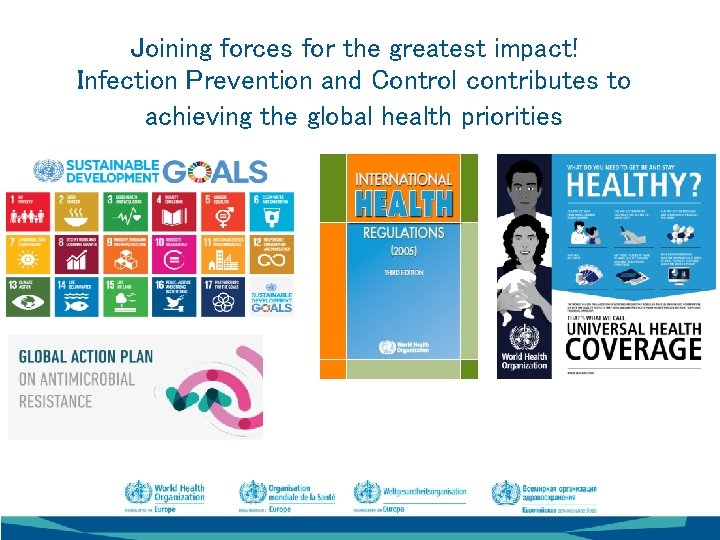
Joining forces for the greatest impact! Infection Prevention and Control contributes to achieving the global health priorities
Standard Precautions All patients, at all times • “Standard precautions are meant to reduce the risk of transmission of bloodborne and other pathogens from both recognized and unrecognized sources. • They are the basic level of infection control precautions which are to be used, as a minimum, in all patient care settings. “ • "Risk assessment is critical. Assess all health-care activities to determine the personal protection that is indicated. " Standard precautions in health care: Aide-memoire. WHO October 2007 http: //www. who. int/csr/resources/publications/EPR_AM 2_E 7. pdf.
How are we doing in terms of Infection Prevention and Control Programmes in the European region?
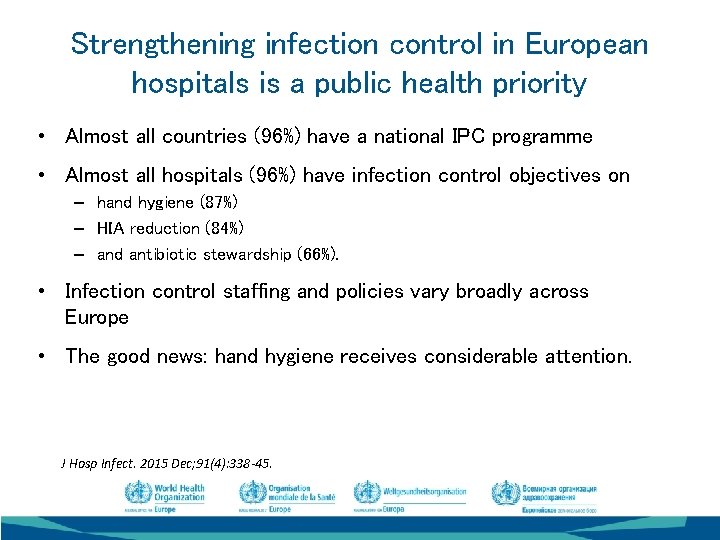
Strengthening infection control in European hospitals is a public health priority • Almost all countries (96%) have a national IPC programme • Almost all hospitals (96%) have infection control objectives on – hand hygiene (87%) – HIA reduction (84%) – and antibiotic stewardship (66%). • Infection control staffing and policies vary broadly across Europe • The good news: hand hygiene receives considerable attention. J Hosp Infect. 2015 Dec; 91(4): 338 -45.
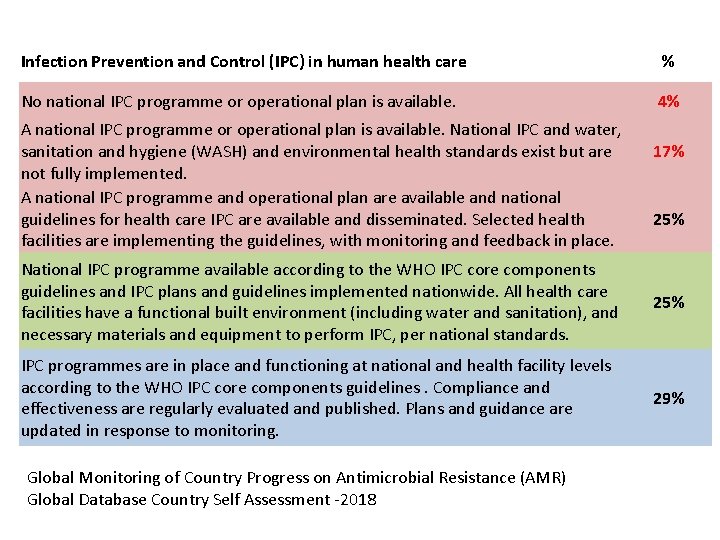
Infection Prevention and Control (IPC) in human health care % No national IPC programme or operational plan is available. 4% A national IPC programme or operational plan is available. National IPC and water, sanitation and hygiene (WASH) and environmental health standards exist but are not fully implemented. A national IPC programme and operational plan are available and national guidelines for health care IPC are available and disseminated. Selected health facilities are implementing the guidelines, with monitoring and feedback in place. 17% 25% National IPC programme available according to the WHO IPC core components guidelines and IPC plans and guidelines implemented nationwide. All health care facilities have a functional built environment (including water and sanitation), and necessary materials and equipment to perform IPC, per national standards. 25% IPC programmes are in place and functioning at national and health facility levels according to the WHO IPC core components guidelines. Compliance and effectiveness are regularly evaluated and published. Plans and guidance are updated in response to monitoring. 29% Global Monitoring of Country Progress on Antimicrobial Resistance (AMR) Global Database Country Self Assessment -2018
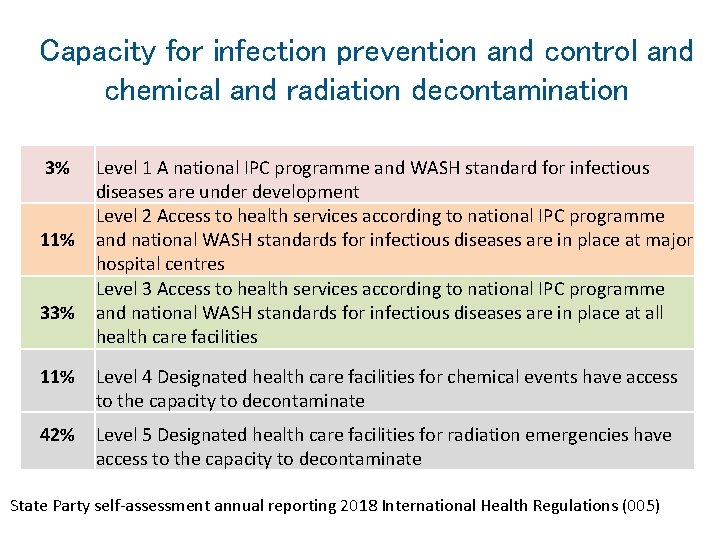
Capacity for infection prevention and control and chemical and radiation decontamination 3% 11% 33% Level 1 A national IPC programme and WASH standard for infectious diseases are under development Level 2 Access to health services according to national IPC programme and national WASH standards for infectious diseases are in place at major hospital centres Level 3 Access to health services according to national IPC programme and national WASH standards for infectious diseases are in place at all health care facilities 11% Level 4 Designated health care facilities for chemical events have access to the capacity to decontaminate 42% Level 5 Designated health care facilities for radiation emergencies have access to the capacity to decontaminate State Party self-assessment annual reporting 2018 International Health Regulations (005)
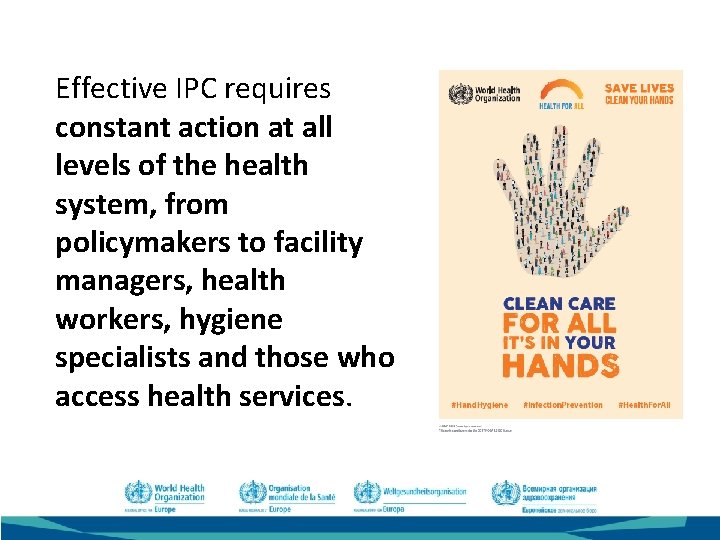
Effective IPC requires constant action at all levels of the health system, from policymakers to facility managers, health workers, hygiene specialists and those who access health services.
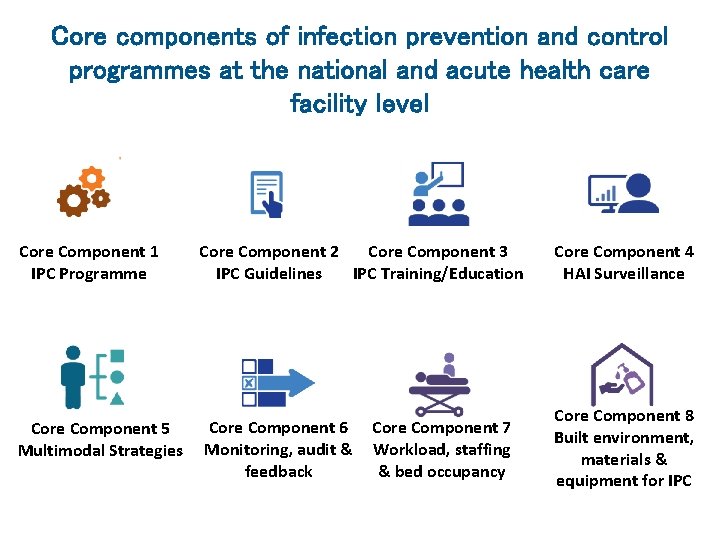
Core components of infection prevention and control programmes at the national and acute health care facility level Core Component 1 IPC Programme Core Component 3 Core Component 2 IPC Training/Education IPC Guidelines Core Component 4 HAI Surveillance Core Component 5 Multimodal Strategies Core Component 6 Monitoring, audit & feedback Core Component 8 Built environment, materials & equipment for IPC Core Component 7 Workload, staffing & bed occupancy
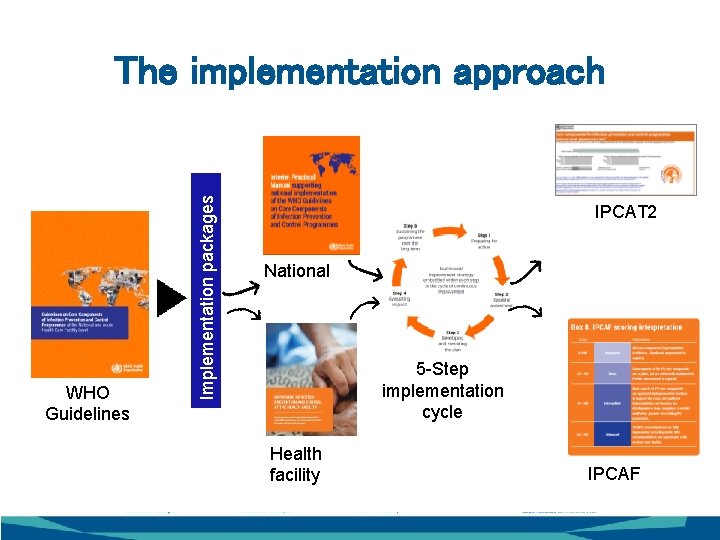
WHO Guidelines Implementation packages The implementation approach IPCAT 2 National 5 -Step implementation cycle Health facility IPCAF
Adapting IPC Core Components Ø Ø Ø multimodal/multidisciplinary strategies patient-centred integrated within clinical procedures innovative and locally adapted tailored to specific cultures and resource level
Conclusion • • • Demonstrate leadership and commitment Exchange good practices Support consolidated Actions Continuous awareness Full cycle of programme management for improvement
Acknowledgment • Dr Zsuzsanna Jakab, WHO Regional Director for Europe • Dr Dorit Nitzan, Coordinator for Health Emergency, WHO Regional Office for Europe • Ms Ana Paula Coutinhou Rehse, Technical Officer, WHO Regional Office for Europe • Member States and Partners
Thank you very much for your attention
- Slides: 17