
Infection Prevention and Control QA APIC Greater NY
- Slides: 12
Infection Prevention and Control Q&A – APIC Greater NY March 18, 2015 Natalie Fucito RN NYULMC Infection Prevention and Control Department 263 -5454 / 598 -6767
Question 1 A 14 -year old boy from rural Maryland was seen in the emergency room with fever, fatigue, chills, headache and a large annular lesion on his left thigh which the patient described as burning and itching. What is the most probable vector of this child’s illness? Does this patient need isolation?
Answer 1 A. Tick B. Mosquito C. Flea D. Louse
Answer 1 – continued… A Lyme test comes back negative and the Dermatology consult suggests this is ringworm. Does the patient need isolation now? How is ringworm transmitted? What precautions would you recommend to the worried staff nurses gathered around you in the hallway?
Question 2 A 73 -year-old woman resides in an extended care facility (ECF). Yesterday, she enjoyed a lengthy visit with her 20 year old grandson. Her grandson calls you, the IP at his grandmother’s ECF, today because he was just informed that he was recently exposed to N. meningitidis from his college roommate who was just hospitalized for this illness. The grandson is asymptomatic. However, after careful evaluation by his physician today, he was strongly urged to start a prophylactic course of rifampin immediately. What should you do?
Answer 2 A. Nothing at this point B. Start a line listing of all the people with whom the boy came in contact during his visit with his grandmother. C. Confirm the diagnosis and explore the boy’s “infectiousness” D. Start the grandmother on rifampin.
Answer 2 – continued… Do you think the asymptomatic grandson needs prophylactic antibiotics? Why is C the right answer?
Question 3 • For 2015, your IP program has selected reduction of Ventilator-Associated Pneumonia (VAP) as your Quality Improvement project. • In your 2014 annual evaluation, you note that the rate has consistently been at or below the NYS mean rate & NHSN 50 th percentile for the past year. In 2013, your VAP rate was above the NYS mean rate/NHSN 50 th percentile. • You recommend:
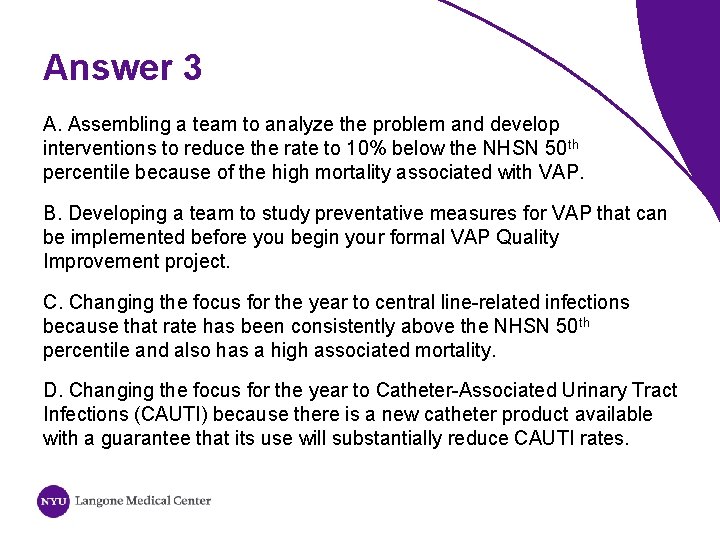
Answer 3 A. Assembling a team to analyze the problem and develop interventions to reduce the rate to 10% below the NHSN 50 th percentile because of the high mortality associated with VAP. B. Developing a team to study preventative measures for VAP that can be implemented before you begin your formal VAP Quality Improvement project. C. Changing the focus for the year to central line-related infections because that rate has been consistently above the NHSN 50 th percentile and also has a high associated mortality. D. Changing the focus for the year to Catheter-Associated Urinary Tract Infections (CAUTI) because there is a new catheter product available with a guarantee that its use will substantially reduce CAUTI rates.
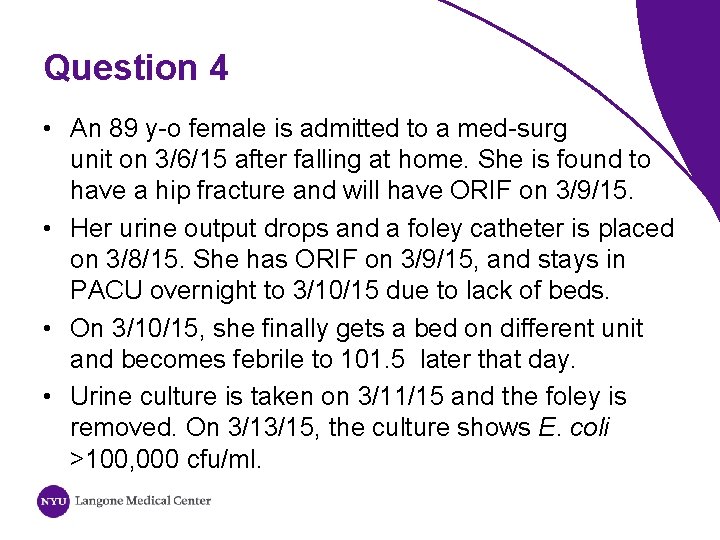
Question 4 • An 89 y-o female is admitted to a med-surg unit on 3/6/15 after falling at home. She is found to have a hip fracture and will have ORIF on 3/9/15. • Her urine output drops and a foley catheter is placed on 3/8/15. She has ORIF on 3/9/15, and stays in PACU overnight to 3/10/15 due to lack of beds. • On 3/10/15, she finally gets a bed on different unit and becomes febrile to 101. 5 later that day. • Urine culture is taken on 3/11/15 and the foley is removed. On 3/13/15, the culture shows E. coli >100, 000 cfu/ml.
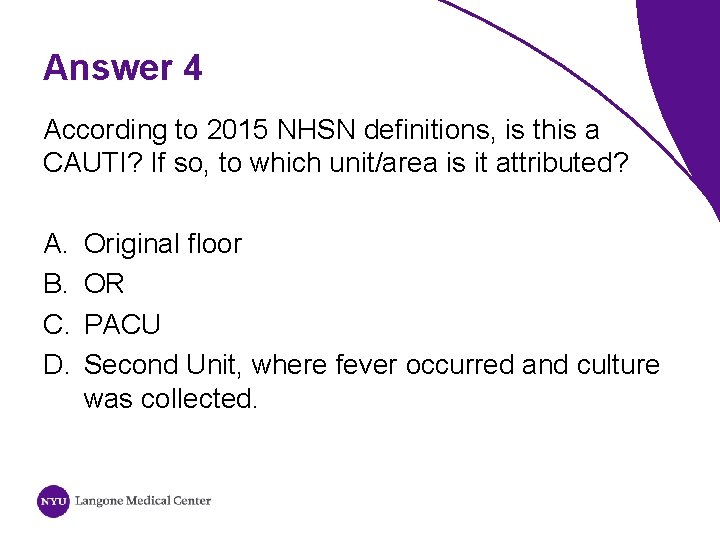
Answer 4 According to 2015 NHSN definitions, is this a CAUTI? If so, to which unit/area is it attributed? A. B. C. D. Original floor OR PACU Second Unit, where fever occurred and culture was collected.
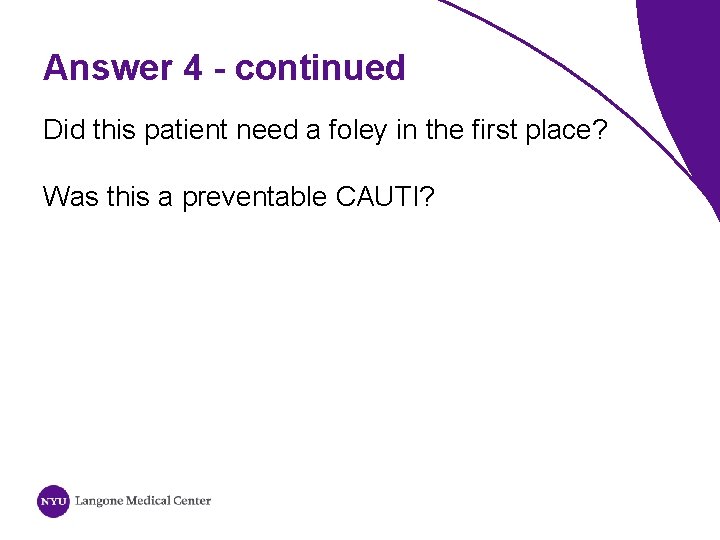
Answer 4 - continued Did this patient need a foley in the first place? Was this a preventable CAUTI?