
Infection Prevention and Control IPC Update for Primary

- Slides: 18
Infection Prevention and Control (IPC) Update for Primary Care 04 January 2021
Learning from Outbreaks As the Covid infection rate rises there have been a number of outbreaks regionally and nationally. Key learning: • Some staff forget or become fatigued and IPC practices slip • Remembering the basics is essential • Staff need to be reminded not to attend work if they are unwell. They should get a test instead. • It is better to have one staff off awaiting a test result than all your staff off due to an outbreak.
Standard Infection Control Precautions (SICPs) SICPs are the basic infection prevention and control measures necessary and are required across all COVID -19 pathways. These precautions must be used by all staff, in all care settings, at all times SICPS include: • Physical Distancing • Hand Hygiene • PPE
Physical Distancing Maintaining social distancing of 2 metres is considered standard practice in all health and social care areas across the UK (except when providing clinical care while wearing PPE). To achieve physical distancing, healthcare services should implement measures to establish separation between care pathways, for example through the provision of separate entrances/exits or restricted access to communal areas.
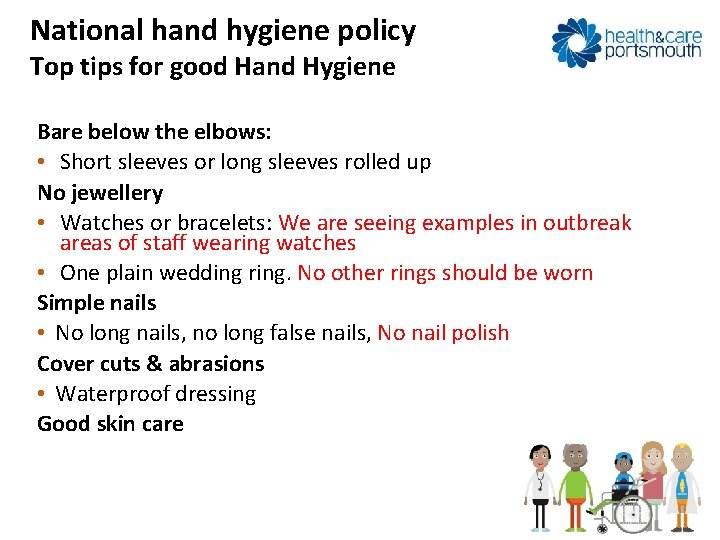
National hand hygiene policy Top tips for good Hand Hygiene Bare below the elbows: • Short sleeves or long sleeves rolled up No jewellery • Watches or bracelets: We are seeing examples in outbreak areas of staff wearing watches • One plain wedding ring. No other rings should be worn Simple nails • No long nails, no long false nails, No nail polish Cover cuts & abrasions • Waterproof dressing Good skin care
Handwashing & Use of Hand Gel Liquid Soap & Water • The type of liquid soap is not important • Handwashing with good technique is just as good as using hand gel – you do not need to do both Alcoholic hand gel • Hand gel is useful when in a hurry • Hand gel should not be used on soiled hands
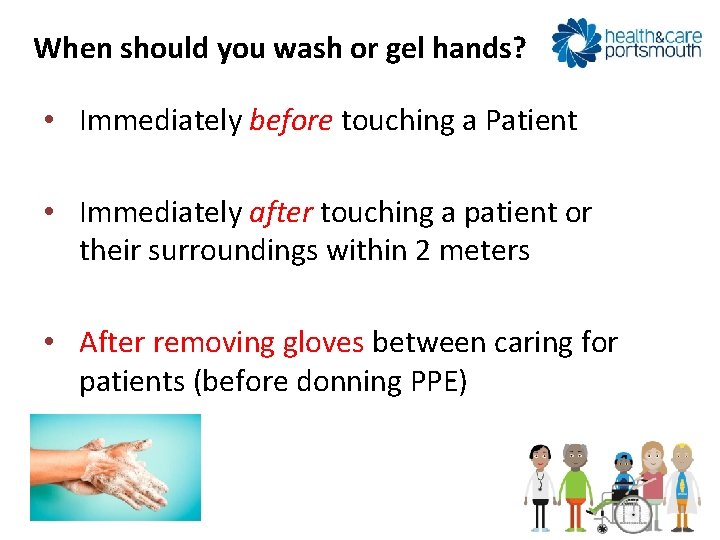
When should you wash or gel hands? • Immediately before touching a Patient • Immediately after touching a patient or their surroundings within 2 meters • After removing gloves between caring for patients (before donning PPE)
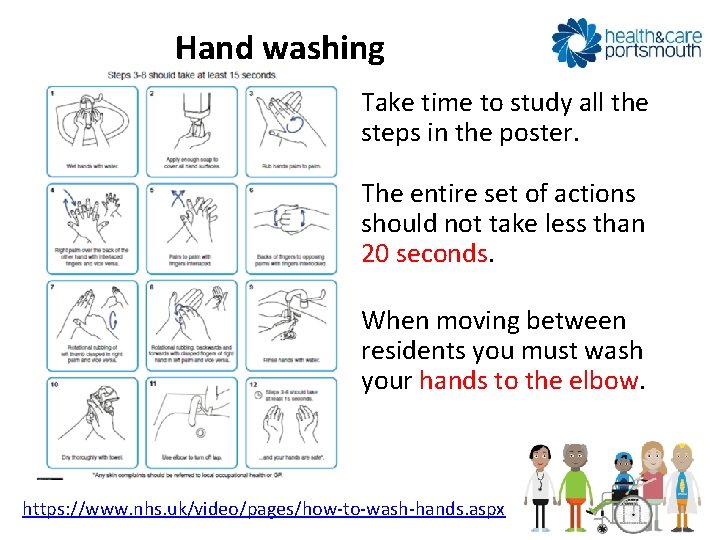
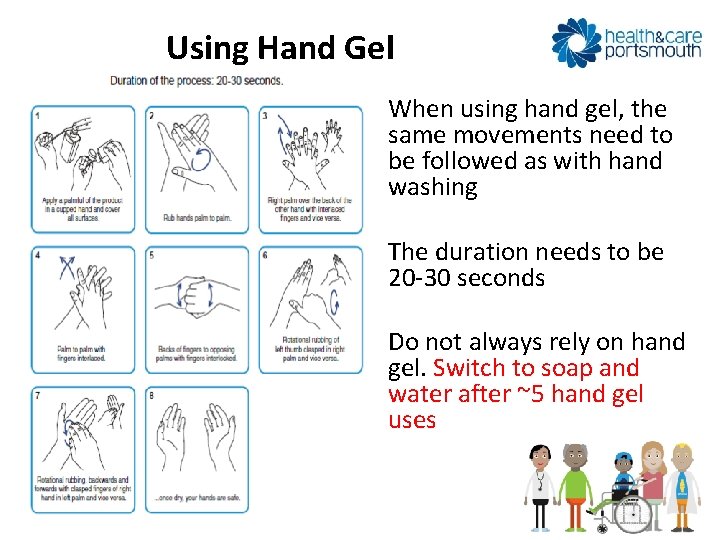
Hand washing Take time to study all the steps in the poster. The entire set of actions should not take less than 20 seconds. When moving between residents you must wash your hands to the elbow. https: //www. nhs. uk/video/pages/how-to-wash-hands. aspx
Using Hand Gel When using hand gel, the same movements need to be followed as with hand washing The duration needs to be 20 -30 seconds Do not always rely on hand gel. Switch to soap and water after ~5 hand gel uses
Personal Protective Equipment (PPE) All PPE should be: • located close to the point of use • stored safely and in a clean, dry area to prevent contamination • within expiry date (or had the quality assurance checks prior to releasing stock outside this date) • single use unless specified by the manufacturer or as agreed for extended/sessional use including surgical facemasks • changed immediately after each patient and/or after completing a procedure or task • disposed into the correct waste stream depending on setting • discarded if damaged or contaminated • safely doffed (removed) to avoid self-contamination. • decontaminated after each use following manufactures guidance if reusable PPE is used, such as non-disposable goggles/face shields/visors
Face Masks and Coverings Face masks and coverings in healthcare settings: • All staff (both clinical and non-clinical) should wear a face mask (Type I, II or IIR) at all times when not otherwise required to wear PPE for the provision of clinical care (including staff only areas). • All outpatients and visitors to healthcare settings should wear a face covering in line with government guidelines.
Face Masks and Coverings (cont. ) • Your mask only provides protection against Covid-19 if worn correctly. • Masks should be removed and hands washed rather than hung from one ear or worn under the chin • Make sure your mask covers your nose and mouth • DON’T: Wear your mask loosely with gaps on the sides
Gloves • • Gloves should be worn when exposure to blood and/or other body fluids, non-intact skin or mucous membranes is anticipated or likely changed immediately after each patient and/or after completing a procedure/task even on the same patient never decontaminated with Alcohol Based Hand Rub (ABHR) or soap between use Gloves should not be worn continually when not in physical contact with patients NB. Double gloving is NOT recommended for routine clinical care of COVID-19 cases
Aprons must be: • worn to protect uniform or clothes when contamination is anticipated or likely • worn when providing direct care within 2 metres of suspected/confirmed COVID-19 cases • changed between patients and/or after completing a procedure or task
Full body gowns or fluid repellent coveralls and FFP 3 Masks These are not routinely required in primary Care settings (except dentistry): • worn when there is a risk of extensive splashing of blood and/or body fluids • worn when undertaking aerosol generating procedures (AGPs) • For examples of AGPs see https: //www. gov. uk/government/publications/wuh an-novel-coronavirus-infection-prevention-andcontrol/covid-19 -infection-prevention-and-controlguidance-aerosol-generating-procedures
Eye or face protection (including fullface visors) Only be worn if: blood and/or body fluid contamination to the eyes or face is anticipated or likely e. g. surgical theatre team and always during AGPs, • Must be used with a face mask not instead of a mask • not be impeded by accessories such as piercings or false eyelashes
Other things to consider • • None of us are perfect all the time so be prepared to challenge others or be challenged Beware of lanyards, ties, scarfs and any other object that can dangle and inadvertently becoming contaminated or restrict good hand hygiene Remind staff to switch off the tracking on their Covid 19 App when wearing full PPE Remind staff that they should observe the 2 metre rule when socialising outside work Beware of car sharing: If staff have to car share they should wear surgical face masks Corona Virus does not respect your tea break Do NOT attend work if you are unwell. Get at test!
Remember Do the Simple things well and help keep everyone safe!