
Infection Prevention and Control 1 Clinical and Non
- Slides: 1
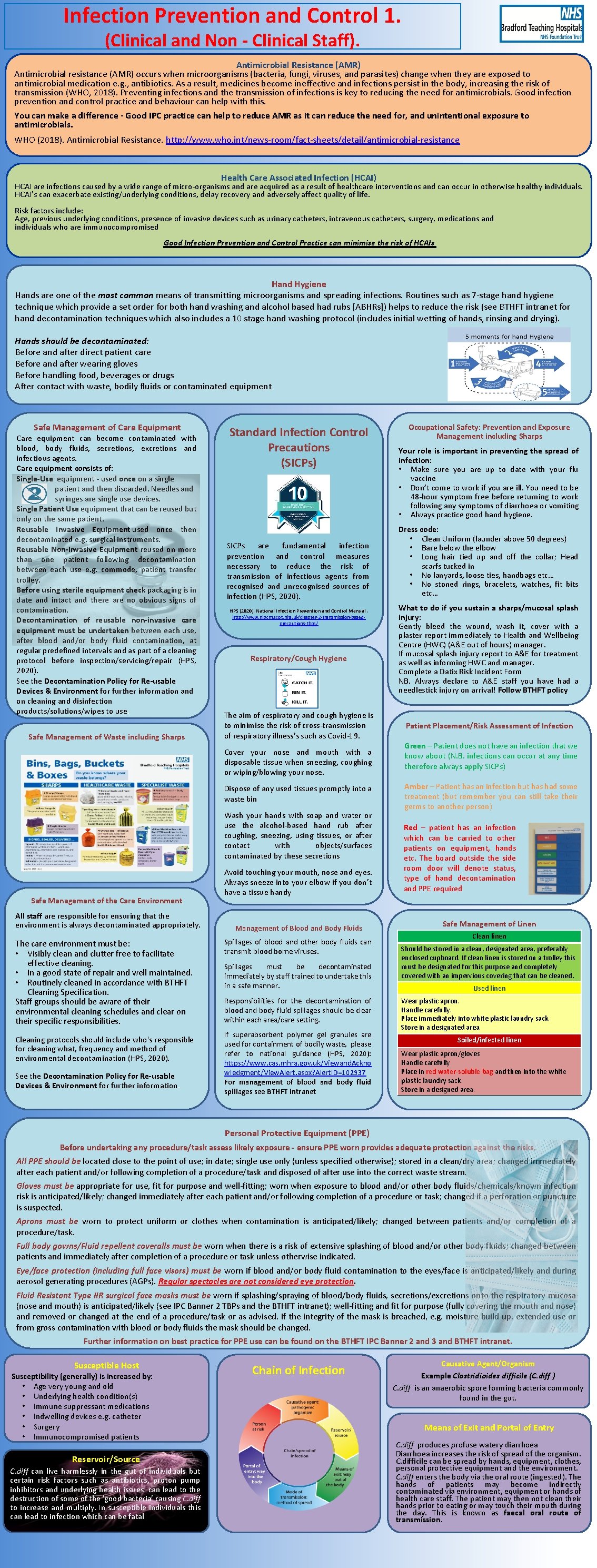
Infection Prevention and Control 1. (Clinical and Non - Clinical Staff). Antimicrobial Resistance (AMR) Antimicrobial resistance (AMR) occurs when microorganisms (bacteria, fungi, viruses, and parasites) change when they are exposed to antimicrobial medication e. g. , antibiotics. As a result, medicines become ineffective and infections persist in the body, increasing the risk of transmission (WHO, 2018). Preventing infections and the transmission of infections is key to reducing the need for antimicrobials. Good infection prevention and control practice and behaviour can help with this. You can make a difference - Good IPC practice can help to reduce AMR as it can reduce the need for, and unintentional exposure to antimicrobials. WHO (2018). Antimicrobial Resistance. http: //www. who. int/news-room/fact-sheets/detail/antimicrobial-resistance Health Care Associated Infection (HCAI) HCAI are infections caused by a wide range of micro-organisms and are acquired as a result of healthcare interventions and can occur in otherwise healthy individuals. HCAI’s can exacerbate existing/underlying conditions, delay recovery and adversely affect quality of life. Risk factors include: Age, previous underlying conditions, presence of invasive devices such as urinary catheters, intravenous catheters, surgery, medications and individuals who are immunocompromised Good Infection Prevention and Control Practice can minimise the risk of HCAIs Hand Hygiene Hands are one of the most common means of transmitting microorganisms and spreading infections. Routines such as 7 -stage hand hygiene technique which provide a set order for both hand washing and alcohol based had rubs [ABHRs]) helps to reduce the risk (see BTHFT intranet for hand decontamination techniques which also includes a 10 stage hand washing protocol (includes initial wetting of hands, rinsing and drying). Hands should be decontaminated: Before and after direct patient care Before and after wearing gloves Before handling food, beverages or drugs After contact with waste, bodily fluids or contaminated equipment Safe Management of Care Equipment Care equipment can become contaminated with blood, body fluids, secretions, excretions and infectious agents. Care equipment consists of: Single-Use equipment - used once on a single patient and then discarded. Needles and syringes are single use devices. Single Patient Use equipment that can be reused but only on the same patient. Reusable Invasive Equipment used once then decontaminated e. g. surgical instruments. Reusable Non-Invasive Equipment reused on more than one patient following decontamination between each use e. g. commode, patient transfer trolley. Before using sterile equipment check packaging is in date and intact and there are no obvious signs of contamination. Decontamination of reusable non-invasive care equipment must be undertaken between each use, after blood and/or body fluid contamination, at regular predefined intervals and as part of a cleaning protocol before inspection/servicing/repair (HPS, 2020). See the Decontamination Policy for Re-usable Devices & Environment for further information and on cleaning and disinfection products/solutions/wipes to use. Safe Management of Waste including Sharps Standard Infection Control Precautions (SICPs) SICPs are fundamental infection prevention and control measures necessary to reduce the risk of transmission of infectious agents from recognised and unrecognised sources of infection (HPS, 2020). HPS (2020). National Infection Prevention and Control Manual. http: //www. nipcm. scot. nhs. uk/chapter-2 -transmission-basedprecautions-tbps/ Respiratory/Cough Hygiene The aim of respiratory and cough hygiene is to minimise the risk of cross-transmission of respiratory illness’s such as Covid-19. Cover your nose and mouth with a disposable tissue when sneezing, coughing or wiping/blowing your nose. Dispose of any used tissues promptly into a waste bin Wash your hands with soap and water or use the alcohol-based hand rub after coughing, sneezing, using tissues, or after contact with objects/surfaces contaminated by these secretions Safe Management of the Care Environment All staff are responsible for ensuring that the environment is always decontaminated appropriately. The care environment must be: • Visibly clean and clutter free to facilitate effective cleaning. • In a good state of repair and well maintained. • Routinely cleaned in accordance with BTHFT Cleaning Specification. Staff groups should be aware of their environmental cleaning schedules and clear on their specific responsibilities. Cleaning protocols should include who's responsible for cleaning what, frequency and method of environmental decontamination (HPS, 2020). See the Decontamination Policy for Re-usable Devices & Environment for further information. Avoid touching your mouth, nose and eyes. Always sneeze into your elbow if you don’t have a tissue handy Management of Blood and Body Fluids Spillages of blood and other body fluids can transmit blood borne viruses. Spillages must be decontaminated immediately by staff trained to undertake this in a safe manner. Responsibilities for the decontamination of blood and body fluid spillages should be clear within each area/care setting. If superabsorbent polymer gel granules are used for containment of bodily waste, please refer to national guidance (HPS, 2020): https: //www. cas. mhra. gov. uk/Viewand. Ackno wledgment/View. Alert. aspx? Alert. ID=102937 For management of blood and body fluid spillages see BTHFT intranet Occupational Safety: Prevention and Exposure Management including Sharps Your role is important in preventing the spread of infection: • Make sure you are up to date with your flu vaccine • Don’t come to work if you are ill. You need to be 48 -hour symptom free before returning to work following any symptoms of diarrhoea or vomiting • Always practice good hand hygiene. Dress code: • Clean Uniform (launder above 50 degrees) • Bare below the elbow • Long hair tied up and off the collar; Head scarfs tucked in • No lanyards, loose ties, handbags etc… • No stoned rings, bracelets, watches, fit bits etc… What to do if you sustain a sharps/mucosal splash injury: Gently bleed the wound, wash it, cover with a plaster report immediately to Health and Wellbeing Centre (HWC) (A&E out of hours) manager. If mucosal splash injury report to A&E for treatment as well as informing HWC and manager. Complete a Datix Risk Incident Form NB. Always declare to A&E staff you have had a needlestick injury on arrival! Follow BTHFT policy Patient Placement/Risk Assessment of Infection Green – Patient does not have an infection that we know about (N. B. infections can occur at any time therefore always apply SICPs) Amber – Patient has an infection but has had some treatment (but remember you can still take their germs to another person) Red – patient has an infection which can be carried to other patients on equipment, hands etc. The board outside the side room door will denote status, type of hand decontamination and PPE required Safe Management of Linen Clean linen Should be stored in a clean, designated area, preferably enclosed cupboard. If clean linen is stored on a trolley this must be designated for this purpose and completely covered with an impervious covering that can be cleaned. Used linen Wear plastic apron. Handle carefully. Place immediately into white plastic laundry sack. Store in a designated area. Soiled/infected linen Wear plastic apron/gloves Handle carefully Place in red water-soluble bag and then into the white plastic laundry sack. Store in a designed area. Personal Protective Equipment (PPE) Before undertaking any procedure/task assess likely exposure - ensure PPE worn provides adequate protection against the risks. All PPE should be located close to the point of use; in date; single use only (unless specified otherwise); stored in a clean/dry area; changed immediately after each patient and/or following completion of a procedure/task and disposed of after use into the correct waste stream. Gloves must be appropriate for use, fit for purpose and well-fitting; worn when exposure to blood and/or other body fluids/chemicals/known infection risk is anticipated/likely; changed immediately after each patient and/or following completion of a procedure or task; changed if a perforation or puncture is suspected. Aprons must be worn to protect uniform or clothes when contamination is anticipated/likely; changed between patients and/or completion of a procedure/task. Full body gowns/Fluid repellent coveralls must be worn when there is a risk of extensive splashing of blood and/or other body fluids; changed between patients and immediately after completion of a procedure or task unless otherwise indicated. Eye/face protection (including full face visors) must be worn if blood and/or body fluid contamination to the eyes/face is anticipated/likely and during aerosol generating procedures (AGPs). Regular spectacles are not considered eye protection. Fluid Resistant Type IIR surgical face masks must be worn if splashing/spraying of blood/body fluids, secretions/excretions onto the respiratory mucosa (nose and mouth) is anticipated/likely (see IPC Banner 2 TBPs and the BTHFT intranet); well-fitting and fit for purpose (fully covering the mouth and nose) and removed or changed at the end of a procedure/task or as advised. If the integrity of the mask is breached, e. g. moisture build-up, extended use or from gross contamination with blood or body fluids the mask should be changed. Further information on best practice for PPE use can be found on the BTHFT IPC Banner 2 and 3 and BTHFT intranet. Susceptible Host Susceptibility (generally) is increased by: • Age very young and old • Underlying health condition(s) • Immune suppressant medications • Indwelling devices e. g. catheter • Surgery • Immunocompromised patients Reservoir/Source C. diff can live harmlessly in the gut of individuals but certain risk factors such as antibiotics, proton pump inhibitors and underlying health issues can lead to the destruction of some of the ‘good bacteria’ causing C. diff to increase and multiply. In susceptible individuals this can lead to infection which can be fatal Chain of Infection Causative Agent/Organism Example Clostridioides difficile (C. diff ) C. diff is an anaerobic spore forming bacteria commonly found in the gut. Means of Exit and Portal of Entry C. diff produces profuse watery diarrhoea Diarrhoea increases the risk of spread of the organism. C. difficile can be spread by hands, equipment, clothes, personal protective equipment and the environment. C. diff enters the body via the oral route (ingested). The hands of patients may become indirectly contaminated via environment, equipment or hands of health care staff. The patient may then not clean their hands prior to eating or may touch their mouth during the day. This is known as faecal oral route of transmission.