
Infection Control Venepuncture and Cannulation Insertion and Maintenance











- Slides: 34
Infection Control: Venepuncture and Cannulation Insertion and Maintenance
Learning outcomes • Explain the chain of infection and standard precautions. • To understand the application of the chain of infection and standard precautions in relation to venepuncture and cannulation. • Discuss the actions required to prevent/minimise the risk of infection in a patient having venepuncture and cannulation. • Describe how vascular access device related infections can be prevented • Describe how vascular access device related infections can be detected.
Risky Business • • High Complication Rate Under reporting Compromises patient treatment Extends treatment duration Endangers patient survival Includes risks to healthcare workers Costs millions of pounds annually
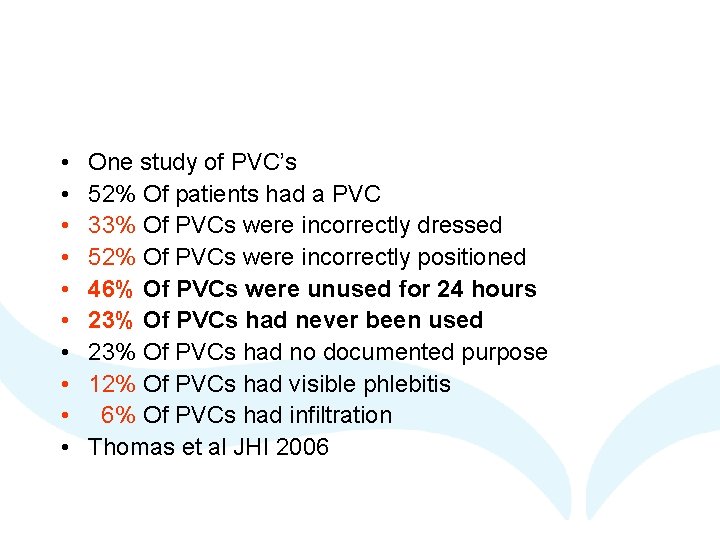
• • • One study of PVC’s 52% Of patients had a PVC 33% Of PVCs were incorrectly dressed 52% Of PVCs were incorrectly positioned 46% Of PVCs were unused for 24 hours 23% Of PVCs had never been used 23% Of PVCs had no documented purpose 12% Of PVCs had visible phlebitis 6% Of PVCs had infiltration Thomas et al JHI 2006
The Chain of Infection – Venepuncture and Cannulation Insertion and Maintenance Infectious Agent/Organism
Infectious Micro-organisms associated with Venepuncture and Cannulation • • Staphylococcus epidermidis Staphylococcus aureus Enterococcus spp. Klebsiella Pseudomonas E. Coli Serratia Candida
• We cannot identify all patients with BBV • 20% of patients with AIDS present without anyone ever knowing they were HIV positive
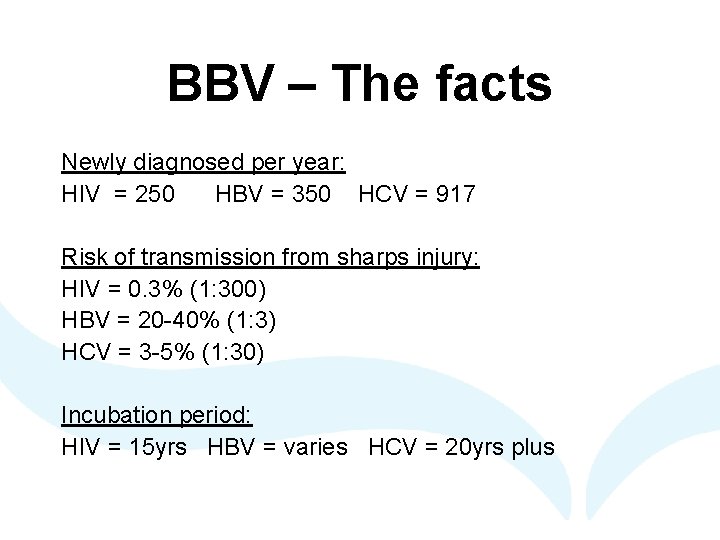
BBV – The facts Newly diagnosed per year: HIV = 250 HBV = 350 HCV = 917 Risk of transmission from sharps injury: HIV = 0. 3% (1: 300) HBV = 20 -40% (1: 3) HCV = 3 -5% (1: 30) Incubation period: HIV = 15 yrs HBV = varies HCV = 20 yrs plus
The Chain of Infection – Venepuncture and Cannulation Insertion and Maintenance Infectious Agent/Organism Reservoir
Reservoirs • Patients Skin – resident microflora • Environment • Equipment • IV Solutions & drugs • HCW Hands -Transient microflora
The Chain of Infection – Venepuncture and Cannulation Insertion and Maintenance Infectious Agent/Organism Reservoir Means of Exit
Means of Exit • Secretions such as bodily fluids e. g. blood • Skin such as skin scales
The Chain of Infection – Venepuncture and Cannulation Insertion and Maintenance Infectious Agent/Organism Reservoir Means of Exit Route of Transmission
Route of Transmission • Direct contact - on healthcare workers hands • Indirect contact- contaminated equipment, fluids, parenteral drugs or infusates • Puncture of skin (inoculation / blood borne)
The Chain of Infection – Venepuncture and Cannulation Insertion and Maintenance Infectious Agent/Organism Reservoir Means of Entry Means of Exit Route of Transmission
Means of entry Operator’s microflora Patient’s skin microflora Local infection Migration down catheter inside and out Contaminated on insertion Haematogenous spread Contaminated fluid
The Chain of Infection – Venepuncture and Cannulation Insertion and Maintenance Infectious Agent/Organism Susceptible Host Reservoir Means of Entry Means of Exit Route of Transmission
Susceptible Host • • Extremes of age Surgery Extended length of stay in hospital Compromised immune system Chronic disease Antibiotics Vascular access device in-situ
The Chain of Infection – Venepuncture and Cannulation Insertion and Maintenance Infectious Agent/Organism Susceptible Host Reservoir Means of Entry Means of Exit Route of Transmission
Preparation • Clean Work Surface • Hand Decontamination • Skin prep • Tourniquets Remember if you are disturbed you need to decontaminate your hands again
Standard Precautions The minimal level of infection control precautions that apply in all situations.
PPE Hand Hygiene Clinical waste There are 9 elements to Standard Precautions Patient Care Equipment Linen Isolation Environment Occupational Exposure Spillages
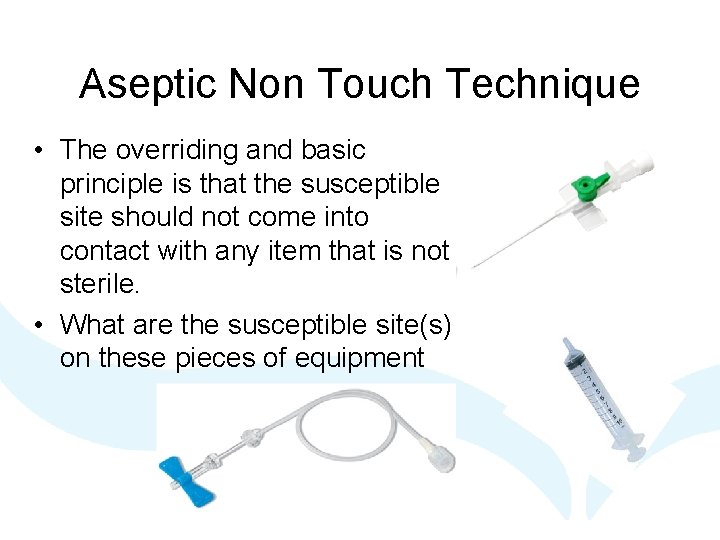
Aseptic Non Touch Technique • The overriding and basic principle is that the susceptible site should not come into contact with any item that is not sterile. • What are the susceptible site(s) on these pieces of equipment
Dressings Function of the dressing is: • To protect the site of venous access • To stabilise the catheter in place • Prevent mechanical damage • Keep site clean
Maintenance
Detection of Infection can present in a number of ways: • Local Site Infection • Microbial Phlebitis • Systemic Infection
IV site healthy 0 No phlebitis, observe cannula 1 of the following is evident Slight pain, Slight redness 1 Possibly early phlebitis, observe cannula 2 of the following are evident Pain, erythema, swelling 2 Early stage of phlebitis, resite cannula All of the following are evident: Pain along the path of the cannula, redness, swelling 3 Medium phlebitis, resite cannula, consider treatment All of the following are evident and extensive Pain along the cannula, swelling, induration, palpable venous cord 4 Advanced phlebitis, or possible thrombophlebitis resite cannula, consider treatment All of the following are evident and extensive Pain along the cannula, swelling, induration, palpable venous cord, pyrexia 5 Advanced thrombophlebitis initiate treatment, resite cannula
Inspection Cannula must be inspected and findings documented at least once per shift 1. 2. 3. 4. 5. Is vascular access still necessary? How long has it been in ? Is the dressing dry and intact ? Is the cap on and locked ? Check for phlebitis
Giving Sets • Change giving set after administration of blood or blood products either every 12 hours or when transfusion is complete • After 24 hours of TPN administration • After 72 hours if clear fluids are used • All ward prepared infusions should be changed after 24 hours
Infusate Sepsis 10 hours after infusion 3 commenced patient spiked a temp. Patient pulled out cannula. Cannula resited same infusion recommenced. Temp spiked again, blood cultures taken. Environmental Pseudomonas sp isolated from blood.
Prevention – Best practice • Do not use the top port • “SCRUB THE HUB” pre and post use • Use needle free device with extension
Removal of the Cannula • • • Wash your hands Wear gloves Use sterile gauze Apply pressure for approx 2 -3 minutes Inspect the cannula to ensure it is complete and undamaged • Dispose of cannula into sharps bin • Wash your hands!!!! • DOCUMENT
Key Points • Venepuncture/cannulation if not done properly can cause infection • Hand hygiene, aseptic technique and correct preparation will minimise the risk of infection • Patients should be closely monitored for signs of infection • Good documentation is essential • If it is not documented it is not done!!