
Infection Control Implications of ESBL producing organisms David

Infection Control Implications of ESBL producing organisms David Paterson University of Pittsburgh Medical Center
Infection control and ESBLs • Classical infection control • Antibiotic modification • Digestive tract decontamination • ESBLs and nursing homes

Epidemiology of ESBL producers • Predominantly occur in hospitals and nursing homes • 14 studies have used a case-control design to assess risk factors for ESBL producers • Plethora of conflicting results
Generalizations • Group 1. Seriously ill patients with prolonged duration of hospital stay, in whom invasive medical devices are present. Acquire ESBL producers 10 -70 days after admission. • Group 2 Elderly patients, frequently nursing home residents, with ESBL producers in urine
Molecular epidemiology • More than 50 studies have been performed using PFGE or other molecular epidemiologic techniques • In every study, at least one isolate has been obtained genotypically related to another • However, in some hospitals multiple clones circulate at any one time

Environmental contamination or transmission via hands? Common environmental sources of ESBL producers appear to be uncommon • Ultrasound coupling gel (Gaillot 1998) • Bronchoscopes (Branger 1997) • Glass thermometers (used in axillary measurement of temperature) (Rogues 2000) • Cockroaches (Cotton 2000)
Environmental common source or patient contaminated environment? • Patients’ soap (Szabo 1999) • Sink basins (Hobson 1996) • Babies’ baths (Eisen 1995)
Documentation of hand carriage • Hand isolates have been identified which are genotypically identical to isolates causing infections in patients • Hand carriage disappears with directly observed hand hygiene • Prolonged hand carriage in a nurse with chronic dermatitis
GI carriage in health care workers? • Has been documented (Hobson 1996, French 1996), BUT • Is astonishingly rare and seldom protracted • EXCEPT, ESBL producing Salmonella in which prolonged GI carriage in health care workers has been documented (Mhand 1999, Hammami 1991)
GI colonization • Ratio of colonization to clinically significant infection is at least 2: 1 • In some outbreaks, 30 -70% of all patients in ICUs have developed colonization • At least 80% of patients with infection can be documented to have prior GI colonization (Pena 1998, Lucet 1996) • We have documented persistence of GI carriage of at least one year
Detecting GI carriage • Mac. Conkey agar with ceftazidime 4 mg/L (Pena 1997) • Nutrient agar with ceftazidime 2 mg/L, vancomycin 5 mg/L and amphotericin 1667 mg/L • Is a perirectal swab good enough?
Infection Control Scenarios • New occurrence of ESBL producers in hospital units where ESBL producers have not previously been endemic • Hospital units where ESBL producers have an established presence • Nursing homes
Initial outbreaks of infection Consequences • Subsequent endemnicity • Change in empiric therapy (especially towards quinolones) • Emergence of resistance in Pseudomonas and Acinetobacter
Steps in preventing endemnicity 1. Perform rectal swabs to delineate the pool of patients who are colonized 2. Evaluate for a common environmental source of infection 3. Campaign to improve hand hygiene 4. Enforce contact isolation for patients found to be colonized or infected
Can gut carriage be interrupted? Selective digestive tract decontamination • Erythromycin based therapies have not been effective (De Champs 1993, Decre 1999). • “Successful interventions” – Polymyxin, neomycin, nalidixic acid (Brun. Buisson 1989) – Colistin and tobramycin (Taylor 1991) – Norfloxacin (Paterson 2001)
Problems with quinolone prophylaxis • High frequency of quinolone resistant strains • Selection of quinolone resistant organisms (we did not document this)
Infection control in the endemic hospital • Is there any hope? • Lucet et al (CID 1999) – successful control of endemic ESBL producers • Reinforcing hand hygiene was not enough • Critical evaluation of nursing work practices which could lead to infection control breakdowns • Attention to visiting surgeons and radiographers • Formal notification of units to which patients were transferred
Antibiotic control • 10 studies have analyzed relationship between third generation cephalosporin use and acquisition of an ESBL producing strain • 5 found a significant association • 3 were underpowered but p-values were between 0. 05 and 0. 10
Restriction of cephalosporins • Restriction of just third generation cephalosporins • Restriction of all cephalosporins (Rahal JAMA 1999)
Beta-lactam/beta-lactamase inhibitor combinations • Are they protective? • Case-control studies have shown lower use of clavulante based antibiotics in controls (Piroth 1998) • Replacement of 3 GCs by piperacillin/tazobactam has been associated with reduction in ESBL producers
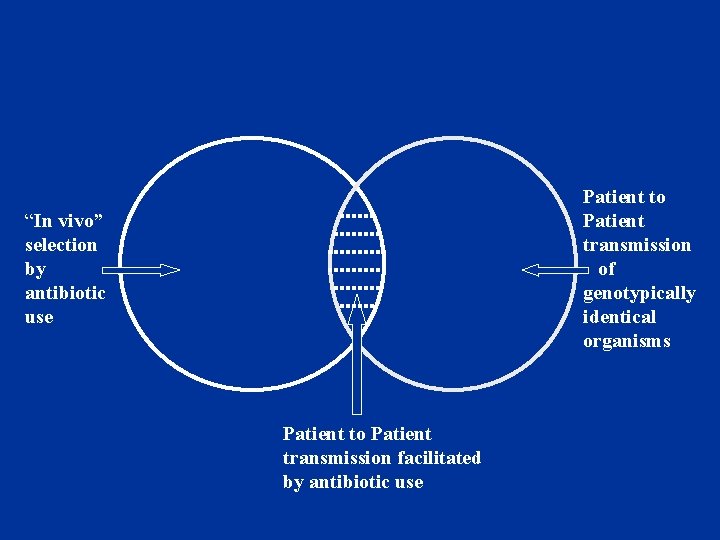
Patient to Patient transmission of genotypically identical organisms “In vivo” selection by antibiotic use Patient to Patient transmission facilitated by antibiotic use
Nursing homes and ESBL producers • Up to 40% of nursing home residents have taken antibiotics in the last month (Smith 2000) • Infection control suboptimal in nursing homes • Urinary catheterization and decubitus ulcers are frequent • Point-prevalence in a Chicago nursing home – 46% of residents colonized with ESBL producers (Wiener 1999)
Risk factors • • • Presence of a decubitus ulcer Presence of a gastrostomy tube Poor functional status Prior receipt of ciprofloxacin Prior receipt of trimethoprimsulfamethoxazole • Wiener 1999
Contrasting experiences • Nursing homes are a reservoir of ESBLs for acute care hospitals (Wiener 1999) • Patients with hospital-acquired colonization or infection may return to their nursing home with ESBL carriage (Bird 1998)
Conclusions General principles to interrupt outbreaks • Identify colonized patients • Contact isolation • Reduction in all unnecessary antibiotic use, but especially cephalosporins • ? ? Gut decolonization

Unanswered questions • Effects of antibiotics on GI, skin and environmental contamination • Duration of GI carriage • “Virulence” factors
- Slides: 26