
Infection Control Basics HealthcareAssociated Infections HAI in Long
Infection Control Basics: Healthcare-Associated Infections (HAI) in Long Term Care Facilities Infectious Disease Epidemiology Section Office of Public Health Louisiana Dept of Health & Hospitals 800 -256 -2748 www. infectiousdisease. dhh. louisiana. gov
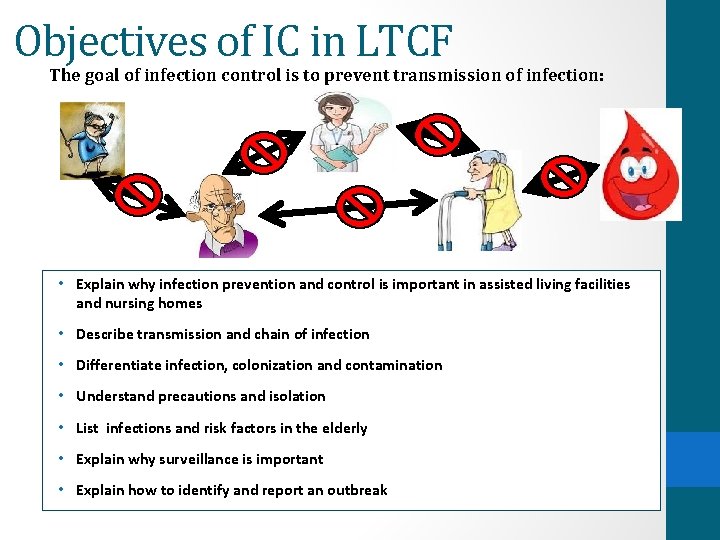
Objectives of IC in LTCF The goal of infection control is to prevent transmission of infection: • Explain why infection prevention and control is important in assisted living facilities and nursing homes • Describe transmission and chain of infection • Differentiate infection, colonization and contamination • Understand precautions and isolation • List infections and risk factors in the elderly • Explain why surveillance is important • Explain how to identify and report an outbreak
Infection Control Program Infrastructure
Principle Functions of Infection Prevention Programs 1. To obtain and manage critical data and information, including surveillance for infections 2. To develop and recommend policies and procedures 3. To intervene directly to prevent infections and interrupt the transmission of infectious diseases 4. To educate and train healthcare professionals (HCP), patients, and nonmedical caregivers

Infection Prevention Team • The core of the infection prevention and control program is the infection preventionist • Occupational health can also participate on the team • Team is responsible for carrying out all aspects of the infection prevention and control program • Facility may have an infection prevention committee (IPC) that functions at the central decision-making and policy-making body for infection prevention • IPC advocates for prevention and control of infections at the facility • IPC must be multidisciplinary • Dissemination of information is a crucial component of the IPC
Role of Infection Prevention Professionals 1. 2. 3. 4. 5. 6. 7. 8. 9. 10. Collection and analysis of infection data Evaluation of products and procedures Development and review of policies and procedures Consultation on infection risk assessment Education efforts directed at interventions to reduce infection risks Education of patients and families Implementing changes mandated by regulatory, accrediting and licensing agencies Application of epidemiological principles directed at improving patient outcomes Antimicrobial management Provision of high-quality services in a cost-efficient manner

Being a Successful Infection Preventionist • Improve leadership strategies and pursue opportunities for self-development • Work with the IPC to create policy changes that are datadriven and patient-centered • Possess multiple skills necessary to meet the demands of the evolving healthcare environment
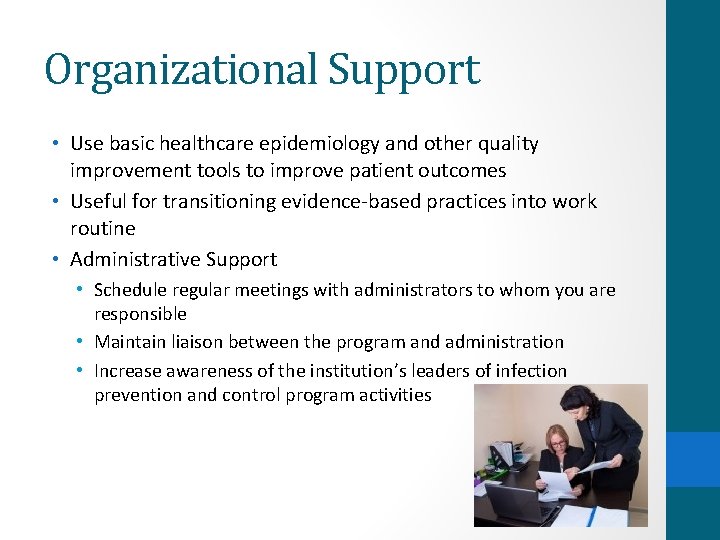
Organizational Support • Use basic healthcare epidemiology and other quality improvement tools to improve patient outcomes • Useful for transitioning evidence-based practices into work routine • Administrative Support • Schedule regular meetings with administrators to whom you are responsible • Maintain liaison between the program and administration • Increase awareness of the institution’s leaders of infection prevention and control program activities

Quality of an Infection Prevention and Control Program 1. Establishing a reliable, focused surveillance program based on the annual risk assessment 2. Streamlining data management activities 3. Analyzing HAI rates 4. Aiming for zero HAI rates 5. Educating staff regarding prevention strategies 6. Identifying opportunities for performance improvement 7. Taking a leadership role on performance improvement teams 8. Developing and implementing action plans that outline the steps needed to accomplish each objective 9. Evaluating the success of action plans in accomplishing the goals and objectives of the infection prevention plan
LTCF v. Hospital Surveillance of Healthcare-Associated Infections
Long-term Care • Long-term care (LTC) is an umbrella term that encompasses several different types of facilities to provide care for individuals • Generally referred to as long-term care facilities (LTCF) • Spans the spectrum of care from providing short-term, episodic skilled nursing and residential support to chronic care management • The number of adults in the United States over the age of 60 will rise by nearly 25% by 2030
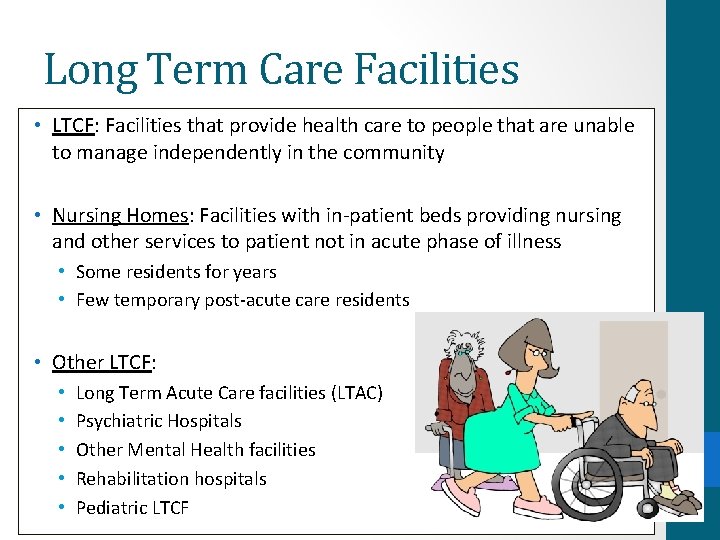
Long Term Care Facilities • LTCF: Facilities that provide health care to people that are unable to manage independently in the community • Nursing Homes: Facilities with in-patient beds providing nursing and other services to patient not in acute phase of illness • Some residents for years • Few temporary post-acute care residents • Other LTCF: • • • Long Term Acute Care facilities (LTAC) Psychiatric Hospitals Other Mental Health facilities Rehabilitation hospitals Pediatric LTCF

Key Differences: LTC v. Acute • Key difference and challenge is the concept of residence • LTCF offers socialization through common activities • LTCFs generally have common air circulation, which may contribute to infection transmission of pathogens that are airborne • Emerging, significant risk factor in LTCFs involves enhanced infection risks for colonization or infection with multidrugresistant organisms (MDRO)

Infection Prevention and Control in the LTACH • LTACH: Long-term acute care hospital • Early identification of MDRO or Clostridium difficile infection and colonization is imperative to limit the risk of transmission • One study showed that 64% of patients in LTACHs were colonized with MRSA, VRE, or both
LTACH Risk Assessment • Annual risk assessment determines goals and objectives for infection prevention and control program • Important to identify the highest risk concerns and target efforts to specifically address those areas • Ongoing review throughout the year allows the IP to determine if the strategies are effective • Communication is vital for an infection prevention program • IPCC members should meet on a regular basis to review surveillance data, identify areas of concern, plan interventions, define outcome measures, and review/develop policies
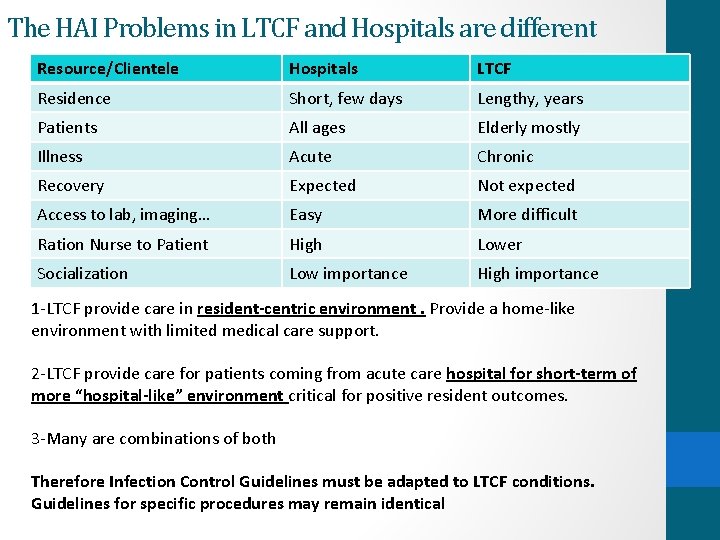
The HAI Problems in LTCF and Hospitals are different Resource/Clientele Hospitals LTCF Residence Short, few days Lengthy, years Patients All ages Elderly mostly Illness Acute Chronic Recovery Expected Not expected Access to lab, imaging… Easy More difficult Ration Nurse to Patient High Lower Socialization Low importance High importance 1 -LTCF provide care in resident-centric environment. Provide a home-like environment with limited medical care support. 2 -LTCF provide care for patients coming from acute care hospital for short-term of more “hospital-like” environment critical for positive resident outcomes. 3 -Many are combinations of both Therefore Infection Control Guidelines must be adapted to LTCF conditions. Guidelines for specific procedures may remain identical
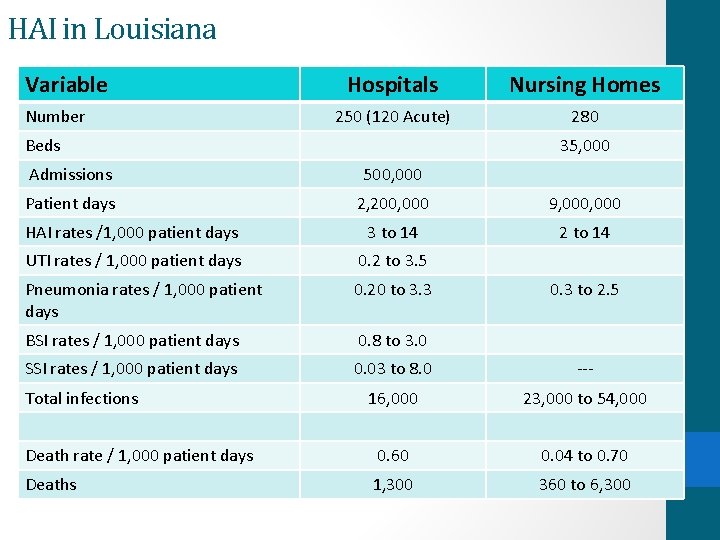
HAI in Louisiana Variable Number Hospitals Nursing Homes 250 (120 Acute) 280 Beds 35, 000 Admissions 500, 000 Patient days 2, 200, 000 9, 000 HAI rates /1, 000 patient days 3 to 14 2 to 14 UTI rates / 1, 000 patient days 0. 2 to 3. 5 Pneumonia rates / 1, 000 patient days 0. 20 to 3. 3 BSI rates / 1, 000 patient days 0. 8 to 3. 0 SSI rates / 1, 000 patient days 0. 03 to 8. 0 --- 16, 000 23, 000 to 54, 000 Death rate / 1, 000 patient days 0. 60 0. 04 to 0. 70 Deaths 1, 300 360 to 6, 300 Total infections 0. 3 to 2. 5
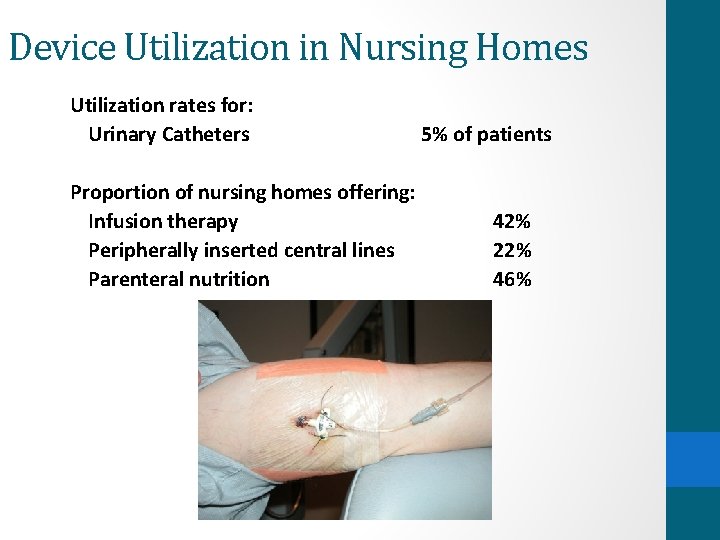
Device Utilization in Nursing Homes Utilization rates for: Urinary Catheters Proportion of nursing homes offering: Infusion therapy Peripherally inserted central lines Parenteral nutrition 5% of patients 42% 22% 46%
Infection Control in LTCF
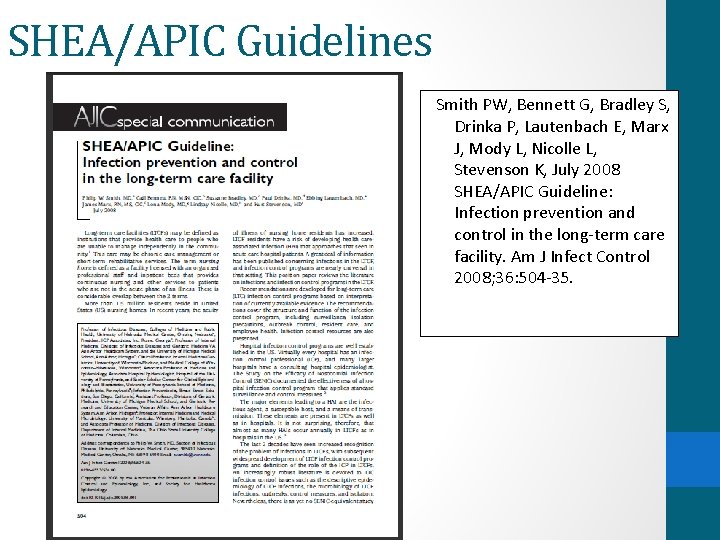
SHEA/APIC Guidelines Smith PW, Bennett G, Bradley S, Drinka P, Lautenbach E, Marx J, Mody L, Nicolle L, Stevenson K, July 2008 SHEA/APIC Guideline: Infection prevention and control in the long-term care facility. Am J Infect Control 2008; 36: 504 -35.
Requirements /Recommendations for Infection Control Program • Skilled Nursing: 1987 Omnibus Reconciliation Budget Act (OBRA) • Nursing Homes: Medicare & Medicaid. Requirements for LTCF -HCFA. Final rule. Fed. Register 1991; 56: 48826 -80 • Occupational exposure to bloodborne pathogens—OSHA. Final rule. Fed Regist 1991; 56: 64004 -182. • Friedman C et al 1999. Requirements for infrastructure and essential activities of infection control and epidemiology in out -of-hospital settings: a consensus panel report. APIC/SHEA. Infect Control Hosp Epidemiol 1999; 20: 695 -705.
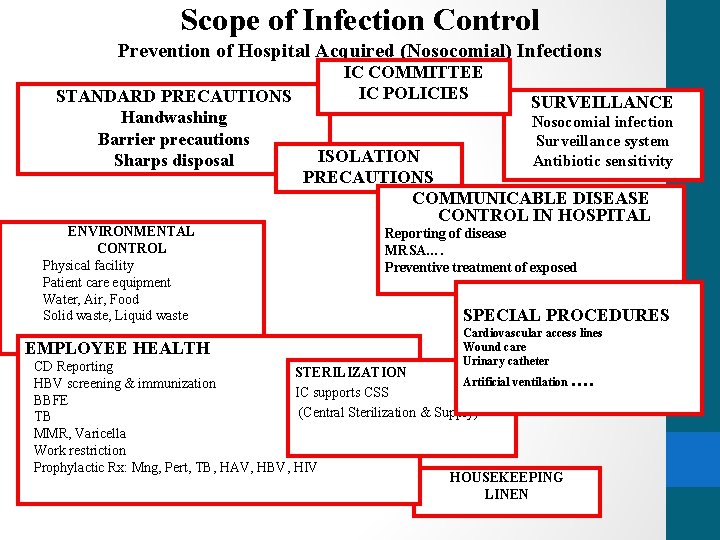
Scope of Infection Control Prevention of Hospital Acquired (Nosocomial) Infections STANDARD PRECAUTIONS Handwashing Barrier precautions Sharps disposal ENVIRONMENTAL CONTROL Physical facility Patient care equipment Water, Air, Food Solid waste, Liquid waste EMPLOYEE HEALTH IC COMMITTEE IC POLICIES SURVEILLANCE Nosocomial infection Surveillance system Antibiotic sensitivity ISOLATION PRECAUTIONS COMMUNICABLE DISEASE CONTROL IN HOSPITAL Reporting of disease MRSA…. Preventive treatment of exposed SPECIAL PROCEDURES Cardiovascular access lines Wound care Urinary catheter CD Reporting STERILIZATION Artificial ventilation …. HBV screening & immunization IC supports CSS BBFE (Central Sterilization & Supply) TB MMR, Varicella Work restriction Prophylactic Rx: Mng, Pert, TB, HAV, HBV, HIV HOUSEKEEPING LINEN

Infection Preventionist & IC Committee • Responsible for directing infection control • Familiar with LTCF & resident care problems • Written job description of IC duties • With sufficient time and administrative support • Sufficient IC knowledge base to carry out responsibilities • Canada’s recommends 1 IP /150 to 250 long term beds

Definitions
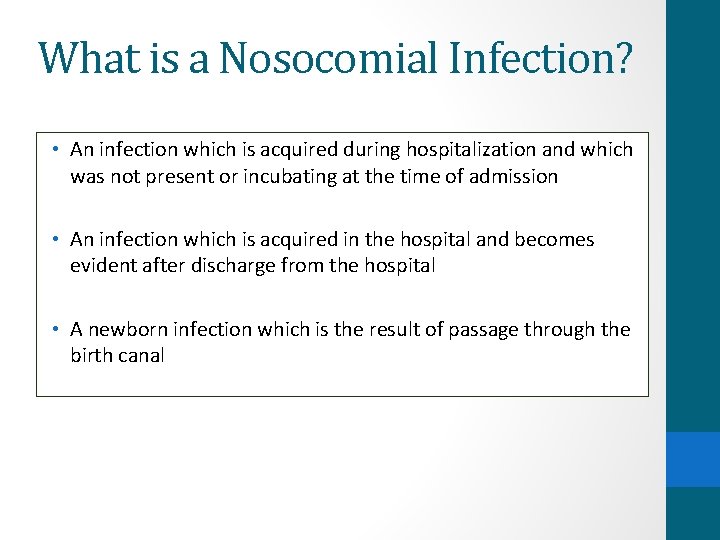
What is a Nosocomial Infection? • An infection which is acquired during hospitalization and which was not present or incubating at the time of admission • An infection which is acquired in the hospital and becomes evident after discharge from the hospital • A newborn infection which is the result of passage through the birth canal
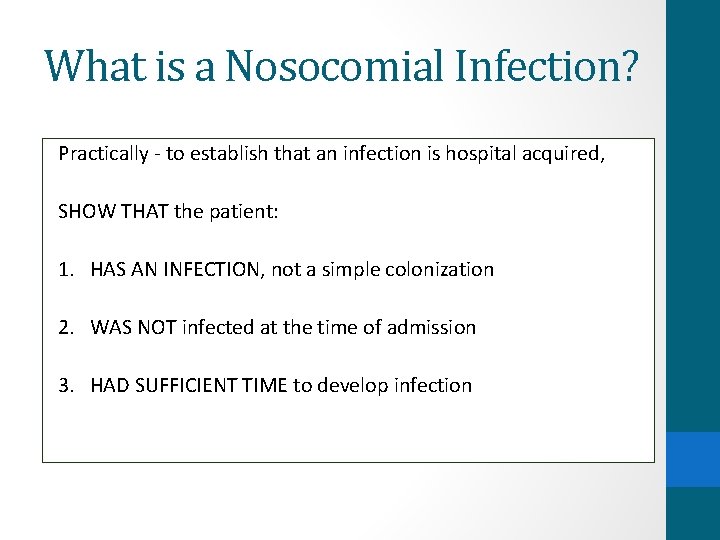
What is a Nosocomial Infection? Practically - to establish that an infection is hospital acquired, SHOW THAT the patient: 1. HAS AN INFECTION, not a simple colonization 2. WAS NOT infected at the time of admission 3. HAD SUFFICIENT TIME to develop infection
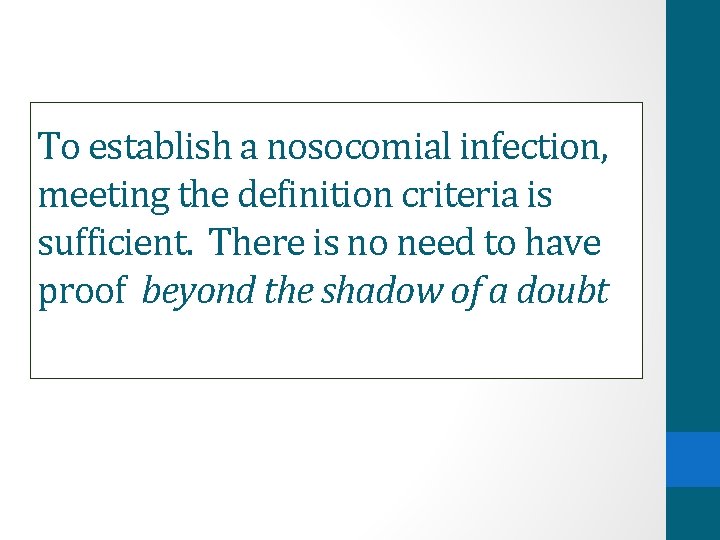
To establish a nosocomial infection, meeting the definition criteria is sufficient. There is no need to have proof beyond the shadow of a doubt
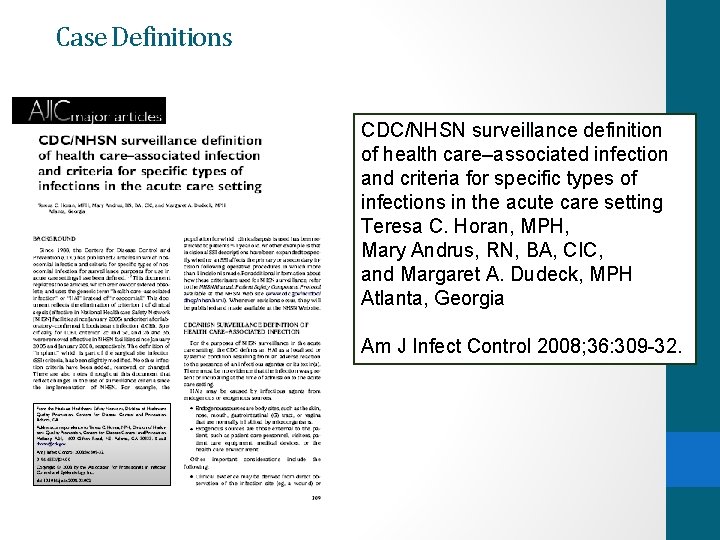
Case Definitions CDC/NHSN surveillance definition of health care–associated infection and criteria for specific types of infections in the acute care setting Teresa C. Horan, MPH, Mary Andrus, RN, BA, CIC, and Margaret A. Dudeck, MPH Atlanta, Georgia Am J Infect Control 2008; 36: 309 -32.
Outbreak Investigations • Three elements required for transmission: source susceptible host mode of transmission • Outbreaks are prevented by the elements basic to an infection prevention and control program in all healthcare settings • Hand hygiene programs • Standard and Transmission-Based Precautions • Identification and isolation measures • Communicate with the health department early in an outbreak
Education • Education can promote compliance when employees comprehend the impact an HAI or MDRO transmission will have on the patient • HCP, ancillary department staff, medical staff, and visitors must also be educated
General Principles of Epidemiology
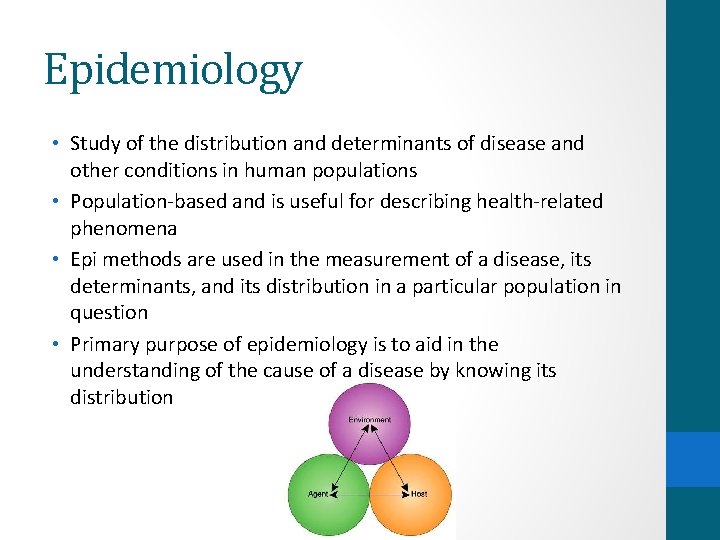
Epidemiology • Study of the distribution and determinants of disease and other conditions in human populations • Population-based and is useful for describing health-related phenomena • Epi methods are used in the measurement of a disease, its determinants, and its distribution in a particular population in question • Primary purpose of epidemiology is to aid in the understanding of the cause of a disease by knowing its distribution
Use of Epidemiology in Healthcare • The goal is to complete prevention of a disease before any manifestation of that disease occurs • Early diagnosis and treatment • Prevention strategies to reduce the risk of transmission, including barrier precautions, immunizations of HCP, and cleaning, sterilizing, and disinfecting • Applications of disease prevention using information gathered
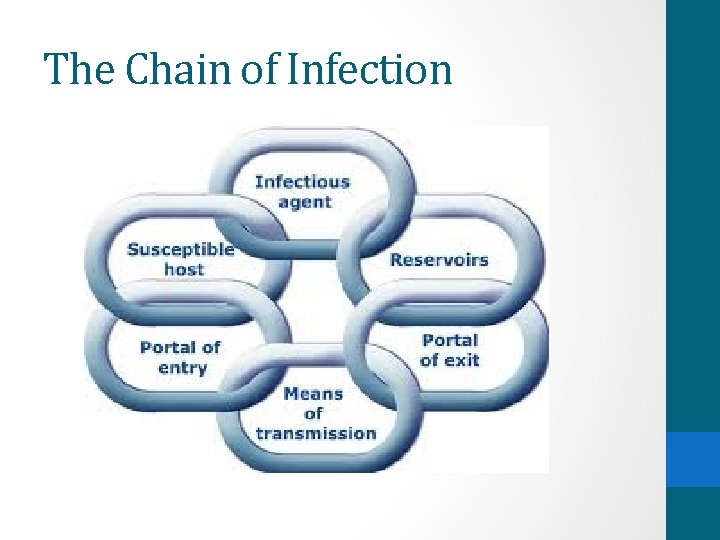
The Chain of Infection
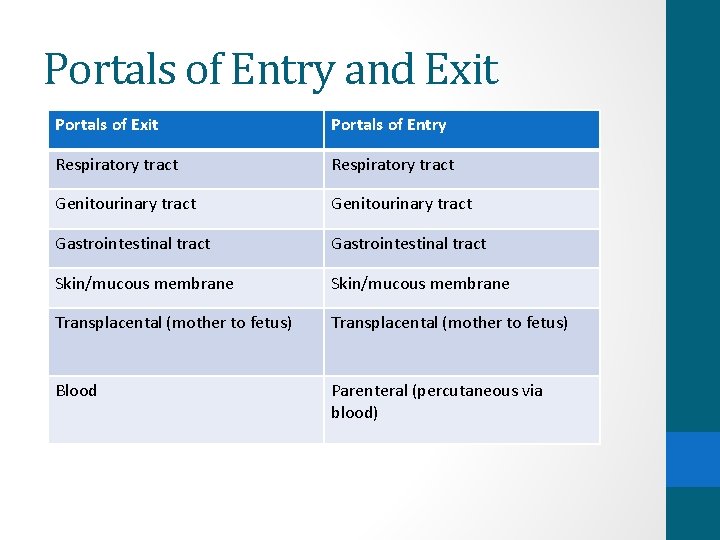
Portals of Entry and Exit Portals of Entry Respiratory tract Genitourinary tract Gastrointestinal tract Skin/mucous membrane Transplacental (mother to fetus) Blood Parenteral (percutaneous via blood)
Resources • Bodily-Bartrum M, Franck J, Spaulding L and Zeller J. Chapter 61 – Long-term care. Association for Professionals in Infection Control and Epidemiology Text. 2015. • Friedman C. Chapter 1 – Infection Prevention and Control Programs. Association for Professionals in Infection Control and Epidemiology Text. 2015. • Knox Sh. Chapter 62 – Long-term acute care. Association for Professionals in Infection Control and Epidemiology Text. 2015. • Tweeten S. Chapter 10 – General Principles of Epidemiology. Association for Professionals in Infection Control and Epidemiology Text. 2015.

Questions? Thank you!
- Slides: 37