
Infection Control Basic Principals of Infection Control How
Infection Control
Basic Principals of Infection Control How disease is transmitted and the main ways to prevent transmission. n Microorganisms are small living organisms invisible to the naked eye n Two types of microorganisms 1. Pathogens 2. Nonpathogens n
What are microorganisms? Microorganisms are small living organisms invisible to the naked eye n There are five classes of microorganisms n Bacteria, protozoa, fungi, rickettsiae, and viruses. n
Classifications of microorganisms n Bacteria – cocci round MRSA, strepthroat bacilli rods i. e. TB, pertussis, botulism spirilla spirals i. e. syphilis, cholera n Protozoa- one cell animal-like i. e. malaria n Fungi – plant-like organisms i. e. Yeasts, molds i. e. Ringworm, thrush etc.
Microorganisms (cont. ) n Rickettsiae- parasitic i. e. Lice, ticks, fleas n Viruses - cannot reproduce without a cell, major risk to healthcare workers and are blood borne: n Examples of viruses, Hepatitis C, Hepatitis B, HIV.
Factors for Growth of Microorganisms Most prefer warm, moist or wet, dark environment i. e. the human body n Oxygen needs vary anaerobic no oxygen aerobic needs oxygen n
Pathogenic microorganisms Cause diseases in different ways ü produce poisons toxins ü allergic reactions ü attack and destroy the cells n q antibiotics are effective against bacteria not against viruses
Classes of Diseases and Infections Endogenous inside the body i. e. tumors, congenital disorders n Exogenous outside the body i. e. trauma, electric shock n
Classes of Diseases and Infections (cont) n n Nosocomial acquired in healthcare facilities i. e. Staph MRSA, pseudomonas Opportunistic infections that only affect the immunosuppressed i. e. Kaposi’s sarcoma, pneumocystis carnii
Chain of Infection Causative agent (pathogen, bacteria, virus) n Reservoir (place to live) i. e. human body. n Portal of exit (the way the pathogen escapes) i. e. urine, feces, secretions n Mode of transmission (transmitted to a reservoir or a host) Direct or Indirect n
Mode of Transmissions Direct person to person sexual contaminated hands n Indirect touching contaminated equipment breathing droplets insect bites n
Chain of Infection (cont. ) Portal of Entry a way to enter a new host or new reservoir i. e. respiratory tract, breaks in the skin etc. n Susceptible Host anyone who can contract the disease weak immune systems anyone with a breakdown in defense mechanisms n
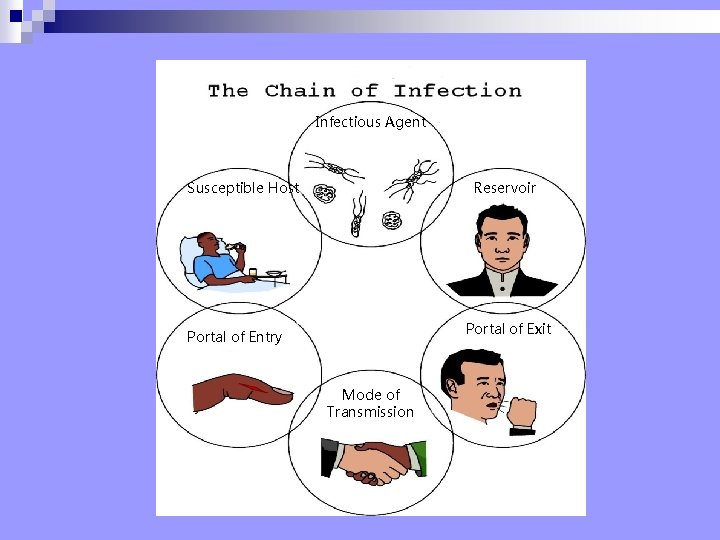
Infectious Agent Susceptible Host Reservoir Portal of Exit Portal of Entry Mode of Transmission
Ending the chain Breaking the chain Use aseptic technique asepsis Best is hand washing n Levels or types of asepsis antiseptics, disinfection, sterilization Antiseptics used in healthcare alcohol and betadine n
- Slides: 14