
Infection and Response Pathogens Learning Objective To understand
Infection and Response Pathogens
Learning Objective • To understand the difference between communicable and non-communicable diseases, and the causes of communicable diseases. Success Criteria • To explain the difference between a communicable and non-communicable disease. • To distinguish between different types of pathogens, in terms of their features. • To demonstrate the methods of pathogen transmission.
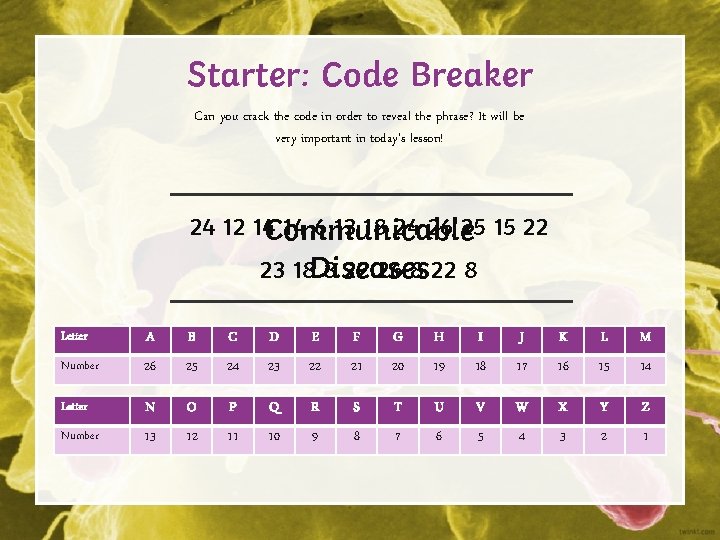
Starter: Code Breaker Can you crack the code in order to reveal the phrase? It will be very important in today’s lesson! 24 12 14 14 6 13 18 24 26 25 15 22 Communicable 23 18 Diseases 8 22 26 8 22 8 Letter A B C D E F G H I J K L M Number 26 25 24 23 22 21 20 19 18 17 16 15 14 Letter N O P Q R S T U V W X Y Z Number 13 12 11 10 9 8 7 6 5 4 3 2 1
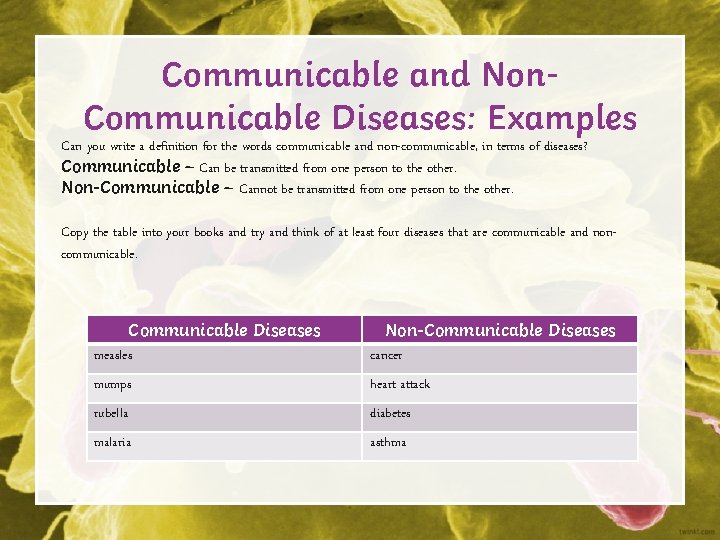
Communicable and Non. Communicable Diseases: Examples Can you write a definition for the words communicable and non-communicable, in terms of diseases? Communicable – Can be transmitted from one person to the other. Non-Communicable – Cannot be transmitted from one person to the other. Copy the table into your books and try and think of at least four diseases that are communicable and noncommunicable. Communicable Diseases measles Non-Communicable Diseases cancer mumps heart attack rubella diabetes malaria asthma
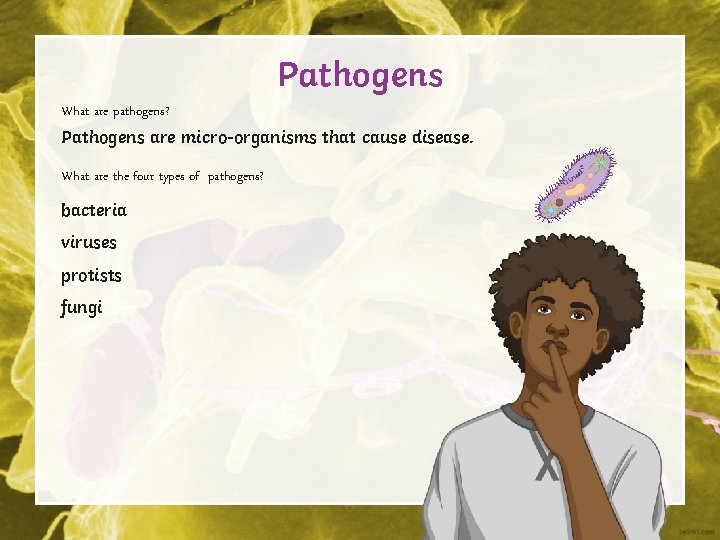
Pathogens What are pathogens? Pathogens are micro-organisms that cause disease. What are the four types of pathogens? bacteria viruses protists fungi
Features of Bacteria, Viruses, Fungi and Protists Using the placemats for each pathogen Spend 20 seconds looking at the bacteria placemat. Your task is to remember as much information and detail as possible. Now share the information with someone in your house. Repeat until information has been collected about all four different types of pathogen.
Features of Bacteria, Viruses, Fungi and Protists Using the features of pathogens help sheet. Try to complete the sentences.
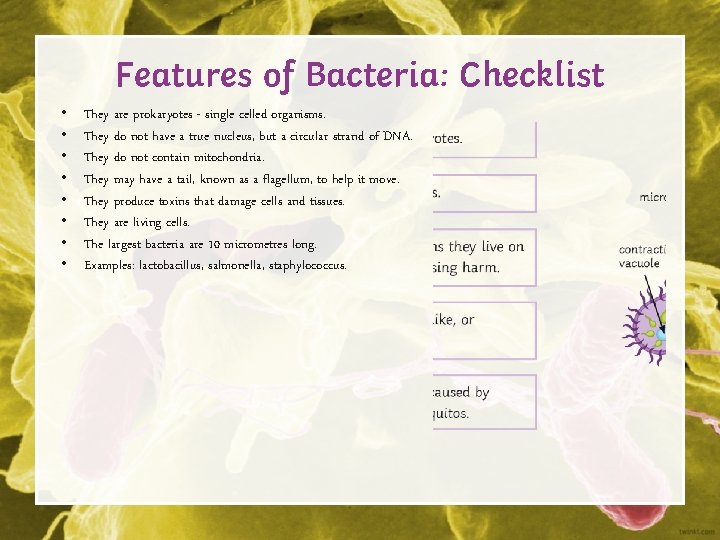
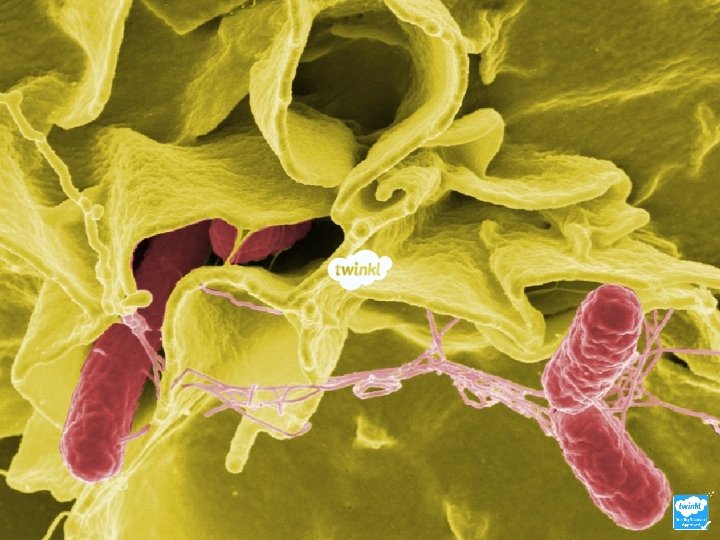
Features of Bacteria: Checklist • • They are prokaryotes - single celled organisms. They do not have a true nucleus, but a circular strand of DNA. They do not contain mitochondria. They may have a tail, known as a flagellum, to help it move. They produce toxins that damage cells and tissues. They are living cells. The largest bacteria are 10 micrometres long. Examples: lactobacillus, salmonella, staphylococcus.
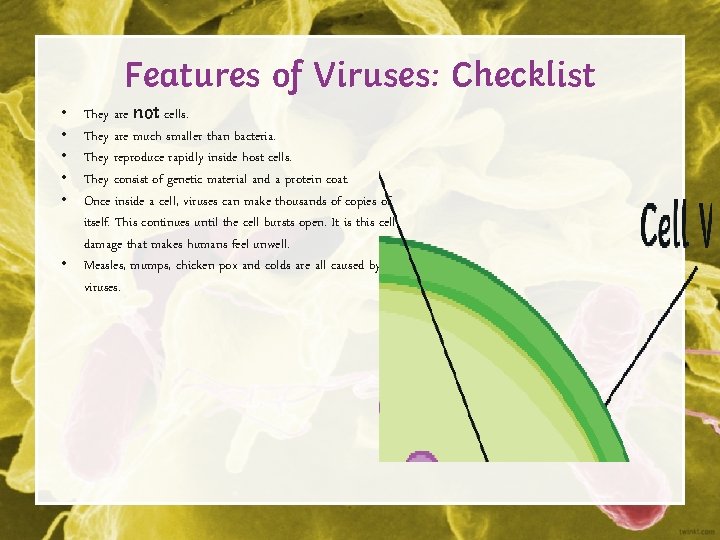
Features of Viruses: Checklist They are not cells. They are much smaller than bacteria. They reproduce rapidly inside host cells. They consist of genetic material and a protein coat. Once inside a cell, viruses can make thousands of copies of itself. This continues until the cell bursts open. It is this cell damage that makes humans feel unwell. • Measles, mumps, chicken pox and colds are all caused by viruses. • • •
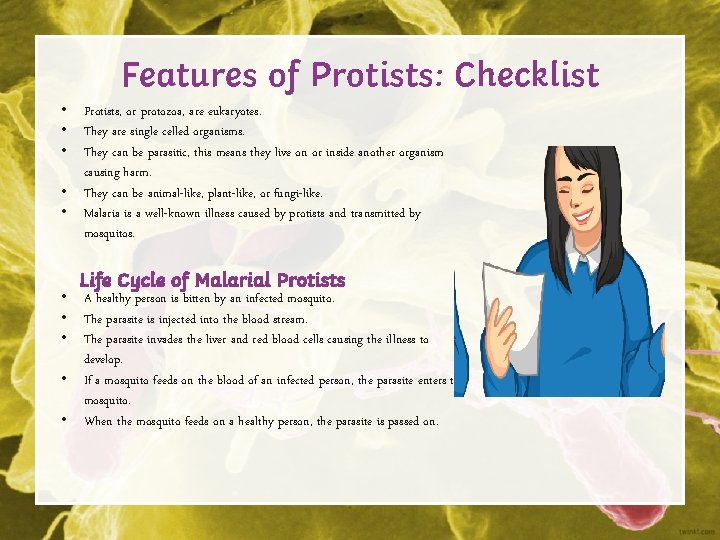
Features of Protists: Checklist • Protists, or protozoa, are eukaryotes. • They are single celled organisms. • They can be parasitic, this means they live on or inside another organism causing harm. • They can be animal-like, plant-like, or fungi-like. • Malaria is a well-known illness caused by protists and transmitted by mosquitos. Life Cycle of Malarial Protists • A healthy person is bitten by an infected mosquito. • The parasite is injected into the blood stream. • The parasite invades the liver and red blood cells causing the illness to develop. • If a mosquito feeds on the blood of an infected person, the parasite enters the mosquito. • When the mosquito feeds on a healthy person, the parasite is passed on.
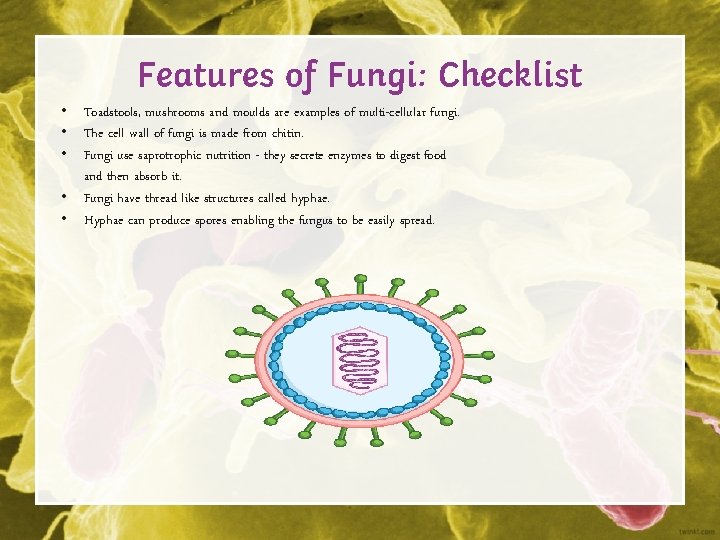
Features of Fungi: Checklist • Toadstools, mushrooms and moulds are examples of multi-cellular fungi. • The cell wall of fungi is made from chitin. • Fungi use saprotrophic nutrition - they secrete enzymes to digest food and then absorb it. • Fungi have thread like structures called hyphae. • Hyphae can produce spores enabling the fungus to be easily spread.
Quick Assessment: What Am I? I am a prokaryote. I do not contain mitochondria, and I produce toxins. bacteria
Quick Assessment: What Am I? I am a eukaryote. I may be parasitic, and can cause malaria. protist
Quick Assessment: What Am I? My cell wall is made from chitin, and I have thread like structures called hyphae. fungi
Quick Assessment: What Am I? I reproduce rapidly inside host cells until they burst open. virus
Quick Assessment: What Am I? I have flagellum and I am a living cell. bacteria
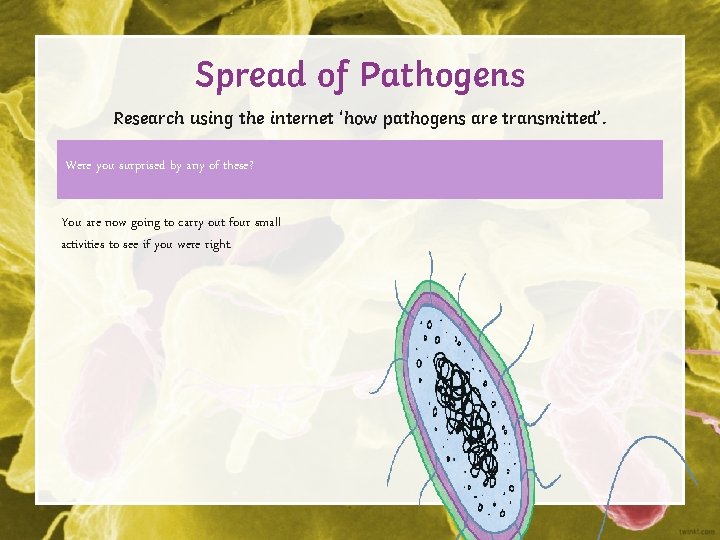
Spread of Pathogens Research using the internet ‘how pathogens are transmitted’. Were you surprised by any of these? You are now going to carry out four small activities to see if you were right.
Spread of Pathogens are spread in four different ways. Make a note about each type. indirect contact airborne water direct contact
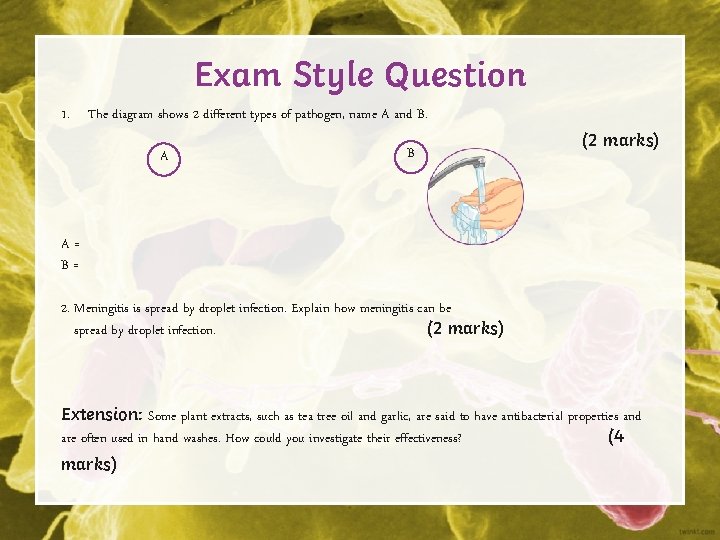
Exam Style Question 1. The diagram shows 2 different types of pathogen, name A and B. A B (2 marks) A= B= 2. Meningitis is spread by droplet infection. Explain how meningitis can be spread by droplet infection. (2 marks) Extension: Some plant extracts, such as tea tree oil and garlic, are said to have antibacterial properties and are often used in hand washes. How could you investigate their effectiveness? (4 marks)
Home Learning Why is it important to wash your hands? Your task is to produce a set of instructions on how to wash your hands properly, and why it is important to wash them.
- Slides: 21